This protocol details the establishment of an adenine-induced oligoasthenozoospermia model in rats and the subsequent delivery of electroacupuncture at CV3, CV4, ST36, and SP6 under isoflurane anesthesia. Outcomes were verified using computer-assisted sperm analysis for count and motility, alongside testicular histology with hematoxylin and eosin staining.
Method Article
Isoflurane-Assisted Electroacupuncture in a Rat Model of Oligoasthenozoospermia
Qian Zhang1 , Xuanrui Chen2 , Chunxue Meng1 , Changbin Zhao1 , Qianxi Na1 , Jing Zhang1 , Fei Wang1 , Huisheng Ma1 , Bin Guo1,2,3
1Ningxia Medical University School of Traditional Chinese Medicine, 2Medical College of Acu-Moxi and Rehabilitation, Guangzhou University of Chinese Medicine, 3Key Laboratory of Dryness Syndrome in Chinese Medicine, Ministry of Education, Ningxia Regional Key Laboratory of Integrated Traditional Chinese and Western Medicine for Prevention and Treatment of Regional High Incidence Disease, Ningxia Medical University
Opens in a new tab
In This Article
Summary
Loading...
$$\rightleftharpoonup{xx}$$
$$\longleftharp{xx}$$,
$$\longrightharp{xx}$$,
Abstract
Loading...
$$\rightleftharpoonup{xx}$$
$$\longleftharp{xx}$$,
$$\longrightharp{xx}$$,
Oligoasthenozoospermia is one of the most common forms of male reproductive dysfunction. In rodent studies, delivering electroacupuncture (EA) consistently across repeated sessions poses a technical challenge, particularly when combining abdominal midline and hind-limb acupoints, where stable electrode contact is critical. Zhongji (CV3), Guanyuan (CV4), Zusanli (ST36), and Sanyinjiao (SP6) were selected because these points are frequently used in acupuncture protocols for infertility and semen abnormalities, and the abdominal midline plus hind-limb configuration suits standardized electrode pairing. This report describes a practical protocol for establishing an adenine-induced rat model of oligoasthenozoospermia and for administering isoflurane-assisted EA with paired stimulation of CV3–CV4 and ST36–SP6. Male Sprague-Dawley rats received adenine by daily gavage for 28 days to induce reproductive impairment. Subsequently, EA was administered daily for 28 days under inhalational anesthesia, using 3% isoflurane for induction and 1.5% for mask maintenance, to enable stable needle placement and electrode pairing (CV3–CV4 and ST36–SP6) with defined stimulation parameters (2 Hz, 1.5 mA, 30 min). Treatment effects were evaluated via computer-assisted semen analysis for sperm count and motility, supplemented by testicular hematoxylin and eosin (HE) histology. Representative results indicate that adenine exposure reduced sperm count and motility and disrupted seminiferous tubule architecture, while EA was associated with partial recovery in both semen parameters and testicular morphology. This protocol offers a ready reference for studies requiring consistent EA delivery and semen/histological verification in a rat model of oligoasthenozoospermia.
Introduction
Loading...
$$\rightleftharpoonup{xx}$$
$$\longleftharp{xx}$$,
$$\longrightharp{xx}$$,
Male factors contribute substantially to infertility, accounting for approximately half of all infertile couples, with abnormalities in sperm count and motility being among the most common clinical findings1,2. Oligoasthenozoospermia, characterized by reduced sperm concentration and impaired motility, is one of the most common forms of male reproductive dysfunction3,4. Despite the availability of assisted reproductive techniques and empirical medical therapies, effective strategies to improve semen quality remain limited, highlighting the need for further preclinical investigation5,6,7. These clinical and translational needs motivate the development of reproducible experimental workflows to study male reproductive impairment under controlled conditions.
Acupuncture interventions have been investigated for semen abnormalities and male infertility in both clinical and experimental contexts8. Although clinical studies suggest potential benefits for certain semen parameters, their designs, intervention protocols, and outcome measures vary widely9. Electroacupuncture (EA) is particularly suitable for laboratory research because it offers controlled stimulation parameters and more uniform regulation than manual acupuncture, which facilitates assessing treatment-related changes in measurable reproductive outcomes10,11,12. This procedural advantage makes EA well-suited to structured preclinical workflows in male reproductive research.
Animal models are central to such evaluation, but model selection remains a key methodological issue in oligoasthenozoospermia research. A recent systematic review noted that busulfan-induced modeling methods are controversial and exhibit substantial heterogeneity in evaluation indices, highlighting the need for clearer procedures and more consistent readouts13. Adenine-based models provide a practical experimental approach because adenine gavage can induce reproductive impairment in rats, including reduced sperm-related endpoints and histological damage in testicular tissue14,15. In our previous work, an adenine-induced oligoasthenozoospermia rat model was treated with EA at a Shu-Mu brain-kidney acupoint set (Epangsanxian, BL23, GB25, and KI3), alongside non-acupoint and positive-drug control conditions, with expanded outcome measures that included organ coefficients and serum hormone levels quantified by ELISA16. Building on this experimental foundation and recognizing the heterogeneity in acupoint selection, control design, stimulation parameters, and outcome measures across existing EA studies, the present protocol was designed to refine and extend the methodological workflow for stable EA delivery.
Accordingly, the present protocol focuses on delivery, addressing two practical variables critical for repeated EA sessions in rodents. First, to prevent needle displacement and intermittent electrode contact caused by animal movement and lead-wire traction, we describe an isoflurane-maintained procedure that stabilizes positioning during stimulation and ensures reliable electrode contact across sessions; this is particularly important when combining abdominal midline points with hind-limb points. Second, based on prior reviews and acupoint-prescription analyses9,17, identifying CV4, SP6, ST36, and CV3 as common reproductive acupoints in infertility and semen-abnormality protocols, we selected CV3, CV4, ST36, and SP6 and applied paired stimulation to CV3-CV4 and ST36-SP6. This configuration, which combines abdominal midline and hind-limb points, standardizes electrode connections, minimizes variability caused by unstable lead attachment, and supports reproducible EA delivery across repeated treatment sessions. To maintain a protocol-oriented scope and avoid duplicating previously reported endocrine, mechanistic, or positive-control modules, outcome verification is limited to a primary semen-and-testis readout set. This set comprises computer-assisted sperm analysis and testicular HE staining, which are sufficient to confirm successful phenotype induction and treatment-associated changes within this workflow.
Protocol
Loading...
$$\rightleftharpoonup{xx}$$
$$\longleftharp{xx}$$,
$$\longrightharp{xx}$$,
All animal procedures complied with institutional guidelines for the care and use of laboratory animals and were approved by the Ethics Committee of Ningxia Medical University (approval no. IACUC-NYLAC-2021-130). Male Sprague-Dawley rats, aged 8 weeks and weighing 180–220 g, were obtained from the Experimental Animal Center of Ningxia Medical University (license no. SYXK (Ning) 2020-0001). The animals were housed under standard laboratory conditions at 22–24 °C and 52%–56% relative humidity with a 12 h light/12 h dark cycle, and they had free access to food and water.
1. Animal preparation, group assignment, and adenine-induced model establishment
- Acclimate the rats for 7 days prior to the experiment and monitor their general condition daily.
- After acclimatization, assign nine rats unique identification numbers and randomly allocate them at a 1:1:1 ratio into three groups using a computer-generated randomization sequence: a control group (n = 3), a model group (n = 3), and an EA group (n = 3). Use each rat as the experimental unit, and include all animals and samples in the final analysis unless predefined exclusion criteria are met.
- Keep the investigators performing computer-assisted semen analysis and histological assessment blinded to group allocation.
NOTE: The investigators delivering EA cannot be blinded because the intervention involves visible group-specific procedures. - Prepare a 20 mg/mL suspension of adenine in normal saline containing 0.5% (w/v) gum arabic as a suspending agent, and mix thoroughly both before and during gavage to prevent sedimentation.
- Administer normal saline to the control group and adenine suspension to the model and EA groups via gavage at 10 mL/kg, equivalent to 1 mL/100 g body weight, once daily for 28 consecutive days. Use an adenine dose of 200 mg/kg/day.
- Record body weight and general condition throughout the modeling period.
NOTE: Adenine is administered as a suspension and tends to sediment during handling. Maintain continuous agitation during gavage to minimize precipitation, which can otherwise cause dosing inconsistency and blockage of the gavage needle. If clogging occurs, re-suspend the solution thoroughly and replace the gavage needle before continuing.
2. Isoflurane anesthesia for electroacupuncture delivery (Figure 1)
- Prepare an isoflurane anesthesia system with an induction chamber, a nose mask, and a heating pad.
- Induce anesthesia with 3% isoflurane in the induction chamber until spontaneous activity decreases markedly.
- Transfer the rat to the heating pad in the supine position, and maintain anesthesia with 1.5% isoflurane via a nose mask throughout EA.
- Confirm adequate anesthesia by reduced spontaneous movement and loss of the blink reflex while maintaining regular respiration.
3. Stimulation delivery fidelity and quality control
- Use a heating pad to maintain body temperature throughout the session and reduce physiological variability due to hypothermia.
- Apply consistent anesthesia settings across all animals and sessions, using 3% isoflurane for induction and 1.5% isoflurane for maintenance. Keep the anesthetic depth at the minimum level needed to prevent struggling while maintaining regular respiration.
- Insert sterile disposable acupuncture needles (0.25 mm × 13 mm) vertically at the selected acupoints. Insert the needles to depths of approximately 2 mm at CV3 and CV4, 7 mm at ST36, and 5 mm at SP6.
- After needle insertion and electrode connection, visually confirm that each needle remains stably positioned, with no observable loosening due to respiration or limb movement. If displacement occurs, reinsert the needle vertically to the original depth and verify stable electrode contact before resuming stimulation.
- Clip the electrode leads near the proximal end of the needle handle, then route and secure them to minimize traction, as lead weight and tugging are common causes of detachment.
- Confirm effective stimulation by observing a mild local muscle tremor at the acupoint without gross body movement. If no tremor is present, recheck and reconfirm electrode contact and needle placement.
- Perform a single standardized check midway through the session at 15 min. If necessary, readjust the needles and reconfirm mild local tremor before proceeding to reduce variability in stimulation delivery across animals.
NOTE: When connecting the EA device, clip the leads to the proximal end of the needle handle to reduce traction from cable weight. If needed, secure the lead and/or needle with tape to prevent detachment during the session.
4. Electroacupuncture treatment (Figure 2)
- Initiate EA on the day following the 28-day adenine gavage period, and administer it once daily for 28 consecutive days.
- Under isoflurane anesthesia, expose the lower abdomen and hind limbs, and locate Zhongji (CV3), Guanyuan (CV4), Zusanli (ST36), and Sanyinjiao (SP6) using surface anatomical landmarks.
- Insert sterile disposable acupuncture needles (0.25 mm × 13 mm) vertically to depths of 2 mm at CV3 and CV4, 7 mm at ST36, and 5 mm at SP6.
- Connect one pair of electrodes to CV3 and CV4, and connect the other pair to ST36 and SP6.
- Deliver electrical stimulation at 2 Hz and 1.5 mA for 30 min. Use these parameters to match those employed previously on adenine-induced oligoasthenozoospermia16.
- Apply the quality control checks outlined in Section 3, including a single mid-session check at 15 min.
NOTE: Localize rat acupoints with reference to Yong Tang’s Experimental Acupuncture and Moxibustion Science18, Appendix II (“Acupuncture Points Commonly Used in Experimental Animals”), together with comparative anatomical landmarks. Because rat acupoints represent discrete anatomical regions rather than fixed geometric points, use a consistent body position, fixed anatomical reference points, and millimeter-based surface measurements across animals and sessions. Locate Zhongji (CV3) on the ventral midline approximately 33 mm caudal to the center of the umbilicus. Locate Guanyuan (CV4) on the ventral midline approximately 25 mm caudal to the center of the umbilicus, near the subcutaneous superficial arteries of the abdominal wall. Locate Zusanli (ST36) on the posterolateral aspect of the knee, approximately 3 mm distal to the fibular head. Locate Sanyinjiao (SP6) on the medial aspect of the hind limb, approximately 10 mm proximal to the tip of the medial malleolus. Apply the same localization references, body position, insertion angle, and insertion depth consistently across all animals and treatment sessions.
5. Sample collection
- Fast the rats for 24 h following the final EA session.
- Induce deep anesthesia via intraperitoneal injection of 2% pentobarbital sodium at 2 mL/kg before tissue collection. Confirm deep anesthesia by the absence of the pedal withdrawal reflex and spontaneous movement.
- Euthanize the rat by decapitation under deep anesthesia, following institutionally approved protocols.
- Immediately expose the reproductive organs aseptically. Isolate one cauda epididymis for sperm analysis and excise one testis for histological examination.
- Fix the testis in 4% paraformaldehyde for at least 24 h before histological processing.
6. Sperm analysis
- Remove the surrounding fat from the cauda epididymis, and immediately place the tissue into 2 mL of normal saline prewarmed to 37 °C.
- Incubate the tissue in a 37 °C water bath for 5 min, mince it with ophthalmic scissors, filter the suspension through a 200-mesh screen, and gently mix the filtrate.
- Load a 10 µL aliquot of the sperm suspension into a prewarmed counting chamber, and analyze sperm count and motility using a computer-assisted semen analysis (CASA) system.
- Use the same chamber type, warming conditions, and acquisition settings for all samples within a given experiment.
7. Histological examination of testicular tissue
- Fix the testicular tissue in 4% paraformaldehyde for a minimum of 24 h. Trim the target area and place it into labeled cassettes.
- Dehydrate the samples through a graded ethanol series, clear them in xylene, infiltrate them with paraffin, embed them, and section them at 4 µm.
- Float the sections on a 40 °C water bath, mount them onto slides, and dry them in a 60 °C oven.
- For hematoxylin and eosin staining, dewax the sections in xylene, rehydrate them through graded ethanol, stain them with hematoxylin for 5–10 min and eosin for 1–5 min, then dehydrate, clear, and mount them.
- Examine seminiferous tubule organization and spermatogenic cell arrangement under consistent magnification settings across all groups.
8. Evaluation of model establishment and treatment-associated changes
- Confirm model establishment by a reduction in sperm count and motility, together with disorganized seminiferous tubule structure, relative to the control group.
- Confirm treatment-associated changes by increased sperm count and motility, together with partial restoration of seminiferous tubule morphology, in the EA group relative to the model group.
- Predefine technically compromised samples, such as those with delayed sperm processing, chamber-loading failure, or low-quality sections unrelated to modeling, as exclusion criteria. Document any exclusions during analysis.
Results
Loading...
$$\rightleftharpoonup{xx}$$
$$\longleftharp{xx}$$,
$$\longrightharp{xx}$$,
Sperm analysis (Figure 3)
Epididymal sperm suspensions were analyzed using a computer-assisted semen analysis system to quantify sperm count and motility. In this representative dataset, adenine administration markedly reduced both parameters relative to the control group, confirming successful model establishment. EA intervention subsequently increased sperm count and motility compared to the model group (Figure 3). One-way ANOVA indicated significant group effects for sperm count (F = 78.39, P < 0.001) and sperm motility (F = 374.81, P < 0.001). Bonferroni-adjusted post hoc comparisons revealed significant differences between the control and model groups and between the model and EA groups.
Testicular histology (Figure 4)
Representative HE-stained sections of rat testes are shown in Figure 4, which provides progressively magnified views for each group, including a 250 µm overview and a 100 µm inset of a representative seminiferous tubule region. The control group exhibited intact testicular architecture, with normally organized seminiferous tubules and an orderly arrangement of spermatogenic cells. In contrast, the model group displayed thinner seminiferous tubule walls and disorganized, reduced cellular layers. Further pathological features included nuclear vacuolization, partial loss of supporting cells, and thinning or deformation of the spermatogenic epithelium, where cellular outlines were often indistinct. These histological changes, combined with the semen analysis results, confirm the successful induction of the oligoasthenozoospermia model.
Following EA intervention, the treated group showed partial restoration of seminiferous tubule integrity, a more regular cellular arrangement, a clearer tubular lumen structure, and an increased number of spermatogenic cells compared to the model group. These histological improvements align with the enhancements observed in sperm count and motility (Figure 3), providing a morphological basis for assessing treatment effects within this experimental model.
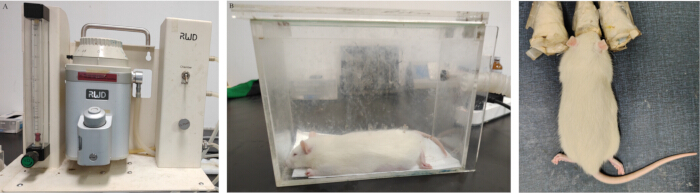
Figure 1: Anesthesia pre-treatment prior to electroacupuncture. Before EA treatment, rats were anesthetized using an inhalational anesthesia system. (A) Anesthesia apparatus. (B) Induction in an anesthesia chamber with 3% isoflurane. (C) Maintenance anesthesia with 1.5% isoflurane delivered via a nose mask while the rat is positioned supine on a heating pad during the treatment session. Please click here to view a larger version of this figure.
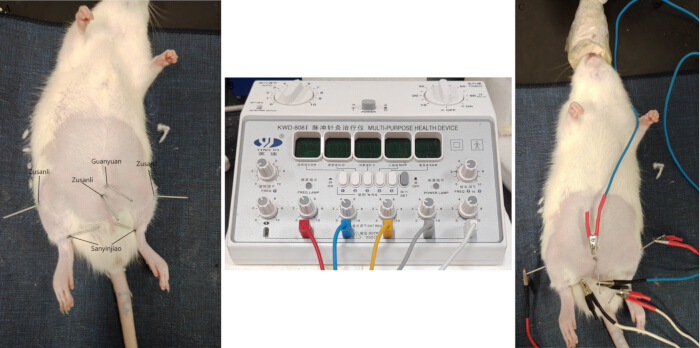
Figure 2: Acupoint localization and electroacupuncture setup in rats. (A) Schematic diagram showing surface anatomical landmarks and the locations of Zhongji (CV3), Guanyuan (CV4), Zusanli (ST36), and Sanyinjiao (SP6) used in this protocol. (B) EA stimulator. (C) Representative image of a rat undergoing EA under inhalational anesthesia, with needles inserted at CV3, CV4, ST36, and SP6 and electrical stimulation delivered using paired connections (CV3-CV4 and ST36-SP6) during the treatment session. Please click here to view a larger version of this figure.
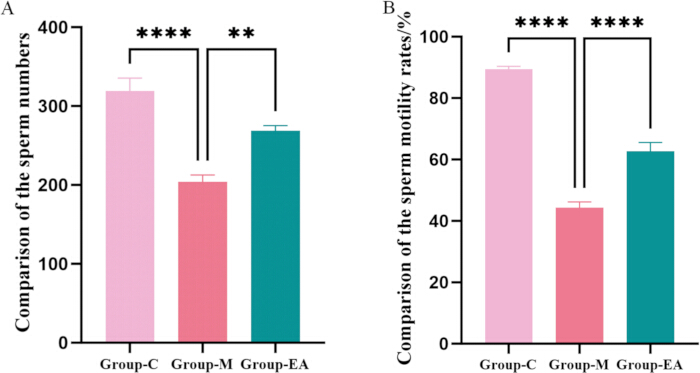
Figure 3: Sperm motility and sperm count after electroacupuncture treatment. Epididymal sperm suspensions from the control group (Group-C), model group (Group-M), and electroacupuncture group (Group-EA) were analyzed using a CASA system to quantify sperm parameters. (A) Sperm motility rate (%). (B) Sperm count. Data are presented as mean ± standard deviation. Statistical significance was determined by one-way ANOVA followed by Bonferroni-adjusted post hoc comparisons. For sperm motility, a significant group effect was observed (F = 374.81, P < 0.001), with Group-M significantly lower than Group-C and Group-EA. For sperm count, a significant group effect was observed (F = 78.39, P < 0.001), with Group-M significantly lower than Group-C and Group-EA. **P < 0.01, ****P < 0.001. Please click here to view a larger version of this figure.

Figure 4: Histological examination of rat testes after electroacupuncture treatment. Representative HE-stained sections of rat testes are shown at the same magnification for group comparison. (A) Control group. (B) Model group. (C) Electroacupuncture group. Colored arrows indicate key histological features: black arrows, normal seminiferous tubules; green arrows, necrosis/degeneration-like areas; blue arrows, vacuole-like structures within the seminiferous epithelium. Scale bars: 200 µm. Please click here to view a larger version of this figure.
Discussion
Loading...
$$\rightleftharpoonup{xx}$$
$$\longleftharp{xx}$$,
$$\longrightharp{xx}$$,
Given the multifactorial etiology of oligoasthenozoospermia and the limited efficacy of available pharmacologic treatments, acupuncture and EA have gained attention as repeatable, nonpharmacological interventions19. The existing clinical and preclinical literature suggests several plausible mechanisms by which acupuncture or EA may influence male reproductive function, including the modulation of neuroendocrine regulation, improvement of reproductive organ microcirculation, and attenuation of oxidative stress and inflammatory responses that compromise spermatogenesis20. These proposed mechanisms offer a translational rationale for evaluating EA in controlled animal studies using semen and testicular histology as primary readouts.
EA is especially suitable for protocol-driven preclinical work, as its stimulation parameters, such as frequency, intensity, session duration, and electrode pairing, can be specified and replicated more consistently than manual needle manipulation21. In rats, parameter-controlled EA has been reported to promote the recovery of spermatogenesis after injury, with improvements in semen-related endpoints observed under defined experimental conditions. Recent clinical studies continue to assess EA for outcomes in male infertility, such as motility and total motile sperm count, reflecting ongoing translational interest while underscoring the need for clearly defined and reproducible procedures in preclinical research.
Compared with the earlier mechanism-oriented work on the same adenine-induced platform16, the present study shifts emphasis to two practical determinants for reliably delivering repeated EA sessions in rodents: (1) the use of inhalational anesthesia to stabilize the stimulation period, and (2) the use of a commonly employed reproductive acupoint set (CV3, CV4, ST36, and SP6) with standardized electrode pairing. This delivery-focused design addresses a persistent technical bottleneck in rodent EA experiments, movement-related needle displacement and intermittent loss of electrode contact, which is especially problematic in setups combining abdominal midline points with hind-limb points, where respiration and cumulative lead-wire traction can compromise effective stimulation delivery during a 30-min session.
The use of isoflurane maintenance is presented here not only as a measure to ensure delivery fidelity but also as a refinement relevant to animal welfare in repeated procedures. Guidelines for laboratory animal anesthesia emphasize selecting appropriate anesthetic regimens, monitoring anesthetized animals, and providing supportive intraoperative care to minimize distress and prevent complications22,23. Inhalational anesthesia permits rapid titration and recovery, which benefits repeated interventions, but it also requires explicit temperature management and monitoring because rodents can rapidly develop hypothermia under isoflurane. Consequently, the protocol incorporates a heating pad and specifies consistent induction and maintenance settings alongside respiratory and reflex monitoring, aiming to maintain the lightest effective anesthetic plane that prevents struggling while ensuring stable needle retention and reliable electrode contact throughout stimulation.
Acupoint selection is a practical design choice, and the present set (CV3, CV4, ST36, and SP6) differs from our previously reported strategy, motivating discussion of its translational and implementation implications. Data-mining analyses of infertility acupuncture prescriptions identify CV4, SP6, ST36, and CV3 among the most frequently used points, supporting the clinical relevance of this acupoint set17. Reviews of acupuncture for male infertility similarly highlight CV4, ST36, and SP6 as core points commonly featured across reported protocols9. Beyond clinical frequency, this particular combination offers practical advantages for a methods-oriented rodent workflow: CV3 and CV4 are easily localized on the abdominal midline using surface landmarks, ST36 and SP6 are readily located on the hind limb, and the pairing scheme (CV3-CV4 and ST36-SP6) enables consistent electrode connections across animals and sessions. Importantly, the abdominal-plus-hind-limb configuration also provides a clear rationale for anesthesia-assisted delivery and explicit delivery quality control, as abdominal needle retention and cable traction become more challenging during respiration and prolonged stimulation. These considerations make the present protocol complementary to prior approaches that employed different point-selection strategies and broader endocrine or mechanistic panels.
Several limitations should be noted. First, because this study was designed as a methodological extension of our previous mechanism-oriented work, no positive-drug control or sham EA group was included. In addition, no generally accepted standardized sham EA instrument or intervention scheme has yet been established for repeated EA in this specific rat model and acupoint configuration. Therefore, the representative results should be interpreted as procedural validation of the establishment of the adenine-induced model and the EA delivery workflow, rather than as definitive evidence of electroacupuncture-specific efficacy. Second, outcome verification was limited to sperm count, sperm motility, and testicular histology. Although these readouts suffice to confirm phenotype induction and treatment-associated changes within this protocol, endocrine markers, such as testosterone, gonadotropin-releasing hormone, and inhibin B, were not measured, limiting mechanistic interpretation of the hypothalamic-pituitary-testicular axis. Third, the representative dataset was generated from a small number of animals (n = 3 per group). Accordingly, the findings should be regarded primarily as methodological validation rather than as a fully powered efficacy or mechanistic evaluation.
In subsequent work, this protocol can serve as a practical backbone for design-oriented extensions, including parameter studies that vary stimulation intensity, waveform, and session duration under the same isoflurane-maintained delivery conditions, as well as expanded semen phenotyping beyond sperm count and motility (e.g., additional CASA motion parameters and sperm morphology). Depending on the hypothesis, endocrine readouts and targeted molecular or imaging assays can be added as modular layers to probe neuroendocrine regulation, changes in the local testicular microenvironment, or spermatogenic injury-repair processes. Beyond these technical extensions, the broader implication for reproductive acupuncture research is that explicitly controlling and transparently reporting delivery conditions, anesthesia handling, electrode contact stability, and stimulation “dose” implementation, may help the field accumulate more comparable preclinical datasets and refine hypothesis-driven choices of stimulation parameters and acupoint strategies in male reproductive dysfunction. Alternative reproductive acupoint sets can also be incorporated within the same delivery framework, enabling systematic exploration of how point selection shapes implementation constraints and outcome patterns when other procedural elements are kept consistent.
Disclosures
Loading...
$$\rightleftharpoonup{xx}$$
$$\longleftharp{xx}$$,
$$\longrightharp{xx}$$,
The authors declare no competing financial or non-financial interests.
Acknowledgements
Loading...
$$\rightleftharpoonup{xx}$$
$$\longleftharp{xx}$$,
$$\longrightharp{xx}$$,
This work was supported by the 2024 National Natural Science Foundation of China Regional Science Fund (82460972) and the 2022 National Natural Science Foundation of China Regional Science Fund (82260967); the 2022 Key Research and Development Program of Ningxia Hui Autonomous Region (2022BEG02040); the First-class Discipline Construction Project of the School of Traditional Chinese Medicine, Ningxia Medical University (ZY0019110305); the 2023 Key Research and Development Program of Yanchi County (2023YCYDCT003); and the Science and Technology Benefiting the People Special Program of Ningxia Hui Autonomous Region (2024CMG03054).
Materials
| Name | Company | Catalog Number | Comments |
|---|---|---|---|
| Adenine | Beijing Solarbio Science & Technology Co.Ltd. | A8330 | |
| CASA computer-assisted semen analysis system | Nanning Songjing Tianlun Biotechnology Co.,Ltd. | VICOS-SPERM | |
| Centrifuge | Sartorius | A-14C | |
| Differentiation fluid | Shanghai Biyuntian Biotechnology Co.,Ltd | C0163M | |
| Disposable sterile acupuncture needles | Hanyi brand | 0.25 mm ´ 13 mm | |
| Drying machine | Leica | HI1220 | |
| Electrical stimulator | Changzhou Yingdi Electronic Medical Device Co., Ltd | KWD-808I | |
| Electronic balance | Hangzhou Youheng Weighing Equipment Co.,Ltd | HLD-6002 | |
| Eosin Y Stain Solution | Lanke Biotech | BS248 | |
| Hematoxylin staining solution | Zhuhai Beso Biotechnology Co. LTD | BA-4041 | |
| Isoflurane | RWD Life Science Co., Ltd. | R510-22-10 | |
| Microtome | Leica | RM2255 | |
| Neutral balsam | Beijing Zhongshan Jinqiao Biotechnology Co.,Ltd | Zli-9555 | |
| Paraffin embedding machine | Leica | HistoCore Arcadia H | |
| SD rats | Animal Center of Ningxia Medical University | 8-week-old,Male,180-220 g | |
| Slide scanner | Leica | Aperio LV1 | |
| Small Animal Anesthesia Machine | RWD Life Science Co., Ltd. | R500 | |
| Vortex oscillator | Haimen Qilin Bell Instrument Manufacturing Co.,Ltd | QL-902 | |
| Warming pad | Dongguan Hongda Electronics Co., Ltd. | 45W-80X28CM |
References
Loading...
$$\rightleftharpoonup{xx}$$
$$\longleftharp{xx}$$,
$$\longrightharp{xx}$$,
- Björndahl, L., et al. The sixth edition of the WHO laboratory manual for the examination and processing of human semen: ensuring quality and standardization in basic examination of human ejaculates. Fertil Steril. 117 (2), 246-251 (2022).
- Agarwal, A., et al. Male infertility. Lancet. 397 (10271), 319-333 (2021).
- Abu-Halima, M., et al. Sperm motility annotated genes: are they associated with impaired fecundity? Cells. 12 (9), 21(2023).
- Li, S. L., et al. Mechanisms of traditional Chinese medicine in regulating Nrf2-related signaling pathways for the treatment of oligoasthenozoospermia: a review. J Ethnopharmacol. 360, 21(2026).
- Pathak, U. I., Gabrielsen, J. S., Lipshultz, L. Cutting-edge evaluation of male infertility. Urol Clin North Am. 47 (2), 129(2020).
- Kimmins, S., et al. Frequency, morbidity and equity - the case for increased research on male fertility. Nat Rev Urol. 21 (2), 102-124 (2024).
- Assidi, M. Infertility in men: advances towards a comprehensive and integrative strategy for precision theranostics. Cells. 11 (10), 29(2022).
- Feng, J. X., et al. The efficacy and mechanism of acupuncture in the treatment of male infertility: a literature review. Front Endocrinol. 13, 14(2022).
- You, F., Ruan, L. G., Zeng, L., Zhang, Y. Efficacy and safety of acupuncture for the treatment of oligoasthenozoospermia: a systematic review. Andrologia. 52 (1), 9(2020).
- Wei, J. Q., et al. Bibliometric and visualized analysis of electroacupuncture in the past 10 years. Complement Ther Med. 69, 10(2022).
- Yu, Y., et al. Effects and mechanism of action of transcutaneous electrical acupuncture point stimulation in patients with abnormal semen parameters. Acupunct Med. 37 (1), 25-32 (2019).
- Jia, W., Wang, C. A., Yin, Y. Acupuncture for oligospermia and asthenozoospermia: a systematic review and meta-analysis. Medicine. 100 (48), 8(2021).
- Pu, R. Y., et al. Modeling methods for busulfan-induced oligospermia and asthenozoospermia in mice: a systematic review and meta-analysis. J Assist Reprod Genet. 40 (1), 19-32 (2023).
- Yu, Z. Z., Chen, J., Shou, P. Q., Feng, L. Effects of micronutrients on the reproduction of infertility rat model induced by adenine. Int J Clin Exp Med. 7 (9), 2754-2762 (2014).
- Zhu, C. Z., et al. Short-term oral gavage administration of adenine induces a model of fibrotic kidney disease in rats. J Pharmacol Toxicol Methods. 94, 34-43 (2018).
- Li, K. Y., et al. Mechanism of Shu-Mu brain-kidney acupoint in treating oligoasthenospermia in rats via the hypothalamic-pituitary-testicular axis. J Vis Exp. (219), e67912(2025).
- Liu, J., et al. Exploration of acupoint compatibility patterns in acupuncture treatment for infertility based on data mining. Int J Womens Health. 18, 15(2026).
- Tang, Y. Experimental Acupuncture and Moxibustion Science. , Shanghai Science and Technology Press. Shanghai. (2021).
- Wang, Z., et al. Efficacy and safety of nonpharmacological strategies for the treatment of oligoasthenozoospermia: a systematic review and Bayesian network meta-analysis. Eur J Med Res. 28 (1), 16(2023).
- He, Y., et al. Acupuncture treatment of male infertility: a systematic review. Zhonghua Nan Ke Xue. 21 (7), 637-645 (2015).
- Napadow, V., et al. Effects of electroacupuncture versus manual acupuncture on the human brain as measured by fMRI. Hum Brain Mapp. 24 (3), 193-205 (2005).
- Grimm, H., et al. Advancing the 3Rs: innovation, implementation, ethics and society. Front Vet Sci. 10, 13(2023).
- Rinwa, P., Eriksson, M., Cotgreave, I., Backberg, M. 3R-refinement principles: elevating rodent well-being and research quality. Lab Anim Res. 40 (1), 11(2024).
Reprints and Permissions
Request permission to reuse the text or figures of this JoVE article
Request Permission