This protocol evaluates postoperative systemic immune-inflammatory responses and perioperative recovery outcomes after robotic and laparoscopic proximal gastrectomy in patients with upper gastric cancer using systemic immune-inflammatory index, neutrophil-to-lymphocyte ratio, and platelet-to-lymphocyte ratio measurements.
Method Article
Systemic Immune-Inflammatory Index For Evaluating Robotic and Laparoscopic Proximal Gastrectomy in Upper Gastric Cancer
Jingjing Dai1 , Junping Bai2 , Zihao Gao3 , Chenggong Zhang3 , Fan Ding3 , Dezhu Dai3 , Liang Shi3 , Xiao Han3 , Yin Huang4
huangyin0129@163.com
xd1song@163.com
taoguoquan5698102@163.com
1Department of Medical Laboratory, The Affiliated Huai'an No.1 People's Hospital of Nanjing Medical University, 2Department of Pharmacy, Huai'an Hospital of Traditional Chinese Medicine, 3Department of Gastrointestinal Surgery, The Affiliated Huai'an No.1 People's Hospital of Nanjing Medical University, 4Department of Clinical Laboratory, The Fourth People's Hospital of Huai'an
Corresponding Authors: Yin Huang <huangyin0129@163.com>, Xudong Song <xd1song@163.com>, Guoquan Tao <taoguoquan5698102@163.com>
* These authors contributed equally
Opens in a new tab
In This Article
Summary
Loading...
$$\rightleftharpoonup{xx}$$
$$\longleftharp{xx}$$,
$$\longrightharp{xx}$$,
Abstract
Loading...
$$\rightleftharpoonup{xx}$$
$$\longleftharp{xx}$$,
$$\longrightharp{xx}$$,
Tumor resection is a commonly used treatment method in clinical practice. With the increasing refinement of tumor surgery, the application of robotic-assisted surgery in clinical procedures has expanded. However, effective indicators for evaluating surgical efficacy and postoperative prognosis remain limited. This study introduced the systemic immune-inflammatory index (SII) to evaluate perioperative inflammatory responses and postoperative recovery following robotic and conventional laparoscopic surgery. A total of 81 patients who underwent robotic-assisted gastrointestinal tumor resection and 81 patients who underwent conventional laparoscopic gastrointestinal tumor resection were included. SII was calculated using the formula: platelet count × (neutrophil count/lymphocyte count). Postoperative SII, neutrophil-to-lymphocyte ratio (NLR), and platelet-to-lymphocyte ratio (PLR) increased after surgery, peaked on postoperative day 3, and gradually returned toward baseline by postoperative day 7. From postoperative day 3 onward, SII and NLR values in the robotic surgery group were significantly lower than those in the laparoscopic surgery group (P < 0.05), and these differences remained significant on postoperative days 5 and 7 (P < 0.05). PLR values were significantly lower in the robotic surgery group on postoperative day 3 only (P < 0.05), whereas no significant differences were observed on postoperative days 5 or 7 (P > 0.05). Patients in the robotic surgery group also demonstrated improved postoperative recovery indicators, including earlier ambulation, earlier postoperative exhaust and feeding, lower average drainage volume and shorter postoperative hospital stay. These findings suggest that SII may serve as a useful indicator for evaluating postoperative inflammatory status and perioperative recovery following minimally invasive gastric cancer surgery.
Introduction
Loading...
$$\rightleftharpoonup{xx}$$
$$\longleftharp{xx}$$,
$$\longrightharp{xx}$$,
Gastric cancer remains one of the leading causes of cancer-related mortality worldwide and represents a major public health burden in China1. The development and progression of gastric cancer are associated with multiple factors, including dietary habits, environmental exposure, and lifestyle-related risk factors2,3,4. Current treatment strategies for gastric cancer commonly involve multimodal management, including neoadjuvant therapy, surgical resection, and adjuvant chemotherapy, depending on tumor stage and patient condition5,6. Surgical resection remains the primary curative treatment for resectable gastric cancer. With the continued advancement of minimally invasive techniques, laparoscopic and robotic-assisted surgical approaches have been increasingly applied in gastric cancer surgery7,8,9. These techniques may improve surgical precision and perioperative recovery while reducing operative trauma.
The Systemic Immune-Inflammatory Index (SII) is a comprehensive biomarker used to evaluate systemic inflammatory and immune status10. Previous studies have demonstrated that postoperative inflammatory responses are associated with clinical recovery and prognosis in patients with gastric cancer11. Conventional inflammatory indicators, including the Neutrophil-to-Lymphocyte Ratio (NLR) and Platelet-to-Lymphocyte Ratio (PLR), have also been used to evaluate postoperative inflammatory status12,13. However, these indicators may not fully reflect the combined immune and inflammatory response of patients after surgery. SII integrates platelet, neutrophil, and lymphocyte counts and may therefore provide a more comprehensive assessment of postoperative inflammatory status14.
In this study, postoperative immune-inflammatory responses were evaluated by analyzing perioperative changes in SII, calculated as follows15:
 (1)
(1)
Here, PLT is the platelet count, N is the neutrophil count, and L is the lymphocyte count.
Differences in SII, NLR, PLR, and postoperative recovery indicators were compared between patients undergoing robotic-assisted surgery and conventional laparoscopic surgery for upper gastric cancer. This study aimed to evaluate the potential clinical value of SII in assessing postoperative inflammatory response and perioperative recovery following minimally invasive gastric cancer surgery.
Protocol
Loading...
$$\rightleftharpoonup{xx}$$
$$\longleftharp{xx}$$,
$$\longrightharp{xx}$$,
The testing data of all patients pathologically diagnosed with gastric adenocarcinoma were obtained from the laboratory database collected between 2024 and 2025 at the Affiliated Huai’an No.1 People’s Hospital of Nanjing Medical University. Upper gastric cancer was defined as tumors located in the upper third of the stomach or esophagogastric junction. We retrospectively analyzed the collected data. The samples were deidentified prior to use and were processed in compliance with approved institutional protocols approved by the Ethics Committee of the Affiliated Huai’an No.1 People’s Hospital of Nanjing Medical University (KY-2024-250-01). Written informed consent was obtained from all patients prior to enrollment. Inclusion criteria included patients diagnosed with gastric adenocarcinoma by surgery and pathological examination who had not undergone preoperative radiotherapy or chemotherapy and whose preoperative routine hematological test results were within normal ranges. Exclusion criteria included conditions inconsistent with the inclusion criteria, including incomplete clinical or laboratory data. Tumor staging was performed according to the 8th edition of the AJCC/UICC TNM staging system. According to the surgical approach, patients were assigned to the laparoscopic surgery group or robotic-assisted surgery group.
Comparison of surgical steps and surgical details between the conventional laparoscopic surgery group and the robotic-assisted surgery group
The indications for proximal gastrectomy (PG) in this study included: (1) adenocarcinoma of the esophagogastric junction or upper third of the stomach; (2) the possibility of achieving R0 resection while preserving at least 5 cm of the distal stomach; and (3) the absence of bulky lymph node metastasis along the celiac axis (No. 12a, 8a, or 11). For patients with advanced-stage (Stage III) disease, PG was performed following multidisciplinary team (MDT) consensus, prioritizing the balance between oncological safety and postoperative nutritional preservation. Among the enrolled patients, 85.2% (n = 69) in the robotic-assisted surgery group and 82.7% (n = 67) in the laparoscopic surgery group underwent curative-intent R0 resection. The remaining patients underwent palliative surgery to alleviate life-threatening symptoms, including tumor-related hemorrhage or gastric outlet obstruction. Negative surgical margins were confirmed by postoperative pathological examination.
Reconstruction was performed using the modified side-overlap with fundoplication by Yamashita (mSOFY) technique. First, a small incision was created on the right side of the esophageal stump and on the anterior wall of the gastric remnant. A 45 mm linear cutting stapler was then inserted into the prepared anastomotic openings of the esophagus and remnant stomach. The esophagus was rotated 90° counterclockwise along its axis to facilitate anastomosis between the right wall of the esophagus and the remnant stomach, after which the gastric wall was sutured to the left side of the esophagus. The common opening between the esophagus and remnant stomach was subsequently closed using inverted sutures. The left and lower sides of the esophagus were then sutured to the remnant stomach to maintain close apposition of the esophagus against the gastric wall. After opening the sutured common opening, the posterior wall of the lower esophageal segment was compressed into a valve-like structure by the pressure generated from the pseudo-fornix configuration. Intracorporeal anastomosis was performed in all patients undergoing the mSOFY procedure.
After re-establishing pneumoperitoneum, both diaphragmatic crura were incised, and the two corners of the gastric remnant were sutured and fixed to the corresponding diaphragmatic crura to facilitate the subsequent reconstruction procedure. For laparoscopic proximal gastrectomy with mSOFY reconstruction, a five-port configuration was used. Patients were placed in the supine split-leg position with a 20° reverse Trendelenburg (head-up) tilt and a 10° right lateral tilt to facilitate exposure of the upper abdomen and esophagogastric junction. Pneumoperitoneum pressure was maintained between 10–15 mmHg according to the patient’s individual condition.
The trocar layout was established using the five-port method. A 12 mm infraumbilical trocar was inserted as the camera port to provide panoramic laparoscopic visualization. A 12 mm trocar placed at the left anterior axillary line below the costal margin served as the main operating port for vessel ligation, lymphadenectomy, and anastomosis. A 5 mm trocar placed at the left midclavicular line approximately 3 cm above the umbilicus served as the left auxiliary port to facilitate esophageal stump management and anastomosis. Two assistant ports were established on the right side: one 5 mm trocar at the right anterior axillary line below the costal margin for tissue retraction and exposure, and another 5 mm trocar at the right midclavicular line approximately 3 cm above the umbilicus to assist with delicate procedures, including anastomotic reinforcement and anti-reflux fundoplication.
According to the 5th edition of the Gastric Cancer Treatment Guidelines published by the Japanese Gastric Cancer Association, standard lymph node dissection included D1+ and D2 lymphadenectomy. D1+ lymph node dissection was generally performed for patients with early upper gastric cancer staged as cT1N0. D2 lymph node dissection was performed for patients with cT2 or higher tumors or clinically lymph node-positive (cN+) disease. D1+ lymph node dissection included lymph node stations No. 1, 2, 3a, 4sa, 4sb, 7, 8a, 9, and 11p, whereas D2 lymph node dissection included stations No. 1, 2, 3a, 4sa, 4sb, 7, 8a, 9, 10, 11p, and 11d.
Indocyanine green fluorescence imaging was not used during surgery. Multiple surgical teams participated in the procedures; however, all participating surgeons were professionally trained and experienced in minimally invasive gastric cancer surgery, ensuring consistent surgical quality and operative standards across cases. Surgical procedures and operative details were compared between the laparoscopic surgery group and robotic-assisted surgery group to evaluate differences between the two minimally invasive surgical approaches.
Performing blood routine tests on the collected two-year specimens
Fasting peripheral blood samples were collected from all patients in EDTA-K2 anticoagulant tubes at 8:00 a.m. on the day of surgery and postoperative days 3, 5, and 7. The collected specimens were sealed in sterile transport bags and transferred to the laboratory for analysis at room temperature. Peripheral blood samples were analyzed using an automated hematology analyzer. Laboratory personnel were blinded to surgical grouping, and all samples were tested under standardized quality control conditions. Platelet count (×109/L), lymphocyte count (×109/L), and neutrophil count (×109/L) were recorded for each patient. The corresponding SII was calculated using Equation 1, and the NLR16 and PLR17 were calculated using the following Equations 2 and 3, respectively:
 (2)
(2)
 (3)
(3)
Collection of patient data from the laparoscopic surgery group and the robotic-assisted surgery group
To achieve the study objectives, comprehensive preoperative and postoperative clinical data were collected and analyzed for patients in both the laparoscopic surgery group and robotic-assisted surgery group. The collected parameters included demographic characteristics (sex and age), hematological profiles (complete blood count results), and perioperative recovery indicators. Key postoperative recovery indicators were defined as follows: (1) time to first flatus, defined as the interval between completion of surgery and the first passage of gas per rectum; (2) time to first ambulation, defined as the interval between completion of surgery and the patient’s first out-of-bed activity, either assisted or independent; and (3) postoperative hospital stay, defined as the total number of days from surgery to discharge according to standardized clinical discharge criteria. Postoperative complications, including anastomotic leakage, reflux esophagitis, anastomotic stenosis, reoperation, and readmission, were assessed during hospitalization. Complication severity was graded according to the Clavien–Dindo classification system. All patients underwent standardized postoperative management and rehabilitation protocols. Perioperative antibiotic administration and thromboprophylaxis protocols were also standardized between groups. The present study focused on perioperative and in-hospital postoperative outcomes; therefore, long-term postoperative follow-up was not included in the study design.
Statistical analysis
All statistical analyses were performed using statistical analysis software and graphing software. Student’s t-tests, chi-square tests, and repeated-measures analysis of variance (ANOVA) were used for statistical comparisons between groups and across postoperative time points. Data are presented as mean ± standard deviation. The chi-square test was used for statistical analysis of categorical clinical data. Normality testing was performed before parametric analyses. A P value <0.05 was considered statistically significant. Missing or incomplete data were excluded from the analysis.
Results
Loading...
$$\rightleftharpoonup{xx}$$
$$\longleftharp{xx}$$,
$$\longrightharp{xx}$$,
Comparison of surgical steps and surgical details between the conventional laparoscopic surgery group and the robotic-assisted surgery group
As shown in Figure 1, statistical analysis of operative parameters demonstrated that the robotic-assisted surgery group required a longer reconstruction time than the laparoscopic surgery group (P < 0.05). However, the robotic-assisted approach was associated with significantly lower estimated intraoperative blood loss compared with the laparoscopic approach (P < 0.05). No significant differences were observed between the two groups with respect to major postoperative complications, including anastomotic leakage, anastomotic stenosis, reflux esophagitis, Clavien–Dindo grade ≥ II complications, or reoperation rate (P > 0.05), confirming the safety and feasibility of robotic-assisted mSOFY reconstruction.
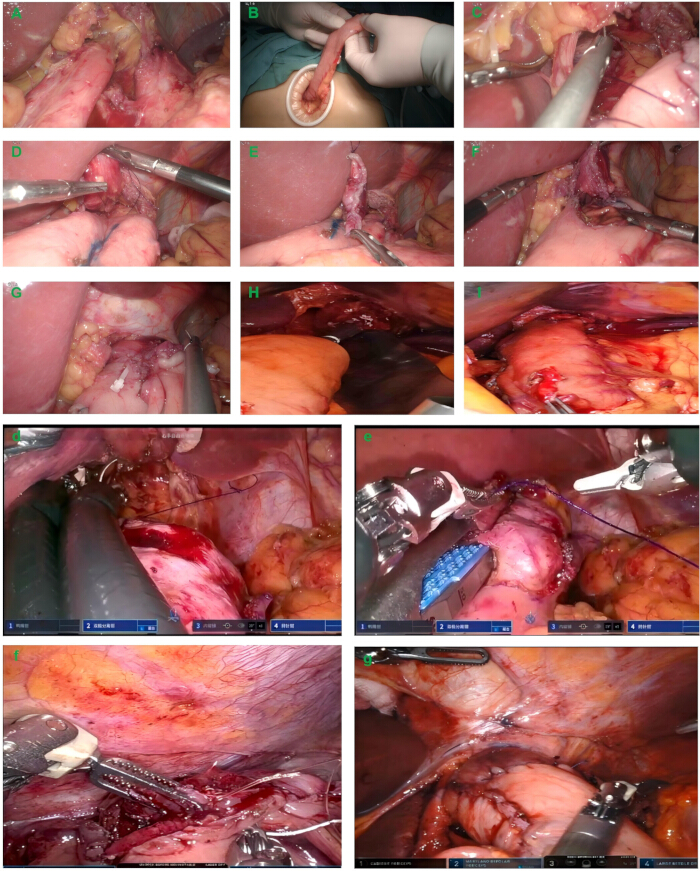
Figure 1: Surgical procedure for proximal gastrectomy and modified side-overlap esophagogastrostomy in the laparoscopic surgery group and robotic-assisted surgery group. (A–I) Representative intraoperative images obtained during conventional laparoscopic proximal gastrectomy and modified side-overlap with fundoplication by Yamashita (mSOFY) reconstruction. The surgical procedure included exposure of the esophagus (A), transection of the tubular stomach (B), fixation of the gastric remnant to the diaphragmatic crura (C), suturing and fixation of the posterior wall of the esophagus to the anterior wall at the midpoint of the gastric closure edge (D), elevation of the left side of the esophagus followed by 90° counterclockwise rotation (E), closure of the common opening between the stomach and esophagus (F), embedding of the esophageal stump (G), placement of the circular stapler shaft (H), and reinforcement of the tubular stomach anastomosis (I). (d–g) Representative intraoperative images obtained during robotic-assisted proximal gastrectomy with mSOFY reconstruction, including suturing and fixation of the posterior wall of the esophagus to the anterior wall at the midpoint of the gastric closure edge (d), elevation and 90° counterclockwise rotation of the left side of the esophagus (e), closure of the common opening between the stomach and esophagus (f), and embedding of the esophageal stump (g). All images were obtained from representative surgical cases, and image acquisition and labeling were standardized across procedures. Please click here to view a larger version of this figure.
MSOFY anastomosis was performed as a manual anastomotic procedure18. During esophageal dissociation and anastomosis within the esophageal hiatus region, the robotic-assisted surgical system enabled precise tissue grasping, suturing, and knotting within a limited operative field. The enhanced dexterity and stable operative visualization provided by the robotic-assisted approach facilitated complex reconstructive procedures in anatomically restricted spaces.
Blood cell count results of two groups of surgical patients from 2024 to 2025
As shown in Figure 2 and Table 1, postoperative SII, NLR, and PLR values increased after surgery in both the laparoscopic surgery group and robotic-assisted surgery group, reached peak levels on postoperative day 3, and gradually decreased toward preoperative baseline levels thereafter. Statistical analysis was performed using Student’s t-test. No significant differences in preoperative SII, NLR, or PLR values were observed between the two groups before surgery (P > 0.05).
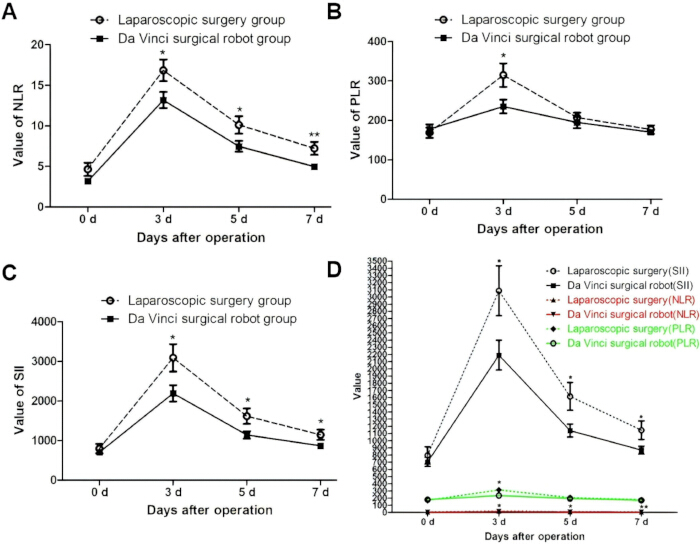
Figure 2: Postoperative changes in systemic immune-inflammatory index, neutrophil-to-lymphocyte ratio, and platelet-to-lymphocyte ratio in the robotic-assisted surgery group and laparoscopic surgery group. (A) Postoperative changes in Neutrophil-to-Lymphocyte ratio (NLR) in the robotic-assisted surgery group and laparoscopic surgery group. (B) Postoperative changes in platelet-to-lymphocyte ratio (PLR) in the robotic-assisted surgery group and laparoscopic surgery group. (C) Postoperative changes in systemic immune-inflammatory index (SII) in the robotic-assisted surgery group and laparoscopic surgery group. (D) Comparative postoperative trends of SII, NLR, and PLR between the two surgical groups. Data are presented as mean ± standard deviation. Statistical analysis was performed using Student’s t-test. *P < 0.05 and **P < 0.01 indicate statistically significant differences between groups. Blood samples were collected at 8:00 a.m. and analyzed at 9:00 a.m. All plotted values represent independent biological samples collected on postoperative days 0, 3, 5, and 7. Please click here to view a larger version of this figure.
| Group | Index | Day 0 | Day 3 | Day 5 | Day 7 |
| Laparoscopic surgery group (n = 81) | SII | 795.52 ± 118.51 | 3086.74 ± 346.31 | 1615.17 ± 193.20 | 1145.48 ± 128.61 |
| NLR | 4.65 ± 0.81 | 16.84 ± 1.34 | 10.12 ± 1.08 | 7.23 ± 0.79 | |
| PLR | 168.92 ± 13.03 | 314.69 ± 29.74 | 207.01 ± 12.63 | 176.77 ± 10.45 | |
| Robotic-assisted surgery group (n = 81) | SII | 704.23 ± 62.15 | 2190.19 ± 206.10 | 1140.40 ± 89.29 | 868.55 ± 52.33 |
| NLR | 3.18 ± 0.23 | 13.18 ± 0.99 | 7.48 ± 0.67 | 4.97 ± 0.29 | |
| PLR | 178.22 ± 11.58 | 235.19 ± 17.30 | 194.67 ± 14.17 | 170.17 ± 7.26 |
Table 1: Postoperative inflammatory indices in the laparoscopic surgery group and robotic-assisted surgery group. The SII, NLR, and PLR were evaluated preoperatively (day 0) and on postoperative days 3, 5, and 7 (calendar days) in patients undergoing laparoscopic surgery or robotic-assisted surgery. Data are presented as mean ± standard deviation. Statistical analysis was performed using Student’s t-test. Platelet count, lymphocyte count, and neutrophil count were expressed in units of ×109/L.
The SII and NLR values in the laparoscopic surgery group were significantly higher than those in the robotic-assisted surgery group on postoperative days 3, 5, and 7 (P < 0.05). PLR values also increased postoperatively in both groups. Significant differences in PLR values between the two groups were observed on postoperative day 3 (P < 0.05), whereas no statistically significant differences were observed on postoperative days 5 or 7 (P > 0.05). To further evaluate the clinical significance of postoperative inflammatory responses, correlation analysis was performed between inflammatory indices and postoperative recovery indicators. Postoperative day 3 SII values showed a significant positive correlation with time to first flatus and postoperative hospital stay. In addition, patients with higher postoperative SII peaks were more likely to experience Clavien–Dindo grade I–II complications, suggesting that SII may serve as a surrogate marker for postoperative surgical stress and early recovery status following gastric cancer surgery.
Comparison of baseline clinicopathological characteristics between the two groups of patients with gastric cancer
As shown in Table 2, no statistically significant differences were observed between the robotic-assisted surgery group and laparoscopic surgery group with respect to age, tumor size, TNM stage, vascular invasion status, body mass index, comorbidities, or neoadjuvant treatment history (P > 0.05). However, a statistically significant difference in sex distribution was observed between the two groups (P < 0.05). Sex distribution differences were not adjusted for during statistical analysis. Among patients with stage III–IV disease, 85.2% (n = 69) in the robotic-assisted surgery group and 82.7% (n = 67) in the laparoscopic surgery group underwent curative-intent R0 resection. The remaining patients underwent palliative surgery to relieve life-threatening symptoms, including tumor-related hemorrhage or gastric outlet obstruction.
| Features | Laparoscopic surgery (n = 81), n (%) | Robotic-assisted surgery (n = 81), n (%) | χ2, P |
| Age (years) | 0.099, 0.753 | ||
| <60 | 38 (46.9) | 40 (49.4) | |
| ≥60 | 43 (53.1) | 41 (50.6) | |
| Sex | 4.343, 0.037 | ||
| Female | 26 (32.1) | 39 (48.1) | |
| Male | 55 (67.9) | 42 (51.9) | |
| Tumor size | 0.953, 0.329 | ||
| <5 cm | 54 (66.7) | 48 (59.3) | |
| ≥5 cm | 27 (33.3) | 33 (40.7) | |
| TNM stage | 0.103, 0.748 | ||
| I–II | 33 (40.7) | 35 (43.2) | |
| III–IV | 48 (59.3) | 46 (56.8) | |
| Vascular invasion | 0.258, 0.611 | ||
| No | 27 (33.3) | 30 (37.1) | |
| Yes | 54 (66.7) | 51 (62.9) | |
| Body mass index | 0.623, 0.441 | ||
| <26.9 | 40 (49.4) | 44 (54.3) | |
| ≥26.9 | 41 (50.6) | 37 (45.7) | |
| Comorbidities | 0, 1 | ||
| Yes | 0 (0) | 0 (0) | |
| No | 81 (100) | 81 (100) | |
| Neoadjuvant treatment history | 0, 1 | ||
| Yes | 0 (0) | 0 (0) | |
| No | 81 (100) | 81 (100) |
Table 2: Baseline clinicopathological characteristics of patients in the laparoscopic surgery group and robotic-assisted surgery group. Baseline demographic and clinicopathological characteristics were compared between patients who underwent laparoscopic surgery and robotic-assisted surgery. The evaluated variables included age, sex, tumor size, TNM stage, vascular invasion status, body mass index, comorbidities, and neoadjuvant treatment history. Tumor staging was performed according to the AJCC/UICC TNM classification system. Tumor size was measured using a ruler during pathological examination. All clinicopathological data were collected postoperatively. Data are presented as number of patients with percentages in parentheses. Statistical comparisons between groups were performed using the chi-square test. P < 0.05 was considered statistically significant.
Comparison of postoperative recovery indicators between the robotic-assisted surgery group and laparoscopic surgery group
As shown in Table 3, patients in the robotic-assisted surgery group demonstrated shorter time to first ambulation, earlier postoperative flatus, earlier postoperative liquid diet initiation, lower average postoperative drainage volume, and shorter postoperative hospital stay compared with patients in the laparoscopic surgery group (P < 0.05). No statistically significant differences were observed between the two groups with respect to postoperative complications, including anastomotic leakage, anastomotic stenosis, reflux esophagitis, reoperation, or readmission rates, as summarized in Table 4 (P > 0.05).
| Features | Laparoscopic surgery (n = 81), n (%) | Robotic-assisted surgery (n = 81), n (%) | χ2, P |
| Time to first ambulation (h) | 45.903, <0.001 | ||
| <36 | 22 (27.2) | 65 (80.2) | |
| ≥36 | 59 (72.8) | 16 (19.8) | |
| Time to first flatus (days) | 28.900, <0.001 | ||
| <3 | 19 (23.5) | 53 (65.4) | |
| ≥3 | 62 (76.5) | 28 (34.6) | |
| Time to first liquid diet (days) | 28.653, <0.001 | ||
| <4 | 26 (32.1) | 60 (74.1) | |
| ≥4 | 55 (67.9) | 21 (25.9) | |
| Time to drainage tube removal (days) | 0.618, 0.432 | ||
| <6 | 39 (48.1) | 44 (54.3) | |
| ≥6 | 42 (51.9) | 37 (45.7) | |
| Average drainage volume (mL/day) | 41.808, <0.001 | ||
| <100 | 30 (37.1) | 70 (86.4) | |
| ≥100 | 51 (62.9) | 11 (13.6) | |
| Postoperative hospital stay (days) | 46.104, <0.001 | ||
| <10 | 23 (28.4) | 66 (81.5) | |
| ≥10 | 58 (71.6) | 15 (18.5) |
Table 3: Comparison of postoperative recovery indicators between the laparoscopic surgery group and robotic-assisted surgery group. Postoperative recovery indicators were compared between patients who underwent laparoscopic surgery and robotic-assisted surgery. The evaluated variables included time to first ambulation, time to first postoperative flatus, time to first liquid diet, drainage tube removal time, average postoperative drainage volume, and postoperative hospital stay. Time to first flatus was defined as the interval between completion of surgery and the first passage of gas per rectum. Time to first ambulation was defined as the interval between completion of surgery and the patient’s first out-of-bed activity, either assisted or independent. Postoperative hospital stay was defined as the total number of days from surgery to discharge according to standardized clinical discharge criteria. Postoperative recovery protocols were standardized between groups. Data are presented as number of patients with percentages in parentheses. Statistical comparisons between groups were performed using the chi-square test. P < 0.05 was considered statistically significant.
| Features | Laparoscopic surgery | Robotic-assisted surgery | t/χ2 value, P value |
| Total operative time (min) | 201.6 ± 35.2 | 239.9 ± 39.9 | 6.8, <0.001 |
| Reconstruction time (min) | 35.2 ± 9.8 | 45.4 ± 12.3 | 5.8, <0.001 |
| Estimated blood loss (mL) | 50.5 ± 9.6 | 20.6 ± 10.4 | 19.1, <0.001 |
| Anastomotic leakage (n, %) | 0, 0% | 0, 0% | 0, 1 |
| Anastomotic stenosis (n, %) | 1, 1.2% | 1, 1.2% | 0, 1 |
| Reflux esophagitis (n, %) | 1, 1.2% | 3, 3.7% | 1.03, 0.31 |
| Clavien–Dindo grade ≥ II (n, %) | 2, 2.5% | 2, 2.5% | 0, 1 |
| Reoperation rate (n, %) | 0, 0% | 0, 0% | 0, 1 |
Table 4: Comparison of operative outcomes and postoperative complications between the laparoscopic surgery group and robotic-assisted surgery group. Operative outcomes and postoperative complications were compared between patients who underwent laparoscopic surgery and robotic-assisted surgery. The evaluated variables included total operative time, reconstruction time, estimated intraoperative blood loss, anastomotic leakage, anastomotic stenosis, reflux esophagitis, Clavien–Dindo grade ≥ II complications, and reoperation rate. Data are presented as mean ± standard deviation or number of patients with percentages in parentheses. Continuous variables were analyzed using Student’s t-test, and categorical variables were analyzed using the chi-square test. P < 0.05 was considered statistically significant.
Operative and Post-operative Complications
As shown in Table 4, the robotic-assisted surgery group demonstrated significantly longer operative and reconstruction times than the laparoscopic surgery group (P < 0.05). However, estimated intraoperative blood loss was significantly lower in the robotic-assisted surgery group (P < 0.05). Postoperative complications, including anastomotic leakage, anastomotic stenosis, reflux esophagitis, Clavien–Dindo grade ≥ II complications, and reoperation rates, were evaluated in both groups. No statistically significant differences in overall postoperative morbidity were observed between the two groups (P > 0.05), indicating that the robotic-assisted approach demonstrated comparable safety to the conventional laparoscopic approach during complex reconstructive procedures.
DATA AVAILABILITY:
The datasets supporting the findings of this study are available in the Supplementary Materials as Supplementary Table 1. The supplementary dataset includes the complete raw perioperative hematological and inflammatory marker data for all patients in the laparoscopic surgery group and robotic-assisted surgery group, including SII, NLR, and PLR values collected preoperatively and on postoperative days 3, 5, and 7.
Supplementary Table 1. Raw perioperative hematological and inflammatory index data of patients in the laparoscopic surgery group and robotic-assisted surgery group. The table contains individual patient-level data, including sex, age, platelet count, neutrophil count, lymphocyte count, SII, NLR, and PLR collected preoperatively (day 0) and on postoperative days 3, 5, and 7. Data were obtained from peripheral blood samples collected in EDTA-K2 anticoagulant tubes and analyzed using an automated hematology analyzer. All values are presented as raw measurements used for statistical analysis and figure generation in this study. Platelet count, neutrophil count, and lymphocyte count are expressed as ×109/L. Supplementary Table 1 supports the analyses presented in Figure 2 and Table 1.Please click here to download this file.
Discussion
Loading...
$$\rightleftharpoonup{xx}$$
$$\longleftharp{xx}$$,
$$\longrightharp{xx}$$,
Gastric cancer is associated with high morbidity and mortality worldwide, and its incidence remains a major public health concern19,20. With the continuous development of diagnostic and therapeutic technologies, particularly advances in surgical treatment, the management of gastric cancer has improved substantially21. Therefore, further evaluation of minimally invasive surgical approaches for gastric cancer remains clinically important. In the present study, laparoscopic surgery and robotic-assisted surgery were compared in combination with perioperative inflammatory indicators to evaluate postoperative recovery and inflammatory response in patients with gastric cancer. Although total gastrectomy remains the standard treatment for advanced proximal gastric cancer, previous studies have suggested that proximal gastrectomy with adequate lymphadenectomy may achieve acceptable oncological outcomes in selected patients with upper-third gastric tumors. The mSOFY reconstruction technique is technically demanding because of the need to create an effective anti-reflux mechanism. In the present study, the robotic-assisted surgical platform provided enhanced three-dimensional visualization and improved instrument articulation, which facilitated precise suturing and reconstruction during mSOFY anastomosis. These technical advantages may reduce operative difficulty during complex reconstructive procedures compared with conventional laparoscopy. The relatively high proportion of advanced-stage cases included in this study reflects the clinical characteristics of patients with gastric cancer in China. In these patients, proximal gastrectomy with mSOFY reconstruction was performed to preserve postoperative nutritional function while maintaining oncological safety when adequate distal surgical margins and lymph node dissection could be achieved.
The SII is a comprehensive indicator used to evaluate systemic inflammatory and immune status in patients22. Because surgical resection remains the primary treatment for gastric cancer, postoperative inflammatory responses are closely associated with postoperative recovery and prognosis23. Song et al.24 reported that patients with cancer experience marked inflammatory stress responses after surgery, which may influence postoperative outcomes. Therefore, peripheral blood inflammatory indicators, including SII, NLR, and PLR, may provide useful information for evaluating postoperative inflammatory status and clinical recovery in patients with gastric cancer.
In the present study, patients who underwent robotic-assisted surgery demonstrated lower postoperative SII and NLR values compared with patients who underwent laparoscopic surgery. In addition, earlier postoperative ambulation, earlier postoperative flatus and feeding, lower postoperative drainage volume, and shorter postoperative hospital stay were observed in the robotic-assisted surgery group. Operative outcomes also demonstrated lower estimated intraoperative blood loss in the robotic-assisted surgery group compared with the laparoscopic surgery group. No significant differences were observed between the two groups with respect to major postoperative complications, including anastomotic leakage, anastomotic stenosis, reflux esophagitis, and reoperation rates. These findings suggested that robotic-assisted surgery may be associated with reduced postoperative inflammatory response and improved short-term postoperative recovery. However, SII alone cannot establish the overall superiority of one surgical approach over another. Comprehensive evaluation of surgical outcomes should incorporate multiple perioperative indicators, including operative variables, postoperative complications, biochemical parameters, immune-related biomarkers, and long-term oncological outcomes. In addition, baseline sex imbalance between the two groups may have influenced postoperative inflammatory responses and recovery outcomes, potentially introducing analytical bias into the study results.
The enhanced visualization and instrument maneuverability provided by robotic-assisted surgical systems may facilitate surgical manipulation within anatomically restricted operative spaces, particularly during esophageal dissociation and anastomosis25,26. Artificial intelligence-assisted surgical systems are also emerging as promising technologies in gastric cancer surgery by integrating automation, advanced image analysis, and clinical decision support. When implemented within appropriate ethical and clinical governance frameworks, artificial intelligence may further improve surgical precision, operative safety, and individualized perioperative management in minimally invasive gastric cancer surgery27. Although the present study demonstrated differences in postoperative inflammatory indicators and short-term recovery outcomes between robotic-assisted surgery and laparoscopic surgery for gastric cancer, several limitations should be acknowledged. First, robotic-assisted surgery required specialized operative skills and was associated with longer operative time compared with laparoscopic surgery (201.6 ± 35.2 min vs. 239.9 ± 39.9 min)28. In addition, this study primarily focused on peripheral blood inflammatory indicators and did not evaluate additional postoperative biomarkers, including albumin and C-reactive protein levels, because these parameters were not included in the study design29.
Furthermore, although significant correlations were observed between SII and early postoperative recovery indicators, the underlying biological mechanisms were not investigated. The study also lacked standardized postoperative quality-of-life assessment using validated instruments, such as the EORTC QLQ-C30 questionnaire, limiting evaluation of patient-reported outcomes following surgery. In addition, this study was retrospective, conducted at a single center, and included a limited sample size. Potential selection bias and baseline sex imbalance between groups may therefore have influenced the observed results. Long-term oncological outcomes, including recurrence-free survival and overall survival, were not evaluated in the present study. Future prospective multicenter studies incorporating larger patient cohorts, standardized postoperative management protocols, additional inflammatory biomarkers, validated quality-of-life assessments, and long-term follow-up are needed to provide a more comprehensive evaluation of postoperative recovery and oncological outcomes following minimally invasive gastric cancer surgery.
In conclusion, this study demonstrated differences in postoperative inflammatory responses and short-term recovery outcomes between robotic-assisted surgery and laparoscopic surgery for gastric cancer. Postoperative SII, NLR, and PLR may provide useful indicators for evaluating perioperative inflammatory status and postoperative recovery in patients undergoing minimally invasive gastric cancer surgery.
Disclosures
Loading...
$$\rightleftharpoonup{xx}$$
$$\longleftharp{xx}$$,
$$\longrightharp{xx}$$,
Conflict of Interests:
The authors declare no competing interests.
Acknowledgements
Loading...
$$\rightleftharpoonup{xx}$$
$$\longleftharp{xx}$$,
$$\longrightharp{xx}$$,
The authors thank all team members for their support and contributions to this study.
Materials
| Name | Company | Catalog Number | Comments |
|---|---|---|---|
| Absorbable sutures | Ethicon, Cincinnati, OH, USA | SXMD1B405 | Anastomotic reinforcement and fixation |
| Automated hematology analyzer | Sysmex, Kobe, Japan | XN-2800 | Peripheral blood cell analysis |
| Carbon dioxide insufflator | Olympus, Tokyo, Japan | UHI system | Pneumoperitoneum establishment |
| Circular stapler | Johnson & Johnson, New Brunswick, NJ, USA | EEA | Esophagogastric anastomosis |
| EDTA-K2 anticoagulant blood collection tubes | WEGO, Weihai, China | 20260101 | Peripheral blood sample collection |
| Endoscopic linear stapler | Ethicon, Cincinnati, OH, USA | ECH60C | Gastric transection and reconstruction |
| Energy device for tissue dissection | Ethicon, Cincinnati, OH, USA | Harmonic 1100 | Tissue dissection and hemostasis |
| Presentation software | Microsoft, Redmond, WA, USA | PowerPoint | Figure preparation, annotation, and data visualization |
| Laparoscopic camera system | Karl Storz, Tuttlingen, Germany | TC200 | Intraoperative visualization |
| Laparoscopic surgical system | Karl Storz, Tuttlingen, Germany | 26605AA | Conventional minimally invasive surgery |
| Nasogastric tube | Huacheng, Guangzhou, China | 16 Fr | Gastric decompression |
| Needle holder | Olympus, Tokyo, Japan | A5690 | Intracorporeal suturing |
| Nonabsorbable sutures | Ethicon, Cincinnati, OH, USA | Mersilke | Tissue fixation |
| Pathology specimen container | Cidabio, Guangzhou, China | Bio-CD2492 | Surgical specimen collection |
| Personal protective equipment | 3M, St. Paul, MN, USA | 4565 | Surgical safety and biosafety compliance |
| Robotic-assisted surgical system | Intuitive Surgical, Sunnyvale, CA, USA | Da Vinci Xi IS4000 | Robotic-assisted minimally invasive surgery |
| Statistical analysis software | GraphPad Software, San Diego, CA, USA | GraphPad Prism 8.0 | Statistical analysis |
| Statistical analysis software | IBM Corp., Armonk, NY, USA | SPSS 17.0 | Statistical analysis |
| Surgical forceps and graspers | Olympus, Tokyo, Japan | A63010S | Tissue manipulation |
| Surgical trocars | AOFO/Intuitive Surgical | FQ/Cannula | Port placement during surgery |
Reprints and Permissions
Request permission to reuse the text or figures of this JoVE article
Request Permission