This observational study investigated the association between the MIR30C rs928508 polymorphism and epidural labor analgesia outcomes, pain scores, labor duration, and adverse reactions in primiparous women undergoing vaginal delivery.
A subscription to JoVE is required to view this content. Sign in or start your free trial.
Research Article
Association of MIR30C rs928508 Polymorphism with Epidural Labor Analgesia Outcomes in Primiparous Women: An Observational Study
* These authors contributed equally
In This Article
Summary
Abstract
Genetic polymorphisms may influence individual variability in labor pain perception and analgesic efficacy. MicroRNA-30c (MIR30C) plays a role in pain modulation, but its association with labor analgesia remains unclear. This study investigated the association between the MIR30C rs928508 polymorphism and epidural labor analgesia in primiparous women. A total of 202 healthy Chinese Han primiparous women receiving standardized epidural analgesia with ropivacaine and sufentanil were enrolled. rs928508 genotypes (GG, GA, and AA) were detected using TaqMan assays, and Hardy–Weinberg equilibrium analysis was performed to assess population genetic distribution. Pain intensity was assessed using the Visual Analogue Scale (VAS) at baseline before analgesia, 30 min after analgesia, 1 h after analgesia, and after discontinuation of analgesia. Factors influencing labor analgesia outcomes were evaluated using multivariable regression analysis. Carriers of the GG genotype exhibited significantly higher VAS scores before analgesia, at 30 min after analgesia, and after discontinuation of analgesia, along with prolonged first-stage labor duration compared with GA and AA carriers. Multivariable regression analysis identified the GG genotype as an independent factor associated with higher post-analgesia VAS scores. Neonatal outcomes and most adverse reactions were comparable among genotypes, except for a higher incidence of puncture-site pain in GG carriers. The MIR30C rs928508 G allele was associated with increased baseline pain, potentially reduced epidural labor analgesia efficacy, and prolonged first-stage labor duration in primiparous women. These findings support further investigation into the potential pharmacogenomic relevance of MIR30C genetic variation in labor analgesia.
Introduction
Labor pain, recognized as one of the most intense forms of human pain, not only induces severe physiological stress in parturients but may also adversely affect maternal and neonatal outcomes through neuroendocrine mechanisms. This can lead to complications such as abnormal uterine contractions, fetal distress, and postpartum depression1,2. Labor analgesia effectively alleviates maternal pain and stress responses, improves the childbirth experience, and demonstrates a favorable safety profile for both mother and infant when appropriately administered3. Epidural analgesia, the preferred method for labor analgesia in clinical practice, has been shown to effectively reduce Visual Analogue Scale (VAS) pain scores. Furthermore, exploration of combined drug regimens has improved analgesic efficacy while reducing adverse effects4.
Substantial evidence indicates that genetic polymorphisms, as a major form of genetic variation, may influence the outcomes of labor analgesia. One study demonstrated that parturients carrying the G allele of the µ-opioid receptor gene (OPRM1) polymorphism rs1799971 required significantly higher opioid doses for labor analgesia compared with individuals with the AA genotype and reported lower analgesic satisfaction. Mutations at this locus may reduce receptor membrane expression, thereby attenuating opioid analgesic efficacy5. Furthermore, polymorphisms in the catechol-O-methyltransferase (COMT) gene may influence the degree of central pain sensitization by modulating dopamine metabolism, subsequently altering maternal pain threshold and responsiveness to analgesic drugs during childbirth6. Polymorphisms in the cytochrome P450 3A4 (CYP3A4) gene have also been reported to modulate analgesic outcomes by affecting drug metabolic rates7,8. In addition, Zhang et al. reported that patients with the MDR1 1236C>T TT genotype required significantly more fentanyl after cesarean section than those with the CC or CT genotype9. Together, these findings provide insight into the genetic basis underlying interindividual variability in pain perception10.
With advances in epigenetic research, the role of non-coding RNA gene polymorphisms in pain modulation has been increasingly recognized. MicroRNAs (miRNAs), as key epigenetic regulators, modulate gene expression by targeting messenger RNA (mRNA) for translational repression or degradation, thereby playing a crucial role in pain signal transmission and the development of pain sensitization11. Numerous studies have demonstrated that miRNAs are differentially expressed in neuropathic pain, inflammatory pain, and other pain conditions and participate in central pain sensitization through regulation of multiple signaling pathways12,13. Polymorphisms in miRNAs may affect their expression levels or binding efficiency to target genes, thereby modulating pain-related signaling cascades14. Prior research has associated miRNA polymorphisms with the phenotypic heterogeneity of complex regional pain syndrome (CRPS) and pathological pain in breast cancer15,16. Among the many pain-related miRNAs, the miR-30 family has garnered increasing attention because of its involvement in neuropathic pain regulation17,18. In particular, the regulatory role of miR-30c-5p has been investigated extensively. Animal studies demonstrated that miR-30c-5p expression was markedly upregulated in pain-related neural structures following sciatic nerve injury, whereas administration of a synthetic inhibitor persistently reversed neuropathic pain hypersensitivity in rats. Further mechanistic studies revealed that miR-30c-5p targets the messenger RNAs of DNA methyltransferase 3a (DNMT3a) and DNMT3b, influencing DNA methylation levels in neural cells through epigenetic regulation and contributing to the long-term maintenance of pain19. Clinical studies also indicated a correlation between miR-30c-5p levels and neuropathic pain intensity in patients20,21. Notably, recent research reported that the G allele in miR-30c rs928508 increased the risk of pain in individuals exposed to workplace bullying22. Another study demonstrated that the G allele reduced miR-30c expression by affecting the processing of primary miR-30c (pri-miR-30c) into mature miR-30c. However, whether miR-30c polymorphisms influence labor pain sensitivity or epidural labor analgesia outcomes remains unclear.
Although labor analgesia techniques have been continuously optimized, the regulatory mechanisms of miRNAs in pain modulation have become increasingly evident. Additionally, miR-30c-5p has been identified as an important regulatory factor in neuropathic pain, and its polymorphisms have been associated with pain-related phenotypes. However, whether miR-30c polymorphisms are involved in the regulation of labor analgesia remains to be elucidated. Therefore, the present study focused on the MIR30C rs928508 polymorphism to investigate its association with labor analgesia outcomes in primiparous women receiving epidural analgesia. The findings may provide theoretical support for future investigations into the potential role of genetic variation in individualized labor analgesia strategies.
Access restricted. Please log in or start a trial to view this content.
Protocol
This study was performed in accordance with the ethical standards of the Medical Ethics Committee of Shijiazhuang Sixth Hospital and was approved by the committee under approval identifier No. 2022111709. Written informed consent was obtained from all participants before enrollment. A schematic overview of the study design and experimental workflow is presented in Figure 1.
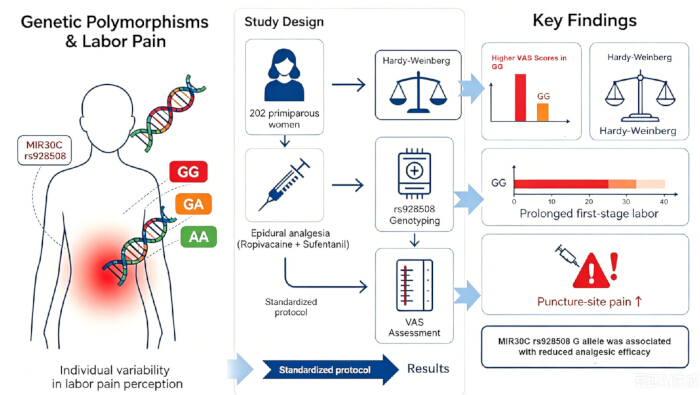
Figure 1. Workflow schematic of the study design and key findings. The figure summarizes the overall workflow of the study investigating the association between the MIR30C rs928508 polymorphism and epidural labor analgesia outcomes in primiparous women. The workflow includes participant recruitment, MIR30C rs928508 genotyping, genotype-based stratification, administration of standardized epidural labor analgesia, outcome assessment, and statistical analysis. Evaluated outcomes included Visual Analogue Scale (VAS) pain scores, labor-stage duration, neonatal outcomes, and analgesia-related adverse reactions. The schematic also highlights the principal findings, including higher pain scores, prolonged first-stage labor, and an increased incidence of puncture-site pain among carriers of the GG genotype. VAS, Visual Analogue Scale; SNP, single nucleotide polymorphism. Please click here to view a larger version of this figure.
Clinical Data
At the Shijiazhuang Sixth Hospital, nulliparous women who delivered between January 2022 and January 2025 were consecutively enrolled as study subjects through the hospital's electronic medical record system, with a total of 202 cases included. During antenatal visits between 28 and 36 weeks of gestation, eligible nulliparous women were introduced to the study and provided written pre-informed consent. The patients ultimately included in the analysis were those who delivered at 37–41 weeks of gestation, had a singleton pregnancy, and presented with cephalic presentation.
The inclusion criteria were as follows: 1) healthy primiparous women aged 20–35 years; 2) Chinese Han ethnicity; 3) singleton pregnancy in cephalic presentation with gestational age between 37 and 41 weeks; and 4) planned spontaneous or assisted vaginal delivery with indications for epidural analgesia. The indications for epidural analgesia were: (a) maternal request with signed informed consent; (b) active labor (cervical dilation ≥2 cm with regular uterine contractions); and (c) obstetric assessment confirming suitability for vaginal delivery.
Exclusion criteria included: 1) pregnancy comorbidities such as gestational hypertension, diabetes mellitus, or severe cardiovascular disease; 2) multiple pregnancy; 3) conversion to cesarean section after initiation of labor analgesia; 4) structural abnormalities of the spine; and 5) contraindications to labor analgesia. Contraindications to labor analgesia included: (a) maternal refusal or inability to cooperate; (b) increased intracranial pressure, spinal deformity, or local infection at the puncture site; (c) coagulation disorders (platelet count of <70 × 109/L or known coagulation factor abnormalities); (d) uncorrected hypovolemia or shock; (e) allergy to local anesthetics or opioids; and (f) obstetric emergencies (e.g., fetal distress requiring immediate cesarean delivery, umbilical cord prolapse, or placenta previa with active bleeding).
The post hoc statistical power was calculated as 0.91, indicating that the sample size was sufficient to detect differences in genotype and allele frequencies between the study population and the reference population.
Analgesia and Anesthesia
Prior to epidural anesthesia, all primiparous women underwent continuous monitoring of vital signs. Respiratory depression was defined as a respiratory rate <10 breaths/min or oxygen saturation (SpO₂) <90%, hypotension as systolic blood pressure <90 mmHg or a decrease of >20% from baseline, and urinary retention as the inability to void spontaneously within 6 h postpartum requiring catheterization. Cervical dilation was assessed by digital vaginal examination performed by the attending obstetrician or a certified midwife on duty. All examiners underwent standardized training in cervical dilation assessment using a cervical examination simulator, with regular quality-control assessments to ensure inter-rater consistency. Cervical examinations were routinely performed every 2 h during active labor or more frequently when abnormalities in labor progression were suspected. Epidural analgesia was initiated when documented cervical dilation reached ≥2 cm, as recorded by the attending obstetric provider.
A standardized epidural analgesia protocol was followed. With the parturient placed in the left lateral decubitus position, the epidural space was accessed through the L3–L4 intervertebral space using the loss-of-resistance-to-saline technique. An epidural catheter was advanced 3–4 cm into the epidural space. Before administration of any medication, gentle aspiration through the catheter was performed. The absence of cerebrospinal fluid or blood confirmed correct catheter placement and excluded intrathecal or intravascular positioning. A test dose of 5 mL of 1% lidocaine hydrochloride was then administered epidurally.
This was followed by a 10 min observation period, during which the parturient was closely monitored according to predefined safety criteria. These criteria included the absence of signs of local anesthetic systemic toxicity (e.g., perioral numbness, metallic taste, tinnitus, or agitation), the absence of signs of high or total spinal block (e.g., rapid progression of motor blockade, dyspnea, dysphonia, or altered mental status), and maintenance of hemodynamic stability, defined as heart rate and blood pressure remaining within 20% of baseline values. After confirmation that all safety criteria had been met, a loading dose of 10 mL containing 0.1% ropivacaine hydrochloride and 0.4 µg/mL sufentanil citrate was administered.
Outcome Measures
Basic demographic and obstetric characteristics of the primiparous women were recorded, including age, body mass index (BMI), gestational age, body temperature at the time of analgesia discontinuation, durations of the first, second, and third stages of labor, and total labor duration. Body temperature was measured using a standardized digital axillary thermometer placed in the right axilla for 5 min by trained nursing staff at the time of analgesia discontinuation. Labor-stage durations were recorded prospectively by the attending midwife or obstetrician according to predefined standardized obstetric criteria. The first stage of labor was defined as the interval from regular uterine contractions with cervical dilation ≥4 cm to complete cervical dilation (10 cm); the second stage extended from complete cervical dilation to fetal delivery; and the third stage extended from fetal delivery to complete placental delivery. Total labor duration was calculated as the sum of the three stages. All measurements were recorded in real time in the partogram and electronic medical record. All clinical personnel involved in labor management received uniform training on these definitions before study initiation.
Pain intensity was assessed using a Visual Analogue Scale (VAS). Each parturient self-reported her pain level by marking a 10-cm line, after which trained research personnel measured and recorded the score. Assessors were blinded to genotype information because genotyping was performed after collection of all clinical outcome data, including VAS scores. Pain scores were recorded at four time points: before analgesia initiation (when cervical dilation reached 2 cm), 30 min after analgesia initiation, 1 h after analgesia initiation, and 30 min after delivery (corresponding to the time of analgesia discontinuation). To account for within-subject correlations arising from repeated VAS measurements, a two-way repeated-measures analysis of variance (ANOVA) was performed across the four assessment time points. VAS scores ranged from 0 to 10, with scores of 0–3 indicating mild pain, 4–6 indicating moderate pain, and 7–10 indicating severe pain23.
The primary analgesia outcome was assessed 30 min after analgesia initiation. Pain intensity was measured using the VAS, where 0 indicated no pain and 10 indicated the worst imaginable pain. Based on an a priori definition, a VAS score >3 was classified as a poor analgesic effect (binary dependent variable coded as 1), whereas a VAS score ≤3 was classified as an adequate analgesic effect (coded as 0). This definition was applied consistently throughout the analysis, and the primary logistic regression model used this binary outcome as the dependent variable.
Neonatal outcomes were evaluated using Apgar scores at 1 min and 5 min after birth. Scores of 8–10 were considered normal, scores of 5–7 indicated mild asphyxia, and scores of 0–4 indicated severe asphyxia24. Apgar assessments were performed in accordance with the Neonatal Resuscitation Program (7th Edition) published jointly by the American Academy of Pediatrics and the American College of Obstetricians and Gynecologists, as well as standardized assessment guidelines established by the hospital's Department of Neonatology. All assessments were performed by trained neonatal nurses or resident physicians who were blinded to study-group allocation.
The incidence of adverse effects following initiation of analgesia was recorded. Adverse reactions included respiratory depression, hypotension, urinary retention, puncture-site pain, dizziness, nausea or vomiting, and pruritus. Respiratory depression was defined as a respiratory rate of <10 breaths/min or SpO₂ of <90%; hypotension as a systolic blood pressure <90 mmHg or a decrease of >20% from baseline; urinary retention as failure to void spontaneously within 6 h postpartum requiring catheterization; puncture-site pain as patient-reported pain at the puncture site with a Numeric Rating Scale (NRS) score ≥4; nausea and vomiting as the presence of nausea or at least one episode of vomiting; and pruritus as patient-reported skin itching without another identifiable cause. Adverse events were monitored from initiation of epidural analgesia until hospital discharge and were recorded prospectively by the attending clinical team.
Blood Sample Collection and Genotyping
During prenatal examinations, peripheral venous blood (2 mL) was collected from each recruited primiparous woman under fasting conditions (minimum fasting period of 8 h) and at a standardized collection time between 08:00 and 10:00 into ethylenediaminetetraacetic acid (EDTA) anticoagulant tubes for subsequent nucleic acid extraction. All samples were immediately stored at −80°C until analysis. The storage period before DNA extraction ranged from 1 to 6 months. To minimize DNA degradation, samples were aliquoted before storage, and freeze–thaw cycles were minimized throughout the study. Frozen samples were thawed slowly on ice before processing.
DNA was extracted from whole blood using a genomic DNA purification kit. Before genotyping, DNA concentration and purity were assessed by ultraviolet spectrophotometry using the A260/A280 ratio, and DNA integrity was evaluated by agarose gel electrophoresis. Only samples meeting predefined quality-control criteria were included in subsequent analyses.
Genotyping of the rs928508 polymorphism was performed using TaqMan single nucleotide polymorphism (SNP) genotyping assays (Cat. No. 4351379). VIC-labeled probes were used for detection of allele A (5′-CAGGCCTGAGAGGCATGATGTTTGG-3′), and FAM-labeled probes were used for detection of allele G (5′-TAGCATCTTCCCAACACTTGCAATT-3′). The total polymerase chain reaction (PCR) volume was 10 µL and consisted of 5.0 µL of 2× TaqMan Genotyping Master Mix, 0.25 µL of pre-formulated TaqMan SNP Genotyping Assay (primer–probe mixture), 10–20 ng of genomic DNA template, and nuclease-free water to the final reaction volume.
Amplification was performed using a quantitative PCR instrument according to standard TaqMan assay procedures. Thermal cycling conditions consisted of an initial enzyme-activation step at 95°C for 10 min, followed by 40 cycles of denaturation at 95°C for 15 s and annealing/extension at 60°C for 60 s. Following amplification, fluorescence signal acquisition and allelic discrimination analysis were performed automatically using the instrument software to determine sample genotypes.
All samples were analyzed in duplicate. For discordant results, a third independent analysis was performed, and the concordant result was adopted. The SNP call rate was ≥95%, and 10% of randomly selected samples demonstrated 100% concordance on repeat testing. Positive controls, negative controls, and no-template controls were included on each assay plate. Genotype assignment was performed in a blinded manner, and all laboratory personnel involved in genotyping remained blinded to clinical outcome data throughout the study.
Statistical Analysis
The Hardy–Weinberg equilibrium (HWE) of the rs928508 allele was evaluated in the study population. The normality of continuous variables was assessed using the Shapiro–Wilk test. Normally distributed data were presented as mean ± standard deviation (SD), whereas non-normally distributed data were reported as the median and interquartile range (IQR).
For comparisons among three groups, one-way analysis of variance (ANOVA) or two-way repeated-measures ANOVA was applied when normality assumptions were satisfied, followed by Tukey’s honestly significant difference (HSD) test for post hoc multiple comparisons. When normality assumptions were not met, the Kruskal–Wallis H test was used, followed by Dunn’s post hoc test with Bonferroni correction. Categorical variables were summarized as frequencies and percentages and analyzed using the chi-square (χ2) test. Expected cell counts were evaluated before analysis, and Fisher’s exact test was used when any expected cell frequency was <5.
Repeated VAS measurements collected at multiple time points were analyzed using two-way repeated-measures ANOVA to account for within-subject correlations. Post hoc comparisons were performed using Bonferroni-adjusted tests to control for multiple comparisons.
Binary logistic regression analysis was performed to identify factors associated with poor labor analgesia outcomes. The primary outcome variable was defined as analgesic efficacy at 30 min after epidural analgesia initiation. VAS scores were dichotomized using a predefined threshold of 3, whereby VAS >3 was classified as a poor analgesic effect and VAS of ≤3 as an adequate analgesic effect. Variables were entered into the multivariable model based on clinical relevance. Multicollinearity was assessed using the variance inflation factor (VIF), and potential interactions among variables were examined. The VIF values for all variables included in the multivariable model are provided in Supplementary Table 1. Model calibration was evaluated using the Hosmer–Lemeshow goodness-of-fit test.
A two-sided P value <0.05 was considered statistically significant. Statistical analyses were performed using SPSS software (Version 23.0).
Access restricted. Please log in or start a trial to view this content.
Results
Clinical Data
Analysis of the MIR30C rs928508 polymorphism among the 202 enrolled primiparous women revealed that the GA genotype was the most prevalent (49.51%, n = 100), followed by GG (26.73%, n = 54) and AA (23.76%, n = 48). The corresponding allele frequencies were 51.49% for G and 48.51% for A. As shown in Table 1, the genotype and allele distributions were generally consistent with the reported frequencies for the East Asian p...
Access restricted. Please log in or start a trial to view this content.
Discussion
This study investigated the association between the miR-30c rs928508 polymorphism and epidural labor analgesia outcomes in a cohort of 202 healthy Chinese Han primiparous women. The findings demonstrated that maternal rs928508 genotype was associated with differences in pain perception during labor analgesia and with the duration of the first stage of labor. In addition, the epidural analgesia regimen used in this study demonstrated a generally comparable safety profile across genotype groups with respect to neonatal out...
Access restricted. Please log in or start a trial to view this content.
Disclosures
Conflict of Interest:
The authors declare no financial, commercial, or proprietary conflicts of interest related to this study.
Materials
| Name | Company | Catalog Number | Comments |
|---|---|---|---|
| Agarose | Sigma-Aldrich | A2929-250G | DNA integrity assessment |
| Cervical Examination Simulator | Erler-Zimmer | R16160 | Examiner training and quality control |
| Digital Axillary Thermometer | Terumo | ETC207S | Body temperature measurement |
| DNA Gel Stain | Biotium | 41020 | Visualization of nucleic acids |
| EDTA Blood Collection Tubes | Greiner Bio-One | 22040161 | Peripheral venous blood collection |
| Electronic Medical Record System | Shijiazhuang Sixth Hospital | N/A | Clinical data collection |
| Epidural Catheter Kit | Teleflex (Arrow) | FlexTip Plus | Epidural catheter placement |
| Epidural Infusion Device / PCEA Pump | Eitan Medical | 17000-031-0035 | Epidural analgesia administration |
| Epidural Needle (Tuohy) | Medline | N/A | 17G × 3.5 in Tuohy needle used for epidural access at L3–L4 |
| Gel Imaging System | Thermo Fisher Scientific | iBright FL1500 | Visualization of DNA bands |
| Genomic DNA Purification Kit | Thermo Fisher Scientific | K0512 | DNA extraction from peripheral whole-blood samples |
| Horizontal Gel Electrophoresis System | Labmate | LMHES-A201 | DNA quality control |
| Ice Bucket and Crushed Ice | Corning | N/A | Sample thawing and handling |
| Lidocaine Hydrochloride Injection (1%) | Pfizer | 0409-4713-65 | Epidural test dose |
| Microcentrifuge Tubes (1.5 mL / 2 mL) | Corning | 430909 (1.5 mL); 430915 (2 mL) | Sample storage and processing |
| Micropipettes (Variable Volume) | Eppendorf | 3125000044 | PCR and sample preparation |
| Multiparameter Patient Monitor | Lepu Creative Medical | PC-3000 | Blood pressure, heart rate, and oxygen saturation monitoring |
| Nuclease-Free Water | Promega | P1195 | PCR reagent preparation |
| Partogram Forms or Electronic Partogram System | GrowthXP (PC PAL) | N/A | Labor-stage documentation |
| Personal Computer Workstation | Lenovo (ThinkStation) | P2 | Data processing and analysis |
| PLINK Software | Purcell Laboratory | Version 1.9 | Hardy–Weinberg equilibrium analysis |
| Pulse Oximeter | Microlife | OXY 500 BT | Oxygen saturation monitoring |
| Quantitative PCR Instrument | Thermo Fisher Scientific (Applied Biosystems) | QuantStudio Dx (4470660) | Allelic discrimination and fluorescence detection |
| Refrigerated Microcentrifuge | Thermo Fisher Scientific (Heraeus) | Fresco 21 (75002425) | Sample preparation |
| Ropivacaine Hydrochloride Injection | Hikma Pharmaceuticals (Naropin) | 0143-9265-10 | Epidural analgesic agent |
| SPSS Statistical Software | IBM Corp. | Version 23.0 | Statistical analysis |
| Sterile Aerosol-Resistant Pipette Tips | Thermo Fisher Scientific (ART) | 2149P-05 | Molecular biology applications |
| Sterile Saline Solution | Baxter Healthcare Corporation | 2B1301X | Loss-of-resistance technique |
| Sterile Syringes (5 mL, 10 mL) | Becton, Dickinson and Company (BD) | 309646; 309695 | Drug preparation and administration |
| Sufentanil Citrate Injection | Hospira, Inc. (Pfizer) | 0409-3382-11 | Opioid analgesic component |
| TaqMan Genotyping Master Mix (2×) | Thermo Fisher Scientific (Applied Biosystems) | 4371353 | PCR amplification reagent |
| TaqMan SNP Genotyping Assay (rs928508) | Thermo Fisher Scientific | 4351379 | Genotyping of MIR30C rs928508 polymorphism |
| Ultra-Low Temperature Freezer (-80 °C) | Thermo Fisher Scientific | FDE30086FV | Long-term sample storage |
| UV Spectrophotometer / NanoDrop Spectrophotometer | Thermo Fisher Scientific (NanoDrop) | ND-1000 | DNA concentration and purity assessment |
| Visual Analogue Scale (VAS) Assessment Form | N/A | N/A | Standard 10-cm Visual Analogue Scale form used for pain assessment |