This protocol describes a novel manual restraint method for immobilizing mice during injections or blood sampling, thereby reducing stress and improving welfare during the procedures.
Method Article
Welfare-Oriented Manual Restraint Technique for Substance Administration and Blood Sampling in Mice
In This Article
Summary
Abstract
Animal testing remains essential in biomedical research, contributing significantly to understanding disease mechanisms and evaluating the efficacy and safety of drugs and chemical substances, with rodents among the most frequently used laboratory animals. Among the most common interventions in laboratory practice are handling and immobilizing restraint during procedures such as injections and blood sampling, which are routinely performed on conscious mice without sedation or anesthesia. Proper restraint is necessary to ensure the safety of both the animal and the handler. However, traditional restraint methods, such as hand fixation or restrainer tubes, are known to induce acute stress responses in mice, thereby negatively affecting animal welfare and potentially influencing experimental outcomes. To promote refinement within the framework of the 3Rs principle and to improve animal welfare, this protocol describes the use of a newly developed application tunnel for injections and blood sampling in mice. The tunnel provides a less harsh yet still secure method of restraint compared with conventional techniques. This welfare-oriented restraint method can be easily implemented for standard procedures, such as intraperitoneal and intravenous injections and blood sampling, while minimizing stress and improving handling conditions for laboratory mice.
Introduction
Animal testing continues to play a central role in biomedical research, contributing significantly to the understanding of disease mechanisms and to the evaluation of drug and chemical substance efficacy and safety. Rodents represent the most commonly used laboratory animal species; in the European Union, approximately 3.5 million mice and 0.5 million rats were used for scientific purposes in 20231. An increasing societal awareness of the suffering caused by experimental procedures has led to legal requirements to improve animal welfare in research studies, following the 3R principle2,3. Since the complete replacement of animal testing with alternative methods is not yet possible, optimizing existing experimental procedures is particularly important to alleviate animal suffering. Handling, including immobilizing restraints during procedures such as injections, is one of the most common interventions to which laboratory animals are subjected both in routine care and during experiments.
Traditional immobilizing restraint for intraperitoneal injections involves firmly grasping the skin and fur at the neck with the thumb and forefinger, securing the tail, and turning the animals around to expose the abdomen for injections. This position is unnatural and may result in difficulty breathing, which induces fear in the animals4. Various refined restraint techniques have already been described, including, for example, the so-called 3-finger method, in which pressure on the neck area is reduced compared to classic neck-grip techniques4. Another method largely avoids complete immobilization: Here, the animals can hold onto a wire mesh while the tail and hind limbs are restrained to allow access to the lower abdomen for injections5. Nevertheless, both procedures have limitations. With the 3-finger method, the animals must still be lifted and placed in an unnatural position, which can potentially trigger stress responses. The alternative technique, on the other hand, does not provide sufficient protection against bites from stressed or defensive animals and may limit the time available for performing injections. In addition to potential bite injuries, there is also an increased risk of improper restraint or accidental needle stick injuries. Immobilization for intravenous injections or blood sampling from the tail vein requires the use of restrainers that immobilize the animals without holding them, so hands are free for procedures. Restrainers are generally tubes made of clear acrylic, featuring a closed end with access slots or holes for tail access and an open end for inserting the mice, which can be secured with adjustable plugs. This requires the animals to be picked up by the tail and pulled into the restrainer rear-end first so the tail can be threaded through the access slots. This is a stressful procedure aggravated by the rather narrow diameter of the restrainers necessary to prevent the mice from turning around during procedures, which could result in injuries6,7.
This protocol describes the use of a newly developed application tunnel for injections and blood collection in mice, which allows for less harsh yet still secure fixation. The tunnel consists of a rigid outer frame and a removable plush inner lining, which creates a soft, dark space resembling a burrow. Compared with conventional restrainers, the tunnel was deliberately designed with larger dimensions to accommodate a cut-to-size Vetbed Isobed insert, providing a soft, comfortable inner lining that enhances the animals' sense of security while maintaining sufficient restraint (Figure 1A–B). Both ends of the tunnel are open, so mice can enter by simply walking in from the front and exit at the back. Once inside the tunnel, the animals are prevented from turning around while the tail remains accessible for intravenous injections or blood sampling (Figure 1C). For intraperitoneal injections, the caudal abdominal region can be accessed by placing the tunnel at an angle (Figure 1D) and holding the tail of the animal at its base while applying soft pressure on the sacral area, bending the rear end of the mouse upwards (Figure 1C). This method is less stressful for both mice and experimenters, as no hand fixation is required.
A previous study showed that using the tunnel for intraperitoneal injections durably reduces stress levels and improves the welfare of mice even in experimental models with frequent intraperitoneal injections8. In this study, the application tunnel was also successfully tested for intravenous injection and blood sampling from the tail vein in both male and female mice.
Protocol
All procedures described in this protocol were reviewed and approved by the competent local authority (State Office for Health and Social Affairs of Berlin (LAGeSo); approval number 2022-077-G) and were conducted in accordance with the ARRIVE 2.0 guidelines. All the materials used in this study are listed in the Table of Materials.
1. Intravenous administration
NOTE: This method describes a welfare-oriented manual restraint approach for intravenous administration in mice. Intravenous injections should be performed only by trained personnel, in compliance with institutional guidelines and established safety and hygienic procedures.
- Preparation of animals
CAUTION: Always wear the necessary personal protective equipment (PPE) according to the institution’s biosafety and hygiene requirements (e.g., gowns, gloves, caps, masks) when working with animals.- Place the home cage under a red lamp for 10–15 min to promote vasodilatation and improve visibility of the tail veins.
- Preparation of the working area
- Clean the application tunnel with 70% ethanol. Allow the ethanol to evaporate completely for approximately 5 min.
- Place a rolled piece of washed and autoclaved lining (cut a Vetbed Isobed to the required size) inside the tunnel (Figure 1B).
- Using the fingers, gently compress the lining at the tunnel entrance until the remaining opening is approximately the width of two adjacent fingers. Do not compress the lining further.
- Position the application tunnel on the working surface and place an additional piece of flat lining in front of the tunnel entrance.
- Prepare the injection syringe fitted with a 27G needle containing the desired injection solution and place it next to the tunnel. Ensure that swabs and disinfectant spray are readily available.
- Welfare-oriented restraint in a tunnel
- Transfer the mouse from the home cage using a handling tube.
- Allow the mouse to voluntarily enter the application tunnel by positioning the handling tunnel directly in front of the tunnel opening (Figure 1C).
NOTE: Some mice prefer to first step onto the lining placed in front of the application tunnel before voluntarily entering the tunnel. Mice can be prevented from walking too deep inside the tunnel by gently holding the base of the tail. - Once inside, the mouse typically remains positioned within the rolled lining without turning around.
NOTE: If mice do not enter the tunnel, the opening may be too small; slightly compress the lining at the tunnel entrance. If mice are too small and tend to turn around, tighten the rolled lining or add an additional layer (Figure 1B).
- Intravenous injection
NOTE: The intravenous injection is performed using well-established conventional tail vein injection procedures.- Gently straighten the tail by holding the tip and disinfect the intended injection site. Rotate the tail approximately 90° to position the lateral tail veins dorsally.
- Begin injection at the distal end of the tail to allow additional attempts at more proximal sites, if necessary.
CRITICAL STEP: Insert the needle at an angle of approximately 15–20° relative to the tail, keeping the needle almost parallel to the tail. Advance the needle only slightly beyond the bevel, as the tail veins are superficial. Correct needle placement is indicated by minimal resistance during injection and visible flow of the injected solution through the vein. Inject the desired volume at a slow, steady rate (≤5 mL/kg over 13 s). Following needle withdrawal, apply gentle pressure to the injection site with a sterile swab to prevent bleeding.
CAUTION: Immediately dispose of used needles/syringes in puncture-proof, leak-resistant sharps containers. Do not attempt to recap syringes to prevent needlestick injuries.
- Release and positive reinforcement
- Return the tunnel containing the mouse to the home cage and allow the animal to voluntarily exit from the opposite end of the tunnel (Figure 1C).
- Provide treats in the home cage to support positive reinforcement and habituation to the procedure.
- Cleaning and maintenance
- Remove the inner lining from the application tunnel. Clean the application tunnel with 70% ethanol.
- If the lining remains clean, it may be reused for subsequent experiments. If contaminated or visibly soiled, wash and autoclave before reuse.
NOTE: Use one lining per experimental group. Replace the lining between different experiments, between male and female animals, and whenever required by institutional hygiene guidelines.
2. Intraperitoneal administration
NOTE: This method describes a welfare-oriented manual restraint approach for intraperitoneal administration in mice. Intraperitoneal injections should be performed only by trained personnel, in compliance with institutional guidelines and in accordance with established safety and hygienic procedures. To facilitate better access to the injection area, the application tunnel is used in combination with a sloped platform (wedge), which raises the posterior of the mice upwards.
- Preparation of the working area
- Clean the application tunnel and wedge with 70% ethanol. Allow the ethanol to evaporate completely for approximately 5 min.
- Place a rolled piece of washed and autoclaved lining (cut a Vetbed Isobed to the required size) inside the tunnel (Figure 1B).
- Using the fingers, gently compress the lining at the tunnel entrance until the remaining opening is approximately the width of two adjacent fingers. Do not compress the lining further
- Position the application tunnel on top of the wedge (Figure 1D) on the working surface and place an additional flat lining in front of the tunnel entrance.
- Prepare the injection syringe fitted with a 27G needle containing the desired injection solution and place it next to the tunnel.
- Welfare-oriented restraint in a tunnel
CAUTION: Always wear the necessary personal protective equipment (PPE) according to the institution’s biosafety and hygienic requirements (e.g., gowns, gloves, caps, masks) when working with animals.- Transfer the mouse from the home cage using a handling tube. Allow the mouse to voluntarily enter the application tunnel by positioning the handling tunnel directly in front of the tunnel opening (Figure 1C).
NOTE: Some mice prefer to first step onto the lining placed in front of the application tunnel before voluntarily entering the tunnel. In this case, let the mouse enter the tunnel first before placing the tunnel on the wedge. - Once inside, hold the base of the tail gently between the forefinger and thumb to prevent the mouse from moving too far into the tunnel. The mouse typically remains positioned within the rolled lining without turning around.
NOTE: If mice do not enter the tunnel, the opening may be too small; slightly compress the lining at the tunnel entrance. If mice are too small and tend to turn around, tighten the rolled lining or add an additional layer (Figure 1B).
- Transfer the mouse from the home cage using a handling tube. Allow the mouse to voluntarily enter the application tunnel by positioning the handling tunnel directly in front of the tunnel opening (Figure 1C).
- Intraperitoneal injection
- Hold the base of the tail between the thumb and forefinger of one hand (Figure 1C). Apply gentle pressure to the sacral area using the middle finger of the same hand and slightly turn the tail upwards. This stabilizes the animal and provides clear access to the caudal abdominal region.
- CRITICAL STEP: Perform the injection by holding the syringe parallel to the working surface and inserting it into the clearly visible caudal abdominal region.
- After injection, gently release pressure and release the tail.
CAUTION: Immediately dispose of used needles/syringes in puncture-proof, leak-resistant sharps containers. Do not attempt to recap syringes to prevent needlestick injuries.
- Release and positive reinforcement
- Return the tunnel containing the mouse to the home cage and allow the animal to voluntarily exit from the opposite end of the tunnel (Figure 1C).
- Provide treats in the home cage to support positive reinforcement and habituation to the procedure.
- Cleaning and maintenance
- Remove the inner lining from the application tunnel. Clean the application tunnel and wedge with 70% ethanol.
- If the lining remains clean, it may be reused for subsequent experiments. If contaminated or visibly soiled, wash and autoclave before reuse.
NOTE: Use one lining per experimental group. Replace the lining between different experiments, between male and female animals, and whenever required by institutional hygiene guidelines.
3. Blood sampling from the tail vein
NOTE: This method describes a welfare-oriented manual restraint approach for blood sampling from the tail vein in mice. All procedures must be performed by trained personnel in compliance with institutional guidelines and established safety and hygiene protocols.
- Preparation of the working area
- Clean the application tunnel with 70% ethanol. Allow the ethanol to evaporate completely for approximately 5 min.
- Place a rolled piece of washed and autoclaved lining (cut a Vetbed Isobed to the required size) inside the tunnel (Figure 1B).
- Using the fingers, gently compress the lining at the tunnel entrance until the remaining opening is approximately the width of two adjacent fingers. Do not compress the lining further.
- Position the application tunnel on the working surface and place an additional flat lining in front of the tunnel entrance.
- Ensure that lancets, blood collection microtubes, swabs, and disinfectant spray are readily available.
- Welfare-oriented restraint in a tunnel
CAUTION: Always wear the necessary personal protective equipment (PPE) according to the institution’s biosafety and hygienic requirements (e.g., gowns, gloves, caps, masks) when working with animals.- Transfer the mouse from the home cage using a handling tube. Allow the mouse to voluntarily enter the application tunnel by positioning the handling tunnel directly in front of the tunnel opening (Figure 1C).
NOTE: Some mice prefer to first step onto the lining placed in front of the application tunnel before voluntarily entering the tunnel. Mice can be prevented from walking too deep inside the tunnel by gently holding the base of the tail. - Once inside, the mouse typically remains positioned within the rolled lining without turning around.
NOTE: If mice do not enter the tunnel, the opening may be too small; slightly compress the lining at the tunnel entrance. If mice are too small and tend to turn around, tighten the rolled lining or add an additional layer (Figure 1B).
- Transfer the mouse from the home cage using a handling tube. Allow the mouse to voluntarily enter the application tunnel by positioning the handling tunnel directly in front of the tunnel opening (Figure 1C).
- Blood sampling
- Gently straighten the tail by holding the tip, and disinfect the intended sampling site. Rotate the tail approximately 90° to position the lateral tail veins dorsally.
- CRITICAL STEP: Puncture the lateral vein using a lancet. Collect blood drops using a microtube or capillary.
CAUTION: Immediately dispose of used lancets in puncture-proof, leak-resistant sharps containers. Do not attempt to recap lancets to prevent needlestick injuries. - After sampling, apply gentle pressure to the puncture site with a sterile swab to control bleeding.
- Release and positive reinforcement
- Return the tunnel containing the mouse to the home cage and allow the animal to voluntarily exit from the opposite end of the tunnel (Figure 1C).
- Provide treats in the home cage to support positive reinforcement and habituation to the procedure.
- Cleaning and maintenance
- Remove the inner lining from the application tunnel. Clean the application tunnel with 70% ethanol.
- If the lining remains clean, it may be reused for subsequent experiments. If contaminated or visibly soiled, wash and autoclave before reuse.
NOTE: Use one lining per experimental group. Replace the lining between different experiments, between male and female animals, and whenever required by institutional hygiene guidelines.
Results
To assess the influence of the new restraint technique on mouse welfare, blood sampling from the tail vein and intravenous injections were performed according to the protocol described. Male and female wildtype C57BL/6 mice were subjected to the procedures either in the application tunnel or a conventional restrainer and assessed for signs of pain and stress. The mouse grimace scale (MGS) was used to determine the stress level of the mice after blood sampling from the tail vein. The MGS is a widely used scoring system, which analyzes the expression of facial muscles as a reaction to pain or stressful procedures9,10. To determine the scores, pictures were taken immediately after releasing the mice from the restrainer or tunnel (representative images are shown in Figure 2). Two observers experienced in assessing mouse behavior evaluated three facial expression parameters (seen on schematic sketches in Figure 2C): orbital tightening (closing of the eye lid and narrowing of orbital area; a wrinkle may be visible around the eye), nose bulge (bulging on the bridge of the nose and vertical wrinkles on the side of the nose may appear), and ear position (ears rotate outwards and/or backwards away from the face and may fold to form a ‘pointed’ shape; space between the ears increases). Whisker position and cheek bulge were not assessed because the dark fur color of the mice made reliable evaluation difficult. Each parameter was scored using a three-point scale ranging from 0 to 2 (0 = not present, 1 = moderately present, 2 = obviously present), and three facial parameters were averaged to obtain one mean MGS score per animal. To ensure reliability, each animal was scored by both observers independently and blinded, and the two MGS scores were subsequently averaged to generate a final MGS score for each animal. Both female and male mice showed a significant reduction in MGS score when blood sampling was performed in the application tunnel compared to the conventional restrainer (Figure 2A–B).
A separate group of mice was subjected to intravenous injection of 100 µL 0.9% sodium chloride (NaCl), and occurrences of audible vocalization as well as attempts to turn around in the restraining device were recorded. Mice vocalize through audible squeaks as a sign of severe distress, especially when experiencing pain or fear and during defensive behavior11,12,13. In addition, mice naturally react to physical restraint with panic, resulting in a flight response to escape the confined space. Therefore, attempts to turn 180 degrees in the restraining device were considered signs of fear. In both female and male mice, a higher occurrence of audible vocalizations and attempts to turn around could be observed when intravenous injections were performed inside a restrainer compared to the application tunnel (Figure 3).
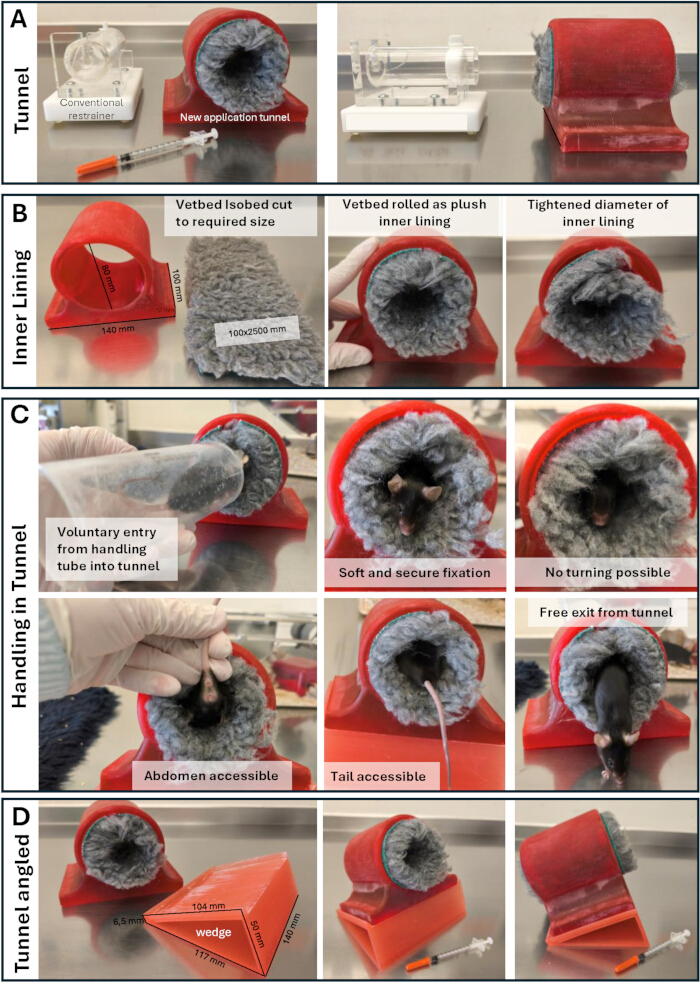
Figure 1: Novel application tunnel. (A) Representative images illustrating the size difference between a conventional restrainer and the novel application tunnel. (B) The inner lining of the tunnel consists of a cut-to-size piece of rolled Vetbed providing a soft, supportive, and dark environment. If mice are too small and tend to turn around, the rolled lining can be tightened to reduce the available space. (C) Different handling steps within the application tunnel, including entry and exit, safe and comfortable fixation, and access to the abdomen and tail. (D) An additional wedge for performing intraperitoneal injections within the tunnel. The wedge increases the tunnel's angle relative to the handler, facilitating easier access to the abdominal region. Please click here to view a larger version of this figure.
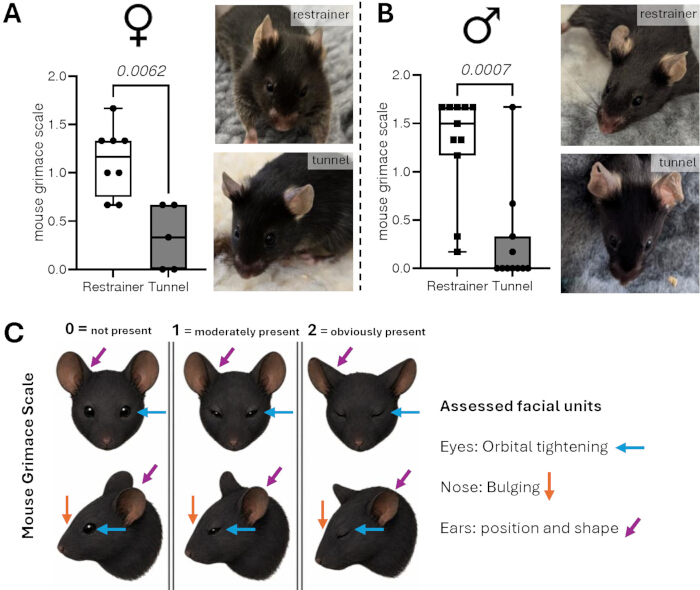
Figure 2: Mouse grimace scale after blood sampling from the tail vein. Male or female mice were subjected to blood sampling either inside the application tunnel or a conventional restrainer. Pictures to assess the mouse grimace scale were taken immediately after the animals exited the restrainer or tunnel and were later scored independently by two experienced experimenters, who were blinded to the mice's group allocation, and assessed orbital tightening, nose bulge, and ear position. An average score was calculated for each animal based on the two scores. (A) Female mice (tunnel n = 5; restrainer n = 8). (B) Male mice (tunnel n = 11; restrainer n = 11). This graph was adapted from Schlutt et al., 2026, PLOS ONE. The original data, published as a bar graph under a CC BY 4.0 license, has been modified and re-plotted here as a box-and-whisker plot. (C) Schematic illustration of the facial action units created from an author-developed text prompt using ChatGPT Image 2 (OpenAI; available from https://chatgpt.com/); the final image was reviewed and approved by the authors for scientific accuracy. Data are presented as box-and-whisker plots (min to max); the line indicates the mean. Mann-Whitney test, p-values < 0.05 were considered significant. Please click here to view a larger version of this figure.
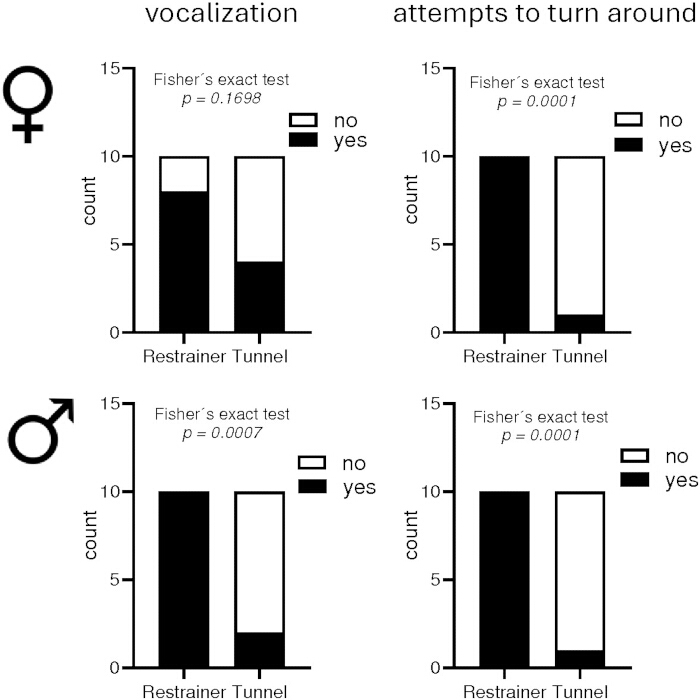
Figure 3: Audible vocalizations and attempts to turn around after intravenous injection. Male or female mice were subjected to intravenous injection of 100 µL 0.9% NaCl either inside the application tunnel or a conventional restrainer. Incidents of audible vocalization and attempts to turn around inside the restraining device were recorded during the procedure (yes/no). All groups n = 10. Data are presented as stacked bar contingency plots. Fisher’s exact test, p-values < 0.05 were considered significant. Please click here to view a larger version of this figure.
Supplementary Figure 1: Intraperitoneal injection in rats using a larger version of the application tunnel. An application tunnel with a 15 cm diameter was used for intraperitoneal injection in rats. The procedure was performed according to the same protocol as described for mice. Please click here to download this file.
Discussion
This restraint technique was developed for substance administration and blood sampling to support a best practice approach to animal welfare. Some scientific communities still remain reluctant to adopt refined handling and restraint methods that differ from long-established standardized procedures, particularly when they may require additional time and effort. However, reducing stress in laboratory animals is not only desirable from an animal welfare perspective, but also contributes substantially to experimental success by reducing data variability, minimizing stress-induced physiological alterations, and decreasing failed attempts and animal dropouts. This protocol presents an easy-to-implement method that significantly improves animal welfare while still providing secure restraint and hands-free access for safe application and sampling procedures.
A critical step in the protocol is ensuring successful entry into and stable positioning within the application tunnel. For voluntary entry, two possible approaches are recommended: either direct entry from the transfer tube into the tunnel or first placing the mice from the transfer tube onto the pre-positioned soft lining, from which they can enter the tunnel. The optimal approach depends on the animals’ behavior, and both methods should be evaluated. The preferred variant is the one in which the mice enter most rapidly and with the least reluctance. If mice hesitate to enter the tunnel, several factors should be considered: the entry opening may be too narrow, in which case the lining can be slightly compressed to enlarge the opening; (2) odor cues from the inner lining may influence acceptance, therefore linings should preferably retain familiar cage odor, while ensuring separation between experimental groups, cages and sexes, and replacing soiled material to avoid confounding odors; (3) mice have been shown to feel safer on surfaces with colors similar to their fur color14, therefore matching the lining color to the animals’ fur may be beneficial; and (4) positioning the tunnel opening toward the cage wall may encourage entry because mice can still see the home cage and cage mates. A potential limitation of the application tunnel is that it relies on voluntary entry by the animal, which could be perceived as introducing a short delay before treatment or sampling. However, in this study, mice entered the tunnel rapidly and consistently, typically within 2–10 s, allowing procedures to be performed within a narrow and reproducible time window. Although this approach may require slightly more time than conventional scruff restraint, the modest increase in handling time should be weighed against the substantial refinement in animal welfare achieved by reducing handling-associated stress. Moreover, insertion into conventional restrainers is also associated with handling time, as mice frequently resist placement, resulting in no relevant difference. In fewer than 5% of cases, mice did not voluntarily enter the tunnel. While the measures described above were generally sufficient to encourage entry, animals could also be gently assisted into the tunnel if necessary. Even in these cases, the soft inner lining provides a welfare advantage over conventional restrainers.
Once inside the tunnel, mice are able to securely grip the inner lining. This is highly favorable from an animal welfare perspective, as it has been shown that restrained mice exhibit lower stress levels when allowed to grip a surface during handling4. Simultaneously, the handler can securely hold the base of the tail without the mouse attempting to turn around. It is essential that the inner lining tightly surrounds the animal. If mice are too small and tend to rotate within the tunnel, rapid adjustments can be made by tightening the rolled lining or adding an additional layer. For experiments involving animals of different sizes (e.g., due to different age, sex, diet), tunnels with varying diameters can also be used (see print templates8).
Injections and blood sampling should always be performed by trained personnel. Still, the application tunnel was effective both for highly experienced personnel and for less experienced users. In particular, inexperienced personnel reported fewer unsuccessful attempts, thereby reducing repeated handling and prolonged procedures. Users also reported feeling more comfortable and secure when restraining mice in the tunnel compared with learning conventional hand fixation techniques. This represents a considerable advantage for laboratories with frequent personnel turnover, as the method is easy to adopt and benefits both the animals and the experimenter. These observations are in line with previously reported improvements in handling comfort and technician confidence associated with refined handling techniques such as tunnel and cup handling15.
Importantly, the method described here is effective even in untrained mice, and all results presented were obtained using animals without prior habituation. Previous studies have shown that habituation and medical training of the animals can reduce stress responses in mice by familiarizing them with planned procedures16,17. A training protocol incorporating the application tunnel may therefore further reduce stress levels, especially when frequent interventions are necessary, which might otherwise induce negative associations with the tunnel. Such a training program was successfully applied in a previous study, which allowed us to use the tunnel for repeated intraperitoneal injections over many weeks8. Particularly in studies requiring repeated injections, the tunnel may represent a major refinement. Refined handling techniques using transfer tubes and reduced restraint have been shown to maintain positive effects even after repeated scruff restraint or intraperitoneal injections, including increased willingness to interact with handlers and reduced anxiety-like behavior in standard behavioral tests18,19. Similarly, repeated injections performed within the tunnel did not increase stress-related parameters in mice8.
In line, food rewards have been shown to facilitate habituation through positive reinforcement, a well-established principle in animal training. Therefore, offering a small treat at the end of each handling session as a reward is recommended. When testing the tunnel, very small amounts, such as a single oat grain, were sufficient and are unlikely to interfere with the animals' normal diet. If food intake is a concern, for example, in metabolic studies, flavored treats compatible with specialized diets (e.g., ketogenic diets) are also available. Importantly, treats should be regarded as an additional refinement measure that enhances habituation rather than a prerequisite for successful use of the application tunnel. Once familiar with the system, mice also voluntarily entered the application tunnel repeatedly without receiving a food reward.
The method described here has certain limitations with respect to access to specific body regions. While the tail can be easily and safely accessed for intravenous injections and blood sampling, and the caudal abdominal region is suitable for intraperitoneal injections, access to the lateral body regions for subcutaneous applications is limited. Oral administration should also be considered carefully. Conventional oral gavage is not compatible with this system because the required neck extension cannot be achieved. However, more refined oral administration methods, in which mice voluntarily consume substances from a pipette tip (e.g., mixed with condensed milk)20, may be feasible through the open side of the tunnel. In such cases, it must be ensured that the head remains clearly visible and that the mouse is not positioned too deeply within the lining or tunnel to confirm complete ingestion of the substance.
Compared with existing restraint tunnels, the application tunnel described here offers clear advantages for animal welfare. Although restraint is often necessary for safe application and sampling procedures, it is also recognized as one of the greatest stressors rodents experience during experimental procedures7,21,22. Previous studies have already demonstrated that replacing traditional tail handling and restraint with refined methods such as tunnel or cup handling significantly improves animal welfare. Mice handled with these refined approaches display lower anxiety and greater willingness to interact with handlers than mice picked up by the tail23,24. Using the application tunnel, which is voluntarily entered by the mice, is a consistent extension of tunnel handling. The grimace scale of mice exiting the application tunnel indicates that the animals are not feeling restrained or trapped. Although the intraperitoneal injection method with the mice holding on to the cage grid resembles the described grip lifting the pelvic area5, the former is based on the animals’ fight to escape. On a grid, mice hold on with their paws and pull forward, away from the handlers’ grip, leading to restraint and thus distress. Additionally, this type of restraint increases abdominal muscle tone with subsequent promotion of pain by needle puncture. In contrast, the application tunnel represents a refined restraint method, and the results indicate reduced stress-associated parameters, including lower grimace scores, fewer audible vocalizations, and maintained willingness to interact with handlers811,12,13. Although ultrasonic vocalizations (USVs) are increasingly recognized as ethologically relevant communication signals, the use as markers of stress in adult mice remains under investigation, as USVs are highly context-dependent and also occur during normal physiological behaviors25.
Nevertheless, recent evidence suggests that USV recording may represent a promising, non-invasive, and reproducible approach to assess behavioral responses to restraint26. Incorporating USV recordings in future studies may therefore provide an additional objective measure to further characterize stress and emotional responses. Together, these findings indicate that the application tunnel enables a safer and less stressful restraint procedure for routine applications and sampling compared with conventional restrainers. Importantly, unlike clear acrylic restrainers, the soft inner lining allows mice to grip the surface securely, which is considered an important welfare refinement according to NC3Rs recommendations27. Markedly fewer attempts to turn around were observed inside the tunnel, improving both welfare and handling safety. In conventional plastic restrainers, attempts to turn around are often associated with urination, and the resulting wet fur further compromises comfort. This issue was largely eliminated with the application tunnel.
The potential applications of this method are extensive. Of note, the improved restraint method is not limited to mice but can also be applied to rats when using a tunnel with a bigger diameter (Supplementary Figure 1). Rodents are the most widely used laboratory animal species across scientific disciplines, and restraint for substance administration and sampling is a routine procedure in many laboratories. However, restraint stress has been shown not only to impair animal welfare, but also to significantly influence scientific outcomes, including behavioral responses28,29 and physiological mechanisms such as immune function30. Therefore, minimizing stress-related variability is essential for both scientific validity and ethical considerations in animal experimentation. By reducing restraint-associated stress while maintaining safe, practical handling, the application tunnel may substantially improve experimental quality and reproducibility while simultaneously enhancing animal welfare.
Disclosures
A.S., J.K.U., and L.H. own a utility model for the injection tunnel in Germany (Registration No. 20 2024 100 448). All other authors declare no conflicts of interest.
Acknowledgements
We thank our Charité animal facility staff and animal welfare officers, especially Dr. André Dülsner, for their support; Charité 3R for financial support for disseminating the application tunnel; and all members of the Charité 3R Refinement Taskforce for helpful discussions.
Materials
| Name | Company | Catalog Number | Comments |
|---|---|---|---|
| Allergy lancettes, sterile | Heinz Herenz Medizinalbedarf GmbH, Hamburg, Germany | 1110106 | |
| Application tunnel with optional wedge | In house 3D printed tunnel | print templates availabe at https://osf.io/vsjnb. | |
| Blood collection tubes: Microvette 100 EDTA K3E, 100 µL | SARSTEDT AG & Co. KG, Nümbrecht, Germany | 20.1278.100 | |
| Clear Handling tube | Datesand Group, Stockport, UK | GZCHTUBE-100 | size: 50 x 3 x 100 mm |
| Ethanol, ≥70% | Carl Roth GmbH + Co. KG, Karlsruhe, Germany | T913.1 | |
| Inject-F single-use fine dosage syringe 1 mL | B.Braun Deutschland GmbH & Co. KG, Melsungen, Germany | 9166017V | |
| Oats | Schapfen Mühle GmbH Co.KG, Ulm, Germany | W100197 | autoclaved |
| Sanitas SIL 06 infrared lamp | Beurer Europe GmbH, Ulm, Germany | 61424 | |
| Soft inner lining: Original Vetbed Isobed SL | Vetbed Deutschland, Mudersbach, Germany | 1999981 | cut to required sizes |
| Softasept ISO 70% disinfectant spray | B.Braun Deutschland GmbH & Co. KG, Melsungen, Germany | 19905 | |
| Sterican 27 G x ¾ sterile hypodermic needles for single use | B.Braun Deutschland GmbH & Co. KG, Melsungen, Germany | 4657705B | size: 0.40 mm x 20 mm |
| Swabs: FIWA app medical applicators | Fink & Walter GmbH, Merchweiler, Germany | 329012 |
References
- Joint Research Center (JRC-ISPRA). Summary report on statistical information on the use of animals for scientific purposes in the Member States of the European Union and Norway in 2023. Luxembourg: Publications Office of the European Union; 2026.
- European Parliament and Council of the European Union. Directive 2010/63/EU of 22 September 2010 on the protection of animals used for scientific purposes. Off J Eur Union. 2010;L276:33–79.
- Russell WMS, Burch RL. The principles of humane experimental technique. London: Methuen & Co. Ltd.; 1959.
- Labitt RN, Oxford EM, Davis AK, Butler SD, Daugherity EK. A validated smartphone-based electrocardiogram reveals severe bradyarrhythmias during immobilizing restraint in mice of both sexes and four strains. J Am Assoc Lab Anim Sci. 2021;60(2):201–12.
- Baek JM, Kwak SC, Kim JY, Ahn SJ, Jun HY, Yoon KH, et al. Evaluation of a novel technique for intraperitoneal injections in mice. Lab Anim (NY). 2015;44(11):440–4.
- Turner PV, Pekow C, Vasbinder MA, Brabb T. Administration of substances to laboratory animals: equipment considerations, vehicle selection, and solute preparation. J Am Assoc Lab Anim Sci. 2011;50(5):614–27.
- Meijer MK, Spruijt BM, van Zutphen LF, Baumans V. Effect of restraint and injection methods on heart rate and body temperature in mice. Lab Anim. 2006;40(4):382–91.
- Schlutt A, Riesner K, Kochan M, Mess AK, Jahn D, Lurje I, et al. A novel application tunnel in combination with medical training reduces stress induced by frequent intraperitoneal injections and blood draws in mice. PLoS One. 2026;21(5):e0341404.
- Onuma K, Watanabe M, Sasaki N. The grimace scale: a useful tool for assessing pain in laboratory animals. Exp Anim. 2024;73(3):234–45.
- Whittaker AL, Liu Y, Barker TH. Methods used and application of the mouse grimace scale in biomedical research 10 years on: a scoping review. Animals (Basel). 2021;11(3).
- Ruat J, Genewsky AJ, Heinz DE, Kaltwasser SF, Canteras NS, Czisch M, et al. Why do mice squeak. Toward a better understanding of defensive vocalization. iScience. 2022;25(7):104657.
- Ehret G. Schallsignale der Hausmaus (Mus musculus). Behaviour. 1974;52(1-2):38–56.
- Blanchard RJ, Hebert MA, Ferrari PF, Palanza P, Figueira R, Blanchard DC, et al. Defensive behaviors in wild and laboratory (Swiss) mice: the Mouse Defense Test Battery. Physiol Behav. 1998;65(2):201–9.
- Kawakami K, Xiao B, Ohno R, Ferdaus MZ, Tongu M, Yamada K, et al. Color preferences of laboratory mice for bedding materials: evaluation using radiotelemetry. Exp Anim. 2012;61(2):109–17.
- Davies JR, Purawijaya DA, Bartlett JM, Robinson ESJ. Impact of refinements to handling and restraint methods in mice. Animals (Basel). 2022;12(17).
- Leussis MP, Bolivar VJ. Habituation in rodents: a review of behavior, neurobiology, and genetics. Neurosci Biobehav Rev. 2006;30(7):1045–64.
- Ahlström T. Handling and training mice and rats: low stress procedures. London: National Centre for the Replacement, Refinement and Reduction of Animals in Research (NC3Rs); 2023.
- Henderson LJ, Dani B, Serrano EMN, Smulders TV, Roughan JV. Benefits of tunnel handling persist after repeated restraint, injection, and anesthesia. Sci Rep. 2020;10(1):14562.
- Gouveia K, Hurst JL. Improving the practicality of using non-aversive handling methods to reduce background stress and anxiety in laboratory mice. Sci Rep. 2019;9(1):20305.
- Krzyzaniak O, Steiner S, Nilsson FAM, Dietrich M, Kampfen L, Johansen P, et al. Applicability of the micropipette-guided drug administration (MDA) method for assessing reward-related behaviors in mice. Physiol Behav. 2025;299:114967.
- Cinelli P, Rettich A, Seifert B, Burki K, Arras M. Comparative analysis and physiological impact of different tissue biopsy methodologies used for the genotyping of laboratory mice. Lab Anim. 2007;41(2):174–84.
- Pare WP, Glavin GB. Restraint stress in biomedical research: a review. Neurosci Biobehav Rev. 1986;10(3):339–70.
- Hurst JL, West RS. Taming anxiety in laboratory mice. Nat Methods. 2010;7(10):825–6.
- Gouveia K, Hurst JL. Reducing mouse anxiety during handling: effect of experience with handling tunnels. PLoS One. 2013;8(6):e66401.
- Faure A, Pittaras E, Nosjean A, Chabout J, Cressant A, Granon S. Social behaviors and acoustic vocalizations in different strains of mice. Behav Brain Res. 2017;320:383–90.
- Yamauchi T, Yoshioka T, Yamada D, Hamano T, Ohashi M, Matsumoto M, et al. Cold-restraint stress-induced ultrasonic vocalization as a novel tool to measure anxiety in mice. Biol Pharm Bull. 2022;45(3):268–75.
- National Centre for the Replacement, Refinement and Reduction of Animals in Research (NC3Rs). Handling and restraint: General principles. London: NC3Rs; https://nc3rs.org.uk/3rs-resources/handling-and-restraint
- Lee EH, Park JY, Kwon HJ, Han PL. Repeated exposure to short-term behavioral stress resolves pre-existing stress-induced depressive-like behavior in mice. Nat Commun. 2021;12(1):6682.
- Mink D, Horvath D, Basler M. Protocol to study social transmission of stress in group-housed mice using restraint stress. STAR Protoc. 2025;6(4):104224.
- Ding JX, Rudak PT, Inoue W, Haeryfar SMM. Physical restraint of mouse models to assess immune responses under stress with or without habituation. STAR Protoc. 2021;2(4):100838.
Reprints and Permissions
This article has been published
Video Coming Soon