In this retrospective study of 125 patients with persistent HR-HPV infection and a spleen-deficiency pattern, WDT plus rhIFN-α-2b was associated with more favorable HPV-related, vaginal microecological, peripheral T-cell subset, and symptom outcomes than rhIFN-α-2b alone, without a significant difference in overall recorded adverse events.
Research Article
Retrospective Study of Wandai Decoction Plus Recombinant Human Interferon Alpha-2b in Persistent High-Risk Human Papillomavirus Infection
In This Article
Summary
Abstract
This retrospective study evaluated clinical outcomes associated with Wandai Decoction (WDT) plus recombinant human interferon α-2b (rhIFN-α-2b) in patients with persistent high-risk human papillomavirus (HR-HPV) infection and a spleen-deficiency pattern, with particular attention to vaginal microecology and peripheral T-cell subsets. Clinical data from 125 patients treated between March 2024 and September 2025 were analyzed. According to the treatment regimen, 57 patients received oral WDT plus rhIFN-α-2b vaginal suppositories, whereas 68 patients received rhIFN-α-2b alone. Both groups received three consecutive treatment courses. After treatment, the observation group had a higher total effective rate than the control group (89.47% vs. 72.06%, p = 0.015) and a shorter time to first HPV conversion (P = 0.028), whereas the overall four-category HPV outcome distribution (P = 0.060) and HPV16/18-specific conversion rate (P = 0.138) did not differ significantly. More favorable vaginal microecological findings included lower pH, leukocyte esterase positivity, and amine test positivity, along with higher rates of normal hydrogen peroxide status, vaginal cleanliness grade I–II, and Lactobacillus predominance (P < 0.05). Fungal detection, bacterial vaginosis-related abnormalities, and mixed infection were also less frequent (P < 0.05). Post-treatment CD4+ T-cell percentage and the CD4+/CD8+ ratio were higher, whereas CD8+ T-cell percentage was lower, in the observation group (P < 0.05). The total traditional Chinese medicine syndrome score, abnormal cervical color, and contact bleeding also showed more favorable findings. The overall rate of recorded adverse events did not differ significantly between groups (P = 0.057). WDT plus rhIFN-α-2b was associated with more favorable HPV-related, vaginal microecological, peripheral T-cell subset, and symptom outcomes; however, the retrospective design and residual confounding preclude causal interpretation.
Introduction
Cervical cancer is one of the common malignant tumors of the female reproductive system, and persistent high-risk human papillomavirus (HR-HPV) infection is an important basis for its occurrence and progression1. Epidemiological data showed that approximately 600,000 new cases of cervical cancer and 340,000 related deaths occurred worldwide in 20202. After persistent HR-HPV infection, the viral early proteins E6 and E7 may interfere with tumor suppressor-related pathways such as P53 and RB, promote uncontrolled proliferation of cervical epithelial cells, and thereby increase the risk of cervical intraepithelial lesions and cervical cancer3. Therefore, promoting HR-HPV clearance before cervical lesions develop remains an important step in reducing the risk of disease progression.
In clinical practice, recombinant human interferon α-2b (rhIFN-α-2b) is a commonly used topical antiviral drug for HR-HPV infection. Its action is not simply to kill the virus directly but to inhibit viral replication and persistent infection by inducing antiviral protein expression, enhancing cellular immune responses, and regulating inflammatory reactions4. Vaginal administration allows the drug to concentrate at cervical and vaginal lesions. It is relatively easy to perform, provides a high local drug concentration, and causes fewer systemic adverse reactions5. However, some patients still experience slow conversion to negative, persistent positivity, or recurrence after treatment. Repeated vaginal administration may also disturb the local microecological balance, leading to increased vaginal pH, reduced Lactobacillus predominance, weakened hydrogen peroxide production, and abnormalities in leukocyte esterase and sialidase. In more severe cases, it may increase the risk of vulvovaginal candidiasis, bacterial vaginosis (BV), and mixed infection6,7. Once the vaginal microecology becomes imbalanced, the mucosal barrier and local immune defense are weakened, making HPV clearance more difficult8.
Relevant traditional Chinese medicine (TCM) studies often interpret the clinical manifestations associated with persistent HR-HPV infection from the perspectives of dampness pathogen, abnormal leukorrhea, and insufficiency of healthy qi and usually relate them to increased leukorrhea, abnormal color and texture of discharge, fatigue, poor appetite, abdominal distension, and loose stools9. Wandai Decoction (WDT) is a commonly used gynecological formula. In this study, it was applied according to the pathogenesis of spleen deficiency with dampness accumulation and dysfunction of the Belt Vessel. Recent studies have shown that WDT can improve the vaginal flora structure in patients with vulvovaginal candidiasis of a spleen-deficiency and dampness-accumulation pattern, suggesting its potential role in regulating vaginal microecology10. From the perspective of modern pharmacology, the related medicinal components in the formula have anti-inflammatory and immunomodulatory effects and may improve the mucosal barrier and inhibit abnormal microbial growth. These effects may help restore local vaginal homeostasis, relieve leukorrhea symptoms, and improve the low immune response associated with persistent HR-HPV infection11.
The roles of rhIFN-α-2b and some Chinese medicinal preparations or herbal formulas in the treatment of HR-HPV infection have been reported12,13. Interferon mainly acts through local antiviral effects and immune activation, whereas WDT is intended to strengthen the spleen, resolve dampness, support healthy qi, eliminate pathogens, improve leukorrhea, and regulate microecology. Theoretically, the combination of the two is well matched. It may help reduce the unfavorable effects of topical medication alone on vaginal microecology, promote the recovery of Lactobacillus predominance, improve the imbalance of peripheral T lymphocyte subsets, and relieve spleen-deficiency leukorrhea-related syndromes at the same time. However, evidence directly supporting this view remains limited.
Based on this, the present study included patients with persistent HR-HPV infection of a spleen-deficiency pattern and compared WDT combined with rhIFN-α-2b with rhIFN-α-2b alone in terms of clinical efficacy, HPV outcomes, vaginal microecology, and other aspects, to provide clinical evidence for improving HR-HPV clearance, correcting vaginal microecological imbalance, relieving spleen-deficiency leukorrhea symptoms, and optimizing integrated Chinese and Western medicine treatment strategies.
Protocol
The study protocol was reviewed and approved by the Maternity and Child Healthcare Hospital of Changxing County (approval No. kyl1-1x-2023 (045)). Because this was a retrospective analysis of existing clinical records, the requirement for informed consent was waived. The research tools used in this protocol are listed in the Table of Materials.
1. Study subjects
Clinical data from patients with persistent high-risk human papillomavirus (HR-HPV) infection and a spleen-deficiency pattern treated at the Maternity and Child Healthcare Hospital of Changxing County from March 2024 to September 2025 were retrospectively collected. According to the actual treatment regimen, patients who received oral Wandai Decoction (WDT) in addition to recombinant human interferon α-2b (rhIFN-α-2b) treatment were assigned to the observation group (n = 57), whereas patients who received rhIFN-α-2b treatment alone were assigned to the control group (n = 68). All case data were obtained from outpatient electronic medical records, the laboratory information system, and other in-hospital databases.
2. Diagnostic and pattern differentiation criteria
Persistent HR-HPV infection was operationally defined as the detection of at least one identical HR-HPV genotype in two consecutive cervical specimens obtained at least 3 months apart before treatment. In patients with multiple infections, persistence was defined as the presence of at least one HR-HPV genotype at both time points14. Patients could have abnormal vaginal discharge, local cervical inflammatory manifestations, or abnormal cervical cytology; however, patients with high-grade cervical lesions or cervical malignancy requiring immediate surgery, physical treatment, or oncological management were not included.
Traditional Chinese medicine (TCM) pattern differentiation was performed according to the syndrome criteria for “leukorrhea disease” in the Guiding Principles for Clinical Research of New Chinese Medicines15. A spleen-deficiency pattern was diagnosed when at least two of the three major manifestations: increased leukorrhea, white or pale-yellow discharge, and thin discharge, were present together with at least one secondary manifestation, including a pale or sallow complexion, limb fatigue or edema, poor appetite, loose stools, or epigastric or hypochondriac discomfort, with compatible tongue and pulse findings. Pattern classification did not use a numerical total-score cutoff. For outcome assessment, the total TCM syndrome score comprised eight items—leukorrhea amount, color, consistency, complexion, limb fatigue or edema, appetite, stool consistency, and epigastric or hypochondriac discomfort—each scored from 0 – 3 according to prespecified severity criteria (Supplementary Table 1), yielding a total score of 0–24; higher scores indicated greater symptom severity.
3. Inclusion and exclusion criteria
Inclusion criteria were female patients aged 18–65 years; HR-HPV positivity before treatment and fulfillment of the definition of persistent infection; TCM pattern differentiation consistent with spleen-deficiency leukorrhea disease; treatment with rhIFN-α-2b alone or WDT combined with rhIFN-α-2b; availability of at least pre- and post-treatment HPV testing, vaginal microecological examination, TCM syndrome scoring, and efficacy evaluation data; and medical records and follow-up data sufficient for analysis of the main outcomes.
Exclusion criteria were pregnancy or lactation; high-grade cervical intraepithelial lesions, cervical cancer, or other cervical lesions requiring immediate surgical intervention; severe heart, liver, kidney, or hematopoietic system disease, malignant tumor, or immunodeficiency disease; recent use of immunosuppressants, glucocorticoids, or other drugs that could significantly affect immune function; concomitant use of other anti-HPV drugs, vaginal microecological preparations, antibacterial drugs, or other treatments that could affect efficacy evaluation during treatment; mental illness resulting in inability to cooperate with treatment or follow-up; and missing major observation indicators that prevented determination of HPV outcomes or clinical efficacy.
4. Treatment methods
The control group received rhIFN-α-2b vaginal suppositories. Before bedtime, the vulva and hands were cleaned, a film finger cot was worn, and the suppository was placed into the posterior vaginal fornix close to the cervix. Each rhIFN-α-2b treatment course comprised nine vaginal administrations given once every other day. Three consecutive courses, corresponding to 27 planned administrations in total, were prescribed. Patients with regular menstruation started medication on the third day after menstruation ended, and administration was suspended during menstruation. Patients with irregular menstruation used the medication according to the treatment cycle, with suspension during menstruation. Postmenopausal patients started treatment on the day after receiving the medication. During treatment, patients were advised to reduce the frequency of sexual intercourse and use condoms correctly. Efficacy was evaluated after three consecutive treatment courses.
The observation group received WDT in addition to the above treatment. The prescription comprised Codonopsis Radix (15 g), Atractylodis Macrocephalae Rhizoma (15 g), Dioscoreae Rhizoma (30 g), Paeoniae Radix Alba (10 g), Atractylodis Rhizoma (10 g), Plantaginis Herba (10 g), Schizonepetae Spica Carbonisata (5 g), Citri Reticulatae Pericarpium (5 g), Bupleuri Radix (10 g), and Glycyrrhizae Radix et Rhizoma (6 g). The herbal decoction pieces were supplied by the outpatient Chinese pharmacy of the Maternity and Child Healthcare Hospital of Changxing County. Each daily prescription was soaked in potable water for 30 min, with the water level approximately 2–5 cm above the herbs, and decocted twice after boiling, for 25 min during the first decoction and 20 min during the second. The two extracts were combined and adjusted to a final volume of 400 mL, with 200 mL taken in the morning and 200 mL in the evening. Crude-drug identity, dispensing weight, and prescription conformity were checked by licensed TCM pharmacists according to the hospital pharmacy standard operating procedure, and supplier/lot, preparation, and dispensing records were retained. Each course comprised 14 treatment days, and treatment continued for three courses, with administration suspended during menstruation. Adherence was assessed retrospectively from prescription and follow-up records. Completion of all three prescribed courses without a recorded premature treatment discontinuation was considered adherent, whereas protocol-defined suspension during menstruation was not considered nonadherence. Any premature discontinuation was retained as a separately recorded safety outcome.
5. Observation indicators
- Clinical efficacy and HPV outcomes
HR-HPV DNA detection and genotyping were performed using a commercial HPV genotyping assay. Polymerase chain reaction amplification was followed by flow-through hybridization. The assay detects HPV 6, 11, 16, 18, 31, 33, 35, 39, 42, 43, 44, 45, 51, 52, 53, 56, 58, 59, 66, 68, and 81. For this study, HR-HPV was defined as positivity for HPV 16, 18, 31, 33, 35, 39, 45, 51, 52, 56, 58, 59, 66, or 68.
Baseline cervical exfoliated-cell specimens were collected within 7 days before the first treatment course. Follow-up HPV testing was performed after each treatment course at approximately monthly intervals to determine the time to first conversion, and the final post-treatment specimen was collected approximately 4 weeks after completion of the third course. After excess cervical mucus was gently removed, a sterile cervical brush was inserted at the cervical os and rotated five times, then immediately placed in the supplied preservation medium. Specimens were labeled with a unique patient identifier and collection date, stored at 4 °C, and tested within 48 h. Baseline and follow-up specimens were processed in the same laboratory using the same assay, platform, and interpretation criteria.
Each run included assay-specified positive and negative controls together with an internal amplification control and biotin hybridization control, and results were accepted only when all required controls were valid. Specimens with a failed internal control or indeterminate hybridization pattern were re-extracted and retested. If repeat testing remained invalid, a new specimen was requested. The laboratory participated in the National Center for Clinical Laboratories external quality-assessment program for HPV genotyping during the study period. Study-group classification was performed retrospectively during data extraction and was therefore unavailable to laboratory personnel at the time of HPV result interpretation.
Post-treatment HR-HPV results were classified into four mutually exclusive categories: complete conversion to negative, partial conversion to negative, persistent positivity, or newly positive HPV genotype. In patients with multiple infections, complete conversion required all baseline HR-HPV genotypes to become undetectable; partial conversion required clearance of at least one but not all baseline genotypes; persistent positivity indicated continued detection of one or more baseline genotypes without detection of a new genotype; and, if any new HR-HPV genotype was detected at follow-up, the case was assigned to the newly positive category for the four-category analysis. The total effective rate was defined as the proportion of patients with complete or partial conversion. For patients positive for HPV16 and/or HPV18 at baseline, HPV16/18-specific conversion required the corresponding baseline HPV16/18 genotype or genotypes to become undetectable, irrespective of whether another HR-HPV genotype persisted. Time to first HPV conversion was calculated from treatment initiation to the first documented complete or partial conversion. - Physicochemical, enzymatic, and scoring indicators of vaginal microecology
Vaginal secretion samples were collected before and after treatment for vaginal microecological examination, including vaginal pH, hydrogen peroxide, leukocyte esterase, sialidase, amine test, and vaginal cleanliness. Nugent score16, Donders score17, and the determination of normal or disordered microecology were also extracted. According to the vaginal microecological reports, Lactobacillus predominance, fungal detection, Trichomonas detection, bacterial vaginosis (BV)-related abnormalities, and mixed infection were recorded. Recovery of Lactobacillus predominance after treatment was evaluated among patients without Lactobacillus predominance at baseline. The routine microecological examination classified Lactobacillus predominance without species-level identification and did not distinguish H₂O₂-producing from non-H₂O₂-producing strains. - Peripheral immune function indicators
Peripheral venous blood was collected before and after treatment. CD4+ and CD8+ T-cell percentages were measured by flow cytometry using a four-color T-cell subset reagent, and the CD4+/CD8+ ratio was calculated. - Local cervical signs and gynecological examination findings
Local cervical signs were extracted from gynecological examination records, including cervical columnar epithelial ectropion, abnormal cervical color, cervical hypertrophy, cervical polyps or neoplasm-like changes, and contact bleeding. - Improvement magnitude of major outcomes
The reductions in Nugent score, Donders score, and total TCM syndrome score were calculated. Recovery of Lactobacillus predominance was assessed among patients without Lactobacillus predominance at baseline, and microecological normalization was based on the final integrated classification in the routine vaginal microecological report.
6. Safety
Adverse reactions during and after treatment were extracted from medical records and follow-up records, including vaginal itching, vaginal burning sensation, and other symptoms. Laboratory-detected vaginal microecological abnormalities were not classified as adverse events unless a corresponding clinical diagnosis or symptom was documented in the medical or follow-up record.
7. Statistical methods
Statistical analyses were performed using statistical software. Quantitative data were first tested for normality. Normally distributed data were expressed as mean ± standard deviation, and between-group comparisons were performed using the independent-samples t test, whereas within-group comparisons before and after treatment were performed using the paired t test. Non-normally distributed data were expressed as median (interquartile range), and between-group comparisons were performed using the Mann–Whitney U test, whereas within-group comparisons before and after treatment were performed using the Wilcoxon signed-rank test. Count data were expressed as the number of cases and percentage, and between-group comparisons were performed using the χ2 test or Fisher’s exact test. Ranked data were analyzed using the rank-sum test.
To examine the robustness of the association between treatment and the total effective rate to measured baseline differences, a modified Poisson regression with robust variance was fitted, including treatment group, age, disease duration, body mass index, baseline number of HPV-positive genotypes, and baseline HPV16/18 status as covariates. Adjusted relative risks (RRs) and 95% confidence intervals (CIs) were reported. The post-treatment association between Lactobacillus predominance and normal hydrogen peroxide status was examined exploratorily using the χ2 test, with treatment-group-specific cross-tabulations used to assess consistency of direction. P < 0.05 was considered statistically significant.
Results
Comparison of baseline characteristics
Before treatment, no statistically significant differences were observed between the two groups in age, disease duration, body mass index (BMI), menstrual status, number of HPV-infected genotypes, or other baseline characteristics (P > 0.05; Table 1).
| Observation group (n=57) | Control group (n=68) | Statistic | P value | |
| Age (years) | 41.37±8.21 | 42.07±8.75 | t=-0.461 | 0.645 |
| Disease duration (months) | 14.82±5.76 | 15.26±6.14 | t=-0.410 | 0.682 |
| BMI (kg/m²) | 22.67±2.58 | 22.94±2.64 | t=-0.573 | 0.567 |
| Regular menstruation | 42 (73.68) | 50 (73.53) | χ2=0.120 | 0.942 |
| Irregular menstruation | 10 (17.54) | 13 (19.12) | ||
| Menopause | 5 (8.77) | 5 (7.35) | ||
| Single genotype infection | 36 (63.16) | 42 (61.76) | χ2=0.026 | 0.873 |
| Multiple genotype infection | 21 (36.84) | 26 (38.24) | ||
| HPV16/18 positive | 20 (35.09) | 25 (36.76) | χ2=0.038 | 0.846 |
| Number of HPV-positive genotypes | 1.39±0.53 | 1.41±0.58 | t=-0.259 | 0.796 |
| TCT NILM | 42 (73.68) | 50 (73.53) | χ2=0.000 | 1 |
| TCT ASC-US | 10 (17.54) | 12 (17.65) | ||
| TCT LSIL | 5 (8.77) | 6 (8.82) | ||
| Baseline vaginal pH | 5.18±0.43 | 5.22±0.45 | t=-0.489 | 0.626 |
| Baseline CD4+/CD8+ | 1.17±0.25 | 1.15±0.27 | t=0.441 | 0.66 |
| Baseline total TCM syndrome score (points) | 18.46±4.09 | 18.22±4.36 | t=0.309 | 0.758 |
Table 1: Baseline characteristics of the two groups. Baseline demographic and clinical characteristics of the observation and control groups, including age, disease duration, body mass index, menstrual status, HPV infection characteristics, cervical cytology findings, vaginal pH, CD4+/CD8+ ratio, and total traditional Chinese medicine syndrome score.
Comparison of clinical efficacy and HPV outcomes
After treatment, the total effective rate was higher in the observation group than in the control group (89.47% vs. 72.06%; χ2 = 5.878, P = 0.015), and the association remained after adjustment for measured baseline covariates (adjusted RR = 1.23, 95% CI 1.08–1.40, P = 0.002). Complete conversion to negative occurred in 66.67% and 45.59% of patients, respectively; however, the overall four-category HPV outcome distribution did not reach statistical significance (χ2 = 7.406, P = 0.060). The time to first HPV conversion was shorter in the observation group (P = 0.028), whereas the HPV16/18-specific conversion rate did not differ significantly between groups (70.00% vs. 48.00%, P = 0.138; Table 2). In exploratory analyses stratified by baseline HPV16/18 status, complete HR-HPV conversion occurred in 1/20 (5.00%) versus 0/25 (0.00%) HPV16/18-positive patients (Fisher’s exact P = 0.444) and in 37/37 (100.00%) versus 31/43 (72.09%) HPV16/18-negative patients (Fisher’s exact P < 0.001) in the observation and control groups, respectively. Most HPV16/18-positive infections were multiple-type infections at baseline (17/20 and 24/25, respectively; Supplementary Table 1).
| Observation group (n=57) | Control group (n=68) | Statistic | P value | |
| Total effective rate | 51 (89.47) | 49 (72.06) | χ2=5.878 | 0.015 |
| Complete conversion to negative | 38 (66.67) | 31 (45.59) | χ2=7.406 | 0.06 |
| Partial conversion to negative | 13 (22.81) | 18 (26.47) | ||
| Persistent positivity | 5 (8.77) | 15 (22.06) | ||
| Newly positive HPV genotype | 1 (1.75) | 4 (5.88) | ||
| HPV16/18 conversion to negative | 14/20 (70.00) | 12/25 (48.00) | χ2=2.204 | 0.138 |
| Time to first HPV conversion (months, effective cases) | 2.25±0.74 | 2.59±0.76 | t=-2.238 | 0.028 |
Table 2: Clinical efficacy and HPV outcomes after treatment. Post-treatment clinical efficacy and HPV outcomes in the observation and control groups, including complete conversion to negative, partial conversion to negative, persistent positivity, newly positive HPV genotype, total effective rate, HPV16/18-specific conversion, and time to first HPV conversion. The overall comparison across the four HPV outcome categories was χ2 = 7.406, P = 0.060.
Comparison of physicochemical and enzymatic indicators of vaginal microecology
Before treatment, no differences were observed in vaginal microecological examination results between the two groups (P > 0.05). After treatment, vaginal pH was lower in the observation group than in the control group (P < 0.001), and the reduction in vaginal pH was greater in the observation group (P = 0.004). In addition, the rate of normal hydrogen peroxide status and the proportion of vaginal cleanliness grade I–II were higher in the observation group than in the control group (P = 0.015 and P = 0.007, respectively), whereas leukocyte esterase positivity and amine-test positivity were lower (P = 0.022 and P = 0.026, respectively). The difference in sialidase positivity between the two groups was not statistically significant (P = 0.055; Table 3).
| Observation group (n=57) | Control group (n=68) | Statistic | P value | |
| Vaginal pH (before treatment) | 5.18±0.43 | 5.22±0.45 | t=-0.489 | 0.626 |
| Vaginal pH (after treatment) | 4.54±0.31 | 4.78±0.34 | t=-4.150 | <0.001 |
| Reduction in vaginal pH | 0.63±0.36 | 0.43±0.41 | t=2.906 | 0.004 |
| Normal hydrogen peroxide (before treatment) | 19 (33.33) | 21 (30.88) | χ2=0.086 | 0.77 |
| Normal hydrogen peroxide (after treatment) | 43 (75.44) | 37 (54.41) | χ2=5.950 | 0.015 |
| Leukocyte esterase positive (before treatment) | 41 (71.93) | 50 (73.53) | χ2=0.040 | 0.841 |
| Leukocyte esterase positive (after treatment) | 17 (29.82) | 34 (50.00) | χ2=5.226 | 0.022 |
| Sialidase positive (before treatment) | 31 (54.39) | 39 (57.35) | χ2=0.111 | 0.739 |
| Sialidase positive (after treatment) | 12 (21.05) | 25 (36.76) | χ2=3.673 | 0.055 |
| Amine test positive (before treatment) | 29 (50.88) | 35 (51.47) | χ2=0.004 | 0.947 |
| Amine test positive (after treatment) | 10 (17.54) | 24 (35.29) | χ2=4.934 | 0.026 |
| Vaginal cleanliness grade I-II (before treatment) | 18 (31.58) | 20 (29.41) | χ2=0.069 | 0.793 |
| Vaginal cleanliness grade I-II (after treatment) | 45 (78.95) | 38 (55.88) | χ2=7.394 | 0.007 |
Table 3: Vaginal physicochemical and enzymatic indicators before and after treatment. Comparison of vaginal pH, hydrogen peroxide status, leukocyte esterase positivity, sialidase positivity, amine-test positivity, and vaginal cleanliness grade before and after treatment in the observation and control groups.
Comparison of vaginal flora and pathogenic microorganism detection
After treatment, Lactobacillus predominance was more frequent in the observation group than in the control group (P = 0.008), whereas fungal detection, bacterial vaginosis (BV)-related abnormalities, and mixed infection were less frequent (P < 0.05). Trichomonas detection did not differ between groups (P = 0.500; Table 4). Across all patients, normal post-treatment hydrogen peroxide status was more frequent when Lactobacillus predominance was present than when it was absent (62/81 [76.54%] vs. 18/44 [40.91%]; χ2 = 15.714, P < 0.001). The same direction was observed in the observation group (84.09% vs. 46.15%) and the control group (67.57% vs. 38.71%).
| Observation group (n=57) | Control group (n=68) | Statistic | P value | |
| Lactobacillus predominance (before treatment) | 20 (35.09) | 22 (32.35) | χ2=0.104 | 0.747 |
| Lactobacillus predominance (after treatment) | 44 (77.19) | 37 (54.41) | χ2=7.055 | 0.008 |
| Fungal detection (before treatment) | 7 (12.28) | 9 (13.24) | χ2=0.025 | 0.874 |
| Fungal detection (after treatment) | 3 (5.26) | 12 (17.65) | χ2=4.503 | 0.034 |
| Trichomonas detection (before treatment) | 2 (3.51) | 3 (4.41) | Fisher | 1 |
| Trichomonas detection (after treatment) | 0 (0.00) | 2 (2.94) | Fisher | 0.5 |
| BV-related abnormalities (before treatment) | 30 (52.63) | 36 (52.94) | χ2=0.001 | 0.972 |
| BV-related abnormalities (after treatment) | 9 (15.79) | 23 (33.82) | χ2=5.295 | 0.021 |
| Mixed infection (before treatment) | 13 (22.81) | 16 (23.53) | χ2=0.009 | 0.924 |
| Mixed infection (after treatment) | 4 (7.02) | 14 (20.59) | χ2=4.633 | 0.031 |
Table 4: Vaginal flora and microorganism detection before and after treatment. Comparison of Lactobacillus predominance, fungal detection, Trichomonas detection, bacterial vaginosis-related abnormalities, and mixed infection before and after treatment in the observation and control groups.
Comparison of peripheral T-cell subset indicators
Before treatment, no between-group differences were observed in T-cell subset measures (P > 0.05). After treatment, the CD4+ T-cell percentage was higher in the observation group than in the control group (P = 0.006), the CD8+ T-cell percentage was lower (P = 0.024), and the CD4+/CD8+ ratio was higher (P < 0.001). The increase in CD4+ T cells, the decrease in CD8+ T cells, and the increase in the CD4+/CD8+ ratio were also greater in the observation group (P < 0.001, P = 0.004, and P < 0.001, respectively; Figure 1).
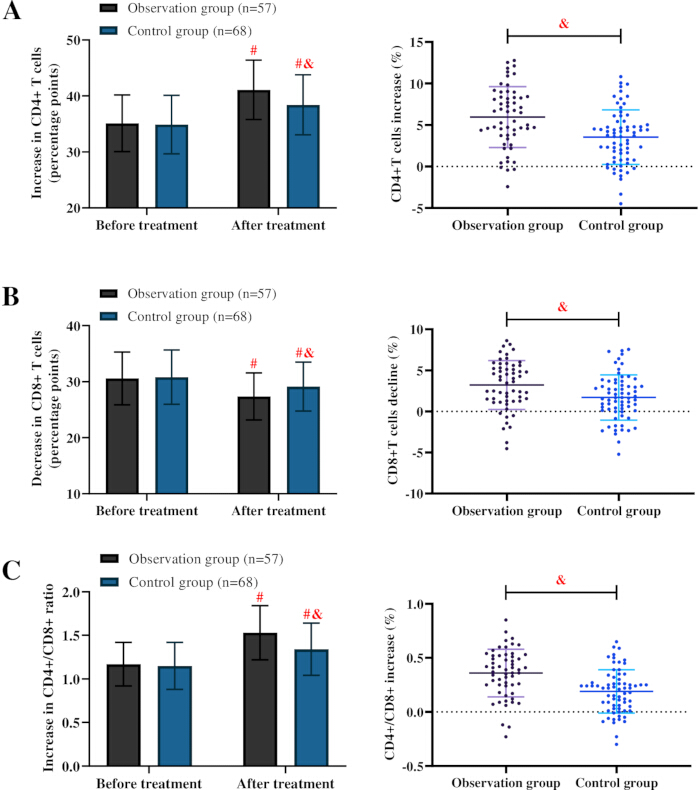
Figure 1: Peripheral T-cell subset measures before and after treatment. (A) CD4+ T-cell percentages before and after treatment and the corresponding increase. (B) CD8+ T-cell percentages before and after treatment and the corresponding decrease. (C) CD4+/CD8+ ratios before and after treatment and the corresponding increase. Changes in CD4+ and CD8+ T cells are expressed as percentage points, whereas changes in the CD4+/CD8+ ratio are unitless. #P < 0.05 versus the corresponding pretreatment value; &P < 0.05 versus the observation group. Please click here to view a larger version of this figure.
Comparison of local cervical signs and gynecological examination findings
After treatment, the incidences of abnormal cervical color and contact bleeding were lower in the observation group than in the control group (P = 0.015 and P = 0.038, respectively). No between-group differences were observed in cervical columnar epithelial ectropion, cervical hypertrophy, or cervical polyps/neoplasm-like changes (P > 0.05; Table 5).
| Observation group (n=57) | Control group (n=68) | Statistic | P value | |
| Cervical columnar epithelial ectropion (before treatment) | 34 (59.65) | 42 (61.76) | χ2=0.058 | 0.809 |
| Cervical columnar epithelial ectropion (after treatment) | 15 (26.32) | 27 (39.71) | χ2=2.492 | 0.114 |
| Abnormal cervical color (before treatment) | 46 (80.70) | 55 (80.88) | χ2=0.001 | 0.98 |
| Abnormal cervical color (after treatment) | 14 (24.56) | 31 (45.59) | χ2=5.950 | 0.015 |
| Cervical hypertrophy (before treatment) | 22 (38.60) | 25 (36.76) | χ2=0.044 | 0.833 |
| Cervical hypertrophy (after treatment) | 9 (15.79) | 19 (27.94) | χ2=2.634 | 0.105 |
| Cervical polyps/neoplasm-like changes (before treatment) | 5 (8.77) | 7 (10.29) | χ2=0.083 | 0.774 |
| Cervical polyps/neoplasm-like changes (after treatment) | 3 (5.26) | 5 (7.35) | Fisher | 0.726 |
| Contact bleeding (before treatment) | 26 (45.61) | 32 (47.06) | χ2=0.026 | 0.872 |
| Contact bleeding (after treatment) | 6 (10.53) | 17 (25.00) | χ2=4.326 | 0.038 |
Table 5: Local cervical examination findings before and after treatment. Comparison of cervical columnar epithelial ectropion, abnormal cervical color, cervical hypertrophy, cervical polyps or neoplasm-like changes, and contact bleeding before and after treatment in the observation and control groups.
Comparison of improvement magnitude in major outcomes
The reductions in Nugent score, Donders score, and total TCM syndrome score were greater in the observation group than in the control group (all P < 0.001). The recovery rate of Lactobacillus predominance and the rate of microecological normalization were also higher in the observation group (81.08% vs. 58.70%, P = 0.029; 70.18% vs. 50.00%, P = 0.022; Table 6).
| Observation group (n=57) | Control group (n=68) | Statistic | P value | |
| Reduction in Nugent score (points) | 3.21±1.68 | 2.16±1.55 | t=3.628 | <0.001 |
| Reduction in Donders score (points) | 3.05±1.44 | 2.03±1.37 | t=4.056 | <0.001 |
| Reduction in total TCM syndrome score (points) | 11.74±3.91 | 8.38±3.78 | t=4.865 | <0.001 |
| Recovery of Lactobacillus predominance | 30/37 (81.08) | 27/46 (58.70) | χ2=4.777 | 0.029 |
| Microecological normalization | 40 (70.18) | 34 (50.00) | χ2=5.226 | 0.022 |
Table 6: Additional change-score and microecological normalization outcomes. Comparison of reductions in Nugent score, Donders score, and total traditional Chinese medicine syndrome score, together with recovery of Lactobacillus predominance and microecological normalization, between the observation and control groups.
Safety and adverse reactions
During treatment, recorded adverse events occurred in 15/57 (26.32%) patients in the observation group and 29/68 (42.65%) patients in the control group; the between-group difference did not reach statistical significance (P = 0.057). Increased vaginal discharge, vulvovaginal candidiasis, and bacterial vaginosis were recorded less frequently in the observation group (P = 0.040, P = 0.034, and P = 0.049, respectively), whereas gastrointestinal discomfort was numerically more frequent (12.28% vs. 2.94%; Fisher’s exact P = 0.078). These individual comparisons should not be interpreted as evidence of an overall safety advantage (Table 7).
| Adverse reaction/safety indicator | Observation group (n=57) | Control group (n=68) | Statistic | P value |
| Vaginal itching | 6 (10.53) | 14 (20.59) | χ2=2.336 | 0.126 |
| Vaginal burning sensation | 4 (7.02) | 11 (16.18) | χ2=2.463 | 0.117 |
| Lower abdominal distension | 5 (8.77) | 12 (17.65) | χ2=2.079 | 0.149 |
| Increased vaginal discharge | 8 (14.04) | 20 (29.41) | χ2=4.218 | 0.04 |
| Abnormal vaginal bleeding | 1 (1.75) | 3 (4.41) | Fisher | 0.625 |
| Vulvovaginal candidiasis | 3 (5.26) | 12 (17.65) | χ2=4.503 | 0.034 |
| Bacterial vaginosis | 4 (7.02) | 13 (19.12) | χ2=3.864 | 0.049 |
| Gastrointestinal discomfort | 7 (12.28) | 2 (2.94) | Fisher | 0.078 |
| Treatment discontinuation | 1 (1.75) | 4 (5.88) | Fisher | 0.375 |
| Total adverse reactions | 15 (26.32) | 29 (42.65) | χ2=3.626 | 0.057 |
Table 7: Recorded adverse events during treatment. Comparison of recorded adverse events in the observation and control groups, including vaginal itching, vaginal burning sensation, lower abdominal distension, increased vaginal discharge, abnormal vaginal bleeding, vulvovaginal candidiasis, bacterial vaginosis, gastrointestinal discomfort, treatment discontinuation, and total adverse reactions.
Data Availability
The deidentified participant-level raw data supporting the conclusions of this study are provided in Supplementary File 1.
Supplementary Table 1: Scoring criteria for the traditional Chinese medicine syndrome score.
Scoring criteria for the eight items included in the total traditional Chinese medicine syndrome score. Each item is scored from 0–3 based on symptom severity, with higher scores indicating greater severity. Please click here to download this file.
Supplementary Table 2: Exploratory HPV outcomes stratified by baseline HPV16/18 status.
Exploratory comparison of HPV outcomes according to baseline HPV16/18 status. HPV16/18-negative patients had HR-HPV infection involving one or more of the other HR-HPV genotypes included in the assay. Individual non-16/18 genotype labels were not retained in the deidentified analytic dataset; therefore, type-specific clearance estimates for individual non-16/18 genotypes were not reconstructed. These analyses were exploratory. Please click here to download this file.
Supplementary File 1: The deidentified participant-level raw data for the protocol. Please click here to download this file.
Discussion
This retrospective study found that WDT plus rhIFN-α-2b was associated with more favorable HPV-related and routine vaginal microecological outcomes than rhIFN-α-2b alone, together with differences in peripheral T-cell subset measures, while the overall rate of recorded adverse events did not differ significantly between groups. These findings warrant further prospective evaluation of WDT as an adjunctive treatment and should be interpreted in light of the nonrandomized design and retrospective ascertainment of outcomes.
From a virological perspective, the higher total effective rate and shorter time to first conversion favored the observation group, but the overall four-category HPV outcome distribution did not differ statistically. The adjusted sensitivity analysis yielded a similar association for the total effective rate, although the retrospective design does not establish causality. This may be partly because rhIFN-α-2b, as a topical antiviral treatment, has shown clinical value, and studies of Chinese medicine combined with rhIFN-α-2b for cervical HPV infection or related lesions also suggest potential benefits for HPV clearance and immune-related indicators18,19. However, clearance of persistent HR-HPV infection does not depend entirely on topical antiviral therapy but is also affected by host immune status, cervical and vaginal local inflammation, and microecological stability20. Even with standardized interferon treatment, slow conversion to negative or persistent positivity may still occur because of impaired local barriers, chronic inflammation, or insufficient cellular immune responses21. Addition of WDT may improve the local environment in which interferon acts by correcting spleen deficiency with dampness accumulation, reducing abnormal leukorrhea, and decreasing local inflammatory irritation. Previous studies have reported that Chinese medicine combined with interferon can improve the clinical efficacy of HR-HPV infection treatment and improve abnormal vaginal discharge and related symptoms22,23, which is consistent with the present findings. The HPV16/18-specific conversion proportion was numerically higher in the observation group than in the control group, but the difference was not statistically significant. Most HPV16/18-positive patients had multiple-type infection at baseline; therefore, complete HR-HPV conversion in this subgroup depended on clearance of concomitant genotypes as well as HPV16/18. In the exploratory HPV16/18-negative subgroup, complete HR-HPV conversion was more frequent in the observation group; however, the study was not powered for genotype-stratified comparisons, no interaction analysis was prespecified, and individual non-16/18 genotype labels were unavailable in the deidentified analytic dataset. These subgroup findings should therefore be interpreted cautiously and do not establish differential efficacy by HPV genotype.
Vaginal microecological outcomes also showed greater improvement after treatment in the observation group. Vaginal Lactobacillus is a key component of vaginal microecological homeostasis and contributes to maintenance of an acidic environment through production of lactic acid, hydrogen peroxide, and antibacterial substances, thereby limiting excessive proliferation of opportunistic pathogens24. When pH increases or Lactobacillus decreases or loses function, the local barrier weakens, and the risk of bacterial vaginosis (BV)-related flora, fungal infection, and mixed infection increases; this may also provide conditions for persistent HPV infection25. The association between Lactobacillus predominance and normal hydrogen peroxide status was consistent in both treatment groups, supporting an internal relationship between these routine microecological indicators. However, the assay did not identify Lactobacillus species or strain-specific H₂O₂ production; therefore, these findings cannot demonstrate restoration of a specifically protective Lactobacillus community. Studies of WDT intervention for vaginitis and local vaginal symptoms have shown improvement in vaginal symptoms and regulation of the local environment26, consistent with the recovery of Lactobacillus predominance and improvement in microecology observed in the present study. Nevertheless, although the sialidase positivity rate showed a decreasing trend, the difference did not reach statistical significance. This may be related to BV severity, sampling time points, and detection-method sensitivity.
Changes in peripheral T-cell subsets should be interpreted as alterations in systemic immune composition rather than direct evidence of enhanced anti-HPV immunity. Although the observation group showed a higher post-treatment CD4+/CD8+ ratio and a greater decrease in peripheral CD8+ T-cell percentage, cytotoxic CD8+ T cells are important in antiviral responses, and a lower peripheral percentage is not inherently beneficial. HPV-specific T-cell function and cervical-vaginal mucosal immunity were not measured; therefore, the relationship between these peripheral changes and local viral clearance remains uncertain. The parallel changes in virological and peripheral immune measures should consequently be regarded as hypothesis-generating rather than evidence of a causal immune mechanism. The numerically lower overall rate of recorded adverse events in the observation group was not statistically significant and should not be interpreted as a protective effect of WDT. The lower frequency of several local vaginal events was directionally consistent with the routine microecological findings, whereas gastrointestinal discomfort was numerically more frequent in the observation group. However, ascertainment of adverse events depended on retrospective clinical documentation; therefore, under-recording of mild or transient events and differential documentation cannot be excluded. Prospective studies with predefined adverse-event surveillance are needed to clarify the safety profile.
Although the measured baseline characteristics were comparable and the sensitivity analysis adjusted for recorded baseline covariates, coital frequency, contraceptive method, partner HPV status, history of recurrent vaginitis, smoking, alcohol consumption, and other lifestyle factors were not consistently available in the retrospective records and could not be adjusted for. Residual confounding, therefore, remains possible, and the observed between-group associations should not be interpreted as causal treatment effects. In addition, individual non-16/18 genotype labels were not retained in the de-identified analytic dataset, thereby limiting more detailed type-specific clearance and persistence analyses. The follow-up duration was relatively limited and was insufficient to evaluate long-term sustained HPV negativity, recurrence rate, or progression of cervical lesions. Prospective, multicenter, large-sample studies with extended follow-up are needed to further verify these findings.
Conclusion:
In patients with persistent HR-HPV infection and a spleen-deficiency pattern, WDT plus rhIFN-α-2b was associated with more favorable HPV-related, vaginal microecological, peripheral T-cell subset, and symptom outcomes than rhIFN-α-2b alone. No significant between-group difference was observed in the overall rate of recorded adverse events. Because treatment allocation was nonrandom and several potential confounders were unavailable, these findings should be interpreted as associations and require prospective confirmation.
Disclosures
The author declares no conflicts of interest.
Acknowledgements
This study was supported by the Huzhou Municipal Science and Technology Bureau (Grant No. 2023GY58).
Materials
| Name | Company | Catalog Number | Comments |
|---|---|---|---|
| 21 HPV GenoArray Diagnostic Kit | HybriBio Ltd., Chaozhou, Guangdong, China | HBGA-21PKG | Multiple clinical lots, traceable in laboratory records |
| BD Multitest CD3 FITC/CD8 PE/CD45 PerCP/CD4 APC reagent | BD Biosciences | Cat. No. 340499 | Multiple clinical lots, traceable in laboratory records |
| Fast nucleic acid molecular hybridization instrument | HybriBio Ltd., Chaozhou, Guangdong, China | HMM-2 | Instrument model |
| Female Sample Collection Kit | HybriBio Ltd., Chaozhou, Guangdong, China | HBCK-F | Cervical exfoliated-cell collection |
| Flow cytometer | Mindray, Shenzhen, China | BriCyte E6 | Instrument model |
| HPV DNA Amplification Analyzer | Hangzhou Bioer Technology Co., Ltd., Hangzhou, China | TC-96/G/H6 | Instrument model |
| Recombinant human interferon α-2b vaginal suppository | Changchun Institute of Biological Products Co., Ltd. | 500,000 IU/piece | National Medicine Approval No. S19991019; multiple clinical lots, traceable in pharmacy records |
References
- Hewavisenti RV, Arena J, Ahlenstiel CL, Sasson SC. Human papillomavirus in the setting of immunodeficiency: Pathogenesis and the emergence of next-generation therapies to reduce the high associated cancer risk. Front Immunol. 2023;14:1112513. doi: 10.3389/fimmu.2023.1112513
- Singh D, et al. Global estimates of incidence and mortality of cervical cancer in 2020: a baseline analysis of the WHO Global Cervical Cancer Elimination Initiative. Lancet Glob Health. 2023;11(2):e197-e206.
- Basukala O, Banks L. The Not-So-Good, the Bad and the Ugly: HPV E5, E6 and E7 Oncoproteins in the Orchestration of Carcinogenesis. Viruses. 2021;13(10):1511. doi: 10.3390/v13101511
- Dalskov L, Gad HH, Hartmann R. Viral recognition and the antiviral interferon response. EMBO J. 2023;42(14):e112907. doi: 10.15252/embj.2022112907
- Tang Y, Tong Q, Dai N, Xu C. Evaluation of the clinical efficacy of vaginal treatment options for persistent high-risk human papillomavirus infection after excisional treatment of cervical high-grade squamous intraepithelial lesions: a systematic review and Bayesian network meta-analysis. Virol J. 2023;20(1):47. doi: 10.1186/s12985-023-01997-3
- Sharifian K, Shoja Z, Jalilvand S. The interplay between human papillomavirus and vaginal microbiota in cervical cancer development. Virol J. 2023;20(1):73. doi: 10.1186/s12985-023-02035-2
- Zeng M, et al. Roles of vaginal flora in human papillomavirus infection, virus persistence and clearance. Front Cell Infect Microbiol. 2022;12:1036869. doi: 10.3389/fcimb.2022.1036869
- Bautista J, Altamirano-Colina A, López-Cortés A. The vaginal microbiome in HPV persistence and cervical cancer progression. Front Cell Infect Microbiol. 2025;15:1634251. doi: 10.3389/fcimb.2025.1634251
- Ding W, Li X, Ji B, Wang Z. Functions of Traditional Chinese Medicine Combined with Recombinant Human Interferon α2b in Cervical Intraepithelial Neoplasias Patients. Evid Based Complement Alternat Med. 2021;2021:6881720. doi: 10.1155/2021/6881720
- Han Y, Shen S, Fu J, Ren Q. Mechanisms of Wandai Decoction in Improving Vaginal Flora of Vulvovaginal Candidiasis of the Spleen Deficiency and Excessive Dampness Type: A Study Based on Metagenomics and Metabolomics. Sichuan Da Xue Xue Bao Yi Xue Ban. 2025;56(1):68-73.
- You H, et al. Modulation of metabolic pathways and EndMT inhibition by a traditional Chinese herbal formula in the treatment of high-risk infections. Front Cell Infect Microbiol. 2024;14:1497965. doi: 10.3389/fcimb.2024.1497965
- He C, et al. Meta-analysis of the effect and safety of recombinant human interferon α-2b combined with Baofukang suppository in the treatment of HPV infection. Am J Transl Res. 2022;14(11):7632-7642.
- Wang ZZ, et al. Traditional Chinese Medicine Erhuang Suppository for Treatment of Persistent High-risk Human Papillomavirus Infection and Its Impact on Transcriptome of Uterine Cervix. Curr Med Sci. 2024;44(4):841-853.
- Perkins RB, et al. 2019 ASCCP Risk-Based Management Consensus Guidelines: Updates Through 2023. J Low Genit Tract Dis. 2024;28(1):3-6.
- Xiaoyu Z. Guiding principles for clinical research of new Chinese medicine. China Medical Science and Technology Press; 2002.
- Theiler T, et al. Bacterial vaginosis in pregnant women: A comparison of the Nugent Score with a multiplex PCR. Diagn Microbiol Infect Dis. 2024;110(1):116403. doi: 10.1016/j.diagmicrobio.2024.116403
- Zeng Z, et al. Characteristics and potential diagnostic ability of vaginal microflora in patients with aerobic vaginitis using 16S Ribosomal RNA sequencing. Diagn Microbiol Infect Dis. 2023;105(1):115806. doi: 10.1016/j.diagmicrobio.2022.115806
- Zhang S, Huang X, Liu X. Clinical efficacy of recombinant human interferon α-2b gel combined with LEEP conization in treating cervical intraepithelial neoplasia with comorbid high-risk HPV infection. Am J Transl Res. 2024;16(10):5649-5658.
- Ma K, et al. Network Meta-analysis of Chinese patent medicines combined with recombinant human interferon α-2b in treatment of cervical human papillomavirus infections. Zhongguo Zhong Yao Za Zhi. 2024;49(24):6784-6802.
- Schellekens HCJ, et al. Vaginal Microbiota and Local Immunity in HPV-Induced High-Grade Cervical Dysplasia: A Narrative Review. Int J Mol Sci. 2025;26(9):4321. doi: 10.3390/ijms26094321
- Lv Z, et al. Outcomes and associated factors of cervical human papillomavirus infection among 608 women in Shenzhen, China, 2018-2023. Front Public Health. 2024;12:1523839. doi: 10.3389/fpubh.2024.1523839
- Li X, et al. Jiawei Ermiao Granules (JWEMGs) clear persistent HR-HPV infection though improving vaginal microecology. J Ethnopharmacol. 2025;341:119342. doi: 10.1016/j.jep.2024.119342
- He N, et al. Clinical efficacy analysis of the Chinese medicine Paiteling applied to human papillomavirus infection: A retrospective study. PLoS One. 2024;19(12):e0315376. doi: 10.1371/journal.pone.0315376
- France M, et al. Towards a deeper understanding of the vaginal microbiota. Nat Microbiol. 2022;7(3):367-378.
- Frąszczak K, Barczyński B, Kondracka A. Does Lactobacillus Exert a Protective Effect on the Development of Cervical and Endometrial Cancer in Women? Cancers (Basel). 2022;14(19):4723. doi: 10.3390/cancers14194723
- Wu Y, Tang L. Efficacy Analysis of Wandai Decoction Combined with Traditional Chinese Medicine Fumigation and Washing in Patients with Chronic Vaginitis After Sintilimab Treatment for Small Cell Lung Cancer. Altern Ther Health Med. 2023;29(6):268-273.