The role of inflammatory cytokines in the prognosis of colorectal cancer (CRC) has been evaluated. However, the impact of perioperative changes on prognosis has not yet been evaluated. The aim was to investigate the correlation between postoperative–to–preoperative ratios of inflammatory cytokines and cancer‑specific survival (CSS) rates in patients with CRC who underwent curative resection. In this retrospective cohort study, patients with CRC who underwent radical resection between September 2019 and December 2020 were analyzed. The effects of the postoperative–to–preoperative ratios of inflammatory cytokines (including IFN–α, IFN–γ, IL–1β, IL–2, IL–4, IL–5, IL–6, IL–8, IL–10, IL–12p70, IL–17, and TNF–α) and six other clinical factors on cancer‑specific survival were assessed through univariate and multivariate Cox regression analyses. Survival curves were generated via Kaplan–Meier analysis. A total of 153 CRC patients who underwent radical resection were included in this study. Univariate analysis revealed that age (hazard ratio (HR) = 1.05, p = 0.031), tumor stage (HR = 3.61, p < 0.001), and the IL–1β ratio (HR = 1.00, p = 0.012) were significant prognostic factors. Multivariate analysis indicated that both the IL–1β ratio (adjusted HR = 1.05, p = 0.037) and tumor stage (adjusted HR = 3.83, p < 0.001) remained independent prognostic factors. Kaplan–Meier analysis confirmed the significant association between a high IL–1β ratio and poorer cancer‑specific survival. The postoperative–to–preoperative IL–1β ratio may serve as a potential prognostic biomarker for patients with CRC following radical resection, with higher ratios indicating poorer cancer‑specific survival; however, these exploratory findings require validation in prospective cohorts with standardized sampling protocols.
Research Article
High Postoperative-to-Preoperative IL-1β Ratio Links to Poor Survival in Colorectal Cancer
* These authors contributed equally
In This Article
Abstract
Introduction
Colorectal cancer (CRC) remains a significant global health challenge and ranks as the third most commonly diagnosed malignancy (6.1% of total cases), as well as the second leading cause of cancer–related deaths worldwide (9.2%)1. Although contemporary treatment strategies combining surgery with chemotherapy, radiotherapy, and targeted therapies have improved clinical outcomes, postoperative recurrence and metastasis continue to adversely affect survival, with 5–year survival rates lower than 13% for patients with advanced or recurrent disease being reported2,3. This persistent clinical challenge highlights the urgent need for reliable biomarkers that can accurately predict recurrence risk and guide personalized therapeutic decisions4.
The well–established association between chronic inflammation and carcinogenesis is supported by epidemiological evidence indicating that ~25% of malignancies arise from inflammatory conditions5. In CRC, the tumor microenvironment (TME) serves as a critical hub for disease progression, with inflammatory cytokines driving oncogenic processes, including proliferative signaling, epithelial–mesenchymal transition (EMT) induction, and immunosuppression6. Clinically, systemic inflammatory markers have emerged as prognostic indicators. For instance, elevated IL–6 levels are consistently correlated with adverse survival outcomes7,8. A prospective study by Brattinga B et al. involving 328 patients revealed that high IL–6 levels could serve as a prognostic factor for 3–year cancer‑specific survival in elderly patients with solid tumors following surgery9. Similarly, the abnormal expression of inflammatory mediators such as IL–8 has been shown to reflect tumor recurrence and metastatic risk10. Concurrently, elevated levels of the anti–inflammatory factor IL–10 have been observed to be associated with CRC liver metastases11. This clinical evidence collectively suggests that inflammatory factors may serve as potential prognostic biomarkers. However, a systematic examination of the relationship between the postoperative–to–preoperative inflammatory cytokine ratio and long–term cancer‑specific survival has not been reported.
Therefore, this research aimed to examine the relationship between perioperative inflammatory factor ratios and clinical outcomes in CRC patients, specifically by evaluating whether the postoperative–to–preoperative inflammatory factor ratio could predict long–term survival prognosis.
Protocol
This study was approved by the Ethics Committee of the First Affiliated Hospital of Chongqing Medical University (Approval No. 2025–420–01), with a waiver for informed consent due to the retrospective design. All data were de–identified and handled in compliance with the Declaration of Helsinki and China’s Ethical Review Measures for Biomedical Research Involving Human Subjects. Hospital information security protocols were strictly followed.
Patients
In this retrospective cohort study, CRC patients who underwent radical surgery at the First Affiliated Hospital of Chongqing Medical University between September 2019 and December 2020 were enrolled consecutively. The initial screening identified 429 patients using the hospital's electronic medical records system. After excluding 276 patients (193 due to incomplete follow–up information, including 11 with non‑cancer‑related mortality, and 83 lacking postoperative/preoperative IL–1β data), 153 eligible patients were ultimately included for analysis (Figure 1). The following inclusion criteria for patient enrolment were employed: (1) ≥18 years of age with histopathologically confirmed primary colorectal adenocarcinoma; (2) R0 radical resection; (3) no preoperative antitumor therapy; and (4) availability of complete clinicopathological and follow–up data. The following exclusion criteria for the patients were utilized: (1) active infection (C–reactive protein [CRP] level > 10 mg/L) or haematologic disorders; (2) neoadjuvant radiotherapy or chemotherapy prior to surgery; and (3) loss to follow–up or noncancer–related mortality during follow–up, as well as concurrent primary malignancies. The study protocol for this retrospective analysis was established in 2025. The clinical data and perioperative blood samples were originally collected as part of routine clinical care between September 2019 and December 2020. The retrospective analysis of these de–identified data was approved by the Ethics Committee of the First Affiliated Hospital of Chongqing Medical University (Approval No. 2025–420–01), which specifically covered the secondary use of the existing clinical and biological data for this research purpose.
Data collection
The retrospective data included the following variables: age, body mass index (BMI, calculated from height and weight), hospital stay, smoking status, alcohol consumption, and TNM stage (UICC 8th edition). Preoperative and postoperative cytokine profiling included serum concentrations of 12 cytokines (IFN–α, IFN–γ, IL–1β, IL–2, IL–4, IL–5, IL–6, IL–8, IL–10, IL–12p70, IL–17, and TNF–α), which were quantified by using flow cytometry during the perioperative period. Follow–up data included cancer‑specific survival (CSS), which was defined as the interval from surgery to cancer‑related death or last follow‑up; non‑cancer‑related deaths were excluded during screening to isolate tumor-specific mortality, and all recorded deaths in the final cohort were cancer‑related. The final follow–up visit occurred on June 30, 2025.
Statistical analysis
All of the statistical analyses in this study were conducted using SPSS (version 22.0). Continuous data are presented as medians with interquartile ranges (IQRs), whereas categorical variables are expressed as counts and percentages. To evaluate prognostic factors, this research initially performed univariate Cox regression analyses. Variables demonstrating an association with outcomes at p < 0.1 were entered into a multivariate Cox proportional hazards model to further adjust for potential confounders. This model captured the effects of the postoperative–to–preoperative IL–1β ratio and other clinical characteristics on cancer‑specific survival, with the results reported as hazard ratios (HRs) and 95% confidence intervals (CIs). Finally, survival outcomes were compared across groups stratified by the IL–1β ratio, which was dichotomized at the 90th percentile of its distribution in the overall cohort (cutoff value = 5.35). Kaplan–Meier curves were generated, and the log–rank test was applied to assess statistical differences. A two–sided P value less than 0.05 indicated statistical significance.
Results
Patient characteristics
The baseline characteristics of the 153 CRC patients who underwent radical resection are detailed in Table 1. The cohort had a median age of 66 years (IQR: 17) and a median BMI of 23.1 kg/m2 (IQR: 4.7). Current smokers comprised 39.9% (n = 61) of the patients, whereas 31.4% (n = 48) reported alcohol consumption. The tumor staging distribution was as follows: stage I, 22.2% (n = 34); stage II, 47.1% (n = 72); stage III, 22.9% (n = 35); and stage IV, 7.8% (n = 12). The median hospitalization duration was 8 days (IQR: 3).
Perioperative inflammatory factor ratio
The medians and interquartile ranges (IQRs) of the postoperative–to–preoperative ratios for the measured inflammatory factors are provided in Table 2. The analysis revealed that IL–6 was most strongly elevated after the operation (median ratio = 7.23, IQR = 28.31), followed by IL–10 (median ratio = 2.13, IQR = 4.18). In contrast, the median ratios of IFN–γ (median ratio = 0.89, IQR = 1.99), IL–12p70 (median ratio = 0.88, IQR = 0.91), IL–17 (median ratio = 0.82, IQR = 0.97), and TNF–α (median ratio = 0.87, IQR = 1.69) were less than 1.0, thereby indicating postoperative decreases. Notably, IL–1β, IL–2 and IL–8 levels remained relatively stable, with median ratios of 1.00 being reported (IQRs = 0.79, 0.95, and 1.96, respectively).
Univariate and multivariate Cox regression analysis models
Univariate Cox proportional hazards regression analysis revealed several clinical parameters significantly associated with long–term survival. Specifically, patient age (HR = 1.05, 95% CI = 1.00–1.10, p = 0.031), tumor stage (HR = 3.61, 95% CI = 2.18–6.00, p < 0.001), IFN–α (HR = 1.00, 95% CI = 1.00–1.00, p = 0.023) and the IL–1β ratio (HR = 1.00, 95% CI = 1.00–1.01, p = 0.012) demonstrated statistically significant associations (p < 0.05). Additionally, TNF–α (HR = 1.00, 95% CI = 1.00–1.00, p = 0.076) met the predetermined significance threshold (p < 0.1).
Variables with p values < 0.1 in the univariate analysis (age, hospital stay, tumor stage, IFN‑α_ratio, IL‑1β_ratio, and TNF‑α_ratio; total 21 events) were subsequently included in the multivariate regression model. The IL‑1β ratio was modeled as a continuous linear term without transformation in both analyses. After adjusting for potential confounders, the multivariate analysis results confirmed that both the IL–1β ratio (adjusted HR = 1.05, 95% CI = 1.00–1.10, p = 0.037) and tumor stage (adjusted HR = 3.83, 95% CI = 2.27–6.46, p < 0.001) retained independent prognostic value (significance threshold p < 0.05). Each 1–unit increase in the IL–1β ratio was associated with a 5% increase in mortality risk (HR = 1.05, 95% CI = 1.00–1.10, p = 0.037). The univariate HR of 1.00 (95% CI 1.00–1.01) reflects rounding to two decimal places (actual β ≈ 0.004), and the change to 1.05 in the multivariate model is attributable to confounder adjustment rather than any inconsistency in model specification. Notably, although IFN–α (p = 0.023) and patient age (p = 0.031) demonstrated statistical significance in the univariate analysis, they failed to maintain significance in the multivariate model. Furthermore, none of the other inflammatory markers demonstrated statistically significant prognostic value in either analysis. Detailed statistical results are provided in Table 3.
Impact of the Il-1β ration on cancer-specific survival
The Kaplan–Meier analysis of patients stratified via the IL–1β ratio (dichotomized at the 90th percentile cutoff of 5.35, as shown in Figure 2) revealed a sustained survival advantage for the low–ratio group (<5.35; n = 136) compared with the high–ratio group (≥5.35; n = 17) (log–rank p = 0.026), with curves that progressively diverged. These numbers decreased to 121 and 12, respectively, at the 40–month follow–up (corresponding to 16 deaths in the low–ratio group and 5 deaths in the high–ratio group). A total of 21 cancer‑related deaths occurred during follow‑up; non‑cancer‑related deaths were excluded per the study criteria and were not counted in the endpoint. To further address potential stage–related confounding, this research performed an additional post–hoc cancer‑specific survival analysis restricted to stage I–III patients (n = 141, 16 deaths). In this subgroup, the adjusted HR for the IL–1β ratio was 1.04 (95% CI 0.99–1.10, p = 0.11), indicating a consistent but not statistically significant trend, likely reflecting reduced statistical power due to the smaller number of events.
DATA AVAILABILITY:
The data that support the findings of this study are available on request from the corresponding author. The de-identified data are available in Supplementary Table 1, and the source code is available in Supplementary File 1.
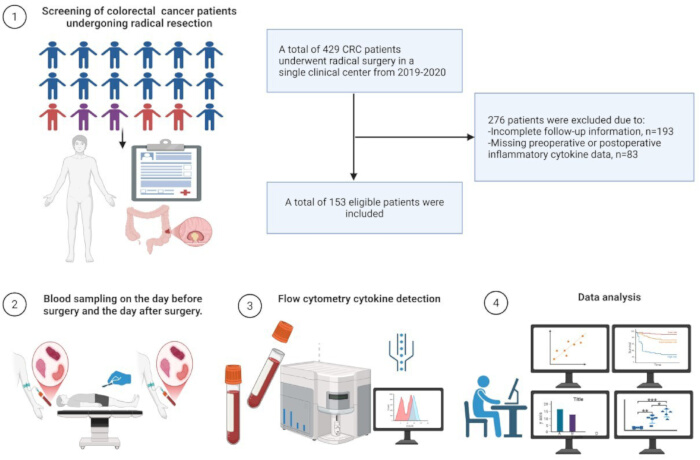
Figure 1: Flowchart of patient selection and data analysis. A total of 429 patients with colorectal cancer (CRC) who underwent radical resection were initially screened. After excluding 276 patients (193 with incomplete follow‑up, including 11 with non‑cancer‑related mortality, and 83 lacking preoperative or postoperative IL‑1β data), 153 patients were included in the final analysis. This figure is created with Microsoft PowerPoint (Microsoft 365). Copyright 2025 The Author(s). This is an original figure created by the authors. All rights reserved. Abbreviation: IL-1β = interleukin‑1 beta. Please click here to view a larger version of this figure.
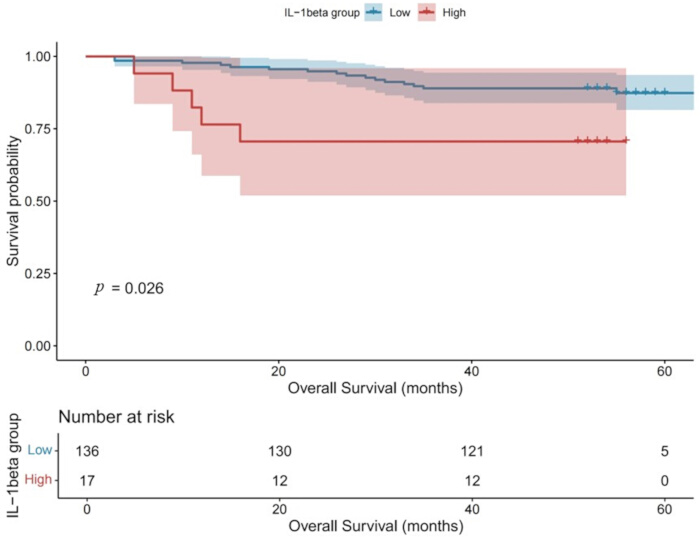
Figure 2: Kaplan–Meier analysis of cancer‑specific survival in CRC patients (n = 153) stratified by the postoperative‑to‑preoperative IL‑1β ratio. The ratio was dichotomized at the 90th percentile cutoff of 5.35: high‑ratio group (≥5.35, n = 17) versus low‑ratio group (<5.35, n = 136). The log‑rank test yielded p = 0.026, indicating a significant survival advantage for the low‑ratio group. Shaded areas represent 95% confidence intervals (CI). Abbreviations: IL-1β = interleukin‑1 beta; CRC = colorectal cancer. Please click here to view a larger version of this figure.
| Factors | n = 153 |
| Age, year | 66 (17) |
| BMI, kg/m2 | 23.1 (4.7) |
| Smoking | 61 (39.9%) |
| Drinking | 48 (31.4%) |
| Tumour stage | |
| I | 34 (22.2%) |
| II | 72 (47.1%) |
| III | 35 (22.9%) |
| IV | 12 (7.8%) |
| Hospital stays, days | 8 (3) |
Table 1: Baseline information of the total cohort. Variables are expressed as the median (IQR = Q3–Q1) or n (%). Abbreviations: BMI = body mass index; IQR = interquartile range.
| Variable | Median | IQR |
| IFN–α_ratio | 1.02 | 1.81 |
| IFN–γ_ratio | 0.89 | 1.99 |
| IL–10_ratio | 2.13 | 4.18 |
| IL–12p70_ratio | 0.88 | 0.91 |
| IL–17_ratio | 0.82 | 0.97 |
| IL–1β_ratio | 1 | 0.79 |
| IL–2_ratio | 1 | 0.95 |
| IL–4_ratio | 0.85 | 2.23 |
| IL–5_ratio | 1.06 | 1.17 |
| IL–6_ratio | 7.23 | 28.31 |
| IL–8_ratio | 1 | 1.96 |
| TNF–α_ratio | 0.87 | 1.69 |
Table 2: Perioperative inflammatory factor ratio. Note: IQR denotes the difference between Q3 and Q1. Abbreviations: IQR = interquartile range; IFN–β = interferon–beta; IFN–γ = interferon–gamma; IL–1β = interleukin–1 beta; TNF–α = tumor necrosis factor–alpha; IL–2_ratio = postoperative–to–preoperative IL–2 ratio.
| Variable | Univariate analysis | Multivariate analysis | |||
| HR (95% CI) | p value | HR (95% CI) | p value | ||
| Age | 1.05 (1.00–1.10) | 0.031 | 1.04 (0.99–1.09) | 0.09 | |
| BMI | 0.95 (0.83–1.09) | 0.471 | |||
| Smoking | 0.92 (0.38–2.23) | 0.858 | |||
| Alcohol | 1.12 (0.45–2.78) | 0.805 | |||
| Tumour stage | 3.61 (2.18–6.00) | < 0.001 | 3.83 (2.27–6.46) | < 0.001 | |
| Hospital stay | 1.03 (1.00–1.06) | 0.079 | 1.03 (0.99–1.07) | 0.151 | |
| IFN–α_ratio | 1.00 (1.00–1.00) | 0.023 | 0.98 (0.96–1.01) | 0.254 | |
| IFN–γ_ratio | 1.00 (0.98–1.02) | 0.981 | |||
| IL–10_ratio | 0.99 (0.96–1.02) | 0.524 | |||
| IL–12p70_ratio | 0.97 (0.83–1.13) | 0.683 | |||
| IL–17_ratio | 0.92 (0.77–1.11) | 0.385 | |||
| IL–1β_ratio | 1.00 (1.00–1.01) | 0.012 | 1.05 (1.00–1.10) | 0.037 | |
| IL–2_ratio | 0.91 (0.72–1.16) | 0.451 | |||
| IL–4_ratio | 1.00 (0.99–1.01) | 0.955 | |||
| IL–5_ratio | 0.98 (0.92–1.04) | 0.524 | |||
| IL–6_ratio | 1.00 (1.00–1.00) | 0.614 | |||
| IL–8_ratio | 0.99 (0.94–1.04) | 0.593 | |||
| TNF–α_ratio | 1.00 (1.00–1.00) | 0.076 | 1.00 (0.99–1.00) | 0.323 | |
Table 3: Cox regression analysis for cancer‑specific survival values. Abbreviations: HR = hazard ratio; 95% CI, 95% confidence interval. Bold values are statistically significant (p < 0.1) or marginally significant (p < 0.05). The multivariate model included six covariates: age, hospital stay, tumor stage, IFN‑α_ratio, IL‑1β_ratio, and TNF‑α_ratio. The IL‑1β ratio was entered as a continuous linear term without logarithmic transformation.
Supplementary Table 1: Raw data. De-identified dataset used in the study .Please click here to download this file.
Supplementary File 1: Source code. The source code used in the study. Please click here to download this file.
Discussion
To the knowledge, this is the first study to analyze postoperative/preoperative inflammatory factor ratios in relation to survival outcomes among patients who underwent radical resection of CRC. Analysis of 12 inflammatory factors revealed that a high postoperative-to-preoperative IL–1β ratio was significantly associated with poorer survival. Inflammation plays a significant role in shaping the development of CRC. Consequently, the expression of inflammatory factors in CRC has attracted considerable attention from researchers. Previous studies examining single time points have revealed that inflammatory factors such as IL–612,13, IL–814, and IL–1011are associated with tumor prognosis. However, Amicarella et al.15 reported no correlation between IL–17 levels and tumor prognosis in their study involving more than 1,000 CRC patients. Although single–time–point testing is simple and practical, multiple factors may influence the expression of inflammatory factors. To avoid confounding effects on predictive efficacy, this retrospective study enrolled 153 patients who underwent radical resection for CRC and focused on postoperative/preoperative inflammatory factor ratios to explore their predictive value.
The findings revealed significantly elevated levels of inflammatory factors after surgery, including IL–6 and IL–10, whereas the levels of IFN–γ, IL–12p70, IL–17, and TNF–α were decreased. Perioperative stable inflammatory factors included IL–1β, IL–2, and IL–8. The postoperative elevation of these factors may be attributed to their heightened sensitivity and intensity in response to surgical procedures, anesthesia, and stress, thereby explaining their widespread use in systemic inflammatory monitoring. However, this study revealed no correlation between these elevated factors and tumor prognosis. IL–1β levels remained relatively stable during the perioperative period. Both univariate and multivariate Cox regression analyses suggested that the postoperative-to-preoperative IL‑1β ratio may be an independent prognostic factor for survival, although this finding should be interpreted with caution, given the limited number of events. Survival analysis further revealed that higher IL–1β ratios were associated with poorer outcomes. These findings suggest the significant potential of the postoperative/preoperative IL–1β ratio for predicting the prognosis of CRC patients.
As a core regulatory factor of inflammatory responses, IL–1β plays a pivotal role in CRC development through multiple pathological processes, including tumor remodeling, immune evasion, angiogenesis, metastasis, and chemotherapy resistance16,17,18,19. A previous study conducted by Dan Nicolae Florescu et al. revealed that compared with healthy individuals, patients with CRC exhibit significantly higher serum IL–1β levels20, thereby indicating its role in CRC diagnosis and prognosis prediction. Marko Vukovic et al.21 reported via immunohistochemical analysis that IL–1β protein expression demonstrates significant prognostic value in bladder cancer tissues. Moreover, Gurcan Tunali et al. demonstrated that IL–1β maintains self–reinforcing mechanisms via the NF–κB and STAT3 signaling pathways, thus promoting the development of an inflammatory environment in triple–negative breast cancer and advancing tumor progression22. This study further suggests that an elevated postoperative-to-preoperative peripheral blood IL‑1β ratio may be associated with CRC cancer‑specific survival, but this association requires validation in larger cohorts. Although this indicator may be influenced by perioperative inflammatory status and other nontumor confounders, the results still suggest the potential of IL‑1β as a prognostic marker, but this should be confirmed in appropriately powered studies. Additionally, the human monoclonal antibody known as canakinumab, which targets IL–1β, has demonstrated antitumor efficacy in clinical trials. For example, the CANTOS trial revealed that this antibody could significantly reduce the incidence of lung cancer23; additionally, IL–1β blockade could significantly reduce the tumor load in the lungs and could also be used as an alternative therapy to existing K–ras–mutant lung adenocarcinoma treatment24, which also provides a new idea for IL–1β inhibition–based CRC treatment strategies.
Notably, Huihui Xiang et al.25demonstrated that IFN–α promotes CRC progression by upregulating NK2R gene expression, which is correlated with poor patient outcomes. However, the univariate Cox regression analysis revealed that elevated postoperative IFN–α levels remained significantly associated with survival, suggesting that this cytokine may contribute to CRC development. However, after adjusting for clinical variables in the multivariate Cox regression analysis, this correlation lost statistical significance. Recent studies have indicated that IFN–α is a potential immunotherapy adjuvant; specifically, it induces PD–1 expression in melanoma cells26 and enhances the immune response27. Moreover, the blockage of IFN–α eliminates the efficacy of anti–PD–1 treatment28. The actual functional state of the IFN–α signaling pathway likely outweighs changes in relative concentration, thereby indicating that isolated IFN–α measurements are insufficient for reliable assessment of CRC prognosis. Therefore, further investigations are needed to elucidate the specific mechanisms of IFN–α in CRC and its potential value as a prognostic biomarker.
However, there were several limitations in this study. Critically, the total number of deaths was only 21, and the multivariate model included six covariates, yielding an events–per–variable (EPV) ratio of approximately 3.5, which is well below the generally recommended threshold of 10. Furthermore, the cutoff value for dichotomizing the IL–1β ratio was derived from the same dataset without external validation, which may lead to overoptimistic estimates of prognostic performance and a substantial risk of overfitting. Moreover, although this research used CSS as the endpoint to isolate cancer‑specific mortality, CSS is not the ideal endpoint for this predominantly early‑stage cohort (69.3% stage I–II) because it excludes non‑cancer deaths and thus limits comparability with standard cancer‑specific survival analyses; DFS/RFS would have been statistically preferable, but recurrence data were not captured in the retrospective registry, preventing such an analysis. The post–hoc stage I–III subgroup analysis (n = 141, 16 events) showed a directionally consistent but non–significant HR of 1.04 (95% CI 0.99–1.10, p = 0.11), which reinforces the limited power of the current dataset. This limited statistical power, together with the small number of events in the high–risk subgroup (n = 5), implies that the findings should be interpreted as exploratory and hypothesis–generating rather than definitive, and require validation in larger independent cohorts.
Additionally, several important determinants of postoperative inflammation and long‑term survival—including adjuvant chemotherapy, surgical approach, MSI status, degree of surgical trauma, anesthesia methods, and antibiotic usage—were not recorded or adjusted for in this retrospective analysis. Because these factors may influence both the IL‑1β ratio and patient outcomes, this research cannot exclude substantial residual confounding, and the observed association cannot be confidently attributed to the IL‑1β ratio itself. First, neither preoperative nor postoperative blood samples were collected at fixed, standardized time points relative to the surgical procedure, and the actual time intervals were not consistently recorded in the retrospective dataset. Because perioperative cytokine levels are highly time‑dependent and the ratio is the primary exposure, this lack of standardization directly compromises the validity and comparability of the IL‑1β ratio across patients; no statistical adjustment can adequately correct for this intrinsic measurement error, and this variability may have substantially affected the prognostic estimate. Given the limited sample size and incomplete time‑interval records, this research was unable to conduct a reliable sensitivity analysis of time heterogeneity, which it acknowledges as a notable limitation. Future prospective studies with predefined postoperative sampling windows are warranted to confirm the reproducibility and clinical utility of the findings. Second, key influencing factors, such as the degree of surgical trauma29, anesthesia methods30, and antibiotic usage31,32, were not stratified in the analysis, thereby limiting a comprehensive assessment of their relationship with prognosis. Finally, the single–centre, retrospective design and relatively small sample size may introduce selection bias, thus affecting the generalizability of the study results. Future large–scale, multicentre prospective studies are warranted to validate the findings, further elucidate the prognostic significance of these inflammatory biomarkers, and enhance the robustness and clinical applicability of the conclusions.
These findings suggest a potential exploratory association between the postoperative–to–preoperative IL‑1β ratio and survival in radically resected CRC patients. However, due to the single-center retrospective design, the absence of adjustment for key perioperative confounders (including surgical trauma, anesthesia, antibiotics, adjuvant therapy, and MSI status), and the lack of recurrence data (which precluded a DFS/RFS analysis), this association cannot be confidently attributed to the IL‑1β ratio itself. Prospective multicentre studies with comprehensive covariate collection and standardized sampling protocols are essential to validate these preliminary observations.
Disclosures
The authors have no conflict of interest to declare.
AUTHORS’ CONTRIBUTIONS:
Donghui Gao and Zhenzhou Chen contributed to data collection. Jie Zhang contributed to data collection and figure preparation. Zongyue Zeng contributed to data collection. Xingye Wu and Li Zeng contributed to conceptualization, data analysis, manuscript review, and supervision. Donghui Gao wrote the original draft of the manuscript. All authors reviewed and approved the final manuscript.
Acknowledgements
This work was supported by Chongqing Science and Technology Bureau Natural Science Foundation Project (Grant No. cstc2020jcyj–msxmX0360); The Senior Medical Talents Program of Chongqing for Young and Middle–aged (Chongqing, China), the Chongqing Health Commission, and the Chongqing Science and Technology Committee (Grant No. 2020GDRC009, Chongqing, China); The Chongqing Municipal Health Commission’s Bayu Young Qihuang Scholars Support Program.
Materials
| Name | Company | Catalog Number | Comments |
|---|---|---|---|
| Multiplex cytokine detection kit | [Please provide manufacturer] | [Please provide catalog no.] | Detection of IFN-alpha, IFN-gamma, IL-1beta, IL-2, IL-4, IL-5, IL-6, IL-8, IL-10, IL-12p70, IL-17, and TNF-alpha |
| Serum blood collection tubes | [Please provide manufacturer] | [Please provide catalog no.] | Preoperative and postoperative serum collection |
| Flow cytometer | [Please provide manufacturer] | [Please provide model/catalog no.] | Cytokine quantification by flow cytometry |
| Centrifuge | [Please provide manufacturer] | [Please provide model/catalog no.] | Serum preparation, if applicable |
| SPSS Statistics, version 22.0 | IBM Corp. | Version 22.0 | Statistical analysis |
| Electronic medical records system | [Please provide manufacturer/system name] | N/A | Patient screening and retrospective clinical data retrieval |
References
- Bray F, Laversanne M, Sung H, Ferlay J, Siegel RL, Soerjomataram I, et al. Global cancer statistics 2022: GLOBOCAN estimates of incidence and mortality worldwide for 36 cancers in 185 countries. CA Cancer J Clin. 2024;74(3):229-263.
- Fan A, Wang B, Wang X, Zhang Y, Liu H, Li J. Immunotherapy in colorectal cancer: current achievements and future perspective. Int J Biol Sci. 2021;17(14):3837-3849.
- Leowattana W, Leowattana P, Leowattana T. Systemic treatment for metastatic colorectal cancer. World J Gastroenterol. 2023;29(10):1569-1588.
- Sawicki T, Ruszkowska M, Danielewicz A, Niedźwiedzka E, Arłukowicz T, Przybyłowicz KE, et al. A review of colorectal cancer in terms of epidemiology, risk factors, development, symptoms, and diagnosis. Cancers (Basel). 2021;13(9):2025.
- Taniguchi K, Karin M. IL-6 and related cytokines as the critical lynchpins between inflammation and cancer. Semin Immunol. 2014;26(1):54-74.
- Long AG, Lundsmith ET, Hamilton KE. Inflammation and colorectal cancer. Curr Colorectal Cancer Rep. 2017;13(4):341-351.
- Cheng E, Shi Q, Shields AF, Nixon AB, Shergill A, Ma C, et al. Association of inflammatory biomarkers with survival among patients with stage III colon cancer. JAMA Oncol. 2023;9(3):404-413.
- Feng S, Li Z, Liu M, Wang Y, Chen H, Zhang L. Postoperative serum interleukin-6 levels correlate with survival in stage I-III colorectal cancer. BMC Gastroenterol. 2023;23(1):156.
- Brattinga B, Rutgers A, De Haan JJ, Van der Wal BC, Van der Laan L, De Bock GH, et al. Preoperative inflammatory markers as a predictor of three-year cancer‑specific survival in older cancer patients undergoing oncologic surgery. Cancers (Basel). 2021;13(8):1824.
- Park JW, Chang HJ, Yeo HY, Han YD, Cho YB, Kim HC, et al. The relationships between systemic cytokine profiles and inflammatory markers in colorectal cancer and the prognostic significance of these parameters. Br J Cancer. 2020;123(4):610-618.
- Avisar A, Cohen M, Aharon A, Brenner B, Barshack I, Ron I, et al. Positive affect and fatigue as predictors of anti-inflammatory IL-10 concentrations among colorectal cancer patients during adjuvant chemotherapy. J Psychosom Res. 2023;167:111162.
- Hung CH, Lee TL, Huang AY, Chen YC, Shih LY, Chang YJ, et al. A positive regulatory feedback loop between EKLF/KLF1 and TAL1/SCL sustaining the erythropoiesis. Int J Mol Sci. 2021;22(15):8024.
- Lu CC, Kuo HC, Wang FS, Jou MJ, Wu CC, Chang CH, et al. Upregulation of TLRs and IL-6 as a marker in human colorectal cancer. Int J Mol Sci. 2014;16(1):159-177.
- Pecqueux M, Brückner F, Oehme F, Weitz J, Rahbari NN, Distler M, et al. Preoperative IL-8 levels as prognostic indicators of overall survival: an extended follow-up in a prospective cohort with colorectal liver metastases. BMC Cancer. 2024;24(1):90.
- Amicarella F, Muraro MG, Hirt C, Cremonesi E, Padovan E, Mele V, et al. Dual role of tumor-infiltrating T helper 17 cells in human colorectal cancer. Gut. 2017;66(4):692-704.
- Pretre V, Papadopoulos D, Regard J, Pelletier M, Borges da Silva H. Interleukin-1 (IL-1) and the inflammasome in cancer. Cytokine. 2022;153:155850.
- Malik A, Kanneganti TD. Function and regulation of IL-1α in inflammatory diseases and cancer. Immunol Rev. 2018;281(1):124-137.
- Zhang Z, Chen Y, Pan X, Wang L, Liu S, Li Q, et al. IL-1β mediates Candida tropicalis-induced immunosuppressive function of MDSCs to foster colorectal cancer. Cell Commun Signal. 2024;22(1):408.
- Zhou J, Tulotta C, Ottewell PD. IL-1β in breast cancer bone metastasis. Expert Rev Mol Med. 2022;24:e11.
- Florescu DN, Boldeanu MV, Șerban RE, Biciușcă V, Ciurea ME, Gheonea IA, et al. Correlation of the pro-inflammatory cytokines IL-1β, IL-6, and TNF-α, inflammatory markers, and tumor markers with the diagnosis and prognosis of colorectal cancer. Life (Basel). 2023;13(12):2261.
- Vukovic M, Chamlati JM, Hennenlotter J, Stenzl A, Todenhöfer T, Bedke J, et al. Interleukin-1β/Interleukin (IL)-1-receptor-antagonist (IL1-RA) axis in invasive bladder cancer—an exploratory analysis of clinical and tumor biological significance. Int J Mol Sci. 2024;25(4):2447.
- Tunali G, Yanik H, Ozturk SC, Acikgoz E, Demir K, Yilmaz D, et al. A positive feedback loop driven by fibronectin and IL-1β sustains the inflammatory microenvironment in breast cancer. Breast Cancer Res. 2023;25(1):27.
- Lee JM, Tsuboi M, Kim ES, Besse B, Ahn MJ, Rizvi NA, et al. Overcoming immunosuppression and pro-tumor inflammation in lung cancer with combined IL-1β and PD-1 inhibition. Future Oncol. 2022;18(27):3085-3100.
- Yuan B, Clowers MJ, Velasco WV, Zhou L, Wang H, Zhang Y, et al. Targeting IL-1β as an immunopreventive and therapeutic modality for K-ras-mutant lung cancer. JCI Insight. 2022;7(11):e157788.
- Xiang H, Toyoshima Y, Shen W, Wang X, Murayama T, Suzuki H, et al. IFN-α/β-mediated NK2R expression is related to the malignancy of colon cancer cells. Cancer Sci. 2022;113(8):2513-2525.
- Holzgruber J, Martins C, Kulcsar Z, Schmidinger M, Berghoff AS, Zielinski CC, et al. Type I interferon signaling induces melanoma cell-intrinsic PD-1 and its inhibition antagonizes immune checkpoint blockade. Nat Commun. 2024;15(1):7165.
- Sharif E, Nezafat N, Ahmadi FM, Mohit E. In silico design of CT26 polytope and its surface display by ClearColi-derived outer membrane vesicles as a cancer vaccine candidate against colon carcinoma. Appl Biochem Biotechnol. 2024;196(12):8820-8847.
- Chen J, Sun HW, Yang YY, Wang Y, Li X, Zhang H, et al. Reprogramming immunosuppressive myeloid cells by activated T cells promotes the response to anti-PD-1 therapy in colorectal cancer. Signal Transduct Target Ther. 2021;6(1):4.
- Takakura Y, Hinoi T, Egi H, Shimizu T, Ohdan H, Suzuki H, et al. Procalcitonin as a predictive marker for surgical site infection in elective colorectal cancer surgery. Langenbecks Arch Surg. 2013;398(6):833-839.
- Huh J, Hwang W. The role of anesthetic management in lung cancer recurrence and metastasis: a comprehensive review. J Clin Med. 2024;13(22):6681.
- Mutavhatsindi H, Manyelo CM, Snyders CI, Malherbe ST, Walzl G, Chegou NN, et al. Baseline and end-of-treatment host serum biomarkers predict relapse in adults with pulmonary tuberculosis. J Infect. 2024;89(1):106173.
- Eckmann C, Aghdassi SJS, Brinkmann A, Kresken M, Meyer E, Naber KG, et al. Perioperative antibiotic prophylaxis—indications and modalities for the prevention of postoperative wound infection. Dtsch Arztebl Int. 2024;121(7):233-242.