This study optimizes the Loop-mediated isothermal amplification (LAMP) assay using activated carbon and bentonite to detect pathogenic Vibrio species in seafood. This pretreatment effectively removes reaction inhibitors, yielding significantly faster, more sensitive, and cost-effective diagnostics compared to conventional methods.
Research Article
Increased Sensitivity Loop-Amplification Using Activated Carbon and Bentonite for the Detection of Vibrio spp. in Fishery Products
In This Article
Summary
Abstract
The Vibrio genus has more than 100 species, of which 12 are considered pathogenic for humans; species most frequently isolated in food are V. cholerae, V. parahaemolyticus, V. vulnificus, and V. alginolyticus. The main problem of identifying them through conventional microbiological methods is the high costs and long-term diagnosis. Loop-mediated isothermal Amplification (LAMP) was used for the identification of V. cholerae, V. parahaemolyticus, V. vulnificus, and V. alginolyticus. Activated carbon with bentonite (ACB) was used to remove inhibitors, improving the sensitivity of the test; pH 6, 7, and 9 were tested, as well as different contact times between the sample and ACB. The LAMP sensitivity method was improved when activated carbon and bentonite were used to remove reaction inhibitors in samples of shrimp, fish, and oyster. LAMP sensitivity, negative predictive value, positive predictive value, and LAMP specificity were equal to or greater than 90% for all samples tested. The LAMP method could be an alternative to identify V. cholerae, V. parahaemolyticus, V. vulnificus, and V. alginolyticus in fishery products due to faster application, higher sensitivity, and lower costs than the standard method.
Introduction
Species of the Vibrio genus are widely distributed in marine environments and may be associated with fish, mollusks, or crustaceans in a way that can be either pathogenic or commensal. It has been reported that 12 species can be pathogenic for humans, with Vibrio cholerae, V. parahaemolyticus, V. vulnificus, and V. alginolyticus revealing a higher frequency of isolation in fishery products. In the United States, health authorities estimate that Vibrio spp. cause more than 80,000 infections per year1,2,3,4,5. The isolation of Vibrio spp. is achieved through conventional methods that involve pre-enrichment, culture in selective media, and confirmation by biochemical and serological tests6,7. These conventional methods are limited by the prolonged time required to isolate the pathogen (up to 5 days) and their lack of resolving power, which often fails to accurately differentiate closely related species within the Vibrio genus due to similar phenotypic and biochemical profiles6,7,8.
Alternatively, Loop-mediated isothermal amplification (LAMP) has been reported as a rapid, accurate, and inexpensive molecular technique for the identification of pathogens9,10. This method is highly cost-effective and faster than conventional PCR, as it does not require sophisticated equipment like thermocyclers9. The LAMP method allows, in a single step, the detection of the target gene by observing turbidity in the reaction tube caused by the precipitation of magnesium pyrophosphate because it is a stable reaction product at 65 °C, the temperature used in the LAMP technique, so that the increase in turbidity correlates with the amount of DNA synthesized, avoiding the use of agarose gels and transilluminators11,12,13,14,15.
The sensitivity detection of these pathogens can be improved by the elimination of reaction inhibitors like proteases, calcium ions, glycogen, and lipids that can inhibit Bst polymerase or bind to the DNA target, avoiding amplification13,16,17,18,19,20. It has been reported that the combination of activated carbon with bentonite (ACB) has high efficiency in eliminating amplification inhibitors, therefore increasing the sensitivity of Escherichia coli detection in oyster samples, decreasing costs because ACB is cheaper than using commercial kits21.
In this work, we propose to optimize the LAMP method by using activated carbon and bentonite to increase the sensitivity in the identification of V. cholerae, V. parahaemolyticus, V. vulnificus, and V. alginolyticus directly from fishery products. This optimized method provides practical guidance for routine monitoring and quality control in the food industry, being highly applicable for the rapid diagnosis of pathogens, avoiding the lengthy pre-enrichment stages. Regarding its expected performance, the method demonstrates excellent sensitivity (greater than 98%) and specificity (100%) in matrices such as fish and shrimp. However, a key limitation to consider is that in highly contaminated samples from origin, such as oysters, the ACB system cannot completely eliminate all interfering organic matter, which can slightly decrease the sensitivity of the assay (94%–98%).
Protocol
This study did not involve human or vertebrate animal subjects; therefore, institutional ethical approval was not required. The reagents and the equipment used are listed in the Table of Materials.
1. Bacterial strains used and extraction of DNA
The Vibrio cholerae no O1 CECT 55, V. parahaemolyticus ATCC 17802, V. vulnificus ATCC 29037, and V. alginolyticus ATCC 17749 strains were grown in brain heart infusion (BHI) broth with 2% NaCl at 37 °C for 24 h. The strains of Escherichia coli ATCC 25922, Cronobacter sakazakii ATCC 12868, Listeria monocytogenes ATCC 49594, and Salmonella Typhimurium ATCC 14028 were cultured in BHI broth without sodium chloride at 37 °C for 24 h to be used as negative controls in the tests. For DNA extraction, an overnight culture was centrifuged at 16,000 x g for 6 min at 25 °C in a centrifuge. The supernatant was carefully decanted to avoid disturbing the cell pellet, and the pellet was thoroughly resuspended by pipetting in 500 μL of TAE buffer solution (Tris-acetic acid-EDTA, pH 8). The suspension was boiled for 6 min to lyse the cells, then immediately cooled on ice for 5 min. A final centrifugation was performed to pellet cellular debris, yielding a clear supernatant containing the extracted DNA, which was subsequently used as a template to amplify by LAMP22,23.
2. LAMP procedure
The primers used in LAMP (Table 1) were tested to corroborate the specificity in the identification of V. cholerae, V. parahaemolyticus, V. vulnificus, and V. alginolyticus. The identification of each Vibrio species using LAMP was performed in reaction tubes by preparing a final volume of 25 μL of the mixture containing: 1.6 μM of each of the primers, 1.4 mM of a mixture of dNTP, 6 mM MgSO4, 800 mM of betaine, 8 U of Bst DNA polymerase, and 5 μL of template DNA. The reaction mixture was gently mixed and incubated in a water bath at 65 °C for 60 min. After the incubation time, the amplification products were separated on a 1.5% agarose gel. The amplification products were then stained using 1 μL of a fluorescent DNA dye diluted 1:100 and revealed using a blue light transilluminator. Another technique to determine if the test was positive in the identification of the pathogen involved adding 4 μL of hydroxynaphthol blue (HNB, 125 μM) to the reaction tubes and observing the color change with the naked eye. A positive test was indicated by the formation of a blue color, and a negative one by a violet color24. Escherichia coli ATCC 25922, Cronobacter sakazakii ATCC 12868, Listeria monocytogenes ATCC 49594, and Salmonella Typhimurium ATCC 14028 were used as negative controls for the LAMP method. The amplifications obtained in LAMP were separated on an agarose gel and observed using a transilluminator. The resulting images were acquired and digitized using the MS 1D Analysis Software.
3. Treatment of samples of oysters, shrimp, and fish for the elimination of Vibrio spp. naturally present in the samples
Ten oyster samples, 10 shrimp samples, and 10 fish samples with an approximate weight of 200 g each were acquired. To remove naturally occurring Vibrio cells, the previously published methodology21 was followed. Fifty grams (50 g) of each sample was weighed and mechanically homogenized in a paddle blender at 260 rpm for 1 min, producing a uniform tissue suspension, which was then stored at -70 °C for 72 h. Subsequently, the samples were completely thawed using a 40 °C water bath, and the samples were washed with 300 mL of saline phosphate buffer solution (0.85% NaCl, pH 9). To ensure that the previous procedure had successfully eliminated Vibrio in the samples, the pre-enrichment methodology indicated in chapter 9 of the Bacteriological Analytical Manual of the Food and Drug Administration7 was performed. The saline solution containing the sample was replaced by 450 mL of alkaline peptone water (APW, pH 9). Serial dilutions were then meticulously prepared in APW up to a 10⁻3 dilution and incubated for 24 h. Finally, an aliquot from each tube was streaked onto a selective medium of thiosulfate-citrate-bile salts-sucrose (TCBS) agar and incubated for 24 h at 37 °C to visually confirm the absence of characteristic Vibrio colonies. All tests were performed in triplicate.
4. Preparation of activated carbon with bentonite (ACB) and evaluation of cellular recovery
To determine the conditions where ACB is most efficient in absorbing inhibitors present in samples of fishery products while maintaining minimal absorption of target cells, the published methodology21 was followed to establish the optimal pH and contact time between ACB and food samples. Activated carbon was thoroughly washed with distilled water and dried at 55 °C. Subsequently, 32.6 g of activated carbon was mixed with 3.04 g of bentonite, stirred continuously at 150 rpm for 24 h to ensure uniform distribution, dried at 55 °C, and sterilized, resulting in a fine, homogeneous dry ACB powder. To evaluate cellular recovery after mixing Vibrio cells with the activated carbon-bentonite (ACB) mixture, strains were grown separately in BHI broth with 2% NaCl until reaching a cell density of 1.5 x 10⁴ CFU/mL. Then, 1 mL of each Vibrio strain was inoculated separately into 100 mL of phosphate buffer (PBS, 0.85% NaCl, adjusted to pH 4, 6, and 9). The bacterial suspension was then combined with 4.6 g of the pre-prepared ACB and left to stir at 150 rpm for 15, 30, and 60 min to facilitate contact. After each designated contact time, a 0.1 mL aliquot was carefully separated, spread-plated onto TCBS agar, and incubated at 37 °C for 24 h before performing the colony count.
5. Evaluation of the detection limit of V. cholerae, V. parahaemolyticus, V. vulnificus, and V. alginolyticus in oysters, shrimp, and fish samples treated with activated carbon and bentonite
Each of the Vibrio species used in this study was grown in BHI broth, and their cell densities were precisely adjusted to 1.5 x 10⁴, 7.5 x 10³, 3.8 x 10³, 1.5 x 10³, 7.5 x 10², 3 x 10², 1.5 x 10², and 76 CFU/mL (A600 nm ~0.25) as measured using a spectrophotometer. Subsequently, 1 mL of each Vibrio culture was used to inoculate 50 g of each sample (oysters, fish, shrimp) that were previously treated to eliminate any Vibrio presence. The inoculated samples were homogenized in a paddle blender at 360 rpm for 30 s and diluted with 450 mL of APW (pH 6). The mixture was then centrifuged at 260 x g for 5 min at 4 °C to separate large debris. The resulting supernatant was decanted into flasks containing 23 g of ACB, stirred at 150 rpm for 15 min to absorb inhibitors, and filtered using filter paper, yielding a clear eluate devoid of large particulates. This eluate was then centrifuged at 16,000 x g for 10 min at 4 °C, resulting in a visible cell pellet at the bottom of the tube, which was subsequently used to extract DNA. Each Vibrio species was identified by the LAMP method. Negative controls consisted of samples inoculated with strains of Escherichia coli ATCC 25922, Cronobacter sakazakii ATCC 12868, Listeria monocytogenes ATCC 49594, and Salmonella Typhimurium ATCC 14028. The reaction mixture was incubated in a water bath at 65 °C for 60 min. After the incubation time, the amplification products were separated on a 1.5% agarose gel and stained with a fluorescent DNA dye. Gels were revealed in a blue light transilluminator. Finally, 4 μL of hydroxynaphthol blue (125 μM) was added to each tube for naked-eye detection24.
6. Determination of positive predictive value, negative predictive value, specificity, and sensitivity of the LAMP method
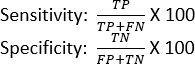
The sensitivity, specificity, and predictive values of the LAMP method were determined using 30 samples (10 of shrimp, 10 of oyster, and 10 of fish). Each sample was inoculated with the minimum detectable concentration established for each species of Vibrio. To determine the percentage of sensitivity and specificity as well as negative predictive value (NPV) and positive predictive value25, a contingency table was used to summarize the true positives (TP), true negatives (TN), false positives (FP), and false negatives (FN) obtained during the experiments. (Table 2). From these data, the following formulas were applied:


Results
Bacterial strains used and the extraction of DNA
DNA was successfully extracted from all pathogenic and negative control strains to be used as templates for the downstream LAMP assays.
LAMP procedure
Primers used in this work were specific for the amplification of the molecular target in each Vibrio species. The amplification products obtained by LAMP when Vibrio strains were used demonstrated that each primer was specific in the target gene amplification of each Vibrio species (Figure 1).
Treatment of samples of oysters, shrimp, and fish for the elimination of Vibrio spp. naturally present in the samples
The treatment to eliminate Vibrio spp. naturally present on samples was adequate, allowing the reduction of 100% Vibrio spp. There was no growth of Vibrio spp. when the BAM method was followed7.
Preparation of activated carbon with bentonite (ACB) and evaluation of cellular recovery
The elimination of the reaction inhibitors using the activated carbon-bentonite allowed an increase in the sensitivity in the detection of the pathogen by the LAMP method. This is due to the ability of the activated carbon-bentonite to absorb inhibitory substances that can affect the polymerase during the amplification procedure, in addition to the limited retention of bacterial cells (Figure 2). The percentage of Vibrio recovery using different pH and contact times showed a greater cellular recovery (93.4% ± 2.9%) when the pH was 6 with a contact time of 15 min. When pH 4 was used, there was no growth of any Vibrio, and pH 7 and 9 were 33.4% ± 7.6% and 67.2% ± 5.8%, respectively. This work suggests the usage of pH 6 to improve the detection sensitivity of the method.
Evaluation of the detection limit of V. cholerae, V. parahaemolyticus, V. vulnificus, and V. alginolyticus in oysters, shrimp, and fish samples treated with activated carbon and bentonite
In oyster samples, the detection limit for V. cholerae was 150 CFU/g, for V. alginolyticus, V. vulnificus, and V. parahaemolyticus was 3 x 10² CFU/g; in shrimp and fish samples, V. cholerae was detected at a minimum concentration of 150 CFU/g, whilst for V. alginolyticus, V. vulnificus, and V. parahaemolyticus was 76 CFU/g. The results obtained by the LAMP method revealed that using hydroxinaphthol blue compared to the LAMP sensitivity by eliminating inhibitors of reaction regarding samples that were not treated with ACB (Figure 3). We observed that the LAMP sensitivity was higher when samples were treated with ACB.
Determination of positive predictive value, negative predictive value, specificity, and sensitivity of the LAMP method
The diagnostic performance of the optimized loop-mediated isothermal amplification (LAMP) method, with and without activated carbon-bentonite (ACB) pretreatment, was systematically evaluated across 150 trials to assess its robustness (Table 3). The elimination of natural food inhibitors using the ACB system significantly improved all diagnostic parameters (sensitivity, specificity, positive predictive value (PPV), and negative predictive value (NPV) to values equal to or greater than 90% across all matrices, compared to untreated samples.
In fish and shrimp samples treated with ACB, the assay demonstrated maximum diagnostic performance, achieving a sensitivity, specificity, PPV, and NPV of 100% (Figure 4). Conversely, in untreated samples of fish and shrimp, the presence of matrix-derived inhibitors severely compromised the assay, reducing the detection sensitivity to 62.5% and 52.5%, respectively. For the highly complex oyster matrix, the ACB treatment successfully mitigated major interference, yielding a high overall sensitivity of 95.0% and an NPV of 71.4% (Figure 5). In contrast, untreated oyster samples exhibited a critical drop in detection sensitivity to 32.5% and an NPV of 15.6% due to the massive presence of organic compounds such as glycogen and lipids that inhibit the polymerase.
The diagnostic specificity of the LAMP method remained at 100% across all 150 trials, regardless of the matrix type or pretreatment, with zero false-positive results recorded. This absolute specificity is attributed to the highly selective design of the primer sets targeting species-specific genes (gyrB for V. alginolyticus, ompW for V. cholerae, tlh for V. parahaemolyticus, and vvhA for V. vulnificus). These statistical findings demonstrate that the optimized ACB-LAMP method is a highly reliable and robust tool for the rapid, culture-free detection of pathogenic Vibrio species in diverse fishery products.
Finally, we consider that the use of the LAMP method in combination with a pretreatment to eliminate reaction inhibitors can increase the sensitivity of detection of pathogens in food using the LAMP method. Therefore, this technique applied to the search for V. cholerae, V. parahaemolyticus, V. alginolyticus, and V. vulnificus should be useful in monitoring to prevent infections caused by these microorganisms.
DATA AVAILABILITY:
All raw data supporting the findings of this study, including the numerical bacterial recovery colony counts (CFU/g) under different pH values and contact times, as well as the complete diagnostic performance results for all 150 validation trials, are publicly available in the Zenodo repository at https://doi.org/10.5281/zenodo.21799272. The associated dataset contains the complete spreadsheet file (Supplementary File 1).
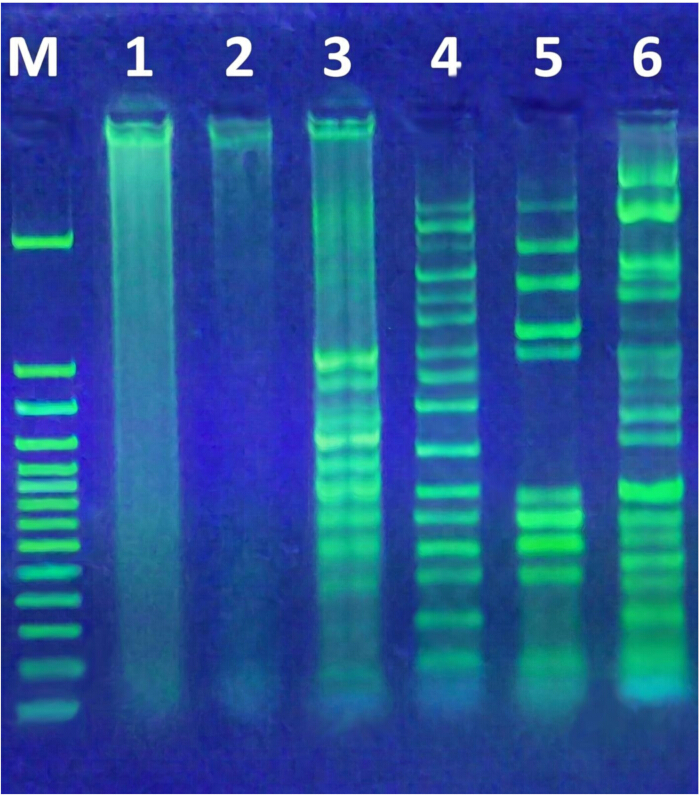
Figure 1: Specificity analysis of LAMP-amplified products on a 1.5% agarose gel. Lane M, 100 bp molecular size marker; Lane 1, negative control (Escherichia coli ATCC 25922); Lane 2, negative control (Listeria monocytogenes ATCC 49594); Lane 3, V. alginolyticus ATCC 17749; Lane 4, V. cholerae no O1 CECT 557; Lane 5, V. parahaemolyticus ATCC 7802; Lane 6, V. vulnificus ATCC 29037. Please click here to view a larger version of this figure.
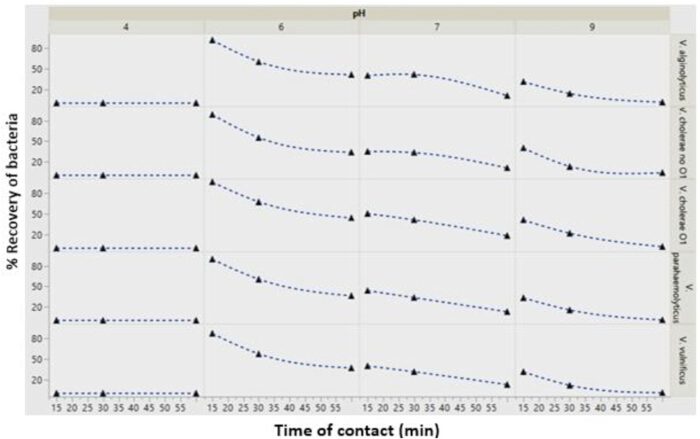
Figure 2: Percentage of recovery of Vibrio strains using different pH conditions and contact times with the activated carbon-bentonite (ACB) mixture. Cellular recovery (%) was determined after inoculating Vibrio strains at 1.5 × 10⁴ CFU/mL in PBS adjusted to pH 4.0, 6.0, 7.0, and 9.0, and treating with 4.6 g of ACB for 15 min, 30 min, and 60 min. The data point at pH 6.0 and 15 min of contact demonstrates optimal cellular recovery (93.4% ± 2.9%), indicating that a brief contact time is sufficient to recover target cells while maintaining high inhibitor-removal efficiency. Please click here to view a larger version of this figure.
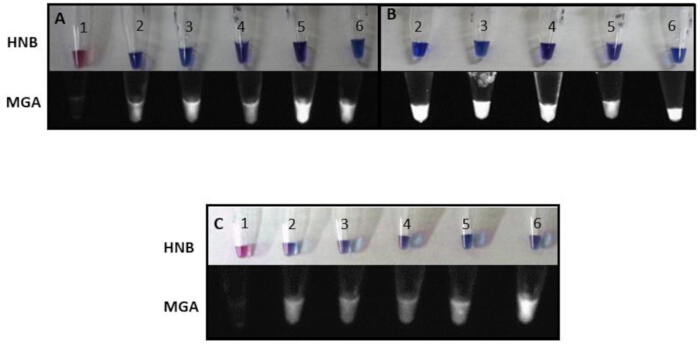
Figure 3: Detection limit of LAMP-amplified products in artificially spiked seafood samples. Amplification results in (A) oyster, (B) shrimp, and (C) fish samples spiked with serial dilutions of Vibrio species and pretreated with ACB. Tubes: (1) Negative control; (2) V. alginolyticus; (3) V. parahaemolyticus; (4) V. vulnificus; (5) V. cholerae no O1; and (6) V. mimicus (used as target control). Top panel: Visual colorimetric detection using 4 μL of Hydroxynaphthol Blue (HNB, 125 μM) under naked-eye inspection, where positive reactions appear blue and negative reactions remain violet. Bottom panel: Fluorescence-based detection using Midori Green Advanced (MGA) stain visualized under a blue light transilluminator. Please click here to view a larger version of this figure.
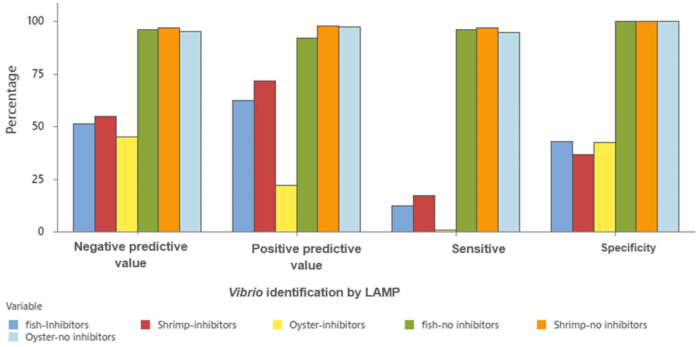
Figure 4: Comparative diagnostic performance parameters of the LAMP method with and without inhibitor removal. Comparison of overall sensitivity, specificity, positive predictive value (PPV), and negative predictive value (NPV) in fish, shrimp, and oyster samples spiked at minimum detectable limits (n = 10 trials per species/matrix combination, for a total of 150 trials). Bars compare samples pretreated with the optimized activated carbon-bentonite (ACB) mixture against untreated controls (no inhibitor removal). Spiking levels were established at 150 CFU/g for V. cholerae across all matrices; 300 CFU/g for V. parahaemolyticus, V. alginolyticus, and V. vulnificus in oyster; and 76 CFU/g in fish and shrimp. Pretreatment with ACB successfully restored all diagnostic parameters to ≥90% across all matrices. Please click here to view a larger version of this figure.
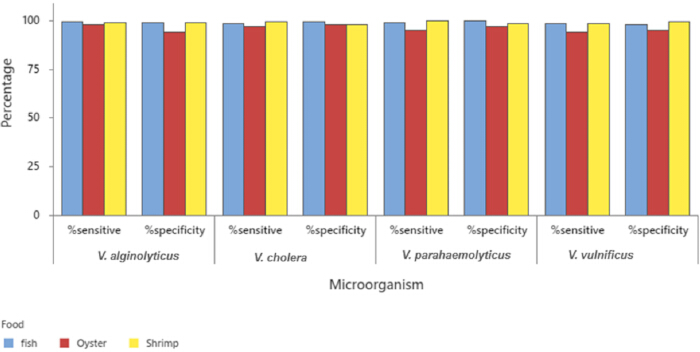
Figure 5: Target-specific sensitivity and specificity of the optimized ACB-LAMP method across different seafood matrices. Individual diagnostic performance for V. alginolyticus, V. cholerae, V. parahaemolyticus, and V. vulnificus in fish, shrimp, and oyster samples (n = 10 tests per target/food combination) pretreated with ACB. Specificity achieved 100% for all targets due to species-specific primer design targeting the gyrB, ompW, tlh, and vvhA genes. Sensitivity reached 100% in fish and shrimp matrices, with a slight decrease to 90% observed in oysters due to the high baseline complexity of the organic matrix interfering with the reaction. Please click here to view a larger version of this figure.
Table 1: Primers used in Loop-mediated Isothermal Amplification (LAMP) assays. Description of forward and backward inner primers (FIP, BIP), outer primers (F3, B3), and loop primers (LF, LB) designed for species-specific targeting of V. alginolyticus (gyrB), V. parahaemolyticus (tlh), V. vulnificus (vvhA), and V. cholerae (ompW). Please click here to download this Table.
Table 2: Contingency table for assessing the diagnostic performance parameters of the LAMP method. Standard 2x2 matrix setup used to classify and summarize True Positives (TP), True Negatives (TN), False Positives (FP), and False Negatives (FN) to calculate sensitivity, specificity, positive predictive value (PPV), and negative predictive value (NPV) in spiked and unspiked seafood samples. Please click here to download this Table.
Supplementary File 1: Raw datasets supporting the findings of this study. Please click here to download this file.
Discussion
This study establishes optimized conditions to enhance the sensitivity of loop-mediated isothermal amplification (LAMP) for detecting V. cholerae, V. parahaemolyticus, V. alginolyticus, and V. vulnificus in contaminated seafood samples. By circumventing the traditional pre-enrichment stage, diagnostic time is significantly reduced, offering a highly efficient and rapid approach for directly identifying pathogens from fishery products.
A key methodological improvement in this study is the optimization of the inhibitor removal step. Previous methodologies utilized a pH of 4 prior to amplification21; however, this resulted in zero recovery of Vibrio strains, primarily because Vibrio species are highly sensitive to acidic environments26. To address this, conditions were systematically modified to simultaneously improve cellular recovery and eliminate naturally occurring reaction inhibitors. Resuspending activated carbon with bentonite (ACB) in a buffer solution at pH 6, followed by a 15-min agitation with the sample, proved to be the optimal condition. This modification maximizes the electrostatic repulsion between the bacteria and the ACB by approaching the isoelectric point of the bacterial membrane21,27,28, thereby minimizing target cell loss. Consequently, this methodological enhancement yielded a detection sensitivity 2–50 times greater than that of samples processed without ACB treatment.
Distinct from these methodological improvements, the successful implementation of this protocol may require explicit troubleshooting if common problems arise. A frequent issue encountered during implementation is the incomplete removal of organic matter, which can interfere with the polymerase and reduce LAMP sensitivity, particularly in highly contaminated matrices. If amplification fails or sensitivity drops, troubleshooting should first involve verifying the pH of the ACB-sample mixture; deviations from pH 6 can lead to cell death (if too acidic) or insufficient inhibitor absorption. Additionally, if false negatives occur despite proper ACB treatment, researchers must ensure the contact time does not exceed 15 min, as prolonged exposure can lead to unintended target cell retention by the matrix. For naked-eye detection, ambiguous color changes can be troubleshot by ensuring the complete removal of matrix calcium ions, which may otherwise interfere with the magnesium pyrophosphate precipitation in the LAMP assay.
This work reports, for the first time, the identification of Vibrio spp. in fish samples using the LAMP method in combination with an ACB pretreatment. This research advances the scientific field by establishing a rapid, reliable, and cost-effective identification method for fishery products13,19,23,29. While conventional PCR represents an alternative approach to testing this hypothesis, the robust specificity and predictive values obtained here demonstrate that the ACB-LAMP assay is a superior option. A critical methodological advantage of this technique is its independence from sophisticated and expensive equipment, such as thermocyclers, electrophoresis chambers, and transilluminators9,30. Furthermore, the visual detection of results via hydroxynaphthol blue significantly simplifies data interpretation.
Despite the high sensitivity and specificity achieved, a notable limitation of the study is observed in matrices with high baseline contamination, such as oyster samples. In these instances, the ACB system cannot completely eliminate all interfering organic matter, which slightly decreases the assay's sensitivity compared to fish or shrimp samples. Finally, the potential applications of this method highlight its utility for routine, high-throughput monitoring in the food industry to prevent Vibrio-related infections. Future directions should prioritize the automation of the DNA extraction and ACB inhibitor-removal steps. Automating these key methodological features is a crucial advantage that will significantly reduce hands-on time, minimize human error, and standardize troubleshooting variables, thereby facilitating the large-scale application of this technique in industrial quality control laboratories.
Disclosures
The authors declare no competing interests.
Materials
| Name | Company | Catalog Number | Comments |
|---|---|---|---|
| Activated carbon | Sigma-Aldrich | C2764 | |
| Bentonite | Sigma-Aldrich | 682659 | |
| Betaine | Sigma-Aldrich | B0300 | |
| Bio-Image systems transilluminator | Bio-Image systems | MBE-CP-01 | |
| Bst DNA polymerase | New England Biolabs | M0374 | |
| Centrifuge (model J2-HS) | Beckman Coulter | https://www.americaninstrument.com/products/beckman-j2-hs-high-speed-1273g-centri | |
| Cronobacter sakazakii | ATCC | 12868 | |
| dNTP mixture | Thermo Fisher Scientific | R0241 | |
| Escherichia coli | ATCC | 25922 | |
| Hydroxynaphthol blue | Sigma-Aldrich | 219916 | |
| Listeria monocytogenes | ATCC | 49594 | |
| Midori Green Advanced | Nippon Genetics | MG01 | |
| MS 1D Analysis Software | Major Science | MBE-IMG-SW | |
| Salmonella Typhimurium | ATCC | 14028 | |
| Spectrophotometer (model 6300) | Jenway | 630531 | |
| Stomacher Circulator (model 400) | Seward | 0400/000/AJ | |
| Vibrio alginolyticus | ATCC | 17749 | |
| Vibrio cholerae no O1 | CECT | 55 | |
| Vibrio parahaemolyticus | ATCC | 17802 | |
| Vibrio vulnificus | ATCC | 29037 | |
| Whatman paper | Whatman | 1001-055 |
References
- Baker GL. Food safety impacts from post-harvest processing procedures of molluscan shellfish. Foods. 2016;5(2):29.
- Kim HJ et al. Multiplex PCR for detection of the Vibrio genus and five pathogenic Vibrio species with primer sets designed using comparative genomics. BMC Microbiol. 2015;15(1):239.
- CDC. Cholera and Other Vibrio Illness Surveillance (COVIS). Cdc.gov; 2022. Available from: http://www.cdc.gov/vibrio/surveillance.html
- Robert-Pillot A et al. Occurrence of the three major Vibrio species pathogenic for human in seafood products consumed in France using real-time PCR. Int J Food Microbiol. 2014;189:75-81.
- Brands DA et al. Prevalence of Salmonella spp. in oysters in the United States. Appl Environ Microbiol. 2005;71(2):893-897.
- Gxalo O et al. Virulence and antibiotic resistance characteristics of Vibrio isolates from rustic environmental freshwaters. Front Cell Infect Microbiol. 2021;11:732001.
- De Paola A, Kaysner CA. Bacteriological Analytical Manual, Vibrio. Food and Drug ENTER
- Chahorm K, Prakitchaiwattana C. Application of Reverse Transcriptase-PCR-DGGE as a rapid method for routine determination of Vibrio spp. in foods. Int J Food Microbiol. 2018;264:46-52.
- Anupama KP et al. Evaluation of loop-mediated isothermal amplification assay along with conventional and real-time PCR assay for sensitive detection of pathogenic Vibrio parahaemolyticus from seafood sample without enrichment. Mol Biol Rep. 2021;48(1):1009-1016.
- Notomi T et al. Loop-mediated isothermal amplification of DNA. Nucleic Acids Res. 2000;28(12):E63.
- Sridapan T et al. Rapid detection of Clostridium perfringens in food by loop-mediated isothermal amplification combined with a lateral flow biosensor. PLoS One. 2021;16(1):e0245144.
- Notomi T, Mori Y, Tomita N, Kanda H. Loop-mediated isothermal amplification (LAMP): principle, features, and future prospects. J Microbiol. 2015;53(1):1-5.
- Yamazaki W, Ishibashi M, Kawahara R, Inoue K. Development of a loop-mediated isothermal amplification assay for sensitive and rapid detection of Vibrio parahaemolyticus. BMC Microbiol. 2008;8:163.
- Nagamine K, Hase T, Notomi T. Accelerated reaction by loop-mediated isothermal amplification using loop primers. Mol Cell Probes. 2002;16(3):223-229.
- Mori Y, Nagamine K, Tomita N, Notomi T. Detection of loop-mediated isothermal amplification reaction by turbidity derived from magnesium pyrophosphate formation. Biochem Biophys Res Commun. 2001;289(1):150-154.
- Yamazaki W et al. Development of a loop-mediated isothermal amplification assay for sensitive and rapid detection of the tdh and trh genes of Vibrio parahaemolyticus and related Vibrio species. Appl Environ Microbiol. 2010;76(3):820-828.
- Di H et al. Development and evaluation of a loop-mediated isothermal amplification assay combined with enrichment culture for rapid detection of very low numbers of Vibrio parahaemolyticus in seafood samples. Biol Pharm Bull. 2015;38(1):82-87.
- Cai SH et al. Loop-mediated isothermal amplification method for rapid detection of Vibrio alginolyticus, the causative agent of vibriosis in mariculture fish. Lett Appl Microbiol. 2010;50(5):480-485.
- Han F, Ge B. Evaluation of a loop-mediated isothermal amplification assay for detecting Vibrio vulnificus in raw oysters. Foodborne Pathog Dis. 2008;5(3):311-320.
- Zhang L et al. Rapid, specific and sensitive detection of Vibrio vulnificus by loop-mediated isothermal amplification targeted to vvhA gene. Hai Yang Xue Bao. 2018;37(4):83-88.
- Luan C, Levin RE. Use of activated carbon coated with bentonite for increasing the sensitivity of PCR detection of Escherichia coli O157:H7 in Canadian oyster (Crassostrea gigas) tissue. J Microbiol Methods. 2008;72(1):67-72.
- Ren C-H, Hu C-Q, Luo P, Wang Q-B. Sensitive and rapid identification of Vibrio vulnificus by loop-mediated isothermal amplification. Microbiol Res. 2009;164(5):514–21.
- Srisuk C et al. Rapid and sensitive detection of Vibrio cholerae by loop-mediated isothermal amplification targeted to the gene of outer membrane protein ompW: Detection of Vibrio cholerae by LAMP. Lett Appl Microbiol. 2010;50(1):36-42.
- Goto M et al. Colorimetric detection of loop-mediated isothermal amplification reaction by using hydroxy naphthol blue. Biotechniques. 2009;46(3):167-172.
- Parikh R et al. Understanding and using sensitivity, specificity and predictive values. Indian J Ophthalmol. 2008;56(1):45-50.
- Yung CM et al. Insensitivity of diverse and temporally variable particle-associated microbial communities to bulk seawater environmental parameters. Appl Environ Microbiol. 2016;82(11):3431-3437.
- Abolmaaty A, Gu W, Witkowsky R, Levin RE. The use of activated charcoal for the removal of PCR inhibitors from oyster samples. J Microbiol Methods. 2007;68(2):349-352.
- Lee JL, Levin RE. Detection of 5 CFU/g of Escherichia coli O157:H7 on lettuce using activated charcoal and real-time PCR without enrichment. Food Microbiol. 2011;28(3):562-567.
- Tian CD et al. Study on detection of Vibrio parahaemolyticus in shellfish by use of loop-mediated isothermal amplification method: V. Parahaemolyticus in shellfish. J Food Saf. 2011;31(3):371-378.
- Niessen L, Luo J, Denschlag C, Vogel RF. The application of loop-mediated isothermal amplification (LAMP) in food testing for bacterial pathogens and fungal contaminants. Food Microbiol. 2013;36(2):191-206.