This narrative review synthesizes pressure-injury assessment and prevention in adults with advanced cancer. Risk assessment should combine structured tools with clinical judgment. Key risks include age, nutritional compromise, moisture, immobility, positioning, and symptom burden. A comfort-prioritized, risk-stratified framework integrates prevention, prognosis, symptom control, intervention burden, and goal-concordant care.
Review Article
Pressure Injury Prevention in Advanced Cancer: A Narrative Review and Proposed Comfort-Prioritized, Risk-Stratified Framework
* These authors contributed equally
In This Article
Summary
Abstract
Patients with advanced cancer are particularly vulnerable to pressure injury (PI) because of immobility, symptom-related positioning constraints, moisture exposure, nutritional compromise, and progressive physiological deterioration. PIs can increase symptom burden and nursing complexity and substantially impair quality of life. This narrative review synthesizes evidence on PI risk assessment tools, risk factors, and preventive strategies for adults with advanced cancer. Evidence was drawn from oncology-specific validation and observational studies, palliative care literature, international clinical guidelines, and studies involving broader high-risk populations, with the directness and certainty of evidence distinguished for major recommendations. Oncology-specific evidence supports selected risk factors and assessment approaches, whereas much of the evidence for preventive interventions is extrapolated from non-oncology populations. Pressure-redistribution support surfaces, individualized repositioning, selective preventive dressings, nutritional care, and symptom management should therefore be tailored to PI risk, intervention burden, prognosis, patient preferences, and goals of care. To integrate these considerations, we propose a comfort-prioritized, risk-stratified conceptual framework for advanced cancer care. The framework supports individualized decision-making across palliative and actively dying phases while emphasizing both PI-related and patient-centered outcomes, including comfort, pain, sleep disruption, and goal-concordant care.
Introduction
Pressure injury (PI) is localized damage to the skin and/or underlying soft tissue, usually over a bony prominence or related to a medical or other device, arising from intense or prolonged pressure or pressure combined with shear1. The burden of PI in cancer varies substantially by population and care setting. A cross-sectional study of 341 hospitalized adults with cancer reported a PI prevalence of 10%2, whereas a multicenter prospective cohort of 440 patients with advanced cancer admitted to hospice reported a 17.3% incidence during the hospice stay3. In a retrospective cohort of 645 patients hospitalized with non-small-cell lung cancer, PI incidence was 27.9%4. These estimates reflect differences in populations and care settings and are therefore best interpreted separately rather than as a pooled rate. In palliative care, PI can contribute to pain, wound-related symptoms, nursing complexity, and loss of comfort in patients who already experience a high symptom burden5.
PI prevention in advanced cancer requires balancing pressure redistribution against the physiological and symptomatic constraints imposed by progressive disease. Pain, dyspnea, fatigue, delirium, cachexia, edema, incontinence, and restricted positioning may limit the feasibility or acceptability of standard preventive measures. Contemporary evidence on palliative care indicates that most prevention data are derived from populations outside specialist palliative care settings and that the overall certainty of the evidence is commonly low or very low5. Clinical decisions, therefore, need to distinguish evidence directly applicable to advanced cancer from evidence extrapolated from general hospital, aged-care, rehabilitation, or other high-risk populations.
This review examines PI risk assessment, major risk factors, and preventive strategies for adults with advanced cancer. To organize the evidence for clinical use, we propose a comfort-prioritized, risk-stratified conceptual framework that integrates PI risk, pressure exposure, symptom burden, prognosis, patient preferences, tolerance of preventive interventions, and goals of care (Figure 1). The framework differentiates ongoing palliative care, in which prevention and comfort are pursued concurrently, from the actively dying phase, in which immediate comfort and goal-concordant care become predominant. It is presented as an author-developed conceptual decision-support approach for advanced cancer care.
A narrative review design was selected because the clinical question extends beyond a single intervention-comparator-outcome framework and encompasses the measurement properties of risk-assessment tools, epidemiological risk factors, preventive interventions, clinical guidelines, and context-dependent palliative-care practices. The included evidence spans validation studies, observational studies, randomized trials, systematic reviews, and clinical guidelines. Oncology-specific studies were prioritized; studies from broader palliative-care or other high-risk populations were incorporated when they provided clinically relevant evidence applicable to advanced cancer, with their source populations and directness identified in the synthesis.
A structured literature search was conducted in PubMed, Web of Science, and CINAHL for publications from January 2000 to January 2025 using combinations of “advanced cancer,” “palliative care,” “pressure injury,” “pressure ulcer,” “prevention,” and “risk assessment.” The evidence base was subsequently updated through August 2026 using targeted searches for recent oncology and palliative-care studies, systematic reviews, and current international guideline recommendations. Eligible literature included studies of adults with advanced cancer and clinically relevant palliative-care evidence, together with evidence from external high-risk populations when clinically applicable to PI prevention in advanced cancer. English- and Chinese-language peer-reviewed studies, clinical guidelines, randomized trials, observational studies, and relevant evidence syntheses were considered. Methodological quality was appraised narratively according to study design, population, comparators, outcome reporting, and applicability to advanced cancer; where formal certainty ratings were available from guidelines or systematic reviews, those ratings were retained in the present synthesis.
Review and Perspective
1. Pressure injury risk assessment tools for patients with advanced cancer
PI risk assessment in advanced cancer should combine a structured instrument with direct skin assessment and clinical judgment. The Braden Scale is widely used across clinical settings, while the Pressure Ulcer Scale in Oncology (PUSO) was developed specifically in patients with cancer. The six-item Curie scale has been used in oncology, whereas the Hunter's Hill Marie Curie Center tool is a distinct seven-domain instrument developed for specialist palliative care6,7,8,9. Recent oncology and palliative-care reviews emphasize that tool performance and cut-off values vary by population and that each instrument captures a different subset of disease-, symptom-, and care-related determinants relevant to advanced cancer8,9. The principal characteristics and applicability of commonly used instruments are summarized in Table 1, with detailed measurement properties in Supplementary Table 1.
The Braden Scale comprises six subscales: sensory perception, moisture, activity, mobility, nutrition, and friction/shear. Total scores range from 6 to 23, with lower scores indicating greater PI risk10. This six-domain structure should be distinguished from the five-domain Norton Scale, which assesses physical condition, mental condition, activity, mobility, and incontinence. The Braden Scale was not developed specifically for cancer, so its scores should be interpreted together with oncology-specific factors such as symptom-related positioning constraints, nutritional decline, treatment burden, and prognosis.
- Braden Scale
The Braden Scale remains clinically feasible for initial and repeated risk assessment in patients with cancer. A score of ≤16 is commonly used to indicate increased risk in general clinical practice, although optimal thresholds vary across settings10. In a cohort of 445 hospitalized patients with cancer who already had PI, lower Braden scores were associated with shorter overall survival, and patients with scores ≤14 had particularly limited survival11. An oncology pilot study reported 82% sensitivity and 84% specificity at a Braden score of 16, demonstrating clinically useful discrimination in that study population12. In advanced cancer, the scale is therefore most useful as one component of a broader assessment that includes skin status, mobility, symptom burden, nutritional status, pressure exposure, and goals of care. - Pressure Ulcer Scale in Oncology (PUSO)
Fromantin and colleagues developed the Pressure Ulcer Scale in Oncology (PUSO) specifically in adults with cancer6. The instrument uses three clinically accessible predictors—bedridden or chair-ridden status, incontinence, and moisture/shearing—to support rapid oncology-specific risk stratification. Its cancer-specific derivation gives it greater population relevance than general-purpose tools, particularly when mobility, continence, and moisture-related shear are prominent contributors to risk. - Curie scale and Hunter's Hill Marie Curie Center tool
The Curie scale used in oncology comprises six items—mobility, incontinence, nutrition, patient participation, moisture/shearing, and tissue damage—with item weights that yield a total score ranging from 0 to 32; higher scores indicate greater PI risk6,9. The oncology-specific PUSO was subsequently derived by retaining the three predictors most strongly associated with PI: bedridden/chair-ridden status, incontinence, and moisture/shearing6. The Hunters Hill Marie Curie Center pressure sore risk assessment tool is a distinct palliative-care instrument comprising seven domains: sensation, mobility, moisture, activity in bed, nutrition/weight change, skin condition, and friction/shear. It was evaluated in 291 patients across 529 risk-assessment events in a specialist palliative-care unit, with scores categorized as low, medium, high, or very high risk7. A recent COSMIN-based review reported favorable findings for content and structural validity in oncology-relevant instruments, including PUSO and the Curie scale, while contemporary palliative-care evidence supports combining structured assessment with clinical judgment across disease phases and care goals8,9.
2. Risk Factors for Pressure Injury
- Age
Advanced age is a non-modifiable background risk factor. In an observational analysis of patients with advanced cancer, age ≥70 years was associated with PI (OR 1.154, 95% CI 1.063–1.368)13. Age-related changes in skin thickness, subcutaneous tissue, perfusion, mobility, and physiological reserve may reduce tissue tolerance to sustained pressure. Risk assessment in older patients should therefore trigger closer surveillance and proportionate preventive care rather than treating age itself as a modifiable intervention target. - Nutrition
Nutritional compromise is common in advanced cancer and may coexist with reduced intake, cachexia, inflammation, anemia, and impaired tissue repair. In an observational study of advanced cancer, serum albumin <30 g/L and hemoglobin <80 g/L were reported as independent PI risk factors13. These findings support the assessment of nutritional and hematological vulnerability as part of PI risk stratification. Nutritional status is partially modifiable, but the intensity and route of nutritional intervention should remain proportionate to gastrointestinal function, prognosis, treatment status, symptom burden, and goals of care. - Mobility limitations and forced positioning
Reduced mobility increases the duration of pressure exposure and limits spontaneous pressure relief. In a cancer population, activities of daily living contributed to a community-acquired PI prediction model with strong discrimination (AUCs of 0.87 in the training cohort and 0.88 in the validation cohort)14. In critically ill patients with cancer, immobility and positioning-related factors also contribute to PI risk15. Advanced cancer adds a distinctive constraint: dyspnea, malignant pleural or ascitic effusions, bone metastases, neurological involvement, or severe fatigue may make particular positions necessary for symptom relief and thereby concentrate pressure over vulnerable anatomical sites.
Cancer pain can further reduce voluntary movement and make full repositioning unacceptable or clinically impractical. Oncology and palliative-care literature describes a relationship between cancer pain, forced positioning, and prolonged local pressure exposure16,17,18. In practice, mobility and positioning should therefore be assessed together with pain, dyspnea, neurological symptoms, and patient tolerance. Symptom relief may increase the range of positions that a patient can tolerate and can enable less burdensome pressure redistribution. - Comorbidities and disease-related physiological deterioration
Comorbid disease and systemic physiological deterioration can compound tissue vulnerability. In 645 patients hospitalized with non-small-cell lung cancer, elevated serum C-reactive protein at admission was independently associated with PI development (OR 2.20, 95% CI 1.40–3.45; P = 0.001), linking systemic inflammatory burden to PI risk in a cancer population4. In a cohort of 1,976 acute palliative-care admissions, a higher Problem Severity Score was independently associated with hospital-acquired PI (OR 1.17 per one-point increase, 95% CI 1.05–1.31; P = 0.004); 43.8% of admissions involved a cancer diagnosis19. Diabetes, vascular disease, edema, infection, neuropathy, and impaired perfusion may further reduce tissue tolerance or delay recognition of early skin injury. These conditions are best considered background or partially modifiable risk modifiers within an integrated assessment rather than uniform independent predictors across all patients with advanced cancer. Overall, PI vulnerability in advanced cancer reflects an interaction between non-modifiable disease characteristics and potentially modifiable pressure, moisture, nutritional, mobility, and symptom-related exposures (Table 2; Supplementary Table 2).
3. Nursing strategies for pressure injury prevention in patients with advanced cancer
Preventive care for advanced cancer should be selected based on both the certainty and directness of the evidence. Current international recommendations for support surfaces, seating surfaces, repositioning, and preventive dressings are based predominantly on general at-risk populations, whereas oncology-specific evidence is predominantly observational and intervention-specific. Recent palliative-care evidence synthesis similarly characterizes most prevention evidence as indirect, with low or very low certainty for many interventions1,5. Where formal certainty ratings are available, the grading assigned by the originating guideline or systematic review is retained; other studies are identified by design and source population. Table 3 summarizes the clinical application, certainty, applicability, and burden of major interventions, and Supplementary Table 3 provides the detailed evidence profile.
- Support surfaces and seating pressure redistribution
Pressure-redistribution support surfaces are low-burden preventive measures that can remain feasible even when active repositioning is difficult. The 2025 International Guideline strongly recommends a pressure-redistribution foam reactive full-body support surface for individuals at PI risk, based on low-certainty evidence.1 Surface selection should reflect body habitus, pressure-redistribution performance, mobility, safety, comfort, and manufacturer specifications rather than a fixed mattress-thickness criterion. For individuals who spend prolonged periods sitting, the guideline strongly recommends a seating support surface with pressure-redistribution properties, supported by moderate-certainty evidence.1 In a randomized trial of older nursing-home wheelchair users, skin-protection cushions reduced ischial-tuberosity ulcers compared with segmented foam cushions (0.9% vs 6.7%; P = 0.04); the combined ischial/sacral outcome was 10.6% versus 17.6% (P = 0.14).20 Because this evidence is indirect to advanced cancer, cushion material, dimensions, and configuration should be individualized according to posture, stability, function, pressure redistribution, and comfort. - Individualized repositioning and positioning
Repositioning should follow an individualized regimen rather than a fixed cancer-specific schedule. The International Guideline suggests that two- or three-hourly repositioning may be implemented for many at-risk individuals when an appropriate pressure-redistribution full-body support surface is in use; this is a conditional recommendation based on very low-certainty evidence1. The interval should be adapted to activity, ability to self-reposition, skin and tissue response, clinical condition, comfort, sleep, support surface, and goals of care. A 30° lateral position may be considered when it achieves effective offloading and is tolerated, based on very-low-certainty evidence1. Evidence from spinal-cord-injury populations indicates that a wheelchair tilt of approximately 30° is required to initiate meaningful unloading of the sacrum and ischial region21, but this is indirect evidence for advanced cancer. Small weight shifts or micro-repositioning can be used when full turns are poorly tolerated. Oncology reports describing positioning devices for patients who require semi-recumbent positions support their use as practical aids for reducing shear and maintaining a tolerated posture, with patient comfort remaining a central criterion22. - Preventive dressings
Preventive dressings should be used as an adjunct to pressure redistribution rather than as a substitute for support surfaces, repositioning, and skin assessment. Current international guidance conditionally suggests multilayered soft silicone foam dressings over the sacrum and heels for individuals at high PI risk where resources permit; the certainty of evidence is very low1. In the 2024 Cochrane update, silicone foam dressings versus no dressing were associated with a lower observed PI incidence (RR 0.50, 95% CI 0.33–0.77), although certainty across dressing comparisons remained low or very low because of risk of bias, inconsistency, and imprecision23. For advanced cancer, dressing selection should prioritize sacral or heel risk, skin condition, secure but atraumatic fixation, repeated skin inspection, and patient comfort; size and material should be individualized to the anatomical site and clinical context. - Individualized nutritional management
Nutritional care should begin with regular screening using a validated oncology-appropriate tool and should be linked to treatment goals rather than to a fixed escalation timetable. Contemporary oncology recommendations support validated instruments including the Malnutrition Universal Screening Tool (MUST), Nutrition Risk Screening-2002 (NRS-2002), and the Patient-Generated Subjective Global Assessment Short Form (PG-SGA SF), among other tools24. Patients who can eat should generally receive individualized dietary counselling, food fortification, and oral nutritional supplements when indicated25,26. When oral intake remains inadequate and the gastrointestinal tract is functional, enteral nutrition may be considered according to the cause and expected duration of inadequate intake. The “4-week” threshold relates to access for longer-term enteral feeding: when enteral feeding is expected to be required for more than approximately 4 weeks, percutaneous endoscopic gastrostomy may be preferred to prolonged nasogastric feeding in appropriate patients26.
Parenteral nutrition is an option when oral and enteral routes are not feasible or remain inadequate because of severely compromised gastrointestinal function; its use should be individualized according to expected benefit, prognosis, performance status, treatment intent, symptom burden, and patient preference25,26. As advanced cancer progresses toward the final weeks of life, nutritional care should increasingly prioritize immediate comfort and preferred oral intake. Patients with an expected survival of days to weeks are unlikely to benefit from enteral or parenteral artificial nutrition, and therapeutic goals should be explicit before artificial nutrition is initiated or continued27. Thus, nutritional management can address reversible nutritional vulnerability while remaining proportionate to the phase of illness and goals of care. Its direct effect on PI prevention in advanced cancer is less certain than its established role in cancer nutritional care. - Symptom management and multidisciplinary care
Symptom management is an enabling component of individualized PI prevention because pain, dyspnea, orthopnea, delirium, fatigue, and other distressing symptoms can restrict mobility or make repositioning intolerable. Cancer pain should be assessed and treated according to oncology pain-management guidance before burdensome positional interventions are attempted17,18. For symptomatic malignant pleural effusion, guideline-concordant pleural intervention can relieve dyspnea and may improve positioning tolerance, but it should be undertaken for its respiratory and palliative indications rather than as a direct PI-prevention procedure28. Once distress is controlled, pressure-relieving position changes can be attempted within the patient’s tolerance. In patients with very limited prognosis or high intervention-related distress, low-burden measures such as pressure-redistribution support surfaces, gentle skin care, moisture management, and small weight shifts may be prioritized. The practical differences between ongoing palliative care and the actively dying phase are summarized in Table 4 and represented conceptually across the disease trajectory in Figure 2.
4. Future perspectives and limitations
Future research should focus on advanced cancer populations in acute oncology, hospice, community, and home settings and should evaluate outcomes that matter across different phases of illness. In addition to PI incidence and severity, prospective studies should measure pain, comfort, sleep disruption, mobility, patient preference, caregiver burden, quality of life, and goal-concordant care. The proposed comfort-prioritized, risk-stratified framework provides a structure for such evaluation, particularly for testing when preventive interventions should be maintained, adapted, or de-intensified as disease progresses.
This review integrates oncology-specific assessment and risk-factor evidence with current international PI guidance and palliative-care literature. Its principal clinical contribution is the explicit separation of direct evidence of advanced cancer from extrapolated evidence and the parallel consideration of evidence certainty and intervention burden. Inclusion of both English- and Chinese-language literature also broadens the clinical contexts represented. Chinese-language reports more often emphasize ward-level nursing implementation, symptom-related positioning, and practical bedside adaptations, whereas international literature more often contributes formal guideline methodology, measurement-property evaluation, and evidence synthesis. These patterns highlight context-specific implementation priorities without implying uniform cultural effects.
The evidence base remains heterogeneous across cancer types, disease stages, care settings, interventions, and outcome definitions. Intervention evidence is derived predominantly from broader high-risk populations, and contemporary palliative-care overviews characterize much of the applicable evidence as indirect and of low or very-low certainty5. Accordingly, the clinical synthesis emphasizes proportionality, directness, and patient-centered applicability rather than a single standardized prevention protocol. Methodological quality across the included literature was appraised based on study design and reported limitations, while formal certainty ratings from current guidelines and systematic reviews were retained when available.
Conclusions
PI prevention in advanced cancer requires individualized assessment that integrates PI risk, skin and tissue status, pressure exposure, nutritional condition, symptom burden, prognosis, patient preferences, and goals of care. Oncology-specific evidence is available for selected risk factors and assessment tools, whereas many preventive interventions are supported primarily by evidence from broader high-risk populations. Pressure-redistribution support surfaces provide a comparatively low-burden foundation for prevention; repositioning frequency should be individualized; preventive silicone foam dressings may be used selectively at high-risk sites; and nutritional and symptom-management interventions should follow oncology and palliative-care indications while supporting pressure-relief goals. As patients move from ongoing palliative care toward the actively dying phase, the relative priority assigned to immediate relief of comfort, pain, and dyspnea, sleep, dignity, and patient/family preferences should increase, and burdensome preventive interventions may appropriately be reduced. The comfort-prioritized, risk-stratified framework presented in this review is an author-developed conceptual approach that integrates evidence certainty, clinical risk, intervention burden, prognosis, and goal-concordant care across the advanced-cancer trajectory.
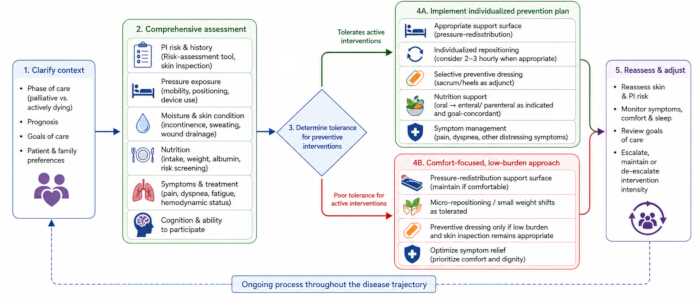
Figure 1: Comfort-prioritized, risk-stratified decision framework for pressure-injury prevention in patients with advanced cancer. The framework integrates phase of care, prognosis, goals and preferences, PI risk, pressure exposure, skin condition, nutrition, symptoms, cognition, and tolerance of preventive interventions to guide individualized prevention or a comfort-focused low-burden approach, with ongoing reassessment across the disease trajectory. Please click here to view a larger version of this figure.
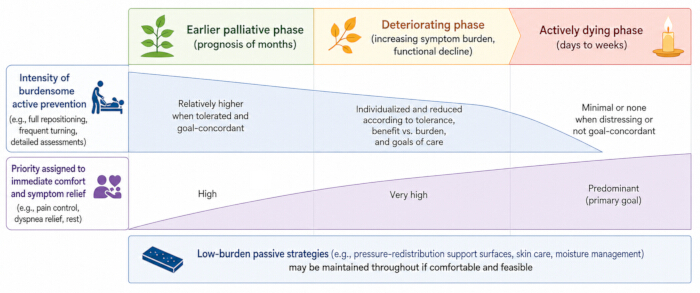
Figure 2: Conceptual continuum of pressure-injury prevention across the advanced-cancer trajectory. The relative intensity of burdensome active prevention is progressively individualized as disease advances and tolerance declines, while the priority assigned to immediate comfort and symptom relief increases; low-burden passive strategies may be maintained when comfortable and feasible. Please click here to view a larger version of this figure.
Table 1: Pressure-injury risk-assessment tools relevant to oncology and palliative care. Comparison of general, oncology-specific, and palliative-care risk-assessment instruments according to domains, scoring direction, development or validation population, and relevance to adults with advanced cancer. Abbreviations: PI = pressure injury; PUSO = Pressure Ulcer Scale in Oncology. Please click here to download this Table.
Table 2: Major risk factors for pressure injury in patients with advanced cancer. Summary of major PI risk domains, quantitative evidence, study populations, modifiability, and clinical relevance. Evidence includes direct advanced-cancer and cancer-population studies as well as mixed palliative-care evidence where indicated. Abbreviations: ADL = activities of daily living; AUC = area under the curve; CI = confidence interval; CRP = C-reactive protein; OR = odds ratio; PI = pressure injury. Please click here to download this Table.
Table 3: Preventive strategies for pressure injury in advanced cancer. Summary of preventive interventions according to clinical application, evidence certainty or recommendation strength, applicability to advanced cancer, and intervention burden. Evidence derived primarily from non-oncology populations is identified as indirect. Abbreviation: PI = pressure injury. Please click here to download this Table.
Table 4: Pressure-injury prevention across palliative and actively dying phases. Comparison of prevention priorities and clinical approaches during ongoing palliative care and the actively dying phase, emphasizing individualized risk assessment, intervention tolerance, symptom relief, comfort, and goal-concordant care. Abbreviation: PI = pressure injury. Please click here to download this Table.
Supplementary Table 1: Detailed measurement characteristics of pressure-injury risk-assessment tools. Comparison of the Braden Scale, Norton Scale, Waterlow Score, Curie Oncology Scale, Hunter's Hill Marie Curie Center tool, and PUSO according to domains, scoring, cut-offs or performance, validation populations, oncology or palliative-care relevance, and key limitations. Abbreviations: PI = pressure injury; PUSO = Pressure Ulcer Scale in Oncology.Please click here to download this file.
Supplementary Table 2: Study-level evidence for pressure-injury risk factors in cancer and palliative-care populations. Summary of study design, population, sample size, quantitative findings, and evidence directness for major PI risk factors identified in cancer and palliative-care populations. Abbreviations: ADL = activities of daily living; AUC = area under the curve; CI = confidence interval; CRP = C-reactive protein; OR = odds ratio; PI = pressure injury; PUSO = Pressure Ulcer Scale in Oncology.Please click here to download this file.
Supplementary Table 3: Detailed evidence profile of pressure-injury preventive interventions. Summary of evidence sources, study populations, intervention effects or recommendations, directness of evidence for advanced cancer, certainty of evidence, and palliative-care considerations for major PI-prevention strategies. Abbreviations: CI = confidence interval; PI = pressure injury; RR = risk ratio.Please click here to download this file.
Disclosures
The authors have no relevant financial or non-financial interests to disclose.
Acknowledgements
This work was supported by the Scientific Research Project of Jiangsu Provincial Maternal and Child Health Association (FYX202359).
References
- National Pressure Injury Advisory Panel, European Pressure Ulcer Advisory Panel, Pan Pacific Pressure Injury Alliance. Prevention and Treatment of Pressure Ulcers/Injuries: Clinical Practice Guideline. 4th ed. Haesler E, ed. NPIAP/EPUAP/PPPIA; 2025.
- Castro DLV et al. Prevalence of pressure injury and associated factors in hospitalized adult patients with cancer. Wounds. 2022;33(1):E96-E100.
- Jakobsen TBT et al. Incidence and prevalence of pressure ulcers in cancer patients admitted to hospice: a multicenter prospective cohort study. Int Wound J. 2020;17(3):641-649.
- Kim JY, Shin YK, Seol GH. Incidence and risk factors for pressure injury in hospitalized non-small cell lung cancer patients: a retrospective observational study. J Tissue Viability. 2023;32(3):377-382.
- Dewidar O, et al. Prevalence, risk factors and management of pressure injuries and their implications for palliative care: a rapid overview of reviews. Palliat Med. 2026;40(1):21-30.
- Fromantin I et al. Inception and validation of a pressure ulcer risk scale in oncology. J Wound Care. 2011;20(7):328,330-334.
- Chaplin J. Pressure sore risk assessment in palliative care. J Tissue Viability. 2000;10(1):27-31.
- Zou W, Liu J, Du X, Yang H. Pressure injury assessment tools for oncology patients: a systematic review. J Clin Nurs. 2026;35(2):524-538.
- Ven S, et al. Pressure injury risk assessment for palliative care patients in the acute hospital setting: a scoping review. BMC Palliat Care. 2025;24:212.
- Bergstrom N, Braden BJ, Laguzza A, Holman V. The Braden Scale for Predicting Pressure Sore Risk. Nurs Res. 1987;36(4):205-210.
- Guo Y et al. Overall survival among patients with cancer and pressure injury and its association with Braden Scale score. J Palliat Med. 2022;25(8):1254-1257.
- Olson K, Tkachuk L, Hanson J. Preventing pressure sores in oncology patients. Clin Nurs Res. 1998;7(2):207-224.
- Li X, Fan M. Risk factors of pressure injury in patients with advanced cancer. Chin Prim Health Care. 2021;28(10):1466-1470.
- Zhang ZL, Luo M, Sun RY, Liu Y. Development and validation of a risk prediction model for community-acquired pressure injury in a cancer population: a case-control study. J Tissue Viability. 2024;33(3):433-439.
- Sun ZW, et al. Risk factor analysis and risk prediction model construction of pressure injury in critically ill patients with cancer: a retrospective cohort study in China. Med Sci Monit. 2020;26:e926669.
- Li Y, Li J. Current research status on preventing pressure injuries in patients with forced positions during palliative care. Tianjin Nurs. 2021;29(2):246-249.
- Weiren L. Evaluation of the effect of nursing intervention on pressure ulcers in bedridden patients with advanced cancer. Chin J Prac Nurs. 2011;27(15):52-53.
- Jiangsu Provincial Medical Quality Control Center for Oncology. Jiangsu provincial guidelines for the diagnosis and treatment of adult cancer pain (2020 edition). Chin J Clin Oncol. 2020;47(7):325-333.
- Ven S, et al. Incidence and characteristics of hospital-acquired pressure injuries in acute palliative care patients: a four-year analysis. J Clin Nurs. 2026;35(1):255-267.
- Brienza D, et al. A randomized clinical trial on preventing pressure ulcers with wheelchair seat cushions. J Am Geriatr Soc. 2010;58(12):2308-2314.
- Giesbrecht EM, Ethans KD, Staley D. Measuring the effect of incremental angles of wheelchair tilt on interface pressure among individuals with spinal cord injury. Spinal Cord. 2011;49(7):827-831.
- He S, Chen L, Xu R. Application of bed limiting devices in preventing pressure-induced injuries in advanced cancer patients. J Nurs Training. 2019;34(7):670-671.
- Patton D, et al. Dressings and topical agents for preventing pressure ulcers. Cochrane Database Syst Rev. 2024;12(12):CD009362.
- Trujillo EB, et al. Malnutrition risk screening in adult oncology outpatients: an ASPEN systematic review and clinical recommendations. JPEN J Parenter Enteral Nutr. 2024;48(8):874-894.
- Muscaritoli M, et al. ESPEN practical guideline: clinical nutrition in cancer. Clin Nutr. 2021;40(5):2898-2913.
- Arends J, et al. Cancer cachexia in adult patients: ESMO Clinical Practice Guidelines. ESMO Open. 2021;6(3):100092.
- Crawford GB, et al. Care of the adult cancer patient at the end of life: ESMO Clinical Practice Guidelines. ESMO Open. 2021;6(4):100225.
- Feller-Kopman DJ, et al. Management of malignant pleural effusions: an official ATS/STS/STR clinical practice guideline. Am J Respir Crit Care Med. 2018;198(7):839-849.