Network pharmacology and molecular docking revealed that Rhizoma Drynariae acts on multiple targets and pathways to relieve rotator cuff injury via anti‑inflammation, anti‑apoptosis and pro‑angiogenesis.
Research Article
Network Pharmacology and Molecular Docking Reveal the Mechanism of Rhizoma Drynariae Against Rotator Cuff Injury
In This Article
Summary
Abstract
Rotator cuff injury (RCI) is a refractory musculoskeletal disorder marked by chronic inflammation, tenocyte apoptosis, impaired angiogenesis, and extracellular matrix (ECM) dysregulation, with limited clinical treatments available. This study employed network pharmacology and molecular docking to systematically investigate the active components, key targets, and signaling pathways of Rhizoma Drynariae (RD) against RCI. Eighteen active ingredients of RD and 213 non‑redundant targets were identified from TCMSP, ETCM, and SymMap, while 870 RCI‑related targets were retrieved from GeneCards and OMIM, yielding 71 overlapping candidate targets. Protein–protein interaction network analysis and cytoHubba screening revealed ten hub genes, including TNF, IL6, VEGFA, PTGS2, CASP3, AKT1, CCL2, PPARG, MAPK3, and HMOX1. Gene Ontology enrichment highlighted inflammatory response, oxidative stress, angiogenesis, cell proliferation, and ECM organization, while KEGG pathway analysis implicated the TNF, PI3K‑Akt, MAPK, and HIF‑1 signaling pathways. Molecular docking confirmed stable high‑affinity binding of eriodictyol, luteolin, catechin, naringenin, and aureusidin to these core proteins. Collectively, RD exerts anti‑RCI effects through a multi‑component, multi‑target, and multi‑pathway network, potentially alleviating RCI by suppressing inflammation and apoptosis, promoting angiogenesis, and enhancing ECM repair, thereby providing a theoretical foundation for its clinical application and experimental validation.
Introduction
Rotator cuff injury (RCI) is one of the most common shoulder disorders in orthopedics and sports medicine, affecting approximately 20% of adults over 20 years old and up to 54% of those over 60 years old1,2. RCI is pathologically featured by tendon degeneration, inflammatory cell infiltration, excessive tenocyte apoptosis, insufficient neovascularization, and disordered extracellular matrix synthesis, which result in chronic shoulder pain, limited mobility, muscle atrophy, and even joint instability3. If left untreated, RCI can severely reduce quality of life and impose a heavy socioeconomic burden4. Current therapeutic strategies for RCI include conservative treatment and surgical repair5. Nonsteroidal anti‑inflammatory drugs (NSAIDs) and corticosteroid injections relieve pain but carry risks of gastrointestinal injury, renal dysfunction, cartilage degeneration, and osteoporosis6,7. Surgical repair improves short‑term function but is limited by high re‑tear rates, postoperative adhesion, and poor long‑term healing quality8,9. Therefore, developing safe, effective, and multi‑target therapeutic agents for RCI is urgently needed.
Traditional Chinese medicine (TCM) has a long history in treating musculoskeletal diseases with the advantages of multi‑component, multi‑target, and low toxicity10. Rhizoma Drynariae (RD), the dried rhizome of Drynaria fortunei (Kunze) J. Sm., is a representative bone‑strengthening herb that promotes blood circulation, removes blood stasis, and accelerates tendon and bone repair11,12. Modern pharmacology has confirmed that flavonoids are the main active ingredients of RD, which exert anti‑inflammatory, antioxidant, osteogenic, and chondroprotective effects13. RD has been widely used in osteoporosis, osteoarthritis, femoral head necrosis, and intervertebral disc degeneration14,15,16. However, no systematic study has explored the efficacy and mechanism of RD against RCI. Network pharmacology is an emerging interdisciplinary approach integrating bioinformatics, systems biology, and pharmacology, which is ideal for deciphering the holistic mechanism of TCM17,18. It enables systematic construction of the “drug–component–target–pathway–disease” regulatory network and high‑throughput prediction of potential therapeutic targets19. In this study, network pharmacology combined with molecular docking was used to explore the active components, hub genes, and core signaling pathways of RD in treating RCI, aiming to provide a theoretical foundation for clinical application and subsequent experimental research.
Protocol
This study used only anonymized public bioinformatics databases and did not involve human or animal experiments. In accordance with Article 32 of China’s national ethical review regulations and the Declaration of Helsinki, ethical approval and informed consent were waived. All the materials used in this study are listed in the Table of Materials.
Study design and workflow diagram
The complete workflow of this network pharmacology study, including ingredient screening, target acquisition, network construction, enrichment analysis, and molecular docking verification, was performed following unified bioinformatics standards at every step to ensure the reproducibility of all predicted data (Figure 1).
Screening for active ingredients in RD
The Traditional Chinese Medicine Systems Pharmacology Database and Analysis Platform (TCMSP, https://old.tcmsp-e.com/tcmsp.php) was an online platform built based on herbal system pharmacology20. It comprehensively collected pharmacokinetic parameters of natural compounds, including oral bioavailability (OB), drug-likeness (DL), blood-brain barrier and corresponding target information. The authors input the keyword "Rhizoma Drynariae" to search all chemical ingredients of RD stored in the TCMSP database, and screened qualified active ingredients relying on absorption, distribution, metabolism, excretion (ADME) indexes, with OB ≥ 30% and DL ≥ 0.18. The compounds that met the above two standards were retained as candidate active ingredients for exploring the therapeutic mechanism of RD against RCI. Database access date: TCMSP V2.3 [2025-12-08]. Exported fields included compound name, OB value, DL value, and corresponding target protein entries. Duplicate compound entries were manually removed.
Collection of potential targets of RD
The researchers retrieved action targets of RD from three independent databases: TCMSP, The Encyclopedia of Traditional Chinese Medicine (ETCM, http://www.tcmip.cn/ETCM/)21 and SymMap (http://www.symmap.org/)22. TCMSP served as a special herbal systems pharmacology platform recording the interrelationship among herbal medicines, small molecule compounds, protein targets and human diseases. ETCM integrated standardized information of common Chinese medicinal herbs and formulas, recording data of herbal ingredients, target genes, pathways and diseases. SymMap integrated TCM theories and modern medicine via molecular mechanisms and symptom mapping. When extracting drug targets, the species was uniformly set as Homo sapiens. After obtaining raw target protein sequences, the UniProt database (https://www.uniprot.org/)23 converted all target entries into unified standard gene symbols. Duplicate target genes were eliminated, and the deduplicated target set of RD was reserved for cross analysis with disease targets. Database access dates: ETCM V2.0 [2025-12-10], SymMap V2.0 [2025-12-11], UniProt release [2025-12-12]. The authors exported raw target-protein entries from TCMSP, ETCM and SymMap. UniProt was used to map protein identifiers to official human HUGO gene symbols. Target duplicates originating from multiple databases were removed, retaining one unique gene symbol per target.
Search for potential targets for RCI
Two authoritative databases were adopted to screen human genes related to RCI with the retrieval keyword "rotator cuff injury". GeneCards (https://www.genecards.org/) aggregated multi-omics data from over 150 genetic platforms and provided gene function annotation24. The Online Mendelian Inheritance in Man (OMIM, https://omim.org/) recorded human hereditary diseases and revealed correlations between gene variation and clinical phenotypes25. All RCI-associated gene entries including gene names and IDs were extracted. Data from the two databases were merged and deduplicated to obtain a complete pool of pathogenic genes for Venn intersection analysis. Database access dates: GeneCards [2025-12-15], OMIM [2025-12-21]. Search term: “rotator cuff injury”. Exported fields contained disease-related human gene names and gene IDs. Duplicate gene entries between the two databases were removed after merging. Species filter was set to Homo sapiens.
Construction of protein-protein interaction (PPI) network
The screened RD target dataset and RCI pathogenic gene dataset were uploaded to the Venny online platform (https://bioinfogp.cnb.csic.es/tools/venny/) to generate a Venn diagram and screen overlapping shared genes. Intersecting genes were imported into STRING v11.5 (https://cn.string-db.org/) for PPI network construction26. STRING retrieved verified and predicted protein interactions, covering over 24 million proteins from more than 5000 species. Species was set as Homo sapiens, and the confidence score cutoff was 0.7 to filter low-credibility interaction pairs. Exported PPI files were imported into Cytoscape 3.8.0 for visualization and topological analysis27. Venny 2.0 was accessed on [2025-12-24] for Venn diagram calculation. STRING v11.5 access date: [2025-12-28]. The authors exported the full TSV-format protein-protein interaction table including protein identifiers, gene symbols, and combined interaction confidence scores.
Hub gene analysis
The cytoHubba plugin embedded in Cytoscape 3.8.0 analyzed topological features of each network node. The top 10 hub genes with the highest Maximal Clique Centrality (MCC) scores were selected. MCC is one built‑in ranking algorithm within cytoHubba; higher MCC scores indicate more critical topological positions within the PPI network. These genes exert core regulatory effects in the entire network.
Gene Ontology (GO) and Kyoto Encyclopedia of Genes and Genomes (KEGG) pathway enrichment analysis
All overlapping therapeutic targets of RD against RCI were imported into R x64 4.0.3 software, with species set as Homo sapiens. The Bioconductor clusterProfiler package completed GO and KEGG enrichment analysis. GO analysis contained three modules: biological process (BP), cellular component (CC), and molecular function (MF), annotating biological behaviors, subcellular localization, and biochemical functions of target proteins separately28. KEGG analysis mapped genes to intracellular signaling cascades to observe target distribution in diverse biological pathways29. Significantly enriched BP, CC, MF terms, and core pathways related to RD intervention on RCI were extracted, and all enrichment results were exported for plotting, with p < 0.05 as the significance threshold.
Molecular docking simulation
Hub genes screened from PPI analysis were defined as protein receptors, and RD active ingredients were set as small-molecule ligands. Molecular docking simulation was performed to explore natural binding interactions between hub proteins and corresponding ingredients. Three-dimensional ligand structures were downloaded from PubChem (https://pubchem.ncbi.nlm.nih.gov/)30, and receptor crystal structures were obtained from RCSB PDB (https://www.rcsb.org/)31. Receptor structures were pretreated in AutoDock 432, including redundant water removal and polar hydrogen addition. Batch docking calculation was completed by AutoDock Vina, combined with Open Babel software. Complexes with binding free energy ≤ −7.0 kcal/mol were defined as stable binding structures representing top‑ranked docking complexes. Complexes with binding free energy ≤ −7.0 kcal/mol were defined as stable binding structures with high intermolecular affinity. This empirical cutoff is commonly applied in AutoDock‑Vina‑based in‑silico investigations of botanical bioactive compounds, though it does not substitute for experimental validation of protein‑ligand interactions33. The top 20 docking complexes with optimal affinity were imported into PyMOL to draw three-dimensional binding conformation diagrams34. PubChem access date: [2026-02-10]; RCSB-PDB access date: [2026-02-03]. Small-molecule structures were retrieved by compound name; protein receptor structures were retrieved by gene-corresponding PDB accession IDs.
Statistical analysis
R x64 4.0.3, Cytoscape 3.8.0, and PyMOL were used to complete all bioinformatics statistics and mapping. p < 0.05 represented a statistically significant difference for all enrichment items.
Results
The active ingredients of RD
A total of 71 raw chemical ingredients were retrieved from TCMSP with "Rhizoma Drynariae" as the keyword. Secondary screening was conducted according to ADME criteria (OB ≥ 30%, DL ≥ 0.18), and 18 bioactive ingredients with favorable oral absorption and druggability were finally obtained. Table 1 summarizes detailed basic information of these 18 active ingredients. These 18 compounds constituted the multi-component material basis of RD against RCI.
Relevant gene targets of RD
TCMSP, ETCM and SymMap databases were searched for target genes matching RD active ingredients, and 327 original target entries were collected in total. After integrating data and removing repeated gene symbols, 213 non-redundant potential target genes of RD were acquired for subsequent intersection analysis.
Relevant gene targets for RCI
Genecards and OMIM databases were searched using the keyword "rotator cuff injury", and 989 raw RCI-related gene entries were obtained. After data integration and deduplication, 870 unique human pathogenic genes closely related to RCI progression were acquired.
Construction of the PPI network
Intersection analysis between 213 RD target genes and 870 RCI pathogenic genes identified 71 overlapping genes, which were defined as potential therapeutic targets of RD for RCI treatment. A Venn diagram showing the intersection relationship was generated by Venny 2.0 software (Figure 2). The 71 overlapping targets were imported into STRING to construct the PPI network of RD intervening RCI (Figure 3). The full PPI data were imported into Cytoscape, and cytoHubba screened the top 10 hub genes with the highest MCC scores: TNF, IL6, VEGFA, PTGS2, CASP3, AKT1, CCL2, PPARG, MAPK3, HMOX1. Their MCC topological information was summarized in Table 2 and visualized in Figure 4. The 71 intersecting genes represented core targets mediating the therapeutic effect of RD against RCI.
GO and KEGG enrichment analysis
To explore the molecular mechanism of RD candidate targets in treating RCI, the clusterProfiler package performed GO and KEGG enrichment analysis on overlapping therapeutic targets. Separate GO enrichment statistics were carried out for BP, CC, and MF. Figures 5A–B, 6A–B and 7A–B illustrated the top 10 significantly enriched entries of BP, CC and MF, and subgraph B of each figure displayed gene distribution of each functional term. KEGG enrichment analysis was further conducted to excavate core pathways involved in RD intervention on RCI, and the top 30 enriched pathways were visualized in Figure 8.
Molecular docking simulation
The top 10 hub genes were set as protein receptors, and all 18 RD active ingredients were adopted as ligands for docking calculation via AutoDock Vina and Open Babel. PyMOL visualized ligand-receptor binding conformations. Docking results demonstrated that most hub target proteins formed stable binding structures with RD active ingredients. Table 3 and Figure 9 recorded complete docking parameters and three-dimensional binding diagrams of the top 20 complexes with optimal binding affinity.
In the present network‑pharmacology analysis, 18 bioactive ingredients of RD and 213 non‑redundant drug‑related targets were retrieved. After intersecting with 870 RCI‑associated genes, 71 shared therapeutic candidate targets were obtained. PPI network construction and cytoHubba‑MCC screening yielded ten hub genes: TNF, IL6, VEGFA, PTGS2, CASP3, AKT1, CCL2, PPARG, MAPK3, and HMOX1. GO enrichment covered BP, CC, and MF, while KEGG enrichment identified multiple enriched signaling pathways. Molecular‑docking simulation verified favorable binding affinity between major active constituents of RD and these hub target proteins.
DATA AVAILABILITY:
All raw and processed data generated in this study, including target lists, PPI network files, GO and KEGG enrichment results, and molecular docking matrix, are deposited in the Science Data Bank. The raw data access link is https://www.scidb.cn/anonymous/alVOVlJu.
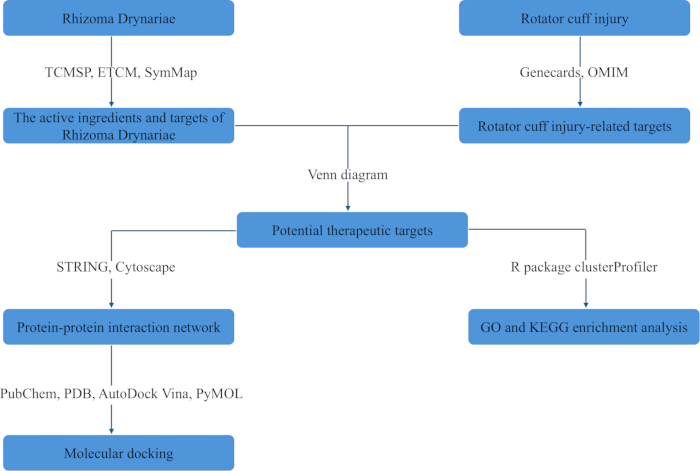
Figure 1: Schematic workflow outlining the bioinformatic pipeline applied in this study. Starting from the left, candidate bioactive compounds and their corresponding RD targets were retrieved from the TCMSP, ETCM, and SymMap databases. On the right, genes associated with RCI were retrieved from GeneCards and OMIM. The overlapping gene targets from these two datasets were identified using a Venn diagram and defined as potential therapeutic targets. The shared targets were then processed in two separate branches: one branch constructed a protein-protein interaction network using STRING and Cytoscape; the other branch performed GO and KEGG enrichment analyses using the R package clusterProfiler. The hub genes extracted from the PPI network were further validated by molecular docking, with structural preparation and simulation completed using PubChem, PDB, AutoDock Vina and PyMOL. Abbreviations: RD = Rhizoma Drynariae, RCI = rotator cuff injury, TCMSP = The Traditional Chinese Medicine Systems Pharmacology Database and Analysis Platform, ETCM = The Encyclopedia of Traditional Chinese Medicine, OMIM = The Online Mendelian Inheritance in Man, GO = gene ontology, KEGG = Kyoto encyclopedia of genes and genomes. Please click here to view a larger version of this figure.
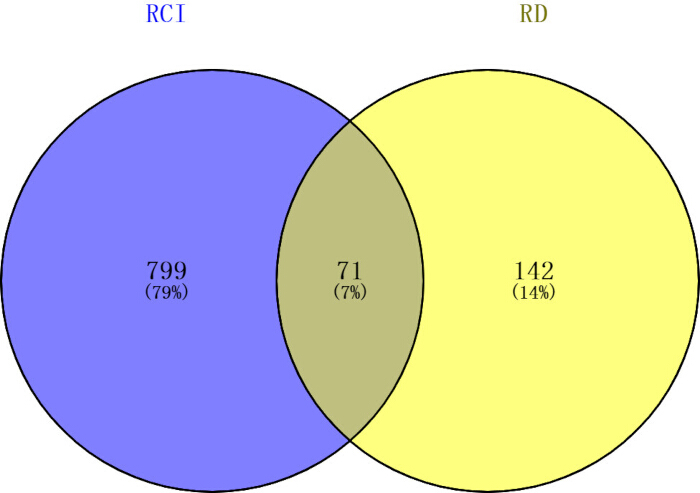
Figure 2: Venn diagram of overlapping targets between RD and RCI. The blue circle represents the targets associated with RCI. The yellow circle represents the potential therapeutic targets of RD. The overlapping olive-green region indicates the shared targets between RD and RCI. The numbers and percentages inside each region denote the count and proportion of unique or shared targets. Abbreviations: RD = Rhizoma Drynariae, RCI = rotator cuff injury. Please click here to view a larger version of this figure.
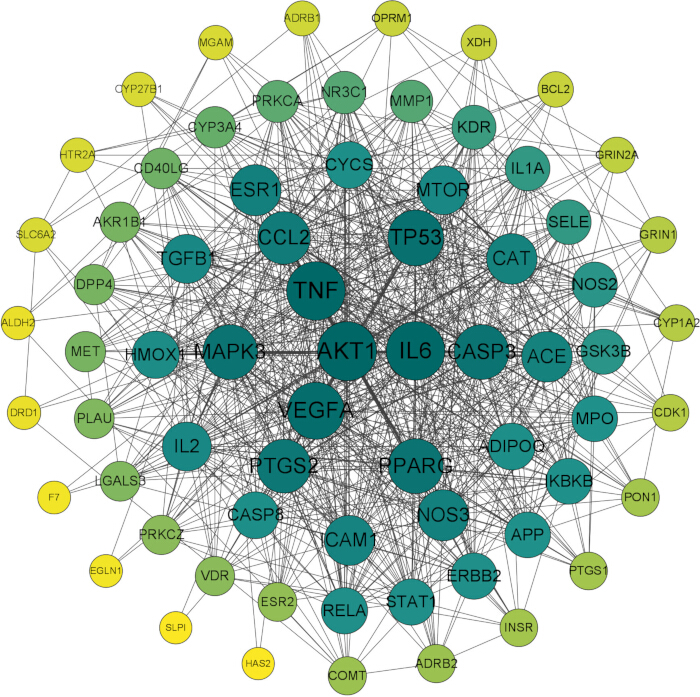
Figure 3:PPI network generated from the 71 overlapping gene targets linking RD and RCI. Each circle in the network represents a target gene, labeled with its official gene symbol. Lines linking two circles illustrate protein-protein associations mined from public bioinformatic databases. Node size and color saturation mirror the topological significance of individual genes inside the network. Genes with larger circles and deeper green hues achieve higher topological scores and occupy more central positions; smaller, pale yellow circles denote genes with weaker topological importance. Abbreviations: RD = Rhizoma Drynariae, RCI = rotator cuff injury, PPI = protein-protein interaction. Please click here to view a larger version of this figure.
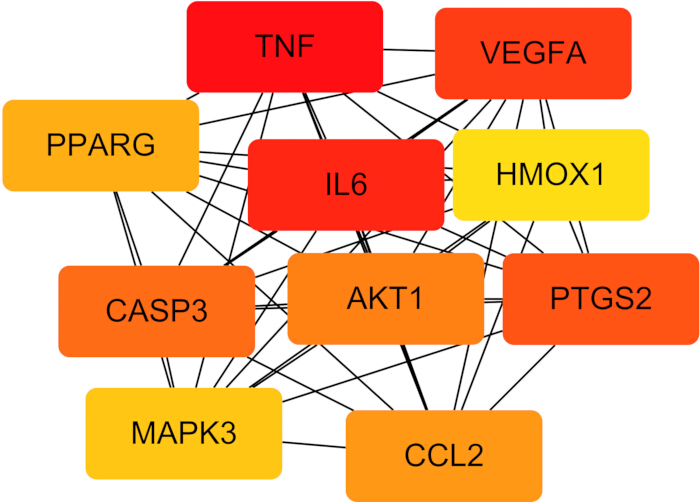
Figure 4: Top 10 hub genes identified from the PPI network using the cytoHubba plugin. Rectangular boxes represent hub genes, each labeled with its official gene symbol. Black lines connecting boxes reflect protein interactions between these core targets. The color gradient from bright red through orange to yellow visualizes the ranking of hub genes according to MCC scores calculated by the cytoHubba plugin; bright red boxes denote genes with the highest MCC scores and greatest network importance, while yellow boxes mark genes with relatively lower scores. Abbreviations: PPI = protein-protein interaction, MCC =Maximal Clique Centrality.Please click here to view a larger version of this figure.
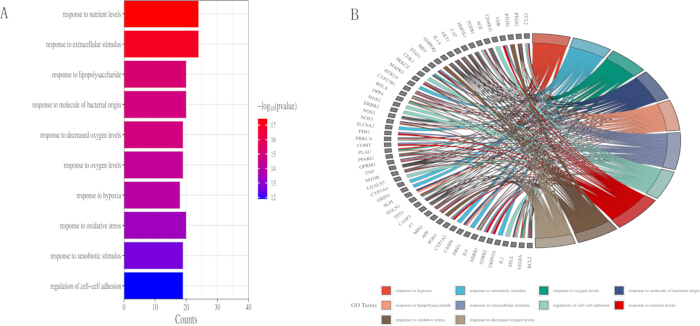
Figure 5:BP enrichment analysis of the 71 shared target genes of RD against RCI. (A) GO enrichment analysis of potential therapeutic targets for BP. It is a horizontal bar chart showing the top 10 significantly enriched GO biological process terms. The horizontal X-axis represents gene count, which corresponds to the number of target genes annotated to each GO term. The vertical Y-axis lists individual enriched GO terms. The continuous color bar on the right encodes -log10(pvalue); warmer red tones indicate higher -log10(pvalue) and stronger statistical significance, while cooler purple and blue tones indicate lower significance. (B) Relationship between potential therapeutic targets and BP. Panel B is a chord diagram illustrating the pairwise associations between enriched GO terms and their corresponding target genes. The outer circular segments are split into two categories: colored blocks stand for distinct GO biological process terms, and grey rectangular ticks label individual target gene symbols. Curved ribbons within the circle connect GO terms to their matched target genes, with each ribbon mapping one gene to the GO term it participates in. The color of each ribbon inherits the hue of its corresponding GO term from the outer ring. A legend at the bottom links each color to its respective GO term. Abbreviations: RD = Rhizoma Drynariae, RCI = rotator cuff injury, BP = biological process, GO = gene ontology. Please click here to view a larger version of this figure.
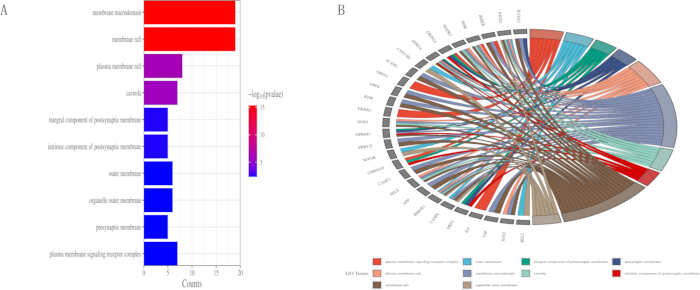
Figure 6: GO-CC terms derived from the 71 candidate targets of RD in the treatment of RCI. (A) GO enrichment analysis of potential therapeutic targets for CC. (B) Relationship between potential therapeutic targets and CC. Panel A is a horizontal bar plot displaying the top 10 significantly enriched GO cellular component entries. The horizontal X-axis quantifies the number of target genes assigned to each GO term, labeled as Counts. Enriched GO cellular component descriptions are arranged along the vertical Y-axis. The color bar on the right maps color variation to -log10(pvalue) values; bright red corresponds to higher -log10(pvalue) values and stronger statistical significance, while blue shades represent lower significance levels. Panel B presents a chord diagram that visualizes connections between enriched GO cellular component terms and their associated target genes. Segments on the outer ring are split into two groups: colored blocks stand for distinct GO cellular component terms, and grey tick marks denote individual target gene symbols. Curved ribbons inside the circle link each gene to its matched GO term, and every ribbon adopts the color of its corresponding GO term from the outer ring. A legend at the bottom defines the color coding for all GO cellular component categories. Abbreviations: RD = Rhizoma Drynariae, RCI = rotator cuff injury, CC = cellular component, GO = gene ontology Please click here to view a larger version of this figure.
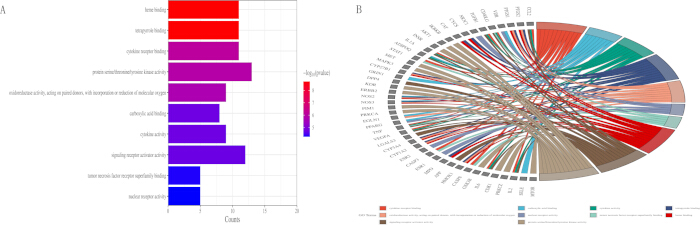
Figure 7: MF enrichment analysis performed on the 71 overlapping target genes of RD for RCI intervention. (A) GO enrichment analysis of potential therapeutic targets for MF. (B) Relationship between potential therapeutic targets and MF. Panel A is a horizontal bar chart that ranks the top 10 significantly enriched GO molecular function terms. Values on the horizontal X-axis represent gene counts, which correspond to the total number of target genes annotated to each molecular function entry. The vertical Y-axis lists individual GO molecular function descriptions. The color gradient bar on the right translates color variation into -log10(pvalue) metrics; bright red corresponds to higher -log10(pvalue) values and stronger statistical significance, while blue shades indicate weaker significance. Panel B is a chord diagram mapping the relationships between enriched GO molecular function categories and their associated target genes. Segments on the outer ring contain two classes of labels: colored blocks denote distinct GO molecular function terms, and small grey rectangular ticks mark individual target gene symbols. Curved ribbons extending inward from the outer ring connect each gene to its matched functional term, and each ribbon inherits the color assigned to its corresponding GO term. A bottom legend defines the color coding for all GO molecular function categories shown in the plot. Abbreviation: RD = Rhizoma Drynariae, RCI = rotator cuff injury, MF = molecular function, GO = gene ontology Please click here to view a larger version of this figure.
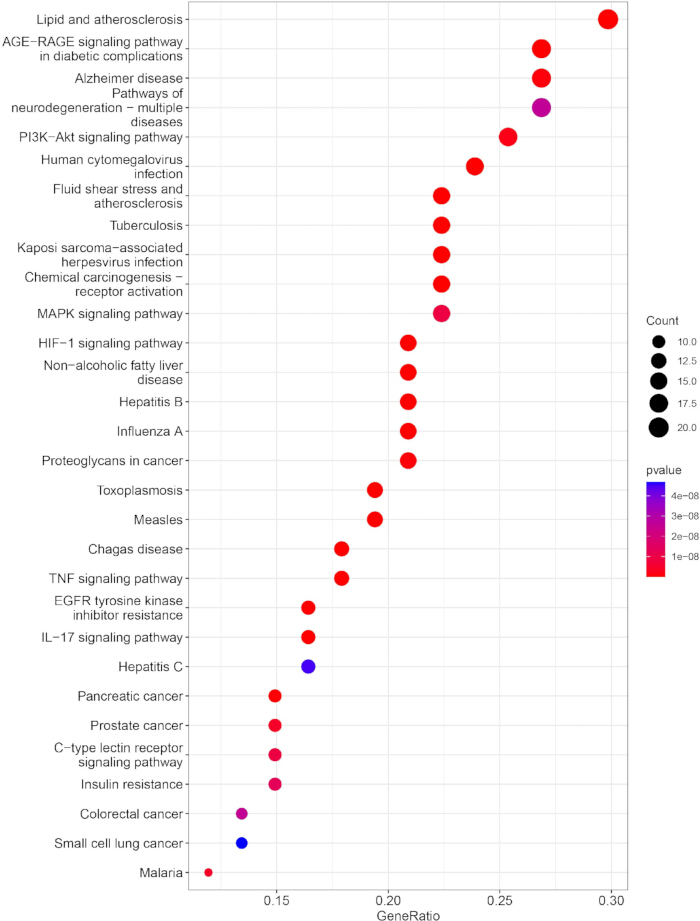
Figure 8: KEGG pathway enrichment analysis of the 71 shared target genes of RD against RCI. This dot plot visualizes the top enriched KEGG pathways. The vertical Y-axis lists the names of individual enriched pathways. The horizontal X-axis represents GeneRatio, defined as the ratio of target genes mapped to a pathway to the total number of genes in that pathway. Each circular dot stands for one enriched pathway. Dot size corresponds to gene count, with larger circles indicating more target genes annotated to the pathway. The dot color reflects the p-value: red indicates lower p-values and stronger statistical significance, while deep blue indicates higher p-values and weaker statistical significance. Two side legends separately define the scale for gene count and p-value color mapping. Abbreviations: RD = Rhizoma Drynariae, RCI = rotator cuff injury, KEGG = Kyoto encyclopedia of genes and genomes. Please click here to view a larger version of this figure.
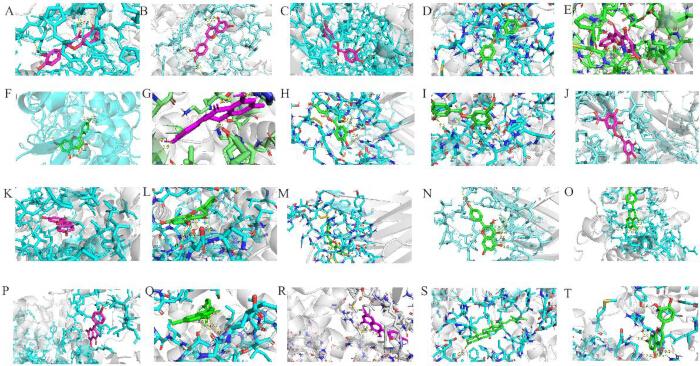
Figure 9: The top-ranked docking complexes. (A) (PTGS2, eriodictyol, -9.7 kcal/mol). (B) (PTGS2, luteolin, -9.6 kcal/mol). (C) (PTGS2, catechin, -9.5 kcal/mol). (D) (PTGS2, naringenin, -9.5 kcal/mol). (E) (PTGS2, Aureusidin, -9.4 kcal/mol). (F) (PTGS2, kaempferol, -9.2 kcal/mol). (G) (PTGS2, chroman, -9.1 kcal/mol). (H) (TNF, catechin, -9.1 kcal/mol), (I) (PTGS2, digallate, -9 kcal/mol). (J) (TNF, digallate, -9 kcal/mol), (K) (PPARG, chroman, -8.9 kcal/mol); (L) (PPARG, naringenin, -8.9 kcal/mol), (M) (TNF, Aureusidin, -8.9 kcal/mol); (N) (TNF, kaempferol, -8.8 kcal/mol); (O) (MAPK3, chroman, -8.7 kcal/mol); (P) (MAPK3, naringenin, -8.7 kcal/mol); (Q) (PPARG, Aureusidin, -8.7 kcal/mol); (R) (PPARG, kaempferol, -8.7 kcal/mol); (S) (PTGS2, 22_Stigmasten_3_one, -8.7 kcal/mol); (T) (MAPK3, luteolin, -8.6 kcal/mol). Panels A through T separately illustrate the computed binding geometry of individual small-molecule compounds within the binding cavity of corresponding protein targets. Cyan stick models depict amino acid residues lining the protein-binding cavity. Small molecule ligands are rendered in magenta or green sticks to differentiate distinct chemical structures. Yellow dashed lines mark intermolecular hydrogen bonds between ligands and pocket residues, with numerical annotations indicating hydrogen bond distances in angstroms (Å). The translucent white surface outlines the overall 3D topology of each protein receptor. All binding pose calculations were carried out via rigid-receptor molecular docking using AutoDock Vina software. Please click here to view a larger version of this figure.
| Mol ID | Molecule Name | oral bioavailability(OB) (%) | drug-likeness (DL) |
| MOL001040 | (2R)-5,7-dihydroxy-2-(4-hydroxyphenyl)chroman-4-one | 42.36 | 0.21 |
| MOL001978 | Aureusidin | 53.42 | 0.24 |
| MOL002914 | Eriodyctiol (flavanone) | 41.35 | 0.24 |
| MOL000449 | Stigmasterol | 43.83 | 0.76 |
| MOL000358 | beta-sitosterol | 36.91 | 0.75 |
| MOL000422 | kaempferol | 41.88 | 0.24 |
| MOL004328 | naringenin | 59.29 | 0.21 |
| MOL000492 | (+)-catechin | 54.83 | 0.24 |
| MOL005190 | eriodictyol | 71.79 | 0.24 |
| MOL000569 | digallate | 61.85 | 0.26 |
| MOL000006 | luteolin | 36.16 | 0.25 |
| MOL009061 | 22-Stigmasten-3-one | 39.25 | 0.76 |
| MOL009063 | Cyclolaudenol acetate | 41.66 | 0.79 |
| MOL009075 | cycloartenone | 40.57 | 0.79 |
| MOL009076 | cyclolaudenol | 39.05 | 0.79 |
| MOL009078 | davallioside A_qt | 62.65 | 0.51 |
| MOL009087 | marioside_qt | 70.79 | 0.19 |
| MOL009091 | xanthogalenol | 41.08 | 0.32 |
Table 1: Pharmacokinetic profiles of eighteen candidate bioactive constituents derived from RD. Compounds were retrieved from the TCMSP database and filtered by two ADME-related thresholds: OB ≥ 30% and DL ≥ 0.18. Columns list the TCMSP accession number (Mol ID), compound name, calculated OB value (%), and DL score for each screened constituent. Abbreviations: RD = Rhizoma Drynariae, RCI = rotator cuff injury, ADME = absorption, distribution, metabolism, excretion, TCMSP = The Traditional Chinese Medicine Systems Pharmacology Database and Analysis Platform, OB = oral bioavailability, DL = drug-likeness.
| Rank | Gene | Name | Score |
| 1 | TNF | tumor necrosis factor | 328291218366500 |
| 2 | IL6 | interleukin 6 | 328291215913592 |
| 3 | VEGFA | vascular endothelial growth factor A | 328291215896284 |
| 4 | PTGS2 | prostaglandin-endoperoxide synthase 2 | 328288656326402 |
| 5 | CASP3 | Caspase 3 | 328288180323600 |
| 6 | AKT1 | AKT serine/threonine kinase 1 | 328287745700516 |
| 7 | CCL2 | C-C motif chemokine ligand 2 | 328161521686320 |
| 8 | PPARG | peroxisome proliferative activated receptor gamma | 325302724852296 |
| 9 | MAPK3 | mitogen-activated protein kinase 3 | 308779166166218 |
| 10 | HMOX1 | heme oxygenase 1 | 299171945318400 |
Table 2: Top 10 hub genes identified from the PPI network. Genes were ranked according to MCC scores calculated by the cytoHubba plugin within Cytoscape. MCC is a cytoHubba topological metric where larger numeric values reflect greater topological importance within the network. Columns present the ranking order, official gene symbol, full gene name, and corresponding raw MCC score for each hub gene. Abbreviations: PPI = protein-protein interaction, MCC =Maximal Clique Centrality.
| Receptors | Ligands | Free energy (kcal/mol) | Corresponding serial numbers in Figure 9 |
| PTGS2 | eriodictyol | -9.7 | A |
| PTGS2 | luteolin | -9.6 | B |
| PTGS2 | catechin | -9.5 | C |
| PTGS2 | naringenin | -9.5 | D |
| PTGS2 | Aureusidin | -9.4 | E |
| PTGS2 | kaempferol | -9.2 | F |
| PTGS2 | chroman | -9.1 | G |
| TNF | catechin | -9.1 | H |
| PTGS2 | digallate | -9 | I |
| TNF | digallate | -9 | J |
| PPARG | chroman | -8.9 | K |
| PPARG | naringenin | -8.9 | L |
| TNF | Aureusidin | -8.9 | M |
| TNF | kaempferol | -8.8 | N |
| MAPK3 | chroman | -8.7 | O |
| MAPK3 | naringenin | -8.7 | P |
| PPARG | Aureusidin | -8.7 | Q |
| PPARG | kaempferol | -8.7 | R |
| PTGS2 | 22_Stigmasten_3_one | -8.7 | S |
| MAPK3 | luteolin | -8.6 | T |
Table 3: Molecular docking binding affinity outcomes for the 20 selected receptor-ligand complexes. Each row lists the receptor protein, small-molecule ligand, calculated binding free energy (kcal/mol), and matching subplot label in Figure 9. More negative free energy values correspond to stronger binding stability between the protein pocket and ligand compound. Abbreviations: PTGS2 = prostaglandin-endoperoxide synthase 2, TNF = tumor necrosis factor, PPARG = peroxisome proliferative activated receptor gamma, MAPK3 = mitogen-activated protein kinase 3.
Discussion
RCI is a complex musculoskeletal disorder involving chronic inflammation, excessive tenocyte apoptosis, impaired angiogenesis, and inadequate extracellular matrix remodeling, whose combined pathological changes result in poor tendon-to-bone healing and suboptimal clinical prognosis35. This disease often arises from acute trauma or long-term shoulder overuse, and persistent inflammation will break the metabolic balance of the tendon extracellular matrix36. Clinically, current treatments fail to simultaneously target multiple pathological links, resulting in limited efficacy and a high recurrence rate37. RD is a classic TCM herb that strengthens bones, activates blood circulation, and promotes tissue repair, which has long been clinically used for the treatment of bone and tendon damage38. However, the precise molecular regulatory mechanism of RD against RCI has not been systematically analyzed in existing studies.
On the basis of the above research background, this study systematically reveals the multi-component, multi-target, and multi-pathway mechanism of RD against RCI using network pharmacology and molecular docking. Previous phytochemical and pharmacological studies have fully verified that flavonoids derived from RD possess significant anti-inflammatory, antioxidant, anti-apoptotic, and pro-angiogenic biological activities, which are the core material basis for its tissue repair function39. Consistent with the findings of previous studies, a total of 18 active components were identified from RD, among which eriodictyol, luteolin, catechin, naringenin, and aureusidin were recognized as core components. A large number of phytochemical studies have proven that flavonoids are the main pharmacodynamic substances of RD40. Such small-molecule compounds can penetrate tissue barriers and exert comprehensive regulatory effects on the repair microenvironment of damaged tendons41. Their favorable ADME properties ensure good OB and drug‑likeness, supporting their potential as natural therapeutic agents for RCI. Different from single-target chemical synthetic drugs, these natural flavonoids can intervene inflammation, oxidative injury, cell survival and angiogenesis at the same time, showing unique advantages for chronic degenerative tendon lesions42.
Accumulating studies have confirmed that the occurrence and development of RCI are closely related to the abnormal expression of multiple functional genes, and a variety of core genes have been proven to participate in the pathological processes of tendon inflammation, apoptosis and tissue remodeling43. Based on the recognized gene regulatory mechanism of RCI, this study further explored the therapeutic targets of RD. Seventy‑one overlapping targets were identified as potential therapeutic targets of RD against RCI. PPI network analysis screened 10 hub genes: TNF, IL6, VEGFA, PTGS2, CASP3, AKT1, CCL2, PPARG, MAPK3, and HMOX1. Among them, TNF and IL6 are pivotal pro‑inflammatory cytokines that trigger inflammatory cascades, inhibit tenocyte proliferation, and suppress extracellular matrix synthesis, thereby aggravating tendon injury44. The massive release of the two cytokines will recruit immune cells, amplify the inflammatory reaction, and restrain the proliferation of tendon stem cells45. VEGFA promotes neovascularization at the injury site, improves local blood supply, and enhances the mechanical strength of healing tissue46. The tendon-bone interface is naturally short of blood vessels, and insufficient new vessels are a major factor leading to unsatisfactory healing quality after injury47. PTGS2 mediates inflammatory pain and prostaglandin production, while CASP3 is a key executor of tenocyte apoptosis48,49. Overexpression of PTGS2 will aggravate inflammatory swelling and pain, while high activation of CASP3 will induce continuous loss of functional tenocytes50,51. AKT1 and MAPK3 are core kinases that regulate cell survival, proliferation, and differentiation, which are essential for tendon regeneration52,53. Moderate activation of the two kinases can maintain the vitality of repair cells and accelerate extracellular matrix deposition54. CCL2 recruits inflammatory cells, whereas PPARG and HMOX1 exert anti‑inflammatory and antioxidant effects55,56,57. The two genes can relieve oxidative stress and reduce excessive inflammatory infiltration in local tendon tissues58. Collectively, these hub genes form a core regulatory network that modulates inflammation, apoptosis, angiogenesis, and tissue remodeling in RCI.
Existing pathological studies have clarified that the pathological progression of RCI is mainly driven by inflammatory response, oxidative stress, abnormal cell proliferation and disordered extracellular matrix organization, which are the key pathological links throughout the occurrence and repair of RCI59. On this basis, GO enrichment analysis was performed in the present study to explore the potential biological mechanism of RD intervening in RCI. These biological processes are exactly the key pathological links of RCI throughout lesion occurrence and repair, suggesting that RD can target multiple pathological processes simultaneously60. A large number of previous mechanistic studies have confirmed that the TNF signaling pathway, PI3K-Akt signaling pathway, MAPK signaling pathway, and HIF-1 signaling pathway are key signaling pathways regulating tendon inflammation, cell repair, and tissue reconstruction61,62,63,64. To further explore the potential signaling mechanism of RD in the treatment of RCI, this study conducted KEGG pathway enrichment analysis based on the above research basis. The results revealed that RD against RCI primarily involves the above four pathways. The TNF signaling pathway promotes inflammatory response and tenocyte apoptosis, which acts as an upstream driver of tendon inflammatory degeneration65. The PI3K‑Akt pathway enhances cell survival and angiogenesis, which are beneficial for tendon healing, and it can coordinate multiple growth factors to facilitate collagen secretion of fibroblast66,67. The MAPK signaling pathway regulates cell proliferation, differentiation, and extracellular matrix synthesis, taking part in the whole process of tendon reconstruction68. The HIF‑1 signaling pathway responds to hypoxia and promotes vascular regeneration, which effectively improves the hypoxic microenvironment of injured tendons69. These pathways cross‑talk and form a complex regulatory network, fully embodying the multi‑pathway characteristics of RD in treating RCI.
Molecular docking has become a routine and auxiliary verification method in network pharmacology research, which can directly characterize the binding activity between active ingredients and core targets. Accordingly, this study adopted molecular docking to verify the predictive results of network pharmacology70. The results demonstrated that core flavonoid components of RD can stably bind to the active pockets of hub proteins, which further validates the reliability of the network pharmacological predictions. These stable binding modes suggest that RD may directly act on key targets to exert therapeutic effects. The tight binding between flavonoid ligands and the active sites of hub proteins provides intuitive molecular interaction evidence, which also offers candidate compounds for subsequent cell functional verification experiments.
This study has several limitations. First, predictions rely on public‑database bioinformatic analyses, which may introduce annotation bias toward well‑studied proteins. Rotator‑cuff tendon‑specific gene expression and protein isoforms were not incorporated, and the undirected STRING‑derived PPI network cannot fully recapitulate tendon‑specific biology. Enriched pathways such as TNF, PI3K‑Akt, and MAPK represent common inflammatory cascades rather than RD‑exclusive signatures. Public omics resources cannot recapitulate in vivo dynamic pathological changes and individual differences of human rotator‑cuff tissue. Future work may integrate single‑cell RNA‑sequencing datasets to refine the mechanistic interpretation. Second, compound screening used empirical ADME cut‑offs (OB ≥ 30%, DL ≥ 0.18), which may discard bioactive compounds with low oral bioavailability. Molecular docking employed a rigid‑receptor setup, ignoring protein flexibility and structural water molecules, without biophysical validation (e.g., SPR, ITC). Positive‑drug controls, sensitivity analysis, toxicity assessment, and full pharmacokinetic profiling were not performed. All outputs are computational predictions; in vitro cellular and in vivo animal experiments are required to validate target‑pathway functions and ingredient‑hub‑gene regulatory relationships. Third, synergistic interactions among multiple RD components and their in vivo pharmacokinetic behaviors remain unexplored. Systematic experimental work is needed to decipher ingredient‑to‑ingredient crosstalk and metabolic profiles of this herbal medicine. This study systematically reveals that RD treats RCI through a multi‑component, multi‑target, and multi‑pathway regulatory network. RD may exert therapeutic effects by inhibiting inflammation, reducing tenocyte apoptosis, promoting angiogenesis, and enhancing extracellular matrix repair via the TNF, PI3K‑Akt, MAPK, and HIF‑1 signaling pathways. These findings provide a solid theoretical basis for the clinical application and mechanistic research of RD in RCI.
Disclosures
The authors declare that the research was conducted in the absence of any commercial or financial relationships that could be construed as a potential conflict of interest.
Acknowledgements
The authors are grateful to the developers and maintainers of the public bioinformatic resources used in this work, including TCMSP, ETCM, SymMap, GeneCards, OMIM, STRING, UniProt, PubChem, and RCSB‑PDB. These open‑access databases supplied publicly available datasets that supported the computational analyses described in this study. This research received no external funding.
Materials
| Name | Company | Catalog Number | Comments |
|---|---|---|---|
| AutoDock Vina | Scripps Research Institute | V1.2.0 | Molecular docking software for protein-ligand binding simulation; RRID: Not available. URL: https://github.com/ccsb-scripps/AutoDock-Vina |
| clusterProfiler | Bioconductor | V3.2.14 | R package for GO and KEGG enrichment analysis; compatible with R 4.0.3; RRID: SCR_016884. URL: https://bioconductor.org/packages/release/bioc/html/clusterProfiler.html |
| cytoHubba | National Taiwan University(Cytoscape plugin) | V0.1 | Cytoscape plugin for hub-gene screening by topological metrics; RRID: SCR_006556. URL: https://apps.cytoscape.org/apps/cytohubba |
| Cytoscape | Institute for Systems Biology | V3.8.0 | Software for network visualization and analysis; RRID: SCR_003032. URL: https://cytoscape.org/ |
| ETCM (Encyclopedia of Traditional Chinese Medicine) | Institute of Chinese Materia Medica, China Academy of Chinese Medical Sciences | V2.0 | Curated database for TCM ingredients, targets and formulas; RRID: Not available. URL: http://www.tcmip.cn/ETCM2/front/#/ |
| GeneCards | Weizmann Institute of Science | — | Integrative human-gene database with periodic major releases and incremental updates; data retrieved on 2025-12-15; RRID: Not available. URL: https://www.genecards.org |
| Open Babel | Open Babel development team | — | Daily-updated gene-phenotype database without a global release version; data retrieved on 2026-02-16; RRID: Not available. URL: https://omim.org |
| OMIM (Online Mendelian Inheritance in Man) | Johns Hopkins University | — | Open-source cheminformatics toolkit for molecular-file conversion; data retrieved on 2025-12-21; RRID: Not available. URL: https://openbabel.org/ |
| PubChem | National Center for Biotechnology Information (NCBI) | — | Public chemical database continuously updated without a global fixed release; compound data retrieved on 2026-02-10; RRID: Not available. URL: https://pubchem.ncbi.nlm.nih.gov |
| PyMOL | Schrödinger, LLC | V2.5 | Software for protein-ligand structure visualization and rendering; RRID: SCR_000305. URL: https://pymol.org |
| R software | R Foundation for Statistical Computing | V4.0.3 | Statistical computing and graphics environment; RRID: SCR_001905. URL: https://cran.r-project.org |
| RCSB PDB | RCSB Protein Data Bank | — | Public archive of 3D protein structures; each PDB entry has independent versioning; structure files retrieved on 2026-02-03; RRID: SCR_012820. URL: https://www.rcsb.org |
| STRING | ELIXIR | V11.5 | Database of known and predicted protein-protein interactions; RRID: SCR_005223. URL: https://string-db.org |
| SymMap | China Academy of Chinese Medical Sciences | V2.0 | Integrated database linking herbal medicines, ingredients, targets and symptoms; RRID: Not available. URL: http://www.symmap.org |
| TCMSP | Northwest A&F University | V2.3 | TCM Systems Pharmacology Database containing ingredients, targets and ADME properties; RRID: Not available. URL: https://old.tcmsp-e.com/tcmsp.php |
| UniProt | European Bioinformatics Institute (EMBL-EBI) | — | Comprehensive protein sequence and annotation database with scheduled releases and continuous updates; data retrieved on 2025-12-12; RRID: SCR_002380. URL: https://www.uniprot.org |
| Venny | BioinfoGP, Spanish National Centre for Biotechnology | V2.0 | Web-based tool for Venn diagram generation and overlapping gene sets; RRID: SCR_016561. URL: https://bioinfogp.cnb.csic.es/tools/venny/index2.0.2.html |
References
- Desmeules F, et al. Rotator cuff tendinopathy diagnosis, nonsurgical medical care, and rehabilitation: a clinical practice guideline. J Orthop Sports Phys Ther. 2025;55(4):235-274.
- Yoshida M, et al. Post-operative rotator cuff integrity, based on Sugaya's classification, can reflect abduction muscle strength of the shoulder. Knee Surg Sports Traumatol Arthrosc. 2018;26(1):161-168.
- Aydın A, et al. The effects of N-acetylcysteine and adipose-derived stem cells on tendon healing in chronic rotator cuff tears: a rabbit model study. BMC Musculoskelet Disord. 2025;26(1):1014.
- Bolam SM, et al. Ethnicity, sex, and socioeconomic disparities in the treatment of traumatic rotator cuff injuries in Aotearoa/New Zealand. J Shoulder Elbow Surg. 2023;32(1):121-132.
- Patel HP, Patel S, Zalin M, Agrawal DK. Calcified vs. non-calcified tendinopathy of the rotator cuff: clinical presentations, prognostic implications, and emerging therapeutic strategies. J Orthop Sports Med. 2025;7(3):379-391.
- Sewpaul Y, et al. Non-steroidal anti-inflammatory drugs and cyclooxygenase-2 inhibitors do not affect healing after rotator cuff repair: a systematic review and meta-analysis. Arthroscopy. 2024;40(3):930-940.e1.
- Hopewell S, et al. Progressive exercise compared with best practice advice, with or without corticosteroid injection, for the treatment of patients with rotator cuff disorders (GRASP): a multicentre, pragmatic, 2 × 2 factorial, randomised controlled trial. Lancet. 2021;398(10298):416-428.
- Kandikattu S, Aavula M, Pisarski T, Parvizi D, Agrawal DK. Effect of metabolic syndrome in the incidence of rotator cuff injury and recovery following surgical repair. J Surg Res (Houst). 2025;8(1):202-210.
- Longo UG, et al. Retear rates after rotator cuff surgery: a systematic review and meta-analysis. BMC Musculoskelet Disord. 2021;22(1):749.
- Siu WS, Ma H, Cheng W, Shum WT, Leung PC. Traditional Chinese medicine for topical treatment of skeletal muscle injury. Pharmaceuticals (Basel). 2023;16(8):1144.
- Jingying G, et al. A comprehensive review of Drynariae rhizoma: botany, traditional applications, and active flavonoid components. J Pharm Pharmacol. 2025;77(10):1319-1337.
- Chen GY, et al. Prediction of Rhizoma Drynariae targets in the treatment of osteoarthritis based on network pharmacology and experimental verification. Evid Based Complement Alternat Med. 2021;2021:5233462.
- Yang G, et al. Total flavonoids of Rhizoma Drynariae enhance bone marrow mesenchymal stem cell-mediated tendon-bone healing by promoting tissue regeneration, angiogenesis, and modulation of cytokine expression. Biology (Basel). 2025;14(11):1593.
- Shen J, et al. Rhizoma Drynariae-derived EV-like particles alleviate osteoporosis by promoting osteogenic differentiation in BMSCs through the activation of the hsa_circ_0001275/miR-422a pathway. Bone. 2025;196:117489.
- Cai L, et al. Hydrogel microspheres loaded with sinomenine and Drynaria rhizome enhance the treatment of rheumatoid arthritis via immune regulation and promoting bone repair. J Nanobiotechnology. 2026;24(1):174.
- Chen GY, et al. Network pharmacology analysis and experimental validation to investigate the mechanism of total flavonoids of Rhizoma Drynariae in treating rheumatoid arthritis. Drug Des Devel Ther. 2022;16:1743-1766.
- Chen GY, et al. Mechanisms of total glucosides of paeony in alleviating methotrexate-induced liver injury. Drug Des Devel Ther. 2025;19:3407-3423.
- Zhang P, et al. Network pharmacology: towards the artificial intelligence-based precision traditional Chinese medicine. Brief Bioinform. 2024;25(1):bbad518.
- Zhao L, et al. Network pharmacology, a promising approach to reveal the pharmacology mechanism of Chinese medicine formula. J Ethnopharmacol. 2023;309:116306.
- Ru J, et al. TCMSP: a database of systems pharmacology for drug discovery from herbal medicines. J Cheminform. 2014;6:13.
- Xu HY, et al. ETCM: an encyclopaedia of traditional Chinese medicine. Nucleic Acids Res. 2019;47(D1):D976-D982.
- Wu Y, et al. SymMap: an integrative database of traditional Chinese medicine enhanced by symptom mapping. Nucleic Acids Res. 2019;47(D1):D1110-D1117.
- UniProt Consortium. UniProt: the universal protein knowledgebase. Nucleic Acids Res. 2018;46(5):2699.
- Stelzer G, et al. The GeneCards Suite: from gene data mining to disease genome sequence analyses. Curr Protoc Bioinformatics. 2016;54:1.30.1-1.30.33.
- Amberger JS, Hamosh A. Searching Online Mendelian Inheritance in Man (OMIM): a knowledgebase of human genes and genetic phenotypes. Curr Protoc Bioinformatics. 2017;58:1.2.1-1.2.12.
- Szklarczyk D, et al. The STRING database in 2023: protein-protein association networks and functional enrichment analyses for any sequenced genome of interest. Nucleic Acids Res. 2023;51(D1):D638-D646.
- Otasek D, Morris JH, Bouças J, Pico AR, Demchak B. Cytoscape Automation: empowering workflow-based network analysis. Genome Biol. 2019;20(1):185.
- Pitarch B, Chagoyen M, Ranea JAG, Pazos F. A review on Gene Ontology evaluations. Database (Oxford). 2025;2025:baaf058.
- Kanehisa M, Furumichi M, Sato Y, Kawashima M, Ishiguro-Watanabe M. KEGG for taxonomy-based analysis of pathways and genomes. Nucleic Acids Res. 2023;51(D1):D587-D592.
- Kim S, et al. PubChem in 2021: new data content and improved web interfaces. Nucleic Acids Res. 2021;49(D1):D1388-D1395.
- Burley SK, et al. RCSB Protein Data Bank: celebrating 50 years of the PDB with new tools for understanding and visualizing biological macromolecules in 3D. Protein Sci. 2022;31(1):187-208.
- Eberhardt J, Santos-Martins D, Tillack AF, Forli S. AutoDock Vina 1.2.0: new docking methods, expanded force field, and Python bindings. J Chem Inf Model. 2021;61(8):3891-3898.
- Li QR, Han YX, Bian YT, Lan MQ, Chen GY. Unveiling the mechanism of Cibotium barometz in the treatment of rheumatoid arthritis: a study based on network pharmacology and experimental validation. Curr Med Chem. 2026. Online ahead of print.
- Seeliger D, de Groot BL. Ligand docking and binding site analysis with PyMOL and Autodock/Vina. J Comput Aided Mol Des. 2010;24(5):417-422.
- Wang Y, Xu B, Ma C, Huang D, Zhou L. Association between inflammatory proteins and rotator cuff tears: a bidirectional Mendelian randomization study. Sci Rep. 2025;15(1):26987.
- Wang KC, et al. The influence of age on cellular senescence in injured versus healthy muscle and its implications on rotator cuff injuries. J Shoulder Elbow Surg. 2025;34(6 Suppl):S117-S126.
- Wellington IJ, et al. Management of failed rotator cuff repairs: a review. Orthop Clin North Am. 2022;53(4):473-482.
- Han L, Wang C, Wang T, Hu Y, Wang H. Total flavonoids of Rhizoma Drynariae improves tendon-bone healing for anterior cruciate ligament reconstruction in mice and promotes the osteogenic differentiation of bone mesenchymal stem cells by the ERR1/2-Gga1-TGF-β/MAPK pathway. Environ Toxicol. 2024;39(1):106-119.
- Chai S, et al. Luteolin rescues postmenopausal osteoporosis elicited by OVX through alleviating osteoblast pyroptosis via activating PI3K-AKT signaling. Phytomedicine. 2024;128:155516.
- Li W, et al. Effects of total flavonoids of Rhizoma Drynariae on biochemical indicators of bone metabolism: a systematic review and meta-analysis. Front Pharmacol. 2024;15:1443235.
- Wang Z, Cao L, Wang X. Total flavonoids of Rhizoma Drynariae ameliorate tendon-bone healing following anterior cruciate ligament reconstruction in rats by activating the FSP1/CoQ10 pathway to inhibit osteoblast mitochondrial dysfunction and ferroptosis. Appl Biochem Biotechnol. 2026;198(8):5916-5938.
- Kim JG, et al. Therapeutic potential of quercetin as an antioxidant for bone-muscle-tendon regeneration and aging. Aging Dis. 2024;16(3):1414-1437.
- Worsfold SI, et al. Rotator cuff tendinopathy: pathways of apoptosis. Sports Med Arthrosc Rev. 2024;32(1):12-16.
- Chen L, et al. AMPK signaling in osteoarthritis: from mechanisms to targeted therapeutics. Front Pharmacol. 2025;16:1681610.
- Li Y, et al. Leptin enhances M1 macrophage polarization and impairs tendon-bone healing in rotator cuff repair: a rat model. Clin Orthop Relat Res. 2025;483(5):939-951.
- Yang Y, et al. Celastrol suppresses neovascularization in rat aortic vascular endothelial cells stimulated by inflammatory tenocytes via modulating the NLRP3 pathway. Open Med (Wars). 2025;20(1):20241121.
- Li Y, et al. Prevascularized bone marrow-derived mesenchymal stem cell sheets promote tendon-bone integration in rotator cuff repair. J Bone Joint Surg Am. 2026;108(17):1389-1398.
- Zhao MJ, et al. Eupatorin as a promising natural compound against knee osteoarthritis: from network pharmacology to experimental validation. Front Biosci (Landmark Ed). 2025;30(12):46747.
- Cho W, et al. Valdecoxib ameliorates apoptosis and ferroptosis in tenocytes via the SIRT6/NRF2-mediated suppression of oxidative stress. Arch Med Res. 2025;56(6):103231.
- Cheng Y, et al. Amentoflavone alleviated cartilage injury and inflammatory response of knee osteoarthritis through PTGS2. Naunyn Schmiedebergs Arch Pharmacol. 2024;397(11):8903-8916.
- Cho W, et al. Therapeutic potential of ginsenoside compound K in managing tenocyte apoptosis and extracellular matrix damage in diabetic tendinopathy. Tissue Cell. 2024;86:102275.
- Cheng P, et al. High-purity magnesium screws modulate macrophage polarization during the tendon-bone healing process in the anterior cruciate ligament reconstruction rabbit model. Regen Biomater. 2022;9:rbac067.
- Zhou L, et al. Regorafenib attenuates osteoclasts differentiation by inhibiting the NF-κB, NFAT, ERK, and p38 signaling pathways. ACS Omega. 2024;9(31):33574-33593.
- Cho MH, Jin H, Ha J, Chu S, An S. An integrated systems pharmacology approach combining bioinformatics, untargeted metabolomics and molecular dynamics to unveil the anti-aging mechanisms of Tephroseris flammea. Biomolecules. 2025;15(12):1740.
- Wang L, et al. IL-33/ST2 drives inflammatory pain via CCL2 signaling and activation of TRPV1 and TRPM8. Commun Biol. 2025;8(1):724.
- Zhang P, Xu X, Wang H, Zhang Y. Anti-inflammatory activity and potential anti-inflammatory mechanisms of Artemisia scoparia essential oil. J Pharm Pharmacol. 2026;78(2):rgag004.
- Wang Z, et al. Engineered mesenchymal stem cells with endogenous trehalose expression activate the NRF2-HMOX1 pathway to enhance antioxidant stress and wound healing capacity. Adv Wound Care (New Rochelle). 2026. Online ahead of print.
- Lu Y, et al. Dual-PPARα/δ agonist H11 alleviates tendinopathy via modulating the Nrf2/HO-1/GPX4 pathway. Free Radic Biol Med. 2026;242:333-344.
- Chung SW, Yoon JP, Park SJ. Inhibiting muscle degeneration in rotator cuff tears: integrative biologic approaches targeting regeneration, fibrosis, and metabolism. Stem Cells Transl Med. 2026;15(6):szag023.
- Feuerriegel GC, et al. Assessment of the rotator cuff muscles: state-of-the-art MRI and clinical implications. Radiology. 2025;315(2):e242131.
- He Y, et al. SHED-derived exosome-mimetics promotes rotator cuff tendon-bone healing via macrophage immunomodulation through NF-κB suppression and autophagy activation. Mater Today Bio. 2025;34:102146.
- Zhang Z, et al. Curcumin improves functional recovery of ruptured tendon by promoting tenogenesis via PI3K/Akt signaling. Stem Cells Transl Med. 2024;13(5):477-489.
- Chen C, et al. CTHRC1 attenuates tendinopathy via enhancing EGFR/MAPK signaling pathway. Adv Sci (Weinh). 2024;11(47):e2406611.
- Zulkifli A, et al. The potential mechanism of hypoxia-induced tenogenic differentiation of mesenchymal stem cell for tendon regeneration. Tissue Cell. 2023;82:102075.
- Xiang L, Deng H, Zhou S. Effects of TNF-α on behaviour and inflammation in rats with rotator cuff injury through NGF. Discov Med. 2024;36(185):1241-1249.
- Liu H, et al. RNA-sequencing-based elucidation of the mechanism underlying aFGF mediated regulation of BMSCs via the PI3K-AKT pathway and its implications for rotator cuff injury repair. J Orthop Surg Res. 2025;20(1):997.
- Chen GY, et al. Total flavonoids of Rhizoma Drynariae restore the MMP/TIMP balance in models of osteoarthritis by inhibiting the activation of the NF-κB and PI3K/AKT pathways. Evid Based Complement Alternat Med. 2021;2021:6634837.
- Wang Y, Gu X, Tu J, Xu B. MCP-1 exacerbates diabetic rotator cuff tear by driving synovial inflammation via MAPK/ERK-mediated macrophage polarization. J Shoulder Elbow Surg. 2026. Online ahead of print.
- Lin J, et al. Hypobaric hypoxia ameliorates impaired regeneration after diabetic skeletal muscle injury by promoting HIF-1α signaling. Int J Mol Sci. 2026;27(2):648.
- Tian M, Wang K, Chen D. Efficacy and mechanisms of Xiangsha Liujunzi Decoction for gastroesophageal reflux disease: a study integrating meta-analysis, network pharmacology and molecular docking. Phytomedicine. 2026;151:157766.