Metabolic/bariatric surgery is a durable intervention for type 2 diabetes mellitus that improves glycemic control through weight-dependent and weight-independent mechanisms. Interpreting long-term remission requires attention to endpoint definitions, procedure-specific benefits and risks, recurrence, cardiovascular health, and lifelong multidisciplinary follow-up.
Review Article
Long-Term Effects of Bariatric Surgery on Type 2 Diabetes: Mechanisms, Outcomes, and Clinical Implications: A Focused Review
* These authors contributed equally
In This Article
Summary
Abstract
Metabolic/bariatric surgery is an effective intervention for people with obesity and type 2 diabetes mellitus (T2DM), with benefits extending beyond weight loss. This focused review examines long-term glycemic outcomes after Roux-en-Y gastric bypass (RYGB), sleeve gastrectomy (SG), one-anastomosis gastric bypass (OAGB), and adjustable gastric banding (AGB). Because reported remission depends on glycated hemoglobin thresholds, medication rules, and follow-up duration, we distinguish durable glycemic improvement from consensus-defined remission. We compare procedure-specific evidence and discuss adiposity, insulin sensitivity, pancreatic β-cell function, incretin hormones, bile acid signaling, and gut microbiota within an integrated intestine–liver–pancreas axis. RYGB and OAGB often show strong metabolic effects, but no operation is universally superior; procedure selection must balance efficacy against reflux, nutritional deficiencies, dumping, postbariatric hypoglycemia, and revisional needs. Current recommendations support considering surgery for eligible adults with T2DM and obesity. Lifelong multidisciplinary follow-up is required for glycemia, micronutrients, bone health, gastrointestinal symptoms, hypoglycemia, and weight recurrence. Glucagon-like peptide-1 receptor agonists and dual glucose-dependent insulinotropic polypeptide/GLP-1 therapies may serve as alternatives, bridges, or postoperative adjuncts, although post-surgical evidence remains limited. Harmonized endpoints and prospective comparative studies are needed to improve individualized care.
Introduction
Type 2 diabetes mellitus (T2DM) is a major global cause of morbidity, mortality, and health-care expenditure. Although glucose-lowering medicines and lifestyle interventions can reduce risk, many people with obesity and T2DM do not achieve durable glycemic control, and treatment burden often increases as the disease progresses. Bariatric surgery has therefore evolved from a weight-loss procedure into a metabolic intervention that can improve glycemia and multiple obesity-related complications1.
Accumulating evidence shows that remission can occur rapidly after surgery and persist for years, with outcomes varying by procedure, diabetes duration, baseline β-cell reserve, and postoperative weight trajectory1,2. This focused review summarizes long-term glycemic outcomes after Roux-en-Y gastric bypass (RYGB), sleeve gastrectomy (SG), one-anastomosis gastric bypass (OAGB), and adjustable gastric banding (AGB), emphasizing mechanisms that are both weight-dependent and weight-independent. These procedures were selected because they represent widely established bariatric approaches with distinct anatomical and metabolic mechanisms and sufficient long-term evidence to permit meaningful comparison. We also discuss predictors of remission and recurrence, cardiovascular and patient-centered outcomes, and implications for personalized procedure selection and lifelong follow-up.
Review and Perspective
Bariatric procedures and T2DM: An overview
The four procedures considered in this review—RYGB, SG, OAGB, and AGB—differ in gastric restriction, nutrient delivery, intestinal exposure, and hormonal signaling. RYGB has extensive long-term evidence and strong metabolic efficacy, but intestinal bypass increases the risks of micronutrient deficiency, dumping syndrome, and postbariatric hypoglycemia. SG avoids intestinal anastomosis and is technically less complex, but gastroesophageal reflux and conversion for inadequate response or recurrence are important considerations. OAGB combines a long gastric pouch with a single anastomosis and substantial metabolic efficacy; bile reflux, protein–energy malnutrition, and micronutrient deficiency require careful selection and surveillance. AGB is adjustable and causes little malabsorption, but its average metabolic effect is smaller, and device-related complications and reoperation are more frequent. Procedure selection is therefore a trade-off among metabolic efficacy, procedure-specific adverse effects, operative complexity, comorbidities, follow-up capacity, and patient preference3,4.
The metabolic consequences of these operations cannot be reduced to the percentage of weight lost. Changes in meal size, nutrient transit, bile acid exposure, gut hormones, inflammation, and adipose-tissue biology occur on different time scales. Glycemic improvement may begin before maximal weight loss, whereas the durability of remission is strongly influenced by longer-term weight maintenance and the preservation of pancreatic β-cell function. This distinction is important when counseling patients and when comparing procedures across studies that use different definitions of remission and different follow-up intervals.
Long-term glycemic outcomes and remission rates
In this review, long-term outcomes refer to follow-up of at least 5 years when such data are available. The 2021 international consensus defines T2DM remission as glycated hemoglobin (HbA1c) below 6.5% for at least 3 months without glucose-lowering medication. Earlier and contemporary studies have used different HbA1c or fasting-glucose thresholds, partial versus complete remission categories, and variable medication-free intervals. Each study's operational definition should therefore be reported, and percentages based on different definitions should not be treated as directly comparable5.
Reported remission is most frequent during the first postoperative year and generally becomes less common with longer follow-up, but the absolute proportion varies widely across procedures, populations, endpoints, medication rules, and follow-up completeness. For example, the five-year STAMPEDE analysis used an HbA1c target of 6.0% or less, with or without glucose-lowering medication, whereas the PCORNet cohort used an electronic health record algorithm that combined medication discontinuation with HbA1c below 6.5%. These endpoints answer different clinical questions and should not be compared as if they represented the same state. RYGB and OAGB often show durable glycemic control, but comparative estimates remain sensitive to baseline disease severity and study design (Table 1); therefore, summarizes the evidence qualitatively rather than presenting fixed procedure-specific remission ranges2,4,6,7.
At 5 years, the STAMPEDE trial showed that metabolic surgery plus medical therapy produced better glycemic control than intensive medical therapy alone. Its primary endpoint—HbA1c of 6.0% or less with or without medication—demonstrates clinically important glycemic efficacy but is not identical to consensus-defined drug-free remission5,6. Importantly, recurrence does not necessarily return patients to their preoperative metabolic state: many retain lower HbA1c levels, a reduced medication burden, and improved cardiometabolic risk. Remission should therefore be regarded as a monitored disease state rather than a permanent cure.
Mechanisms of glycemic improvement
Bariatric surgery induces a network of metabolic adaptations that extend beyond weight reduction (Figure 1). Bariatric surgery induces a network of metabolic adaptations that extend beyond weight reduction. Weight-dependent pathways include reductions in visceral adiposity, ectopic lipid accumulation, and chronic inflammation. Weight-independent pathways include altered nutrient sensing, gut-hormone secretion, bile acid signaling, and microbiota remodeling. These processes interact to influence hepatic glucose production, peripheral glucose uptake, insulin secretion, and appetite regulation8.
Insulin sensitivity
Weight loss after surgery reduces visceral adiposity and systemic inflammation, thereby improving hepatic and peripheral insulin sensitivity. Improvement can begin within days of surgery, before substantial weight loss has occurred, suggesting that caloric restriction, altered nutrient flux, and other weight-independent mechanisms contribute to the early response8. Over time, reduced adipose tissue inflammation and lower ectopic lipid deposition may reinforce insulin receptor signaling in the liver and muscle. These changes help explain why some patients achieve better glycemia even when complete medication independence is not maintained.
Incretin hormones
Bariatric surgery changes the postprandial release of glucagon-like peptide-1 (GLP-1) and peptide YY (PYY), which support glucose-dependent insulin secretion, suppress glucagon, and promote satiety. The increase in GLP-1 is often more pronounced after bypass procedures than after SG, although the size and persistence of the response vary among individuals9,10. These observations have informed the use of GLP-1 receptor agonists as adjunctive therapies for postoperative weight regain or recurrent hyperglycemia and have also highlighted the need to monitor for postbariatric hypoglycemia in susceptible patients.
Ghrelin reduction
SG removes much of the gastric fundus, a major source of ghrelin, and is therefore associated with reduced ghrelin signaling. Lower ghrelin concentrations may decrease appetite and influence hepatic glucose output and lipid metabolism. The contribution of ghrelin reduction to long-term diabetes remission is likely procedure-specific and interacts with changes in meal patterns, weight, and other gut hormones11.
Bile acid metabolism
RYGB and other operations that alter intestinal flow change bile acid delivery and signaling via receptors such as the farnesoid X receptor (FXR) and the Takeda G protein-coupled receptor 5 (TGR5). These pathways can influence gluconeogenesis, GLP-1 secretion, energy expenditure, and insulin sensitivity. Human and experimental studies suggest that bile acids form part of a broader intestine–liver–adipose signaling network rather than acting as an isolated mechanism12.
Gut microbiota
Postoperative shifts in gut microbiota composition and function have been associated with glucose homeostasis, endotoxemia, and short-chain fatty acid production. However, findings vary by procedure and are strongly influenced by diet, medication exposure, baseline T2DM, geography, sampling time, sequencing platform, and bioinformatic methods. Reported increases in taxa such as Akkermansia are therefore not universal signatures. Microbial metabolites may affect intestinal barrier function, bile acid pools, immune signaling, and insulin action, but most human evidence remains associative; causal claims and pooled procedure-independent conclusions should be avoided until standardized prospective studies and mechanistic interventions are available13,14,15.
Integrated intestine-liver-pancreas axis
The mechanisms described above converge along an intestine–liver–pancreas axis. Accelerated nutrient delivery increases postprandial GLP-1 and PYY signaling and modifies insulin secretion; bile acid signaling through FXR and TGR5 can affect GLP-1 release, hepatic glucose production, and energy expenditure; and microbial metabolites can reshape bile acid pools, intestinal-barrier integrity, and inflammatory tone. In parallel, reduced adiposity improves hepatic and peripheral insulin sensitivity and decreases secretory demand on residual β-cells. This framework explains why early glycemic improvement can precede major weight loss while long-term durability still depends on weight trajectory and β-cell reserve8,9,12,13.
Comparative effectiveness of surgical procedures
No procedure is universally superior. RYGB has the broadest long-term evidence for durable metabolic benefit but requires surveillance for bypass-related nutritional complications, dumping, and postbariatric hypoglycemia. OAGB can produce strong weight and glycemic responses, although long-term comparative evidence is less extensive, and bile reflux and nutritional risk remain important. SG offers a favorable balance of efficacy and technical simplicity but may aggravate reflux and sometimes requires conversion for inadequate response or recurrence. AGB causes little malabsorption but generally has smaller metabolic effects and more device-related reoperations. Table 1 presents these trade-offs qualitatively because remission percentages based on heterogeneous definitions are potentially misleading1,2,3,4.
Predictors of diabetes remission and recurrence
Sustained remission is more likely in patients with a shorter duration of diabetes, no preoperative insulin use, higher baseline C-peptide levels, lower glycated hemoglobin, and greater early weight loss. Postoperative incretin responses may provide additional information about β-cell reserve and metabolic adaptation. In contrast, recurrence is associated with longer disease duration, preoperative insulin therapy, older age, inadequate weight loss, and subsequent weight regain16,17. These factors can support shared decision-making but should not be used as rigid exclusion criteria, because individual benefit may still be substantial in patients with advanced disease.
Risk stratification may eventually incorporate fasting insulin, adiponectin, glycemic variability, genetic markers, and longitudinal measures of β-cell function. At present, however, no single biomarker reliably predicts durable remission across all procedures and populations. A practical approach is to combine disease duration, medication history, metabolic phenotype, nutritional risk, and the patient's ability to participate in long-term follow-up.
Long-term weight trajectory and impact on diabetes
Although metabolic/bariatric surgery usually produces substantial and durable weight loss, some patients experience weight recurrence during long-term follow-up. Contributing factors include dietary and behavioral adaptation, anatomical changes, reduced physical activity, and biological pressure toward weight regain. Recurrent hyperglycemia may parallel weight recurrence; anatomical evaluation, nutritional counseling, behavioral support, physical activity guidance, and individualized anti-obesity or glucose-lowering pharmacotherapy should therefore be considered within a structured pathway rather than used as isolated rescue measures17,18,19,20.
Cardiovascular outcomes and mortality
The benefits of metabolic surgery extend beyond glycemic endpoints. Studies and meta-analyses have linked bariatric surgery with lower rates of macrovascular complications, cardiovascular events, and all-cause mortality among patients with severe obesity and T2DM. Improvements in blood pressure, lipid profiles, inflammation, sleep apnea, and kidney risk may contribute to this benefit, although the relative contributions of each pathway are difficult to disentangle in long-term observational data21.
Socioeconomic and quality-of-life considerations
The upfront cost and resource requirements of surgery must be balanced against potential reductions in diabetes medication use, hospitalizations, complications, and long-term health-care utilization. Patient-centered benefits may include improved mobility, psychological well-being, sexual function, and work productivity. These gains are not automatic: they depend on nutritional monitoring, access to follow-up, management of adverse effects, and social support. Health-system differences and inequitable access remain important considerations when translating efficacy data into clinical policy3.
Clinical implications and future perspectives
Current recommendations extend beyond the historical body mass index (BMI) thresholds of 40 kg/m2 or 35 kg/m2 with comorbidity. The 2022 ASMBS/IFSO statement recommends metabolic/bariatric surgery for BMI above 35 kg/m2 regardless of comorbidity and for patients with T2DM and BMI above 30 kg/m2; it also supports consideration at BMI 30–34.9 kg/m2 when nonsurgical treatment does not achieve substantial or durable improvement, with lower thresholds for Asian populations. The ADA Standards of Care—2026 recommend considering surgery in appropriate adults with T2DM and a BMI of at least 30.0 kg/m2, or at least 27.5 kg/m2 in Asian American individuals. Surgery should be performed in high-volume centers with interprofessional teams, and BMI should not be the sole selection criterion22,23.
Selection should integrate diabetes duration, insulin use, HbA1c, C-peptide or other evidence of β-cell reserve, BMI and fat distribution, obesity-related comorbidities, gastroesophageal reflux, nutritional and psychosocial risk, operative risk, prior treatment response, and the patient's values and ability to participate in long-term care. Shorter diabetes duration and preserved β-cell function increase the likelihood of remission, but a lower predicted remission should not automatically preclude surgery when other health benefits are likely. Shared decision-making should distinguish the probability of medication-free remission from the broader goals of glycemic improvement, risk reduction, and quality of life3,16,17.
Lifelong postoperative management
Postoperative follow-up should be lifelong and shared among the bariatric team, endocrinology, primary care, dietetics, and, when needed, mental-health specialists. Monitoring should be tailored to the procedure and include glycemia, weight trajectory, protein intake, complete blood count, iron indices, vitamin B12, folate, vitamin D, calcium, parathyroid hormone, and additional micronutrients when clinically indicated. Bone health requires optimization of calcium and vitamin D, risk-based bone density assessment, and evaluation for secondary hyperparathyroidism. Clinicians should also recognize dumping syndrome and postbariatric hypoglycemia, distinguish them from fasting hypoglycemia, review medications, and escalate from dietary strategies to pharmacologic or procedural treatment when necessary24,25,26.
Contemporary incretin-based therapies, including GLP-1 receptor agonists and dual glucose-dependent insulinotropic polypeptide/GLP-1 receptor agonists, can be considered nonsurgical alternatives when surgery is deferred, bridges during preoperative optimization, or adjuncts for postoperative weight or glycemic recurrence. Current postbariatric evidence for semaglutide and tirzepatide is encouraging but is dominated by retrospective studies; optimal timing, dosing, durability, and cost-effectiveness remain uncertain. These drugs should not be framed as universal replacements for surgery, and surgery should not preclude later pharmacotherapy. Future trials should directly compare and sequence contemporary medical and surgical strategies, use harmonized remission endpoints, and include nutritional safety, patient-reported outcomes, and health-economic measures19,20.
Conclusions
Metabolic/bariatric surgery is an effective long-term treatment for T2DM that improves glycemia through interacting with weight-dependent and weight-independent mechanisms. The probability of consensus-defined remission depends on endpoint definition, diabetes duration, β-cell reserve, procedure, weight trajectory, and follow-up; no operation is universally superior. Procedure choice should balance metabolic goals against the risks of reflux, nutrition, hypoglycemia, and revision. Long-term benefit is best framed as a lifelong care pathway that integrates surgery, nutrition, behavioral support, surveillance for recurrence and complications, and pharmacotherapy when indicated. Harmonized definitions and prospective comparisons of contemporary surgical and incretin-based strategies are needed to improve individualized treatment.
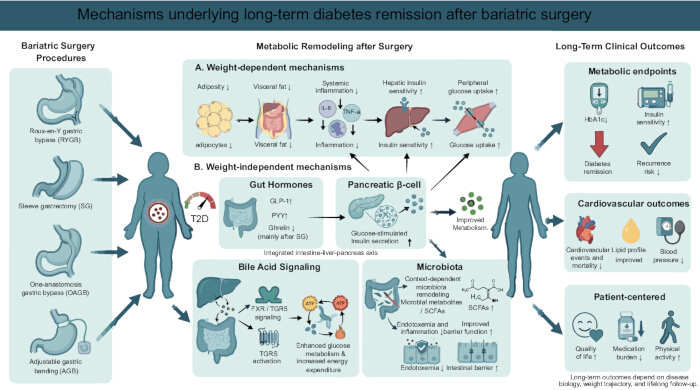
Figure 1. Integrated mechanisms supporting long-term diabetes remission after metabolic/bariatric surgery. RYGB, SG, OAGB, and AGB alter adiposity, gut-hormone signaling, bile acid signaling, and microbiota–barrier interactions. These pathways converge along an intestine–liver–pancreas axis to improve insulin sensitivity, β-cell function, and glucose disposal. Long-term outcomes remain dependent on weight trajectory, disease biology, and lifelong follow-up. Abbreviations: AGB = adjustable gastric banding; GLP-1 = glucagon-like peptide-1; OAGB = one-anastomosis gastric bypass; PYY = peptide YY; RYGB = Roux-en-Y gastric bypass; SG = sleeve gastrectomy. Please click here to view a larger version of this figure.
Table 1: Comparative long-term evidence, metabolic features, practical advantages, and important limitations of RYGB, SG, OAGB, and AGB. Remission is summarized qualitatively because definitions, medication rules, follow-up duration, patient characteristics, and study design vary. Please click here to download this file.
Disclosures
The authors declare that they have no conflicts of interest.
References
- Affinati AH, Esfandiari NH, Oral EA, Kraftson AT. Bariatric surgery in the treatment of type 2 diabetes. Curr Diabetes Rep. 2019;19(12):156.
- Yu J, et al. The long-term effects of bariatric surgery for type 2 diabetes: systematic review and meta-analysis of randomized and non-randomized evidence. Obes Surg. 2015;25(1):143-58.
- Courcoulas AP, Daigle CR, Arterburn D. Long term outcomes of metabolic/bariatric surgery in adults. BMJ. 2023;383.
- Plamper A, et al. A long-term comparative study between one anastomosis gastric bypass and sleeve gastrectomy. J Gastrointest Surg. 2023;27(1):47-55.
- Riddle MC, et al. Consensus report: definition and interpretation of remission in type 2 diabetes. Diabetes Care. 2021;44(10):2438-44.
- Schauer PR, et al. Bariatric surgery versus intensive medical therapy for diabetes—5-year outcomes. N Engl J Med. 2017;376(7):641-51.
- McTigue KM, et al. Comparing the 5-year diabetes outcomes of sleeve gastrectomy and gastric bypass: the National Patient-Centered Clinical Research Network (PCORNet) Bariatric Study. JAMA Surg. 2020;155(5).
- Camastra S, et al. Early and longer term effects of gastric bypass surgery on tissue-specific insulin sensitivity and beta cell function in morbidly obese patients with and without type 2 diabetes. Diabetologia. 2011;54(8):2093-102.
- Holst JJ, et al. New lessons from the gut: studies of the role of gut peptides in weight loss and diabetes resolution after gastric bypass and sleeve gastrectomy. Peptides. 2024;176:171199.
- Hernández-Montoliu L, et al. A specific gut microbiota signature is associated with an enhanced GLP-1 and GLP-2 secretion and improved metabolic control in patients with type 2 diabetes after metabolic Roux-en-Y gastric bypass. Front Endocrinol (Lausanne). 2023;14:1181744.
- Fazliana M, Hanipah ZN. Mechanisms and outcomes of metabolic surgery in type 2 diabetes. Metabolites. 2022;12(11):1134.
- Koliaki C, Liatis S, le Roux CW, Kokkinos A. The role of bariatric surgery to treat diabetes: current challenges and perspectives. BMC Endocr Disord. 2017;17(1):50.
- Münzker J, et al. Functional changes of the gastric bypass microbiota reactivate thermogenic adipose tissue and systemic glucose control via intestinal FXR-TGR5 crosstalk in diet-induced obesity. Microbiome. 2022;10(1).
- Davies NK, O'Sullivan JM, Plank LD, Murphy R. Altered gut microbiome after bariatric surgery and its association with metabolic benefits: a systematic review. Surg Obes Relat Dis. 2019;15(4):656-65.
- Morales-Marroquin E, et al. Comparison of methodological approaches to human gut microbiota changes in response to metabolic and bariatric surgery: a systematic review. Obes Rev. 2020;21(8).
- Casajoana A, et al. Role of gastrointestinal hormones as a predictive factor for long-term diabetes remission: randomized trial comparing metabolic gastric bypass, sleeve gastrectomy, and greater curvature plication. Obes Surg. 2021;31(4):1733-44.
- Jiménez A, et al. Long-term effects of sleeve gastrectomy and Roux-en-Y gastric bypass surgery on type 2 diabetes mellitus in morbidly obese subjects. Ann Surg. 2012;256(6):1023-9.
- Steffen R, Horber FF. Surgical prevention of weight regain and type 2 diabetes recurrence in 3 different bariatric operations and their differential long-term outcome: an 8-year prospective observational study. Ann Surg Open. 2021;2(2).
- Osorio Manyari AA, et al. Effects of semaglutide and tirzepatide on recurrent weight gain after bariatric surgery: a systematic review and meta-analysis. Obes Surg. 2025;35(12):5596-605.
- Saeed H, Patti ME. How do we balance metabolic surgery and emerging incretin-based medical therapies for type 2 diabetes? Expert Rev Endocrinol Metab. 2025;20(5):349-51.
- Yan G, et al. Long-term outcomes of macrovascular diseases and metabolic indicators of bariatric surgery for severe obesity type 2 diabetes patients with a meta-analysis. PLoS One. 2019;14(12).
- Eisenberg D, et al. 2022 American Society for Metabolic and Bariatric Surgery (ASMBS) and International Federation for the Surgery of Obesity and Metabolic Disorders (IFSO): indications for metabolic and bariatric surgery. Surg Obes Relat Dis. 2022;18(12):1345-56.
- American Diabetes Association Professional Practice Committee for Diabetes. 8. Obesity and weight management for the prevention and treatment of diabetes: Standards of Care in Diabetes—2026. Diabetes Care. 2026;49(Suppl 1).
- Mechanick JI, et al. Clinical practice guidelines for the perioperative nutrition, metabolic, and nonsurgical support of patients undergoing bariatric procedures—2019 update. Endocr Pract. 2019;25(12):1346-59.
- O'Kane M, et al. Guidelines for the follow-up of patients undergoing bariatric surgery. Obes Rev. 2020;21(11).
- Hazlehurst J, et al. Society for Endocrinology guidelines for the diagnosis and management of post-bariatric hypoglycaemia. Endocr Connect. 2024;13(5).