This study employed network pharmacology and molecular docking to investigate the predicted mechanisms of Corydalis yanhusuo in fibromyalgia syndrome.
Research Article
Multi-Target Mechanism of Corydalis yanhusuo Against Fibromyalgia Syndrome: A Network Pharmacology and Molecular Docking Study
In This Article
Summary
Abstract
Fibromyalgia syndrome (FMS) is a chronic pain disorder with limited therapeutic options. This study aimed to predict the multi-target mechanism of Corydalis yanhusuo against FMS using network pharmacology and molecular docking. Active ingredients were retrieved from the Traditional Chinese Medicine Systems Pharmacology Database and Analysis Platform (TCMSP) with oral bioavailability (OB) ≥30% and drug-likeness (DL) ≥0.18. Disease targets were obtained from GeneCards. Overlapping targets were used for protein–protein interaction (PPI), Gene Ontology (GO), and Kyoto Encyclopedia of Genes and Genomes (KEGG) analyses. Molecular docking was performed using CB-Dock2. A total of 49 active ingredients and 53 overlapping targets were identified. Hub targets included tumor necrosis factor (TNF), interleukin-6 (IL6), interleukin-1 beta (IL1B), estrogen receptor 1 (ESR1), and prostaglandin-endoperoxide synthase 2 (PTGS2). KEGG analysis revealed interleukin-17 (IL-17), TNF, nuclear factor kappa B (NF-κB), and neuroactive ligand–receptor interaction pathways. Predicted docking scores ranged from −10.1 to −6.5 kcal/mol, with stigmasterol showing the lowest predicted binding energy to cholinergic receptor muscarinic 3 (CHRM3) (−10.1 kcal/mol). These findings suggest that C. yanhusuo may exert potential anti-FMS effects through multi-component, multi-target, and multi-pathway mechanisms, particularly by modulating neuroinflammation and neurotransmitter signaling. Experimental validation is required.
Introduction
Fibromyalgia syndrome (FMS) is a chronic pain disorder that affects approximately 2–4% of the global population1,2,3. It predominantly occurs in women and presents with widespread musculoskeletal pain, fatigue, sleep disturbances, and cognitive dysfunction4,5,6. Meanwhile, fibromyalgia syndrome often occurs as a complication of various diseases, including rheumatoid arthritis and systemic lupus erythematosus7,8,9. Despite decades of research, its etiology remains incompletely understood10,11. Current evidence points to central sensitization as a core mechanism, involving aberrant amplification of pain signals within the central nervous system12. This process is further modulated by imbalances in neurotransmitters such as serotonin, dopamine, and norepinephrine, along with chronic neuroinflammation, oxidative stress, and genetic susceptibility13,14,15. This multifaceted pathophysiology not only explains the marked heterogeneity in clinical presentations but also accounts for the limited efficacy of conventional pharmacotherapies, which typically target a single molecular pathway. Drugs including antidepressants, anticonvulsants, and opioids often provide only modest relief and are frequently associated with adverse effects16,17,18,19. Therefore, new drug therapies need further development to achieve simultaneous modulation of multiple pathogenic targets.
Network pharmacology is a powerful systems biology approach that integrates drug–target–disease network analysis to systematically elucidate the synergistic mechanisms of multi-component therapies20,21. Unlike conventional reductionist strategies, this method enables prediction of potential active ingredients, their corresponding protein targets, and the biological pathways they collectively modulate, thereby offering a rational framework for exploring the mechanisms of herbal medicines22,23,24. Molecular docking, as a complementary in silico tool, further evaluates predicted ligand–target interactions and potential binding modes between small molecules and their targets, thereby significantly enhancing the credibility of network-based predictions25. C. yanhusuo, a well-known analgesic herb rich in isoquinoline alkaloids such as corydaline and dehydrocorydaline, has shown promising effects on pain-related disorders, yet its specific mechanism against FMS remains largely unclarified26,27. In this study, we employed network pharmacology combined with molecular docking to systematically investigate the multi-component, multi-target, and multi-pathway mechanism of C. yanhusuo in treating FMS, aiming to provide a theoretical basis for its clinical application and to offer insights into multi‑target drug discovery for complex chronic pain syndromes.
Protocol
Acquisition of active ingredients and targets
The Traditional Chinese Medicine Systems Pharmacology Database and Analysis Platform (TCMSP) (https://www.tcmsp-e.com, accessed August 2, 2026)28 was searched using the herb name "yanhusuo" to retrieve all available ingredients, along with their corresponding IDs, names, molecular weights, oral bioavailability (OB), drug-likeness (DL), and structural formulas. Ingredients with OB ≥30% and DL ≥0.18 were screened as key ingredients for subsequent construction of a regulatory network29,30. Subsequently, the targets associated with these key ingredients were obtained from the TCMSP database. The obtained target proteins were then standardized to official gene symbols using the UniProt database (version 2025_01; https://www.uniprot.org; accessed August 2, 2026)31. After removing duplicate entries, the remaining targets were designated as drug-related.
Acquisition of disease-related targets
The GeneCards database (https://www.genecards.org/, accessed August 2, 2026)32 was searched using the keyword “fibromyalgia”. All retrieved targets were downloaded and used for subsequent intersection analysis without additional threshold filtering.
Construction of the “drug-key ingredients-targets-disease” regulatory network
The drug- and disease-related targets were intersected, and the overlapping genes were identified as the therapeutic targets of C. yanhusuo against fibromyalgia. Associations were established in spreadsheets among C. yanhusuo and its key ingredients, between the key ingredients and the therapeutic targets, and between the therapeutic targets and fibromyalgia, respectively. These association data were then converted into text (TXT) files. Subsequently, Cytoscape software (version 3.7.2, https://cytoscape.org/) was employed to visualize the network, in which drugs, key ingredients, targets, and diseases were distinguished by different colors and symbols, and their interconnections were graphically displayed33.
Protein-protein interaction (PPI) network analysis
The STRING database (https://cn.string-db.org/, accessed August 2, 2026)34 was accessed, and the therapeutic targets of C. yanhusuo against fibromyalgia were pasted into the "Multiple Proteins" search field, with "Homo sapiens" selected as the organism. Upon retrieval of the PPI network, the active interaction sources were set to include Textmining, Experiments, Databases, Co-expression, Neighborhood, Gene Fusion, and Co-occurrence, while the minimum required interaction score was set to the medium confidence threshold (0.400). The resulting PPI network associations were exported as a TSV file and subsequently imported into Cytoscape software. After data loading, a comprehensive topological analysis was performed using the Network Analyzer tool, and all nodes were sorted in descending order by Degree values35. Finally, the top 20 targets with the highest connectivity in the PPI network were visualized using a bar chart.
GO and KEGG enrichment analysis
The therapeutic targets of C. yanhusuo against fibromyalgia were uniformly mapped and converted to their corresponding Entrez IDs using the National Center for Biotechnology Information (NCBI) database. Gene Ontology (GO) enrichment analysis was performed on these targets using the clusterProfiler package in R software (version 4.3.1, https://www.r-project.org/), covering biological process (BP), cellular component (CC), and molecular function (MF) terms36,37. The enrichment results were visualized using bar charts and GO circular plots. For Kyoto Encyclopedia of Genes and Genomes (KEGG) pathway enrichment analysis, the enrichKEGG() function within the clusterProfiler package was applied to the same target set. Enrichment significance was set at p < 0.05, and raw p-values were used for visualization. The obtained KEGG pathway terms were filtered to exclude the two broad categories of "Human Diseases" and "Metabolism", which lack direct biological relevance in this context. Subsequently, the top 15 signaling pathways (ranked by significance) were selected and visualized using bubble plots. Furthermore, the associations between targets and pathways were extracted and imported into Cytoscape software for network visualization.
Molecular docking target selection
The docking targets were selected from the “drug–active ingredient–target–disease” regulatory network rather than from the PPI network. Specifically, all target nodes in the regulatory network were ranked by degree, and the top 10 nodes with the highest connectivity were selected for molecular docking. These 10 targets were PTGS2, PTGS1, KCNH2, ADRB2, CHRM3, OPRM1, OPRD1, SLC6A4, SLC6A3, and ESR1.
Molecular docking
The two-dimensional (2D) structures of the active ingredients were retrieved from the PubChem database (https://pubchem.ncbi.nlm.nih.gov/, accessed August 3, 2026)38 using the PubChem CIDs listed in Supplementary Table 1, and saved in Structure Data File (SDF) format for use as docking ligands. The three‑dimensional (3D) structures of the top 10 core targets from the regulatory network were retrieved and downloaded from the AlphaFold Protein Structure Database (https://alphafold.ebi.ac.uk/, accessed August 3, 2026)39 using the AlphaFold DB entry IDs listed in Supplementary Table 2 in Protein Data Bank (PDB) format to serve as docking receptors. Although experimental crystal structures are available for some of these targets, AlphaFold models were used uniformly for all 10 targets to ensure methodological consistency, as several targets lack complete or high-resolution experimental structures, and mixed structural sources could introduce bias. Before docking, no manual structural modification was performed on either the ligands or the receptors. Each ligand was paired with each receptor and submitted to the online blind docking platform CB‑Dock2 (https://cadd.labshare.cn/cb-dock2/, accessed August 3, 2026) for molecular docking calculations. CB-Dock2 automatically performed the necessary preparation steps, including removing co-crystallized water molecules, adding hydrogen atoms, assigning charges, and converting to docking-ready formats. This platform, which is based on the AutoDock Vina algorithm40, automatically identifies and encloses potential binding pockets on the protein surface to predict docking conformations between small molecules and proteins. After docking, a summary table of all ligand–receptor combinations was exported, containing the lowest binding energy values for each pair. For each ligand–receptor pair, the pose with the lowest predicted binding energy was selected as the representative binding mode. The resulting docking data were organized and visualized using a heatmap. For 3D visualization, the docking output file and the receptor file were imported simultaneously into ChimeraX (version 1.1). The ligand small molecule was selected, and the "Contact/H-bonds" tool under "Structural Analysis" was used with the option "Limit by selection: with at least one end selected" to reveal the atoms of interacting residues and log the interactions. The command "cartoon suppress false" was then entered to display residue atoms when interactions were connected to the protein ribbon. Finally, the command "label @@display" was used to display the residue names. Two‑dimensional interaction diagrams were generated using LigPlus (version 2.3.1) to comprehensively display molecular interactions, including hydrogen bonds and hydrophobic interactions.
Results
Acquisition of overlapping genes for C. yanhusuo against fibromyalgia
A search of the TCMSP database yielded 77 components from C. yanhusuo. Further screening with the criteria of OB ≥30% and DL ≥0.18 yielded 49 active ingredients (Table 1). A total of 177 targets for C. yanhusuo active ingredients and 485 fibromyalgia-related targets were retrieved from the TCMSP and GeneCards databases, respectively. Intersection analysis of the two target sets yielded 53 common targets, designated as the therapeutic targets of C. yanhusuo for fibromyalgia (Figure 1).
Construction of the “drug-active ingredients-target-disease” regulatory network
To further construct a "drug-active ingredients-target-disease" regulatory network, one traditional Chinese medicine (C. yanhusuo), 49 active ingredients, 53 potential targets, and one disease (fibromyalgia) were incorporated into the network (Figure 2). Using the number of targets associated with each active ingredient as a screening criterion, the top 10 core active ingredients were identified, namely quercetin, isocorypalmine, hyndarin, (R)-canadine, leonticine, (S)-scoulerine, fumarine, clarkeanidine, stigmasterol, and cryptopin.
PPI network analysis
The therapeutic targets of C. yanhusuo against fibromyalgia were subjected to a PPI network analysis, yielding a network comprising 53 nodes and 480 interaction edges (Figure 3A). The top 20 ranked targets were TNF, IL6, IL1B, ESR1, PTGS2, CXCL8, CCL2, IL1A, MMP9, ICAM1, IL10, IFNG, CRP, MYC, VCAM1, IL2, SERPINE1, CXCL10, ERBB2, and MMP1 (Figure 3B).
GO enrichment analysis
GO enrichment analysis was conducted on the potential targets of C. yanhusuo for the treatment of fibromyalgia. The enriched biological processes (BP) comprised response to xenobiotic stimulus, response to ethanol, monoamine transport, cellular response to lipopolysaccharide, phospholipase C‑activating G protein‑coupled receptor signaling pathway, cellular response to molecule of bacterial origin, response to lipopolysaccharide, dopaminergic synaptic transmission, blood circulation, and nitric oxide metabolic process. The cellular components (CC) were enriched in postsynaptic membrane, synaptic membrane, presynaptic membrane, neuronal cell body, neuronal dense core vesicle, dense core granule, G protein‑coupled receptor complex, synaptic vesicle membrane, exocytic vesicle membrane, and synaptic vesicle. For molecular functions (MF), the enriched terms included cytokine activity, cytokine receptor binding, growth factor receptor binding, monoamine transmembrane transporter activity, catecholamine binding, amine binding, sodium: chloride symporter activity, oxidoreductase activity acting on the CH‑NH₂ group of donors with oxygen as acceptor, chemokine activity, and monoatomic anion: sodium symporter activity (Figure 4A,B).
KEGG enrichment analysis
KEGG enrichment analysis of overlapping genes between C. yanhusuo and fibromyalgia yielded 102 enriched signaling pathways. After excluding pathways related to human diseases and general metabolism, 39 pathways with clear biological regulatory significance were retained. The top 15 pathways were the IL-17 signaling pathway, neuroactive ligand signaling, TNF signaling pathway, cytokine–cytokine receptor interaction, viral protein interaction with cytokine and cytokine receptor, NF-κB signaling pathway, serotonergic synapse, hormone signaling, C‑type lectin receptor signaling pathway, neuroactive ligand–receptor interaction, Toll‑like receptor signaling pathway, intestinal immune network for IgA production, cellular senescence, JAK‑STAT signaling pathway, and HIF‑1 signaling pathway (Figure 5A). Subsequently, a target–pathway network was constructed, in which the top 10 targets were IL6, TNF, IL1B, CXCL8, PTGS2, IL10, IL2, CXCL10, CCL2, and IFNG (Figure 5B).
Molecular docking
Molecular docking was performed between the top 10 active ingredients and the top 10 core targets from the “drug–active ingredient–target–disease” regulatory network. These 10 targets were PTGS2, PTGS1, KCNH2, ADRB2, CHRM3, OPRM1, OPRD1, SLC6A4, SLC6A3, and ESR1. For all docking combinations, the predicted binding energies did not exceed -5 kcal/mol, and the distribution of overall scores was visualized as a heatmap (Figure 6A). Among all paired models, the predicted binding energy between stigmasterol and CHRM3 was the global minimum (–10.1 kcal/mol). Therefore, this complex was selected for further visualization, generating a three‑dimensional conformational structure and a two‑dimensional binding mode diagram illustrating the key residue interactions (Figure 6B). These values represent predicted docking scores/energies rather than experimentally determined binding affinities. For the selected stigmasterol–CHRM3 complex, the predicted binding mode was mainly stabilized by hydrophobic contacts with residues Thr215, Ser227, Asp518, Pro217, Leu226, Glu220, Asn514, Phe222, Lys523, Trp526, Tyr128, and Asn527. No obvious hydrogen bonds were detected in this docking pose. These interactions suggest that stigmasterol occupies a distinct predicted pocket on CHRM3; however, its relationship to established orthosteric or allosteric binding sites was not independently validated.
DATA AVAILABILITY:
The data supporting the findings of this study are openly available in the Science Data Bank at https://doi.org/10.57760/sciencedb.013nm. Further details can be obtained from the corresponding author upon reasonable request.
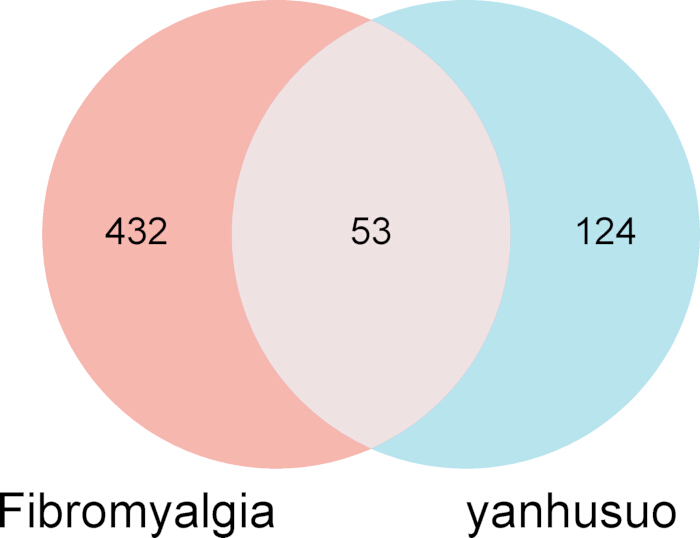
Figure 1: Venn diagram of the intersection between the active ingredient targets of C. yanhusuo and fibromyalgia disease targets. The left circle represents fibromyalgia-related targets; the right circle represents targets of the active ingredients of C. yanhusuo. The overlapping region represents the 53 common targets. Please click here to view a larger version of this figure.
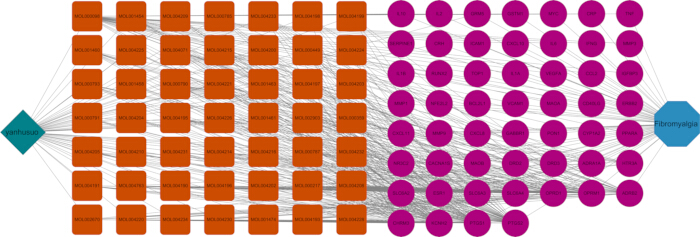
Figure 2: The ‘drug–active ingredient–target–disease’ regulatory network. Nodes represent drugs, active ingredients, targets, and diseases, each distinguished by a different color and shape. Edges represent associations between nodes. Please click here to view a larger version of this figure.
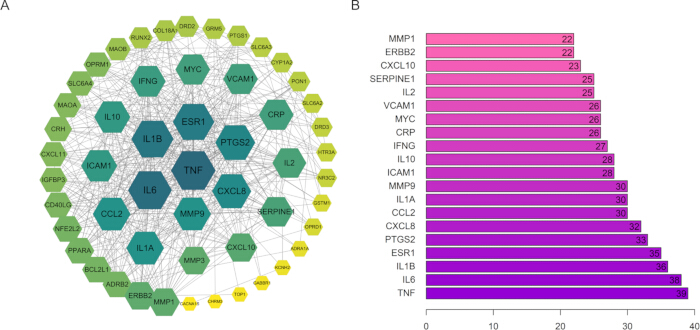
Figure 3: Protein–protein interaction network analysis of therapeutic targets. (A) PPI network of the 53 overlapping therapeutic targets of C. yanhusuo against fibromyalgia, visualized using Cytoscape. All 53 targets were mapped and retained in the network. Nodes represent proteins, and edges represent protein–protein interactions. (B) Top 20 targets ranked by degree centrality. The x-axis represents degree value, and the y-axis represents target gene symbols. Abbreviations: PPI = protein–protein interaction. Please click here to view a larger version of this figure.
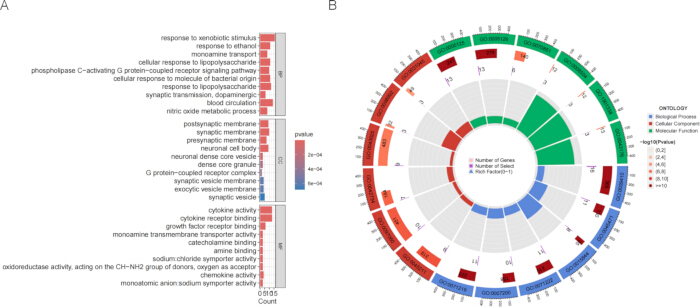
Figure 4: GO enrichment analysis of the targets of active ingredients from C. yanhusuo and fibromyalgia targets. (A) Bar chart showing the top enriched GO terms. The x-axis represents the number of genes; the y-axis represents GO terms. (B) Circular plots visualizing the GO enrichment results. GO terms are grouped into biological process (BP), cellular component (CC), and molecular function (MF). Color scales indicate raw p-values. Abbreviations: GO = Gene Ontology; BP = biological process; CC = cellular component; MF = molecular function. Please click here to view a larger version of this figure.
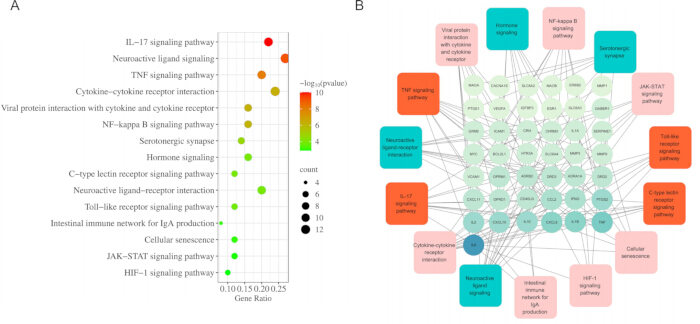
Figure 5: KEGG enrichment analysis of the targets of active ingredients from C. yanhusuo and fibromyalgia targets. (A) Top 15 signaling pathways. The x-axis represents gene ratio; the y-axis represents pathway names. Dot size indicates gene count; dot color indicates raw p-value. (B) Associations between the top 15 signaling pathways and the targets. In (B), nodes are colored according to pathway category: red/orange nodes represent inflammatory/immune pathways, and blue nodes represent neural signaling pathways. Among them, IL-17, TNF, Toll-like receptor, and C-type lectin receptor signaling pathways act as upstream triggers; NF-κB, cytokine–cytokine receptor interaction, Janus kinase-signal transducer and activator of transcription (JAK-STAT), hypoxia-inducible factor 1 (HIF-1), cellular senescence, and intestinal immune network for IgA production act as downstream effectors; and neuroactive ligand signaling, neuroactive ligand–receptor interaction, serotonergic synapse, and hormone signaling serve as amplifiers of central sensitization. Please click here to view a larger version of this figure.
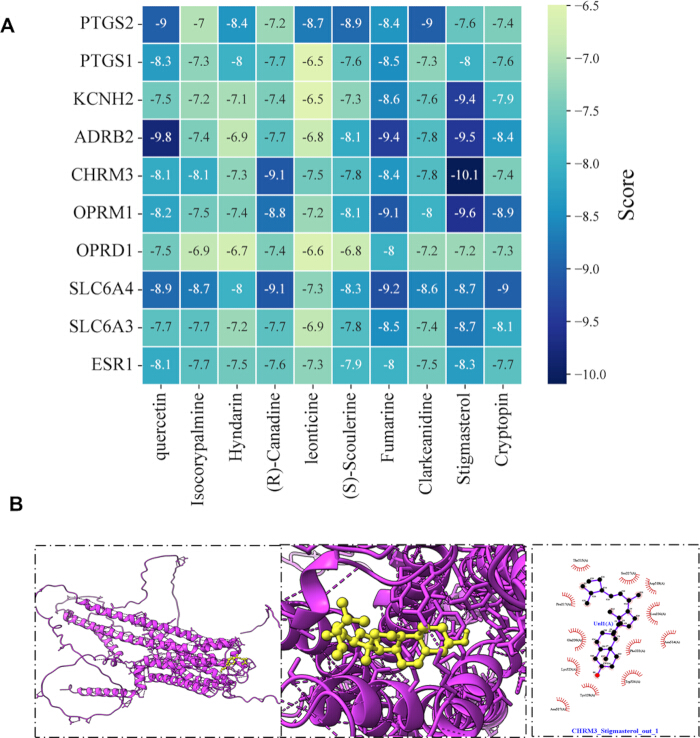
Figure 6: Molecular docking analysis of core active ingredients and target proteins. (A) Heatmap of predicted molecular docking binding energies between the top 10 active ingredients and the top 10 core targets from the “drug–active ingredient–target–disease” regulatory network (PTGS2, PTGS1, KCNH2, ADRB2, CHRM3, OPRM1, OPRD1, SLC6A4, SLC6A3, and ESR1). (B) Three-dimensional (3D) and two-dimensional (2D) binding mode diagrams of stigmasterol with CHRM3. Please click here to view a larger version of this figure.
| Mol ID | Molecule Name | MW | OB(%) | DL |
| MOL004193 | Clarkeanidine | 327.41 | 86.65 | 0.5 |
| MOL001460 | Cryptopin | 369.45 | 78.74 | 0.7 |
| MOL004234 | 2,3,9,10-tetramethoxy-13-methyl-5,6-dihydroisoquinolino[2,1-b]isoquinolin-8-one | 381.46 | 76.77 | 0.7 |
| MOL004071 | Hyndarin | 355.47 | 73.94 | 0.6 |
| MOL000791 | bicuculline | 367.38 | 69.67 | 0.9 |
| MOL004195 | CORYDALINE | 369.5 | 65.84 | 0.7 |
| MOL000785 | palmatine | 352.44 | 64.6 | 0.7 |
| MOL004191 | Capaurine | 371.47 | 62.91 | 0.7 |
| MOL004200 | methyl-[2-(3,4,6,7-tetramethoxy-1-phenanthryl)ethyl]amine | 355.47 | 61.15 | 0.4 |
| MOL001463 | Dihydrosanguinarine | 333.36 | 59.31 | 0.9 |
| MOL000787 | Fumarine | 353.4 | 59.26 | 0.8 |
| MOL004232 | tetrahydroprotopapaverine | 329.43 | 57.28 | 0.3 |
| MOL002903 | (R)-Canadine | 339.42 | 55.37 | 0.8 |
| MOL004226 | 24240-05-9 | 353.4 | 53.75 | 0.8 |
| MOL004196 | Corydalmine | 340.45 | 52.5 | 0.6 |
| MOL004230 | stylopine | 323.37 | 48.25 | 0.9 |
| MOL000793 | C09367 | 325.39 | 47.54 | 0.7 |
| MOL004203 | Dehydrocorybulbine | 352.44 | 46.97 | 0.6 |
| MOL000098 | quercetin | 302.25 | 46.43 | 0.3 |
| MOL004198 | 18797-79-0 | 367.43 | 46.06 | 0.9 |
| MOL004215 | leonticine | 327.46 | 45.79 | 0.3 |
| MOL004190 | (-)-alpha-N-methylcanadine | 354.46 | 45.06 | 0.8 |
| MOL004210 | (1S,8'R)-6,7-dimethoxy-2-methylspiro[3,4-dihydroisoquinoline-1,7'-6,8-dihydrocyclopenta[g][1,3]benzodioxole]-8'-ol | 369.45 | 43.95 | 0.7 |
| MOL004205 | Dehydrocorydalmine | 338.41 | 43.9 | 0.6 |
| MOL000449 | Stigmasterol | 412.77 | 43.83 | 0.8 |
| MOL004228 | saulatine | 396.47 | 42.74 | 0.8 |
| MOL004204 | dehydrocorydaline | 366.47 | 41.98 | 0.7 |
| MOL004220 | N-methyllaurotetanine | 341.44 | 41.62 | 0.6 |
| MOL004216 | 13-methylpalmatrubine | 352.44 | 40.97 | 0.6 |
| MOL004214 | isocorybulbine | 368.51 | 40.18 | 0.7 |
| MOL004763 | Izoteolin | 327.41 | 39.53 | 0.5 |
| MOL004202 | dehydrocavidine | 351.43 | 38.99 | 0.8 |
| MOL004208 | demethylcorydalmatine | 327.41 | 38.99 | 0.5 |
| MOL004225 | pseudocoptisine | 320.34 | 38.97 | 0.9 |
| MOL004199 | Corynoloxine | 365.41 | 38.12 | 0.6 |
| MOL001474 | sanguinarine | 332.35 | 37.81 | 0.9 |
| MOL004197 | Corydine | 341.44 | 37.16 | 0.6 |
| MOL000359 | sitosterol | 414.79 | 36.91 | 0.8 |
| MOL001454 | berberine | 336.39 | 36.86 | 0.8 |
| MOL004209 | 13-methyldehydrocorydalmine | 352.44 | 35.94 | 0.6 |
| MOL000790 | Isocorypalmine | 341.44 | 35.77 | 0.6 |
| MOL002670 | Cavidine | 353.45 | 35.64 | 0.8 |
| MOL004231 | Tetrahydrocorysamine | 337.4 | 34.17 | 0.9 |
| MOL001461 | Dihydrochelerythrine | 349.41 | 32.73 | 0.8 |
| MOL000217 | (S)-Scoulerine | 327.41 | 32.28 | 0.5 |
| MOL004233 | ST057701 | 341.44 | 31.87 | 0.6 |
| MOL001458 | coptisine | 320.34 | 30.67 | 0.9 |
| MOL004221 | norglaucing | 341.44 | 30.35 | 0.6 |
| MOL004224 | pontevedrine | 381.41 | 30.28 | 0.7 |
Table 1: Active ingredients of C. yanhusuo identified from TCMSP and their pharmacokinetic parameters. MW, molecular weight; OB, oral bioavailability; DL, drug-likeness. Ingredients with OB ≥30% and DL ≥0.18 were retained as key ingredients for subsequent network construction.
Supplementary Table 1: PubChem ligands used for molecular docking. The 10 active ingredients used as docking ligands are listed with their names, PubChem CIDs, and molecular formulas. All ligand structures were retrieved from PubChem in SDF format using the CIDs listed.Please click here to download this file.
Supplementary Table 2: AlphaFold receptor structures used for molecular docking. The 10 target proteins used as docking receptors are listed with their gene symbols, UniProt accession numbers, and AlphaFold DB entry IDs. All receptor structures were downloaded from the AlphaFold Protein Structure Database in PDB format.Please click here to download this file.
Discussion
In the present study, we employed a network pharmacology approach combined with molecular docking to systematically predict the multi‑target mechanisms of C. yanhusuo in the potential treatment of FMS. The in silico findings predict that the potential therapeutic effects of C. yanhusuo against FMS may be mediated through a complex regulatory network involving 49 active ingredients, 53 overlapping targets, and multiple signaling pathways. This comprehensive analysis is not only consistent with the traditional use of C. yanhusuo as an analgesic herb but also provides preliminary, prediction-based, molecular-level insights into its potential mechanisms for managing the multifaceted symptomatology of FMS.
The construction of the "drug‑active ingredients‑target‑disease" regulatory network identified quercetin, isocorypalmine, hyndarin, (R)‑canadine, leonticine, (S)‑scoulerine, fumarine, clarkeanidine, stigmasterol, and cryptopin as the top 10 core active components based on their degree of target connectivity. Quercetin is a common flavonoid compound with significant biological activities, including antioxidant, anti-inflammatory, and immunomodulatory effects41. In experimental pharmacological studies, quercetin intervention has been reported to markedly ameliorate muscle hyperalgesia, tactile allodynia, and cold allodynia in reserpine-induced fibromyalgia model rats42. In an animal model, stigmasterol has been reported to dose-dependently reduce mechanical and cold allodynia, heat-induced thermal hyperalgesia, periorbital mechanical allodynia, muscle strength loss, and affective‑motivational pain behaviors in the reserpine‑induced fibromyalgia mouse model43. These in vivo findings provide indirect pharmacological support for the potential relevance of these compounds in fibromyalgia models but do not validate the specific molecular targets predicted in the present study. Isocorypalmine, hyndarin, (R)‑canadine, leonticine, (S)‑scoulerine, fumarine, clarkeanidine, and cryptopin are alkaloids present in C. yanhusuo, and these alkaloids have been reported to produce pain-relieving effects via ion channel blockade, neurotransmitter regulation, and cyclooxygenase-2 (COX-2) inhibition.
PPI network analysis predicted TNF, IL6, IL1B, ESR1, and PTGS2 as the top-ranked hub targets, suggesting a potentially important role of neuroinflammation and immune modulation in the pathophysiology of FMS. To move beyond simple ranking, we further grouped the hub targets into three functional modules based on their known biological functions and network connectivity: an inflammatory/cytokine module (TNF, IL6, IL1B, CXCL8), a neurotransmitter receptor module (CHRM3, ADRB2, ESR1), and a signal transduction module (PTGS2, MMP9). These modules may cooperatively drive the vicious cycle of “peripheral immune activation → central sensitization” in FMS, rather than acting in isolation. Chronic low‑grade inflammation has been increasingly recognized as a contributing factor to central sensitization, a core mechanism underlying FMS. TNF and IL‑1β are key pro‑inflammatory cytokines that amplify pain signaling by activating glial cells and enhancing synaptic excitability in the spinal cord and brain regions involved in pain processing44,45,46. The predicted network suggests that multiple active components of C. yanhusuo, such as quercetin and stigmasterol, may simultaneously target these inflammatory mediators, indicating a potential broad-spectrum anti-neuroinflammatory effect47,48,49. This is particularly relevant, given that conventional pharmacotherapies, such as pregabalin and duloxetine, are primarily designed to modulate neurotransmitter levels and may not directly target the inflammatory component of FMS.
The GO enrichment analysis further predicted the biological processes that C. yanhusuo may modulate, with prominent terms including response to xenobiotic stimulus, monoamine transport, dopaminergic synaptic transmission, and cellular response to lipopolysaccharide. These predicted findings are consistent with the known roles of dopamine and serotonin in pain modulation and mood regulation, both of which are frequently disrupted in FMS patients. The KEGG pathway enrichment analysis predicted that the potential targets of C. yanhusuo may be primarily involved in the IL-17 signaling pathway, neuroactive ligand-receptor interaction, TNF signaling pathway, cytokine-cytokine receptor interaction, and NF-κB signaling pathway.
The IL‑17 signaling pathway has emerged as a critical driver of chronic pain in inflammatory and autoimmune conditions, mediating neutrophil recruitment and promoting the release of pro‑inflammatory cytokines such as TNF and IL‑650,51,52. The targeting of C. yanhusuo to this pathway suggests that the herb may attenuate peripheral immune activation and subsequent central neuroinflammation, which are increasingly recognized as contributors to FMS symptom flares. Moreover, the neuroactive ligand‑receptor interaction pathway serves as a convergence point for multiple neurotransmitter systems, including glutamatergic, GABAergic, and cholinergic signaling, all of which are implicated in pain processing and cognitive dysfunction in FMS50,51,52,53,54,55. The regulation of this pathway by C. yanhusuo may partly explain the herb's predicted potential to modulate not only pain but also fatigue, sleep disturbances, and mood disorders associated with FMS.
The molecular docking results provided an in silico prediction of the potential binding interactions between the top 10 active ingredients and the top 10 core targets from the “drug–active ingredient–target–disease” regulatory network (PTGS2, PTGS1, KCNH2, ADRB2, CHRM3, OPRM1, OPRD1, SLC6A4, SLC6A3, and ESR1). Notably, the predicted binding energies for all ligand–receptor pairs were below -5 kcal/mol, indicating moderate to strong predicted binding. The lowest predicted docking score was observed for stigmasterol–CHRM3 (−10.1 kcal/mol), followed by quercetin–ADRB2 (−9.8 kcal/mol) and stigmasterol–OPRM1 (−9.6 kcal/mol). Stigmasterol, a plant‑derived phytosterol previously identified in C. yanhusuo, has demonstrated anti‑inflammatory and antioxidant activities across various disease models56,57,58. Its predicted strong binding to CHRM3 and ADRB2 suggests that, in addition to alkaloids, non-alkaloidal constituents may also contribute to the therapeutic efficacy of C. yanhusuo by modulating cholinergic and adrenergic signaling, which are critical for autonomic nervous system regulation and pain modulation. The predicted strong binding of stigmasterol to CHRM3 and ADRB2 may be relevant to the traditional “regulating Qi and relieving pain” property of C. yanhusuo. Unlike nonsteroidal anti-inflammatory drugs (NSAIDs), C. yanhusuo may potentially act through both inflammatory mediators and autonomic neurotransmitter receptors, suggesting a potential dual mechanism. The relative contributions of the cholinergic anti-inflammatory pathway and the classical TNF/IL-6 pathway remain to be experimentally validated. Among the core ingredients, quercetin may act as a broad-spectrum anti-inflammatory component, whereas stigmasterol may show relatively strong predicted docking interactions with selected targets such as CHRM3 and ADRB2. This “broad coverage + high precision” pattern may match the heterogeneous pain characteristics of FMS.
Translating predictions into limitations
Although network pharmacology is predictive, the findings should be interpreted with caution. Based on the predictions, we hypothesize that the most clinically promising fraction of C. yanhusuo may be a specific extract enriched in quercetin and stigmasterol, rather than the whole mixture. This hypothesis requires experimental validation. Future studies should focus on isolating and testing such enriched fractions in vitro and in vivo to confirm the predicted targets and pathways.
Conclusion
This study suggests that C. yanhusuo is predicted to exert therapeutic effects against fibromyalgia syndrome through a synergistic mechanism involving multiple components, targets, and pathways, with core actions potentially centered on suppressing neuroinflammation and neuromodulation. The integrated network pharmacology and molecular docking analyses reveal that key active ingredients, such as quercetin and stigmasterol, are predicted to collectively regulate pivotal inflammatory mediators and neuroactive signaling pathways, thereby potentially modulating both peripheral immune activation and central sensitization. These findings provide a preliminary, prediction-based rationale for future experimental investigation and potential clinical application of C. yanhusuo in FMS, and may inform hypothesis-driven multi-target drug discovery for complex chronic pain disorders. Experimental validation is required to confirm these predictions.
Limitations:
This study is exclusively based on in silico network pharmacology and molecular docking predictions, which lack experimental and clinical validation. The OB ≥30% and DL ≥0.18 thresholds are standard in network pharmacology; however, they may exclude potentially active low-OB compounds, such as certain analgesic alkaloids. The use of AlphaFold-predicted structures rather than experimental crystal structures for molecular docking is a limitation. Future docking studies should validate these predictions using available PDB structures where possible. Future investigations will include in vitro and in vivo experiments to validate the identified targets and pathways, followed by clinical trials to evaluate the therapeutic efficacy and safety of C. yanhusuo extract in patients with fibromyalgia. Ultimately, we aim to develop a standardized C. yanhusuo preparation for clinical application in fibromyalgia syndrome.
Disclosures
The authors declare no conflicts of interest.
AI Usage Disclosure: During the preparation of this work, the authors used Deepseek for language polishing and grammar checking. All AI-assisted content was reviewed and revised by the authors, who take full responsibility for the publication.
Acknowledgements
The authors declared that financial support was not received for this work and/or its publication.
Materials
| Name | Company | Catalog Number | Comments |
|---|---|---|---|
| AlphaFold Protein Structure Database | DeepMind & EMBL-EBI | https://alphafold.ebi.ac.uk/ | Downloaded 3D structures (PDB) of core target proteins as docking receptors. |
| CB-Dock2 | Online blind docking platform | https://cadd.labshare.cn/cb-dock2/ | AutoDock Vina-based blind docking; identified binding pockets, predicted conformations, and exported lowest binding energies. |
| ChimeraX | UCSF Resource for Biocomputing, Visualization, and Informatics | https://www.cgl.ucsf.edu/chimerax/ | Visualized 3D binding conformations of protein–ligand complexes. Version 1.1 |
| Cytoscape | Cytoscape Consortium | https://cytoscape.org/ | Constructed and visualized drug–ingredient–target–disease and PPI networks; topological analysis via Network Analyzer (Degree ranking). Version 3.7.2 |
| GeneCards | Weizmann Institute of Science, Israel | https://www.genecards.org/ | Retrieved fibromyalgia-related targets using the keyword “fibromyalgia”; all retrieved targets were retained without additional threshold filtering. |
| LigPlus | Not applicable | http://www.ebi.ac.uk/thornton-srv/software/LigPlus/ | Generated 2D interaction diagrams showing hydrogen bonds and hydrophobic interactions. Version 2.3.1 |
| PubChem | National Library of Medicine (NCBI), USA | https://pubchem.ncbi.nlm.nih.gov/ | Retrieved 2D structures (SDF) of top 10 active ingredients as docking ligands. |
| R | R Foundation for Statistical Computing | https://www.r-project.org/ | Performed GO and KEGG enrichment using clusterProfiler; excluded "Human Diseases" and "Metabolism" pathways. Version 4.3.1 |
| STRING | STRING Consortium (EMBL, SIB, etc.) | https://string-db.org/ | Constructed PPI network (Homo sapiens, confidence ≥0.400); exported TSV for Cytoscape. |
| TCMSP | Northwest A&F University, China | https://www.tcmsp-e.com/ | Retrieved all components of C. yanhusuo; screened active ingredients (OB≥30%, DL≥0.18); obtained corresponding target proteins. |
| UniProt | UniProt Consortium (EBI, SIB, PIR) | https://www.uniprot.org/ | Converted target proteins to official gene symbols (Homo sapiens). Version 2025_01 |
References
- Winslow BT, Vandal C, Dang L. Fibromyalgia: diagnosis and management. Am Fam Physician. 2023;107(2):137-144.
- Kocyigit BF, Akyol A. Fibromyalgia syndrome: epidemiology, diagnosis and treatment. Reumatologia. 2022;60(6):413-421.
- Berwick R, Barker C, Goebel A; Guideline Development Group. The diagnosis of fibromyalgia syndrome. Clin Med (Lond). 2022;22(6):570-574.
- Carrasco-Querol N, et al. Nutrition and chronobiology as key components of multidisciplinary therapeutic interventions for fibromyalgia and associated chronic fatigue syndrome: a narrative and critical review. Nutrients. 2024;16(2):182.
- Ughreja RA, Venkatesan P, Balebail Gopalakrishna D, Singh YP. Effectiveness of myofascial release on pain, sleep, and quality of life in patients with fibromyalgia syndrome: a systematic review. Complement Ther Clin Pract. 2021;45:101477.
- Favretti M, Iannuccelli C, Di Franco M. Pain biomarkers in fibromyalgia syndrome: current understanding and future directions. Int J Mol Sci. 2023;24(13):10443.
- Minhas D, Murphy A, Clauw DJ. Fibromyalgia and centralized pain in the rheumatoid arthritis patient. Curr Opin Rheumatol. 2023;35(3):170-174.
- Monteiro JAM, et al. Fibromyalgia comorbidity in systemic lupus erythematosus patients: assessing impact on quality of life. Adv Rheumatol. 2024;64(1):90.
- Chen G, Yan Z, Wang Y, Tao Q. Rheumatoid arthritis and fibromyalgia syndrome: a bibliometric and bioinformatics perspective on comorbidity research. J Multidiscip Healthc. 2025;18:6811-6827.
- Jurado-Priego LN, Cueto-Ureña C, Ramírez-Expósito MJ, Martínez-Martos JM. Fibromyalgia: a review of the pathophysiological mechanisms and multidisciplinary treatment strategies. Biomedicines. 2024;12(7):1543.
- Paroli M, Gioia C, Accapezzato D, Caccavale R. Inflammation, autoimmunity, and infection in fibromyalgia: a narrative review. Int J Mol Sci. 2024;25(11):5922.
- Marino Y, et al. Role of mitochondrial dysfunction and biogenesis in fibromyalgia syndrome: molecular mechanism in central nervous system. Biochim Biophys Acta Mol Basis Dis. 2024;1870(7):167301.
- Malik A, et al. Serotonin and norepinephrine reuptake inhibitors (SNRIs) for treatment of fibromyalgia: a comprehensive clinical review. Psychopharmacol Bull. 2025;55(2):24-40.
- García-Domínguez M. Fibromyalgia and inflammation: unrevealing the connection. Cells. 2025;14(4):271.
- Assavarittirong C, Samborski W, Grygiel-Górniak B. Oxidative stress in fibromyalgia: from pathology to treatment. Oxid Med Cell Longev. 2022;2022:1582432.
- Giorgi V, et al. Pharmacological treatment of fibromyalgia syndrome: a practice-based review. Curr Pain Headache Rep. 2024;28(12):1349-1363.
- Migliorini F, et al. Duloxetine for fibromyalgia syndrome: a systematic review and meta-analysis. J Orthop Surg Res. 2023;18(1):504.
- Moore A, et al. Effectiveness of pharmacological therapies for fibromyalgia syndrome in adults: an overview of Cochrane Reviews. Rheumatology (Oxford). 2025;64(5):2385-2394.
- Lum G, et al. Current pharmacological management, treatment challenges, and potential future treatment options for fibromyalgia syndrome. Expert Opin Pharmacother. 2025;26(18):2013-2025.
- Zhang P, et al. Network pharmacology: towards the artificial intelligence-based precision traditional Chinese medicine. Brief Bioinform. 2024;25(1):bbad518.
- Wang Y, El-Kott AF, El-Kenawy AE, Xue L. Decorated CuO nanoparticles over chitosan-functionalized magnetic nanoparticles: investigation of its anti-colon carcinoma and anti-gastric cancer effects. Arabian J Chem. 2021;14(7):103201.
- Zeng Y, et al. Fisetin micelles precisely exhibit a radiosensitization effect by inhibiting PDGFRβ/STAT1/STAT3/Bcl-2 signaling pathway in tumor. Chin Chem Lett. 2025;36(2):109734.
- Chen GY, et al. Mechanisms of total glucosides of paeony in alleviating methotrexate-induced liver injury. Drug Des Devel Ther. 2025;19:3407-3423.
- Chen GY, et al. Prediction of Rhizoma Drynariae targets in the treatment of osteoarthritis based on network pharmacology and experimental verification. Evid Based Complement Alternat Med. 2021;2021:5233462.
- Aguiar C, Camps I. Molecular docking in drug discovery: techniques, applications, and advancements. Curr Med Chem. 2025;32(28):5924-5938.
- Wu L, et al. Processing and compatibility of Corydalis yanhusuo: phytochemistry, pharmacology, pharmacokinetics, and safety. Evid Based Complement Alternat Med. 2021;2021:1271953.
- Alhassen L, et al. The analgesic properties of Corydalis yanhusuo. Molecules. 2021;26(24):7498.
- Ru J, et al. TCMSP: a database of systems pharmacology for drug discovery from herbal medicines. J Cheminform. 2014;6:13.
- Chen GY, et al. Integrating network pharmacology and experimental validation to explore the key mechanism of Gubitong recipe in the treatment of osteoarthritis. Comput Math Methods Med. 2022;2022:7858925.
- Jin Q, et al. Network and experimental pharmacology to decode the action of Wendan decoction against generalized anxiety disorder. Drug Des Devel Ther. 2022;16:3297-3314.
- UniProt Consortium. UniProt: the Universal Protein Knowledgebase in 2025. Nucleic Acids Res. 2025;53(D1):D609-D617.
- Stelzer G, et al. The GeneCards Suite: from gene data mining to disease genome sequence analyses. Curr Protoc Bioinformatics. 2016;54:1.30.1-1.30.33.
- Otasek D, et al. Cytoscape Automation: empowering workflow-based network analysis. Genome Biol. 2019;20(1):185.
- Szklarczyk D, et al. The STRING database in 2025: protein networks with directionality of regulation. Nucleic Acids Res. 2025;53(D1):D730-D737.
- Majeed A, Mukhtar S. Protein-protein interaction network exploration using Cytoscape. Methods Mol Biol. 2023;2690:419-427.
- Yu G, Wang LG, Han Y, He QY. clusterProfiler: an R package for comparing biological themes among gene clusters. OMICS. 2012;16(5):284-287.
- Feng S, et al. Harnessing gene editing technology for tumor microenvironment modulation: an emerging anticancer strategy. Chemistry. 2024;30(62):e202402485.
- Kim S, et al. PubChem in 2021: new data content and improved web interfaces. Nucleic Acids Res. 2021;49(D1):D1388-D1395.
- Varadi M, et al. AlphaFold Protein Structure Database: massively expanding the structural coverage of protein-sequence space with high-accuracy models. Nucleic Acids Res. 2022;50(D1):D439-D444.
- Eberhardt J, Santos-Martins D, Tillack AF, Forli S. AutoDock Vina 1.2.0: new docking methods, expanded force field, and Python bindings. J Chem Inf Model. 2021;61(8):3891-3898.
- He L, et al. Shape-based virtual screen for the discovery of novel CDK8 inhibitor chemotypes. Bioorg Med Chem Lett. 2019;29(4):549-555.
- Quinto-Ortiz YE, et al. Pharmacological interaction of quercetin derivatives of Tilia americana and clinical drugs in experimental fibromyalgia. Metabolites. 2022;12(10):916.
- Perazzio AC, et al. Stigmasterol attenuates nociplastic pain and fatigue-like symptoms in a reserpine-induced fibromyalgia model in mice. Inflammopharmacology. 2026;34(1):509-523.
- Ji RR, et al. Neuroinflammation and central sensitization in chronic and widespread pain. Anesthesiology. 2018;129(2):343-366.
- Biltz RG, Sawicki CM, Sheridan JF, Godbout JP. The neuroimmunology of social-stress-induced sensitization. Nat Immunol. 2022;23(11):1527-1535.
- Ahmed I, et al. Oral and gut health, (neuro)inflammation, and central sensitization in chronic pain: a narrative review of mechanisms, treatment opportunities, and research agenda. Int J Mol Sci. 2026;27(1):114.
- Wu J, et al. The role of quercetin in NLRP3-associated inflammation. Inflammopharmacology. 2024;32(6):3585-3610.
- Xiong QQ, et al. Hypericum aqueous extract promotes skin wound healing by modulating the PI3K/Akt signaling pathway. Food & Medicine Homology. 2026;3(4):9420125.
- Sun M, et al. Stigmasterol from Prunella vulgaris L. alleviates LPS-induced mammary gland injury by inhibiting inflammation and ferroptosis. Phytomedicine. 2025;137:156362.
- McNamee KE, et al. IL-17 induces hyperalgesia via TNF-dependent neutrophil infiltration. Pain. 2011;152(8):1838-1845.
- Jiang X, et al. Interleukin-17 as a potential therapeutic target for chronic pain. Front Immunol. 2022;13:999407.
- Gao SJ, et al. Interleukin-17: a putative novel pharmacological target for pathological pain. Curr Neuropharmacol. 2024;22(2):204-216.
- Yang Y, et al. Inhibition of neuroactive ligand-receptor interaction pathway can enhance immunotherapy response in colon cancer: an in silico study. Expert Rev Anticancer Ther. 2023;23(11):1205-1215.
- Li QR, et al. Unveiling the mechanism of Cibotium barometz in the treatment of rheumatoid arthritis: a study based on network pharmacology and experimental validation. Curr Med Chem. In press. https://www.eurekaselect.com/article/158465
- Chan RJ, et al. Perturbations in the neuroactive ligand-receptor interaction and renin angiotensin system pathways are associated with cancer-related cognitive impairment. Support Care Cancer. 2025;33(4):254.
- Cao W, et al. Structural elucidation of an active polysaccharide from Radix Puerariae lobatae and its protection against acute alcoholic liver disease. Carbohydr Polym. 2024;325:121565.
- Tong Y, et al. Stigmasterol exerts antioxidant effects through activation of the Keap1/Nrf2 signaling pathway in Parkinson's disease model. J Transl Med. 2026;24:9.
- Ohara Y, Osada K. Effect of dietary oxidized stigmasterol on the antioxidant system in mice. J Oleo Sci. 2024;73(12):1493-1503