7.14
在处理一个固定在两个支撑物上并受到均匀载荷的电缆时,能够确定电缆的最大张力至关重要。这个过程可以分解为以下几个关键步骤:
分析问题:首先要分析给定的情境和电缆的条件。并确定支撑物、加载类型和其他的相关信息。
确定电缆的形状方程:利用平衡原理和电缆的属性来建立描述电缆曲线形状的方程。这个方程能够将电缆…
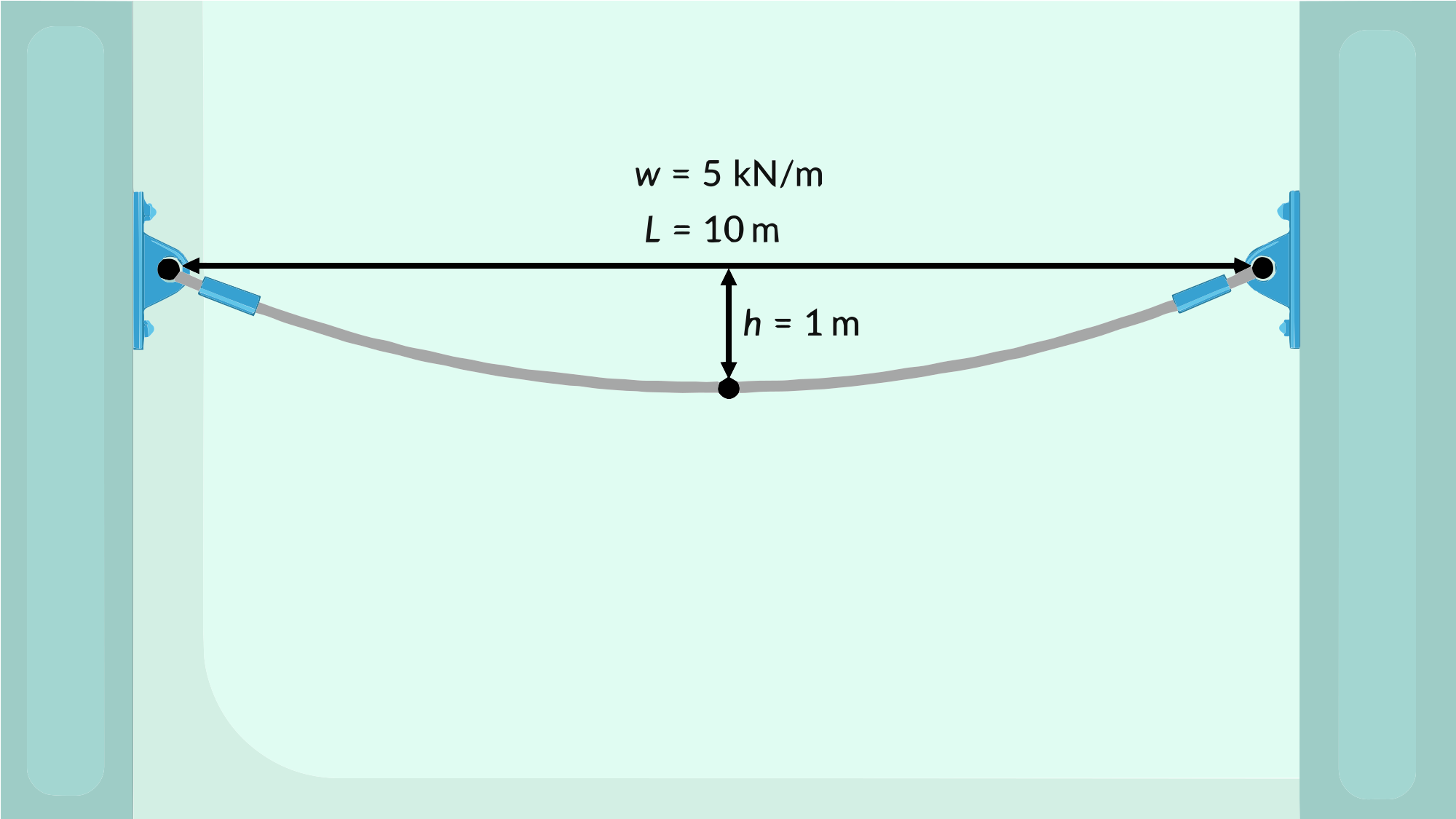
考虑一根在两个支点处固定的缆索,承受均匀载荷。确定该缆索中的最大张力。
进行分析时,由于电缆具有对称性,可将其中心设为坐标原点。
回顾分布式载荷的缆索形状方程,并代入已知的恒定载荷值。
接下来,对公式进行积分,并通过应用原点处的边界条件,确定常数 C2。
通过对缆线形状方程求一阶导数,可确定其斜率。将原点处斜率的边界条件代入,可得到 C1。
通过代入支座的积分常数和位置坐标并重新整理方程,可得到水平拉力。
回顾斜率方程,并代入在角度最大的支点处的 x 坐标值。
缆索的张力随角度而变化,在支点附近达到最大值。
应用三角函数关系并重新整理各项,可得到最大张力方程。
最后,代入水平张力方程和已知数值,可求得缆绳中的最大张力。
View the full transcript and gain access to JoVE Core videos
Q1: How do you set up the coordinate system when analyzing a cable fixed at two supports?
Place the origin at the cable's center to leverage its symmetry. This positioning simplifies calculations by allowing you to apply boundary conditions at a single point. The symmetric setup reduces the complexity of the shape equation and integration constants, making the analysis more efficient and manageable for determining cable behavior under uniform loading.
Q2: What role does the cable's shape equation play in finding maximum tension?
The shape equation describes how the cable curves under uniform loading and relates the cable's geometry to applied forces. By integrating this equation and applying boundary conditions, you obtain integration constants that define the cable's exact profile. These constants are essential for calculating the horizontal tensile force and ultimately determining where maximum tension occurs along the cable.
Q3: Why is the slope of the cable important when calculating maximum tension?
The slope, found by taking the first derivative of the shape equation, determines the cable's angle at each point. Maximum tension occurs where this angle is greatest, typically near the supports. Using trigonometric relationships between the slope angle and horizontal tensile force allows you to express and calculate the maximum tension value accurately.
Q4: How do boundary conditions help determine integration constants?
Boundary conditions specify known values at particular locations, such as zero slope at the cable's center. Applying these conditions to the integrated shape equation and slope equation yields the integration constants C1 and C2. These constants are then substituted back into equations to find the horizontal tensile force and ultimately the maximum tension in the cable.
Q5: What is the relationship between horizontal tensile force and maximum tension?
Horizontal tensile force is the constant tension component acting along the cable's length. Maximum tension combines this horizontal force with the vertical component created by the cable's angle at the support. Using trigonometric relations, maximum tension equals the horizontal force divided by the cosine of the maximum angle, making it always greater than the horizontal component.
Q6: Where does maximum tension occur in a uniformly loaded cable, and why?
Maximum tension occurs near the cable's supports where the slope angle reaches its maximum value. At these locations, the cable must support both the accumulated load and resist the steepest angle, creating the highest combined tensile stress. The symmetric loading ensures maximum angles occur symmetrically at both supports.
Q7: How do you calculate the horizontal tensile force from the cable's support coordinates?
Substitute the support's position coordinates and integration constants into the rearranged shape equation to isolate the horizontal tensile force. This force remains constant throughout the cable under uniform loading and serves as the foundation for calculating maximum tension. Once determined, it combines with the angle at the support to yield the final maximum tension value.