18.15
体积模量是一个科学术语,能够用来描述材料对均匀压缩的抵抗力。它是将压力的变化与其所产生的相对体积变化相互联系起来的比例常数。
将各向同性材料单元可视化为单位体积的立方体时,这个概念就会变得更加清晰。当这个立方体受到法向应力时,它就会发生变形,将它的形状变成具有不同体积的长方体。新的体积与原始体积之间…
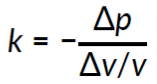
体积模量用于衡量材料抵抗均匀压缩的能力。它被定义为压力变化与相应体积相对变化之间的比例常数。
考虑一个单位体积的各向同性立方体。当受到正应力作用时,它会变形为一个具有新体积的长方体平行六面体。
这种新体积与原始体积之间的差值称为材料的体应变。体应变可表示为三个方向上应变的总和。
对于承受均匀静水压力的物体,其应力的每个分量均等于静水压力的负值。
将这些值代入膨胀方程,可得到一个表达式,该表达式引入了一个称为体积模量的常数,其单位与弹性模量相同。
在静水压力下稳定的材料体积会减小,导致体应变呈负值,体模量为正值。
具有零泊松比的理想材料在拉伸时不会发生横向收缩。相反,泊松比为0.5则表示完全不可压缩。
View the full transcript and gain access to JoVE Core videos
Q1: What does bulk modulus measure in materials?
Bulk modulus measures a material's resistance to uniform compression. It is defined as the proportionality constant between a change in pressure and the resulting relative volume change. Materials with higher bulk modulus values resist compression more effectively than those with lower values.
Q2: How is dilatation related to bulk modulus?
Dilatation represents the total volume change of a material and is calculated as the sum of strains in all three directions. When a material undergoes uniform hydrostatic pressure, the dilatation becomes negative for stable materials. The bulk modulus is derived by substituting stress components into the dilatation equation.
Q3: What happens to an isotropic cube under hydrostatic pressure?
An isotropic cube of unit volume deforms into a rectangular parallelepiped when subjected to normal stresses. The difference between the new volume and original volume is termed dilatation. Under uniform hydrostatic pressure, each stress component equals the negative of the pressure applied.
Q4: How does Poisson's ratio affect material incompressibility?
Poisson's ratio determines lateral contraction behavior during deformation. A material with zero Poisson's ratio can stretch without lateral contraction. Conversely, a Poisson's ratio of 0.5 signifies perfect incompressibility, meaning the material maintains constant volume during deformation under the relation between Poisson's ratio, modulus of elasticity and modulus of rigidity.
Q5: Why is bulk modulus always positive for stable materials?
Stable materials decrease in volume when subjected to hydrostatic pressure, making dilatation negative. Since bulk modulus is the proportionality constant relating pressure change to relative volume change, the negative dilatation combined with negative pressure results in a positive bulk modulus value.
Q6: What units does bulk modulus use?
Bulk modulus is expressed in the same units as the modulus of elasticity, typically pascals (Pa) or megapascals (MPa). This consistency in units allows for direct comparison between bulk modulus and other elastic constants when analyzing material behavior under various loading conditions.
Q7: How does bulk modulus differ from other elastic constants?
Bulk modulus specifically measures resistance to uniform volumetric compression, while other elastic constants address different deformation modes. The modulus of elasticity measures resistance to axial loading, and modulus of rigidity measures resistance to shear. Bulk modulus uniquely characterizes material behavior under hydrostatic pressure.