31.3
多机稳定性分析对于理解具有多台同步电机的电力系统的动态和稳定性至关重要。目标是求解连接到 N 母线电力系统的 M 台电机网络的摆动方程。
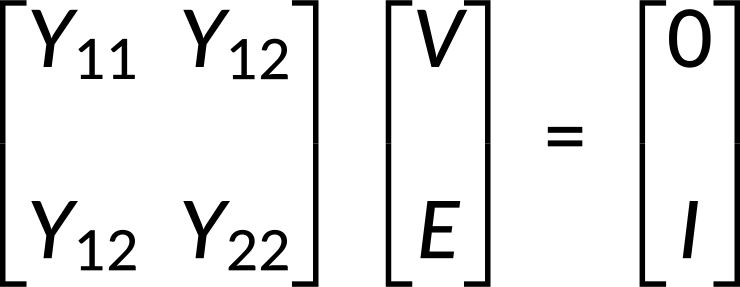
在分析系统时,节点方程表示母线电压、电机电压和电机电流之间的关系。节点方程由以下公式给出:
V 是母线电压的 N 向量,E 是电机电压的 M 向量,I 是电机电流…
在包含 M 台同步电机的 N 节点电力系统中,负荷被建模为恒定导纳,且网络节点方程被建立。
导纳矩阵被划分为包含负载导纳和逆向发电机阻抗。
在已知电机电压的情况下,通过求解母线电压方程来确定电机电流和电功率。
暂态稳定性分析需要求解发电机的转子运动方程和网络的潮流方程。
首先,运行故障前潮流程序,以确定初始母线电压、电机电流和电气输出。
将机械输出功率设为等于电输出功率,并将频率初始化为同步角频率。
接下来,计算负荷导纳、电机内部电压以及潮流计算节点导纳矩阵。
根据开关操作、负荷变化或故障等事件调整导纳矩阵。
在每个时间步 t 加上 Δt 时,计算电机的电功率、功率角和转速。
重复此过程直至达到预期的时间范围,确保步长在解的精度与计算时间之间取得平衡。
View the full transcript and gain access to JoVE Core videos
Q1: What is the role of the admittance matrix in multimachine stability analysis?
The admittance matrix partitions load admittances and inverted generator impedances to relate bus voltages and machine currents through nodal equations. It consists of four submatrices: Y11 (load admittances), Y12 and Y21 (coupling terms), and Y22 (machine impedances). Engineers modify this matrix during events like faults or switching operations to accurately model system dynamics and compute electrical power outputs.
Q2: How do you initialize a transient stability simulation?
Run a pre-fault power-flow program to determine initial bus voltages, machine currents, and electrical power outputs. Set mechanical power equal to electrical power and initialize frequency to the synchronous angular frequency. Compute load admittances, internal machine voltages, and the admittance matrix. These initial conditions ensure accurate representation of the system state before disturbances occur.
Q3: What equations must be solved at each time step in transient stability analysis?
At each time step, solve the swing equation to compute machine power angles and speeds, and solve power-flow equations to determine electrical power outputs and bus voltages. These coupled equations are solved iteratively using methods like Gauss elimination or Gauss-Seidel. The process repeats until the desired simulation time horizon is reached.
Q4: Why is time step selection critical in multimachine stability computation?
Accurate time step selection balances solution accuracy and computation time while avoiding numerical instability during integration. A step size that is too large may miss system dynamics or cause divergence, while one that is too small increases computational burden. Engineers must choose an appropriate step size to ensure reliable transient stability analysis across the entire simulation period.
Q5: How are machine currents and electrical power determined from bus voltages?
Once bus voltages are computed by solving the first nodal equation iteratively, machine currents are obtained from the second nodal equation. Real electrical power output for each machine is then calculated using the machine voltage, current, and power angle. This sequential solution approach decouples the voltage and current calculations for computational efficiency.
Q6: What adjustments are made to the admittance matrix during system events?
The admittance matrix is modified to reflect switching operations, load changes, or faults that alter network topology or component parameters. These modifications update Y11, Y22, and Y12 submatrices to represent the new system configuration. Accurate matrix adjustment ensures that transient stability calculations reflect actual system conditions during and after disturbances.
Q7: How does the simplified synchronous machine model support multimachine stability analysis?
The simplified synchronous machine model provides the mathematical framework for representing machine dynamics in swing equations and nodal equations. It defines machine voltage, current, and power relationships essential for solving coupled network and machine equations. This model enables engineers to analyze how multiple machines interact and maintain stability in complex power systems.