一些患有单侧脑性瘫痪的儿童似乎忽视了其受累上肢仍保留的功能。这种发育性忽视在文献中已有广泛描述,但其涉及的认知过程尚未得到研究。为了研究上肢控制背后的认知因素,本研究设计了一种事件相关电位实验方案。
本文内容
摘要
摘要
单侧脑性瘫痪(CP)是一种神经发育障碍性疾病,是儿童期致残的常见原因之一。其特征为单侧运动功能障碍,且常以上肢受累为主。除了患侧上肢运动能力下降外,许多单侧脑性瘫痪患儿对患侧上肢尚存的运动能力也缺乏足够的意识。这种忽视患侧上肢保留功能的现象通常被称为发育性忽视(DD)。目前已有多种理论试图解释DD,每种理论对治疗提出了略有不同的指导建议。然而,可能在单侧脑性瘫痪儿童中进一步导致DD的认知过程,至今尚未被直接研究。本研究方案旨在探讨单侧脑性瘫痪伴或不伴DD的儿童在上肢控制过程中涉及的认知因素。通过记录在目标-反应任务中提取自持续脑电图(EEG)的事件相关电位(ERPs),并要求受试者做出手部运动反应,来实现这一目标。ERPs包含多个成分,每个成分均与特定的认知过程密切相关(例如,N1成分与早期注意过程相关,N2成分与认知控制相关,P3成分与认知负荷和心理努力相关)。由于ERP技术具有优异的时间分辨率,能够研究显性运动反应之前发生的多种隐性认知过程,从而有助于揭示可能参与DD现象的认知机制。采用本方案可为现有的行为学研究提供更深层次的解释,并为深入研究儿童发育性运动受限中的认知因素开辟新的方向。
引言
脑性瘫痪(Cerebral Palsy, CP)是一组与运动和姿势障碍相关的神经发育性疾病,由发育中的胎儿或婴儿大脑受到干扰所致1。尽管这些障碍本身不具有进行性,但会导致终身残疾1,2。CP最常见的亚型之一是单侧型脑性瘫痪,占所有病例的三分之一以上3。其特征为身体一侧出现明显的运动功能缺陷,且通常以上肢受累更为显著1,3。除了受累上肢的运动能力下降外,许多单侧型脑性瘫痪患儿似乎在日常生活中也无法自发地使用患手尚存的功能4-8。这种在单侧型脑性瘫痪中对患侧上肢残余功能的忽视现象,常被称为发育性忽视(Developmental Disregard, DD)4-11。
除了基于行为强化理论的传统解释外4,近期研究更加强调认知因素在理解使用发育障碍(DD)中的重要性5,9-11。这些理论认为,单侧脑性瘫痪儿童的某些运动功能缺陷实际上是由成功实现目标导向性运动行为所必需的认知过程功能障碍所致,而非单纯由运动受限本身引起。在此背景下,DD 被类比于脑卒中后运动性忽视现象,提示存在视觉空间注意缺陷9,11,12,。另一种观点认为,在关键发育阶段对患侧手的使用不足不仅影响运动发育,还与运动相关认知过程的发育延迟有关5,10。
尽管发育性协调障碍(DD)在文献中已有广泛描述,且不同理论强调了认知过程异常可能带来的影响5,9-11,但与目标导向运动行为相关的这些认知过程在单侧脑性瘫痪(CP)中尚未被直接研究过。本研究方案旨在评估单侧脑性瘫痪儿童上肢控制相关的认知方面。该方案描述了在手动目标-反应任务期间,从持续脑电图(EEG)中提取事件相关脑电位(ERPs)的方法。
事件相关电位(ERPs)提供了独特的研究机会,可用于测量与明显反应相关的不同加工阶段精确时间锁定的神经反应。也就是说,它们能够用于研究与目标导向运动反应相关的多种认知过程,例如反应选择、反应准备和反应抑制过程。此外,事件相关电位包含多个成分,每个成分均与不同的认知过程相关(例如,N1 成分与早期注意过程相关,N2 成分与认知控制相关,P3 成分与认知负荷和心理努力相关)。同样,在简单的手动目标-反应任务中使用事件相关电位,可使我们直接研究伴有或不伴有发展性协调障碍(DD)的单侧脑性瘫痪儿童在上肢控制不同加工阶段所涉及的多种认知过程。
方案
采用本实验设计的不同实验已获得奈梅亨拉德堡德大学社会科学学院当地伦理委员会(ECSW)以及地区医学研究伦理委员会CMO阿纳姆-奈梅亨的批准(注册编号:2012/049;荷兰编号:39607.091.12)。
1. 参与者
- 仅纳入由医学专家诊断为单侧脑性瘫痪的儿童即神经科医生、儿科医生
注意:用于评估上肢运动控制相关认知功能的ERP实验范式虽是为单侧脑性瘫痪儿童开发的,但并不仅限于该群体使用。 - 仅包括5岁以上儿童10,11.
注意:年幼的儿童可能无法在整个实验过程中保持对任务的注意力。 - 排除患有严重视觉和听觉障碍的儿童。
注意:如果仅有轻微视觉和听觉障碍的儿童能够完成任务,并且在反应速度或准确性方面与无视觉障碍的儿童相比无差异,则建议将其纳入研究。然而,可能存在的障碍应在后续报告中予以明确说明,并在最终分析中进行可能的控制。 - 最后,排除因可能存在认知障碍和/或行为障碍而无法配合完成任务的儿童。
- 在进行脑电图测量之前,应由经过培训的作业治疗师和/或物理治疗师对儿童患侧手部的手工操作能力(MACS)进行评估 13 以及DD可能存在的状况。
- 为评估使用差异(DD),需计算一个指数,将患侧手和手臂在自发性日常活动中的典型使用量(实际表现)与在理想条件下的手/臂技能质量(能力)进行比较。 14,15为此,应使用有效且可靠的测试方法来评估手部功能能力和手部实际表现 16. 建议:使用先前已使用过且经过验证的指数14,15. 强烈推荐使用 VOAA-DDD-R 来测定 DD,因为该任务的心理测量学特性已有文献发表 14.
- 由于手部功能以及发育迟缓(DD)可能随时间而变化(例如,由于治疗效果的影响,在脑电图测量前后不久进行此项评估(最好在同1周内)。
- 此外,收集儿童的人口学数据(例如年龄、性别、用药情况和癫痫发作史)以考虑这些变量的影响(例如,当进行组间匹配或解释结果时)。
2. 视觉目标-反应任务的开发
- 编写计算机化视觉目标-反应任务的脚本。示例脚本请参见补充代码文件。
- 为了在计算机屏幕上呈现视觉刺激,请使用具有足够时间精度的刺激呈现与实验控制程序,以便在每次呈现刺激时向脑电图(EEG)信号发送时间锁定的标记。对于反应记录,请使用能够精确记录时间(1毫秒)的按钮按压设备,并将相应的刺激标记发送至EEG计算机(参见材料表)。
- 视觉刺激应采用在白色背景上显示的清晰图形,易于识别(例如几何形状或简单物体),并易于区分(例如,基于颜色、形状或大小)。建议使用简单的图形设计,而非照片等复杂刺激。
- 请遵循以下建议设计适用于儿童的事件相关电位(ERP)实验。注意:为儿童设计ERP实验通常具有挑战性,因为儿童可能难以长时间配合重复性实验。
- 呈现足够大的刺激,以便儿童能够轻松识别(推荐尺寸:7 × 7 cm)。
- 此外,建议使用对儿童具有吸引力的刺激,以维持其对任务的注意力(例如,笑脸图案)。图1展示了一种可用于幼儿的实验方案,用于研究简单手部运动期间的不同认知过程。
- 确保为右手与左手运动启动提供明显不同的刺激。这使得可以比较单侧脑瘫儿童中受影响手与较轻 受影响手运动所涉及的不同加工阶段。这种被试内设计使参与儿童可作为自身的对照(受影响手 vs. 较轻 受影响手)。
- 建议:将刺激分别呈现在屏幕左侧或右侧,以诱发左手或右手运动。为控制刺激的侧化效应,可在屏幕另一侧同时呈现背景刺激。
- 向受影响侧和较轻受影响侧呈现相同数量的刺激。每种刺激类别至少重复20次,以便对事件相关电位进行平均11。然而,需确保实验总时长不超过10分钟 ,因为儿童可能无法持续关注更长时间的任务。以往针对脑瘫儿童的ERP研究报道的实验时长在4.5至10分钟之间 10,11,17,18。若使用更长的实验流程,建议在10分钟 后允许儿童休息片刻,再继续实验。
- 为记录对所呈现刺激的反应,提供两个较大的反应按钮(推荐直径:9.5 cm;高度:5.5 cm),并确保按钮按压所需力量极小,以保证即使存在明显运动障碍的儿童也能轻松做出反应。
- 调整实验范式,以测量感兴趣的认知过程,并排除数据可能存在的其他解释。
- 实验设计示例:提示性Go/Nogo任务(图1)
- 为研究反应选择、反应准备以及反应抑制,采用提示性Go/Nogo任务,呈现四种不同类型的视觉刺激:背景刺激(用于评估视觉刺激处理的基线水平)、左侧和右侧的提示刺激(用于研究刺激选择过程)、左侧和右侧的Go/目标刺激(用于研究反应准备过程)以及左侧和右侧的Nogo刺激(用于研究反应抑制过程)。
- 建议:背景刺激和提示刺激呈现时间为1,000毫秒。目标刺激持续呈现至被试做出反应为止。Nogo刺激呈现时间为1,500毫秒。保持提示刺激与目标/Nogo刺激之间的刺激间间隔(ISI)固定(推荐:1,000毫秒)。目标刺激或Go刺激引发正确反应后的ISI应随机设置(推荐:1,000–1,500毫秒)。
- 为避免混淆“oddball”效应,目标刺激与Nogo刺激应以相等概率呈现。
注意:尽管该范式会减弱Nogo刺激上的抑制效应19,但它允许更直接地比较目标刺激与Nogo刺激诱发的事件相关电位(ERPs)。 - 每次对目标刺激做出正确反应,或对Nogo刺激成功抑制反应后,提供某种形式的激励性反馈(例如,短暂的笑声)。
3. 数据采集系统
注意:对儿童进行测量时,强烈建议使用移动式脑电图实验室。移动式实验室可使研究在儿童熟悉的环境中进行(例如,学校、康复中心、家庭)。若无法使用移动式脑电图设备,请确保儿童对测试环境感到舒适。在脑电图准备过程中,建议为儿童提供一些分散注意力或娱乐的活动(例如,观看电影)。
- 使用两台计算机:一台用于呈现刺激,另一台用于记录和数字化脑电图(EEG)。将两台计算机连接,以便在发生某种事件时,可将事件编码发送至脑电图数字化计算机例如刺激,反应
- 选择电极-放大器系统时,应使用有源电极系统(强烈推荐),以降低信噪比。
注意:有源电极可提高信噪比,因为信号的首次放大在电极位置即完成,从而最大限度地减少了中间噪声信号的干扰。这种有源电极系统的一大优势在于,脑电图记录过程中无需使用电隔离屏蔽室,因此几乎可在任何环境中进行测量。- 即使使用主动电极系统,也应避免在电气或机械装置附近进行测量。
- 根据研究问题和研究人群选择电极数量。对于研究儿童上肢控制不同加工阶段相关的大多数认知过程,一个32通道的电极系统(配合32通道脑电图放大器)已足够。
4. 电生理记录
- 首先清洁放置参考电极部位的皮肤,以降低阻抗(建议:将参考电极置于左侧乳突骨,另一主动电极置于右侧乳突骨,以便在离线分析时重新参考至双侧乳突连接)。
- 通过轻轻涂抹去角质膏清洁参考电极放置部位的皮肤,以去除死皮细胞,并用酒精擦拭以清除油脂类物质。
- 此外,还需清洁前额及眼周皮肤,用于眼电图(EOG)电极的放置(有关EOG记录的更多信息见步骤4.6)。面部去角质时需格外小心,此处皮肤可能非常敏感。
- 在将电极帽戴在受试者头部之前,测量头围以确定合适的帽尺寸。测量时,将卷尺围绕头部最宽处,即耳部上方一圈,进行测量。
- 佩戴相应尺寸的电极帽,并检查其是否处于正确位置。
- 为此,测量枕外隆突(Inion,颅骨后方枕骨突出部分)与鼻根点(Nasion,鼻梁上端与前额嵴相交处)之间的距离,以及左右耳间凹陷之间的距离。将Cz电极精确置于这些距离的50%位置处。使用电极帽可确保当Cz电极准确位于中央顶点时,其余所有电极将自动按照国际10-20系统20定位在标准位置。
- 根据国际10-20系统20,利用电极帽和电极上的编号放置电极。
- 在五个中线位置(Fz、FCz、Cz、Pz和Oz)及24个侧位点(FP1/2、F7/8、F3/4、FC5/6、FC1/2、C3/4、CP5/6、CP1/2、P7/8、P3/4、T7/8、O1/2)放置电极,以便在离线数据处理期间估算脑电地形分布,定位感兴趣事件相关电位(ERP)成分的空间最大值(见图2)。
- 若参考电极置于左侧乳突骨,则需在右侧乳突骨再放置一个电极,用于连接参考记录。接地电极置于AFz位置(电极布局示意图见图2)。
- 通过将钝头针插入电极内部,向电极中注入导电凝胶。凝胶可最大化电极与皮肤的接触,并作为电极的可塑性延伸部分。为降低阻抗,可轻柔地摩擦电极下方的皮肤。注意避免使用过多导电凝胶,以防凝胶与邻近电极的凝胶接触,从而导致信号失真。
- 同步记录眼电图(EOG),以便在离线数据处理过程中校正眼动对脑电(EEG)信号的影响。
注意:尤其是对于儿童,仅通过指导难以完全避免眼动伪迹。因此,强烈建议对这类受试者同步记录EOG信号,以校正眼睛产生的电活动。- 为此,将EOG电极放置于儿童眼部周围。
- 由于儿童皮肤非常敏感,应尽量避免放置四个EOG电极。建议仅使用两个EOG电极:一个置于右眼下方的某个有源电极位置,另一个置于右眼外眦处。在离线数据处理中进行眼动校正时,使用F7和FP2电极作为EOG记录的参考电极。
- 在安装电极的同时,使用阻抗表将各电极的阻抗保持在20 kΩ以下。
注意:建议使用具备内置阻抗检测功能的放大系统。 - 按照设备制造商的说明,使用数字化软件对脑电信号进行数字化和记录。推荐采用以下记录参数:采样率为1,000次/秒,在线滤波范围为0.016至250 Hz。
5. 在脑电图记录期间执行目标-反应任务
- 将笔记本电脑或计算机屏幕放置在儿童前方约 40 cm 处。在笔记本键盘旁边找到两个红色按钮,一个位于右侧,一个位于左侧。保持两个按钮之间的距离为 30 cm,以避免儿童误用对侧手按压按钮。让儿童双手略置于两个红色按钮上方,肘部自然 resting 在桌面上。
- 指导儿童在目标刺激出现时,尽快按下与目标刺激同侧的红色按钮(右侧刺激出现时按右键,左侧刺激出现时按左键)。如果实验中包含无刺激(nogo-stimuli),需指导儿童在无刺激出现时抑制按键反应。
- 进行一次简短的练习测试。确保实验中使用的所有刺激在此练习阶段至少呈现一次。但应尽量缩短练习时间(约 1 分钟,避免不必要的重复),以防止在后续正式实验中引起疲劳。
6. 离线数据处理
- 行为数据处理
- 定义行为变量(例如、错误率、反应时)后再处理脑电数据。确保事件相关电位(ERP)数据与行为数据相对应非常重要。例如,仅使用正确反应的试验数据进行平均ERP分析。
- 建议:将错误定义为假阳性结果(例如,对提示刺激和无提示刺激在2,000毫秒内的反应,对目标刺激的遗漏(建议:在2,000毫秒内无反应),以及错误反应(按错按钮或同时按下两个按钮)。根据具体研究问题,研究者可能希望在反应时(RT)和事件相关电位(ERP)数据中排除这些错误。
- ERP分析的电生理数据处理(推荐步骤)
注意:选择适合分析数据并旨在回答特定研究问题的数据分析系统。不同的系统适用于不同的分析目的。例如ERP分析与频谱分析)。该软件既可独立编程使用,也可结合商用脑电分析系统进行操作。以下说明专为BrainVision Analyzer编写,但使用BrainVision Analyzer仅是分析ERP数据的多种可选方法之一。- 如果选择了连接参考记录方式(参考电极置于一侧乳突骨,另一活动电极置于对侧乳突骨),则将每个脑电图电极的信号重新参考至连接乳突。选择放置在右侧乳突骨的通道作为新的参考通道,并将隐式参考纳入新参考的计算中(变换——> 通道预处理--> 新参考文献
- 通过使用垂直和水平EOG通道记录的信号进行眼动校正例如,格拉顿 & 科尔斯 21)。如果仅使用两个EOG通道,则使用F7和Fp2电极作为EOG通道的参考电极(Transformations--> 眼部矫正
- 应用适当的滤镜(变换——> 数据过滤--> IIR滤波器)。对于儿童记录的事件相关电位(ERPs),建议使用截止频率为0.5 Hz的高通滤波器,以及不超过40 Hz的低通滤波器。
- 根据不同的标记位置,将与不同刺激相关的信号分割为相等的片段时段(Transformations--> 片段分析功能 --> 分割——> 根据标记位置创建新的片段。对于视觉刺激呈现后的事件相关电位(ERPs),建议使用刺激前250毫秒至刺激后至少750毫秒的片段。此外,排除错误试验(误报)的片段。 & 遗漏)通过布尔选择方式。
- 对信号进行去趋势处理,以校正信号中的漂移(变换——> 片段分析功能--> DC去趋势
- 对每个片段应用伪迹剔除,以筛查运动和眼动伪迹(如高频肌电活动),并剔除振幅超过±150 µV的含伪迹片段。建议:采用半自动模式,以便更清楚地了解被剔除的数据内容(变换——> 伪迹剔除--> 半自动片段选择
- 应用适当的基线校正(变换——> 片段分析功能--> 基线校正。建议:对于视觉刺激呈现后诱发的事件相关电位(ERPs),采用刺激呈现前-250毫秒至刺激呈现之间的时段进行基线校正。
- 按刺激类型和手别(患侧 vs. 非患侧)对各片段进行平均(变换——> 片段分析功能 --> 平均值
- 最后,导出各个目标峰的平均振幅(导出——> 区域信息)。建议:为实现盲法评分,应在固定的潜伏期时间窗内定义平均值。为确定所研究组别的合适潜伏期时间窗,需在所有儿童的总平均事件相关电位(ERPs)中找到目标峰值的最大值,并以此峰值为中心,向前和向后各延伸至该峰值幅度50%处,定义时间窗范围。使用此时间窗导出所有个体被试该成分时间窗内的平均值 22.
- 建议:由于当前研究方案旨在探讨信息加工与认知能力的差异,应纳入中线电极的数据。由于信号在头皮上的活动范围广泛且拓扑分布弥散,反映信息加工和认知能力差异的内源性成分在头顶区域清晰可见且易于识别。
注意:在先前使用本方案的研究中,数据分析采用了 Fz、FCz 和 Cz 电极的数据 10,11.
结果
本方案已用于先前发表的研究中,用于探讨单侧脑性瘫痪(CP)儿童发育性忽视(DD)现象背后的认知因素10,11。在这些研究中采用了两种略有不同的方案,以区分目标导向手部反应过程中涉及的不同认知过程。这两项研究均发现,在面对目标刺激呈现时,DD组与非DD组在中线电极(Fz、FCz、Cz)上的认知过程存在显著差异。因此,代表性结果展示了单侧CP伴或不伴DD的儿童在目标刺激(如图1所示的go/nogo任务中呈现)诱发的事件相关脑电位(ERPs)。所展示的图示数据基于24名年龄在5至11岁之间的单侧CP儿童的记录结果。
对试验和参与者进行平均,可得到由一系列正负偏转组成的事件相关电位(ERP)波形,即ERP成分。图3展示了24名单侧脑性瘫痪(CP)儿童在视觉目标刺激呈现时的总平均ERP波形(刺激呈现方式见图1)。图3A展示了FCz电极位置的总平均ERP,以便更清晰地观察不同电位成分,其中分别显示了刺激呈现于患侧(AS)和较轻侧(LAS)时的电位。图3B展示了电位在头皮表面的分布情况。这些总平均ERP反映了对呈现于患侧(AS)和较轻侧(LAS)刺激的平均反应。图3A和图3B所示的总平均ERP中包含明显的N1和P2成分。在目标刺激后,于额中央区头皮位置未观察到典型的P3成分,而是出现了一个晚潜伏期的负相成分(Nc)。先前研究已报道,儿童额中央区的这一负波与成人的典型P3波具有可比性20,并且在单侧脑性瘫痪儿童的目标反应任务中已多次观察到该现象10,11。
图4展示了伴有和不伴有阅读障碍(DD)的单侧脑瘫儿童在事件相关电位(ERPs)上的组间差异。图4A分别显示了两组儿童(DD组与无DD组)及其各自半球(受累侧与非受累侧)的总平均事件相关电位。在两组中均可观察到N1和P2成分以及晚期负波成分。然而,DD组在P3时段的负向波幅显著更大(p < .05)。此外,两组间N1成分的波幅也存在显著差异。在统计分析中,采用固定潜伏期时间窗内的平均值进行分析。为了展示显著差异,通常使用柱状图,如图4B所示。在解释两组之间的差异时,已有大量文献将各个ERP成分与特定的认知操作相关联。每当发现显著的组间差异时,应参考现有文献对这些差异的意义进行合理解释。这些代表性结果如何结合研究问题进行解释,已在相应的出版物中予以记录10,11。
除了来自事件相关电位(ERP)记录的数据外,不同的目标反应任务还会产生可用于进一步分析的行为数据。反应时间(从目标呈现到按键的时间)和错误(例如,目标刺激后遗漏反应)可作为独立的额外因变量使用。在研究单侧脑性瘫痪(CP)儿童时,可预期双手之间的反应时间存在差异(患侧 vs. 较轻侧)10,11,如图5所示。然而,即使观察到ERP上存在组间差异,行为测量结果仍可能显示组间无显著差异10。
另一种将反应时和错误率作为独立维度使用的方法是通过计算反效率分数(Inverse Efficiency Scores, IES)来获得一个综合分数。IES 的计算方法为平均反应时除以正确反应的比例,结果以毫秒为单位23。该方法被认为在错误率较低(<10%)的任务中尤为适用23。由于本方案所建议的目标-反应程序非常简单,预期会出现较低的错误率,这一点已在先前发表的研究中得到证实10,11。

图1. 适用于广泛年龄范围的靶目标-反应任务实验示例。 该示例包含在白色背景上呈现的一对笑脸图像作为视觉刺激。图中展示了两种不同类型的试验:右手的目标试验(左图)和右手的非目标(nogo)试验(右图)。两种试验均包含背景刺激和提示刺激。请点击此处查看此图的放大版本。

图2. 基于国际10-20系统的电极放置示意图。 白色电极为32个主动电极的实际放置位置,采用连接乳突参考电极布置,并包含两个用于眼电图(EOG)测量的主动电极。橙色电极为参考电极。灰色电极为接地电极。请点击此处查看该图的放大版本。

图3. 靶刺激后具有代表性的总平均事件相关电位(ERPs)。24名单侧脑性瘫痪儿童在靶刺激时间锁定后的总平均ERP波形。(A)FCz电极位置处的总平均ERPs。实线表示靶刺激呈现至较轻偏侧(LAS)后的ERP;虚线表示靶刺激呈现至受累偏侧(AS)后的ERP。各感兴趣成分(N1、P2和P3/Nc)峰值附近的时间窗已高亮标出。(B)总平均ERPs在全头皮的分布图示。 请点击此处查看该图的放大版本。
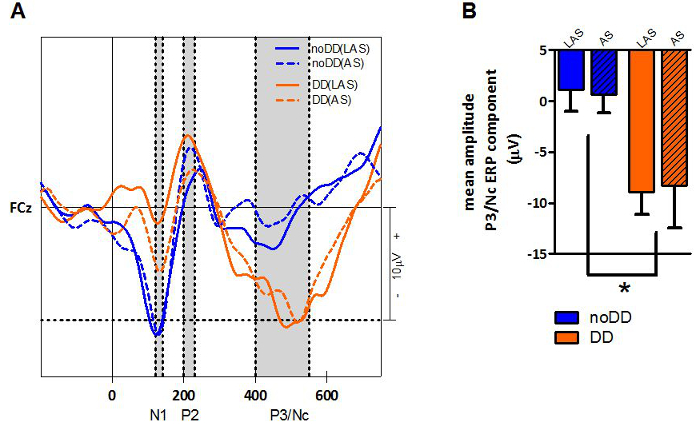
图4. 靶刺激诱发的代表性总平均事件相关电位(ERPs),显示两组之间的差异。(A)与图3中相同的24名单侧脑性瘫痪(CP)儿童的总平均ERP波形,时间锁定于靶刺激。其中12名儿童被归类为具有发育障碍(DD)。蓝色线条表示无发育障碍(noDD;N = 12)的单侧CP儿童的ERP。橙色线条表示有发育障碍(DD;N = 12)儿童的ERP。实线表示靶刺激呈现至较轻偏侧(LAS)后的ERP。虚线表示靶刺激呈现至受累侧(AS)后的ERP。围绕各感兴趣成分峰值(N1、P2和P3/Nc)的时间窗已用高亮标出。(B) 靶刺激诱发的P3/Nc波幅(均值 ± 标准误 SEM µV),如图3A所示。蓝色柱表示无DD儿童的P3/Nc波幅均值。橙色柱表示有DD儿童的P3/Nc波幅均值。空心柱表示较轻偏侧(LAS)的结果。条纹柱表示受累侧(AS)的结果。星号表示两组在P3/Nc波幅上存在显著差异(p < 0.05)。请点击此处查看该图的放大版本。
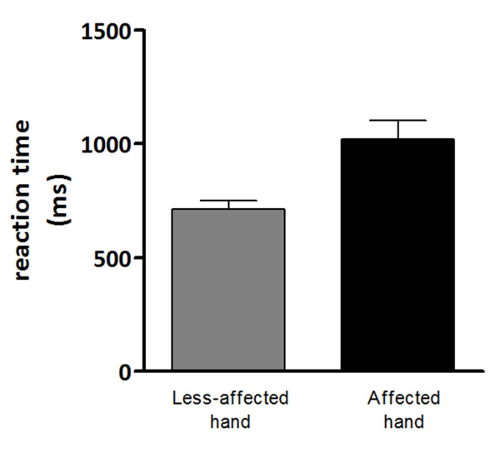
图5. 显示受影响手与较少受影响手之间差异的代表性反应时间数据。图中显示均值 ± 标准误(SEM)。灰色柱表示24名单侧脑性瘫痪儿童使用较少受影响手对目标刺激的平均反应时间。黑色柱表示同一批儿童使用受影响手对目标刺激的平均反应时间。请点击此处查看该图的放大版本。
讨论
本文介绍了一种用于直接评估单侧脑性瘫痪(CP)和发育性忽视(DD)儿童在进行简单上肢运动时与运动控制相关的认知过程的实验方案。单侧脑性瘫痪是一种非进行性神经发育障碍,其特征为身体一侧出现运动功能缺陷,主要影响上肢1,3。患有发育性忽视的儿童在日常自发活动中会忽视其患侧手部仍保留的功能能力5。本实验方案旨在揭示可能与发育性忽视现象相关的认知机制,以期改进针对这些儿童现有的康复治疗程序。通过应用该方案,研究人员已获得了关于发育性忽视儿童简单上肢运动背后认知过程的重要新见解10,11。
本方案的关键在于,在一项极易执行的目标反应任务中使用事件相关脑电位(ERPs)。该任务操作简便,便于纳入存在运动受限的年幼儿童。在任务过程中记录ERPs是一种强大的无创神经影像技术,能够以高时间分辨率测量神经活动。采用本方案可研究与单侧脑性瘫痪儿童上肢控制的不同加工阶段相关的认知特征,从而将行为学检查延伸至神经生理学层面。此外,该方案可通过呈现不同刺激(例如,提示刺激、无反应刺激)或调整刺激呈现时间及刺激间间隔而轻松进行调整,因此可直接评估参与上肢控制的多种认知过程(例如,反应准备与反应抑制)。
除了单侧脑性瘫痪儿童的某些运动障碍实际上可能由认知功能障碍引起这一观点外,另一个可能导致发育协调障碍(DD)儿童出现运动障碍的重要因素是可能存在的感觉功能缺陷。 18由于丘脑皮层和皮层间通路的特定损伤,部分患有单侧脑性瘫痪的儿童无法从其运动中获得准确的感官反馈 24这反过来可能导致患侧手的使用不足, 即,DD。本方案未直接评估这种可能存在的感觉障碍。有关对运动障碍儿童不同感觉处理的详细评估,我们参考 Maitre 和 Key(2014)的研究。25.
为确保结果的准确性和有效性,需牢记以下几个关键点。在开始脑电图(EEG)实验之前,首先应充分了解该技术的相关局限性。相对较低的空间分辨率以及难以推断皮层下活动是需要重点考虑的问题。如果研究目标涉及在上肢控制过程中对特定神经过程进行神经解剖学定位,则应考虑采用其他神经影像学方法例如然而,必须明确指出,与其它技术相比,脑电图(EEG)具有非侵入性的优势,并且可以使用移动实验室在儿童熟悉的环境中进行测量,这带来了巨大的优势。
除了脑电图(EEG)测量的空间分辨率较差之外,眨眼和肌肉活动引入的噪声也是一个不利因素。尤其对于儿童而言,很难给出适当的指导以减少这些伪迹。因此,采用一种能够保持儿童注意力且耗时不过长的实验方案显得尤为重要。
本方案为单侧脑性瘫痪儿童中发育性协调障碍(DD)现象背后的认知过程提供了新的实证见解10,11。这些见解不仅可能对进一步理解DD具有重要价值,也有助于当前治疗方法的个体化。此外,该方案能够直接评估上肢控制中潜在的认知因素,因此有望在儿童运动发育相关认知研究领域实现更广泛的应用。
披露
作者声明不存在任何竞争性财务利益。
致谢
本工作是一项博士论文的一部分,得到了以下机构资助(按字母顺序排列):Hersenstichting Nederland、Johanna KinderFonds、Stichting Rotterdams Kinderrevalidatie Fonds Adraanstichting、Phelps Stichting voor Spastici 和 Revalidatie fonds。
材料
| 姓名 | 公司 | 目录编号 | 评论 |
|---|---|---|---|
| 神经科学领域的“呈现”刺激传递与实验控制程序 | NeuoBehavioralSystems | 公司网站地址:http://www.neurobs.com/index_html 可使用其他刺激呈现软件 | |
| 按钮盒,用于时间精确(1ms)的按钮按压记录 | TSG, Radboud University Nijmegen | 公司网站地址:http://tsgdoc.socsci.ru.nl/ index.php?title=ButtonBoxes 可使用其他按钮按压记录设备 | |
| BrainAmp DC 32通道EEG/EP系统,配备BUA 128 USB接口 序列号:AMP13061963DC, BUA128-1302289, EIB13010349 | MedCaT B.V. | BP-01100 | 公司网站地址:http://www.medcat.nl/Research/acticap.htm 对儿童进行测量时,强烈 建议使用移动式脑电实验室 |
| Acticap 32通道标准帽套装 序列号:aCAP11101664, aEB13032942 | MedCaT B.V. | BP-04200 | 公司网站地址:http://www.medcat.nl/Research/acticap.htm 强烈建议使用有源电极系统 |
| BrainVision Recorder软件许可证 USB加密狗:UR11471 & BrainVision Analyzer软件许可证 USB加密狗:U12512 | Brain products | BP00020 & BP00120 | 公司网站地址:http://www.brainproducts.com/ 可使用其他记录与分析软件 |
| NuPrep | MedCatSupplies | 10-30 | 公司网站地址:http://www.medcat.nl/supplies/ 可使用其他皮肤准备去角质剂 |
| 皮肤导电电极膏 | MedCatSupplies | TD-246 | 公司网站地址:http://www.medcat.nl/supplies/ 可使用其他脑电导电电极凝胶 |
| 钝头针 和 注射器套件 | MedCatSupplies | JG161.5 & 30xxxx | 公司网站地址:http://www.medcat.nl/supplies/ 钝头针和注射器套件用于将导电凝胶注入脑电帽中的电极 |
| 有源电极用Acticap固定架和 贴纸 | MedCatSupplies | BP-04244 & Z85-10x | 公司网站地址:http://www.medcat.nl/supplies/ Acticap固定架和贴纸用于固定眼电(EOG)电极 |
参考文献
- Rosenbaum, P., et al. A report: the definition and classification of cerebral palsy April 2006. Dev Med Child Neurol. Supplement. 109, 8-14 (2007).
- Aisen, M. L., et al. Cerebral palsy: clinical care and neurological rehabilitation. Lancet Neurol. 10, 844-852 (2011).
- Odding, E., Roebroeck, M. E., Stam, H. J. The epidemiology of cerebral palsy: incidence, impairments and risk factors. Disabil Rehabil. 28, 183-191 (2006).
- Taub, E., Ramey, S., DeLuca, S., Echols, K. Efficacy of constraint-induced movement therapy for children with cerebral palsy with asymmetric motor impairment. Pediatrics. 113, 305-312 (2004).
- Houwink, A., Aarts, P., Geurts, A., Steenbergen, B. A neurocognitive perspective on developmental disregard in children with hemiplegic cerebral palsy. Res Dev Disabil. 32, 2157-2163 (2011).
- Deluca, S., Echols, K., Law, C., Ramey, S. Intensive pediatric constraint-induced therapy for children with cerebral palsy: randomized, controlled, crossover trial. J Child Neurol. 21, 931-938 (2006).
- Hoare, B., Wasiak, J., Imms, C., Carey, L. Constraint-induced movement therapy in the treatment of the upper limb in children with hemiplegic cerebral palsy. Cochrane Database Syst Rev. (2), (2007).
- Boyd, R., et al. INCITE: A randomised trial comparing constraint induced movement therapy and bimanual training in children with congenital hemiplegia. BMC Neurol. 10, 4(2010).
- Sutcliffe, T., Logan, W., Fehlings, D. Pediatric constraint-induced movement therapy is associated with increased contralateral cortical activity on functional magnetic resonance imaging. J Child Neurol. 24, 1230-1235 (2009).
- Zielinski, I. M., Jongsma, M. L., Baas, C. M., Aarts, P. B., Steenbergen, B. Unravelling developmental disregard in children with unilateral cerebral palsy by measuring event related potentials during a simple and complex task. BMC Neurol. 14, 6(2014).
- Zielinski, I. M., Steenbergen, B., Baas, C., Aarts, P., Jongsma, M. Neglect-like characteristics of developmental disregard in children with cerebral palsy revealed by event related potentials. BMC Neurol. 14, 221(2014).
- Saevarsson, S. Motor Response Deficits of Unilateral Neglect: Assessment, Therapy, and Neuroanatomy . Appl Neuropsychol Adult. , (2013).
- Eliasson, A. C., et al. The Manual Ability Classification System (MACS) for children with cerebral palsy: scale development and evidence of validity and reliability. Dev Med Child Neurol. 48, 549-554 (2006).
- Houwink, A., Geerdink, Y., Steenbergen, B., Geurts, A., Aarts, P. Assessment of upper-limb capacity, performance, and developmental disregard in children with cerebral palsy: validity and reliability of the revised Video-Observation Aarts and Aarts module: Determine Developmental Disregard (VOAA-DDD-R). Dev Med Child Neurol. 55, 76-82 (2013).
- Sutcliffe, T., Logan, W., Fehlings, D. Pediatric constraint-induced movement therapy is associated with increased contralateral cortical activity on functional magnetic resonance imaging. J.Child Neurol. 24 (10), 1230-1235 (2009).
- Klingels, K., Jaspers, E., Van de Winkel, A. A systematic review of arm activity measures for children with hemiplegic cerebral palsy. Clin Rehabil. 24 (10), 887-900 (2010).
- Maitre, N. L., et al. Feasibility of event-related potential methodology to evaluate changes in cortical processing after rehabilitation in children with cerebral palsy: a pilot study.J Clin Exp Neuropsyc. 36 (7), 669-679 (2014).
- Maitre, N. L., Barnett, Z. P., Key, P. F. Novel Assessment of Cortical Response to Somatosensory Stimuli in Children With hemiparetic Cerebral Palsy. J Child Neurol. 27 (10), 1276-1283 (2012).
- Lavric, A., Pizzagalli, D. A., Forstmeier, S. When 'go' and 'nogo' are equally frequent: ERPcomponents and cortical tomography. Eur J Neurosci. 20, 2483-2488 (2004).
- Sharbrough, F., et al. American Encephalographic Society guidelines for standard electrode position nomenclature. J Clin Neurophysiol. 8, 200-202 (1991).
- Gratton, G., Coles, M., Donchin, E. A new method for off-line removal of ocular artifact. Electroen Clin Neuro. 55 (4), 468-484 (1983).
- Picton, T. W. The P300 wave of the human event-related potential. J Clin Neurophysiol. 9, 456-479 (1992).
- Bruyer, R., Brysbaert, M. Combining Speed and Accuracy in Cognitive Psychology: Is the Inverse Efficiency Score (Ies) a Better Dependent Variable Than the Mean Reaction Time (Rt) and the Percentage of Errors (Pe)? Psychol Belg. 51, 5-13 (2011).
- Auld, M. L., Ware, R. S., Boyd, R. N., Moseley, G. L., Johnston, L. M. Reproducibility of tactile assessments for children with unilateral cerebral palsy. Phys Occup Ther Pediatr. 32 (2), 151-166 (2012).
- Maitre, N. L., Key, A. P. Quantitative assessment of cortical auditory-tactile processing in children with disabilities. J Vis Exp. 29 (83), (2014).
重印与许可
