我们介绍了用于评估环境中黑炭(PyC)的苯多羧酸(BPCA)方法。该化合物特异性方法能够同时提供关于黑炭的特征、含量及其同位素组成(13C 和 14C)的独有信息。
本文内容
摘要
摘要
由燃烧产生的热解碳(PyC),有时称为黑碳(BC),是生物质和化石燃料燃烧后形成的碳质固体残留物,例如木炭和烟灰。由于热解碳在环境中具有持久性,因此广泛存在于自然环境中,且随着全球野火活动的预测性增加以及化石燃料的持续燃烧,其含量可能进一步上升。此外,有机废弃物的工业热解过程也越来越多地产生热解碳,用于制备炭基土壤改良剂(生物炭)。同时,纳米技术的发展也可能导致类似热解碳的化合物释放到环境中。因此,可靠地检测、表征和定量这些炭化物质已成为一项重要任务,以研究其环境特性并阐明其在碳循环中的作用。
本文介绍了苯多羧酸(BPCA)方法,该方法可同时评估黑炭(PyC)的特征、含量及其同位素组成13C 和 14C)的分子层面。该方法适用于多种环境样品材料,可检测燃烧连续体广泛范围内存在的黑炭(PyC), 即, 它对轻度炭化的生物质以及高温生成的焦炭和烟灰均具有敏感性。本文所介绍的BPCA方法操作简便、高度可重复,且易于根据特定需求进行扩展和修改。因此,该方法为多种学科领域中的黑炭研究提供了多功能工具,应用范围涵盖考古学、环境法医学,以及生物炭和碳循环研究。
引言
在完全燃烧过程中,生物质或化石燃料会转化为 CO2、H2O 和无机残留物(灰分)。然而,在局部或暂时缺氧的条件下,燃烧变得不完全,发生热解反应,生成一种称为焦炭(char)的固态有机残留物1。这些炭化残留物也被称为热解有机质(pyrogenic organic matter, PyOM),主要成分为热解碳(pyrogenic carbon, PyC),亦称黑碳(black carbon, BC)2-4。炭化过程普遍存在,可发生于自然和人为燃烧过程中5-6。野火是一种重要的自然过程,内在于大多数生态系统之中,每年产生大量热解碳4,7-10。同样,工业和交通领域为能源生产而燃烧化石燃料,也是热解碳的重要人为来源11-13。这两类来源共同导致热解碳在环境中广泛分布:热解碳以气溶胶形式存在于大气中13-14,以颗粒态或溶解态有机质形式存在于水体中15-17,也存在于冰芯18-19、土壤20-21 和沉积物22-24 中,其尺寸范围从米级到纳米级不等(例如,森林火灾后残留的大型炭化树干,或从柴油发动机尾气中逸出的纳米级烟尘颗粒)。热解碳在环境中的广泛存在不仅源于其巨大的生成量,还因其具有较长的存留时间和对降解的相对稳定性25-26。尽管确切的周转时间尚未明确,且可能受特定环境条件影响27-28,但显然热解碳比大多数其他形式的有机碳更难分解为 CO229-30。这一现象对全球碳循环具有重要意义:由于炭化物质能够长期储存热解碳,从而将原本会迅速以 CO2 形式呼吸释放的碳以有机形式封存,长期来看有助于降低大气中温室气体浓度31-32。
除了减缓气候变化的作用外,生物炭还具有其他与环境相关的特性。其高孔隙度、巨大的比表面积以及负表面电荷能够固定有害化合物。33 并提高土壤肥力34-35将木炭视为一种潜在有益的土壤改良剂的认识,推动了所谓生物炭技术这一新兴领域的发展。36生物炭在未来几年可能会大规模生产,从而显著增加土壤中热解碳(PyC)的含量37此外,预计在整个21世纪,野火的发生以及化石燃料的燃烧仍将保持在较高水平。th 世纪以来,持续向环境中贡献大量PyC11,38-39另一个日益重要的PyC来源可能是纳米技术,该技术同样使用类似PyC的化合物。40-41因此,准确检测、表征和定量这些生热物质对于研究其性质并理解其在环境中的作用至关重要。
本文介绍了一种先进的化合物特异性方法,用于分析各类样品中的黑炭(PyC):即最新一代的苯多羧酸(BPCA)方法。42该方法在PyC研究领域具有广泛适用性,因其直接针对 "骨架" PyC的多环缩合结构,其在热处理过程中形成43-45 因此是所有各种形式的PyC所固有的5,46然而,由于这些结构的尺寸和异质性,无法通过色谱方法直接检测。为了对这类生烟化合物进行色谱分析,首先需在高温高压条件下用硝酸消化PyC,将大分子多环结构降解为其基本组成单元,即单个的BPCAscf. 图1经过几步纯化后,BPCAs 可用于色谱分析。20,42因此,可以对PyC进行分子水平的分离和分析,并用于量化其在环境组分中的丰度20,42此外,通过比较B3-、B4-、B5-和B6CA的相对产率,BPCA方法还可对所研究的热解碳进行表征。参见 图 1不同羧基化BPCAs的相对比例与原始多环结构的大小相关,因此可指示热解碳(PyC)的质量和热解温度44,47-48此外,所介绍的方法还可用于测定碳同位素组成(13C 和 14C) 的 PyC,因为单个 BPCA 来自纯的 PyC 结构,分离后可进行同位素分析(参见 图1,步骤5和6)49. 黑碳的化合物特异性同位素分析备受关注50 因为它可以被使用, 例如, 以区分热带地区生物炭前体生物质的差异51-52,以测定炭化材料的年代53-54 或使用同位素标记在碳循环研究中追踪黑炭(PyC)26,55-56有关PyC以及BPCA方法的历史、发展和具体应用的进一步信息,可参见Wiedemeier, 201457,上述部分段落和讨论内容由此处汇编而成。
方案
1. 一般注意事项和准备工作
- 整个实验过程中仅使用洁净、脱钙(10% HCl 浸泡)并经灼烧处理(500 °C,5 小时)的玻璃器皿、彻底清洁的工具,以及超纯的高压液相色谱(HPLC)级水和溶剂。
- 使用无碳球磨机对样品进行冷冻干燥和均质化处理58,并通过元素分析测定其总有机碳(TOC)含量59-60。
注意:对于BPCA的化合物特异性14C分析,化学品和实验设备的纯度要求尤其高。应包括空白评估49和擦拭测试61,以监测样品可能受到污染的来源。
2. HNO3 消解
- 称取冻干并均质的样品(cf将1.2)中的样品放入石英消解管中,并用铝箔覆盖以防灰尘。
- 用于 PyC 定量与表征的样品,应包含 > 1 mg TOC42因此,对于土壤和沉积物,应使用 约 200 - 400 毫克;对于有机质含量较高的样品(如纯木炭),应使用 约 每消化管 10 - 20 mg。
- 用于后续的黑炭(PyC)化合物特异性同位素分析13C 和 14C),确保样品中含有足够的BPCA-C,以满足第6步之后所用特定同位素比值质谱仪的检测限。如果不存在 先验的 有关样品中PyC含量的信息可获取(例如, 根据之前的测量结果,首先测定其黑炭(PyC)含量(步骤1-5),若BPCA-C产率过低无法满足同位素分析要求,则后续制备更多样品。
注意:需包含空白样品和已知PyC的参考样品 13C 和 14C 含量(例如, 从 "黑碳参考物质", 参见 结果部分)。这将有助于验证PyC定量的可重复性,并在分析后对化合物特异性同位素测定结果进行空白校正计算。
- 加入 2 ml 65% HNO₃3 将样品加入消化管后,使用涡旋振荡器充分润湿样品,然后将消化管插入压力腔中。按照说明书关闭压力腔。62 放入预热至170 °C的烘箱中,孵育8小时。
警告:消化完成后,让消解罐在烘箱内冷却,待其降至室温后,方可在通风橱内打开,以防有害气体逸出。 - 使用一次性玻璃纤维滤膜将样品加水过滤至容量瓶中(< 0.7 微米),例如在玻璃注射器中,并调整体积至 25 毫升。稀释的目的是终止进一步的消化反应。
注意:含有BPCAs的25 ml溶液可在冰箱中保存最多2个月,然后再进行后续处理。原则上也可使用其他仪器进行消化,例如加压微波系统。16在此情况下,应使用标准参考物质进行检测,以验证BPCA的回收率及方法的重现性(参见 代表性结果部分)
3. 阳离子的去除
- 针对每个样品,准备两个玻璃柱(400 mm 高度,15 mm 直径),每根柱中装入 11 g 阳离子交换树脂。通过依次用以下溶液冲洗柱内树脂来对树脂进行预处理:2 柱体积的水、1 柱体积的 2 M NaOH、2 柱体积的水(用于中和 pH)、1 柱体积的 2 M HCl,最后再用 2 柱体积的水冲洗。
- 检测树脂预处理后流出水的电导率。当电导率低于 2 µS cm-1 时,认为树脂已充分预处理。
- 将样品的一半(即 12.5 ml,参见 步骤 2.3)分别上样至每根柱,随后依次用 10 ml 水冲洗 5 次,并将收集的水溶液进行冷冻干燥。样品经冷冻干燥后稳定,若保持干燥并存放在阴凉避光处,可在后续处理前保存最多一周。
注意:使用液氮对样品进行速冻(“骤冻”),以避免 HNO3 析出形成强酸性非冻结液体。确保冷冻干燥机具有良好的耐酸性能,若计划对 BPCA 进行化合物特异性的 14C 分析,则需检测真空泵蒸气可能带来的污染。
4. 非极性化合物的去除
- 根据制造商说明书对C18固相萃取小柱进行活化处理, 即依次用2.5 ml甲醇、2.5 ml水和最后用2.5 ml甲醇/水(1:1 v/v)冲洗。
- 将冻干残余物重新溶解于3 ml甲醇/水(1:1 v/v)中。将溶液各取一半(1.5 ml)分别通过两个C18固相萃取小柱,收集于2.5 ml离心管中。再用1 ml甲醇/水(1:1 v/v)冲洗小柱。
- 将含有样品溶液的试管干燥,例如使用真空浓缩仪,在45 °C下加热并保持一定真空度 约 50 mbar。也可使用其他蒸发方式,例如氮气吹扫系统2 气体,同第6步。
- 将残余物用1 ml水在试管中重新溶解,使用涡旋混合器助溶,然后转移至1.5 ml自动进样瓶中。
注意:此阶段样品可在冰箱中保存最多3个月42.
5. 色谱法
- 将20 ml 85%的正磷酸与980 ml水混合制备溶剂A,并在减压条件下通过一次性玻璃纤维滤膜过滤溶液。避免溶剂A暴露于阳光下,且应在24小时内使用完毕,以防止藻类生长。使用纯HPLC级乙腈作为溶剂B。
- 制备市售BPCAs(偏苯三酸、均苯三酸、均苯四酸、五羧基苯甲酸和苯六甲酸)的标准溶液,以制备外标浓度系列(例如6 个西林瓶,分别含有 5、20、60、100、150 和 250 µg 的每种 BPCA 混合物,溶于 1 ml 水中。
- 使用以下设置进行色谱分析 表1 和 表 2 通过将相应的BPCA峰面积与外标系列的测量值进行比较,定量分析BPCA含量63.
- 以样品中BPCA-C/干重 [g/kg] 或 BPCA-C/总有机碳 [%] 表示PyC的含量。此外,可通过各单个BPCA所占比例描述样品中PyC的定性特征。 例如, B6CA(B6CA/BPCA [%])的比例反映了热解碳中芳香环缩合的程度44.
6. 纯化BPCA的湿法氧化以进行后续的13C和14C分析
- 在完成步骤5.3后,收集足量的单个BPCAs(例如, > 30 µg BPCA-C,适用于当前的加速器质谱仪49,64使用与高效液相色谱仪(HPLC)连接的馏分收集器49 然后用温和的氮气吹扫各组分以除去溶剂2 在加热至70 °C的同时进行气流吹扫。仅有微量的液体磷酸(包括BPCAs)会残留在小瓶中。
- 通过将 2 g Na 溶解于2S2O8 在50 ml水中,现配现用,配制后24小时内使用。
注意:通过将数克过硫酸钠完全溶解于热水中,待水冷却后收集析出的固体,重复此过程两次,以提高其纯度65-66. - 将吹干后的残留物(步骤 6.1)用 4 ml 水重新溶解,并将样品转移至 12 ml 耐压硼硅酸盐小瓶中。加入 1 ml 氧化试剂,用带有丁基橡胶隔垫的标准瓶盖密封。
- 用 He 气对包含水溶液的气密小瓶吹扫 8 分钟,以去除 CO2 来自小瓶和溶液66.
- 在密封小瓶中将样品于100 °C加热60分钟以进行氧化。
- 直接分析 CO2 同位素比值质谱仪上的氧化反应 13C 含量65-66 并在加速质谱仪上进行 14C 含量67-68.
注意:氧化后的样品可保存至少一周66 之前 13C 和/或 14C分析。
结果
我们建议通过测量一系列已有充分描述的热解碳材料(“黑碳参考物质”),来验证方法的建立,这些材料在文献中已被广泛用于多种方法开发与比较44,48,69-77。有关这些参考物质的信息可从苏黎世大学获取(http://www.geo.uzh.ch/en/units/physische-geographie-boden-biogeographie/services/black-carbon-reference-materials)。
所描述的程序可通过高效液相色谱法(HPLC)实现所有BPCA目标化合物的基线分离。参考物质“黑钙土”(含显著含量PyC的粉质土壤)和草本木炭(由 Oryza sativa) 如下所示 图2通过调整色谱参数 表1 和 2 (例如, 色谱温度、溶剂A的pH值或流速 等等。),可根据具体需求进一步调整分离条件42,63.
使用外标法对参比材料的色谱图进行定量分析(步骤 5.3)应得到如图所示的 PyC 值 图3请注意,实验步骤中的细微变化(例如, 在特定情况下省略步骤3或步骤4可能会导致更高的PyC值。通常应使用纯BPCA标准品检查回收率:添加标准物质的参照材料有助于检测步骤3和步骤4中不成比例的损失,并提供有关步骤5中色谱性能的信息 42,63.
表3 显示 13C 和 14在完成第6步后,对标准物质的纯化BPCA进行碳同位素分析所获得的C值。为获得可靠结果,必须收集足量的BPCA-C(例如, > 30 µg 适用于当前加速器质谱仪的 BPCA-C, 参见 图4以及采取一切可能措施,最大限度减少外来污染物对样本的污染 49.
除了使用上述参考物质检查方法建立情况外,强烈建议对样品进行重复制备和测定,包括用于PyC定量(步骤5)以及后续BPCAs的化合物特异性13C和14C分析(步骤6)。
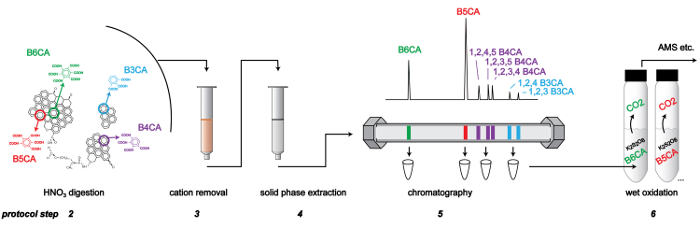
图 1: BPCA 分析流程。 在本方案的 步骤 2 中,热解炭(PyC)的多环芳烃缩合结构被消解,生成不同的 BPCA,随后进一步纯化(步骤 3 和 步骤 4),并通过色谱法进行分析与分离(步骤 5)。经过湿法氧化(步骤 6)后,纯化的 BPCA 可用于在同位素比值质谱仪上进行化合物特异性同位素分析(13C 和 14C)。请点击此处查看此图的放大版本。
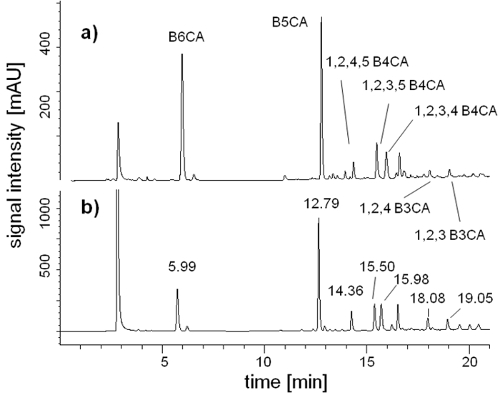
图2: BPCA 分离的色谱图。 图中显示的是黑碳标准物质“chernozem”(a) 和“grass char”(b)。所有目标 BPCA 化合物(B6CA;B5CA;1,2,4,5-、1,2,3,5-、1,2,3,4-B4CA;1,2,4-、1,2,3-B3CA)均实现了基线分离42。有关黑碳标准物质的信息可从苏黎世大学获取(http://www.geo.uzh.ch/en/units/physische-geographie-boden-biogeographie/services/black-carbon-reference-materials)。本图改编自 Wiedemeier et al. 201342,经爱思唯尔公司许可重印。请点击此处查看此图的放大版本。
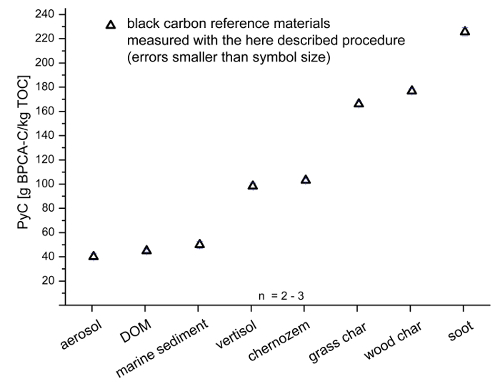
图 3: 不同黑碳标准物质的重复 PyC 测定结果。 实验室重复测定的误差棒小于符号尺寸,变异系数平均为 5%(最小值:1%,最大值:10%)。该图改编自 Wiedemeier et al. 201342,经 Elsevier 许可重印。 请点击此处查看此图的高清版本。
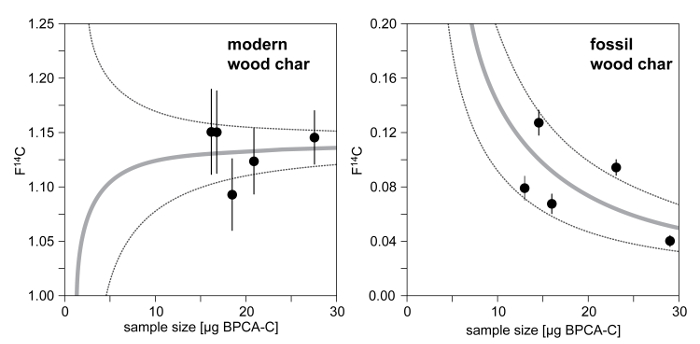
图 4: 从现代和化石木炭中分离出的 B5CA 和 B6CA 的放射性碳(14C)值。 所示误差包括对仪器加速器质谱仪本底的校正以及湿氧化空白的校正。实心灰色线表示相应样品的真实 F14C 值与测定的平均外部污染混合后的理想化曲线。该图改编自 Gierga et al. 201449,经 Elsevier 许可转载。 请点击此处查看此图的放大版本。
| 流动相 A | 980 ml 超纯水中加入 20 ml 正磷酸(85%) |
| 流动相 B | 乙腈 |
| 色谱柱 | C18 反相色谱柱(cf. 材料清单以获取详细信息) |
| 柱温 | 15 °C |
| 流速 | 0.4 ml min-1 |
| 鉴定方法 | 保留时间、216 nm 处的紫外吸收 |
| 定量方法 | BPCAs 外标法 |
| 压力 | ca. 120 bar |
表1: 色谱设置。
| 时间 | 流动相 B |
| [min] | [vol %] |
| 0 | 0.5 |
| 5 | 0.5 |
| 25.9 | 30 |
| 26 | 95 |
| 28 | 95 |
| 28.1 | 0.5 |
| 30 | 0.5 |
表2:流动相的梯度混合。
| 块体木炭 | 苯多环芳烃羧酸法(BPCA) | |||
| δ13C [‰ vs. VPDB] | ||||
| 栗木木炭 | -27.4a | ±0.4a | -27.7 | ±0.8 |
| 玉米木炭 | -12.9 | ±0.4 | -13.0 | ±0.4 |
| F14C [%] | ||||
| 现代木炭 | 1.142b | ±0.004b | 1.13 | ±0.013 |
| 化石木炭 | 0.003b | ±0.001b | 0.014 | ±0.001 |
表3:碳同位素值(δ13C 和 F14参考炭材料的碳同位素值(C)及相应苯多环芳烃的化合物特异性同位素分析。 BPCA 值代表在第 5 步中同时采集的 B6CA 和 B5CA。然而,当 BPCA 单独采集时,也可采用类似方法对单个 BPCA 进行同位素分析。整体炭屑数据来自 Yarnes 等 (2011) 73 中国台湾栗色炭疽菌 (a) 和 Gierga 等 (2014) 49 用于化石与现代的石斑鱼 (b)δ 的误差13C 测量值来自三个重复样本的标准误差,而 F 的误差14C 测量值(块体炭:ETH-50456,ETH-50458;BPCA:ETH-62324,ETH-62335)源自误差传递64.
讨论
与其它现有的生炭(PyC)方法相比,BPCA 方法具有多个重要优势78-79:i) 它可在较宽的燃烧连续体范围内检测生炭,即,对轻度炭化的生物质以及高温生成的炭和烟炱均具有灵敏性42,70;ii) 可同时对生炭进行表征16,44,80-81、定量20,42以及同位素分析49-50,66,73,82-83;iii) 适用于极为广泛的环境样品材料42,70;iv) 其方法学已受到广泛评述,并可与其他生炭检测方法的评估结果建立一致的框架44,47,70,84-85。基于上述所有原因,BPCA 方法可以说是迄今为止最通用的生炭分析方法,其基本假设条件明确,且已通过与其他方法的持续比对得到验证。
上述方案整合了先前BPCA方法的优点,形成了一套单一的操作流程,具有高度可重复性,操作简便,并可根据特定需求轻松扩展和修改。例如,当色谱分析采用pH梯度而非有机溶剂时,可实现BPCA的在线同位素比值监测42,从而无需进行湿法氧化步骤。类似地,若已知某些样品中不含阳离子和/或非极性化合物,则可省略去除阳离子和/或非极性化合物的步骤(步骤3和4)(例如,在某些实验室制备的炭材料中)。
与所有热解碳(PyC)分析方法一样,BPCA 方法也存在一些局限性。需要特别指出的是,BPCA 方法在本质上会低估样品中总的 PyC 含量:该方法通过破坏 PyC 的多环结构以提取其 BPCA 结构单元,因此无法以 BPCA 形式定量回收全部的 PyC。20,86过去曾提出使用转换系数将BPCA产量转化为总PyC含量。然而,由于大多数炭中芳香缩合程度具有异质性,实际上不可能找到一个准确的转换系数。41,48,80,86在许多情况下,样品的PyC含量是相互比较的42,81,87-88我们建议不要使用任何转换系数,而直接报告BPCA数据 "如所测量的"48在特定情况下,当利用BPCA产量来估算绝对的PyC含量时24,89-90,最初发表的转换系数20 2.27 的数值似乎是合适的,因为它可将 BPCA 产量转换为 PyC 含量的保守估计值86.
PyC方法的另一个难点在于,它们可能对干扰性非PyC物质敏感,和/或在分析过程中自身产生PyC,从而导致对样品中实际PyC含量的高估70BPCA 方法对这类干扰物质具有很强的抗干扰能力70,本身不产生任何PyC16,70,86 且具有保守性(参见 上一段所述)。即使是化学性质与热解碳非常相似但成因上属于岩源的石墨,也不会干扰BPCA测定。(Schneider, M. P. W. 未发表结果 苏黎世,(2013)目前,BPCA方法已知的唯一非PyC干扰物是一些真菌产生的缩合芳香色素。91,对于绝大多数研究而言,其定量影响应可忽略不计86BPCA 方法具有同时进行定性、定量和 13C 和 14因此,碳同位素信息是研究各种学科中黑碳(PyC)的有力工具。
披露
作者无任何利益冲突需要披露。
致谢
作者们衷心感谢以下资助方的支持:苏黎世大学研究重点计划“全球变化与生物多样性”、瑞士国家科学基金会项目 134452、131922、143891、119950 和 134847,以及深部碳观测计划——深部能源奖 60040915。
材料
| 姓名 | 公司 | 目录编号 | 评论 |
|---|---|---|---|
| 球磨机 | Retsch | N/A | 配备无碳研磨罐和研磨球的球磨机(Retsch MM 200,配石英研磨罐和研磨球) |
| 燃烧炉 | Nabertherm | N/A | 温度为 500 °C 的燃烧炉/马弗炉(Nabertherm L40/11 或类似型号) |
| 带聚四氟乙烯(PTFE)压力腔的压力弹, 带石英盖的石英消化管 | Seif Aufschlusstechnik, Unterschleissheim, Germany | N/A | Helma U. Rudolf Seif Aufschlusstechnik Fastlingerring 67 85716 Unterschleissheim Germany 电话: (+49) 89 3108181 |
| 涡旋混合器 | 常见实验室用品 | N/A | |
| 烘箱 | Thermo Scientific | 50051010 | 带恒温控制的干燥烘箱(Thermo Scientific Heraeus 或类似型号) |
| 带聚四氟乙烯(PTFE)接头的真空抽滤装置 | Machery Nagel | Chromabond 730151 730106 | ftp://ftp.mn-net.com/english/Instruction_leaflets/Chromatography/SPE/CHROMABOND_VK_DE_EN.pdf |
| 可重复使用的玻璃注射器,配一次性玻璃纤维滤膜 | Machery Nagel | 730172 730192 | http://www.mn-net.com/SPEStart/SPEaccessories/EmptySPEcolumns/tabid/4285/language/en-US/Default.aspx |
| 25 ml 容量玻璃烧瓶 | 常见实验室用品 | N/A | 与其他所有玻璃器皿不同,切勿进行燃烧处理,以确保容量精度。应使用酸浴、超声波及超纯水清洗。 |
| 带烧结板、聚四氟乙烯(PTFE)活塞和玻璃棉的层析玻璃柱 | 定制 | N/A | 玻璃柱尺寸: 约 40 cm 长,约 1.5 cm 直径 |
| 阳离子交换树脂 | Sigma Aldrich | 217514 | Dowex 50 WX8 400 |
| 电导率仪 | WTW | 300243 | LF 320 Set |
| 用于冻干机的 100 ml 锥形瓶 | 常见实验室用品 | N/A | |
| 液氮 | 常见实验室设备 | N/A | 用于去除阳离子后快速冷冻水溶液 |
| 冻干机 | Christ | N/A | Alpha 2 - 4 LD plus |
| C18 固相萃取小柱 | Supelco | 52603-U | http://www.sigmaaldrich.com/catalog/product/supelco/52603u?lang=de®ion=CH |
| 2.5 ml 玻璃试管 | Agilent Technologies | 5022-6534 | http://www.chem.agilent.com/store/en_US/Prod-5022-6534/5022-6534?navAction=push&navCount=0 |
| 浓缩仪 | Eppendorf | 5305000.100 | |
| 1.5 ml HPLC 自动进样瓶 | 根据 HPLC 要求 | N/A | |
| 6 ml 馏分收集瓶 | 根据 HPLC 要求 | N/A | |
| 高纯度 N2 气体 | 常见实验室设备 | N/A | |
| 12 ml 硼硅酸盐密封顶空瓶 | Labco | 538W | http://www.labco.co.uk/europe/gas.htm#doublewad12ml |
| 针头 | B Braun | 4665643 | http://www.bbraun.ch/cps/rde/xchg/cw-bbraun-de-ch/hs.xsl/products.html?prid=PRID00000510 |
| 高纯度 He 气体 | 常见实验室设备 | N/A | |
| HNO3 (65%) p.a. | Sigma Aldrich | 84378 | http://www.sigmaaldrich.com/catalog/product/sial/84378?lang=de®ion=CH |
| 2 M HCl | Sigma Aldrich | 258148 | 与超纯水混合配制成 2 M 溶液 |
| 2 M NaOH | Sigma Aldrich | 71691 | 与超纯水混合配制成 2 M 溶液 |
| 甲醇 | Sigma Aldrich | 34860 | http://www.sigmaaldrich.com/catalog/product/sial/34860?lang=de®ion=CH |
| 水 | Milli-Q | Z00QSV0WW | 一级纯度,低碳优化 |
| 正磷酸 | Sigma Aldrich | 79606 | http://www.sigmaaldrich.com/catalog/product/fluka/79606?lang=de®ion=CH |
| 乙腈 | Sigma Aldrich | 34851 | http://www.sigmaaldrich.com/catalog/product/sial/34851?lang=de®ion=CH |
| C18 反相色谱柱 | Agilent Technologies | 685975-902 | Agilent Poroshell 120 SB-C18 (4.6 x 100 mm) |
| Na2S2O8, 过硫酸钠 | Sigma Aldrich | 71890 | http://www.sigmaaldrich.com/catalog/product/sial/71890?lang=de®ion=CH |
| BPCA 标准品 | |||
| 偏苯三酸 | Sigma Aldrich | 92119 | http://www.sigmaaldrich.com/catalog/product/fluka/92119?lang=de®ion=CH |
| 间苯二甲酸 | Sigma Aldrich | 51520 | http://www.sigmaaldrich.com/catalog/product/aldrich/51520?lang=de®ion=CH |
| 均苯四酸 | Sigma Aldrich | 83181 | http://www.sigmaaldrich.com/catalog/search? term=83181&interface=All& N=0&mode=match%20partialmax& lang=de®ion=CH&focus=product |
| 苯五羧酸 | Sigma Aldrich | S437107 | http://www.sigmaaldrich.com/catalog/product/aldrich/s437107?lang=de®ion=CH |
| 苯六甲酸 | Sigma Aldrich | M2705 | http://www.sigmaaldrich.com/catalog/product/aldrich/m2705?lang=de®ion=CH |
| 氧化标准品 | |||
| 邻苯二甲酸 | Sigma-Aldrich | 80010 | http://www.sigmaaldrich.com/catalog/product/sial/80010?lang=de®ion=CH |
| 蔗糖 | Sigma-Aldrich | S7903 | http://www.sigmaaldrich.com/catalog/product/sigma/s7903?lang=de®ion=CH |
| 黑碳标准物质 | 苏黎世大学 | N/A | http://www.geo.uzh.ch/en/units/physische-geographie-boden-biogeographie/services/black-carbon-reference-materials |
参考文献
- Shafizadeh, F. Introduction to pyrolysis of biomass. Journal J. Anal. Appl. Pyrolysis. 3 (4), 283-305 (1982).
- Simoneit, B. R. T. Organic matter of the trophosphere - III. Characterization and sources of petroleum and pyrogenic residues in aerosols over the western United States. Atmos. Environ. 18 (1), 51-67 (1984).
- Goldberg, E. D. Black carbon in the environment. , Wiley. (1985).
- Preston, C. M., Schmidt, M. W. I. Black (pyrogenic) carbon: a synthesis of current knowledge and uncertainties with special consideration of boreal regions. Biogeosciences. 3 (4), 397-420 (2006).
- Schmidt, M. W. I., Noack, A. G. Black carbon in soils and sediments: Analysis, distribution, implications, and current challenges. Global Global Biogeochem. Cycles. 14 (3), 777-793 (2000).
- Scott, A. C., Bowman, D. M. J. S., Bond, W. J., Pyne, S. J., Alexander, M. E. Fire on Earth: An Introduction. , Wiley. (2014).
- Tinner, W., Hubschmid, P., Wehrli, M., Ammann, B., Conedera, M. Long-term forest fire ecology and dynamics in southern Switzerland. J. Ecol. 87 (2), 273-289 (1999).
- Forbes, M. S., Raison, R. J., Skjemstad, J. O. Formation, transformation and transport of black carbon (charcoal) in terrestrial and aquatic ecosystems. Sci. Total Environ. 370 (1), 190-206 (2006).
- Bowman, D. M. J. S., et al. Fire in the Earth System. Science. 324 (5926), 481-484 (2009).
- Krawchuk, M. A., Moritz, M. A., Parisien, M. A., Van Dorn, J., Hayhoe, K. Global pyrogeography: The current and future distribution of wildfire. PLoS ONE. 4 (4), (2009).
- Bond, T. C., et al. A technology-based global inventory of black and organic carbon emissions from combustion. J. Geophys. Res.: Atmos. 109 (14), (2004).
- Cao, G., Zhang, X., Zheng, F. Inventory of black carbon and organic carbon emissions from China. Atmos. Environ. 40 (34), 6516-6527 (2006).
- Bond, T. C., et al. Bounding the role of black carbon in the climate system: A scientific assessment. J. Geophys. Res.: Atmos. 118 (11), 5380-5552 (2013).
- Ramanathan, V., Carmichael, G. Global and regional climate changes due to black carbon. Nat. Geosci. 1 (4), 221-227 (2008).
- Dittmar, T., Koch, B. P. Thermogenic organic matter dissolved in the abyssal ocean. Mar. Chem. 102 (3-4), 208-217 (2006).
- Dittmar, T. The molecular level determination of black carbon in marine dissolved organic matter. Org. Geochem. 39 (4), 396-407 (2008).
- Ziolkowski, L., Druffel, E. Aged black carbon identified in marine dissolved organic carbon. Geophys. Res. Lett. 37 (16), L16601(2010).
- McConnell, J. R., et al. 20th-Century Industrial Black Carbon Emissions Altered Arctic Climate Forcing. Science. 317 (5843), 1381-1384 (2007).
- Ming, J., et al. Black carbon record based on a shallow Himalayan ice core and its climatic implications. Atmos. Chem. Phys. 8 (5), 1343-1352 (2008).
- Glaser, B., Haumaier, L., Guggenberger, G., Zech, W. Black carbon in soils: the use of benzenecarboxylic acids as specific markers. Org. Geochem. 29 (4), 811-819 (1998).
- Knicker, H. Pyrogenic organic matter in soil: Its origin and occurrence, its chemistry and survival in soil environments. Quat. Int. 243 (2), 251-263 (2011).
- Masiello, C. A., Druffel, E. R. M. Black carbon in deep-sea sediments. Science. 280 (5371), 1911(1998).
- Gustafsson, Ö, et al. Evaluation of a protocol for the quantification of black carbon in sediments. Global Biogeochem. Cycles. 15 (4), 881-890 (2001).
- Sánchez-Garcìa, L., de Andrés, J. R., Gélinas, Y., Schmidt, M. W. I., Louchouarn, P. Different pools of black carbon in sediments from the Gulf of Cádiz (SW Spain): Method comparison and spatial distribution. Mar. Chem. 151, 13-22 (2013).
- Marschner, B., et al. How relevant is recalcitrance for the stabilization of organic matter in soils? J. Plant Nutr. Soil Sci. 171 (1), 91-110 (2008).
- Kuzyakov, Y., Subbotina, I., Chen, H., Bogomolova, I., Xu, X. Black carbon decomposition and incorporation into soil microbial biomass estimated by 14C labeling. Soil Biol. Biochem. 41 (2), 210-219 (2009).
- Schmidt, M. W. I., et al. Persistence of soil organic matter as an ecosystem property. Nature. 478 (7367), 49-56 (2011).
- Singh, N., Abiven, S., Torn, M. S. Fire-derived organic carbon in soil turns over on a centennial scale. Biogeosciences. 9 (8), 2847-2857 (2012).
- Santos, F., Torn, M. S., Bird, J. A. Biological degradation of pyrogenic organic matter in temperate forest soils. Soil Biol. Biochem. 51, 115-124 (2012).
- Kuzyakov, Y., Bogomolova, I., Glaser, B. Biochar stability in soil: Decomposition during eight years and transformation as assessed by compound-specific 14C analysis. Soil Biol. Biochem. 70, 229-236 (2014).
- Kuhlbusch, T. A. J. Black Carbon and the Carbon Cycle. Science. 280 (5371), 1903-1904 (1998).
- Liang, B., et al. Stability of biomass-derived black carbon in soils. Geochim. Cosmochim. Acta. 72 (24), 6069-6078 (2008).
- Beesley, L., et al. A review of biochars' potential role in the remediation, revegetation and restoration of contaminated soils. Environ. Pollut. 159 (12), 3269-3282 (2011).
- Biederman, L. A., Harpole, W. S. Biochar and its effects on plant productivity and nutrient cycling: a meta-analysis. GCB Bioenergy. 5 (2), 202-214 (2013).
- Glaser, B., Birk, J. J. State of the scientific knowledge on properties and genesis of Anthropogenic Dark Earths in Central Amazonia (terra preta de ìndio). Geochim. Cosmochim. Acta. 82, 39-51 (2012).
- Lehmann, J., Joseph, S. Biochar for Environemental Management: Science and Technology. , Earthscan. (2009).
- Marris, E. Putting the carbon back: Black is the new green. Nature. 442 (7103), 624-626 (2006).
- Flannigan, M., et al. Global wildland fire season severity in the 21st century. For. Ecol. Manage. 294, 54-61 (2013).
- Kelly, R., et al. Recent burning of boreal forests exceeds fire regime limits of the past 10,000 years. Proc. Natl. Acad. Sci. U. S. A. 110 (32), 13055-13060 (2013).
- Hoet, P. H. M., Brüske-Hohlfeld, I., Salata, O. V. Nanoparticles - Known and unknown health risks. J. Nanobiotechnol. 2, (2004).
- Ziolkowski, L. A., Druffel, E. R. M. The feasibility of isolation and detection of fullerenes and carbon nanotubes using the benzene polycarboxylic acid method. Mar. Pollut. Bull. 59 (4-7), 213-218 (2009).
- Wiedemeier, D. B., Hilf, M. D., Smittenberg, R. H., Haberle, S. G., Schmidt, M. W. I. Improved assessment of pyrogenic carbon quantity and quality in environmental samples by high-performance liquid chromatography. J. Chromatogr. A. 1304, 246-250 (2013).
- Keiluweit, M., Nico, P. S., Johnson, M. G., Kleber, M. Dynamic molecular structure of plant biomass-derived black carbon (biochar). Environ. Sci. Technol. 44 (4), 1247-1253 (2010).
- Wiedemeier, D. B., et al. Aromaticity and degree of aromatic condensation of char. Org. Geochem. 78, 135-143 (2015).
- Franklin, R. E. Crystallite growth in graphitizing and non-graphitizing carbons. Proc. R. Soc. London, Ser. A. 209 (1097), 196-218 (1951).
- Masiello, C. A. New directions in black carbon organic geochemistry. Mar. Chem. 92 (1-4), 201-213 (2004).
- McBeath, A., Smernik, R., Plant, E. Determination of the aromaticity and the degree of aromatic condensation of a thermosequence of wood charcoal using NMR. Org. Geochem. 42 (10), 1194-1202 (2011).
- Schneider, M. P. W., Smittenberg, R., Dittmar, T., Schmidt, M. W. I. Comparison of gas with liquid chromatography for the determination of benzenepolycarboxylic acids as molecular tracers of black carbon. Org. Geochem. 42 (3), 275-282 (2011).
- Gierga, M., et al. Purification of fire-derived markers for µg scale isotope analysis (δ13C, Δ14C) using high-performance liquid chromatography (HPLC). Org. Geochem. 70, 1-9 (2014).
- Bird, M. I., Ascough, P. L. Isotopes in pyrogenic carbon: A review. Org. Geochem. 42 (12), 1529-1539 (2012).
- Roscoe, R., Buurman, P., Velthorst, E. J., Vasconcellos, C. A. Soil organic matter dynamics in density and particle size fractions as revealed by the 13C/12C isotopic ratio in a Cerrado's oxisol. Geoderma. 104 (3-4), 185-202 (2001).
- Wiedemeier, D. B., Bloesch, U., Hagedorn, F. Stable forest-savanna mosaic in north-western Tanzania: local-scale evidence from δ13C signatures and 14C ages of soil fractions. J. Biogeogr. 39 (2), 247-257 (2012).
- Pessenda, L. C. R., et al. The use of carbon isotopes (13C,14C) in soil to evaluate vegetation changes during the holocene in Central Brazil. Radiocarbon. 38 (2), 191-201 (1996).
- Bird, M. I., et al. Radiocarbon dating of "old" charcoal using a wet oxidation, stepped-combustion procedure. Radiocarbon. 41 (2), 127-140 (1999).
- Fang, Y., Singh, B., Singh, B. P., Krull, E. Biochar carbon stability in four contrasting soils. Eur. J. Soil Sci. 65 (1), 60-71 (2014).
- Maestrini, B., Herrmann, A. M., Nannipieri, P., Schmidt, M. W. I., Abiven, S. Ryegrass-derived pyrogenic organic matter changes organic carbon and nitrogen mineralization in a temperate forest soil. Soil Biol. Biochem. 69, 291-301 (2014).
- Wiedemeier, D. B. New insights into pyrogenic carbon by an improved benzene polycarboxylic acid molecular marker method. , University of Zurich. (2014).
- Perttila, M., Pedersen, B. Qualilty Assurance in Environmental Monitoring. , Wiley. (2007).
- Baldock, J., Smernik, R. Chemical composition and bioavailability of thermally altered Pinus resinosa (Red pine) wood. Org. Geochem. 33 (9), 1093-1109 (2002).
- Nelson, D. W., Sommers, L. E. Methods of Soil Analysis: Part 3, Chemical methods. SSSA Book Series. , (1996).
- Buchholz, B. A., Freeman, S. P. H. T., Haack, K. W., Vogel, J. S. Tips and traps in the 14C bio-AMS preparation laboratory. Nucl. Instrum. Methods Phys. Res., Sect. B. 172 (1-4), 404-408 (2000).
- Schramel, P., Wolf, A., Seif, R., Klose, B. J. Eine neue Apparatur zur Druckveraschung von biologischem Material. Fresenius' Z. Anal. Chem. 302 (1), 62-64 (1980).
- Meyer, V. Practical High-Performance Liquid Chromatography. , Wiley. (2010).
- Shah, S. R., Pearson, A. Ultra-microscale (5-25 µg C) analysis of individual lipids by 14C AMS: Assessment and correction for sample processing blanks. Radiocarbon. 49 (1), 69-82 (2007).
- Lang, S. Q., Früh-Green, G. L., Bernasconi, S. M., Wacker, L. Isotopic (δ13C, Δ14C) analysis of organic acids in marine samples using wet chemical oxidation. Limnol. Oceanogr.: Methods. 11 (4), 161-175 (2013).
- Lang, S., Bernasconi, S., Früh-Green, G. Stable isotope analysis of organic carbon in small (µg C) samples and dissolved organic matter using a GasBench preparation device. Rapid Commun. Mass Spectrom. 26 (1), 9-16 (2012).
- Wacker, L., et al. Micadas: Routine and high-precision radiocarbon dating. Radiocarbon. 52 (2), 252-262 (2010).
- Wacker, L., et al. A versatile gas interface for routine radiocarbon analysis with a gas ion source. Nucl. Instrum. Methods Phys. Res., Sect. B. 294, 315-319 (2013).
- Hammes, K., Smernik, R., Skjemstad, J., Herzog, A., Vogt, U. Synthesis and characterisation of laboratory-charred grass straw (Oryza saliva) and chestnut wood (Castanea sativa) as reference materials for black carbon quantification. Org. Geochem. 37 (11), 1629-1633 (2006).
- Hammes, K., et al. Comparison of quantification methods to measure fire-derived (black/elemental) carbon in soils and sediments using reference materials from soil, water, sediment and the atmosphere. Global Biogeochem. Cycles. 21 (3), GB3016(2007).
- Meredith, W., et al. Assessment of hydropyrolysis as a method for the quantification of black carbon using standard reference materials. Geochim. Cosmochim. Acta. 97, 131-147 (2012).
- Kaal, J., Schneider, M. P. W., Schmidt, M. W. I. Rapid molecular screening of black carbon (biochar) thermosequences obtained from chestnut wood and rice straw: A pyrolysis-GC/MS study. Biomass Bioenergy. 45, 115-129 (2012).
- Yarnes, C., et al. Stable isotopic analysis of pyrogenic organic matter in soils by liquid chromatography-isotope-ratio mass spectrometry of benzene polycarboxylic acids. Rapid Commun. Mass Spectrom. 25 (24), 3723-3731 (2011).
- Han, Y. M., et al. Evaluation of the thermal/optical reflectance method for discrimination between char- and soot-EC. Chemosphere. 69, 569-574 (2007).
- Leifeld, J. Thermal stability of black carbon characterised by oxidative differential scanning calorimetry. Org. Geochem. 38 (1), 112-127 (2007).
- Roth, P. J., et al. Differentiation of charcoal, soot and diagenetic carbon in soil: Method comparison and perspectives. Org. Geochem. 46, 66-75 (2012).
- Schmidt, M. W. I., Masiello, C. A., Skjemstad, J. O. Final recommendations for reference materials in black carbon analysis. Eos. 84 (52), (2003).
- Bird, M. Biochar for Environemental Management: Science and Technology. , Earthscan. (2009).
- Hammes, K., Abiven, S. Fire Phenomena and the Earth System. , Wiley. (2013).
- Schneider, M. P. W., Hilf, M., Vogt, U. F., Schmidt, M. W. I. The benzene polycarboxylic acid (BPCA) pattern of wood pyrolyzed between 200 °C and 1000 °C. Org. Geochem. 41 (10), 1082-1088 (2010).
- Schneider, M. P. W., et al. Toward a "molecular thermometer" to estimate the charring temperature of wildland charcoals derived from different biomass sources. Environ. Sci. Technol. 47 (20), 11490-11495 (2013).
- Ziolkowski, L. A., Druffel, E. R. M. Aged black carbon identified in marine dissolved organic carbon. Geophys. Res. Lett. 37 (16), (2010).
- Coppola, A. I., Ziolkowski, L. A., Masiello, C. A., Druffel, E. R. M. Aged black carbon in marine sediments and sinking particles. Geophys. Res. Lett. 41 (7), 2427-2433 (2014).
- Wurster, C. M., Lloyd, J., Goodrick, I., Saiz, G., Bird, M. I. Quantifying the abundance and stable isotope composition of pyrogenic carbon using hydrogen pyrolysis. Rapid Commun. Mass Spectrom. 26 (23), 2690-2696 (2012).
- Wiedemeier, D. B., Brodowski, S., Wiesenberg, G. L. B. Pyrogenic molecular markers: Linking PAH with BPCA analysis. Chemosphere. 119, 432-437 (2015).
- Brodowski, S., Rodionov, A., Haumaier, L., Glaser, B., Amelung, W. Revised black carbon assessment using benzene polycarboxylic acids. Org. Geochem. 36 (9), 1299-1310 (2005).
- Singh, N., et al. Transformation and stabilization of pyrogenic organic matter in a temperate forest field experiment. GCB. 20 (5), 1629-1642 (2014).
- Abiven, S., Hengartner, P., Schneider, M. P. W., Singh, N., Schmidt, M. W. I. Pyrogenic carbon soluble fraction is larger and more aromatic in aged charcoal than in fresh charcoal. Soil Biol. Biochem. 43 (7), 1615-1617 (2011).
- Lehndorff, E., et al. Industrial carbon input to arable soil since 1958. Org. Geochem. 80, 46-52 (2015).
- Lehndorff, E., Roth, P. J., Cao, Z. H., Amelung, W. Black carbon accrual during 2000 years of paddy-rice and non-paddy cropping in the Yangtze River Delta, China. GCB. 20 (6), 1968-1978 (2014).
- Glaser, B., Knorr, K. H. Isotopic evidence for condensed aromatics from non-pyrogenic sources in soils - implications for current methods for quantifying soil black carbon. Rapid Commun. Mass Spectrom. 22 (7), 935-942 (2008).
重印与许可
