向蓝细菌中引入多种基因组修饰是开发用于工业和基础研究菌株的关键工具。本文描述了一种在模式蓝细菌物种集胞藻(Synechocystis sp. PCC6803)中产生无标记突变体,以及在聚球藻(Synechococcus sp. PCC7002)中产生有标记突变体的系统。
需要JoVE订阅才能观看此内容。 请登录或开始免费试用
本文内容
摘要
摘要
蓝细菌是具有重要生态意义的生物,也是生产生物燃料和有用工业产品的潜在平台。对蓝细菌进行遗传操作,特别是对集胞藻(Synechocystis sp. PCC6803)和聚球藻(Synechococcus sp. PCC7002)等模式生物的操作,是基础与应用研究中的关键工具。无标记突变体的构建是一种尤为强大的技术,其过程首先通过插入抗生素抗性盒(一段包含一个或多个基因的可操作DNA片段)对菌株染色体进行修饰,随后利用负筛选标记将该抗性盒移除。无标记突变体可进行多次遗传操作,从而可在同一菌株中引入任意数量的遗传改变。此外,突变菌株中不含编码抗生素抗性蛋白的基因具有优势,可避免耐药生物逃逸至环境中的风险。然而,科学文献中对蓝细菌反复进行遗传操作的详细方法描述尚不充分。本文中,我们全面介绍了这一技术,并已成功应用于构建具有多个基因缺失、目标基因单点突变以及插入新型基因盒的突变体。
引言
蓝细菌是一类进化历史悠久且种类多样的细菌门类,几乎存在于地球上的所有自然环境中。在海洋生态系统中,它们尤为丰富,并在多种营养循环中发挥关键作用,每年约占海洋中碳固定量的一半1、氮固定量的大部分2,以及数亿吨碳氢化合物的生成3。真核藻类和植物中负责光合作用的细胞器——叶绿体,很可能起源于被宿主生物吞噬的一类蓝细菌4。蓝细菌已被证明是研究光合作用、电子传递5及多种生化途径的有用模式生物,其中许多途径在植物中是保守的。此外,由于蓝细菌能够利用太阳能将水和CO2高效转化为生物量9,它们正越来越多地被用于食品、生物燃料6、电能7和工业化合物8的生产。许多蓝细菌种类可在非耕地上使用极少营养物质和海水进行培养,表明其有望大规模培养而不影响农业生产。某些种类还可提供天然产物,包括抗真菌、抗菌和抗癌化合物10,11。
获得突变体的能力对于理解蓝细菌的光合作用、生物化学和生理学至关重要,同时也是开发工业用途菌株的基础。大多数已发表的研究通过将抗生素抗性盒插入目标位点来构建基因改造菌株。这种方法限制了可在同一菌株中引入的突变数量,因为在蓝细菌中可用的抗生素抗性盒种类有限。含有赋予抗生素抗性基因的菌株不能用于开放池塘中的工业生产,而开放池塘很可能是生产生物燃料和其他低价值产品的唯一具有成本效益的方式12。构建无标记突变体可克服这些限制。无标记突变体不含任何外源DNA(除非有意引入),并可进行多次遗传操作。因此,可以根据需要在菌株中引入任意数量的遗传改变。此外,还可以最大限度地减少对修饰位点下游基因的极性效应,从而实现对生物体更精确的改造13。
为获得突变菌株,首先构建含有两个DNA片段的自杀型质粒,这两个片段分别与蓝细菌染色体上待删除基因两侧的区域(称为5'和3'侧翼区)相同。随后将两个基因插入这两个侧翼区之间:其中一个基因编码抗生素抗性蛋白,另一个基因编码SacB,后者产生果聚糖蔗糖酶,使菌株对蔗糖敏感。在该过程的第一阶段,获得标记突变株, 即 含有外源DNA的菌株被构建出来。将质粒构建体与蓝细菌细胞混合,使该DNA被生物体自然摄取。通过在含有适当抗生素的琼脂平板上培养,筛选转化子,并通过PCR验证突变基因型。自杀性质粒无法在目标菌株内复制,因此任何具有抗生素抗性的菌落均源于重组事件,即目标基因已插入染色体中。为了产生无标记突变体,可将带有标记的突变体与第二种仅包含5'和3'侧翼区域的自杀性质粒混合。然而,若需要插入外源DNA,则可使用一种由5'和3'侧翼区域组成、并在这些DNA片段之间插入含目标基因的表达盒的质粒。筛选通过在含有蔗糖的琼脂平板上培养进行。由于蔗糖对表达蔗糖敏感基因的细胞具有致死性,当 sacB 基因产物表达后,只有发生第二次重组事件的细胞才能存活,即蔗糖敏感基因连同抗生素抗性基因一起从染色体上重组至质粒上。由于重组交换,两侧的侧翼区域及其中间的任何DNA片段都被插入到染色体中。
我们已成功利用这些方法在集胞藻属Synechocystis sp. PCC6803(下文简称Synechocystis)的同一菌株中引入多个染色体突变13,14,用于在目标基因中引入单点突变13,以及用于基因表达盒的表达。尽管在我们开展工作之前,已有研究在Synechocystis中实现无标记基因敲除的报道15,16,但目前尚无公开的详细方法,尤其缺乏对关键步骤的可视化展示。我们还应用相同的方法在另一种模式蓝细菌——聚球藻属Synechococcus sp. PCC7002(下文简称Synechococcus)中构建了有标记的基因敲除突变体。本实验方案提供了一种清晰、简便的突变体构建方法,以及快速验证和保藏这些菌株的操作流程。
访问受限。请登录或开始试用以查看此内容。
方案
1. 培养基的制备
- 根据 Castenholz(1988)的方法配制 BG11 培养基17。
- 配制 100 倍浓缩的 BG11、微量元素和铁储备液(表 1)。
- 分别配制磷酸盐储备液、Na2CO3 储备液、N-[三(羟甲基)甲基]氨基乙烷磺酸(TES)缓冲液和 NaHCO3 溶液(表 1)。
- 对磷酸盐和 Na2CO3 储备液进行高压灭菌。使用 0.2 µm 滤膜对 TES 缓冲液和 NaHCO3 溶液进行过滤除菌。
- 通过混合 976 ml 水、10 ml 100x BG11、1 ml 微量元素溶液和 1 ml 铁储备液配制 BG11 培养基,并对溶液进行高压灭菌。待溶液冷却至室温后,加入 1 ml 磷酸盐储备液、1 ml Na2CO3 储备液和 10 ml NaHCO3 溶液。
- 对于固体 BG11 培养基,取一个烧瓶加入 15 g 琼脂和 700 ml 水;另取一个烧瓶加入 3 g Na2S2O3、226 ml 水、10 ml 100x BG11、1 ml 微量元素溶液和 1 ml 铁储备液。将两种溶液分别高压灭菌。待溶液冷却至室温后,将其混合,并加入 1 ml 磷酸盐储备液、1 ml Na2CO3 储备液、10 ml TES 缓冲液和 10 ml NaHCO3 溶液。
注:将溶液分开配制是为了避免某些盐类发生沉淀。
- 若需在蔗糖上进行筛选,配制 50%(w/v)的蔗糖溶液。使用 0.2 µm 滤膜过滤除菌后,将 100 ml 该溶液加入 900 ml BG11 培养基中,制成含 5% 蔗糖的 BG11 平板(BG11/5% 蔗糖平板)。
注:在制备 BG11/5% 蔗糖琼脂平板时,不要添加 NaHCO3,仍按常规添加 Na2CO3。 - 培养 Synechococcus 时,向 1 L BG11 培养基中加入 10 ml 1 M 的 4-(2-羟乙基)哌嗪-1-乙磺酸(N-(2-羟乙基)哌嗪-N′-(2-乙磺酸),HEPES)和 1 ml 维生素 B12(表 1)。
注:使用市售 BG11 培养基培养的菌株,其转化效率显著低于本方案所述 BG11 配方的转化效率,因此不推荐使用市售培养基。
2. 蓝细菌菌株的培养
- 在100 ml锥形瓶中培养菌株,最大培养体积为50 ml,并以120 rpm振荡。用Parafilm密封BG11平板,并在平板侧面打三个小孔以允许气体交换。将所有菌株置于光生物反应器中,在30 °C、光照强度为20–40 µmol photons m-2 sec-1的荧光灯条件下培养。
- 严格遵守无菌操作技术。所有蓝细菌菌株均应在超净工作台内操作。
注意:当使用含有蔗糖的培养基培养菌株时,尤其需要注意无菌操作,因为此类培养基容易发生污染。
3. 质粒构建体的构建
- 使用引物设计软件(如 Primer3,http://frodo.wi.mit.edu/primer3/)设计引物序列,需包含所需的限制性内切酶位点,用于扩增目标基因上下游各约 1 kb 的两个区域。通过 Cyanobase(http://genome.kazusa.or.jp/cyanobase)查阅蓝细菌物种的基因组序列。参见 表 2 此处使用的所有引物均需遵循以下设计原则:
- 确保扩增的区域包含将要发生突变的基因的5'和3'区域, 例如 图1.
- 不要突变基因间区域,以避免反义RNA和非编码RNA的意外突变。对于突变体的构建 集胞藻属,参见Mitschke记录的转录起始位点列表 等., 201118,以避免反义RNA或非编码RNA发生突变。
- 选择侧翼区域时,不要包含相邻基因的完整开放阅读框,因为这些基因的表达可能会干扰目标基因的功能分析。 大肠杆菌 可能会干扰克隆。
- 使用高保真DNA聚合酶,按照制造商说明书通过PCR扩增产物。
注:根据我们的经验,该酶产生的错误较少。- 设置50 µl PCR反应体系,包含HF缓冲液以及0、1.5或3 µl的DMSO。每个反应使用100 ng基因组DNA。采用以下程序:98 °C预变性30秒,随后进行35个循环(98 °C变性10秒,67 °C退火30秒,72 °C延伸30秒),最后72 °C终延伸5分钟。该程序通常可获得稳定的扩增产物。
- 通过凝胶电泳验证PCR产物及内切酶消化样品的正确大小。使用含0.02%(v/v)溴化乙锭的1%(w/v)琼脂糖凝胶,在100 V电压下电泳45分钟。
警告:溴化乙锭具有潜在致突变性,操作时应采取适当的防护措施。 - 使用DNA纯化试剂盒,按照制造商说明书纯化PCR产物。该试剂盒同样用于质粒片段的纯化,包括从琼脂糖凝胶中切下的DNA片段。用14 µl水洗脱纯化的DNA。
- 对于克隆步骤,将限制性内切酶反应混合物在 37 °C 下孵育 >根据制造商说明书,在30 µl的总体积中孵育1小时。
- 连接步骤中,将DNA片段在室温下连接 >总体积为20 µl的连接反应体系中,包含5 µl纯化的酶切质粒、12 µl纯化的酶切片段、2 µl缓冲液和1 µl连接酶,反应1小时。
- 准备 大肠杆菌 根据以下方法制备DH5α转化子细胞。
- 过夜培养 E. coli 在10 ml LB(Luria Bertani)培养基中培养。
- 在1 L锥形瓶中加入400 ml LB培养基和6 ml 1 M MgCl₂,接种菌种2 (表1用1 ml过夜培养物。
- 在37 °C、220 rpm条件下培养约4小时,或直至OD600 nm 达到 0.4-0.6。
- 将细胞置于冰上 1 小时。
- 在 4 °C 条件下以 2,800 x g 离心 10 分钟,使细胞沉淀。
- 去除上清液,并将沉淀重悬于160 ml溶液A中(表1)并在冰上孵育20分钟。
- 在 4 °C 条件下以 2,800 x g 离心 10 分钟,使细胞沉淀。
- 去除上清液,并将沉淀重悬于 4 ml 溶液 A + 甘油中(表1).
- 制备50 µl分装液,于液氮中速冻2,于 -80 °C 保存。
- 将5 µl连接混合物与50 µl感受态细胞混合,冰上孵育1小时。
- 将细胞在 42 °C 下热激 90 秒,随后冰上孵育 2 分钟。
- 加入 950 µl LB 培养基(表1并在37 °C下孵育1小时。
- 在含有适当抗生素(氨苄青霉素,100 µg/ml 和/或卡那霉素,30 µg/ml)的平板上分别加入 50 和 200 µl。
注意:卡那霉素和氨苄青霉素均有毒性,操作时应采取适当的防护措施。 - 挑取单菌落,接种于含有适当抗生素的2 ml LB培养基中,进行培养。
- 使用质粒小提纯化试剂盒,按照制造商说明书纯化所有质粒。
- 构建质粒,在本具体实例中用于敲除 cpcC1C2 基因,具体步骤如下。
- 使用引物 cpcC1C2leftfor 和 cpcC1C2leftrev 扩增 1,012 bp 的 5' 侧翼区(左侧片段)(见步骤 3.2) 表2)。取出少量PCR反应产物,通过凝胶电泳(步骤3.3)确认是否扩增出正确大小的产物。用限制性内切酶对扩增片段和pUC19进行酶切消化 Xba我与 BamHI(步骤 3.5)。
- 纯化两种制备物(步骤3.4),连接(步骤3.6),转化(步骤3.7),并从不同的单菌落接种四份含氨苄青霉素(100 µg/ml)的2 ml LB液体培养基,用于通过质粒小提(minipreps)进行质粒纯化(步骤3.8)。
- 通过pUC19检测片段的插入情况 XbaI/BamHI 消化与凝胶电泳(步骤 3.3)。2,660 bp 和 1,012 bp 条带表明插入片段已正确导入质粒。
- 使用引物 cpcC1C2rightfor 和 cpcC1C2rightrev 扩增 1,016 bp 的 3' 侧翼区(右侧片段)(见步骤 3.2) 表2)。取出少量PCR反应产物,通过凝胶电泳(步骤3.3)确认是否扩增出正确大小的产物。用限制性内切酶对扩增片段和pUC19进行酶切消化 Sac我与 生态RI(步骤 3.5)。
- 纯化两种制备物(步骤3.4),连接(步骤3.6),转化(步骤3.7),并从不同的单菌落接种四份含氨苄青霉素(100 µg/ml)的2 ml LB液体培养基,用于通过质粒小提(minipreps)进行质粒纯化(步骤3.8)。
- 通过pUC19检测片段的插入情况 SacI/生态RI 酶切(步骤 3.5)和琼脂糖凝胶电泳(步骤 3.3)。出现 2,660 bp 和 1,016 bp 的条带表明插入片段已正确导入质粒中。
注意: XbaI/Bam用于克隆5'区域的HI位点及 SacI/生态尽可能使用RI将3'区域克隆至pUC19。若条件允许,应始终包含一个 Bam在5'区的反向引物或3'区的正向引物上添加HI位点,以确保后续克隆步骤更易于操作。 - 对插入片段进行测序,使用跨越插入位点的引物以确认序列是否正确, 例如 M13 正向和 M13 反向(表 2序列必须正确,以确保侧翼区域不引入错误。
- 通过切除 pUC19 中的左侧片段 XbaI/BamHI 消化。用 HI 消化 pUC19 + 右侧片段 XbaI/BamHI(步骤 3.5)。
- 从琼脂糖凝胶(步骤 3.3)中使用手术刀片切下 DNA,纯化 1,012 bp 的左侧片段以及 3,676 bp 的 pUC19 + 右侧片段。
- 纯化两种制备物(步骤3.4),连接(步骤3.6),转化(步骤3.7),并从不同的单菌落分别接种四管含氨苄青霉素(100 µg/ml)的2 ml LB液体培养基,用于通过质粒小量提取法进行质粒纯化(步骤3.8)。
- 通过pUC19 + 正确片段检测片段的插入情况 XbaI/BamHI 消化(步骤 3.5)和凝胶电泳(步骤 3.3)。出现 3,676 bp 和 1,012 bp 条带表明插入片段已正确插入质粒中(将此质粒称为质粒 B)。
- 切除 npt1/sacB pUM24cm 载体中的盒式结构19 通过 BamHI 酶切。用 HI 酶消化质粒 B BamHI(步骤 3.5)。
注意:该 npt1/sacB cassette 无需从琼脂糖凝胶中纯化,因为 pUM24cm 编码一种赋予氯霉素抗性的蛋白。因此,若将菌落培养于 LB/氨苄青霉素/卡那霉素琼脂平板上,唯一可能产生抗性菌落的组合是 cassette 的整合 npt1/sacB 将cassette插入质粒B中。 - 纯化两种制备物(步骤3.4),连接(步骤3.6),转化(步骤3.7),并从独立的菌落中分别接种四管含氨苄青霉素(100 µg/ml)和卡那霉素(30 µg/ml)的2 ml LB液体培养基,用于通过质粒小提(miniprep)进行质粒纯化(步骤3.8)。
- 检查插入情况 npt1/sacB 通过将盒式结构插入质粒B BamHI 消化(步骤 3.5)和凝胶电泳(步骤 3.3)。出现 4,688 bp 和 3,894 bp 条带表明插入片段已正确插入质粒中(将此质粒称为质粒 A)。
- 或者,进行平末端处理 npt1/sacB 将盒式结构克隆至质粒B中左右片段之间的不同限制性内切酶位点。 npt1/sacB cassette 必须克隆至左侧片段与右侧片段之间。
注意:如果需要表达外源表达盒,则应将其插入质粒B的左片段和右片段之间。该质粒随后用于无标记敲除步骤。
4. 标记的生成 集胞藻属 和 集胞藻属 突变体
- 取一环细胞接种于30-50 ml BG11培养基中,建立新鲜培养物。将培养物培养2-3天,至OD750nm = 0.2至0.6。
注意:通常单个菌落过小,不适用于接种;且单个细胞即使暴露于低强度光照下也会导致光抑制,并筛选出耐光突变体。 - 取1-2 ml培养物在2,300 × g下离心5分钟,弃去上清液。切勿将任何蓝细菌培养物在>2,300 × g条件下离心,以免损伤细胞。用BG11培养基洗涤沉淀一次。
注意:切勿通过涡旋振荡重悬细胞,以免导致对DNA摄取至关重要的菌毛丢失。应通过轻柔吹打进行重悬。 - 加入BG11培养基至终体积为100 µl。将细胞转移至14 ml圆底试管中。
- 向细胞中加入1 µg质粒A,轻轻敲击混匀。加入<10 µl的质粒。
注意:质粒浓度最好高于>100 ng/µl,但较低浓度也可实现成功转化。 - 将试管水平放置于培养箱中,培养4-6小时。
注意:可每隔1-2小时轻敲混匀一次,但非必需。样品可置于摇床培养箱中,但对转化效率无显著提升。 - 将细胞培养物与质粒DNA混合液分装至不含抗生素的BG11琼脂平板上。通常分别取20 µl和80 µl点种于不同平板。
- 约24小时后,向琼脂平板上添加2.5-3 ml含卡那霉素的0.6%水琼脂溶液(每20 ml含0.12 g琼脂和100 µl 100 mg/ml卡那霉素),将该溶液冷却至约42 °C,沿平板边缘加入,并倾斜平板使溶液在表面形成均匀的“顶层琼脂”层。
- 继续培养琼脂平板。约7天后应可见菌落。
注意:琼脂平板在培养箱中可堆叠至三层高。通常每次转化可获得数百个菌落。 - 在BG11 + 卡那霉素(30 µg/ml)琼脂平板上划线分离单菌落。将平板分为6个区域,使用钝头牙签在每个区域内划线接种菌落。无需获得单菌落,只需确保转化子生长即可。
- 根据制造商说明,使用Taq DNA聚合酶通过PCR验证标记敲除。每反应加入2 µl MgCl2(25 mM)。
- 取少量细胞转移至含50 µl水和约20颗425-600 µm玻璃珠的离心管中。在振荡器中以约2,000 rpm振荡5分钟。在15,700 × g下离心5分钟,每50 µl PCR反应使用5 µl上清液。
注意:切勿重悬溶液。细胞碎片应保留在管底。
- 取少量细胞转移至含50 µl水和约20颗425-600 µm玻璃珠的离心管中。在振荡器中以约2,000 rpm振荡5分钟。在15,700 × g下离心5分钟,每50 µl PCR反应使用5 µl上清液。
- 验证突变体
- 使用引物设计软件(如Primer3)设计跨越敲除区域的引物,引物起始位置应位于敲除区域两侧约200 bp处。
注意:cpcC1C2突变体的验证引物见表2,命名为cpcC1C2for和cpcC1C2rev。 - 采用以下程序进行扩增:95 °C预变性2分钟;随后进行35个循环(95 °C变性1分钟,60 °C退火1分钟,72 °C延伸每kb序列1分钟),最后72 °C延伸5分钟。设置野生型对照。该程序通常可获得稳定扩增产物。
- 通过凝胶电泳验证基因型。标记敲除转化子应显示约4 kb的条带(左右片段各0.2 kb加上npt1/sacB盒),且无野生型条带(图2)。
注意:在某些情况下,由于PCR产物较大,标记突变体中可能无法观察到约4 kb条带。然而,若未检测到对应于野生型预期大小的条带,则该菌株通常为标记敲除株。
- 使用引物设计软件(如Primer3)设计跨越敲除区域的引物,引物起始位置应位于敲除区域两侧约200 bp处。
- 若仍存在野生型条带,则将菌株重新划线接种于新鲜的BG11 + 卡那霉素(30 µg/ml)琼脂平板上,并重复PCR检测。重复划线操作直至突变体完全分离,PCR反应中不再观察到野生型条带。
注意:有时需将卡那霉素浓度提高至50 µg/ml,甚至100 µg/ml,才能实现标记突变体的完全分离。 - 若PCR结果显示为标记突变体特征,则将其重新划线接种于新鲜的BG11 + 卡那霉素(30 µg/ml)琼脂平板上。使用该菌株构建无标记敲除株。
注意:本方案可用于仅含抗生素抗性盒的标记突变体构建,即将pUC18K20中的npt1盒替换npt1/sacB盒,置于左右片段之间。
5. 无标记突变体的构建 集胞藻属 突变体
- 通过将一环细胞接种到 30–50 ml BG11 培养基中,建立标记敲除株的新鲜培养物。培养 2–3 天,使 OD750nm 达到 0.2 至 0.6。
- 取 10 ml 培养物在 2,300 × g 离心 5 分钟,弃去上清液。用 BG11 培养基洗涤一次。
注意:不要通过涡旋振荡重悬细胞,因为这可能导致对 DNA 摄取至关重要的菌毛丢失。应通过轻柔吹打重悬细胞。 - 加入 BG11 培养基至终体积为 200 µl。将细胞转移至 14 ml 圆底试管中。
- 向细胞中加入 1 µg 质粒 B DNA,并通过轻弹混匀。
- 将样品孵育 4–6 小时,试管水平放置。
注意:可每隔 1–2 小时轻弹混匀一次,但并非必需。样品可置于摇床培养箱中,但不会提高转化效率。 - 加入 1.8 ml BG11 培养基,并在摇动条件下继续孵育,总孵育时间为 4 天。此时间足以使多个染色体拷贝之间发生重组。
- 将转化混合物分装点样于 BG11/5% 蔗糖琼脂平板上。每块琼脂平板分别点样 50 µl、10 µl 和 1 µl。若所有这些琼脂平板上均出现菌落草坪,则需进一步稀释溶液,并点样于新的平板上。菌落约在 7 天后可见。
- 先用钝头牙签将 30–50 个单菌落转接到 BG11 + 卡那霉素(30 µg/ml)琼脂平板,再转接到 BG11/5% 蔗糖琼脂平板。能在 BG11/5% 蔗糖平板上生长但不能在 BG11 + 卡那霉素平板上生长的细菌,可能是无标记敲除株。在两种平板上均能生长的细菌可能因 sacB 基因突变而具有蔗糖抗性。
- 使用与检测标记敲除株相同的引物和方法验证无标记敲除株。例如,使用 cpcC1C2for 和 cpcC1C2rev(表 2)验证 cpcC1C2 无标记敲除株。无标记敲除株在琼脂糖凝胶电泳中将显示一条对应于野生型大小减去缺失区域的条带(图 2)。
- 若菌株经 PCR(步骤 4.11.2)和凝胶电泳(图 2)检测显示为无标记突变特征,则重新划线接种于不含抗生素的新鲜 BG11 琼脂平板上。
6. 菌株的长期保存
- 通过将一环菌体接种到 30–50 ml BG11 培养基中,建立该菌株的新鲜培养物。在 OD750nm 达到 0.4 至 0.7 时,继续培养 3–4 天。
- 用 BG11 洗涤菌体一次,并重悬于约 2 ml BG11 中。
- 取 0.8 ml 浓缩菌液加入一支离心管中,然后加入 0.2 ml 80% 过滤除菌的甘油。
- 可选:将 0.93 ml 浓缩菌液加入另一支离心管中,再向该管中加入 0.07 ml DMSO。
注意:DMSO 具有毒性,操作时应采取适当的防护措施。 - 将两支离心管均于 -80 °C 保存。复苏菌株时,取出离心管,用无菌牙签刮取少量菌体,涂布于不含抗生素的琼脂平板上,然后使用无菌接种环按常规方法划线分离。
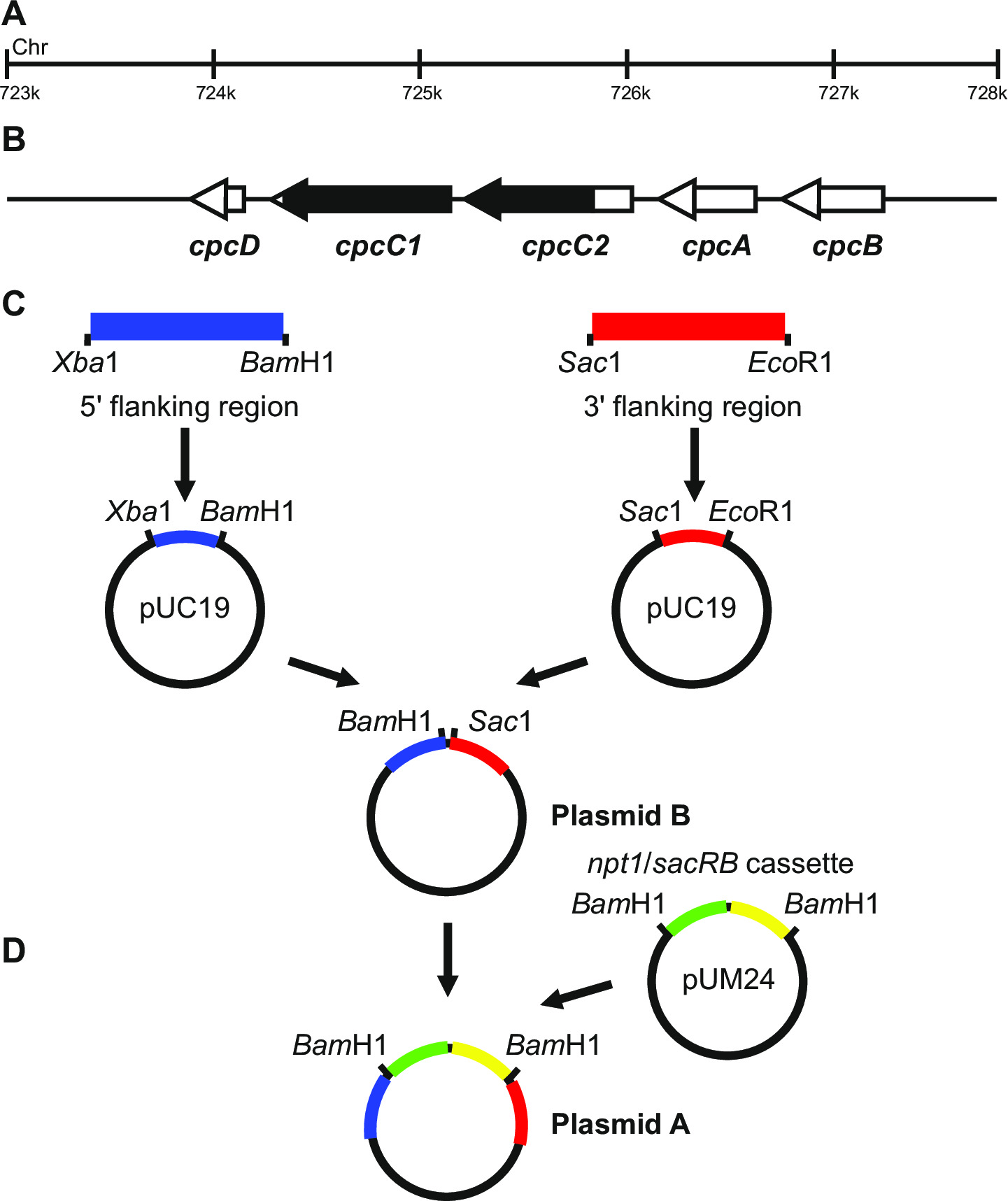
图1:用于构建标记型与非标记型基因敲除株的质粒构建示意图,例如 Synechocystis 中的 cpcC1 和 cpcC2。(A)Synechocystis 基因组中(B)cpcC1 和 cpcC2 及其邻近基因所在的区域。以黑色高亮显示的是突变体中拟被删除的基因组区域。(C)通过PCR扩增的基因组位点。5'侧翼区(蓝色表示)和3'侧翼区(红色表示)被扩增,并带有用于克隆至pUC19的限制性内切酶位点。将5'(或3')侧翼区从pUC19中切除,并插入至含有pUC19 + 3'(或5')侧翼区的质粒中,从而构建质粒B。(D)通过 BamHI 酶切从pUM24中切除 npt1/sacB 插入片段,并将其插入5'与3'侧翼区之间,以构建质粒A。请点击此处查看该图的高清版本。
访问受限。请登录或开始试用以查看此内容。
结果
质粒设计对于成功构建标记与非标记突变体至关重要。 Figure 1 展示了质粒A和B的示例,这些质粒用于在集胞藻(Synechocystis)的cpcC1和cpcC2基因中构建缺失突变体。 Synechocystis genes cpcC1 and cpcC213在这两种情况下,5' 和 3' 侧翼区域均约为 900-1,000 bp。虽然我们成功试验过的最小侧翼区域约为 500 bp,但也可以使用更短的侧翼区域。质粒 B 还可以在 5' 和 3' 侧翼区域(约 1 kb)之间包含一个基因盒,或是天然基因序列的修饰版本。' and 3' 侧翼区域长度约为900-1000 bp。虽然我们已成功验证的最小侧翼区域长度约为500 bp,但也可使用更短的侧翼区域。质粒B的5'端和3'端约1 kb侧翼区域之间还可包含一个基因盒。' and 3' 约1 kb的侧翼区域或经修饰的天然基因序列版本。
访问受限。请登录或开始试用以查看此内容。
讨论
构建无标记突变体最关键的步骤包括:1)精心设计质粒,确保仅目标区域发生改变;2)保持样品无菌,尤其是在蔗糖培养基上培养时;3)将转化后的细胞首先接种于不含抗生素的BG11琼脂平板上,用于获得有标记的突变体,24小时后再添加含抗生素的琼脂;4)在接种于含蔗糖的BG11琼脂平板前,将有标记的突变体连续培养满4天;5)确保有标记的突变体已完全分离;6)充分验证突变株的基因型。对于最后一步,可设计额外的引物以扩增缺失区域的一部分,从而确认该区域已被删除。Southern印迹法虽然操作繁琐,也可用于验证。然而,根据我们的经验,本文所述方法已足以正确验证突变体。该方法也曾成功用于构建集胞藻Synechococcus elongatus PCC7942的有标记突变体,但对该蓝细菌进行多次转化仍具有挑战性。
如果无法分离出标记突变体,则需采用不同的环境条件,如高 CO2,弱光(<20 µmol 光子 m⁻² s⁻¹-2 秒-1)或其他营养物质(即 葡萄糖)可以进行检测。例如,添加葡萄糖对于...
访问受限。请登录或开始试用以查看此内容。
披露
作者声明不存在任何竞争性经济利益。
致谢
我们感谢环境服务协会教育信托基金、剑桥合成生物学 SynBio 基金以及印度政府社会正义与赋能部提供的经费支持。
访问受限。请登录或开始试用以查看此内容。
材料
| 姓名 | 公司 | 目录编号 | 评论 |
|---|---|---|---|
| NaNO3 | Sigma | S5506 | |
| MgSO4·7H2O | Sigma | 230391 | |
| CaCl2 | Sigma | C1016 | |
| 柠檬酸 | Sigma | C0759 | |
| Na2EDTA | Fisher | EDT002 | |
| H3BO3 | Sigma | 339067 | |
| MnCl2·4H2O | Sigma | M3634 | |
| ZnSO4·7H2O | Sigma | Z4750 | |
| Na2MoO4·2H2O | Sigma | 331058 | |
| CuSO4·5H2O | Sigma | 209198 | |
| Co(NO3)2·6H2O | Sigma | 239267 | |
| 柠檬酸铁铵 | Sigma | F5879 | |
| K2HPO4 | Sigma | P3786 | |
| Na2CO3 | Fisher | SODC001 | |
| TES | Sigma | T1375 | |
| NaHCO3 | Fisher | SODH001 | |
| HEPES | Sigma | H3375 | |
| 氰钴胺 | Sigma | 47869 | |
| Na2S2O3 | Sigma | 72049 | |
| Bacto琼脂 | BD | 214010 | |
| 蔗糖 | Fisher | SUC001 | |
| 90 mm 三重通气培养皿 | Greiner | 633185 | |
| 0.2 µm 滤膜 | Sartorius | 16534 | |
| 100 ml 锥形瓶 | Pyrex | CON004 | |
| Parafilm M 100 mm × 38 m | Bemis | FIL003 | |
| Phusion 高保真 DNA 聚合酶 | Phusion | F-530 | |
| 琼脂糖 | Melford | MB1200 | |
| DNA 纯化试剂盒 | MoBio | 12100-300 | |
| 限制性内切酶 | NEB | ||
| T4 DNA 连接酶 | Thermo Scientific | EL0011 | |
| LB 肉汤培养基 | Invitrogen | 12795-027 | |
| MES | Sigma | M8250 | |
| 硫酸卡那霉素 | Sigma | 60615 | |
| 氨苄青霉素 | Sigma | A9518 | |
| GeneJET 质粒小提试剂盒 | Thermo Scientific | K0503 | |
| 14 ml 圆底管 | BD falcon | 352059 | |
| GoTaq G2 Flexi DNA 聚合酶 | Promega | M7805 | |
| 425-600 µm 玻璃珠 | Sigma | G8772 | |
| 甘油 | Sigma | G5516 | |
| DMSO | Sigma | D8418 | |
| 荧光灯管 | Gro-Lux | 69 | |
| HT multitron 光生物反应器 | Infors |
参考文献
- Zwirglmaier, K., et al. Global phylogeography of marine Synechococcus and Prochlorococcus reveals a distinct partitioning of lineages among oceanic biomes. Environ Microbiol. 10, 147-161 (2008).
- Galloway, J. N., et al. Nitrogen cycles: past, present, and future. Biogeochemistry. 70, 153-226 (2004).
- Lea-Smith, D. J., et al. Contribution of cyanobacterial alkane production to the ocean hydrocarbon cycle. Proc Natl Acad Sci U S A. , (2015).
- Howe, C. J., Barbrook, A. C., Nisbet, R. E. R., Lockhart, P. J., Larkum, A. W. D. The origin of plastids. Philos Trans R Soc Lond B Biol Sci. 363, 2675-2685 (2008).
- Lea-Smith, D. J., Bombelli, P., Vasudevan, R., Howe, C. J. Photosynthetic, respiratory and extracellular electron transport pathways in cyanobacteria. Biochim Biophys Acta. , (2015).
- McCormick, A. J., et al. Hydrogen production through oxygenic photosynthesis using the cyanobacterium Synechocystis sp PCC 6803 in a bio-photoelectrolysis cell (BPE) system. Energy Environ. Sci. 6, 2682-2690 (2013).
- Bradley, R. W., Bombelli, P., Lea-Smith, D. J., Howe, C. J. Terminal oxidase mutants of the cyanobacterium Synechocystis sp. PCC 6803 show increased electrogenic activity in biological photo-voltaic systems. Phys Chem Chem Phys. 15, 13611-13618 (2013).
- Ducat, D. C., Way, J. C., Silver, P. A. Engineering cyanobacteria to generate high-value products. Trends Biotechnol. 29, 95-103 (2011).
- Dismukes, G. C., Carrieri, D., Bennette, N., Ananyev, G. M., Posewitz, M. C. Aquatic phototrophs: efficient alternatives to land-based crops for biofuels. Curr Opin Biotechnol. 19, 235-240 (2008).
- Tan, L. T. Bioactive natural products from marine cyanobacteria for drug discovery. Phytochemistry. 68, 954-979 (2007).
- Volk, R. B., Furkert, F. H. Antialgal, antibacterial and antifungal activity of two metabolites produced and excreted by cyanobacteria during growth. Microbiol Res. 161, 180-186 (2006).
- Scott, S. A., et al. Biodiesel from algae: challenges and prospects. Curr Opin Biotechnol. 21, 277-286 (2010).
- Lea-Smith, D. J., et al. Phycobilisome-deficient strains of Synechocystis sp. PCC 6803 have reduced size and require carbon-limiting conditions to exhibit enhanced productivity. Plant Physiol. 165, 705-714 (2014).
- Lea-Smith, D. J., et al. Thylakoid terminal oxidases are essential for the cyanobacterium Synechocystis sp. PCC 6803 to survive rapidly changing light intensities. Plant Physiol. 162, 484-495 (2013).
- Liu, X., Sheng, J., Curtiss, R. 3rd Fatty acid production in genetically modified cyanobacteria. Proc Natl Acad Sci U S A. 108, 6899-6904 (2011).
- Xu, H., Vavilin, D., Funk, C., Vermaas, W. Multiple deletions of small cab-like proteins in the cyanobacterium Synechocystis sp PCC 6803 - Consequences for pigment biosynthesis and accumulation. J Biol Chem. 279, 27971-27979 (2004).
- Castenholz, R. W. Culturing methods for Cyanobacteria. Method Enzymol. 167, 68-93 (1988).
- Mitschke, J., et al. An experimentally anchored map of transcriptional start sites in the model cyanobacterium Synechocystis sp PCC6803. Proc Natl Acad Sci U S A. 108, 2124-2129 (2011).
- Ried, J. L., Collmer, A. An nptI-sacB-sacR cartridge for constructing directed, unmarked mutations in gram-negative bacteria by marker exchange-eviction mutagenesis. Gene. 57, 239-246 (1987).
- Vieira, J., Messing, J. The pUC plasmids, an M13mp7-derived system for insertion mutagenesis and sequencing with synthetic universal primers. Gene. 19, 259-268 (1982).
- Vermaas, W. F. J., Williams, J. G. K., Rutherford, A. W., Mathis, P., Arntzen, C. J. Genetically Engineered Mutant of the Cyanobacterium Synechocystis 6803 Lacks the Photosystem-Ii Chlorophyll-Binding Protein Cp-47. Proc Natl Acad Sci U S A. 83, 9474-9477 (1986).
- Westphal, S., Heins, L., Soll, J., Vothknecht, U. C. Vipp1 deletion mutant of Synechocystis: A connection between bacterial phage shock and thylakoid biogenesis? Proc Natl Acad Sci U S A. 98, 4243-4248 (2001).
- Zhang, S. Y., Shen, G. Z., Li, Z. K., Golbeck, J. H., Bryant, D. A. Vipp1 Is Essential for the Biogenesis of Photosystem I but Not Thylakoid Membranes in Synechococcus sp PCC 7002. J Biol Chem. 289, 15904-15914 (2014).
- Taroncher-Oldenberg, G., Nishina, K., Stephanopoulos, G. Identification and analysis of the polyhydroxyalkanoate-specific beta-ketothiolase and acetoacetyl coenzyme A reductase genes in the cyanobacterium Synechocystis sp strain PCC6803. Appl Environ Microbiol. 66, 4440-4448 (2000).
- Hein, S., Tran, H., Steinbuchel, A. Synechocystis sp. PCC6803 possesses a two-component polyhydroxyalkanoic acid synthase similar to that of anoxygenic purple sulfur bacteria. Arch Microbiol. 170, 162-170 (1998).
- Ng, A. H., Berla, B. M., Pakrasi, H. B. Fine tuning of photoautotrophic protein production by combining promoters and neutral sites in Synechocystis 6803, a cyanobacterium. Appl Environ Microbiol. , (2015).
访问受限。请登录或开始试用以查看此内容。
重印与许可
