The objective of this study was to determine the effects of bleach and chlorine gas sterilization on seed germination of a range of Arabidopsis genotypes grown on sterile media. Optimized sterilization protocols have been developed to prevent the growth of microbial contaminants while providing satisfactory seed survival.
方法文章
Standardized Method for High-throughput Sterilization of Arabidopsis Seeds
* These authors contributed equally
本文内容
摘要
摘要
Arabidopsis thaliana (Arabidopsis) seedlings often need to be grown on sterile media. This requires prior seed sterilization to prevent the growth of microbial contaminants present on the seed surface. Currently, Arabidopsis seeds are sterilized using two distinct sterilization techniques in conditions that differ slightly between labs and have not been standardized, often resulting in only partially effective sterilization or in excessive seed mortality. Most of these methods are also not easily scalable to a large number of seed lines of diverse genotypes. As technologies for high-throughput analysis of Arabidopsis continue to proliferate, standardized techniques for sterilizing large numbers of seeds of different genotypes are becoming essential for conducting these types of experiments. The response of a number of Arabidopsis lines to two different sterilization techniques was evaluated based on seed germination rate and the level of seed contamination with microbes and other pathogens. The treatments included different concentrations of sterilizing agents and times of exposure, combined to determine optimal conditions for Arabidopsis seed sterilization. Optimized protocols have been developed for two different sterilization methods: bleach (liquid-phase) and chlorine (Cl2) gas (vapor-phase), both resulting in high seed germination rates and minimal microbial contamination. The utility of these protocols was illustrated through the testing of both wild type and mutant seeds with a range of germination potentials. Our results show that seeds can be effectively sterilized using either method without excessive seed mortality, although detrimental effects of sterilization were observed for seeds with lower than optimal germination potential. In addition, an equation was developed to enable researchers to apply the standardized chlorine gas sterilization conditions to airtight containers of different sizes. The protocols described here allow easy, efficient, and inexpensive seed sterilization for a large number of Arabidopsis lines.
引言
Arabidopsis thaliana (Arabidopsis) is a prime model organism for basic and applied research in plant biology1,2,3. While standard conditions for Arabidopsis growth have been well established4, the effect of seed sterilization on seed viability has not been rigorously tested. Solid media in plates or boxes is routinely used to facilitate growth of Arabidopsis seedlings for many experimental applications, such as identification of homozygous lethal mutants in a segregating population, observation of shoot and root phenotypes at early stages, isolation of pathogen-free tissue, collection of large amounts of seedling tissue, selection of transformants or drug-resistant plants and evaluation of germination1,2,3,4. Seeds harvested from plants grown in a greenhouse or growth chamber are occasionally contaminated with microorganisms and dust. Growth of Arabidopsis seedlings on different types of sterile media requires prior seed sterilization to remove microbial contaminants such as fungi and bacteria present on the seed surface. The use of an effective seed sterilization regime is critical for a balance of high germination, minimum contamination, and vigorous plant growth.
The two most common methods used for Arabidopsis seed sterilization are based on commercial bleach (liquid-phase) and chlorine gas (vapor-phase). Various procedures have been employed for both liquid-phase sterilization1,4,5,6,7,8,9,10 and vapor-phase sterilization of Arabidopsis seeds8,10,11,12,13,14,15,16. However, while these procedures have been effective in accomplishing seed sterilization of the utilized genotypes, a detailed analysis of the effect of different sterilization treatments on the seeds of different genotypes has not been reported. Therefore, the optimization of these sterilization procedures is required to define conditions in which efficient sterilization is combined with high germination rate.
The Arabidopsis Biological Resource Center (ABRC) is uniquely positioned to a) test seed viability of a variety of different genotypes in the collection and b) take advantage of the quality control procedures applied internally and in response to user feedback about seed germination. The objectives of the experiments presented here were to determine the effects of various sterilization methods on seed germination of a range of Arabidopsis genotypes. Optimized sterilization procedures which result in high seed germination rates while maintaining minimal pathogen contamination are presented for both bleach and chlorine gas sterilization.
方案
1. 1倍MS(Murashige和Skoog)培养基的制备
- 在含有 0.8 L 蒸馏水的烧杯中加入 4.31 g MS 基本盐混合物、10 g 蔗糖和 0.5 g 2-(N-吗啉代)乙磺酸(MES),搅拌至溶解。使用 1 M 氢氧化钾(KOH)调节 pH 至 5.7。用蒸馏水定容至 1 L。
- 将培养基分装至两个 1 L 瓶中,每瓶 500 mL。每瓶加入 5 g 琼脂。瓶盖保持松动。
- 在 121 °C、15 psi 条件下高压灭菌 20 分钟,瓶内放置磁力搅拌子。
- 灭菌后,将瓶子置于磁力搅拌器上,低速搅拌,使 MS 培养基冷却至 45–50 °C(直至瓶子可用手直接握住)。
- 从本步骤开始,所有操作均需在超净工作台内无菌条件下进行。向每瓶中加入 500 µL Gamborg 维生素溶液,并搅拌 MS 培养基,使维生素溶液均匀分布。
- 将适量培养基倒入培养皿中,覆盖培养皿约一半深度即可。
- 在室温下静置约 1 小时,使琼脂完全凝固。
注意:若培养皿不立即使用,需用塑料膜包裹,并于 4 °C(冰箱温度)保存。已凝固的琼脂培养皿、培养盒或试管可在密闭容器中于 4 °C 保存数周。
2. 使用漂白剂对拟南芥种子进行消毒
- 按照本方案第1节的要求制备MS平板。在对MS培养基进行高压灭菌的同时,将100 mL蒸馏水一同高压灭菌。后续可用作冲洗用水,并有助于悬浮种子以辅助接种。
注意:如需要,可在本步骤中将0.8%(w/v)琼脂混合物(例如 phytagar)一同进行高压灭菌。在接种步骤(2.5.3)中,可用琼脂混合物替代蒸馏水。由于琼脂混合物具有更高的黏度,因此更易于在平板上分散种子,或在必要时按行种植。 - 配制50%(v/v)次氯酸钠溶液用于种子灭菌。稀释时,将100 mL次氯酸钠加入100 mL蒸馏水中。向次氯酸钠溶液中加入50 µL Tween 20去垢剂。
注意:配制好的次氯酸钠溶液可在无菌条件下开启并储存长达一个月。 - 将100粒种子分装至1.5 mL微量离心管中。
- 使用50%次氯酸钠溶液对种子进行灭菌。
- 在超净工作台内,向含有种子的微量离心管中加入500 µL 50%次氯酸钠溶液。轻弹管底,使种子充分悬浮于次氯酸钠溶液中。
注意:也可使用旋转仪或摇床持续悬浮种子。
- 在超净工作台内,向含有种子的微量离心管中加入500 µL 50%次氯酸钠溶液。轻弹管底,使种子充分悬浮于次氯酸钠溶液中。
- 从管中洗去次氯酸钠溶液。
- 10分钟后,使用移液器或配有移液枪头的抽吸装置将次氯酸钠溶液从微量离心管中移除。
- 向管中加入500 µL无菌蒸馏水。盖紧管盖并倒置混匀。静置使种子沉降至管底。待种子完全沉降后,小心用移液器吸除上清液。重复此洗涤步骤共6次。
- 向管中加入1 mL经高压灭菌的蒸馏水以悬浮种子。
- 将灭菌后的种子接种至MS平板上。
- 在超净工作台内,用记号笔在MS平板底部标记品系名称和当前日期。
- 将微量离心管中的种子倾倒至MS平板上。使用无菌的一次性接种环或无菌移液枪头将种子在平板表面均匀分散。
注意:若需按行播种,可使用带有200 µL枪头的移液器将种子逐个放置于所需位置。为改善种子流动,可用剪刀将移液枪头末端剪去3–5 mm。任何位置不当的种子或成簇的种子,可用无菌的一次性接种环重新调整位置或分开。 - 将MS平板置于超净工作台后部,皿盖半开,使平板表面多余水分蒸发。
- 盖上MS平板盖子,并用微孔透气医用胶带密封平板(参见材料表)。
3. 用氯气对拟南芥种子进行灭菌
- 按照方案第1节制备MS平板。在对MS培养基进行高压灭菌的同时,对100 mL蒸馏水进行高压灭菌;该蒸馏水后续将用于悬浮种子,以辅助接种。
注意:如需要,可使用0.8%琼脂混合物(w/v)(例如 phytagar)在此步骤中也可进行高压灭菌。在铺板过程中(步骤 3.6.2),可用琼脂混合液替代蒸馏水。由于琼脂混合液具有更高的黏度,因此更便于在培养板上分散种子,或在必要时按行种植。 - 开始灭菌前,计算生成氯气所需的漂白剂和盐酸(HCl)的用量。
- 计算生成6.1% Cl所需的HCl量2 灭菌所需。
- 使用以下公式:

以7,000 mL为灭菌容器的体积,6.1为Cl的百分比2;HCl 的体积计算为 3 mL。
注意:已编程的电子表格可用于计算不同容器体积和不同氯含量百分比(%Cl)的情况。2 作为提供 补充表 1.
- 将100粒种子分装至0.5 mL微量离心管中。盖紧每管管盖,将离心管放入塑料试管架中,备用。
注意:只要在适当条件下储存,种子在此阶段可长期保存。储存条件详见Rivero及其同事所著方案的第3.3.2节。4也可使用96孔板格式。 - 准备进行氯气灭菌所需的材料。
- 从储存位置取出漂白剂和盐酸。
- 剪下一长条大号石蜡膜(参见 材料清单用于第 3.5.3 步密封灭菌容器。
- 将带盖的塑料容器放入通风橱中,用于灭菌操作。打开所有种子小瓶的瓶盖,将整个种子架放入塑料容器内。
- 在室温下进行氯气灭菌。
注意:请分别使用漂白剂和酸液。切勿将任一试剂瓶敞口放置,以减少泼洒风险。操作时应穿戴适当的个人防护装备(PPE),包括手套和实验服。若漂白剂或酸液溅到手套上,须在接触其他材料前更换手套。若存在漂白剂或酸液污染可能,务必在通风橱内脱去手套。- 将一个250 mL烧杯放入容器中,并加入100 mL次氯酸钠溶液。
注意:盐酸与次氯酸钠溶液之间的反应需要至少22倍体积过量的次氯酸钠溶液。该反应会消耗盐酸和次氯酸钠,并释放出氯气2 气体副产物为氯化钠(NaCl)和水。使用过量的次氯酸钠可在排气过程中消耗更多的盐酸(HCl),从而减少碳酸氢钠(NaHCO₃)的用量。3) 需中和溶液以供处理。
注意:烧杯的容积应至少为次氯酸钠溶液与盐酸总体积的两倍。这可以防止下一步操作中液体溅出烧杯,避免损伤种子、腐蚀衣物或灼伤暴露的皮肤。 - 向含有漂白剂的烧杯中加入 3 mL 盐酸。
注意:初始反应会产生气泡,尤其是在气体浓度高于6.1%时。此步骤必须穿戴长袖实验服。 - 关闭灭菌容器,并立即用石蜡膜密封。
- 在灭菌过程中监测灭菌容器,以确保气体积聚;容器内应可见氯气积聚形成的淡黄色薄雾。
注意:定期检查灭菌容器,确保内部压力未导致盖子松动或石蜡膜脱落。若发现盖子已松动或石蜡膜已松开,应立即盖紧盖子,并小心地用额外一层石蜡膜重新包裹容器。 - 消毒1小时后,撕去石蜡膜并打开容器一角的盖子。让容器通风3小时,以完成反应并排除氯气。
- 盖上种子架上所有微量离心管的管盖。
注意:只要将灭菌后的种子保存在干燥条件下,即可在接种前储存一段时间。 - 移除种子架并将其放入超净工作台。
- 中和氯气反应
- 加入1.5 g NaHCO₃3 将粉末缓慢加入含有次氯酸钠/盐酸溶液的烧杯中,并用玻璃棒搅拌以溶解 NaHCO₃。3 进入溶液。继续加入 NaHCO₃。3 直至二氧化碳(CO2气体气泡已停止形成。
注意:缓慢加入,以防飞溅。使用适当的个人防护装备,包括手套和实验服。 - 使用 pH 试纸或 pH 计检测溶液的 pH 值。加入额外的 NaHCO₃3 如有必要,继续调节至溶液 pH 为中性(pH 7.0)。此时可将溶液移出通风橱,并依照所有适用的废弃物处理规范进行处置。
注意:若在处理过程中闻到任何气味,应立即将溶液移回通风橱。
- 加入1.5 g NaHCO₃3 将粉末缓慢加入含有次氯酸钠/盐酸溶液的烧杯中,并用玻璃棒搅拌以溶解 NaHCO₃。3 进入溶液。继续加入 NaHCO₃。3 直至二氧化碳(CO2气体气泡已停止形成。
- 将一个250 mL烧杯放入容器中,并加入100 mL次氯酸钠溶液。
- 将灭菌后的种子接种到MS培养基平板上。
- 在超净工作台中,用菌株名称和当前日期标记 MS 培养基平板底部。
- 添加 500 µL 向每个微量离心管中加入无菌蒸馏水以重悬种子。将种子倒入MS平板上,使用无菌一次性接种环或无菌移液器吸头将种子在平板上均匀铺开。
- 将MS平板置于超净工作台后部,平板盖半开。使MS平板上多余的水分蒸发。
- 将盖子盖在MS培养皿上。用微孔纸手术胶带包裹培养皿以密封。
4. 在MS平板上培养拟南芥
- 将培养皿盖朝上置于 4 ˚C、环境湿度条件下放置三天。
注意:此过程称为春化处理,旨在同步单个种子的萌发。 - 将培养皿转移至生长环境。
- 保持温度为 23 °C,光照强度为 120 - 150 µmol/m2s,光周期为 16 小时光照 / 8 小时黑暗。将培养皿平放于生长环境中,皿盖朝上,以确保根部向培养基内生长。
- 让培养皿中的幼苗生长 8 天。
注意:8 天的生长期可确保迟萌发的种子完成萌发。若所有种子均已萌发,可提前进行观察记录。 - 统计萌发率。
- 记录已萌发和未萌发的种子数量。通过将萌发种子数除以培养皿中种子总数,计算萌发率。
注意:当胚根伸出种皮且两片子叶可见时,记为萌发。 - 同时统计受霉菌污染的种子数量,以评估灭菌条件的有效性。
- 记录已萌发和未萌发的种子数量。通过将萌发种子数除以培养皿中种子总数,计算萌发率。
结果
从露天环境、温室或人工气候室采集的拟南芥种子有时会被真菌和细菌等不同微生物污染1,4。因此,由于培养皿污染问题,尤其是在种子供应有限的情况下,在无菌培养基上萌发种子可能极具挑战性。以下展示的次氯酸钠和氯气消毒优化方案可最大限度地减少此类问题,同时保持种子活力,满足高通量实验的应用需求。
漂白剂消毒对拟南芥Col-0种子萌发的影响
次氯酸钠是多种植物种子灭菌中最常用的试剂。不同物种间,灭菌试剂的最佳浓度和处理时间各不相同。已有多种实验方案采用次氯酸钠对拟南芥种子进行灭菌1,4,5,6,7,8,9,10。本研究测试了四种不同浓度的次氯酸钠溶液和五种不同的处理时间,结果如 图1所示。实验处理对象为哥伦比亚野生型(Col-0)种子。次氯酸钠浓度对Col-0种子萌发的影响因灭菌时间的不同而有所差异,灭菌浓度与时间之间存在显著的交互效应(图1,P < 0.001,ANOVA——方差分析)。
在灭菌时间为5至10分钟的实验中,所有次氯酸钠浓度处理下的Col-0种子均表现出同样高的萌发率(图1)。对于40%和50%家用次氯酸钠溶液,在所有灭菌时间下也观察到较高的萌发率。使用80%和100%次氯酸钠处理超过10分钟时,种子萌发率显著低于较短浸泡时间(P < 0.01,ANOVA)。此外,与相应浓度为40%和50%的处理相比,80%和100%次氯酸钠处理20分钟后的萌发率显著降低(P < 0.001,ANOVA)。
使用高浓度次氯酸钠处理15分钟或更长时间时,种子表现出不同程度的漂白和皱缩现象。除了相对较高的种子死亡率(最高达32%)外,在这些条件下灭菌的萌发种子常出现生长缺陷,表现为子叶和下胚轴无法展开和伸长,导致发育停滞。大多数处理组(20组中的14组)完全无霉菌污染,总体霉菌污染率平均为0.21% ± 0.003(表1)。
选择50%次氯酸钠处理并浸泡10分钟作为最佳灭菌方案,因其兼具较高的萌发率和良好的表面病原菌生长抑制效果。该处理方案被用于检测次氯酸钠灭菌对不同突变品系的影响,具体方法如下所述。
氯气灭菌对Col-0种子萌发的影响
为优化氯气灭菌条件,采用三种不同浓度的氯气对Col-0种子进行两个时间段的灭菌处理(表2)。氯气浓度根据浓盐酸体积和灭菌容器体积,按以下公式计算:

该方程基于理想气体定律推导得出,假设使用12.3 M HCl,温度为23 °C,标准大气压为101.3 kPa。
氯气浓度对Col-0种子萌发的影响取决于灭菌时间,时间与浓度因素之间存在显著交互作用(图2A,P < 0.01,ANOVA)。对于经过1小时灭菌处理的Col-0种子,氯气浓度对其萌发无显著影响。在此灭菌时间下,所有氯气浓度均促进种子达到相似的高萌发率,均高于85%(P > 0.05,ANOVA)。然而,当灭菌时间为3小时时,与两种较低浓度的氯气相比,最高浓度的氯气显著降低了种子的萌发率(P < 0.05,ANOVA)。这些结果表明,拟南芥种子在1小时内使用任何测试浓度的氯气处理,或在3小时内使用低于16.5%浓度的氯气处理,均能同样有效地保持种子活力,因为萌发率始终高于82%。然而,使用16.5%浓度的氯气对种子进行3小时灭菌会损害种子的萌发能力。
霉菌的发生率也依赖于气体浓度和暴露时间。使用相对较高的6.1%和16.5%氯气浓度处理1小时,以及所有浓度的气体处理3小时,均可有效抑制霉菌生长。图2B).
根据这些结果,选择气体浓度为6.1%、处理1小时(表2)作为最佳的气相灭菌条件,用于测试气体灭菌对不同突变株系的影响,因为该条件兼具较高的发芽率(85%)和极低的霉菌污染水平(0.02%)。
漂白剂和氯气灭菌对不同萌发潜力种子的影响
统计分析表明,不同品系对消毒方法的萌发反应取决于其萌发潜力(图3A, P < 0.01,ANOVA)。漂白剂或氯气消毒均未降低高萌发潜力种子组(第4组和第5组)的萌发率。两种处理对本身萌发潜力最低组(第1组)已较低的萌发率亦无影响。相反,氯气消毒使萌发率显著降低了约12–18%(P < 0.01,ANOVA)在具有中等萌发潜力的种子(第2组和第3组)萌发中表现显著。次氯酸钠消毒使第2组种子的萌发率降低了13%,但对第3组种子的萌发率无显著影响。尽管在各萌发组中,次氯酸钠处理与氯气处理之间的萌发率差异均无统计学显著性(图 3A, P > 0.442, ANOVA),在所有发芽组中,使用次氯酸钠消毒的种子发芽率略高于气体消毒的种子。
灭菌处理显著改变了受霉菌影响的种子百分比(P < 0.001,ANOVA)(图3B)。与不进行灭菌相比,氯气和次氯酸钠灭菌均导致更少的霉菌生长(P < 0.05,ANOVA)。在任何组别中,气体灭菌与次氯酸钠灭菌之间的霉菌水平均无显著差异(图3B,P > 0.4,ANOVA)。
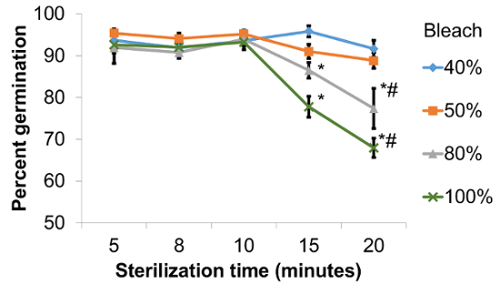
图1:次氯酸钠浓度和灭菌时间对拟南芥Col-0种子萌发的影响。 数据为5次独立实验重复的平均值±标准差。*表示在不同次氯酸钠浓度下,与5分钟浸种时间相比具有显著差异(P < 0.01,ANOVA)。#表示在20分钟处理时间内,80%和100%次氯酸钠浓度与40%和50%浓度相比具有显著差异(P < 0.01,ANOVA)。请点击此处查看该图的放大版本。
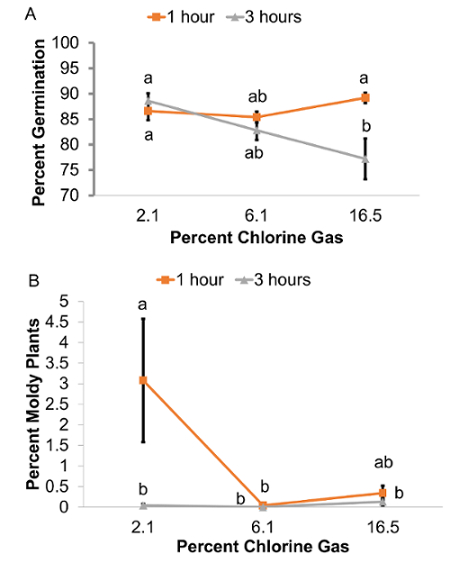
图 2:氯气浓度和灭菌时间对拟南芥Col-0种子的影响。(A)萌发率和(B)霉菌水平。误差线表示实验5次生物学重复和5次技术重复的平均值±标准差(SD)。均值之间若字母不同,则表示差异显著(P < 0.05,ANOVA)。请点击此处查看该图的放大版本。
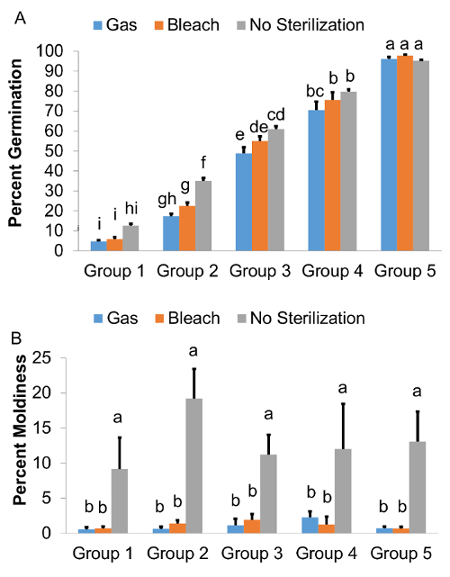
图3:次氯酸钠与氯气灭菌对不同萌发潜力种子的影响。(A)萌发率和(B)霉变程度。100个SALK T-DNA株系根据其萌发潜力被分为五组,萌发潜力定义为未使用任何灭菌剂条件下的萌发率。各组按萌发率划分如下:第1组(0–20%)、第2组(21–50%)、第3组(51–70%)、第4组(71–90%)和第5组(91–100%)。这些株系为随机选取,其萌发潜力不依赖于基因型。数据为三次独立重复实验所得平均值±标准差(SD)。每个数值上方的字母(“a”、“ab”、“c”等)表示类别均值的统计分组。均值之间若不共享相同字母,则差异显著(P < 0.05,单因素方差分析ANOVA)。请点击此处查看该图的放大版本。
| 灭菌时间(分钟) | 次氯酸钠溶液浓度(%) | |||
| 40 | 50 | 80 | 100 | |
| 5 | 0.00% | 0.00% | 0.00% | 2.13% |
| 8 | 0.00% | 0.00% | 0.00% | 0.00% |
| 10 | 0.00% | 0.50% | 0.00% | 0.36% |
| 15 | 0.00% | 0.00% | 0.00% | 0.68% |
| 20 | 0.19% | 0.28% | 0.00% | 0.00% |
表1:漂白消毒的Col-0种子的霉菌污染水平。
| 漂白剂 | HCl | 时间 | 氯气含量(mol Cl2/mol 总气体)% |
| (mL) | (mL) | (h) | |
| 25 | 1 | 1 | 2.1 |
| 25 | 1 | 3 | 2.1 |
| 100 | 3 | 1 | 6.1 |
| 100 | 3 | 3 | 6.1 |
| 200 | 9 | 1 | 16.5 |
| 200 | 9 | 3 | 16.5 |
表2:使用7 L容器对哥伦比亚野生型种子进行氯气(Cl2)气体灭菌处理。
补充表 1:一个已编程的电子表格,用于根据不同容器体积和 Cl2 百分比进行计算。 请点击此处下载该文件。
讨论
When growing Arabidopsis seeds on sterile media, some form of sterilization must be applied. Both bleach and chlorine gas sterilization treatments result in similar germination rate and mold growth inhibition. Neither sterilization method causes a significant reduction in germination rate for seeds with high germination potential; however, bleach sterilization is recommended for lines with lower germination potential (20-70%), due to the small, albeit non-significant, improvement in germination rate compared to gas sterilization (Figure 3A).
Sterilizing Arabidopsis seeds with bleach concentrations from 40-100% for up to 10 min provides satisfactory germination percentages and effective mold suppression. Although bleach concentrations less than 40% provide adequate sterilization for most seed lots, using a concentration of 40% or higher guarantees effective sterilization of even heavily contaminated seed lots. It is important not to exceed 10 min of sterilization when using bleach concentrations equal or higher than 80% to avoid high seed mortality and defects in seedling development.
Treating Arabidopsis seeds with chlorine gas concentrations of 6.1% or 16.5% for 1 h results in high germination rates and adequate mold elimination. Low chlorine gas concentration (2.1%) can be used successfully by increasing duration of sterilization to 3 h.
When few lines need to be sterilized, liquid sterilization in a solution of 50% bleach for 10 min is recommended. For greater numbers of lines, gas sterilization with a gas concentration of 6.1% for 1 h is a better option since many lines can be sterilized quickly and easily with less manipulation.
Our results provide standardized conditions for sterilizing both large number of seeds of different genotypes and the seeds with lower germination potential. The only limitation of these sterilization techniques is that they cannot be applied to the seeds with germination rates less than 20% due to extensive seed mortality. Alternative methods, such as sonication17, to increase germination rate in the absence of sterilization might be beneficial in those cases.
披露
The authors have nothing to disclose.
致谢
We would like to thank Gauri Datta for her assistance in preparing experimental materials. We are also grateful to Bettina Wittler and James Mann for the critical review of the manuscript. This work was supported by the NSF grants DBI-1049341 and MCB-1143813.
材料
| 姓名 | 公司 | 目录编号 | 评论 |
|---|---|---|---|
| 0.65 mL 微量离心管 | GeneMate | C-3260-5 | 芥种子进行灭菌的管 |
| 1.7 mL 微量离心管 | GeneMate | C-3262-1 | 放置拟南芥种子进行灭菌的管 |
| 7 L 塑料容器 | Sistema | 1016265438 | 进行 |
| 气体灭菌的容器用于 | 产生氯气的 | Sigma-Aldrich | 320331 |
| 一次性无菌接种环 | Fisher Scientific | 22-363-603 | 环用于将拟南芥种子铺展或放置在 MS 板 |
| Gamborg' 上s 维生素溶液 | Sigma-Aldrich | G1019 | 用于制作 MS 培养基过程的维生素溶液 |
| 家用漂白 | Clorox | Regular-漂白剂 | 产生氯气和液体消毒过程的化学品 |
| MES 水合 | Sigma-Aldrich | M2933 | 用于制造 MS 培养基过程中的化学品 |
| 微孔手术胶带 | 3M | 1530-1 | 用于密封 MS 板的微孔手术纸胶带 |
| Murashige 和 Skoog 基础盐混合物 (MS) | Sigma-Aldrich | M5524 | 用于制作 MS 培养基的化学品 |
| Parafilm M | Bemis 公司 | #PM996 | 用于密封灭菌容器的 Parraffin 薄膜 |
| 培养皿 100 X 15 mm | Fisher Scientific | FB0875713 | 为培养拟南芥 pH 条而倒入 MS 培养基的培养皿 拟南芥 |
| pH 指示条 | Whatman | 2613991 | 用于检查中和氯和碳酸氢钠溶液的 pH 值 |
| 植物琼脂 | Fisher Scientific | 50-255-212 | 用于在铺板种子过程中帮助悬浮拟南芥种子 |
| 碳酸氢钠 | Sigma-Aldrich | S5761 | 用于中和氯气反应过程的化学品 |
| 蔗糖 | Sigma-Aldrich | S0389 | 用于制备 MS 介质过程的化学品 |
| 吐温 20 | Fisher BioReagents | BP337-100 | 用于液体灭菌过程的化学品 |
| 拟南芥种子 | ABRC;通过 TAIR www.arabidopsis.org CS70000 订购 | (Col-0) | 拟南芥野生型种子 |
| 拟南芥种子 | ABRC;通过 TAIR www.arabidopsis.org 订购 | 作为第 1 组 | |
| 种子 | ABRC;通过 TAIR SALK_041402C www.arabidopsis.org 作为 | 第 1 组 | |
| 拟南芥种子 | ABRC订购;通过 TAIR www.arabidopsis.org SALK_059101C 订购 | 用于测试的拟南芥种子作为第 1 组 | |
| 拟南芥种子的一部分 | ABRC;通过 TAIR www.arabidopsis.org 订购 | 的 | 种子SALK_063470C作为第 1 组 |
| 拟南芥种子的一部分 | ABRC;通过 TAIR SALK_072048C www.arabidopsis.org 订购 | 用于测试的拟南芥种子,作为第 1 组 | |
| 拟南芥种子 | 的一部分ABRC;通过 TAIR 订购 www.arabidopsis.org | 第 1 组 | |
| 种子 | ABRC;通过 TAIR www.arabidopsis.org 作为 | 第 1 组 | |
| 种子 | ABRC 订购;通过 TAIR SALK_084124C www.arabidopsis.org 作为 | 第 1 | |
| 拟南芥种子 | ABRC;通过 TAIR www.arabidopsis.org 订购 | 作为第 1 组 | |
| 种子 | ABRC;通过 TAIR SALK_089717C www.arabidopsis.org 作为 | 第 1 组 | |
| 种子 | ABRC订购;通过 TAIR www.arabidopsis.org | SALK_107354C | 订购用于测试的拟南芥种子作为第 1 组 |
| 拟南芥种子的一部分 | ABRC;通过 TAIR www.arabidopsis.org 订购 | 种子SALK_110111C作为第 1 组 | |
| 拟南芥种子的一部分 | ABRC;通过 TAIR SALK_111322C www.arabidopsis.org 订购 | 作为第 1 组 | |
| 南芥种子 | ABRC;通过 TAIR 订购SALK_113109C | 的一部分用于测试的拟南芥 | |
| 种子 | www.arabidopsis.org;通过 TAIR www.arabidopsis.org 作为 | 第 1 组 | |
| 种子 | ABRC 订购;通过 TAIR SALK_114872C www.arabidopsis.org 作为 | 第 1 | |
| 拟南芥种子 | ABRC;通过 TAIR www.arabidopsis.org 订购 | 作为第 1 组 | |
| 种子 | ABRC;通过 TAIR SALK_116803C www.arabidopsis.org 作为 | 第 1 组 | |
| 种子 | ABRC 订购;通过 TAIR www.arabidopsis.org | SALK_039445C | 订购用于测试的拟南芥种子作为第 2 组 |
| 拟南芥种子的一部分 | ABRC;通过 TAIR SALK_039782C www.arabidopsis.org 订购 | 作为第 2 组 | |
| 种子 | ABRC;通过 TAIR SALK_043037C www.arabidopsis.org 订购 | 第 2 组 | |
| 拟南芥种子 | ABRC;通过 TAIR www.arabidopsis.org 订购SALK_045828C | 第 2 组 | |
| 种子 | ABRC;通过 TAIR www.arabidopsis.org 作为 | 第 2 组 | |
| 种子 | ABRC 订购;通过 TAIR www.arabidopsis.org 作为 | 第 2 | |
| 拟南芥种子 | ABRC;通过 TAIR www.arabidopsis.org 订购 | 作为第 2 组 | |
| 种子 | ABRC;通过 TAIR SALK_080816C www.arabidopsis.org 作为 | 第 2 组 | |
| 种子 | ABRC 订购;通过 TAIR www.arabidopsis.org SALK_081176C 订购 | 拟南芥种子作为第 2 组 | |
| 拟南芥种子 | ABRC 的一部分用于测试;通过 TAIR www.arabidopsis.org 订购 | 第 2 组 | |
| 种子 | ABRC;通过 TAIR SALK_082262C www.arabidopsis.org 订购 | 第 2 组 | |
| 南芥种子 | ABRC;通过 TAIR www.arabidopsis.org 订购 | 第 2 组 | |
| 种子 | ABRC;通过 TAIR www.arabidopsis.org 作为 | 第 2 组 | |
| 种子 | ABRC 订购;通过 TAIR SALK_083630C www.arabidopsis.org 作为 | 第 2 | |
| 南芥种子 | ABRC;通过 TAIR www.arabidopsis.org 订购 | 作为第 2 组 | |
| 种子 | ABRC;通过 TAIR www.arabidopsis.org 作为 | 第 2 组 | |
| 种子 | ABRC;通过 TAIR www.arabidopsis.org | SALK_085656C | 订购拟南芥种子作为第 2 组 |
| 芥种子 | ;通过 TAIR SALK_093049C www.arabidopsis.org 订购 | 作为第 2 组 | |
| 种子 | ABRC;通过 TAIR SALK_103332C www.arabidopsis.org 作为 | 第 2 组 | |
| 南芥种子 | ABRC;通过 TAIR 订购 www.arabidopsis.org | 第 2 组 | |
| 种子 | ABRC;通过 TAIR www.arabidopsis.org 作为 | 第 2 组 | |
| 种子 | ABRC 订购;通过 TAIR www.arabidopsis.org 作为 | 第 2 | |
| 拟南芥种子 | ABRC;通过 TAIR www.arabidopsis.org 订购 | 作为第 2 组 | |
| 种子 | ABRC;通过 TAIR SALK_110580C www.arabidopsis.org 作为 | 第 2 组 | |
| 种子 | ABRC 订购;通过 TAIR www.arabidopsis.org SALK_110617C 订购 | 用于测试的拟南芥种子作为第 2 组 | |
| 拟南芥种子的一部分 | ABRC;通过 TAIR SALK_111424C www.arabidopsis.org 订购 | 作为第 2 组 | |
| 种子 | ABRC;通过 TAIR SALK_111584C www.arabidopsis.org 作为 | 第 2 组 | |
| 南芥种子 | ABRC;通过 TAIR 订购 www.arabidopsis.org | 第 2 组 | SALK_112097C |
| 种子 | ;通过 TAIR www.arabidopsis.org 作为 | 第 2 组 | |
| 种子 | ABRC 订购;通过 TAIR www.arabidopsis.org 作为 | 第 2 | |
| 拟南芥种子 | ABRC;通过 TAIR www.arabidopsis.org 作为 | 第 3 组 | |
| 种子 | ABRC 订购;通过 TAIR SALK_026478C www.arabidopsis.org 作为 | 第 3 组 | |
| 拟南芥种子 | ABRC 订购;通过 TAIR www.arabidopsis.org SALK_046565C 订购 | 拟南芥种子作为第 3 组 | |
| 拟南芥种子 | ;通过 TAIR www.arabidopsis.org 订购 | 第 3 组 | |
| 拟南芥种子 | SALK_049258C通过TAIR SALK_049339C www.arabidopsis.org 作为 | 第 3 组 | |
| 南芥种子 | ABRC;通过 TAIR 订购 www.arabidopsis.org | 第 3 组 | |
| 种子 | ABRC;通过 TAIR www.arabidopsis.org 作为 | 第 3 组 | |
| 种子 | ABRC 订购;通过 TAIR www.arabidopsis.org 作为 | 第 3 | |
| 拟南芥种子 | ABRC;通过 TAIR 订购 www.arabidopsis.org | 第 3 组 | |
| 种子 | ABRC;通过 TAIR SALK_110573C www.arabidopsis.org 作为 | 第 3 组 | |
| 种子 | ABRC订购;通过 TAIR www.arabidopsis.org SALK_112793C 订购 | 用于测试的拟南芥种子作为第 3 组 | |
| 拟南芥种子的一部分 | ABRC;通过 TAIR www.arabidopsis.org 订购 | 用于测试的拟南芥种子SALK_113658C作为第 3 组 | |
| 拟南芥种子的一部分 | ABRC;通过 TAIR SALK_113904C www.arabidopsis.org 作为 | 第 3 组 | |
| 拟南芥种子 | ABRC;通过 TAIR 订购 www.arabidopsis.org | 第 3 组 | |
| 种子 | ABRC;通过 TAIR www.arabidopsis.org 作为 | 第 3 组 | |
| 种子 | ABRC 订购;通过 TAIR www.arabidopsis.org 作为 | 第 3 组的一部分用于测试的 SALK_115455C 拟南芥种子 | |
| 拟南芥种子 | ABRC;通过 TAIR www.arabidopsis.org 订购 | 作为第 4 组 | |
| 种子 | ABRC;通过 TAIR www.arabidopsis.org 作为 | 第 4 组 | |
| 种子 | ABRC;通过 TAIR www.arabidopsis.org | SALK_062509C | 订购拟南芥种子作为第 4 组 |
| 拟南芥种子 | ABRC 的一部分用于测试;通过 TAIR www.arabidopsis.org 订购 | 第 4 组 | |
| 种子 | ABRC;通过 TAIR SALK_088586C www.arabidopsis.org 作为 | 第 4 组 | |
| 南芥种子 | ABRC;通过 TAIR 订购 www.arabidopsis.org | SALK_096651C | 拟南芥 |
| 种子 | ;通过 TAIR www.arabidopsis.org 作为 | 第 4 组 | |
| 种子 | ABRC 订购;通过 TAIR www.arabidopsis.org 作为 | 第 4 | |
| 拟南芥种子 | ABRC;通过 TAIR www.arabidopsis.org 订购 | 作为第 4 组 | |
| 种子 | ABRC;通过 TAIR SALK_111245C www.arabidopsis.org 作为 | 第 4 组 | |
| 种子 | ABRC订购;通过 TAIR www.arabidopsis.org SALK_113223C订购 | 用于测试的拟南芥种子作为第 4 组 | |
| 拟南芥种子的一部分 | ABRC;通过 TAIR www.arabidopsis.org 订购 | SALK_121391C | 作为第 4 组 |
| 拟南芥种子的一部分 | ABRC;通过 TAIR SALK_125097C www.arabidopsis.org 订购 | 作为第 4 组 | |
| 南芥种子 | ABRC;通过 TAIR SALK_201905C www.arabidopsis.org 作为 | 测试的拟南芥 | |
| 种子 | ABRC 订购;通过 TAIR www.arabidopsis.org 作为 | 第 4 组 | |
| 种子 | ABRC 订购;通过 TAIR www.arabidopsis.org 作为 | 第 5 | |
| 拟南芥种子 | ABRC;通过 TAIR www.arabidopsis.org 订购 | 作为第 5 组 | |
| 种子 | ABRC;通过 TAIR SALK_047760C www.arabidopsis.org 作为 | 第 5 组 | |
| 拟南芥种子 | ABRC 订购;通过 TAIR www.arabidopsis.org SALK_071275C 订购 | 拟南芥种子作为第 5 组 | |
| 种子 | ABRC;通过 TAIR www.arabidopsis.org 作为 | 第 5 组 | |
| 种子 | ABRC 订购;通过 TAIR SALK_103881C www.arabidopsis.org 作为 | 第 5 组 | |
| 南芥种子 | ABRC;通过 TAIR 订购 www.arabidopsis.org | 第 5 组 | |
| 种子 | ABRC;通过 TAIR www.arabidopsis.org 作为 | 第 5 组 | |
| 种子 | ABRC 订购;通过 TAIR www.arabidopsis.org 作为 | 第 5 | |
| 拟南芥种子 | ABRC;通过 TAIR www.arabidopsis.org 订购 | 作为第 5 组 | |
| 种子 | ABRC;通过 TAIR SALK_137036C www.arabidopsis.org 作为 | 第 5 组 | |
| 拟南芥种子 | ABRC 订购;通过 TAIR www.arabidopsis.org SALK_139519C 订购 | 拟南芥种子作为第 5 组 | |
| 拟南芥种子 | ABRC 的一部分用于测试;通过 TAIR www.arabidopsis.org 订购 | 第 5 组 | |
| 种子 | ABRC;通过 TAIR SALK_142288C www.arabidopsis.org 订购 | 作为第 5 组 | |
| 南芥种子 | ABRC;通过 TAIR www.arabidopsis.org 订购SALK_143304C | 第 5 组 | |
| 种子 | ABRC;通过 TAIR www.arabidopsis.org 作为 | 第 5 组 | |
| 种子 | ABRC 订购;通过 TAIR www.arabidopsis.org 作为 | 第 5 | |
| 南芥种子 | ABRC;通过 TAIR 订购 www.arabidopsis.org | 第 5 组和第 1 组的一部分用于测试的拟南芥种子 | SALK_081081C |
| 芥种子 | ABRC;通过 TAIR SALK_107487C www.arabidopsis.org 作为 | 第 5 组和第 2 组的一部分用于测试的拟南芥种子 |
参考文献
- Weigel, D., Glazebrook, J. Arabidopsis: a laboratory manual. , Cold Spring Harbor Laboratory Press. Cold Spring Harbor, N.Y. (2002).
- Koornneef, M., Meinke, D. The development of Arabidopsis as a model plant. Plant J. 61 (6), 909-921 (2010).
- The Arabidopsis Genome Initiative. Analysis of the genome sequence of the flowering plant Arabidopsis thaliana. Nature. 408 (6814), 796-815 (2000).
- Rivero, L., et al. Handling Arabidopsis plants: growth, preservation of seeds, transformation, and genetic crosses. Methods Mol Biol. 1062, 3-25 (2014).
- Yamada, K., et al. Empirical analysis of transcriptional activity in the Arabidopsis genome. Science. 302 (5646), 842-846 (2003).
- Alonso, J. M., Stepanova, A. N. Arabidopsis transformation with large bacterial artificial chromosomes. Methods Mol Biol. 1062, 271-283 (2014).
- Savage, L. J., Imre, K. M., Hall, D. A., Last, R. L. Analysis of essential Arabidopsis nuclear genes encoding plastid-targeted proteins. PLoS One. 8 (9), e73291(2013).
- Podar, D. Plant growth and cultivation. Methods Mol Biol. 953, 23-45 (2013).
- Xu, W., et al. An improved agar-plate method for studying root growth and response of Arabidopsis thaliana. Sci Rep. 3, 1273(2013).
- Clough, S. J., Bent, A. F. Floral dip: a simplified method for Agrobacterium-mediated transformation of Arabidopsis thaliana. Plant J. 16, (1998).
- Cederholm, H. M., Benfey, P. N. Distinct sensitivities to phosphate deprivation suggest that RGF peptides play disparate roles in Arabidopsis thaliana root development. New Phytol. 207 (3), 683-691 (2015).
- Ye, G. N., et al. Arabidopsis ovule is the target for Agrobacterium in planta vacuum infiltration transformation. Plant J. 19 (3), 249-257 (1999).
- Kuromori, T., et al. A collection of 11 800 single-copy Ds transposon insertion lines in Arabidopsis. Plant J. 37 (6), 897-905 (2004).
- Fiers, M., et al. The 14-amino acid CLV3, CLE19, and CLE40 peptides trigger consumption of the root meristem in Arabidopsis through a CLAVATA2-dependent pathway. Plant Cell. 17 (9), 2542-2553 (2005).
- Stepanova, A. N., Alonso, J. M. PCR-based screening for insertional mutants. Methods Mol Biol. 323, 163-172 (2006).
- O'Malley, R. C., Alonso, J. M., Kim, C. J., Leisse, T. J., Ecker, J. R. An adapter ligation-mediated PCR method for high-throughput mapping of T-DNA inserts in the Arabidopsis genome. Nat Protoc. 2 (11), 2910-2917 (2007).
- López-Ribera, I., Vicient, C. M. Use of ultrasonication to increase germination rates of Arabidopsis seeds. Plant Methods. 13 (31), (2017).
重印与许可
