本方案详细阐述了针对非特异性腰痛的针灸临床指南推荐意见的制定过程,包括系统性证据整合、质量评价、专家共识程序以及治疗方案的制定。
本文内容
摘要
摘要
针灸是补充和替代医学中广泛应用的一种疗法,在治疗非特异性下腰痛方面已显示出疗效。尽管针灸已被纳入国际指南,但制定针对针灸的临床推荐意见的正式规范仍显不足。本研究阐述了制定非特异性下腰痛针灸-艾灸临床实践指南所采用的方法,并通过一个代表性临床问题来说明指南制定的各个阶段。指南的制定过程包括系统性地收集临床证据,并对证据质量及其在真实世界临床环境中的适用性进行严格评估。 研究结果展示了一个结构清晰、透明的流程,用于达成专家共识,并形成指南推荐意见和治疗方案。本研究提供了一个可复制的框架,用于制定针灸临床实践指南,从而推动针灸实践的进一步标准化,并促进其融入循证医疗体系。
引言
针灸被公认为补充和替代医学领域应用最广泛的疗法之一,已有45个国家通过立法承认其地位,39个国家在其医疗体系中承认其为有效疗法1,2。非特异性下腰痛(NSLBP)是最常见的医学病症3,4。现有系统评价和国际指南均支持针灸在临床实践中的积极疗效。尽管国际下腰痛指南持续提及针灸1,5,6,但在科学证据以及标准化针灸临床实践指南的可及性方面仍存在明显空白。临床指南在推动循证实践方面发挥着关键作用7。已有文献概述了指南制定的方法学框架,包括证据检索和系统评价程序8,9,10。然而,针对如何在针灸特定的临床指南中系统性地收集、整合证据并将其转化为可操作的推荐意见,目前仍缺乏系统性的指导。
"非特异性下腰痛针灸临床实践指南"项目于2020年9月30日由世界针灸学会联合会(WFAS)发起,最终共回答了十个关键临床问题11,12。本研究选取一个具有代表性的临床问题,用以阐述制定最终推荐意见的逐步过程,从而为未来针灸临床实践指南的标准化提供方法学参考。
在实际应用中,当该方案用于支持结构化决策过程和证据整合的多学科临床环境时,效果最佳。然而,在方法学资源有限或数字基础设施薄弱的地区,可能需要进行适当调整。例如,在缺乏电子化基础设施的情况下,共识的建立可依赖纸质调查工具或简化的评估量表。此外,指南制定过程的成功取决于专家的及时协调,以及能够获得接受过培训的人员来完成证据综合与文档记录工作。任何希望在不同医疗体系中复制或调整此方法的团队,均应考虑这些背景因素。
方案
本方案遵循世界针灸学会联合会的伦理准则,不涉及对患者的直接实验。
1. 工作概述
- 建立项目结构。
- 指定一名指南负责人(GL),负责监督资金获取、协调项目团队以及管理整个项目时间表。确保 GL 能够促进专家讨论并监督科学质量控制。
- 按照世界针灸学会联合会(WFAS)标准组建多学科指南制定小组(GDG)。
注:确保小组成员涵盖针灸、骨科、疼痛管理、卫生经济学及患者权益倡导等领域的专家,并来自至少六个不同国家。
- 明确子团队及其职责。
- 在 GL 领导下设立撰写团队(DT),由系统评价小组(SRG)成员组成,负责文献筛选和证据分析。通过分发标准化筛选表格、培训成员掌握纳入标准,并确保每篇文章由两人独立进行双重评审,以分配具体任务。
- 指派行政 DT 成员负责专家会议的会务安排和记录工作。
- 建立文献检索机制。
- 指定文献检索机构(LRI),即中国中医科学院信息研究所,负责执行所有系统性文献检索。
- 指导 LRI 使用标准化查询协议和一致的索引逻辑,访问中英文数据库。
- 组织沟通与协作。
- 指派一名秘书负责内部沟通、会议安排及行政资料收集。
- 通过视频会议软件每周举行一次在线会议。通过电子邮件发送日历邀请,并使用协作平台提前制定共享议程。指定专人实时记录关键讨论内容、决策事项和待办任务。通过屏幕共享汇报进展,并使用内置录制功能记录会议过程。会后立即上传会议纪要至共享云盘,并以标准化格式保存。
- 文档管理与归档
- 使用标准化模板(Word 和 PDF 格式)归档所有会议记录。通过视频会议工具录制会议,并将录像导出为 MP4 文件。将所有资料上传至仅限 GDG 成员和项目负责人访问的密码保护共享云盘。
- 将记录存档于共享的、受权限控制的数字工作空间中,以确保整个流程的可追溯性和透明度。
2. 工作流程
注:该指南涵盖10个临床问题,涉及非特异性腰痛治疗的关键针灸领域11,12。本研究以一个关键问题为例,具体说明指南的制定过程:对于急性或亚急性非特异性腰痛患者,细针针刺疗法是否比口服西药更有效?(图1,推荐流程图)。
- 第一阶段:制备证据体
- 明确临床关注点。
- 使用“人群、干预、对照、结局”(PICO)框架明确核心临床问题: "对于患有急性或亚急性非特异性下背痛的患者,细针针刺疗法是否比口服西药更有效?" 根据初步评估,排除不符合PICO标准的干预措施、对照组或结局指标13,14,15,16,17,18.
- 使用此PICO问题指导本方案中的所有证据检索、筛选和分级决策。
- 进行文献检索。
- 指示LRI在中文和英文数据库中进行全面的文献检索,时间截至2021年3月。
- 包括中国知网(CNKI)、万方数据库、维普(中国学术期刊)数据库、中国生物医学文献数据库(CBM)、PubMed、Web of Science、Embase、Cochrane 图书馆、Scopus 和 Epistemonikos。在每个数据库中使用与 PICO 问题相关的预定义术语组合进行检索。将所有检出的文献条目导出至文献管理软件,并去除重复条目。
- 从 ClinicalTrials.gov、欧盟临床试验注册库(EUCTR)、世界卫生组织国际临床试验注册平台(WHO ICTRP)和中国临床试验注册中心(ChiCTR)获取灰色文献。
- 确保对检索结果进行筛选,以判断其是否符合PICO问题。
- 评估现有的系统评价。
- 指导DT和GDG成员使用AMSTAR 2清单独立评估所有纳入的系统综述和荟萃分析。要求评审人员对全部16个领域进行评分,通过共识会议解决分歧,并将最终的质量评级记录在集中式数据库中。
- 确认所有纳入的干预措施、对照措施和结局指标均符合PICO框架。
- 若现有证据不符合纳入标准,则在 PROSPERO 上注册一项新的系统评价(SR)与荟萃分析(MA)方案。
注意:2021年9月13日,本临床问题的系统评价与荟萃分析已在国际方案注册平台(http://www.crd.york.ac.uk/prospero)注册,注册编号为CRD42021278346。
- 筛选并选择随机对照试验
- 遵循系统评价和荟萃分析方案的报告规范(PRISMA)指南,根据PICO原则筛选和分类试验19通过将所有检索结果导入文献管理软件进行文献筛选。去除重复文献后,由两名独立评审员依据纳入和排除标准进行筛选,并使用标准的系统综述报告框架清单和流程图记录文献筛选流程。如有分歧,通过讨论解决;若无法达成一致,由第三名独立评审员协助裁决。
- 从初筛中确定19项可能相关的随机对照试验,并根据系统评价小组(SRG)与指南发展小组(GDG)的交叉评审纳入14项。通过人工参考文献核查及补充性检索,确保文献全面性。
- 提取并分析数据。
- 指派两名SRG成员独立提取关键数据,包括所纳入研究的特征20,21,22,23,24,25,26,27,28,29,30,31,32,33.
注意:进行 表1, 纳入研究的特征,用于准备荟萃分析。 - 进行荟萃分析以整合证据,并辅以森林图和亚组分析来处理异质性补充图1, 补充图2, 补充图3, 补充图4,以及 补充图5,主要荟萃分析结果的森林图)。在适当情况下,使用叙述性综合来补充统计结果,特别是在异质性较高而不适合进行荟萃分析的情况下。
注意:在异质性较高而限制定量整合的情况下,应特别采用叙述性综合。 - 将证据转化为推荐意见:在“结果汇总”中总结定量结果(表 2,研究结果摘要)并提供给专家组,以制定证据到决策(EtD)框架及指南的最终推荐意见。
注意:对于该问题 "对于患有急性或亚急性非特异性腰痛的患者,毫针疗法是否比口服西药更有效?",荟萃分析中纳入的14项符合条件的随机对照试验(RCTs),主要结果如下:
i) 疼痛(VAS 或 NRS):基于9项随机对照试验(RCT),共468名受试者,细针疗法相较于口服药物的平均差值为-1.17 cm(95% CI:-1.61 至 -0.72),表明具有中等效应量20,21,22,23,24,25,26,27,28.
ii) 应答率:在涉及1,278名参与者的14项随机对照试验(共16个比较组)中,相对危险度(RR)为1.11(95% CI:1.05 至 1.18),表明针刺治疗优于口服治疗,每1,000名患者中应答者绝对增加91例20,21,22,23,24,25,26,27,28,29,30,31,32,33.
iii) 功能障碍(ODI/RMDQ):来自4项RCT研究的6个比较(共346名参与者),标准化均数差(SMD)为-1.42(95% CI:-2.22 至 -0.62),表明针灸具有显著优势的大效应量21,25,26,28.
iv) 腰椎活动范围:一项包含95名受试者的随机对照试验(涉及2个比较)报告了+1.27 cm的均值差异(95% CI:-0.77 至 3.31),差异无统计学意义。26.
v) 腰椎活动范围(Schober 试验):两项包含 120 名受试者的随机对照试验报告了无显著性差异的平均差值为 +1.27 cm(95% CI:-0.77 至 3.31)24,27.
v) 安全性:14 项研究中有 4 项报告了不良事件。与针灸相关的不良事件为轻微且具有自限性(如一过性晕厥、轻度出血),而与药物相关的不良反应包括胃肠道不适。21,26,28,29.
根据定量研究结果,本研究提出的方法学方案得出了最终建议: "专家组建议优先考虑毫针疗法。"
- 指派两名SRG成员独立提取关键数据,包括所纳入研究的特征20,21,22,23,24,25,26,27,28,29,30,31,32,33.
- 利用间接证据弥补空白。
- 在缺乏直接证据时,咨询卫生经济学家以估算成本和政策影响34.
- 结合市场价格数据,以便在缺乏正式的成本效益分析时,对经济因素进行背景化说明。
- 评估证据质量。
- 采用推荐等级评估、制定与评价(GRADE)方法35 从多个维度评估证据质量。针对每个结局指标,评估偏倚风险和不一致性(采用 I2 50% 的阈值、间接性、不精确性以及发表偏倚36,37 (表3可信度评估
- 使用偏倚风险(RoB)评估工具评价单个随机对照试验中的方法学局限性37,38,39.
- 评估 I2 通过评估不一致性来判断其数值;检查置信区间和样本量以确定不精确性36,40使用用于荟萃分析的统计软件计算 I2 异质性检验(阈值:I2 > 50% 被视为具有显著性)。解释95%置信区间,若总样本量较小时,应认为精确度不足具有重要意义 < 400 或置信区间包含无效效应22,26.
- 从整体数据集中单独进行亚组分析,以降低异质性并提高临床相关性37.
- 根据最低评分的关键结局,将最终质量评级定为高、中等、低或极低36,40使用遵循 GRADE 方法学的证据到决策软件工具记录所有判断。
- 将证据转化为推荐意见。
- 使用专用指南制定软件生成证据到决策(EtD)框架。整合结果总结(SoF)表格表2,研究结果摘要)并填写与优先级、获益、危害、可行性、可接受性及资源使用相关的标准。以 PDF 格式导出已完成的框架,供专家小组评审。
- 确保每个框架均包含研究结果的简明总结、效益与危害的评估,以及可行性考量。
- 呈现EtD标准,包括问题优先级、获益、危害、资源使用、公平性、可接受性和可行性,供专家组投票。
- 明确临床关注点。
- 第二阶段:指南专家组确定推荐意见
- 设计共识流程。
- 按照步骤 2.2.1.2-2.1.1.4 实施两轮改良版德尔菲法
- 通过电子邮件将评分表单独发送给所有评审人员,并附上在5天内完成的说明;
- 初次评分后,整理定量结果和匿名评论;
- 举行一次结构化的在线会议以讨论分歧,随后进行第二轮匿名投票。
- 第一轮用于收集个体的EtD评估;第二轮用于开展小组讨论并最终确定推荐意见。
- 准备投票平台和材料。
- 向 GDG 成员提供与 PICO 框架和 GRADE 评估领域明确对应的数字化 EtD 评估表41.
- 通过安全的在线调查平台分发结构化的EtD评估表。设置与GRADE领域相对应的单选投票选项。启用匿名提交,限制每个用户仅提交一次,并记录带时间戳的数据以供导出和分析。将结果导出为Excel文件,用于共识分析。
- 指导专家进行推荐评估。
- 指导专家组评估关键维度:获益-风险平衡、价值观、可行性、资源利用和公平性42.
- 在讨论过程中展示支持性证据摘要,并提供推荐强度与方向评分的指导说明。
- 分类推荐强度。
- 使用 GRADE 表格将推荐意见归类为以下类型之一36,40,43
强烈推荐干预措施
对干预措施的有条件推荐
对干预措施的弱推荐
强烈建议设置对照
控制的条件性推荐
弱推荐用于对照
无推荐
将强推荐定义为 ≥70% 的专家达成共识;将有条件/弱推荐定义为 ≥50% 的专家达成共识,且对对照方案的支持率 ≤20%30.
- 使用 GRADE 表格将推荐意见归类为以下类型之一36,40,43
- 记录共识流程。
- 要求每位专家独立完成第一轮评分,不受专家组其他成员的影响。
- 使用GL汇总结果,包括所有提交的评论和数值数据。投票结果通过响应表进行可视化呈现 表4,证据到决策框架,详细说明 GRADE 领域内的同意比例。
- 审阅摘要,并在第二轮中开展结构化讨论以达成共识。
- 完成建议。
- 根据第二轮共识更新推荐表述,并提交至DT以供整合41.
- 起草最终推荐意见,整合证据到决策(EtD)框架证据、多数投票结果及专家意见。若经过两轮讨论仍未达成共识,则专家组对该临床问题不提出推荐意见42,44.
注意:关于细针针刺疗法与口服西药的推荐意见,共有13位专家小组成员参与了最终轮投票。其中,13位专家中的10位(77%)支持推荐该干预措施,达到预先设定的强推荐意见标准(≥70%达成共识)。在证据到决策(EtD)框架的各个领域中,专家共识情况如下:问题优先性:13/13(100%),获益 & 各选项的益处与危害:12/13(92%),资源使用:10/13(77%),公平性:10/13(77%),可接受性:11/13(85%),可行性:11/13(85%),证据的确定性:评定为 极低 (基于 GRADE),尽管证据确定性存在局限,但因获得强烈共识而被认可并予以抵消。尽管与公平性相关的影响获得的支持略低(77%),但总体支持度——包括对低伤害风险、临床可行性和患者偏好的考量——达到了发布强推荐意见的预设阈值。这些因素弥补了证据确定性方面的不足。这些定量结果为专家组的最终共识提供了透明且可重复的基础。表2,研究结果摘要及 表4,证据到决策框架)。尽管针对该建议的证据总体确定性被评定为 "极低" 根据 GRADE 标准,由于存在高度异质性、偏倚风险以及样本量有限等因素,专家组认为仍有必要提出有条件推荐意见。多项非基于证据的 EtD 标准支持了该决策:
i) 患者价值观与偏好:专家共识表明,由于针灸具有安全性高、文化亲和性强以及非药物干预的特性,患者明显倾向于选择针灸而非药物治疗。
ii) 可接受性与可行性:针灸在亚洲许多临床环境中被广泛实践并得到良好整合。该技术无需复杂设备,且大多数操作在特定地区已被纳入报销范围。
iii) 资源使用与成本:尽管正式的经济学分析较为有限,但来自高收入国家的现有研究表明,与常规治疗相比,针灸具有成本效益或成本中性。专家组认为这属于支持可行性的间接证据。
iv) 公平性考量:针灸可能通过提供低成本的药物治疗替代方案,减少健康差异,特别是在获取西药受限的地区。
v) 风险-获益特征:细针疗法相关的报告不良事件罕见且具有自限性,而西药则存在已知风险,如胃肠道不适或依赖性。
这些定性因素通过EtD投票过程获得了定量支持:超过85%的专家组成员将该干预措施评为 "可接受的" "可行的" 以及 "高优先级" (表4,证据到决策框架)。尽管证据质量较弱,但利益相关者的价值取向、安全性特征以及实施可行性的趋同,依据 GRADE 框架支持作出有条件推荐。
- 设计共识流程。
- 第三阶段:提交草稿以供审阅和发表
- 整理最终文件
- 根据第二阶段专家共识结果,确定推荐意见和治疗方案。
- 整理并归档所有支持性文件,包括教育技术设计框架、投票记录以及系统评价/荟萃分析结果。
- 提交以供内部和外部评审
- 将指南草案提交给指南制定小组(GDG)指定的五位内部审稿人。
注意:这些人员包括针灸和骨科领域的高级临床医生、卫生经济学家,以及接受过GRADE方法学培训的方法学家。每位评审人员均获得了完整的研究方案和结果总结(Summary of Findings,表 2,研究结果摘要)以及EtD框架(表4,证据到决策框架)。通过结构化意见表收集反馈,对内容清晰度、方法学透明度以及与GRADE的一致性进行评分。
随后,修订后的文件被发送给来自欧洲、亚洲和北美的八位外部同行评审专家,这些专家代表了学术机构和专业针灸协会。外部评审专家就所提出建议的临床相关性、普适性及实际可行性提供了结构化意见。经过两轮评审,共收到十二条实质性建议,并对其进行分类以作出回应。主要修改内容包括:
i) 将PICO要素与选定结局更精确地对齐;
ii) 扩展结果摘要,以纳入针对不同针灸方式的亚组分析;
iii) 报告所有EtD领域的专家共识及相应的定量指标;
iv) 通过纳入可行性考量和专家组判断,论证基于低确定性证据的强推荐意见。
所有审稿意见、修改记录及逐条回复均已存档于项目系统中。EtD 投票的定量结果(推荐意见达成 77% 的一致,问题优先级达成 100% 的一致) >85% 的可行性和可接受性)被纳入最终报告(表4,证据到决策框架)。这一严格且透明的审查流程确保了最终指南既基于证据又符合临床实际,并清晰记录了根据专家反馈所作的修改。
- 将指南草案提交给指南制定小组(GDG)指定的五位内部审稿人。
- 完成指南的最终定稿以供发表。
- 根据审稿人意见修改草稿,并提交至排版部门进行最终格式与样式审核45.
- 审查并最终确定指南,确保其符合世界过敏学会(WFAS)和世界卫生组织(WHO)的程序标准。在最终提交材料中包含完整的方案文档。
注意:根据上述流程,制定最终的推荐意见和治疗方案(表5,最终建议与治疗方案
- 标记指南完成情况。
- 确认所有文件(包括最终建议、证据到决策框架、投票记录、评审反馈及方案细节)均已汇总、审核并归档。通知所有项目参与者项目已完成,并准备将指南提交至出版与传播平台。"
- 最后一步:归档并关闭。
- 将所有最终文件归档,包括最终推荐意见、证据概况、决策表(EtD tables)、审查反馈,存储于机构服务器中。由指南负责人和主要方法学家共同签署生成最终批准备忘录。向所有指南制定小组(GDG)成员发送项目结项通知。将指南提交至同行评审期刊以供发表,并向世界过敏科学基金会(WFAS)报告项目完成。
- 整理最终文件
结果
为了系统化地制定针灸操作的指南建议和治疗方案,涵盖系统性证据检索、纳入标准筛选、数据提取、定量整合以及多轮专家小组评估,我们编制了一系列汇总表格,用以呈现该方案的核心方法学和决策要素。这五个表格共同勾画了从证据评价到最终推荐意见的完整路径,从而为解读研究结果及其临床意义提供了透明的框架。
表1总结了所有纳入研究20,21,22,23,24,25,26,27,28,29,30,31,32,33的特征,涵盖研究设计、参与者数量与人口学特征、干预措施细节、对照类型、主要结局指标以及随访周期。该表格为理解本综述所依据的证据基础提供了支撑,并有助于评估研究结果的外部有效性和可比性。
表2通过将统计综合的证据整合为可比较且易于解释的格式,总结了合并效应20,21,22,23,24,25,26,27,28,29,30,31,32,33。治疗效应的解释进一步参考了已确立的最小临床重要差异(MCID)阈值46,47。该表格将证据评估与决策过程相联系。证据概要表(SoF)为后续的证据到决策(EtD)专家组投票提供了事实依据。
表3确保了推荐意见基于对证据的透明且可重复的评估。每个重要结局均采用GRADE进行评估。该表格对应于从系统性证据检索到形成推荐意见这一路径的初始阶段。它使读者能够识别出哪些结局主要决定了整体证据的确定性,并理解降级判断的理由,从而为后续的证据概要(SoF)和决策与沟通(EtD)评估框定范围和限制。
表4展示了专家组在关键EtD维度上的评分及简要理由。该表格清晰地说明了当证据确定性有限时,非证据因素如何影响推荐意见的强度和方向,是体现本方案透明性和可接受性的核心载体48,49,50,51,52,53。这些结果有助于解释最终推荐意见的依据及其适用范围。
整合来自表1、表2、表3和表4的证据概况,表5明确了最终推荐意见及相应的针灸治疗方案。该表格代表了将证据转化为临床实践的最终阶段,提供了一种具有临床适用性和可重复性的操作规程,可适用于多种临床环境。表5中提出的治疗方案基于对既往已发表的随机对照试验(RCT)所进行的系统评价和荟萃分析,反映了专家组依据GRADE框架和EtD评估所达成的共识推荐意见。该方案尚未由作者在前瞻性临床试验中实施或验证,而是作为一项基于现有证据的标准化临床方案,供未来应用与进一步检验之用。
整个开发过程已成功通过内部和外部评审,目前正在等待发布,作为官方临床实践指南的一部分(表5,最终推荐意见与治疗方案)。结果表明,采用一种结构化的多阶段流程,整合证据检索、GRADE 评估以及通过改良德尔菲法达成共识,能够产生可重复且透明的结果。
专家共识的高水平不仅反映了结构化方法的稳健性,也体现了角色分配和操作流程的清晰性。这些发现进一步证实了该方案在指导复杂、多学科环境中决策制定方面的适用性。在较不理想的情况下,对间接证据(如经济数据或患者可接受性)的不同解读导致了有条件或较弱的推荐意见。这些情况凸显了推荐强度对结局数据缺失和利益相关方分歧的敏感性,强调了全面且均衡的证据整合的重要性。
尽管该方案在制定针灸领域特异性指南方面显示出有效性,但其推广至其他临床状况和医疗体系时仍需根据具体情境进行调整。尽管存在这一局限性,该框架仍为今后基于证据的指南制定提供了一种可复制且方法学严谨的模型。为确保更广泛的适用性,还需在不同的临床主题和实践环境中进一步验证。
数据可用性:
本发表文章及其补充信息文件包含了本研究期间生成或分析的所有数据。本研究中生成或分析的所有数据均已包含在主文章及其补充信息文件中。未生成其他数据集。
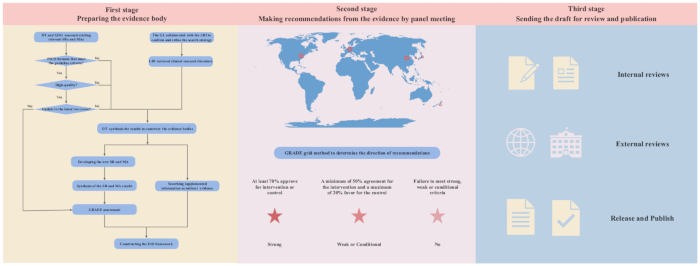
图1:推荐意见制定流程图。该图总结了指南制定的三个阶段流程,包括证据准备、使用GRADE网格法形成共识,以及内部/外部评审和发布的最终步骤。请点击此处查看此图的放大版本。
表1:纳入研究的特征。 所有纳入的随机对照试验的研究设计、参与者人口学特征、干预类型、对照措施、结局指标及随访时间。 请点击此处下载该表格。
表2:研究结果汇总。 通过将统计综合证据整合为可比较且易于解释的格式,得出临床问题的合并效应。请点击此处下载该表格。
表3:可信度评估。该表格为每项综述提供了领域层面的评估,有助于对关键结局的证据可靠性进行透明评价。请点击此处下载该表格
表4:证据到决策框架。该表格概述了专家在优先性、获益、危害、可接受性、可行性、资源使用和公平性等关键EtD标准方面的评估。这些数据反映了专家组达成的共识水平,为最终推荐意见的强度和方向提供了依据。请点击此处下载该表格。
表5:最终推荐意见与治疗方案。该表格基于既往发表的随机对照试验的系统评价与荟萃分析,反映了专家组使用 GRADE 框架和 EtD 评估达成的共识推荐意见。表格提供了详细的针灸治疗方案,包括穴位选择、干预方法、治疗频次以及针对非特异性下腰痛的治疗持续时间。请点击此处下载该表格。
补充图1:VAS的森林图。 请点击此处下载该图表。
补充图2:疗效反应的森林图。 请点击此处下载该图片。
补充图3:DOI的森林图。 请点击此处下载该图表。
补充图4:LROM的森林图。 请点击此处下载该图。
补充图5:Schober试验的森林图。 请点击此处下载该图表。
讨论
临床实践指南是宝贵的资源,可为临床医生提供高质量的治疗选择,并为患者提供知情决策依据54。1991年至2007年间,已发表的临床实践指南超过1300项,其中包含2189条关于针灸的推荐意见,反映出针灸日益融入主流医疗体系的趋势55。然而,中国目前仍缺乏专门的指南制定机构,导致指南框架不完整、方法学细节不足11,56。尤为突出的是,在制定这些指南的核心推荐意见和治疗方案时,亟需更全面的技术信息和对实际操作过程的详细描述56。本研究通过提出一个结构化的针灸指南制定方案,填补了上述空白,该方案遵循世界卫生组织(WHO)手册,整合了GRADE方法学,并提供了切实可行的操作步骤11,12。该方法旨在提高针灸指南制定过程中的科学严谨性、临床适用性以及国际可重复性。
该方案引入了多项改进措施,以提高指南制定全过程的效率、透明度和标准化水平。通过设计结构化步骤,确保不同工作组在证据整合、专家评估和共识形成方面保持一致。采用自动化工具(如结构化调查平台、在线投票系统和证据概要模板)降低了行政负担,并促进了远程协作。
此外,针灸疗效受多种干预变量的影响,包括穴位数量和位置、针刺手法、电针使用以及治疗频率45,57,58。与仅可通过剂量进行分层的药物治疗不同,针灸需要多维度的亚组划分1。为应对这一复杂性,由经验丰富的针灸临床医师与方法学专家通过共识制定了一种专门的分类方法。未来的指南应明确针对不同疾病和疗法的亚组划分方法,以减少异质性并支持制定可靠的推荐意见40。
针灸指南的实施受到个人因素和外部因素的共同影响1,5。个人因素包括医疗提供者对指南的知识掌握程度、临床态度以及对循证工具的熟悉程度1。外部因素如指南的覆盖范围、报销政策、临床医生的工作负荷以及患者的经济承受能力也起着关键作用5。在中国和美国,遵循循证针灸指南治疗腰痛的临床医生均不足25%2,5。在本指南制定过程中,遇到了若干实施方面的挑战。由于受到新冠疫情期间的影响,采用了线上与线下相结合的共识会议模式59。尽管线上会议提高了可及性和时间安排的灵活性,但部分专家指出互动减少、参与度下降51。为解决这一问题,引入了会前投票材料和简报环节,以明确共识原则并简化现场讨论流程34。灵活的时间进度管理在协调不同时区专家的工作中也显得至关重要。
共有13位专家参与了该指南的制定工作,其中包括来自亚洲、欧洲、北美洲和大洋洲六个国家和地区的代表。专家组还包括卫生经济学专家和患者代表。通过一个结构化的制定框架,包括证据综合、GRADE质量评估以及多轮共识投票,专家组确保了所提出建议的平衡性和临床相关性。患者的视角在制定既易于理解又具有实际可操作性的建议方面尤为重要60。
尽管根据现有证据,针灸具有中等至显著的效果,但在许多领域证据的确定性仍为低或极低,因此需要谨慎解读50,61。在一个关键建议中,专家组基于德国、英国和美国等高收入国家的间接证据评估了成本效益50,62,63。尽管研究结果提示其成本效益良好50,62,63,但若干专家组成员对在中低收入国家(包括中国和东南亚地区)的适用性有限表示担忧64。针灸实施的强度,例如人员培训、治疗时长和治疗频率,可能降低在这些环境中的可行性及经济价值,尤其是在缺乏报销机制的情况下。由于经济学证据在外部有效性方面存在局限性,特别是其向中低收入环境的可转移性,专家组成员对可行性及资源使用表达了保留意见。然而,考虑到患者对针灸持续偏好的倾向、不良反应极少以及临床可行性,尽管证据确定性较低,专家组仍提出了有条件推荐。这表明,即使临床疗效已得到充分证实,经济学证据的外部有效性局限仍可能削弱推荐意见的强度。
尽管针灸对非特异性下背痛(NSLBP)具有已知益处,但很少有国家的医疗系统将其正式纳入临床指南或医疗保险计划。21世纪初,北京的医疗保险广泛覆盖了针灸治疗,即使当时尚无正式的经济学评估支持1,64,65。然而,在过去十年中,中国的医疗保险决策日益以证据为基础。这一转变既体现了进步的态度,也凸显了迫切需要高质量的卫生经济学研究,以支持针灸治疗的可持续医保覆盖1,64,65。
披露
作者声明,他们不存在与本作品内容相关的任何竞争性财务利益或其他利益冲突。
致谢
本工作得到国家关键研发计划&中国国家重点研发计划:No. 2019YFC1712200 和国家重大研发计划&中国“十三五”重点研发计划子课题:编号2019YFC1712203
材料
| 姓名 | 公司 | 目录编号 | 评论 |
|---|---|---|---|
| 中国生物医学文献数据库(CBM) | SinoMed | N/A (http://www.sinomed.ac.cn/) | 用于生物医学文献检索 |
| 中国临床试验注册中心 | ChiCTR | N/A (http://www.chictr.org.cn/) | 中国临床试验注册数据来源 |
| 文献管理软件 | Clarivate Analytics | EndNote X9 (https://endnote.com/) | 用于整理参考文献并去除重复条目 |
| ClinicalTrials.gov | 美国国立卫生研究院(U.S. NIH) | N/A (https://clinicaltrials.gov/) | 注册临床试验的数据来源 |
| 中国知网数据库(CNKI) | 清华同方 | N/A (https://www.cnki.net/) | 用于检索中文临床文献 |
| Cochrane 图书馆 | Wiley | N/A (https://www.cochranelibrary.com/) | 用于获取系统评价资源 |
| Cochrane 偏倚风险评估工具 | Cochrane | N/A (https://www.riskofbias.info/welcome/rob-2-0-tool) | 用于评估随机对照试验的偏倚风险 |
| 在线问卷平台 | 问卷星(WJX.cn) | N/A (https://www.wjx.cn/) | 用于在线收集专家小组的反馈意见 |
| Embase | Elsevier | N/A (https://www.embase.com/) | 用于证据综合 |
| Epistemonikos | Fundación Epistemonikos | N/A (https://www.epistemonikos.org/) | 临床研究证据来源 |
| 证据到决策软件工具 | Evidence Prime, Inc. | GRADEpro GDT (https://gradepro.org/) | 用于创建证据到决策(EtD)框架和摘要表 |
| GRADE 证据到决策框架 | GRADE 工作组 | N/A (https://www.gradeworkinggroup.org/) | 用于将证据转化为临床推荐意见 |
| PRISMA 指南 | N/A | N/A (http://www.prisma-statement.org/) | 用于指导系统评价和荟萃分析的研究方案撰写 |
| PROSPERO | 约克大学 | CRD42021278346 (https://www.crd.york.ac.uk/prospero/) | 本研究中系统评价与荟萃分析的注册平台 |
| 研究方案注册平台 | 约克大学 | PROSPERO (CRD42021278346) (https://www.crd.york.ac.uk/prospero/) | 用于注册系统评价研究方案 |
| PubMed | 美国国家医学图书馆(NLM) | N/A (https://pubmed.ncbi.nlm.nih.gov/) | 用于检索英文医学文献 |
| Scopus | Elsevier | N/A (https://www.scopus.com/) | 文献检索数据库 |
| 荟萃分析统计软件 | Cochrane 协作网 | RevMan 5.4 (https://training.cochrane.org/online-learning/core-software/revman) | 用于执行荟萃分析和绘制森林图 |
| 腾讯会议 | 腾讯 | N/A (https://meeting.tencent.com/) | 用于每周在线专家会议和协调会议 |
| 维普(中国学术期刊) | 重庆维普 | N/A (http://www.cqvip.com/) | 文献筛选的数据来源 |
| 万方数据库 | 万方数据 | N/A (https://www.wanfangdata.com.cn/) | 用于文献检索 |
| Web of Science | 科睿唯安(Clarivate) | N/A (https://www.webofscience.com/) | 用于英文证据检索 |
| 微信 | 腾讯 | N/A (https://www.wechat.com/) | 用于团队内部沟通与协调 |
| 世界卫生组织国际临床试验注册平台(WHO ICTRP) | 世界卫生组织(WHO) | N/A (https://trialsearch.who.int/) | 国际临床试验的数据来源 |
| 问卷星投票平台 | WJX.cn | N/A (https://www.wjx.cn/) | 用于专家小组在线投票 |
参考文献
- Zhang, Y. Q., et al. Increasing the usefulness of acupuncture guideline recommendations. BMJ. 376, e070533(2022).
- Lu, L., et al. Evidence mapping and overview of systematic reviews of the effects of acupuncture therapies. BMJ Open. 12 (6), e056803(2022).
- Knezevic, N. N., Candido, K. D., Vlaeyen, J. W. S., Van Zundert, J., Cohen, S. P. Low back pain. Lancet. 398 (10294), 78-92 (2021).
- Maher, C., Underwood, M., Buchbinder, R. Nonspecific low back pain. Lancet. 389 (10070), 736-747 (2017).
- Qaseem, A., et al. Nonpharmacologic and pharmacologic management of acute pain from non-low back, musculoskeletal injuries in adults: a clinical guideline from the American College of Physicians and American Academy of Family Physicians. Ann Intern Med. 173 (9), 739-748 (2020).
- Oliveira, C. B., et al. Clinical practice guidelines for the management of nonspecific low back pain in primary care: an updated overview. Eur Spine J. 27 (11), 2791-2803 (2018).
- Guyatt, G. H., et al. What is "quality of evidence" and why is it important to clinicians. BMJ. 336 (7651), 995-998 (2008).
- Chen, Y., et al. A reporting tool for practice guidelines in health care: the RIGHT statement. Ann Intern Med. 166 (2), 128-132 (2017).
- Qaseem, A., Snow, V., Owens, D. K., Shekelle, P. The development of clinical practice guidelines and guidance statements of the American College of Physicians: summary of methods. Ann Intern Med. 153 (3), 194-199 (2010).
- Brouwers, M. C., et al. Development and validation of a tool to assess the quality of clinical practice guideline recommendations. JAMA Netw Open. 3 (5), e205535(2020).
- Liu, L., et al. Identification of clinical questions for the development of clinical practice guideline on acupuncture and moxibustion for nonspecific low back pain using the modified Delphi method. Chin Gen Med. 26 (9), 1037-1043 (2023).
- Lin, H., et al. Questionnaire of clinical questions for clinical practice guideline of acupuncture-moxibustion: nonspecific low back pain. World J Acupunct Moxibustion. 32 (2), 109-114 (2022).
- Lee, J. H., et al. Acupuncture for acute low back pain: a systematic review. Clin J Pain. 29 (2), 172-185 (2013).
- Gianola, S., et al. Effectiveness of treatments for acute and subacute mechanical nonspecific low back pain: a systematic review with network meta-analysis. Br J Sports Med. 56 (1), 41-50 (2022).
- Wang, Y., Sun, Y., Wu, Y., Zhang, J., Zhang, Y. Meta-analysis of clinical randomized controlled trial of electro-acupuncture Houxi point in the treatment of acute lumbar sprain. J Acupunct Tuina Sci. 13 (5), 332-338 (2015).
- Valério, R. T. Systematic review and meta-analysis of acupuncture treatment of acute lumbar sprain in recent 10 years [Master's Thesis]. , Beijing University of Chinese Medicine. (2016).
- Hu, X. Systematic evaluation of "exercise acupuncture" treatment of acute lumbar sprain [Master's Thesis]. , Chengdu University of Traditional Chinese Medicine. (2015).
- Su, X., et al. Acupuncture for acute low back pain: a systematic review and meta-analysis. Ann Palliat Med. 10 (4), 3924-3936 (2021).
- Page, M. J., et al. The PRISMA 2020 statement: an updated guideline for reporting systematic reviews. J Clin Epidemiol. 134, 178-189 (2021).
- Du, L. Analgesia time-effects study of acupuncture at Yaoyong point combined with exercise therapy for acute lumbar sprain [Master's Thesis]. , Traditional Chinese Medicine University of Guangzhou. (2018).
- Fan, Y., Wu, Y. Effect of electroacupuncture on muscle state and infrared thermogram changes in patients with acute lumbar muscle sprain. J Tradit Chin Med. 35 (5), 499-506 (2015).
- Gao, H., Wei, C., He, T. Treatment of 36 cases of acute lumbar sprain by acupuncture at Jingweiqi point. J Gansu Coll Tradit Chin Med. (2), 49-50 (2006).
- Huang, J. Clinical study of acupuncture at lumbar pain point combined with lumbar activity in the treatment of acute lumbar sprain [Master's Thesis]. , Traditional Chinese Medicine University of Guangzhou. (2012).
- Jin, M., Chen, J. Acupuncture treatment of 40 cases of acute lumbar sprain. Jiangxi Univ Tradit Chin Med. 39 (6), 74(2008).
- Li, K., Liu, Y. Treatment of 66 cases of acute lumbar sprain with hand acupuncture exercise therapy. Chin Arch Tradit Chin Med. 4, 652-653 (2005).
- Liu, L., Lu, J., Ma, H. Clinical trials for treatment of acute lumbar sprain by acupuncture stimulation of "Yaotong" and local Ashi-points in combination with patient's lumbar movement. Acupunct Res. 42 (1), 72-75 (2017).
- Qu, F., et al. Clinical observation on treating acute lumbar muscle sprain by electropuncture. Clin Res Tradit Chin Med. 9 (16), 39-40 (2017).
- Shang, L., et al. Clinical study on distal-points acupuncture combined with exercise for acute lumbar sprain: Experiences from Professor Sun Yuanzheng. J Clin Acupunct Moxibustion. 33 (7), 38-40 (2017).
- Sun, Y., Shao, P., Zheng, X. Clinical observation of acute lumbar sprain treated by electroacupuncture at Chengshan (BL57). Liaoning J Tradit Chin Med. 47 (4), 176-182 (2020).
- Wang, L., Pan, L., Sun, Y., Chen, X., Sheng, L. Effect of electroacupuncture at A Shi point combined with para-acupuncture on pain and lumbar motion in patients with acute lumbar sprain. Hubei J Tradit Chin Med. 38 (4), 67-69 (2016).
- Wu, Y., et al. Observation on short-term and long-term therapeutic effects of electroacupuncture at Houxi (SI 3) on acute lumbar sprain. Chin Acupunct Moxibustion. 01 (1), 3-5 (2007).
- Xu, B. Observation of curative effect on acute lumbar sprain treated by strong stimulation of pension point. Fujian J Tradit Chin Med. 44 (3), 14-15 (2013).
- Zhao, Y., Li, L., Pan, J., Yu, Q. To explore the clinical observation of acupuncture combined with exercise therapy in the treatment of acute lumbar sprain. World Latest Med Inf Dig (Electr Ed). (18), 169-172 (2014).
- Hu, Z., et al. Chinese medicine rapid dynamic guidelines formulation methods (3): A rapid evidence collection and integration and recommendation opinions. J Tradit Chin Med. 1, 1-5 (2014).
- Brożek, J. L., et al. Grading quality of evidence and strength of recommendations in clinical practice guidelines part 3 of 3: The GRADE approach to developing recommendations. Allergy. 66 (5), 588-595 (2011).
- Atkins, D., et al. Grading quality of evidence and strength of recommendations. BMJ. 328 (7454), 1490(2004).
- Zhang, Y., et al. guidelines: 20. Assessing the certainty of evidence in the importance of outcomes or values and preferences-inconsistency, imprecision, and other domains. J Clin Epidemiol. 111, 83-93 (2019).
- Higgins, J. P., et al. The Cochrane Collaboration's tool for assessing risk of bias in randomised trials. BMJ. 343, d5928(2011).
- Morgan, R. L., et al. A risk of bias instrument for non-randomized studies of exposures: A users' guide to its application in the context of GRADE. Environ Int. 122, 168-184 (2019).
- Harbour, R., Miller, J. A new system for grading recommendations in evidence-based guidelines. BMJ. 323 (7308), 334-336 (2001).
- Alonso-Coello, P., et al. Evidence to Decision (EtD) frameworks: A systematic and transparent approach to making well-informed healthcare choices. 1: Introduction. BMJ. 353, i2016(2016).
- Wiercioch, W., et al. Methodology for the American Society of Hematology VTE guidelines: Current best practice, innovations, and experiences. Blood Adv. 4 (10), 2351-2365 (2020).
- Phillippo, D. M., et al. Threshold analysis as an alternative to GRADE for assessing confidence in guideline recommendations based on network meta-analyses. Ann Intern Med. 170 (8), 538-546 (2019).
- Guidance on prevention of venous thromboembolism. Lancet. 375 (9713), (2010).
- Li, H., et al. A framework on developing integrative medicine clinical practice guideline for stroke management and rehabilitation in Hong Kong. Phytomedicine. 106, 154442(2022).
- Chapman, J. R., et al. Evaluating common outcomes for measuring treatment success for chronic low back pain. Spine (Phila Pa 1976). 36 (21 Suppl), S54-S68 (2011).
- Smeets, R., Köke, A., Lin, C. W., Ferreira, M., Demoulin, C. Measures of function in low back pain/disorders: Low Back Pain Rating Scale LBPRS), Oswestry Disability Index (ODI), Progressive Isoinertial Lifting Evaluation (PILE), Quebec Back Pain Disability Scale (QBPDS), and Roland-Morris Disability Questionnaire (RDQ). Arthritis Care Res (Hoboken). 63 (Suppl 11), S158-S173 (2011).
- Skonnord, T., et al. Cost-effectiveness analysis of acupuncture compared with usual care for acute nonspecific low back pain: Secondary analysis of a randomised controlled trial. Acupunct Med. 40 (2), 123-132 (2022).
- Witt, C. M., et al. Pragmatic randomized trial evaluating the clinical and economic effectiveness of acupuncture for chronic low back pain. Am J Epidemiol. 164 (5), 487-496 (2006).
- Ratcliffe, J., Thomas, K. J., MacPherson, H., Brazier, J. A randomised controlled trial of acupuncture care for persistent low back pain: Cost effectiveness analysis. BMJ. 333 (7569), 626(2006).
- Kim, N., Yang, B., Lee, T., Kwon, S. An economic analysis of usual care and acupuncture collaborative treatment on chronic low back pain: A Markov model decision analysis. BMC Complement Altern Med. 10, 74(2010).
- Liu, B., Li, D. World Acupuncture-International Acupuncture Application Survey and Analysis. China Academic Journal. , (2014).
- Liu, B. White Paper on the Development of Chinese Traditional Medicine. , Information Office of the State Council. China. (2016).
- Brignardello-Petersen, R., Carrasco-Labra, A., Guyatt, G. H. How to interpret and use a clinical practice guideline or recommendation: Users' guides to the medical literature. JAMA. 326 (15), 1516-1523 (2021).
- Dobos, G. J., Kirschbaum, B., Choi, K. E. The Western model of integrative oncology: The contribution of Chinese medicine. Chin J Integr Med. 18 (9), 643-651 (2012).
- Liao, X., et al. How to draft editorial explanation for transparent and concise guideline on clinical practice-case analysis. Chin J Tradit Chin Med. 42 (23), 4520-4528 (2017).
- Moon, H. Y., et al. Safety of acupuncture during pregnancy: A retrospective cohort study in Korea. BJOG. 127 (1), 79-86 (2020).
- Liao, Y. Y., Seto, K., Saito, H., Fujita, M., Kawakami, M. Effect of acupuncture on adrenocortical hormone production: I. Variation in the ability for adrenocortical hormone production in relation to the duration of acupuncture stimulation. Am J Chin Med. 7 (4), 362-371 (1979).
- Shi, Y., Li, Y., Yuan, X. A study on the perceived measurement of knowledge exchange effect of academic conferences affected by the epidemic. Mod Inf. 42 (7), 57-67 (2022).
- Sonyi, M., Keller, J., Fox, M., Hammer, H. F. Development of a multinational clinical practice guideline: A practical structured procedure. Dig Dis. 39 (5), 477-487 (2021).
- Witt, C. M., et al. Acupuncture in patients with dysmenorrhea: A randomized study on clinical effectiveness and cost-effectiveness in usual care. Am J Obstet Gynecol. 198 (2), 166.e1-166.e8 (2008).
- Borah, B. J., Naessens, J. M., Glasgow, A. E., Bauer, B. A., Chon, T. Y. Cost-effectiveness of acupuncture in an employee population: A retrospective analysis. Complement Ther Med. 31, 14-19 (2017).
- Spackman, E., et al. Cost-effectiveness analysis of acupuncture, counselling and usual care in treating patients with depression: The results of the ACUDep trial. PLoS One. 9 (11), e113726(2014).
- Lu, L., et al. Evidence on acupuncture therapies is underused in clinical practice and health policy. BMJ. 376, e067475(2022).
- Li, H., et al. Using economic evaluations to support acupuncture reimbursement decisions: Current evidence and gaps. BMJ. 376, e067477(2022).