本文综述了使用 scikit-learn 机器学习库预测输血不良反应的潜力。文章概述了一种数据驱动的框架,旨在改进风险评估,克服传统方法的局限性,并推动精准输血医学的发展。
需要JoVE订阅才能观看此内容。 请登录或开始免费试用
综述文章
基于机器学习的输血不良反应精准风险评估方法:一项基于 Scikit-learn 的综述
* These authors contributed equally
本文内容
摘要
摘要
输血不良反应(TARs)是指在输血期间或输血后由于输入血液、血液制品或与输血相关的材料而引发的不良效应。这些反应可导致从轻度到重度的临床表现,包括过敏反应、溶血以及输血相关性急性肺损伤(TRALI)。目前的常规方法——如ABO/Rh血型匹配和大量输血方案——虽可改善患者预后,但未能解决复杂的患者个体化因素。因此,建立专门的TAR风险预测模型至关重要。机器学习(ML)算法能够利用大规模的临床和实验室数据集构建诊断与预后模型,推动个体化医疗和精准医学的发展。值得注意的是,scikit-learn(SK-learn)机器学习算法尚未被直接应用于TAR风险评估;然而,其在构建类似医学风险预测模型方面的有效性已获得广泛认可。本综述提出了一种基于机器学习的TAR预测与预防框架,特别强调SK-learn在不同临床场景中的作用。我们的分析为未来TAR的精准诊断以及SK-learn算法的开发奠定了基础。关键的是,我们对文献的综合分析表明,sklearn为此项任务提供了多功能且强大的工具包;但其成功转化为临床实践仍取决于克服若干关键挑战,包括多中心数据异质性以及模型可解释性不足的问题。
引言
输血是一种用于多种临床情况下的挽救生命干预措施,包括创伤救治、外科手术、产科急症、肿瘤学治疗以及慢性血液系统疾病的管理1,2。尽管输血具有显著的治疗益处,但也可能引发各种不良事件,统称为输血不良反应(Transfusion Adverse Reactions, TARs)3,4。TAR 是一种多因素导致的临床状况,其表现从轻度过敏反应到严重并发症不等。最常见的反应包括发热性非溶血性输血反应(FNHTRs)和过敏反应,其报告发生率分别为每10万单位输血中约26例和21例5,6。尽管ABO/Rh血型匹配和标准化输血操作可显著降低TAR风险,从而提高患者安全性7,8,9,但仍无法完全预防这些事件,尤其是那些病因复杂或由免疫机制介导的反应。
证据表明,机器学习(ML)作为人工智能(AI)的一个分支,能够促进复杂、多模态数据的整合。这一能力有助于提升临床决策水平、实现个体化治疗,并优化医疗服务,最终改善患者的治疗结局10,11。SK-learn 是于2007年推出的开源 Python 机器学习库。其核心功能包括通过机器学习算法实现的回归分析,以及分类、聚类、降维、模型选择和数据预处理能力12。在医学应用中,SK-learn 主要用于疾病预测、诊断分类和临床风险分层13,14。例如,有研究利用 SK-learn 库构建了一个预测模型,能够有效区分糖尿病肾病与非糖尿病肾病,从而辅助临床诊断与治疗15。凭借 sklearn 算法的优势,其在构建输血后不良反应(TAR)风险预测模型方面的有效性已获得广泛认可16,17。
本文综述了SK-learn机器学习算法的最新进展,并阐述了其在多种疾病背景下的转化应用。此外,本文还建立了SK-learn在未来临床实践中用于风险分层TAR诊断及预测建模的框架。
访问受限。请登录或开始试用以查看此内容。
综述与观点
TAR 概述
TAR 的发病机制
TAR 包括一系列多样的临床表现和病理生理机制(表 I)。这些反应主要分为免疫介导型和非免疫介导型7,9,18,19。免疫介导反应通常涉及抗原-抗体相互作用,导致溶血或全身性炎症反应。典型例子是 ABO 血型不合,可引发急性溶血性输血反应(AHTRs)。该情况表现为发热、腰痛、高血压、弥散性血管内凝血(DIC)和急性肾衰竭7,9,20。此外,I 型超敏反应可引发过敏性输血反应,临床表现从轻度荨麻疹到危及生命的过敏性休克不等。值得注意的是,这类反应常与血小板制品相关,原因是其中含有残留的供体血浆蛋白,包括次花粉过敏原分子18,21,22,23。输血相关性急性肺损伤(TRALI)在临床上定义为输血后6小时内急性发生的低氧血症和非心源性肺水肿。其发病机制主要涉及供体来源的针对人类白细胞抗原(HLAs)或粒细胞特异性抗原的抗体21,22,24。值得注意的是,某些血型抗原(如Kidd系统抗原)在受到供体来源的抗HLA抗体攻击时,可引发迟发性溶血性输血反应,即DHTRs。此外,TRALI作为一种输血相关性急性肺损伤,是通过中性粒细胞活化机制由供体抗HLA抗体介导的独特病理实体6,22。非免疫介导的输血反应包括多种临床情况,如细菌污染引起的败血症反应、容量超负荷、机械性或热损伤导致的溶血,以及输血相关循环超负荷(TACO)9,23。败血性输血反应源于被细菌污染的血液制品输注,最常见的是血小板中污染的Staphylococcus spp.、Staphylococcus aureus 和 Escherichia coli,以及红细胞中污染的Yersinia enterocolitica。临床上表现为高热、寒战、低血压,并可迅速进展为休克。值得注意的是,随着高灵敏度病原体筛查技术的应用,经典的输血传播感染(TTIs,例如HIV、HCV)风险已大幅降低。因此,败血性反应——尤其是因血小板制品在室温下储存所致者——目前已成为比TTIs更常报告的输血感染并发症。输血可传播的感染可能由多种病原体(如病毒、细菌和寄生虫)引起,可通过激活固有免疫系统而触发TAR。近期的系统综述指出,对免疫原性病原体进行全面筛查仍是预防感染相关TAR的主要挑战25,26,27,28(表1)。
TAR 的流行病学
在发达国家,TAR 的总体发病率仍然相对较低。目前的监测数据显示,过敏反应和非溶血性发热性输血反应(FNHTR)是最常报告的不良事件之一,且在许多报告系统中,过敏反应的发生率已超过 FNHTR。延迟性血清学输血反应(DSTR)的报告频率较低5,9,29。然而,在发展中国家和特定人群中,TAR 仍构成重大的临床挑战,其风险升高源于多种因素,包括标准化筛查方案的差异、血液制品处理流程的欠佳、输血实践的异质性以及人群特异性的遗传易感性26,27。镰状细胞病(SCD)患者尤其容易发生溶血性输血反应和同种免疫。这种风险升高归因于慢性炎症、主要为高加索人种的献血者与非洲裔 SCD 患者之间红细胞抗原表型的差异,以及终身输血暴露频率较高,而非镰状血红蛋白本身的存在20,30。值得注意的是,来自中国主要医学中心的最新监测数据显示,在儿童和新生儿群体中,过敏性 TAR 的发病率高于成人,这与不同的输血阈值和临床实践有关。相反,欧洲队列在这些年龄组中表现出相反的流行病学模式19,31,32。例如,Guo, K. 等人19 报告称,在中国一家大型国家级中心,儿童发生过敏反应的频率高于成人,而在新生儿中,欧洲各地的输血阈值和实践存在显著差异33。
目前开发输血相关反应(TAR)风险评估模型的临床试验采用了三种核心策略,包括针对高风险人群的风险分层预防措施、连续实时监测系统以及个体化管理方案。这些风险模型呈现出双模态分类体系,既包含适用于所有输血受者的综合性筛查工具,也包含用于识别特定不良反应亚型的专用预测算法34,35。以英国输血严重危害(SHOT)系统为代表的通用风险评估工具,利用人群层面的数据集对输血受者进行风险分层,尤其在识别高风险群体方面表现出显著效果,例如有多次输血史或患有自身免疫性疾病的患者36。传统的输血风险与临床知识(TRACK)评分方法采用静态性能指标和预设的截断值,在既定决策边界内量化模型性能,从而表征模型在受限操作参数下的预测能力37。近年来的新进展催生了用于输血预测的新型风险分层工具。新开发的SCORE系统整合了六个经临床验证的预测因子,用于估算输血概率。比较分析表明,该简化模型在预测心脏外科手术输血需求时,其预测准确性和校准性能与传统的TRACK评分相当38。
除了特定的反应模型外,近年来还研究了许多体内模型39。输血相关性急性肺损伤(TRALI)是一种具有临床意义的并发症,其风险特征由供体来源的抗人白细胞/中性粒细胞抗原抗体(anti-HLA/HNA 抗体)、受体炎症生物标志物(包括白细胞介素-6)的升高以及输注的血制品体积共同决定34,39,40。输血相关性循环超负荷(TACO)的风险通常通过临床评分系统进行评估,该系统包含B型利钠肽(BNP 或 NT-proBNP)水平升高、心脏功能障碍病史、高输血速率和正液体平衡等参数。免疫介导溶血的风险通过间接抗球蛋白试验(间接Coombs试验)进行抗体筛查,以检测受体血浆中具有临床意义的同种抗体。识别这些抗体有助于选择抗原阴性的血液单位进行输注,从而预防可能引发溶血的抗原-抗体反应。患者的输血史对于识别既往致敏情况及延迟性溶血反应风险也至关重要。这些机制模型整合了多维度的临床和实验室参数,以提高对不良反应预测的精确性34,39,41。此外,已制定大量输血方案(MTPs),通过标准化红细胞、血浆和血小板的输注比例,以降低严重创伤或手术患者因出血性休克导致的死亡率42,43。然而,尽管这些措施降低了输血相关的发病率,但仍未能全面涵盖决定输血安全性的免疫性和非免疫性变量之间的复杂相互作用。许多现有的评分系统和操作规程仅在受控条件或较窄的患者群体中得到验证,因此在真实世界中异质性较高的环境中表现欠佳16,44,45,46。病原体谱的变化、供体人群的演变以及现代医疗的复杂性进一步挑战了静态评估方法的适用性25,26,47。在此背景下,人们日益关注应用机器学习技术来优化输血风险评估,结合临床数据、实验室结果以及多组学等新兴领域,构建更强大的预测模型(图1)48,49,50。
通过机器学习构建当前临床风险评估模型
机器学习(ML)作为一种基础的人工智能范式,能够通过自动发现数据中的潜在模式并归纳生成预测模型,实现自适应决策,从而避免显式的过程化编程,并在包括医学诊断与预测在内的复杂且不断演进的领域中实现持续的性能优化51。机器学习的发展经历了三个不同阶段:(1)基础时期,奠定了理论基础52;(2)算法复兴期,以支持向量机和集成方法的重大进展为标志53;以及(3) 深度学习革命时期,在GPU加速和大数据的推动下,卷积神经网络和循环神经网络在多个领域引发了根本性的范式转变54。在医学应用中,这些技术已彻底改变了医学影像诊断和生物标志物检测55。
当前的机器学习系统根据其学习机制分为三大核心范式:(1)监督学习,依赖带有标签的训练集进行预测建模;(2)无监督学习,从无标注数据中发现潜在结构;(3)深度学习,利用分层神经网络架构实现自动特征抽象。这些范式共同构成了当代人工智能应用的基础方法论56。
近年来,机器学习(ML)在医学诊断标志物开发、预后评估及风险模型构建中得到了广泛应用57,58。医学数据通常具有高维度特征,这为传统方法的有效分析带来了重大挑战14,59。机器学习技术擅长从此类复杂数据集中提取关键特征,从而有助于识别重要特征。机器学习在输血医学中的应用正迅速兴起。例如,机器学习模型在医学图像分类和病理分析等任务中表现出优越性能,显著提高了早期诊断和预后分层的准确性60,61。通过利用患者特异性数据(如基因组和代谢组学谱),机器学习可预测个体化治疗反应,推动精准医学的发展62。除了预测输血需求外,机器学习还被用于优化血液制品管理。已有研究将机器学习应用于预测血小板使用量和个性化制定术前备血计划等任务,显示出改善库存管理并减少浪费的潜力。
此外,机器学习(ML)能够整合多源数据,包括影像学、基因组学和电子健康记录(EHR),以构建全面的预测模型63。同时,机器学习支持实时风险预警,例如对重症监护病房(ICU)患者进行脓毒症预测,并可自动化诊断工作流程,从而减轻医疗专业人员的工作负担64。通过整合多组学数据、挖掘复杂模式并加速药物设计,机器学习显著提升了癌症预后模型的精确性及靶点开发水平。此外,机器学习通过识别提示癌症存在或不存在的已知和未知模式,提高了诊断准确性65。一项模拟研究表明,放射科医生可跳过被预测为阴性的病例,仅需阅读80.7%的乳腺X线摄影图像,同时保持整体的敏感性和特异性。已有研究证明,卷积神经网络(CNN)模型可用于从乳腺超声图像中分割功能组织,从而辅助临床医生对这些图像进行解读和诊断66。预后判断和治疗方案选择在很大程度上依赖于肿瘤特征,而其中许多特征可通过基于图像的机器学习模型进行预测。一些研究人员已应用三维卷积神经网络(3D CNN)从CT扫描中人工选定的兴趣区域(ROIs)预测肺腺癌的EGFR突变状态,为癌症基因分型提供了一种无创替代方法,并有助于制定潜在的治疗策略67。新兴的基因组学技术,如单细胞转录组学和空间转录组学,在彻底改变实体瘤组织病理学表征方面具有巨大潜力。特别是单细胞转录组学可实现对细胞组成的详细分析,使机器学习模型能够预测癌症治疗反应及潜在的耐药机制68。
深度学习(DL)作为机器学习(ML)的一个子领域,采用受大脑神经结构启发的多层神经网络算法进行预测建模69。与逻辑回归等传统机器学习方法不同,深度学习利用其神经网络架构,使模型能够随着数据量和维度的增加呈指数级扩展69。深度学习已在医学领域得到广泛应用。近年来,新兴的深度学习技术被广泛用于癌症的诊断、预后判断以及治疗方案的识别。多种神经网络架构,包括多层感知机(MLPs)、循环神经网络(RNNs)和卷积神经网络(CNNs),构成了先进方法的基础组件69。已有研究提出一种卷积神经网络模型,不仅能够在图像层面预测癌症风险,还能在像素层面进行预测,生成热图以突出最可能发展为恶性病变的区域70。将深度卷积神经网络整合到基于组织病理学的癌症分级系统中已取得成功,研究表明,这些模型在前列腺癌、乳腺癌、结肠癌和淋巴瘤的分级中,性能可达到与人类病理学家相当的水平71,72,73,74,75。研究人员已证明,使用基于卷积神经网络的生成器对癌组织进行分割,可辅助基于卷积神经网络的分类器预测前列腺癌的分级76。一些研究者采用混合图卷积神经网络(GCNN)模型,将基因表达谱映射到STRING蛋白质-蛋白质相互作用(PPI)网络上,从而实现对乳腺癌分子亚型的预测69,77。机器学习在非癌症疾病中也展现出显著的应用价值,特别是在诊断建模方面。例如,已有研究对机器学习模型进行了外部和前瞻性训练与验证,用于预测不同时间段内新冠肺炎(COVID-19)患者的死亡率和危重事件。这些模型成功识别出高风险患者,并阐明了影响预测结果的潜在关联因素78。传统的放射组学模型主要依赖于从医学图像中显式提取的手工设计特征。研究人员探索了是否可通过迁移学习提取深层特征,用于生成放射组学特征以预测多形性胶质母细胞瘤(GBM)患者的总体生存期(OS)79。近年来,机器学习在微生物学领域也取得了显著进展80。该领域的一个关键应用是帮助医疗专业人员快速、准确地诊断导致患者感染性疾病的微生物,这对于制定适当的治疗策略至关重要。当提供合适输入数据时,机器学习模型可实现精确诊断80。已有研究证明,使用预训练的卷积神经网络(CNN)作为特征提取器,结合患者层面的交叉验证,可有效区分疟疾感染细胞与未感染细胞,从而提升疾病筛查效率81。一项基于英国1,839株细菌分离株队列开发的机器学习模型,可用于分类结核分枝杆菌(Mycobacterium tuberculosis,M. tuberculosis)对八种抗结核药物(异烟肼、利福平、乙胺丁醇、吡嗪酰胺、环丙沙星、莫西沙星、氧氟沙星和链霉素)的耐药谱型,包括耐多药结核病。与以往方法相比,表现最佳的模型将异烟肼、利福平和乙胺丁醇的敏感性提高了2%-4%,达到97%的敏感性(P < 0.01)。环丙沙星和耐多药结核病的敏感性提高至96%。对于莫西沙星和氧氟沙星,敏感性分别从基于已知耐药等位基因的83%和81%提升至95%和96%(P < 0.01),分别提高了12%和15%。值得注意的是,与基于规则的方法相比,该模型将吡嗪酰胺和链霉素的敏感性分别提高了15%和24%,达到84%和87%(P < 0.01)。表现最佳的模型还将吡嗪酰胺和链霉素的ROC曲线下面积分别提高了10%(P < 0.01),其他药物提高了4%-8%(P < 0.01)。
例如,深度学习模型通常被训练用于分析乳腺X线摄影图像,以预测患者未来患癌的可能性82。此外,一些研究人员强调了这种直接风险预测方法的优势,指出由Inception-ResNet-v2卷积神经网络模型生成的乳腺癌风险评分比基于临床乳腺密度评估得出的评分更为准确83。类似地,有研究人员开发了一种基于深度学习的乳腺X线摄影模型,在预测女性五年内乳腺癌发病风险方面优于依赖患者年龄等临床特征的Tyrer-Cuzick风险模型84。
此外,机器学习已应用于输血医学领域。人工智能在输血医学中的应用日益受到关注,这一点在其被纳入主要专业论坛议程中得到了体现,例如国际输血协会(ISBT)临床输血工作组主办的专题会议,该会议探讨了人工智能在输血医学(TM)实践、教育和研究中的潜力85。血液输注(BT)是重症监护病房(ICU)外科患者医疗护理的关键组成部分。该研究分析了UMC数据库中9,118名外科ICU患者的数据,利用机器学习预测患者的输血需求。通过比较XGBoost与逻辑回归(LR)算法在ICU入院前6小时至入院后1、2、3和6小时时间点的数据表现,研究发现输血组与非输血组患者在临床特征上存在显著差异。这些结果证实了机器学习在预测外科ICU患者输血需求方面的可行性86。异体输血在髋关节手术中常有需求,但与较高的发病率风险相关。准确预测输血需求对于减少血液制品浪费并优化术前决策至关重要。近期研究建立了14种机器学习算法用于预测输血风险,纳入了患者的 demographic 数据、术前实验室检查结果及手术相关信息。模型性能通过区分度、校准度和决策曲线分析进行评估。研究采用SHapley加性解释(SHAP)方法对模型进行解读,其中岭分类器表现出最高的预测准确性,AUC达到0.85(95% CI:0.81–0.88),Brier得分为0.21。该研究的机器学习模型在利用可获取的临床变量预测髋关节手术围手术期输血需求方面展现出较高的预测性能87。
此外,机器学习已成功整合到药物设计中,能够解决时间消耗和计算成本等挑战,同时提高预测的可靠性88,89。通过利用蛋白质的三维配体结合环境,机器学习有助于确定靶标蛋白结构,这是药物发现中的关键步骤90。例如,由人工智能驱动的工具AlphaFold可直接基于蛋白质数据库(PDB)数据进行训练,能够从氨基酸序列预测蛋白质的三维结构91。AlphaFold采用两步流程:首先,卷积神经网络(CNN)将蛋白质的氨基酸序列转化为距离矩阵和扭转角矩阵;其次,通过梯度优化技术将这些矩阵转化为蛋白质的三维结构92。
Scikit-learn(sklearn)是一个基于 Python 的机器学习库,因其易于使用、文档详尽以及强大的社区支持而广受赞誉93。它提供了丰富的监督学习方法,例如逻辑回归、支持向量机和随机森林,以及包括聚类和降维在内的无监督学习方法93。此外,它还提供管道(Pipelines),可在统一框架中简化数据预处理、模型训练、交叉验证和超参数调优流程93。在医疗健康领域,其模型可解释性工具(如排列特征重要性分析和部分依赖图)以及随机森林和梯度提升等先进的集成学习方法, consistently exhibit robust predictive performance45,93。
鉴于这些特点,SK-learn 已在医学研究中得到广泛应用,例如用于疾病诊断12,94、生存时间预测95、大规模影像数据集分析96,以及构建输血使用风险预测模型97。本节将详细探讨其具体应用案例与技术实现,展示 SK-learn 在构建疾病诊断与风险评估模型中的优势(图 2)。特别聚焦于应用最为广泛且成熟的癌症领域,我们分析了已取得的成功实践,并探讨了当前存在的挑战12,93,95,98。此外,我们还探讨了这些研究成果如何为创伤性凝血病(TAR)风险预测模型的开发提供有价值的参考与启发。
SK-learn 提供了一个强大的算法框架,将传统机器学习技术(包括支持向量机(SVM)、随机森林和逻辑回归)与深度学习方法(如多层感知器(MLP)分类器)相结合,因此非常适用于建模多种癌症数据集。例如,在开发一种用于诊断肾上腺皮质癌的新型组织学系统时,研究人员利用 Python 中的 sklearn 库构建了一个多维数学模型。该模型的整体诊断准确率达到 100%,在所有形态学变异类型中均表现出广泛的适用性99。
此外,SK-learn、GridSearchCV 和 RandomizedSearchCV 工具可实现超参数的自动优化。例如,在预测淋巴结转移时,通过交叉验证对 XGBoost 模型的参数进行精细调优,最终获得 0.952 的 AUC 值12。例如,支持向量机(SVM)在乳腺癌分类任务中表现出优越性能,其非线性核函数能够有效处理高维影像数据。一项针对口腔癌患者光谱数据的研究表明,SVM 结合递归特征消除(RFE)方法,灵敏度达到 95%,特异性达到 96%,显著优于传统的费希尔线性判别分析(FLD)100。另外,在 UCI 乳腺癌数据集上进行的对比分析显示,SVM 在分类准确率和泛化能力方面均优于 K 均值聚类和人工神经网络101。SVM 处理高维数据的能力在 TAR 预测中同样具有重要意义,因为在 TAR 预测中,模型需要整合大量临床和实验室参数。
随机森林方法在特征重要性分析中表现出更优的性能。一些研究人员已利用随机森林整合基因组学和临床数据,识别与乳腺癌预后相关的关键特征。聚类结果与临床结局显著相关102。该方法可直接应用于TAR建模,以从大量候选特征中识别最具影响力的风险因素,例如特定的供体抗体或受体炎症标志物。
XGBoost 作为一种典型的梯度提升算法,在癌症分期预测中表现出色。一项基于 TCGA 多组学数据的研究表明,XGBoost 结合 DNA 甲基化特征可进一步提升分类模型的预测性能103。在另一项关于乳腺癌转移的研究中,XGBoost 通过网格搜索交叉验证优化了超参数,并结合 SHAP 值可视化方法,成功鉴定了 SQSTM1 和 GDF9 等六个关键基因,模型的 AUC 达到 0.82,为转移风险预测提供了新的生物标志物104。将 XGBoost 等高性能集成方法与 SHAP 解释相结合,是一种强大的范式,可用于 TAR 模型,为临床医生提供透明且可操作的风险评估。
SK-learn 提供了一个标准化的数据预处理工具包,能够有效应对癌症数据中的高维度、不平衡性以及缺失值问题。例如,在结直肠癌的预测中,通过筛选癌胚抗原(CEA)和血红蛋白等四项核心指标的逻辑回归模型,构建了一个曲线下面积(AUC)为 0.849 的无创诊断模型,其性能显著优于单一肿瘤标志物的检测方法105。在处理不平衡数据方面,结合 imbalanced-learn 库中的 SMOTE 过采样技术,XGBoost 在乳腺癌分类任务中使少数类(恶性样本)的敏感度提高了 8.36%,F1 值达到 96.2%106。
将SK-learn与SHAP和eli5等工具结合,可为癌症模型提供透明的可解释性。在乳腺癌前哨淋巴结转移的预测中,通过SHAP值可视化的XGBoost模型显示,超声特征如"可疑淋巴结"和"边缘毛刺"对转移风险的贡献最大,这与临床诊断逻辑高度一致12。
SK-learn 在非癌症疾病相关研究中已展现出显著优势。非癌症疾病通常需要整合多来源数据,包括电子健康记录(EHR)、影像学、基因组学、蛋白质组学及其他类型数据。SK-learn 能够整合患者的电子健康记录、遗传特征及生活方式信息,以更精确地预测相关疾病的发病风险。例如,已有研究采用 SK-learn 中的随机森林算法整合电子健康记录数据,用于预测心血管疾病风险。该方法不仅显著提高了心血管风险预测的准确性,还增加了可从预防性干预中获益的患者数量,同时减少了对其他人群不必要的治疗107。研究人员利用 Python 的 SK-learn 机器学习库,开发并训练了五种不同的 AI 模型——逻辑回归、随机森林、AdaBoost、CATBoost 和 LightGBM,用于预测关节镜下肩袖修复术(ARCR)后肩袖再撕裂的风险。训练完成的模型随后在测试数据集上进行评估。值得注意的是,LightGBM 模型达到了 0.87 的 AUC 值,显示出其在估计 ARCR 术后再撕裂可能性方面优越的预测性能108。
尽管sklearn已在医学预测领域得到广泛应用,但目前尚无关于其在预测输血不良反应方面应用的直接文献。这一空白并不意味着存在技术缺陷,而是凸显了预测输血不良反应所面临的独特挑战以及尚未开发的潜力。
评估输血不良反应风险的传统方法主要依赖于静态临床指标、病史的回顾性分析以及标准化筛查问卷,这些方法存在多种局限性109,110,111。输血相关反应(TAR)事件极为罕见。在普通成人群体中,输血反应的发生率约为2%,导致类别极度不平衡112。这种不平衡使得标准分类器倾向于优先提高多数类别的准确性,而忽视少数类别。为解决这一问题,sklearn的imbalanced-learn模块(例如SMOTE+ENN)为数据集再平衡提供了成熟有效的解决方案。多种因素可导致输血后不良反应的发生113。SK-learn能够对收集的数据进行高效预处理,便于后续分析。通过使用列变换器(column transformers)进行异质性预处理,以及使用特征联合(feature union)实现多模态特征融合,可实现结构化数据的无缝整合114,115。在临床决策中,模型的可解释性至关重要。SHAP/LIME方法与sklearn模型兼容,包括适用于随机森林的TreeExplainer,可在保持预测性能的同时确保符合监管要求116,117。
为了将所讨论的 sklearn 功能转化为 TAR 预测的切实可行策略,我们提出一个遵循既定机器学习路线图的实用建模流程(图3)。该框架旨在应对 TAR 所特有的挑战,例如数据异质性和极端类别不平衡问题。
建立一个用于输血不良反应的稳健预测模型,需要一个端到端的分析流程。该流程首先整合并预处理多模态临床数据,包括患者人口统计学信息、生命体征、实验室检测值、输血详情以及供者特征。利用 sklearn 的 ColumnTransformer 在 Pipeline 中高效整合异构数据类型,以实施适当的缩放与编码,从而构建一个统一的分析数据集。接下来的关键步骤是解决罕见输血不良反应(TAR)事件中固有的严重类别不平衡问题;目标标签由严格判定的结局定义,可借助兼容的 imbalanced-learn 库中的 SMOTE-ENN 等技术进行重平衡,以防止模型偏差。在完成数据准备后,使用 sklearn 一致的 API 训练并评估多种算法,并通过 GridSearchCV 进行超参数调优与校准,以优化模型性能并确保概率估计的可靠性。为了增强临床可信度并提供机制性见解,采用 SHAP 等工具解释模型预测结果,以量化特定特征对个体风险评分的贡献。随后,通过在不同患者队列数据上采用嵌套交叉验证等稳健技术,严格验证模型的泛化能力。最后,为实现潜在的临床转化,可将整个训练好的流程进行序列化,并集成至电子健康记录系统中,作为实时决策支持工具,在临床诊疗点为医务人员提供可解释的风险评分。
在本综述中,我们首先介绍输血相关调节(TAR),总结现有的TAR模型,介绍机器学习的概念,强调机器学习的优势,并讨论其在疾病预测中的应用。我们进一步探讨机器学习在TAR中的潜在应用,为未来研究人员开发TAR-SK学习模型提供指导。此外,我们详细阐述SK-learn在评估TAR风险中的潜在作用,但强调显著的局限性严重制约了其临床应用。当前的TAR模型主要依赖回顾性、单中心数据集,可能无法捕捉输血实践中的地区差异、人群人口学特征(如儿童与成人人群之间的年龄相关差异),或不同人群间的遗传易感性19,26,31,32。此外,这些模型未能充分整合多组学数据,包括供者HLA抗体谱型和受者炎症相关蛋白质组学数据,而这些数据对于理解TRALI等免疫介导的TAR机制至关重要。这一局限性限制了模型对免疫性与非免疫性亚型的区分能力25,40。可解释性仍是一个关键挑战:尽管SK-learn提供了SHAP值等分析工具,但如果算法预测结果(如罕见遗传标志物)缺乏作为风险因素的生物学验证,临床医生可能不愿采纳这些模型,从而导致机器学习结果与临床直觉之间脱节14,50。实际应用中也面临挑战,例如需要强大的计算基础设施以及对电子健康记录(EHR)数据进行标准化预处理,而这些在资源有限的环境中往往难以实现47,87。
为弥补这些不足,未来的研究应优先开展前瞻性多中心数据收集工作,例如整合来自国际输血相关急性肺损伤(TAR)登记系统的数据,包括英国 SHOT 系统和中国儿科队列,以减少选择偏倚并提高模型的泛化能力19,36。将多模态数据(包括供者血液的单细胞 RNA 测序数据和炎症蛋白标志物)纳入 SK-learn 分析流程,有望提升 TAR 亚型分类的准确性,其效果可类比于结核病耐药性预测研究中观察到的 12-24% 的敏感性提升73。与免疫学家合作,验证 SK-learn 识别出的风险特征(如特定 HLA 抗体组合)与体外补体激活实验之间的机制关联,有助于弥合算法预测与生物学机制之间的鸿沟22,24。开发用户友好的临床决策支持工具,能够从电子健康记录(EHR)中自动提取实时特征(如输血量和 BNP 水平),并在传统诊断标准基础上提供可解释的风险评分,对于实现与临床工作流程的无缝整合至关重要97,107。
与传统的TAR模型(如ABO/Rh配型和TRACK评分)相比,SK-learn具有显著优势。例如,集成学习算法(如LightGBM)在建模风险因素之间的非线性相互作用方面表现优异,如供体抗HLA抗体与受体IL-6水平之间的关系,这在抗生素耐药性预测研究中使敏感性提高了12-24%。数据驱动的特征优先级分析工具(如排列特征重要性)能够识别出超出预设临床知识范围的新风险指标,包括血液储存时长和未被发现的并发症45,93。此外,其开源架构和适中的计算需求使其适用于资源有限的环境,而深度学习框架则不具备这一优势69,93。
为了将这一潜力转化为临床影响,未来的研究工作必须聚焦于几个关键领域。首先,需要开展前瞻性、多中心的数据收集,以克服选择偏倚,并提高模型在不同人群中的泛化能力。其次,整合多模态数据(例如供体抗体谱型、受体炎症标志物)将提供更全面的特征集,使 sklearn 模型能够更准确地区分急性排斥反应(TAR)亚型,并捕捉复杂的風險交互作用。第三,对算法识别出的风险特征进行生物学验证(例如将特定 HLA 抗体与体外实验关联)至关重要,这有助于弥合统计预测与机制理解之间的鸿沟,从而建立临床信任。最后,开发用户友好且可解释的临床工具,以提供实时风险评分,将有助于这些模型无缝整合到常规临床流程中,推动临床实践从被动应对管理向主动预防的范式转变。
总之,本综述强调了SK-learn在输血风险评估中的变革性潜力,弥补了传统基于规则方法的局限性。通过整合复杂的临床数据、优先识别风险特征并提供可解释的预测结果,SK-learn成为精准输血医学的重要基石。然而,实现这一潜力需要跨学科合作、对SK-learn模型进行大规模多中心验证、整合多组学与实时临床数据,并开发便于临床医生使用的工具,以将算法洞察与生物学机制相连接。
访问受限。请登录或开始试用以查看此内容。
结论
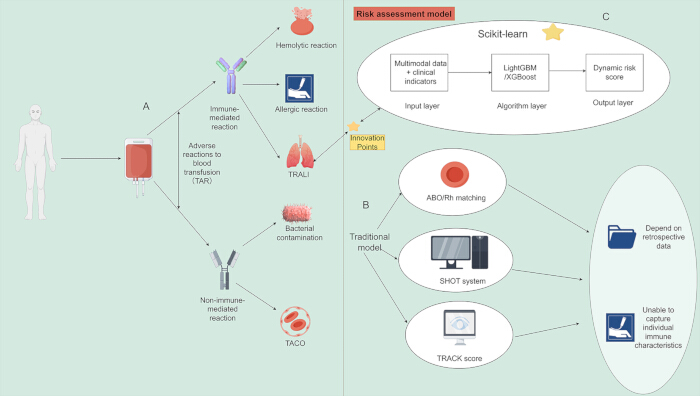
图1:TAR 类别示意图及结合 SK-learn 潜在策略的当前风险评估模型。(A) TAR 可分为两种类型:免疫介导反应和非免疫介导反应。 (B) 针对TAR的当前风险评估模型。 (C) SK-learn在TAR的TRALI风险评估模型构建方法学中的假设。缩写:TAR = 输血不良反应;TRALI = 输血相关急性肺损伤;TACO = 输血相关循环超负荷 请点击此处以查看此图的放大版本。
访问受限。请登录或开始试用以查看此内容。
披露
作者声明不存在任何竞争利益。
致谢
本工作由泸州市科学技术局资助,项目编号:2024JYJ034,项目名称:辐照及储存时间对血小板浓缩液中外泌体的影响。
访问受限。请登录或开始试用以查看此内容。
参考文献
- Tanhehco, Y. C. Red blood cell transfusion. Clin Lab Med. 41 (4), 611-619 (2021).
- Albright, C. M., Spillane, T. E., Hughes, B. L., Rouse, D. J. A regression model for prediction of cesarean-associated blood transfusion. Am J Perinatol. 36 (9), 879-885 (2019).
- Abdallah, R., Rai, H., Panch, S. R. Transfusion reactions and adverse events. Clin Lab Med. 41 (4), 669-696 (2021).
- Wang, Y., Rao, Q., Li, X. Adverse transfusion reactions and what we can do. Expert Rev Hematol. 15 (8), 711-726 (2022).
- Chen, C., et al. Incidence and risk factor of blood transfusion after abdominal radical hysterectomy for cervical cancer: A 10-year retrospective study of the us nationwide inpatient sample. BMC Cancer. 24 (1), 1454(2024).
- Deb, J., et al. Delayed haemolytic transfusion reaction due to kidd antibodies. Transfus Clin Biol. 29 (3), 269-272 (2022).
- Gehrie, E. A., Savani, B. N., Booth, G. S. Risk factors for hemolytic transfusion reactions resulting from abo and minor red cell antigen incompatibility: From mislabeled samples to stem cell transplant and sickle cell disease. Blood Rev. 45, 100719(2021).
- Maitland, K., et al. Transfusion management of severe anaemia in african children: A consensus algorithm. Br J Haematol. 193 (6), 1247-1259 (2021).
- McCullagh, J., et al. Assessing the risks of haemolysis as an adverse reaction following the transfusion of abo incompatible plasma-containing components - a scoping review. Blood Rev. 56, 100989(2022).
- Beam, A. L., Kohane, I. S. Big data and machine learning in health care. Jama. 319 (13), 1317-1318 (2018).
- Nwanosike, E. M., Conway, B. R., Merchant, H. A., Hasan, S. S. Potential applications and performance of machine learning techniques and algorithms in clinical practice: A systematic review. Int J Med Inform. 159, 104679(2022).
- Zhang, G., et al. A machine learning model based on ultrasound image features to assess the risk of sentinel lymph node metastasis in breast cancer patients: Applications of scikit-learn and shap. Front Oncol. 12, 944569(2022).
- Poly, T. N., Islam, M. M., Li, Y. J. Early diabetes prediction: A comparative study using machine learning techniques. Stud Health Technol Inform. 295, 409-413 (2022).
- Esteva, A., et al. Dermatologist-level classification of skin cancer with deep neural networks. Nature. 542 (7639), 115-118 (2017).
- Zhou, D., et al. A machine learning model for predicting diabetic nephropathy based on tg/cys-c ratio and five clinical indicators. Diabetes Metab Syndr Obes. 18, 955-967 (2025).
- Li, N., Down, D. G. Deep learning for platelet transfusion. Blood. 142 (26), 2231-2232 (2023).
- Lou, S. S., et al. Personalized surgical transfusion risk prediction using machine learning to guide preoperative type and screen orders. Anesthesiology. 137 (1), 55-66 (2022).
- Kulhas Celik, I., et al. Frequency and clinical characteristics of allergic transfusion reactions in children. Transfus Apher Sci. 60 (4), 103152(2021).
- Guo, K., et al. Transfusion reactions in pediatric patients: An analysis of 5 years of hemovigilance data from a national center for children's health in china. Front Pediatr. 9, 660297(2021).
- Thein, S. L., et al. Hemolytic transfusion reactions in sickle cell disease: Underappreciated and potentially fatal. Haematologica. 105 (3), 539-544 (2020).
- Chin, J. L. J., et al. Poor utility of current nomograms assessing the risk of intraoperative blood transfusion in patients undergoing liver resection for hepatocellular carcinoma and proposal of a new model. Surgery. 172 (5), 1442-1447 (2022).
- Nguyen, N. T., Titze, T. L., Nissen-Meyer, L. S. H. Evaluation of transfusion reactions in patients following transfusion of blood components containing antibodies to hla class i - an attempt to prevent trali in patients. Transfus Apher Sci. 63 (4), 103970(2024).
- Saadah, N. H., et al. Transition from fresh frozen plasma to solvent/detergent plasma in the netherlands: Comparing clinical use and transfusion reaction risks. Haematologica. 105 (4), 1158-1165 (2020).
- Yanagisawa, R., Yamanaka, M., Kawakami, F., Nakazawa, H. Sub-pollen in platelet products: A potential cause of allergic transfusion reactions. Allergol Int. 73 (1), 184-186 (2024).
- Kiely, P., et al. Erratum to "emerging infectious diseases and blood safety: Modeling the transfusion-transmission risk" (transfusion medicine reviews 31/3 [2017] 154-164). Transfus Med Rev. 32 (1), 66-68 (2018).
- Mangala, C., et al. Prevalence and factors associated with transfusion-transmissible infections (hiv, hbv, hcv and syphilis) among blood donors in gabon: Systematic review and meta-analysis. PLoS One. 19 (8), e0307101(2024).
- McManus, H., et al. Risk of variant creutzfeldt-jakob disease transmission by blood transfusion in australia. Vox Sang. 117 (8), 1016-1026 (2022).
- Shahi, N., et al. Decision-making in pediatric blunt solid organ injury: A deep learning approach to predict massive transfusion, need for operative management, and mortality risk. J Pediatr Surg. 56 (2), 379-384 (2021).
- Rogers, M. A., Rohde, J. M., Blumberg, N. Haemovigilance of reactions associated with red blood cell transfusion: Comparison across 17 countries. Vox Sang. 110 (3), 266-277 (2016).
- Shah, N., et al. Real-world effectiveness of voxelotor for treating sickle cell disease in the us: A large claims data analysis. Expert Rev Hematol. 15 (2), 167-173 (2022).
- Hanson, S. J., et al. Transfusion practices in pediatric cardiac surgery requiring cardiopulmonary bypass: A secondary analysis of a clinical database. Pediatr Crit Care Med. 22 (11), 978-987 (2021).
- Kohorst, M. A., et al. Transfusion reactions in pediatric and adolescent young adult haematology oncology and immune effector cell patients. EClinicalMedicine. 26, 100514(2020).
- Houben, N. A. M., et al. Platelet transfusion in neonatal intensive care units of 22 european countries: A prospective observational study. Lancet Reg Health Eur. 47, 101086(2024).
- Semple, J. W., Rebetz, J., Kapur, R. Transfusion-associated circulatory overload and transfusion-related acute lung injury. Blood. 133 (17), 1840-1853 (2019).
- Murphree, D., et al. Ensemble learning approaches to predicting complications of blood transfusion. Annu Int Conf IEEE Eng Med Biol Soc. 2015, 7222-7225 (2015).
- Bolton-Maggs, P. H., Cohen, H. Serious hazards of transfusion (shot) haemovigilance and progress is improving transfusion safety. Br J Haematol. 163 (3), 303-314 (2013).
- Leff, J., Romano, C. A., Gilbert, S., Nair, S. Validation study of the transfusion risk and clinical knowledge (track) tool in cardiac surgery patients: A retrospective analysis. J Cardiothorac Vasc Anesth. 33 (10), 2669-2675 (2019).
- Madhu Krishna, N. R., et al. Evaluation of risk scores in predicting perioperative blood transfusions in adult cardiac surgery. Ann Card Anaesth. 22 (1), 73-78 (2019).
- Roubinian, N. Taco and trali: Biology, risk factors, and prevention strategies. Hematology Am Soc Hematol Educ Program. 2018 (1), 585-594 (2018).
- Tung, J. P., et al. Transfusion-related acute lung injury (trali): Potential pathways of development, strategies for prevention and treatment, and future research directions. Blood Rev. 53, 100926(2022).
- Hendrickson, J. E., Fasano, R. M. Management of hemolytic transfusion reactions. Hematology Am Soc Hematol Educ Program. 2021 (1), 704-709 (2021).
- Nunez, T. C., Young, P. P., Holcomb, J. B., Cotton, B. A. Creation, implementation, and maturation of a massive transfusion protocol for the exsanguinating trauma patient. J Trauma. 68 (6), 1498-1505 (2010).
- Ohbe, H., et al. Trends in massive transfusion practice for trauma in japan from 2011 to 2020: A nationwide inpatient database study. J Intensive Care. 11 (1), 46(2023).
- Ahmadzia, H. K., et al. Machine learning models for prediction of maternal hemorrhage and transfusion: Model development study. JMIR Bioinform Biotechnol. 5, e52059(2024).
- Maynard, S., et al. Machine learning in transfusion medicine: A scoping review. Transfusion. 64 (1), 162-184 (2024).
- Mitterecker, A., et al. Machine learning-based prediction of transfusion. Transfusion. 60 (9), 1977-1986 (2020).
- Shang, G., Biggerstaff, B. J., Richardson, A. M., Gahan, M. E., Lidbury, B. A. A simulation model to estimate the risk of transfusion-transmitted arboviral infection. Transfus Apher Sci. 55 (2), 233-239 (2016).
- D'Alessandro, A. Red blood cell omics and machine learning in transfusion medicine: Singularity is near. Transfus Med Hemother. 50 (3), 174-183 (2023).
- Lopes, M. G. M., et al. Big data in transfusion medicine and artificial intelligence analysis for red blood cell quality control. Transfus Med Hemother. 50 (3), 163-173 (2023).
- Roubinian, N. H., et al. Donor genetic and nongenetic factors affecting red blood cell transfusion effectiveness. JCI Insight. 7 (1), e152598(2022).
- Toma, A., Diller, G. P., Lawler, P. R. Deep learning in medicine. JACC Adv. 1 (1), 100017(2022).
- Stilgoe, J. We need a weizenbaum test for ai. Science. 381 (6658), eadk0176(2023).
- Valkenborg, D., Rousseau, A. J., Geubbelmans, M., Burzykowski, T. Support vector machines. Am J Orthod Dentofacial Orthop. 164 (5), 754-757 (2023).
- Sarker, I. H. Deep learning: A comprehensive overview on techniques, taxonomy, applications and research directions. SN Comput Sci. 2 (6), 420(2021).
- Howell, M. D., Corrado, G. S., DeSalvo, K. B. Three epochs of artificial intelligence in health care. Jama. 331 (3), 242-244 (2024).
- Rauschert, S., Raubenheimer, K., Melton, P. E., Huang, R. C. Machine learning and clinical epigenetics: A review of challenges for diagnosis and classification. Clin Epigenetics. 12 (1), 51(2020).
- Darcy, A. M., Louie, A. K., Roberts, L. W. Machine learning and the profession of medicine. Jama. 315 (6), 551-552 (2016).
- Obermeyer, Z., Emanuel, E. J. Predicting the future - big data, machine learning, and clinical medicine. N Engl J Med. 375 (13), 1216-1219 (2016).
- Topol, E. J. High-performance medicine: The convergence of human and artificial intelligence. Nat Med. 25 (1), 44-56 (2019).
- McKinney, S. M., et al. International evaluation of an ai system for breast cancer screening. Nature. 577 (7788), 89-94 (2020).
- Coudray, N., et al. Classification and mutation prediction from non-small cell lung cancer histopathology images using deep learning. Nat Med. 24 (10), 1559-1567 (2018).
- Jiang, P., et al. Signatures of t cell dysfunction and exclusion predict cancer immunotherapy response. Nat Med. 24 (10), 1550-1558 (2018).
- Ardila, D., et al. End-to-end lung cancer screening with three-dimensional deep learning on low-dose chest computed tomography. Nat Med. 25 (6), 954-961 (2019).
- Tomašev, N., et al. A clinically applicable approach to continuous prediction of future acute kidney injury. Nature. 572 (7767), 116-119 (2019).
- Swanson, K., Wu, E., Zhang, A., Alizadeh, A. A., Zou, J. From patterns to patients: Advances in clinical machine learning for cancer diagnosis, prognosis, and treatment. Cell. 186 (8), 1772-1791 (2023).
- Xu, Y., et al. Medical breast ultrasound image segmentation by machine learning. Ultrasonics. 91, 1-9 (2019).
- Wang, S., et al. Predicting egfr mutation status in lung adenocarcinoma on computed tomography image using deep learning. Eur Respir J. 53 (3), 1800986(2019).
- Wu, Z., et al. Single-cell techniques and deep learning in predicting drug response. Trends Pharmacol Sci. 41 (12), 1050-1065 (2020).
- Tran, K. A., et al. Deep learning in cancer diagnosis, prognosis and treatment selection. Genome Med. 13 (1), 152(2021).
- Ha, R., et al. Convolutional neural network based breast cancer risk stratification using a mammographic dataset. Acad Radiol. 26 (4), 544-549 (2019).
- Ryu, H. S., et al. Automated gleason scoring and tumor quantification in prostate core needle biopsy images using deep neural networks and its comparison with pathologist-based assessment. Cancers (Basel). 11 (12), 1860(2019).
- Nir, G., et al. Comparison of artificial intelligence techniques to evaluate performance of a classifier for automatic grading of prostate cancer from digitized histopathologic images. JAMA Netw Open. 2 (3), e190442(2019).
- Ström, P., et al. Artificial intelligence for diagnosis and grading of prostate cancer in biopsies: A population-based, diagnostic study. Lancet Oncol. 21 (2), 222-232 (2020).
- Ehteshami Bejnordi, B., et al. Using deep convolutional neural networks to identify and classify tumor-associated stroma in diagnostic breast biopsies. Mod Pathol. 31 (10), 1502-1512 (2018).
- El Achi, H., Khoury, J. D. Artificial intelligence and digital microscopy applications in diagnostic hematopathology. Cancers (Basel). 12 (4), 797(2020).
- Poojitha, U. P., Lal Sharma, S. Hybrid unified deep learning network for highly precise gleason grading of prostate cancer. Annu Int Conf IEEE Eng Med Biol Soc. 2019, 899-903 (2019).
- Szklarczyk, D., et al. String v10: Protein-protein interaction networks, integrated over the tree of life. Nucleic Acids Res. 43 (Database issue), D447-D452 (2015).
- Vaid, A., et al. Machine learning to predict mortality and critical events in a cohort of patients with covid-19 in new york city: Model development and validation. J Med Internet Res. 22 (11), e24018(2020).
- Lao, J., et al. A deep learning-based radiomics model for prediction of survival in glioblastoma multiforme. Sci Rep. 7 (1), 10353(2017).
- Goodswen, S. J., et al. Machine learning and applications in microbiology. FEMS Microbiol Rev. 45 (5), fuab015(2021).
- Rajaraman, S., et al. Pre-trained convolutional neural networks as feature extractors toward improved malaria parasite detection in thin blood smear images. PeerJ. 6, e4568(2018).
- Hamidinekoo, A., Denton, E., Rampun, A., Honnor, K., Zwiggelaar, R. Deep learning in mammography and breast histology, an overview and future trends. Med Image Anal. 47, 45-67 (2018).
- Dembrower, K., et al. Comparison of a deep learning risk score and standard mammographic density score for breast cancer risk prediction. Radiology. 294 (2), 265-272 (2020).
- Yala, A., et al. Toward robust mammography-based models for breast cancer risk. Sci Transl Med. 13 (578), eaba4373(2021).
- Al-Riyami, A. Z., Gammon, R. R., Seheult, J., Arora, S., Goel, R. Artificial intelligence and transfusion education, research and practice: The view from the isbt clinical transfusion working party. Vox Sang. , 1-7 (2025).
- Sheikhalishahi, S., et al. Predicting blood transfusion demand in intensive care patients after surgery by comparative analysis of temporally extended data selection. BMC Med Inform Decis Mak. 24 (1), 397(2024).
- Zang, H., Hu, A., Xu, X., Ren, H., Xu, L. Development of machine learning models to predict perioperative blood transfusion in hip surgery. BMC Med Inform Decis Mak. 24 (1), 158(2024).
- Lavecchia, A., Cerchia, C. In silico methods to address polypharmacology: Current status, applications and future perspectives. Drug Discov Today. 21 (2), 288-298 (2016).
- Gupta, R., et al. Artificial intelligence to deep learning: Machine intelligence approach for drug discovery. Mol Divers. 25 (3), 1315-1360 (2021).
- Smith, J. S., Roitberg, A. E., Isayev, O. Transforming computational drug discovery with machine learning and ai. ACS Med Chem Lett. 9 (11), 1065-1069 (2018).
- Powles, J., Hodson, H. Google deepmind and healthcare in an age of algorithms. Health Technol (Berl). 7 (4), 351-367 (2017).
- Senior, A. W., et al. Improved protein structure prediction using potentials from deep learning. Nature. 577 (7792), 706-710 (2020).
- Abraham, A., et al. Machine learning for neuroimaging with scikit-learn. Front Neuroinform. 8, 14(2014).
- Dreizin, D., et al. Deep learning-based quantitative visualization and measurement of extraperitoneal hematoma volumes in patients with pelvic fractures: Potential role in personalized forecasting and decision support. J Trauma Acute Care Surg. 88 (3), 425-433 (2020).
- Nayshool, O., Kol, N., Javaski, E., Amariglio, N., Rechavi, G. Surviveai: Long term survival prediction of cancer patients based on somatic rna-seq expression. Cancer Inform. 21, 11769351221127875(2022).
- Tanaka, T. [[fundamentals] 5. Python+scikit-learn for machine learning in medical imaging]. Nihon Hoshasen Gijutsu Gakkai Zasshi. 79 (10), 1189-1193 (2023).
- Cohen, O., Barzilai, M., Cohen, O. Ai applications in transfusion medicine: Opportunities, challenges, and future directions. Acta Haematol. 148 (5), 516-526 (2025).
- Tang, M., et al. An artificial intelligence-assisted clinical framework to facilitate diagnostics and translational discovery in hematologic neoplasia. EBioMedicine. 104, 105171(2024).
- Urusova, L., et al. The new histological system for the diagnosis of adrenocortical cancer. Front Endocrinol (Lausanne). 14, 1218686(2023).
- Majumder, S. K., Ghosh, N., Gupta, P. K. Support vector machine for optical diagnosis of cancer. J Biomed Opt. 10 (2), 024034(2005).
- Liu, H. X., et al. Diagnosing breast cancer based on support vector machines. J Chem Inf Comput Sci. 43 (3), 900-907 (2003).
- Quist, J., Taylor, L., Staaf, J., Grigoriadis, A. Random forest modelling of high-dimensional mixed-type data for breast cancer classification. Cancers (Basel). 13 (5), 991(2021).
- Ma, B., et al. Diagnostic classification of cancers using extreme gradient boosting algorithm and multi-omics data. Comput Biol Med. 121, 103761(2020).
- Li, Q., et al. Xgboost-based and tumor-immune characterized gene signature for the prediction of metastatic status in breast cancer. J Transl Med. 20 (1), 177(2022).
- Li, H., et al. Colorectal cancer detected by machine learning models using conventional laboratory test data. Technol Cancer Res Treat. 20, 15330338211058352(2021).
- Tran, T., Le, U., Shi, Y. An effective up-sampling approach for breast cancer prediction with imbalanced data: A machine learning model-based comparative analysis. PLoS One. 17 (5), e0269135(2022).
- Weng, S. F., Reps, J., Kai, J., Garibaldi, J. M., Qureshi, N. Can machine-learning improve cardiovascular risk prediction using routine clinical data. PLoS One. 12 (4), e0174944(2017).
- Shinohara, I., et al. Re-tear after arthroscopic rotator cuff tear surgery: Risk analysis using machine learning. J Shoulder Elbow Surg. 33 (4), 815-822 (2024).
- Roubinian, N. H., et al. Incidence and clinical characteristics of transfusion-associated circulatory overload using an active surveillance algorithm. Vox Sang. 112 (1), 56-63 (2017).
- Vlaar, A. P. Transfusion-related acute lung injury: Current understanding and preventive strategies. Transfus Clin Biol. 19 (3), 117-124 (2012).
- Allain, J. P., Goodrich, R. Pathogen reduction of whole blood: Utility and feasibility. Transfus Med. 27 (Suppl 5), 320-326 (2017).
- Hendrickson, J. E., et al. Incidence of transfusion reactions: A multicenter study utilizing systematic active surveillance and expert adjudication. Transfusion. 56 (10), 2587-2596 (2016).
- Wang, K., et al. Improving risk identification of adverse outcomes in chronic heart failure using smote+enn and machine learning. Risk Manag Healthc Policy. 14, 2453-2463 (2021).
- Lipkova, J., et al. Artificial intelligence for multimodal data integration in oncology. Cancer Cell. 40 (10), 1095-1110 (2022).
- Ahn, S. Building and analyzing machine learning-based warfarin dose prediction models using scikit-learn. Transl Clin Pharmacol. 30 (4), 172-181 (2022).
- Nayebi, A., Tipirneni, S., Foreman, B., Reddy, C. K., Subbian, V. An empirical comparison of explainable artificial intelligence methods for clinical data: A case study on traumatic brain injury. AMIA Annu Symp Proc. 2022, 815-824 (2022).
- Contreras, J., Winterfeld, A., Popp, J., Bocklitz, T. Spectral zones-based shap/lime: Enhancing interpretability in spectral deep learning models through grouped feature analysis. Anal Chem. 96 (39), 15588-15597 (2024).
访问受限。请登录或开始试用以查看此内容。