本文介绍了一种使用重复经颅磁刺激(nTMS)结合基于扩散张量成像(DTI)的皮质脊髓束(CST)重建进行运动区定位的标准化操作流程。该方案具有可重复性,临床可行性高,可轻松整合到常规临床工作流程中,为运动通路评估、神经可塑性研究以及康复方案制定提供了可靠且有价值的技术框架。
本文内容
摘要
摘要
导航经颅磁刺激(nTMS)基于个体脑成像数据的整合,以确定刺激线圈的精确定位,从而实现对皮质靶区的解剖学引导式刺激。神经导航系统在重复经颅磁刺激(rTMS)治疗过程中优化线圈定位方面的价值已得到广泛认可。此外,nTMS 越来越多地应用于不同场景下的脑区功能定位,例如在肿瘤切除术前识别和界定重要的运动区和语言区。除了在优化神经外科手术中的作用外,nTMS 定位还可用于监测皮质可塑性,并在多种神经系统疾病中量化运动系统的完整性。本文介绍了一种使用 nTMS 进行运动功能定位的标准化操作方案,并结合基于扩散张量成像(DTI)的皮质脊髓束(CST)重建技术。该方法可精确描绘重要的皮质运动区及其皮层下投射通路,并检测邻近病灶患者的功能重组情况。当整合到术前规划中时,该方法可为个体化的手术策略提供指导,在最大限度切除病灶的同时保护运动功能。本文所述方案具有可重复性,适用于临床实践,并可融入常规工作流程,是神经可塑性研究和康复规划中一项具有前景的工具。
引言
在运动功能区脑肿瘤手术中,如何在最大程度切除肿瘤的同时最小化术后运动功能缺损,仍是神经外科面临的核心挑战。术中直接电刺激(DES)定位是提供有关运动通路皮质及皮质下功能解剖信息的"金标准"技术1,2,3,4,5。然而,在术前规划、风险分层以及为患者提供最佳咨询时,明确个体化的功能解剖结构至关重要。由于脑肿瘤可能引起显著的解剖结构变形或运动网络的可塑性重组,仅依靠常规结构性脑部磁共振成像(MRI)无法推断皮质运动区的结构与功能关系。
经颅磁刺激(transcranial magnetic stimulation, TMS)最初作为一种非侵入性方法被引入,用于探测运动皮层6,随后被改进用于运动皮层的功能定位7,8,包括通过表面肌电图记录来自不同肌肉的运动诱发电位(motor evoked potentials, MEPs)进行术前评估9,10,11。早期的非导航TMS方案技术要求高,且缺乏解剖学准确性。随着个体化MRI数据和基于电场的导航技术的整合,实现了对刺激位点的精确定位,提高了皮层功能-解剖对应关系的准确性12,13,14和可重复性15,16。通过直接诱发MEPs,导航式TMS(nTMS)可实现毫秒级的时间分辨率和亚厘米级的空间定位,精确反映皮质脊髓输出,在功能定位结果上与术中直接电刺激(DES)具有良好的一致性17,18,19。图像引导的nTMS安全性良好,耐受性高20,21,且已被美国食品药品监督管理局(Food and Drug Administration, FDA)批准用于术前运动皮层功能定位超过15年22。
在运动功能定位中,通过在目标刺激位点采样运动诱发电位(MEP)的幅度,绘制出个体化的运动功能图谱,从而界定皮层代表区23。与基于任务的功能磁共振成像(fMRI)相比,导航经颅磁刺激(nTMS)与术中直接电刺激(DES)在空间定位上具有更高的吻合度24,25,26。尽管当病变邻近或侵犯运动区时,术中决策最终仍依赖于直接电刺激(DES),但术前nTMS可通过导出刺激阳性位点作为扩散张量成像(DTI)重建皮质脊髓束(CST)的种子点,提供有价值的补充信息。当肿瘤主要影响皮层下白质中的运动传导通路时,该方法在评估皮质脊髓完整性方面尤为有用27,28。此外,术前nTMS运动定位已显示出良好的阳性预测值29,30和较高的阴性预测值29,30,31,并可改善手术预后17,18,19,32。最近的研究还证实,nTMS是一种评估术后运动功能的有效工具31,33。基于上述原因,nTMS运动定位在神经外科的术前评估和术后随访中正被越来越广泛地应用。关于nTMS皮层定位的方法学建议已于2017年发布34。鉴于近年来的研究进展以及现代影像技术的整合,该方法目前可进一步优化,为临床和科研实践提供更精确的指导。
本文介绍了一种使用神经导航经颅磁刺激(nTMS)进行运动功能定位的标准化操作流程,结合多种技术手段,在真实临床条件下评估术前运动通路的皮层及皮层下功能表征,以辅助肿瘤切除手术的规划。
方案
本研究遵循国家和国际关于人类研究的伦理指南。根据法国法规,在常规诊疗期间收集的匿名患者数据的回顾性分析是在诊疗时获得知情同意后进行的。来自健康受试者(均为本文共同作者)的示范数据,均在签署书面知情同意书后纳入,同意参与研究以及数据和图像的发表。该方案目前在中国台湾亨利·蒙多医院(法国克雷泰伊)和奥胡斯大学医院(丹麦)用于脑肿瘤手术的术前规划。
1. 神经导航用神经影像数据的获取
- 通过查阅病历和患者访谈,确认无nTMS和MRI的禁忌证,包括颅内铁磁性装置、未控制的癫痫、起搏器、妊娠或哺乳35。
- 获取高分辨率的解剖学脑部图像,图像需包含双耳及颅顶(避免MRI耳机造成的褶皱或形变),以便神经导航系统进行精确的脑结构重建。
- 建议采用以下MRI序列:
三维T1加权(T1w)梯度回波序列
体素各向同性,1 mm(或更小)
≥1.5 特斯拉 MRI 系统(推荐使用 3 特斯拉)。 - 也可采用以下可接受的序列:
三维FLAIR
增强后三维T1加权成像(contrast-enhanced 3D T1w)
- 建议采用以下MRI序列:
- 在注射对比剂前获取弥散加权成像(DWI),用于后续基于弥散张量成像(DTI)的纤维束追踪36。
- 采用以下最低采集参数37:
各向同性2 mm体素
弥散编码方向:≥25个方向
b值:≈800 s/mm²
非弥散加权图像:≥3个体b0(b = 0 s/mm²) - 推荐采用以下参数(以提高张量估计和纤维束成像质量):
弥散编码方向:≥64个方向
b值:1000 s/mm2
更高空间分辨率(≤2 mm各向同性)
- 采用以下最低采集参数37:
2. 准备受试者
- 将受试者的解剖 MRI 图像导入神经导航系统,以生成三维脑重建图像。
- 在神经导航软件中对 MRI 上的关键解剖点进行标记(鼻根点、右耳、左耳)。
- 使用耳轮脚根部以获得更高的精度。
- 也可使用耳屏,但其较大的表面积可能增加共配准的错配误差。
注意:为缩短运动映射时间,这些准备步骤可在将受试者安置于实验室内之前完成。
- 将受试者置于舒适的扶手椅上,略微后倾(20–30°),以减少背部张力38。调整头枕,使其在枕外隆凸处支撑头部和颈部。
- 检查头颈部区域是否存在金属物体(例如耳环、发夹、穿孔饰品),并在开始操作前将其移除。
- 清洁前额皮肤,为头部追踪器的放置做准备。
- 使用酒精棉片或轻度研磨凝胶清洁皮肤。
- 确保皮肤完全干燥后再放置追踪器。
- 将头部追踪器置于前额,确保在整个刺激过程中保持稳定。
- 将其置于眉毛上方、发际线下方。
- 可置于中线位置或稍偏侧方。
- 使用其自带的粘性表面或弹性头带固定追踪器。
- 在神经导航软件中,将受试者身上的关键解剖点与导入的图像进行共配准(见图1)。
- 使用数字化探笔标记解剖标志点。
- 确保耳垂未被头枕压迫,以避免耳部标志点发生位移39。
- 若 MRI 上耳部解剖结构出现变形(例如耳廓折叠),应在数字化前重新定义图像上的对应点。
- 完成后,若错配误差小于 3 mm,软件将验证三个基准点。若错配误差过大,请依次尝试以下步骤:
- 对受试者身上的关键解剖点进行第二次数字化。
- 在 MRI 上重新定义左右耳的解剖点。
- 在数字化时轻轻按压耳垂的耳轮,因为 MRI 使用的耳机可能使耳朵产生数毫米的位移。
- 通过数字化额外的头皮点进一步优化配准(头皮表面匹配)。
- 验证共配准结果,确保共配准误差低于 3 mm(推荐 2 mm 以下)。若错配超过 3 mm,重复步骤 2.7–2.9。
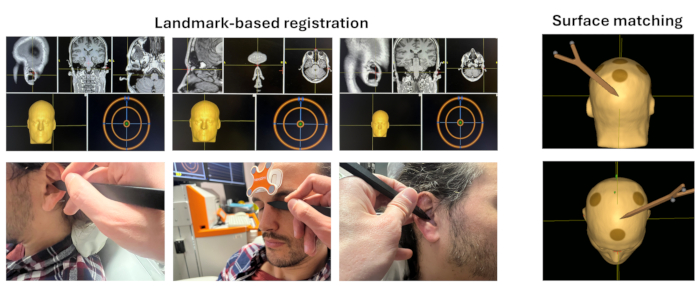
图1:患者头部与解剖MRI的共配准。左侧:基于标志点的配准。上排图像:在神经导航软件中识别MRI上的解剖标志点(左耳、鼻根点、右耳)。下排图像:使用数字化探针在患者身上采集标志点坐标。右侧:利用额外的头皮点进行表面匹配优化。 请点击此处查看该图的放大版本。
3. 绘制肌肉的制备
- 为受试者佩戴耳塞,并在刺激期间佩戴防护耳罩。
- 使用酒精棉片和/或含有轻度研磨凝胶的棉片轻轻擦拭目标肌肉区域的皮肤,以进行皮肤准备。
- 将表面电极以肌腹-肌腱排列方式放置于目标肌肉上,方法同常规临床运动诱发电位(MEPs)检测。最多可同时对六个不同肌肉进行定位。
- 将接地电极置于中性部位,例如肩部残端、手背表面或胫骨内侧表面。
- 将所有电极连接至肌电图(EMG)放大器。
- 启动肌电图采集,以连续显示所有通道的肌电信号,并确认肌肉处于静息状态。
- 检查肌电图通道是否无过度的50/60 Hz噪声(< 50 µV)。若交流电干扰过大,请依次尝试以下步骤:
- 确认电极牢固贴附于皮肤,无任何松脱现象。
- 将电极导线重新布置于座椅内部,避免接触金属部件或地面。
- 将电极引线的远端远离神经导航系统及交流电源。
- 更换电极并使用不同方向的导线重新安放(参见步骤3.7.2和3.7.3)。
- 断开座椅的电源供应。
- 将接地电极置于与目标肌肉所在相同的肢体上。
- 按顺序重复上述步骤,直至噪声降低至阈值以下。
- 当50/60 Hz噪声降至最低后,重新启动肌电图记录以重置基线。
- 完成上述准备步骤后,即可开始对选定肌肉进行粗略定位。
注:标准定位会话应至少包括每个上肢节段一块肌肉以及两块下肢肌肉。表1列出了常用的定位肌肉,具体选择应根据病变位置及患者的临床表现进行调整34。
| 肢体 | 肌肉 | 可选肌肉 |
| 手 | 第一背侧骨间肌 (FDI) | 拇短展肌 (APB) |
| 小指展肌 (ADM) | ||
| 前臂 | 桡侧腕屈肌 (FCR) | 桡侧腕长伸肌 (ECR) |
| 上臂 / 肩部 | 肱二头肌 | - |
| 三角肌 | ||
| 腿部 | 胫骨前肌 (TA) | 比目鱼肌 (SOL) |
| 足部 | 拇展肌 (AH) | 内侧跖肌 (MP) |
| 面部 | 口轮匝肌 | 鼻肌 |
表1:运动功能定位建议检测的肌肉。
4. 粗略定位以识别热点区域并确定静息运动阈值(RMT)
- 在软件中对重建的脑容积图像,根据具体情况将剥离深度调整至距头皮15–25 mm,以最佳显示皮层解剖结构。目标是可视化中央前回和中央后回、中央沟,以及额上沟和额下沟。
注意:当受试者呈现“Ω形”手结节时,识别中央前回更为容易40,41。然而,这一解剖标志并不恒定42,43。在此类情况下,建议采用多种方法识别中央前回43,44,45。 - 启动刺激器设备。
- 将刺激线圈(8字形线圈)置于与头皮相切的位置(见图2)。
- 一手握住线圈手柄,另一手扶住线圈本体,以在重新定位过程中保持线圈与头皮的稳定接触。
- 利用神经导航辅助功能(线圈角度、线圈与头部距离、倾斜指示器),确保在线圈每次定位时准确对准刺激位点。
- 避免线圈倾斜,以维持稳定的感应电场(EF,V/m)。
- 采用舒适的姿势操作,因线圈可能较重。可使用电缆支撑臂以减少电缆张力,同时保持线圈自由移动。
- 调节刺激强度,以诱发振幅在100–500 µV(峰峰值)范围内的反应46。
注意:上肢刺激通常需要最大刺激输出(MSO)的35%至45%,下肢则需50%至80%的MSO。但该强度范围适用于健康受试者;当肿瘤浸润运动区时,所需强度可能更高。 - 请注意,粗略定位(以及精细定位)时的线圈方向取决于所定位的肢体(见图3):
- 对于上肢和面部:保持线圈方向垂直于中央沟(与沟对齐),以使感应电流方向保持从后向前47。
- 对于上肢:从手结节后壁的上部(肩部)或中部(前臂和手部肌肉)开始刺激,朝向额上沟。
- 对于面部:从中央前回后壁、朝向额下沟的位置开始刺激。检查反应潜伏期,以确认其来源于皮质延髓束通路。面部运动诱发电位(MEP)潜伏期为7–13 ms,而经颅磁刺激(nTMS)诱发的直接肌肉反应(下颌反射)潜伏期约为3–4 ms。
- 对于下肢:保持线圈方向垂直于矢状中线,使感应电流方向为中线至外侧方向34。其他可选线圈方向包括与矢状中线平行48,49,50,和/或垂直于旁中央小叶及中央前回的脑回走行方向。
- 对于上肢和面部:保持线圈方向垂直于中央沟(与沟对齐),以使感应电流方向保持从后向前47。
- 在中央前回区域进行刺激。
- 刺激点间距为1–2 mm,可通过目测或使用刺激网格实现。
- 若采用目测法,可在脑回上选取三条平行线进行采样,通常已足够。
- 每次刺激间隔至少1.5 s,建议采用随机化的刺激间间隔。
- 若未获得任何反应,将刺激强度较初始值提高10%,并重复前述操作。
- 当每块肌肉记录到20–30个反应后,停止粗略定位。
- 回顾所有运动诱发电位(MEP)记录,排除受干扰的信号。
- 确定每块肌肉的“热点”。“热点”是指诱发最大振幅MEP的刺激位点。为确保热点定义的可靠性51:
- 使用归一化的颜色标尺显示每块肌肉的记录结果。
- 定位包含最高振幅MEP的区域。
- 按振幅从高到低对MEP进行排序。
- 在该区域内选择振幅最高的MEP,避免异常高的单次反应(通常为前两次MEP)。
- 对于每块肌肉,选择热点以确定静息运动阈值(RMT)。此操作将在RMT测定过程中保存线圈的位置和方向,确保测量结果可靠52。
- 分别测定每块肌肉的RMT,可采用阈值搜索技术53,或确定在连续10次刺激中至少有5次诱发MEP ≥ 50 µV的最低刺激强度(% MSO)(Rossini-Rothwell方法)54。将每块肌肉的RMT作为精细定位过程中设定刺激强度的参考依据。
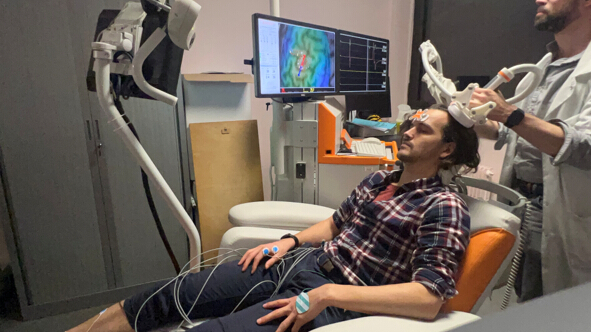
图 2:实验性 nTMS 装置设置。 受试者取轻度后倾坐位,并有手臂支撑,目标肌肉表面放置肌电图(EMG)电极。操作者手持“8”字形线圈,保持其稳定以确保与头皮表面呈切向接触,同时监测诱发的电场(箭头:方向,圆圈:强度)以及诱发的运动诱发电位(MEPs)。请点击此处查看该图的放大版本。
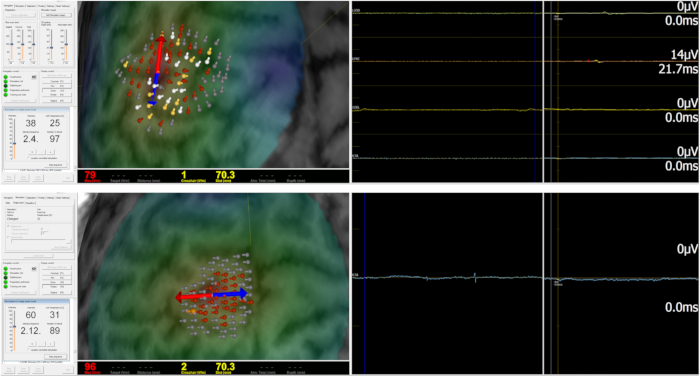
图3:定位过程中的神经导航界面。 实时反馈线圈位置(蓝箭头与红箭头交点)、线圈倾斜角度、电场方向(由蓝至红的箭头)以及场强(周围彩色环),确保在每个皮层位点进行精确刺激。上图:上肢的粗略定位,线圈方向垂直于中央沟。下图:胫骨前肌的精细定位,线圈方向垂直于矢状中线。请点击此处查看该图的放大版本。
5. 精细定位
- 确保受试者完全放松,无非自主性肌肉收缩。
- 对每块肌肉,以该肌肉静息运动阈值(RMT)的105-110%进行刺激。
- 使用与粗略定位时相同的线圈方向(见步骤4.5和4.6)。
- 减小刺激点之间的间距(每脑回4-6条平行线)。
- 保持刺激间间隔≥1.5秒,建议采用随机化间隔。
- 将功能性运动图谱定义为经颅磁刺激(nTMS)可诱发峰-峰振幅≥50 µV的运动诱发电位(MEP)的皮质区域。
注:对于下肢定位,可选择从上肢RMT的110%开始,然后以±10 V/m为步长调整电场强度(EF),直至获得稳定的MEP34。 - 持续进行刺激,直至运动图谱边缘出现一条或两条连续的无反应刺激点。
- 若未获得清晰的阴性边界,则在保持相同间距的前提下扩展采样范围,直至反应稳定消失。
- 若阳性反应出现在非典型区域,应检查并调整线圈角度、电场强度(EF)和RMT。
注:每块肌肉的刺激点数量可能不同(30至100次脉冲),具体取决于肌肉皮质代表区的大小以及肿瘤引起的脑移位程度。
- 避免使用会产生异常MEP位置或振幅的线圈方向。特别是,相对于中线呈45°的线圈方向可能在非常靠前的区域诱发上肢MEP,这可能无法准确反映运动皮质的真实代表区47。
- 确保运动图谱呈椭圆形,内部仅有少量阴性刺激点。对于运动图谱内的阴性刺激点,应在评估过程中的不同时间点重复刺激,以排除运动皮质兴奋性短暂变化的影响。
- 若在定位过程中出现大量阴性反应(<50 µV),请依次尝试以下步骤:
- 提醒受试者保持清醒状态,因为此类情况常反映警觉水平下降。
- 检查刺激强度是否有所降低。
- 考虑重新测定RMT,因为初始值可能受到短暂性皮质高兴奋状态的影响。
- 若出现大量异常高振幅MEP(> 1000 µV)且图谱过度扩展,请依次尝试以下步骤:
- 要求受试者放松肢体,必要时可通过显示实时肌电活动(信号反馈)来提示其肌肉仍处于紧张状态。
- 若肌电活动持续存在,可让受试者轻轻晃动肢体或将其置于更放松的位置;如需进一步干预,可对被测肌肉施加同心性被动运动(例如,用手部物体刺激手部肌肉或拇展肌,或用足部支撑装置刺激胫前肌)。
- 考虑重新测定RMT,因为初始值可能受到运动皮质短暂低兴奋状态的影响。
6. MEP 数据的后期处理分析与导出
- 查看并调整每块肌肉的运动诱发电位(MEP)。
- 在神经导航软件中打开 MEP 审查面板或信号查看器。
- 检查每个记录到的 MEP,校正其幅值和潜伏期,并在需要时调整标记。
- 排除伪迹或异常的刺激点。
- 在软件中打开刺激列表或映射工作区。
- 删除包含伪迹或线圈位置不正确的刺激试验(见 图4)。
- 以二进制格式(阳性/阴性;高于/低于 50 µV)显示每块肌肉的运动图谱。
- 以 15、20 和 25 mm 深度导出二值化的 DICOM 格式的阳性刺激点。将这些文件用于纤维追踪,以重建皮质脊髓束(CST),并将阳性刺激点作为纤维束成像的种子点。
- 为测量其他皮层图谱参数(如重心位置、图谱密度、运动图谱面积),请在刺激剥离深度或 20 mm(标准剥离深度)导出数据25,55,56,57,58。
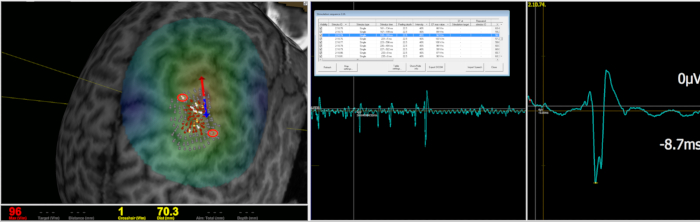
图4:MEP数据的后处理分析。对MEP波形进行复查,以校正幅值和潜伏期标记,并剔除含伪迹的试验(右侧面板:受持续EMG活动污染的试验示例)。两次刺激(红色圆圈)显示了在负相区域出现的“异常反应”,可能与线圈方向效应有关。请点击此处查看该图的放大版本。
7. 运动定位图谱的后期处理分析
- 将运动功能图的DICOM文件导入适用于脑肿瘤切除术神经外科导航的图像分析软件中。
- 将解剖图像(T1w)与运动功能图DICOM文件及弥散加权成像(DWI)进行配准。如有必要,导入并配准其他图像(如FLAIRw、SWI、钆增强T1w)。
- 根据运动功能图DICOM文件生成对象,并将其扩大1-2 mm,以提高敏感性59。
- 裁剪运动功能图,去除耳部和鼻根区域,以防止纤维追踪过程中出现异常的纤维重建。
- 在脑桥下部水平,于被映射半球同侧手动绘制终点感兴趣区域(ROI)。
- 以运动功能图ROI作为种子点,脑桥ROI作为终点,进行纤维追踪。常用的纤维束成像算法包括确定性流线追踪或概率性纤维束成像,具体选择取决于临床问题和纤维追踪结果。
注意:使用开源弥散成像软件时,在进行纤维束成像前需完成多个预处理步骤(去噪、吉布斯伪影校正、运动与畸变校正、B1偏置场校正、张量拟合及FA图生成)。 - 根据具体病例调整纤维追踪参数。推荐参数包括:最小长度110-120 mm,最大弯曲角度30°,FA阈值设为FA阈值(FAT,即首次可见皮质脊髓束纤维时的FA值)的75%60,61。
- 在其他图像上(如FLAIR、钆增强T1w)分割脑肿瘤,并创建相应的对象。
- 可分别显示各肢体部分的皮质脊髓束(CST)(用不同颜色表示),或显示完整的运动功能图谱。
- 将所有数据(皮层种子点、CST、脑肿瘤对象)整合至神经外科手术室导航软件中。
结果
我们展示了使用神经导航经颅磁刺激(TMS)系统在不同健康受试者以及临床环境中接受运动功能定位的患者中获得的代表性步骤和运动定位结果。皮质脊髓束(CST)重建采用适用于神经外科手术规划的图像处理软件完成,该软件具备多模态图像配准和基于弥散张量成像(DTI)的纤维束追踪功能。神经导航系统集成了带有导航功能的双线圈、立体定位相机、肌电图(EMG)放大器,并利用个体化的多球头模型,在三维脑重建图像上实时可视化诱发的电场分布。
图5展示了通过粗略定位确定的热点处的RMT测定结果。在整个操作过程中,借助神经导航靶点,线圈的位置和方向始终保持完全一致。图6展示了一名健康受试者的运动功能定位图。对左侧下肢(大腿、小腿、足部)、上肢(肩部、前臂、手部)以及面部进行了定位。阳性刺激位点(按MEP幅值颜色编码)和阴性位点(灰色)共同勾画出运动皮层的代表区域。图7展示了一名肺癌转移累及运动前区并表现为上肢运动功能障碍的患者的运动功能定位图及皮质脊髓束(CST)重建结果。
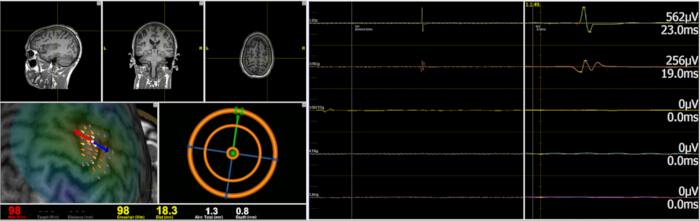
图 5:在健康受试者的第一背侧骨间肌热点区域,通过神经导航经颅磁刺激(TMS)进行粗略定位及静息运动阈值(RMT)测定。 热点区域通过粗略定位法确定(左下图),并被选为RMT测定的目标位置。在整个操作过程中,借助神经导航目标系统,线圈的位置和方向始终保持在完全相同的位置(右下图)。运动诱发电位(MEPs)通过连续肌电图(EMG)记录和片段化反应获取。请点击此处查看该图的放大版本。
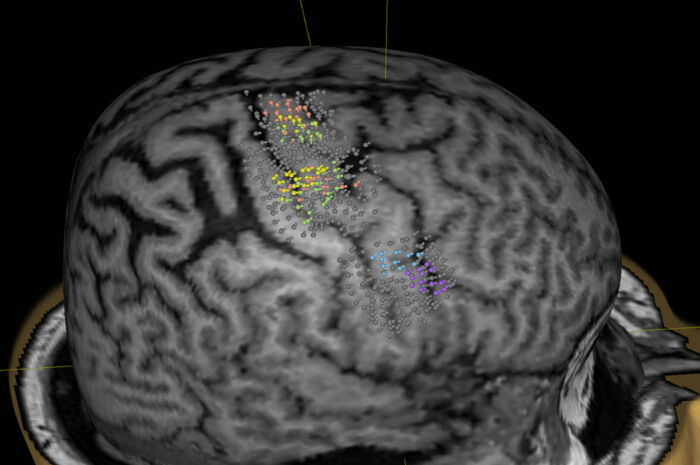
图6:使用神经导航经颅磁刺激(TMS)对下肢、上肢和面部肌肉进行运动皮层定位。 下肢记录的肌肉:股四头肌(绿色)、胫骨前肌(橙色)、拇展肌(黄色)。上肢记录的肌肉:小指展肌(绿色)、桡侧腕屈肌(橙色)、三角肌(黄色)。面部记录的肌肉:鼻肌(蓝色)、降口角肌(紫色)。请点击此处查看该图的放大版本。
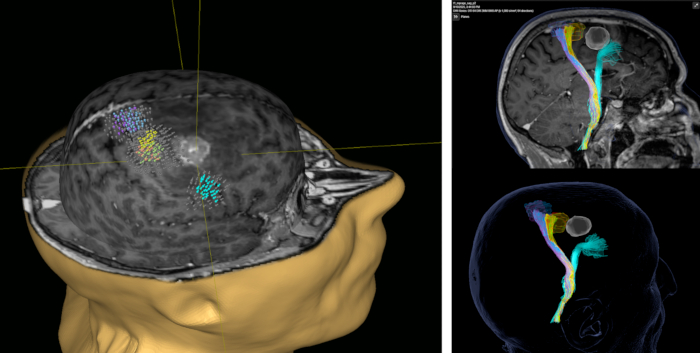
图7:用于神经外科手术规划的运动皮层定位与皮质脊髓束重建。 一名肺癌脑转移(白色)患者的nTMS运动定位图(左图)和nTMS引导下的皮质脊髓束重建图(右图)。记录的肌肉包括:拇展肌(紫色)、胫骨前肌(蓝色)、三角肌(黄色)、桡侧腕屈肌(红色)、第一背侧骨间肌(绿色)、眼轮匝肌(青色)。 请点击此处查看此图的放大版本。
讨论
本文介绍了一种标准化且可重复的功能性运动皮层定位方案,采用神经导航经颅磁刺激(nTMS)技术,可直接应用于术前手术规划。通过将神经导航系统与受试者脑部解剖结构重建相结合,该标准化方案可在不到90分钟的检查时间内识别并勾画出运动功能关键皮层区域,具体时长取决于所研究的肌肉数量。该方法在运动功能关键区肿瘤患者中尤为重要,因为皮质脊髓束(CST)的解剖重建常受到两个因素的限制:(i)由于占位效应和/或水肿引起的解剖结构移位;(ii)运动功能代表区的功能重组。基于固定解剖标志的解剖学种子纤维追踪可能因此在定位皮层起源时产生误导,并在整个纤维追踪过程中传播误差。功能性运动皮层定位通过使用nTMS阳性位点作为皮层种子点,将纤维追踪锚定于驱动皮质脊髓输出的患者当前运动图谱,从而解决了这一问题。在后续处理分析中,应将运动图谱所得的皮层感兴趣区域(ROI)扩大2–3 mm,以减轻融合相关错配,标准化ROI体积(0.9 ± 0.1 cm3),减少操作者间及个体间差异,提高CST纤维追踪的可比性59。与基于解剖标志的纤维追踪相比,nTMS种子点引导的纤维追踪可生成更合理、体位对应更一致的CST重建结果,异常流线更少,且观察者间变异度更低27,61,62。与基于fMRI的种子点追踪相比,在肿瘤邻近CST的患者中,nTMS引导的纤维追踪同样可产生更合理的重建结果和更高的观察者间一致性25。此外,该方法还可从nTMS运动定位图和nTMS种子点CST中提取多种指标,这些指标可能作为术后运动功能预后的预测因子。在皮层水平,肿瘤内部存在nTMS可诱发反应的位点与运动功能缺损风险增加相关,其阳性预测值范围为50–90%30,63,64,65。相反,切除nTMS阴性位点被认为是安全的,其阴性预测值较高,范围为90–100%30,31,65。在皮层下水平,当肿瘤与纤维束距离<8–12 mm时,已被确定为与术后功能缺损风险升高相关的关键阈值,前提是肿瘤未侵犯中央前回66,67,68,69,70,71。此外,nTMS种子点CST的微结构改变(分数各向异性降低,平均扩散率升高)也被提出作为术后功能缺损的额外风险因素70。最后,使用基于nTMS的纤维追踪技术与更高的肿瘤切除程度和更长的生存期相关,同时可保留运动功能,支持其在术前规划中的整合应用72。
在运动功能定位过程中,显著影响运动诱发电位(MEP)空间分布及运动图谱可解释性的关键参数是刺激强度(SI)。较高的刺激强度会增加反应概率和空间扩散范围(可能导致假阳性反应),而刺激强度不足则会增加假阴性反应的风险。为尽量减少这种偏差,刺激强度应相对于静息运动阈值(RMT)进行标定,并在可能的情况下调整以维持稳定的目标电场强度(EF)。在实际操作中,接近阈值的刺激强度可在敏感性与特异性之间取得平衡,从而生成与直接电刺激定位结果相近的保守图谱。另一方面,当临床安全性要求在图谱边缘优先保证敏感性时,选择高于阈值的刺激强度(例如120% RMT)是合理的,但需认识到较高的刺激强度会系统性地扩大运动图谱范围73。在对多个肌肉进行定位时,若使用单一刺激强度,可能会使定位结果偏向阈值最低的肌肉,因为邻近肌肉可能具有不同的兴奋性特征。因此,应针对每块肌肉分别估算其静息运动阈值(RMT)74。此外,在一次运动定位过程中,皮层兴奋性可能发生显著变化,表现为MEP振幅出现意料之外的改变,此时需要重新估算RMT并调整刺激强度。
在运动功能定位过程中使用刺激网格有助于标准化间距并促进定位图的量化(例如,通过计算激活的网格方格数)。然而,网格尺寸会直接影响结果:较大的方格可能高估定位图的范围,而较小的方格则会增加采样不足的风险。近期证据表明,可以不使用网格进行nTMS定位,而是采用解剖引导的方法,在解剖标志附近和定位图边缘施加更密集的刺激75。
可以从运动定位图中提取多个定量参数,例如重心(CoG)、运动图面积和体积。重心定义为以幅值加权的坐标位置,代表运动表征的中心58。连续检查已显示脑肿瘤患者重心发生偏移76,77,78,反映出运动皮层随时间推移发生的功能重组。运动图面积和体积表示运动表征的空间范围。面积通常通过计算刺激网格上激活方格的数量获得,或在无网格刺激中采用样条插值法,将阳性刺激点用平滑的多项式曲线连接,从而生成连续的表面或体积56。这些指标可用于纵向监测(随访研究或干预效果评估),或与病灶对侧半球进行比较,以研究皮层运动可塑性79,80,81,82。定量运动定位图指标有望超越神经肿瘤学领域,为神经系统疾病中的运动系统完整性及疾病相关可塑性提供生物标志物55,83。
尽管nTMS目前已广泛用于术前运动功能区定位,但仍需认识到其存在若干局限性。首先,共配准和皮层映射的准确性在一定程度上依赖于操作者。尽管已有研究表明,nTMS在专家与新手检查者之间具有良好的一致性,能够提供可靠的运动功能拓扑图84,但仍需接受适当的培训,包括线圈操作、头部追踪器稳定性控制以及刺激参数的及时调整,以确保该技术的可靠性与可重复性。第二个局限性涉及病灶周围水肿和占位效应对纤维束成像的影响。显著的病灶周围水肿可能降低基于nTMS的皮质脊髓束重建的准确性,尤其是在邻近病灶的体素中85。同样,由于术中脑移位,术前数据集与实际术中解剖结构之间可能出现偏差86,87。由于脑移位无法完全避免——特别是对于具有明显占位效应的肿瘤——在切除手术的后期阶段,基于nTMS获得的运动区域(包括皮层和皮层下区域)的准确性可能下降。可通过多种策略减轻这些不准确性,包括限制不必要的皮层暴露、反复核对浅表解剖标志88,以及联合使用术中影像技术(如MRI、超声或CT)并结合脑组织形变校正方法89,90,91,92。最后,就安全性而言,nTMS在肿瘤相关性癫痫患者中已显示出良好的安全特性。在大样本研究中,术前映射过程中由刺激诱发的癫痫发作极为罕见甚至未见报道93,表明在采取适当预防措施的前提下,该技术是安全的。
总体而言,神经导航经颅磁刺激(nTMS)可为手术规划提供具有临床价值的功能信息,并为开展针对多种神经系统或精神疾病中运动系统可塑性的纵向研究开辟了路径。
披露
作者无任何利益冲突需要披露。
致谢
本工作由丹麦独立研究基金(资助编号:3165-00230B)、Aage & Johanne Louis-Hansens 基金会(资助编号:25-1-17926)和 Muskelsvindfonden(资助编号:2025-0010)支持
材料
| 姓名 | 公司 | 目录编号 | 评论 |
|---|---|---|---|
| Elements 软件 | BrainLAB AG, Munich, Germany | 图像处理软件和手术室神经导航软件 | |
| 神经导航 TMS 系统 | Nexstim, Helsinki, Finland | NBS 5.1 系统 | 配备八字形线圈和肌电图放大器的导航式 TMS 系统 |
| 用于肌电图记录的表面电极 | Natus, Middleton, WI, USA | 9013L0453 | 用于肌电图记录 |
参考文献
- Berger, M. S., Ojemann, G. A., Lettich, E. Neurophysiological monitoring during astrocytoma surgery. Neurosurg Clin N Am. 1 (1), 65-80 (1990).
- Kombos, T., Suess, O., Funk, T., Kern, B. C., Brock, M. Intra-operative mapping of the motor cortex during surgery in and around the motor cortex. Acta Neurochir. 142 (3), 263-268 (2000).
- Keles, G. E., Lundin, D. A., Lamborn, K. R., Chang, E. F., Ojemann, G., Berger, M. S. Intraoperative subcortical stimulation mapping for hemispherical perirolandic gliomas located within or adjacent to the descending motor pathways: evaluation of morbidity and assessment of functional outcome in 294 patients. J Neurosurg. 100 (3), 369-375 (2004).
- Duffau, H., et al. Contribution of intraoperative electrical stimulations in surgery of low grade gliomas: a comparative study between two series without (1985-96) and with (1996-2003) functional mapping in the same institution. J Neurol Neurosurg Psychiatry. 76 (6), 845-851 (2005).
- De Witt Hamer, P. C., Robles, S. G., Zwinderman, A. H., Duffau, H., Berger, M. S. Impact of intraoperative stimulation brain mapping on glioma surgery outcome: a meta-analysis. J Clin Oncol. 30 (20), 2559-2565 (2012).
- Barker, A. T., Jalinous, R., Freeston, I. L. Non-invasive magnetic stimulation of human motor cortex. Lancet. 1 (8437), 1106-1107 (1985).
- Cohen, L. G., Bandinelli, S., Topka, H. R., Fuhr, P., Roth, B. J., Hallett, M. Topographic maps of human motor cortex in normal and pathological conditions: mirror movements, amputations and spinal cord injuries. Electroencephalogr Clin Neurophysiol Suppl. 43 (1), 36-50 (1991).
- Levy, W. J., Amassian, V. E., Schmid, U. D., Jungreis, C. Mapping of motor cortex gyral sites non-invasively by transcranial magnetic stimulation in normal subjects and patients. Electroencephalogr Clin Neurophysiol Suppl. 43 (1), 51-75 (1991).
- Asakura, T., Tokimura, H., Hirahara, K., Baba, K. Identification of the cerebral motor cortex by focal magnetic stimulation: clinical application to neurosurgical patients. Stereotact Funct Neurosurg. 63 (1-4), 177-181 (1994).
- Krings, T., et al. Functional magnetic resonance imaging and transcranial magnetic stimulation: complementary approaches in the evaluation of cortical motor function. Neurology. 48 (5), 1406-1416 (1997).
- Krings, T., et al. Stereotactic transcranial magnetic stimulation: correlation with direct electrical cortical stimulation. Neurosurgery. 41 (6), 1319-1325 (1997).
- Krings, T., Chiappa, K. H., Foltys, H., Reinges, M. H., Cosgrove, G. R., Thron, A. Introducing navigated transcranial magnetic stimulation as a refined brain mapping methodology. Neurosurg Rev. 24 (4), 171-179 (2001).
- Lefaucheur, J. -P. Why image-guided navigation becomes essential in the practice of transcranial magnetic stimulation. Neurophysiol Clin. 40 (1), 1-5 (2010).
- Ruohonen, J., Karhu, J. Navigated transcranial magnetic stimulation. Neurophysiol Clin. 40 (1), 7-17 (2010).
- Gugino, L. D., et al. Transcranial magnetic stimulation coregistered with MRI: a comparison of a guided versus blind stimulation technique and its effect on evoked compound muscle action potentials. Clin Neurophysiol. 112 (10), 1781-1792 (2001).
- Cavaleri, R., Schabrun, S. M., Chipchase, L. S. The reliability and validity of rapid transcranial magnetic stimulation mapping. Brain Stimul. 11 (6), 1291-1295 (2018).
- Frey, D., et al. Navigated transcranial magnetic stimulation improves the treatment outcome in patients with brain tumors in motor eloquent locations. Neuro Oncol. 16 (10), 1365-1372 (2014).
- Krieg, S. M., et al. Utility of presurgical navigated transcranial magnetic brain stimulation for the resection of tumors in eloquent motor areas. J Neurosurg. 116 (5), 994-1001 (2012).
- Picht, T., et al. Preoperative functional mapping for rolandic brain tumor surgery: comparison of navigated transcranial magnetic stimulation to direct cortical stimulation. Neurosurgery. 69 (3), 581-588 (2011).
- Tarapore, P. E., et al. Safety and tolerability of navigated TMS in healthy volunteers. Clin Neurophysiol. 127 (3), 1916-1918 (2016).
- Rossi, S., et al. Safety and recommendations for TMS use in healthy subjects and patient populations, with updates on training, ethical and regulatory issues: Expert Guidelines. Clin Neurophysiol. 132 (1), 269-306 (2021).
- Cohen, S. L., Bikson, M., Badran, B. W., George, M. S. A visual and narrative timeline of US FDA milestones for transcranial magnetic stimulation (TMS) devices. Brain Stimul. 15 (1), 73-75 (2022).
- Nahas, Z. Handbook of Transcranial Magnetic Stimulation. J Psychiatry Neurosci. 28 (5), 373-375 (2003).
- Mangraviti, A., et al. Practical assessment of preoperative functional mapping techniques: navigated transcranial magnetic stimulation and functional magnetic resonance imaging. Neurol Sci. 34 (9), 1551-1557 (2013).
- Weiss Lucas, C., et al. Functional MRI vs. navigated TMS to optimize M1 seed volume delineation for DTI tractography. A prospective study in patients with brain tumours adjacent to the corticospinal tract. Neuroimage Clin. 13, 297-309 (2017).
- Weiss Lucas, C., et al. Invasive versus non-invasive mapping of the motor cortex. Hum Brain Mapp. 41 (14), 3970-3983 (2020).
- Krieg, S. M., Buchmann, N. H., Gempt, J., Shiban, E., Meyer, B., Ringel, F. Diffusion tensor imaging fiber tracking using navigated brain stimulation-a feasibility study. Acta Neurochir. 154 (3), 555-563 (2012).
- Picht, T., Frey, D., Thieme, S., Kliesch, S., Vajkoczy, P. Presurgical navigated TMS motor cortex mapping improves outcome in glioblastoma surgery: a controlled observational study. J Neurooncol. 126 (3), 535-543 (2016).
- Raffa, G., et al. Multimodal surgical treatment of high-grade gliomas in the motor area: the impact of the combination of navigated transcranial magnetic stimulation and fluorescein-guided resection. World Neurosurg. 128, e378-e390 (2019).
- Eibl, T., et al. Significance of navigated transcranial magnetic stimulation and tractography to preserve motor function in patients undergoing surgery for motor eloquent gliomas. Heliyon. 10 (6), e28115(2024).
- Seidel, K., et al. Postoperative navigated transcranial magnetic stimulation to predict motor recovery after surgery of tumors in motor eloquent areas. Clin Neurophysiol. 130 (6), 952-959 (2019).
- Picht, T., Schulz, J., Hanna, M., Schmidt, S., Suess, O., Vajkoczy, P. Assessment of the influence of navigated transcranial magnetic stimulation on surgical planning for tumors in or near the motor cortex. Neurosurgery. 70 (5), 1248-1256 (2012).
- Eibl, T., Liebert, A., Ritter, L., Schebesch, K. -M. Evaluating postoperative motor function using postoperative navigated transcranial magnetic stimulation motor mapping. Neurophysiol Clin. 55 (4), 103072(2025).
- Krieg, S. M., et al. Protocol for motor and language mapping by navigated TMS in patients and healthy volunteers; workshop report. Acta Neurochir. 159 (7), 1187-1195 (2017).
- Rossi, S., Hallett, M., Rossini, P. M., Pascual-Leone, A. Safety of TMS Consensus Group. Safety, ethical considerations, and application guidelines for the use of transcranial magnetic stimulation in clinical practice and research. Clin Neurophysiol. 120 (12), 2008-2039 (2009).
- Zolal, A., et al. The effect of a gadolinium-based contrast agent on diffusion tensor imaging. Eur J Radiol. 81 (8), 1877-1882 (2012).
- Sanvito, F., Kaufmann, T. J., Cloughesy, T. F., Wen, P. Y., Ellingson, B. M. Standardized brain tumor imaging protocols for clinical trials: current recommendations and tips for integration. Front Radiol. 3, (2023).
- Stinson, M. D., Porter-Armstrong, A., Eakin, P. Seat-interface pressure: a pilot study of the relationship to gender, body mass index, and seating position. Arch Phys Med Rehabil. 84 (3), 405-409 (2003).
- Nieminen, A. E., et al. Accuracy and precision of navigated transcranial magnetic stimulation. J Neural Eng. 19 (6), 066037(2022).
- Yousry, T. A., et al. Localization of the motor hand area to a knob on the precentral gyrus. A new landmark. Brain. 120 (1), 141-157 (1997).
- Caulo, M., et al. New morphologic variants of the hand motor cortex as seen with MR imaging in a large study population. AJNR Am J Neuroradiol. 28 (8), 1480-1485 (2007).
- Wu, R., et al. The new morphologic classification of the hand motor cortex with magnetic resonance imaging in glioma patients. Heliyon. 10 (7), e28548(2024).
- Berger, M. S., Cohen, W. A., Ojemann, G. A. Correlation of motor cortex brain mapping data with magnetic resonance imaging. J Neurosurg. 72 (3), 383-387 (1990).
- Boling, W., Olivier, A., Bittar, R. G., Reutens, D. Localization of hand motor activation in Broca's pli de passage moyen. J Neurosurg. 91 (6), 903-910 (1999).
- Kido, D. K., LeMay, M., Levinson, A. W., Benson, W. E. Computed tomographic localization of the precentral gyrus. Radiology. 135 (2), 373-377 (1980).
- Sartori, L., et al. Selective stimulus intensity during hotspot search ensures faster and more accurate preoperative motor mapping with nTMS. Brain Sci. 13 (2), 285(2023).
- Raffin, E., Pellegrino, G., Di Lazzaro, V., Thielscher, A., Siebner, H. R. Bringing transcranial mapping into shape: sulcus-aligned mapping captures motor somatotopy in human primary motor hand area. Neuroimage. 120, 164-175 (2015).
- Cacchio, A., Cimini, N., Alosi, P., Santilli, V., Marrelli, A. Reliability of transcranial magnetic stimulation-related measurements of tibialis anterior muscle in healthy subjects. Clin Neurophysiol. 120 (2), 414-419 (2009).
- Cacchio, A., et al. Reliability of TMS-related measures of tibialis anterior muscle in patients with chronic stroke and healthy subjects. J Neurol Sci. 303 (1), 90-94 (2011).
- Sondergaard, R. E., Martino, D., Kiss, Z. H. T., Condliffe, E. G. TMS motor mapping methodology and reliability: a structured review. Front Neurosci. 15, (2021).
- Reijonen, J., Pitkänen, M., Kallioniemi, E., Mohammadi, A., Ilmoniemi, R. J., Julkunen, P. Spatial extent of cortical motor hotspot in navigated transcranial magnetic stimulation. J Neurosci Methods. 346, 108893(2020).
- Julkunen, P., et al. Comparison of navigated and non-navigated transcranial magnetic stimulation for motor cortex mapping, motor threshold and motor evoked potentials. Neuroimage. 44 (3), 790-795 (2009).
- Awiszus, F. TMS and threshold hunting. Suppl Clin Neurophysiol. 56, 13-23 (2003).
- Rossini, P. M., et al. Non-invasive electrical and magnetic stimulation of the brain, spinal cord, roots and peripheral nerves: basic principles and procedures for routine clinical and research application. An updated report from an I.F.C.N. committee. Clin Neurophysiol. 126 (6), 1071-1107 (2015).
- Bardel, B., et al. Motor function in multiple sclerosis assessed by navigated transcranial magnetic stimulation mapping. J Neurol. 271 (7), 4513-4528 (2024).
- Julkunen, P. Methods for estimating cortical motor representation size and location in navigated transcranial magnetic stimulation. J Neurosci Methods. 232, 125-133 (2014).
- Sinitsyn, D. O., Chernyavskiy, A. Y., Poydasheva, A. G., Bakulin, I. S., Suponeva, N. A., Piradov, M. A. Optimization of the navigated TMS mapping algorithm for accurate estimation of cortical muscle representation characteristics. Brain Sci. 9 (4), 88(2019).
- Sollmann, N., Krieg, S. M., Säisänen, L., Julkunen, P. Mapping of motor function with neuronavigated transcranial magnetic stimulation: a review on clinical application in brain tumors and methods for ensuring feasible accuracy. Brain Sci. 11 (7), 897(2021).
- Weiss, C., et al. Improved nTMS- and DTI-derived CST tractography through anatomical ROI seeding on anterior pontine level compared to internal capsule. Neuroimage Clin. 7, 424-437 (2015).
- Frey, D., Strack, V., Wiener, E., Jussen, D., Vajkoczy, P., Picht, T. A new approach for corticospinal tract reconstruction based on navigated transcranial stimulation and standardized fractional anisotropy values. Neuroimage. 62 (3), 1600-1609 (2012).
- Ivren, M., et al. Comparison of anatomical-based vs. nTMS-based risk stratification model for predicting postoperative motor outcome and extent of resection in brain tumor surgery. Neuroimage Clin. 38, 103436(2023).
- Rosenstock, T., et al. Specific DTI seeding and diffusivity-analysis improve the quality and prognostic value of TMS-based deterministic DTI of the pyramidal tract. Neuroimage Clin. 16, 276-285 (2017).
- Muir, M., et al. TMS seeded diffusion tensor imaging tractography predicts permanent neurological deficits. Cancers. 14 (2), 340(2022).
- Moser, T., et al. Resection of navigated transcranial magnetic stimulation-positive prerolandic motor areas causes permanent impairment of motor function. Neurosurgery. 81 (1), 99-110 (2017).
- Raffa, G., et al. The role of navigated transcranial magnetic stimulation for surgery of motor-eloquent brain tumors: a systematic review and meta-analysis. Clin Neurol Neurosurg. 180, 7-17 (2019).
- Eibl, T., et al. Tumor-specific alterations in motor cortex excitability and tractography of the corticospinal tract-a navigated transcranial magnetic stimulation study. J Integr Neurosci. 23 (7), 132(2024).
- Ivren, M., et al. Comparison of anatomical-based vs. nTMS-based risk stratification model for predicting postoperative motor outcome and extent of resection in brain tumor surgery. Neuroimage Clin. 38, 103436(2023).
- Rosenstock, T., Tuncer, M. S., Münch, M. R., Vajkoczy, P., Picht, T., Faust, K. Preoperative nTMS and intraoperative neurophysiology-a comparative analysis in patients with motor-eloquent glioma. Front Oncol. 11, 676626(2021).
- Rosenstock, T., et al. Risk stratification in motor area-related glioma surgery based on navigated transcranial magnetic stimulation data. J Neurosurg. 126 (4), 1227-1237 (2017).
- Rosenstock, T., et al. Bicentric validation of the navigated transcranial magnetic stimulation motor risk stratification model. J Neurosurg. 136 (4), 1194-1206 (2022).
- Sollmann, N., et al. Associations between clinical outcome and navigated transcranial magnetic stimulation characteristics in patients with motor-eloquent brain lesions: a combined navigated transcranial magnetic stimulation-diffusion tensor imaging fiber tracking approach. J Neurosurg. 128 (3), 800-810 (2018).
- Weiss Lucas, C., et al. Surgery of motor eloquent glioblastoma guided by TMS-informed tractography: driving resection completeness towards prolonged survival. Front Oncol. 12, (2022).
- Kallioniemi, E., Julkunen, P. Alternative stimulation intensities for mapping cortical motor area with navigated TMS. Brain Topogr. 29 (3), 395-404 (2016).
- Nazarova, M., Novikov, P., Ivanina, E., Kozlova, K., Dobrynina, L., Nikulin, V. V. Mapping of multiple muscles with transcranial magnetic stimulation: absolute and relative test-retest reliability. Hum Brain Mapp. 42 (8), 2508-2528 (2021).
- Pitkänen, M., Kallioniemi, E., Julkunen, P. Extent and location of the excitatory and inhibitory cortical hand representation maps: a navigated transcranial magnetic stimulation study. Brain Topogr. 28 (5), 657-665 (2015).
- Bulubas, L., Sollmann, N., Tanigawa, N., Zimmer, C., Meyer, B., Krieg, S. M. Reorganization of motor representations in patients with brain lesions: a navigated transcranial magnetic stimulation study. Brain Topogr. 31 (2), 288-299 (2018).
- Conway, N., et al. Cortical plasticity of motor-eloquent areas measured by navigated transcranial magnetic stimulation in patients with glioma. J Neurosurg. 127 (5), 981-991 (2017).
- Forster, M. -T., Senft, C., Hattingen, E., Lorei, M., Seifert, V., Szelényi, A. Motor cortex evaluation by nTMS after surgery of central region tumors: a feasibility study. Acta Neurochir. 154 (8), 1351-1359 (2012).
- Cirillo, S., Caulo, M., Pieri, V., Falini, A., Castellano, A. Role of functional imaging techniques to assess motor and language cortical plasticity in glioma patients: a systematic review. Neural Plast. 2019, 4056436(2019).
- de Almeida, C. C., et al. Quantification of tumor induced motor cortical plasticity using navigated transcranial magnetic stimulation in patients with adult-type diffuse gliomas. Front Neurosci. 17, 1143072(2023).
- Moser, I., et al. Analysis of neuronal excitability profiles for motor-eloquent brain tumor entities using nTMS in 800 patients. Cancers. 17 (6), 935(2025).
- Onyiriuka, L., et al. Identifying functional cortical plasticity after spinal tumour resection using navigated transcranial magnetic stimulation. Ann R Coll Surg Engl. 107 (6), 446-450 (2025).
- Durner, G., et al. Mapping motor neuroplasticity after successful surgical brachial plexus reconstruction using navigated transcranial magnetic stimulation (nTMS). Neurol Int. 16 (1), 239-252 (2024).
- Zdunczyk, A., Fleischmann, R., Schulz, J., Vajkoczy, P., Picht, T. The reliability of topographic measurements from navigated transcranial magnetic stimulation in healthy volunteers and tumor patients. Acta Neurochir. 155 (7), 1309-1317 (2013).
- Henderson, F., Abdullah, K. G., Verma, R., Brem, S. Tractography and the connectome in neurosurgical treatment of gliomas: the premise, the progress, and the potential. Neurosurg Focus. 48 (2), E6(2020).
- Gerard, I. J., Kersten-Oertel, M., Petrecca, K., Sirhan, D., Hall, J. A., Collins, D. L. Brain shift in neuronavigation of brain tumors: a review. Med Image Anal. 35, 403-420 (2017).
- Romano, A., et al. Pre- and intraoperative tractographic evaluation of corticospinal tract shift. Neurosurgery. 69 (3), 696-704 (2011).
- Bello, L., et al. Intraoperative use of diffusion tensor imaging fiber tractography and subcortical mapping for resection of gliomas: technical considerations. Neurosurg Focus. 28 (2), E6(2010).
- Senova, S., et al. Case report: multimodal functional and structural evaluation combining preoperative nTMS mapping and neuroimaging with intraoperative CT-scan and brain shift correction for brain tumor surgical resection. Front Hum Neurosci. 15, 646268(2021).
- Morin, F., et al. Brain-shift compensation using intraoperative ultrasound and constraint-based biomechanical simulation. Med Image Anal. 40, 133-153 (2017).
- Valencia, A., Blas, B., Ortega, J. Modeling of brain shift phenomenon for different craniotomies and solid models. J Appl Math. , (2012).
- Chowdhury, T., et al. The role of intraoperative MRI in awake neurosurgical procedures: a systematic review. Front Oncol. 8, 434(2018).
- Tarapore, P. E., et al. Safety and tolerability of navigated TMS for preoperative mapping in neurosurgical patients. Clin Neurophysiol. 127 (3), 1895-1900 (2016).
重印与许可
