在虚拟名人体验的背景下,内容质量对满意度的影响最为显著;而满意度又通过忠诚度间接提升购买意愿。via 个性化增强了满意度与忠诚度之间的关联,因此企业应优先打造激发情感、叙事一致的虚拟名人内容,并实施个性化的忠诚度计划。
需要JoVE订阅才能观看此内容。 请登录或开始免费试用
本文内容
摘要
摘要
近年来,企业开始引入虚拟名人,通过各类媒体渠道推广其产品和品牌。本研究采用刺激-机体-反应(SOR)框架,实证探讨虚拟名人的吸引力因素(如外貌、声音和内容质量)如何影响消费者满意度、忠诚度及购买意愿。基于249名曾体验过虚拟名人用户的样本,采用偏最小二乘结构方程模型(PLS-SEM)对假设进行检验。研究结果表明,内容质量是用户满意度最强的预测因子,且满意度通过忠诚度间接影响购买意愿。此外,个性化调节了满意度与忠诚度之间的关系,表明个性化体验有助于增强虚拟名人与粉丝之间的互动。研究结果提示,企业在策划虚拟名人营销活动时,应更注重激发情感、叙事连贯的内容,而非视觉上的真实感。此外,还需投入资源建设忠诚度培养计划和个性化互动方案,以将消费者满意度转化为持续性行为。
引言
名人代言仍然被广泛使用,且企业正越来越多地在数字媒体渠道中采用虚拟名人1。人工智能及相关技术的进步,丰富了虚拟名人的表现形式,并提升了其可扩展性与互动性2。
虚拟名人是虚拟角色与传统名人的结合体3,本文将其定义为通过基于叙事的持续互动而获得公众认知和情感依附的数字化人物3,4。本研究聚焦于面向消费者的数字营销中的音视频虚拟名人。尽管企业日益依赖虚拟名人影响消费者行为5,但学术研究对其体验如何转化为满意度、忠诚度及购买意愿的关注仍较为有限。
以往的研究探讨了行为、认知和情感视角4,强调可信度与真实性6,7、感知真实性8、身份披露9、信息质量10以及情感反应11。研究还突出了吸引力线索,如外貌、声音和内容质量12,但往往未能解释这些因素如何驱动消费者行为结果13,14。因此,积极的评价并不总能转化为购买意愿,关于满意度与购买行为之间关系的证据仍不一致。
为弥补这一不足,本研究采用SOR框架,考察外貌、声音和内容质量如何影响满意度、忠诚度和购买意愿,并检验个性化在其中的调节作用15,16。
本研究通过将虚拟名人的吸引力概念化为外貌、声音和内容17,阐明忠诚度是连接满意度与购买意愿的关键机制18,19,并识别出个性化是增强满意度与忠诚度关系的放大器20。
刺激-有机体-反应(SOR)框架
SOR 框架通过刺激(S)、有机体状态(O)和反应(R)的序列,解释环境刺激如何影响个体的内在状态和行为反应21。该框架已广泛应用于元宇宙、游戏、零售、广告、电子商务及名人代言等情境22,23,24,25,26,27,28。然而,尽管 SOR 能够描述虚拟名人属性、评价与结果之间的关系结构,却未能充分解释评价如何转化为行为意向。因此,本研究整合关系营销与忠诚度理论29,以阐明满意度—忠诚度—购买意向的作用机制。
消费者对虚拟名人的反应日益受到视听吸引力和内容参与度等体验性线索的影响4,30。外貌和声音影响初始印象,而内容质量则维持情感和叙事层面的参与14,31。尽管这些因素有助于形成积极评价,但先前研究表明,仅凭积极感知可能不足以驱动购买意愿。忠诚度和承诺等关系构念似乎能将积极体验转化为行为意图32,33。因此,外貌、声音和内容质量被建模为刺激因素;满意度和忠诚度为有机体状态;购买意愿则作为行为反应。忠诚度被概念化为心理承诺,购买意愿则被视为意动结果。
名人代言
名人代言是一种广泛使用的营销策略34,指知名人士推广产品或服务35。该策略已在全球范围内得到扩展1,36,37,尤其是随着社交媒体影响者的兴起37。计算机生成的影响者已作为人类代言人的替代方案出现37,主要通过数字平台开展活动38。
大量研究探讨了代言效果的有效性39,40,提出了诸如信息源可信度41、意义迁移35、扩展的信息源吸引力42、名人与品牌契合度43以及过程迁移效应44等模型。这些理论框架强调可信度、吸引力、象征意义的传递以及品牌一致性45,为理解虚拟情境中的代言机制奠定了基础。
虚拟名人
近期研究探讨了在数字环境中由人工智能生成的网红、VTuber(虚拟主播)以及虚拟品牌代言人,强调互动性、个性化与真实性。46 媒体丰富性理论认为,媒介越丰富,越能提升传播效果47,而虚拟角色通过沉浸式、多感官的互动体现了这种丰富性,从而影响用户的情感与社会反应4849。
尽管“虚拟名人”涵盖多种数字形象50,本研究聚焦于具有稳定身份和持续内容产出的视觉化音视频虚拟名人。以往研究从行为、认知和情感三个角度探讨其影响力4。行为研究关注用户参与度和购买行为32,51;认知研究强调可信度、真实性8、身份披露9,52以及信息质量10;情感研究则侧重于情感态度11。
虚拟名人的特征
基于信源可信度理论,研究已探讨了拟人化、吸引力、可信度、专业性以及在虚拟情境中的准社会互动1,32,53。拟人化对消费者反应具有积极影响54,55,并符合“计算机即社会行为体”范式56,该范式已被扩展至媒体代理57、聊天机器人58以及虚拟影响者。然而,虚拟名人在真实感程度上存在差异4,而恐怖谷理论表明,接近人类的表征可能引发不适感59。
技术进步使虚拟名人逐渐转变为能够动态生成内容的智能体,从而提升了内容质量、声音表现力等体验性特征的重要性。已有研究探讨了合成语音14、面部外貌13、外貌与声音的一致性60、视听吸引力30以及对计算机生成面孔的反应61。
本研究从外貌、声音和内容三个方面构建虚拟名人的吸引力。外貌吸引力会影响社会评价62,这与光环效应一致62,并预期能够提升满意度。内容质量代表了虚拟名人产出的叙事性和体验性维度,在概念上区别于服务质量63,64,65。
满意度
满意度反映了消费者对其体验是否达到预期的认知和情感评估66,67,并由感知表现相对于预期的比较所决定68,69。该概念已在在线环境中得到广泛研究70,并构成绩效评估的核心内容71。在服务场景中,吸引力会影响满意度72,73,而声音吸引力也表现出类似效应74。因此,在虚拟名人情境中,外貌、声音和内容质量均被认为会影响用户满意度。
因此,提出以下假设:
H1:虚拟名人的外貌吸引力对消费者满意度有正向影响。
H2:虚拟名人的声音吸引力对消费者满意度有正向影响。
H3:虚拟名人的内容质量对消费者满意度有正向影响。
忠诚度
本研究将忠诚度概念化为态度忠诚,反映消费者对虚拟名人的心理承诺及其情感联结,而非实际的重复行为19,33。忠诚度体现了个体在存在障碍的情况下仍愿意维持该关系的倾向75,并已被广泛作为满意度的结果变量,在在线环境67,76、旅游领域77以及虚拟主播代言情境33中得到检验。因此,提出以下假设:
H4:消费者对虚拟名人的满意度正向影响其对虚拟名人的忠诚度。
虚拟名人代言商品与服务的购买意愿
购买意愿反映了消费者购买某一产品或服务的可能性与准备程度67,78,79,并受到满意度、信任、忠诚度和愉悦感等因素的影响78。研究表明,忠诚度能够显著预测购买意愿80。在虚拟名人情境中,已有研究探讨了购买意愿的影响8,52,以及吸引力与购买意愿之间满意度的中介作用81,82。据此,提出以下假设:
H5a:消费者满意度通过忠诚度对购买意愿产生正向间接影响。
H5b:当模型中包含忠诚度时,满意度与购买意愿之间的直接关系不显著。
H6:消费者对虚拟名人的忠诚度对购买意愿具有正向影响。
个性化(个性化服务)
互动性源于社会学,指基于关系的沟通83,通常通过技术实现84。人工智能通过个性化服务增强了互动营销46,使个性化成为数字营销有效性的核心85。个性化是指针对个体定制内容或互动方式,以提升效果86,并支持用户参与和价值共创87。大数据和数字痕迹技术的进步使企业能够利用用户的行为历史和自行披露的信息,实现个性化沟通88,89,90。
先前的研究表明,个性化能够调节一些关键关系,例如质量与满意度之间的关系91、信任与满意度之间的关系16,以及在隐私担忧情境下的技术采纳行为92,以及其他相关的关系路径24,25,26,27。在本研究中,个性化被视为一种情境性调节变量,影响满意度和忠诚度向购买相关结果转化的方式。据此提出以下假设:
H7a:感知到的个性化增强了满意度与忠诚度之间的关系。
H7b:感知到的个性化增强了满意度与购买意愿之间的关系。
H7c:感知到的个性化增强了忠诚度与购买意愿之间的关系。
概念研究模型
图1 展示了基于刺激–机体–反应框架的概念模型:外观、声音和内容(刺激)影响满意度和忠诚度(机体),而购买意愿(反应)主要通过忠诚度产生。个性化增强了满意度与忠诚度之间的关系,并被建模为所选结构路径的调节变量。
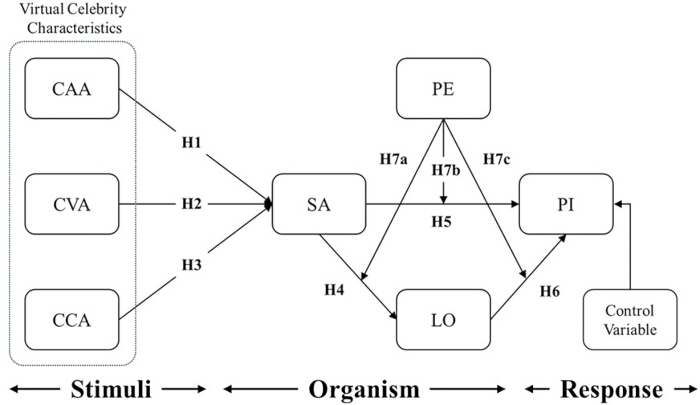
图 1: 基于刺激–机体–反应框架的研究模型。 概念模型展示了虚拟名人属性(外貌、声音和内容质量)作为刺激因素,机体变量(满意度与忠诚度)以及行为结果(购买意愿)之间的关系。个性化被建模为满意度与忠诚度关系的调节变量。图中还描绘了通过忠诚度产生的间接效应。注:CAA = 特征外貌吸引力;CVA = 特征声音吸引力;CCA = 特征内容吸引力;LO = 忠诚度;PE = 个性化;PI = 购买意愿;SA = 满意度。请点击此处查看此图的放大版本。
访问受限。请登录或开始试用以查看此内容。
方案
根据机构规定的最低风险指南,本研究符合免除全面伦理审查的条件,因其仅涉及一项匿名在线调查,且未收集任何可识别个人身份的信息。在调查开始时,会向参与者展示一份知情同意书,说明研究目的、自愿参与原则、匿名性及数据使用方式;只有签署同意书的参与者才会继续参与调查。
1. 样本量确定
最终样本量(N = 249)根据偏最小二乘结构方程模型(PLS–SEM)的统计检验力要求确定。单个内生构念的最大预测变量数为六个(三个虚拟名人特征和三个满意度的控制变量;满意度、交互项和忠诚度的控制变量)。功效分析表明,在α = 0.05、检验力为0.80的条件下,检测中等效应量(f2 = 0.15)至少需要约97个观测值。实际样本量超过该阈值,确保了对结构模型、中介效应和调节效应分析具有足够的统计检验力。
2. 受试者招募与筛选
受试者被招募 通过 采用目的性非概率抽样方法招募在线研究小组,以确保参与者具有虚拟名人的使用经验。仅限18岁及以上个体参与。研究包含筛选问题和注意力检测题项,并排除无效作答。当达到目标样本量时,数据收集结束。
3. 标准化定义与调查说明
向参与者提供虚拟名人的标准化定义,即具有稳定视觉形象、声音和重复性叙事内容的数字创建的音视频角色。要求他们根据自身实际经历进行回答。
4. 问卷工具的开发与实施
已验证的测量量表被调整用于虚拟名人情境(表1),所有构念均采用7点李克特量表进行测量(1 = 非常不同意;7 = 非常同意)。问卷包括外貌、声音、内容质量、满意度、忠诚度、个性化、购买意愿以及人口统计学信息等部分。平台控制措施防止了重复提交。
表1:测量项目及来源。 每个构念所使用的测量项目包括外貌吸引力、声音吸引力、内容质量、满意度、忠诚度、个性化和购买意愿。提供了量表改编的来源。请点击此处下载该表格。
5. 数据准备与清洗
数据以 CSV 格式导出。删除了不完整、未通过筛选及未通过注意力检查的作答记录。将清理后的数据集导入 PLS-SEM 软件进行分析。
6. 测量与结构模型评估
所有构念均设定为反射性。使用Cronbach’s α系数和组合信度(≥ 0.70)评估信度。采用平均方差提取值(AVE,≥ 0.50)评估收敛效度,采用Fornell–Larcker准则和HTMT(< 0.90)评估区分效度。
根据概念模型确定了结构路径。使用方差膨胀因子(VIF)评估多重共线性,阈值为 VIF < 5.0。通过 5,000 次重复抽样进行自助法分析,生成路径系数、t 值、p 值、95% 置信区间以及效应量(f2)。
- 中介效应分析
采用基于自抽样法的间接效应检验(5,000 个子样本,95% 置信区间)对顺序中介模型(虚拟名人特征 → 满意度 → 忠诚度 → 购买意愿)进行检验。 - 调节效应分析
通过检验交互项评估个性化程度的调节作用。采用自抽样法估计调节效应系数和效应量大小,并通过交互作用图展示条件效应。 - 预测相关性
采用盲法检验和/或样本外预测程序评估模型的预测性能。将 Q2_predict 值、RMSE 和 MAE 与线性基准模型进行比较。当 Q2_predict > 0 且 PLS 模型的误差低于基准模型时,表明模型具有预测相关性。 - 报告与验证
汇总所有信度、效度、结构模型、中介效应、调节效应及预测性能结果用于报告。将输出结果与软件生成结果进行交叉核对,以确保准确性和一致性。
7. 故障排除与改进方法
若筛选失败率较高,则需优化纳入标准和指导说明。若信度(CR < 0.70)或平均方差提取值(AVE < 0.50)低于阈值,则在保持理论一致性的前提下剔除表现不佳的指标。对于多重共线性问题(VIF 超出限定范围),应重新评估构念的设定。若中介或调节效应不显著,则需重新评估样本量或操作化定义。采用 5,000 次重复抽样(bootstrap)以确保估计结果稳定。
访问受限。请登录或开始试用以查看此内容。
结果
表2总结了最终样本(N = 249)的人口统计学特征,包括性别、年龄、教育水平以及与虚拟名人的互动频率。样本的性别分布较为均衡(女性占52.6%),主要由年轻至中年成年人组成,且教育程度相对较高。互动频率主要集中于每周至每月一次的范围,每日使用的用户较少。当将其作为控制变量纳入分析时,使用频率对因变量或核心关系均无显著影响,表明其对主要结果不具有实质性影响。
表2:样本的人口统计学特征与参与频率。 受访者特征的描述性统计,包括性别、年龄、教育水平以及自报的虚拟名人参与频率。请点击此处下载该表格。
采用 Cronbach’s α、组合信度(CR)和平均方差提取量(AVE)评估构念的信度与效度。如表3所示,所有指标均达到推荐阈值(α = 0.798–0.8...
访问受限。请登录或开始试用以查看此内容。
讨论
本研究基于SOR框架,探讨虚拟名人的特征如何影响满意度、忠诚度和购买意愿,并以个性化程度作为调节变量。研究得出三个关键发现:内容质量相较于外貌和声音,是驱动满意度的最强因素;满意度仅通过忠诚度间接影响购买意愿(即仅存在间接中介效应);个性化程度能够增强满意度与忠诚度之间的关系,但对购买意愿无直接作用。
内容质量的重要性凸显了虚拟名人吸引力概念化方式的转变。尽管以往的代言研究强调视觉真实性和表层线索,但研究结果表明,叙事连贯性、情感共鸣以及体验丰富性在塑造评价反应中起着更为核心的作用。内容质量构建了重复互动和意义积累的过程,使其成为关系结果的基础,而不仅仅是一种信息输入。
一个核心贡献在于证明了在虚拟名人情境中,满意度本身并不直接产生购买意愿。尽管先前的研究报告了满意度对购买或重复购买意愿的直接影响100,但在虚拟代言情境中的研究结果仍存在分歧82,101...
访问受限。请登录或开始试用以查看此内容。
披露
作者声明无利益冲突。
致谢
本工作得到了aSSIST大学研究经费的支持。
访问受限。请登录或开始试用以查看此内容。
材料
| 姓名 | 公司 | 目录编号 | 评论 |
|---|---|---|---|
| Qualtrics 版本:N/A | Qualtrics, LLC | N/A | 问卷编码,https://www.qualtrics.com/ |
| Prolific 版本:N/A | Prolific | N/A | 在线问卷平台服务商,https://www.prolific.com/ |
| SmartPLS 版本:4.0.1 | SmartPLS GmbH | N/A | 偏最小二乘结构方程模型(PLS-SEM)分析,https://www.smartpls.com/ |
| ChatGPT 版本:5.2 | OpenAI | N/A | 提升文本可读性与语法检查,https://www.chatgpt.com/ |
参考文献
- Erdogan, B. Z. Celebrity endorsement: A literature review. J Mark Manag. 15 (4), 291-314 (1999).
- Yu, J., Dickinger, A., So, K. K. F., Egger, R. Artificial intelligence–generated virtual influencer: Examining the effects of emotional display on user engagement. J Retail Consum Serv. 76, 103560(2024).
- Hoang, T. D., Su, Y. Virtual Celebrities and Consumers: A Blended Reality: How Virtual Celebrities are Consumed in the East and West. [Master’s Thesis]. , Copenhagen Business School. Copenhagen, Denmark. (2019).
- Yan, J., Xia, S., Jiang, A., Lin, Z. The effect of different types of virtual influencers on consumers’ emotional attachment. J Bus Res. 177, 114646(2024).
- Bowen, J. T., Chen, S. L. The relationship between customer loyalty and customer satisfaction. Int J Contem Hosp Manag. 13 (5), 213-217 (2001).
- De Brito Silva, M. J., De Oliveira Ramos Delfino, L., Alves Cerqueira, K., De Oliveira Campos, P. Avatar marketing: A study on the engagement and authenticity of virtual influencers on instagram. Soc Netw Anal Min. 12 (1), 130(2022).
- Chaihanchanchai, P., Anantachart, S., Ruangthanakorn, N. Unlocking the persuasive power of virtual influencer on brand trust and purchase intention: A parallel mediation of source credibility. J Mark Commun. 32 (3), 1-23 (2024).
- Lee, H., Shin, M., Yang, J., Chock, T. M. Virtual influencers vs. Human influencers in the context of influencer marketing: The moderating role of machine heuristic on perceived authenticity of influencers. Int J Hum Comput Interact. 41 (10), 1-18 (2024).
- Muniz, F., Stewart, K., Magalhães, L. Are they humans or are they robots? The effect of virtual influencer disclosure on brand trust. J Consum Behav. 23 (3), 1234-1250 (2024).
- Engström, J. Virtual influencers: Antecedents and typologizing. The SAGE Handbook of Social Media Marketing. , Sage. London. 276-292 (2022).
- Na, Y., Kim, Y., Lee, D. Investigating the effect of self–congruity on attitudes toward virtual influencers: Mediating the effect of emotional attachment. Int J Hum Comput Interact. 40 (18), 5534-5547 (2024).
- Stevenage, S. V., Neil, G. J., Hamlin, I. When the face fits: Recognition of celebrities from matching and mismatching faces and voices. Memory. 22 (3), 284-294 (2014).
- Suk, H., Laine, T. H. Influence of avatar facial appearance on users’ perceived embodiment and presence in immersive virtual reality. Electronics. 12 (3), 583(2023).
- Higgins, D., Zibrek, K., Cabral, J., Egan, D., Mcdonnell, R. Sympathy for the digital: Influence of synthetic voice on affinity, social presence and empathy for photorealistic virtual humans. Comput Graph. 104, 116-128 (2022).
- Anggraini, J. D., Adiwijaya, M., Herjanto, H. The moderating role of personalization on attitude–emotion–behavior (aeb) model. Indones Manag Account Res. 23 (2), 137-156 (2024).
- Hassan, N., Abdelraouf, M., El–Shihy, D. The moderating role of personalized recommendations in the trust–satisfaction–loyalty relationship: An empirical study of AI–driven e-commerce. Future Bus J. 11 (1), 66(2025).
- Gao, Y., et al. Trust in virtual agents: Exploring the role of stylization and voice. IEEE Trans Vis Comput Graph. 31 (5), 3623-3633 (2025).
- Vinoi, N., Shankar, A., Abdullah Alzeiby, E., Gupta, P., Agarwal, V. Unveiling customer intentions: Exploring factors driving engagement with hospitality virtual influencers. J Hosp Mark Manag. 34 (3), 325-354 (2025).
- Liu, C., Zhang, Y., Zhang, J. The impact of self–congruity and virtual interactivity on online celebrity brand equity and fans’ purchase intention. J Prod Brand Manag. 29 (6), 783-801 (2020).
- Honora, A., Wang, K. –Y., Chih, W. –H. Gaining customer engagement in social media recovery: The moderating roles of timeliness and personalization. Internet Res. 34 (6), 1963-1991 (2024).
- Mehrabian, A., Russell, J. A. The basic emotional impact of environments. Percept Mot Skills. 38 (1), 283-291 (1974).
- Abumalloh, R. A., Halabi, O., Nilashi, M. The relationship between technology trust and behavioral intention to use metaverse in baby monitoring systems’ design: Stimulus–organism–response (sor) theory. Entertain Comput. 52, 100833(2025).
- Ting, M. P., Min, C. D. What drives user churn in serious games? An empirical examination of the TAM, SOR theory, and game quality in Chinese cultural heritage games. Entertain Comput. 52, 100758(2025).
- Su, Y., Teo, P. C. A literature review on the impact of SOR theory on the retail industry and its applicability in studying blockchain technology's influence on consumer loyalty. Int J Acad Res Bus Soc Sci. 15 (3), 142-165 (2025).
- Li, X., Liu, Z., Chen, Y., Ren, A. Consumer avoidance toward message stream advertising on mobile social media: A stimulus–organism–response perspective. Information Technology & People. 38 (1), 23-47 (2025).
- Chang, H. H., Eckman, M., Yan, R. N. Application of the stimulus–organism–response model to the retail environment: The role of hedonic motivation in impulse buying behavior. Int Rev Retail Distrib Consum Res. 21 (3), 233-249 (2011).
- Kalam, A., Goi, C. L., Tiong, Y. Y. The effects of celebrity endorser on consumer advocacy behavior through the customization and entertainment intention–a multivariate analysis. Young Consum. 26 (1), 1-35 (2025).
- Zhou, T., Ma, X. Examining generative AI user continuance intention based on the SOR model. Aslib J Inf Manag. , (2025).
- Hussain, M., Javed, A., Khan, S. H., Yasir, M. Pillars of customer retention in the services sector: Understanding the role of relationship marketing, customer satisfaction, and customer loyalty. J Knowl Econ. 16 (1), 2047-2067 (2025).
- Akhtar, N., Siddiqi, U. I., Gugnani, R., Islam, T., Attri, R. The potency of audiovisual attractiveness and influencer marketing: The road to customer behavioral engagement. J Retail Consum Serv. 79, 103807(2024).
- Thielsch, M. T., Hirschfeld, G. Facets of website content. Hum Comput Interact. 34 (4), 279-327 (2019).
- Kim, H., Park, M. Virtual influencers’ attractiveness effect on purchase intention: A moderated mediation model of the product–endorser fit with the brand. Comput Hum Behav. 143, 107703(2023).
- The impact of VTuber endorsements on consumer satisfaction and brand loyalty in digital marketing. Hsu, K. K., Hung, W. –H. Proc Int Conf Electron Bus. (ICEB 2024), Zhuhai, China, , (2024).
- Shah, Z., Olya, H., Monkhouse, L. L. Developing strategies for international celebrity branding: A comparative analysis between Western and South Asian cultures. Int Mark Rev. 40 (1), 102-126 (2023).
- Mccracken, G. Who is the celebrity endorser? Cultural foundations of the endorsement process. J Consum Res. 16 (3), 310-321 (1989).
- Jun, M., Han, J., Zhou, Z., Eisingerich, A. B. When is celebrity endorsement effective? Exploring the role of celebrity endorsers in enhancing key brand associations. J Bus Res. 164, 113951(2023).
- Ozdemir, O., Kolfal, B., Messinger, P. R., Rizvi, S. Human or virtual: How influencer type shapes brand attitudes. Comput Hum Behav. 145, 107771(2023).
- Schouten, A. P., Janssen, L., Verspaget, M. Leveraged marketing communications. Ch. 12, 208-231 (2021).
- Khan, S., Sookhai, S. Reviewing the impact of country–of–origin on consumer purchase intention: The role of celebrity endorsement in existing literature. J Manag SMEs. 18 (2), 897-918 (2025).
- Schimmelpfennig, C., Hunt, J. B. Fifty years of celebrity endorser research: Support for a comprehensive celebrity endorsement strategy framework. Psychol Mark. 37 (3), 488-505 (2020).
- Hovland, C. I., Weiss, W. The influence of source credibility on communication effectiveness. Public Opin Q. 15 (4), 635-650 (1951).
- Frank, B., Mitsumoto, S. An extended source attractiveness model: The advertising effectiveness of distinct athlete endorser attractiveness types and its contextual variation. Eur Sport Manag Q. 23 (4), 1091-1114 (2023).
- Thomas, T., Johnson, J. The impact of celebrity expertise on advertising effectiveness: The mediating role of celebrity brand fit. Vision. 21 (4), 367-374 (2017).
- Chan, K., Fan, F. Perception of advertisements with celebrity endorsement among mature consumers. J Mark Commun. 28 (2), 115-131 (2022).
- Arora, N., Prashar, S., Tata, S. V., Parsad, C. Measuring personality congruency effects on consumer brand intentions in celebrity–endorsed brands. J Consum Mark. 38 (3), 251-261 (2021).
- Gao, Y., Liu, H. Artificial intelligence–enabled personalization in interactive marketing: A customer journey perspective. J Res Interact Mark. 17 (5), 663-680 (2023).
- Daft, R. L., Lengel, R. H. Organizational information requirements, media richness and structural design. Manage Sci. 32 (5), 554-571 (1986).
- Boyd, D. E., Koles, B. An introduction to the special issue “Virtual reality in marketing”: Definition, theory and practice. J Bus Res. 100, 441-444 (2019).
- Chen, H., Lou, C., Wang, Y., Lee, Y. Social virtual influencer effectiveness: Environmental factor and source trust. Soc Mark Q. , 15245004251342800(2025).
- Shen, Z. Shall brands create their own virtual influencers? A comprehensive study of 33 virtual influencers on instagram. Humanit Soc Sci Commun. 11 (1), 1-14 (2024).
- Lee, J., Kim, H. The moderating role of homophily and need for uniqueness in the relationship between anthropomorphism of virtual influencer and intention to imitate and word of mouth. Int J Hum Comput Interact. 41 (5), 1-12 (2025).
- Lim, R. E., Lee, S. Y. ”You are a virtual influencer!”: Understanding the impact of origin disclosure and emotional narratives on parasocial relationships and virtual influencer credibility. Comput Hum Behav. 148, 107897(2023).
- Kuo, Y. –H., Le, S. B. H. Authenticity meets aesthetics: Physical attractiveness as the equalizer for virtual and human influencers. Asia Pac Manag Rev. 30 (2), 100359(2025).
- Epley, N., Waytz, A., Cacioppo, J. T. On seeing human: A three–factor theory of anthropomorphism. Psychol Rev. 114 (4), 864(2007).
- Dabiran, E., Farivar, S., Wang, F., Grant, G. Virtually human: Anthropomorphism in virtual influencer marketing. J Retail Consum Serv. 79, 103797(2024).
- Nass, C., Steuer, J., Tauber, E. R. Proceedings of the SIGCHI Conference on Human Factors in Computing Systems. (CHI ’94). ACM. , 72-78 (1994).
- Gambino, A., Fox, J., Ratan, R. A. Building a stronger casa: Extending the computers are social actors paradigm. Hum Mach Commun. 1, 71-85 (2020).
- Gu, C., Zhang, Y., Zeng, L. Exploring the mechanism of sustained consumer trust in ai chatbots after service failures: A perspective based on attribution and casa theories. Humanit Soc Sci Commun. 11 (1), 1-12 (2024).
- Mori, M. The uncanny valley. Energy. 7 (4), 33-35 (1970).
- Alimardani, M., De Roode, R., Vaitonyte, J., Louwerse, M. M. Proceedings of the ACM International Conference on Intelligent Virtual Agents. (IVA ’24). , Glasgow, United Kingdom. 1-7 (2024).
- Miller, E. J., Foo, Y. Z., Mewton, P., Dawel, A. How do people respond to computer–generated versus human faces? A systematic review and meta–analyses. Comput Hum Behav Rep. 10, 100283(2023).
- Dion, K., Berscheid, E., Walster, E. What is beautiful is good. J Pers Soc Psychol. 24 (3), 285(1972).
- Bíziková, V., Psotová, E. Visitor profile of enological tourism in Slovakia: Implications of the regional analysis of the demand for wine–themed experience stay. J Infrastruct Policy Dev. 8 (11), 8072(2024).
- Lampropoulos, G. Combining artificial intelligence with augmented reality and virtual reality in education: Current trends and future perspectives. Multimodal Technol Interact. 9 (2), 11(2025).
- Sumi, R. S., Kabir, G. Satisfaction of e-learners with electronic learning service quality using the SERVQUAL model. J Open Innov Technol Mark Complex. 7 (4), 227(2021).
- Giese, J. L., Cote, J. A. Defining consumer satisfaction. Acad Mark Sci Rev. 1 (1), 1-22 (2000).
- Hellier, P. K., Geursen, G. M., Carr, R. A., Rickard, J. A. Customer repurchase intention: A general structural equation model. Eur J Mark. 37 (11/12), 1762-1800 (2003).
- Suchánek, P., Králová, M. Customer satisfaction and different evaluation of it by companies. Econ Res. 31 (1), 1330-1350 (2018).
- Gajewska, T., Zimon, D., Kaczor, G., Madzík, P. The impact of the level of customer satisfaction on the quality of e-commerce services. Int J Prod Perform Manag. 69 (4), 666-684 (2020).
- Hill, N., Brierley, J. How to Measure Customer Satisfaction. , Routledge. London. (2017).
- Grigoroudis, E., Siskos, Y. Customer Satisfaction Evaluation: Methods for Measuring and Implementing Service Quality. , Springer. New York. (2009).
- Söderlund, M., Julander, C. –R. Physical attractiveness of the service worker in the moment of truth and its effects on customer satisfaction. J Retail Consum Serv. 16 (3), 216-226 (2009).
- Koernig, S. K., Page, A. L. What if your dentist looked like Tom Cruise? Applying the match-up hypothesis to a service encounter. Psychol Mark. 19 (1), 91-110 (2002).
- Hey Alexa … Examining Factors Influencing the Educational Use of AI-Enabled Voice Assistants During the COVID-19 Pandemic. Rohan, R., Pal, D., Funilkul, S. in 15th International Conference on Knowledge and Smart Technology (KST), , 1-6 (2023).
- Oliver, R. L. Satisfaction: A Behavioral Perspective on the Consumer. , 2nd ed, Routledge. New York. (2014).
- Ariff, M. S. M., Yun, L. O., Zakuan, N., Ismail, K. The impacts of service quality and customer satisfaction on customer loyalty in internet banking. Procedia Soc Behav Sci. 81, 469-473 (2013).
- Nieves–Pavón, S., López–Mosquera, N., Jiménez–Naranjo, H. The factors influencing STD through SOR theory. J Retail Consum Serv. 75, 103533(2023).
- Dutta, B. Exploring the factors of consumer repurchase intention in online shopping. Int J Comput Sci Inf Secur. 14 (12), 520(2016).
- Seiders, K., Voss, G. B., Grewal, D., Godfrey, A. L. Do satisfied customers buy more? Examining moderating influences in a retailing context. J Mark. 69 (4), 26-43 (2005).
- Malik, M. E., et al. Importance of brand awareness and brand loyalty in assessing purchase intentions of consumer. Int J Bus Soc Sci. 4 (5), 167-171 (2013).
- Kim, H. –R., Yang, H. –M. The mediating effect of life satisfaction on relation between perceived physical attractiveness and health–promoting lifestyle in korean adults. Int J Environ Res Public Health. 18 (15), 7784(2021).
- Zhang, Y., He, J., Li, J. The role of flow experience in virtual influencer marketing: Insights into aesthetic, entertainment and parasocial influences on purchase intention. J Fash Mark Manag. 29 (6), 1109-1129 (2025).
- Blumer, H. Symbolic Interactionism: Perspective and Method. , University of California Press. Berkeley, CA. (1986).
- Quiring, O., Schweiger, W. Interactivity: A review of the concept and a framework for analysis. Communications - J Comm Res. 33 (2), 147-167 (2008).
- Casaca, J. A., Miguel, L. P. The influence of personalization on consumer satisfaction: Trends and challenges. Data-Driven Marketing for Strategic Success. , 256-292 (2024).
- Modersitzki, N., Phan, L. V., Mcdonald, S., Wright, A. G., Renner, K. –H. Personality psychology is getting personal: Advancing the field through personalization. Eur J Pers. 39 (1), 08902070251316915(2025).
- Manser Payne, E. H., Dahl, A. J., Peltier, J. Digital servitization value co–creation framework for ai services: A research agenda for digital transformation in financial service ecosystems. J Res Interact Mark. 15 (2), 200-222 (2021).
- Winter, S., Maslowska, E., Vos, A. L. The effects of trait–based personalization in social media advertising. Comput Hum Behav. 114, 106525(2021).
- Dijkstra, A. The psychology of tailoring-ingredients in computer-tailored persuasion. Soc Pers Psychol Compass. 2 (2), 765-784 (2008).
- Lee, J., Kim, C., Lee, K. C. Exploring the personalization–intrusiveness–intention framework to evaluate the effects of personalization in social media. Int J Inf Manag. 66, 102532(2022).
- Trivedi, J. P., Trivedi, H. Investigating the factors that make a fashion app successful: The moderating role of personalization. J Internet Commer. 17 (2), 170-187 (2018).
- Scortzaru, A. The moderating effect of personalization on the influence of consumer privacy concerns on mobile technology adoption. , Capella University. (2022).
- Henseler, J., Ringle, C. M., Sarstedt, M. A new criterion for assessing discriminant validity in variance–based structural equation modeling. J Acad Mark Sci. 43, 115-135 (2015).
- Hair, J. F., Ringle, C. M., Sarstedt, M. PLS–SEM: Indeed a silver bullet. J Mark Theory Pract. 19 (2), 139-152 (2011).
- Chin, W. W. Pls–graph user’s guide. 15, CT Bauer College of Business, University of Houston, USA. 1-16 (2001).
- Henseler, J., Hubona, G., Ray, P. A. Using PLS path modeling in new technology research: Updated guidelines. Ind Manag Data Syst. 116 (1), 2-20 (2016).
- Hair, J. F., Risher, J. J., Sarstedt, M., Ringle, C. M. When to use and how to report the results of PLS–SEM. Eur Bus Rev. 31 (1), 2-24 (2019).
- Shmueli, G., Ray, S., Estrada, J. M. V., Chatla, S. B. The elephant in the room: Predictive performance of PLS models. J Bus Res. 69 (10), 4552-4564 (2016).
- Cohen, J., Cohen, P., West, S. G., Aiken, L. S. Applied multiple regression/correlation analysis for the behavioral sciences. , Routledge. (2013).
- Sipos, D. The effects of AI–powered personalization on consumer trust, satisfaction, and purchase intent. Eur J Appl Sci Eng Technol. 3 (2), 14-24 (2025).
- Yao, Y., Meng, D., Wei, X. Empirical analysis of influencer attributes and social satisfaction effects on purchase intentions in Chinese social media. Sci Rep. 15 (1), 18860(2025).
- Rakovic, M. Comparative analysis of human and virtual influencers: The mediating role of perceived attractiveness and parasocial interaction in purchase intentions. , Tilburg University Tilburg. The Netherlands. (2023).
- Kong, H., Fang, H. Research on the effectiveness of virtual endorsers: A study based on the match-up hypothesis and source credibility model. Sustainability. 16 (5), 1761(2024).
- Huang, X., Chandra, A., Depaolo, C., Cribbs, J., Simmons, L. Measuring transactional distance in web-based learning environments: An initial instrument development. Open Learn. 30 (2), 106-126 (2015).
- Kim, C., Costello, F. J., Lee, J., Lee, K. C. Metaverse-based distance learning as a transactional distance mitigator and memory retrieval stimulant. Inf Process Manag. 62 (1), 103957(2025).
- Thielsch, M. T., Hirschfeld, G. Facets of website content. Hum Comput Interact. 34 (4), 279-327 (2019).
- Davlembayeva, D., Chari, S., Papagiannidis, S. Virtual influencers in consumer behaviour: A social influence theory perspective. Br J Manag. 36 (1), 202-222 (2025).
- Wang, Q., Long, S., Zeng, Y., Tang, L., Wang, Y. The creative behavior of virtual idol fans: A psychological perspective based on moa theory. Front Psychol. 14, 1290790(2023).
访问受限。请登录或开始试用以查看此内容。
重印与许可
