This source-verified systematic review evaluates randomized evidence on Jidesheng Snake Pills as an adjunctive therapy for snakebite. It separates incompatible response definitions, applies robust small-sample meta-analysis, and identifies the evidence needed before broader clinical use.
研究文章
Jidesheng Snake Pills as Adjunctive Therapy for Snakebite: A Systematic Review and Meta-Analysis of Randomized Controlled Trials
* These authors contributed equally
本文内容
摘要
摘要
Jidesheng Snake Pills are used in China as an adjunctive treatment for snakebite. However, the randomized evidence has not been critically synthesized with attention to endpoint definitions, intervention heterogeneity, duplicate reports, and source-data provenance. Seven Chinese and international databases were searched from inception through February 2026 and updated through 26 September 2026. Trial registries were searched during revision. Five unique randomized trials were included. Source-specific clinical-response definitions were reported separately, and a harmonized any-improvement analysis was designated post hoc. Continuous outcomes were synthesized using restricted maximum-likelihood random-effects models with modified Hartung-Knapp confidence intervals. Fixed-effect, leave-one-out, and population-restriction sensitivity analyses were also performed. Risk of bias was assessed using the Risk of Bias 2 (RoB 2) framework, and certainty was evaluated using the Grading of Recommendations Assessment, Development and Evaluation (GRADE) approach. Five trials involving 458 participants were included. Clinical-response definitions differed materially, so no primary pooled response estimate was calculated. Study-specific risk ratios ranged from 1.20 to 1.26. The post hoc harmonized estimate was 1.14 (95% confidence interval, 0.97 to 1.35; I2 = 7.9%). Swelling-resolution time was shorter on average by 1.64 days (95% confidence interval, 3.05 to 0.24 days shorter; I2 = 90.0%). However, every leave-one-out robust interval crossed the null. Hospital stay was shorter by 1.49 days (95% confidence interval, 2.38 to 0.61 days shorter; I2 = 0%). Two-study sensitivity analyses remained imprecise. C-reactive protein was summarized narratively because analytes, printed units, and assessment times were incompatible. Certainty was very low for every principal outcome. The trials suggest possible reductions in swelling-resolution time and hospital stay, but the clinical benefit remains uncertain. The evidence is small, methodologically weak, clinically heterogeneous, and indirect. Standardized interventions, patient-important outcomes, and structured safety assessment are required.
引言
Snakebite envenoming is a time-critical toxicological emergency and a World Health Organization priority neglected tropical disease1. Global estimates remain imprecise because many affected people never reach formal health services. Modeling studies nevertheless indicate hundreds of thousands to several million envenomings each year, with a disproportionate burden in resource-limited rural regions2. Mortality captures only part of this burden. Survivors may experience chronic wounds, amputations, contractures, neuropathy, renal impairment, psychological distress, unemployment, and long-term household impoverishment3. International strategy, therefore, emphasizes mortality reduction, prevention of disability, equitable access to treatment, stronger clinical systems, and context-appropriate research4.
Clinical manifestations depend on snake species, venom composition, dose, bite site, patient characteristics, and time to care. Neurotoxicity, venom-induced consumption coagulopathy, bleeding, shock, acute kidney injury, rhabdomyolysis, and local tissue destruction may occur alone or together5. Snakebite is also closely linked to poverty. Exposure is concentrated among agricultural workers and communities with limited transport, laboratory capacity, antivenom supply, and rehabilitation services6,7. These structural constraints make apparently straightforward treatment questions difficult to evaluate in routine care.
Species-appropriate antivenom remains the only specific treatment capable of neutralizing most clinically important circulating venom toxins8,9. Chinese consensus guidance similarly prioritizes early assessment, antivenom when indicated, organ support, wound surveillance, and avoidance of harmful first-aid practices10,11. Severe local injury may nevertheless progress after antivenom. This may occur when treatment is delayed, when venom has entered tissue, or when toxins have already caused microvascular and myofiber damage. Ecchymosis, bullae, necrosis, and absent Doppler flow have been associated with surgical intervention and prolonged recovery12. A safe adjunct that limits edema, inflammation, pain, or microcirculatory injury could therefore be valuable. Such treatment must not delay antivenom or definitive supportive care.
The biological basis of local injury is multifactorial. Snake venom metalloproteinases degrade basement membranes and the extracellular matrix, destabilize microvessels, and promote hemorrhage13. Phospholipase A2 myotoxins disrupt cell membranes and amplify tissue damage. Venom-triggered signaling recruits inflammatory cells, activates complement and coagulation pathways, and increases capillary permeability14. Damaged muscle releases adenosine triphosphate and potassium, which contribute to pain and propagate injury15. Inflammasome activation and interleukin-1 signaling may further intensify local pathology16. These processes begin early, and systemic antivenom may be less effective against tissue-bound toxins than circulating toxins17,18.
Antivenom also has practical limitations, including product specificity, cold-chain requirements, cost, delayed access, variable neutralizing potency, and early hypersensitivity reactions19,20. A randomized trial of green pit viper bites suggested limited effects on early local edema21. This residual burden has encouraged research into toxin inhibitors, monoclonal antibodies, local delivery systems, and anti-inflammatory adjuncts22. Plant-derived preparations are also used in many endemic settings. Some compounds show anti-inflammatory, antioxidant, phospholipase-inhibitory, or metalloproteinase-inhibitory activity. Traditional use alone does not establish clinical efficacy, and topical remedies may be harmful if they delay transport or contaminate wounds23. Adjunctive traditional medicines, therefore, require reproducible formulations, rigorous trials, patient-important outcomes, and structured safety monitoring.
Jidesheng Snake Pills are a proprietary traditional Chinese medicinal preparation used orally and, in some institutions, topically around the bite site. The product is administered with conventional treatment rather than as an antivenom substitute. A metabolomic study in a mouse model of Agkistrodon halys envenomation reported treatment-associated changes in inflammatory, oxidative-stress, and energy-metabolism pathways24. These findings provide a hypothesis-generating rationale, not clinical proof. Small Chinese trials have reported changes in swelling, pain, inflammatory markers, and hospitalization25,26,27,28,29. However, product descriptions, routes, doses, cointerventions, populations, assessment times, and response definitions differ substantially.
The organization of snakebite care in China adds another layer of complexity. Emergency departments may integrate antivenom, supportive treatment, traditional Chinese medicine, wound care procedures, and rehabilitation into a single pathway. Integration can facilitate pragmatic evaluation, but it can also complicate attribution. Antivenom timing, limb elevation, analgesia, wound review, and discharge practices may influence recovery independently of the study product. Random allocation reduces these problems only when concealment is adequate and post-randomization care is standardized.
No previous review identified by the search restricted synthesis to randomized trials of Jidesheng treatment while auditing endpoint definitions, duplicate publications, and source-data discrepancies. This review, therefore, examined whether randomized evidence supports Jidesheng Snake Pills as an adjunct to conventional snakebite care. Clinical response, swelling-resolution time, hospital stay, inflammatory and tissue-injury markers, pain-related outcomes, and available safety reporting were evaluated. Intervention reproducibility, risk of bias, certainty, analytical robustness, generalizability, and priorities for future trials were also assessed.
方案
This systematic review used aggregated data from published studies and did not enroll participants or access identifiable individual-level information. Institutional ethics approval and individual informed consent were therefore not required. The protocol was registered in PROSPERO (CRD420261322801), and reporting followed Preferred Reporting Items for Systematic Reviews and Meta-Analyses (PRISMA) 2020 guidance30.
Search strategy
CNKI, Wanfang Data, VIP, SinoMed, PubMed, Embase, and Web of Science were searched from inception through February 2026. Search concepts combined controlled vocabulary and free-text terms for snakebite or snake envenoming, Jidesheng Snake Pills or Jidesheng Sheyao, randomization, and trials. Chinese databases were searched using equivalent native-language terms for snakebite, venomous snakebite, snake injury, Jidesheng treatment, random allocation, control groups, and clinical trials. English terms included snakebite, snake bite, snake envenomation, snake envenoming, Jidesheng, Jidesheng Snake Pill, randomized, trial, and controlled. Reference lists of included studies and relevant reviews were also screened. The database-level search framework is supplied in Supplementary File 1.
The same seven bibliographic databases were updated for the period 23 February 2026 through 26 September 2026 using the same concept structure adapted to each database. The update retrieved nine records: five from Wanfang Data and four from VIP, with no records from PubMed, Embase, Web of Science, CNKI, or SinoMed. After cross-database deduplication, six unique records were screened; none was an eligible independent randomized trial. Supplementary Tables 1–7 provide, in sequence, the intervention details, outcome definitions, duplicate-report audit, risk-of-bias assessment, certainty assessment, quantitative-analysis results, and updated-search audit. Detailed screening decisions are provided in Supplementary Table 7 and Supplementary File 1.
During revision, ClinicalTrials.gov, the Chinese Clinical Trial Registry, and the World Health Organization International Clinical Trials Registry Platform were searched through 8 September 2026. English and Chinese product and snakebite terms were used. No matching eligible, completed, or ongoing public Jidesheng snakebite trial record was identified.
Eligibility criteria
Randomized controlled trials were eligible if they enrolled patients with clinically diagnosed snakebite or with inseparable mixed-bite populations. Eligible studies compared conventional therapy plus oral and/or topical Jidesheng Snake Pills with the same conventional therapy alone. At least one prespecified clinical or laboratory outcome had to be available. Conventional care could include antivenom, wound care, analgesia, fluid therapy, organ support, and other symptomatic measures. Animal experiments, nonrandomized studies, case reports, reviews, conference abstracts, dissertations, duplicate reports, and studies without usable data were excluded. Mixed or uncertain populations were retained only with explicit assessment of indirectness and population-restriction sensitivity analyses.
Clinical response, as defined by each trial, was considered, along with swelling resolution time, hospital stay, C-reactive protein, creatine kinase, liver-related biochemical indicators, pain outcomes, adverse events, and other complications. Mortality, amputation, disability, functional recovery, quality of life, antivenom dose, and health-economic outcomes were sought but were not consistently reported.
Study selection, extraction, and source verification
Two investigators independently screened titles, abstracts, and full texts. They extracted study setting, population, snake classification, sample size, intervention product, manufacturer, approval number, route, dose, topical preparation, treatment duration, comparator, antivenom information, outcome definitions, assessment times, event counts, means, standard deviations, and safety reporting. Disagreements were resolved through discussion or third-investigator adjudication. Numerical values were extracted directly from the primary reports and checked against the structured workbook. Detailed intervention and outcome mappings are provided in Supplementary Tables 1–2, and study selection is summarized in Figure 1.
Six primary reports were available for source verification. Two reports described the same 200-patient trial. The reports had the same center, allocation, baseline characteristics, regimen, and outcome counts29,31. The more complete 2019 report was retained as the primary report, and the 2018 article was treated as a companion publication. Consequently, five unique randomized trials, rather than six independent trials, were included. The duplicate-publication audit is provided in Supplementary Table 3.
The legacy RevMan file and extraction worksheet were prepared internally by Zengwen Ma and Yalan Song between March and May 2025. They were preliminary scoping and pilot-extraction files created before PROSPERO registration. They were not obtained from an external source. During revision, two investigators independently re-extracted eligible data from the six primary reports and rebuilt the analytical dataset in R. The legacy files were used only to identify and trace discrepancies and were not final numerical sources. The provenance record is provided in Supplementary File 1.
Source verification corrected two material ambiguities. Source verification showed that the intervention-group standard deviation for swelling-resolution time was 1.8 days rather than 7.8 days25. In another trial, 88/100 versus 70/100 represented the source-defined marked-response endpoint29. The counts 96/100 versus 87/100 represented a derivable any-improvement reclassification. This reclassification was used only in a clearly labeled post hoc sensitivity analysis.
Outcome definitions and data handling
Clinical response was not treated as one primary pooled construct because the trials used different category definitions. Each source-specific response effect was reported separately. A post hoc harmonized any-improvement sensitivity analysis was performed only when complete category counts permitted the same reclassification. This endpoint was not equated with survival, prevention of disability, or validated functional recovery.
Swelling-resolution time and hospital stay were analyzed in days. Final values and change scores were not mixed. When several time points were available, the assessment corresponding most closely to the trial-defined end of treatment was selected. C-reactive protein was summarized narratively because reports differed in analyte label, printed unit, and assessment time. Pain-disappearance data were not pooled because one source reported hours while the others reported days. Creatine kinase and liver-related results were retained as narrative observations. No missing variances were imputed from unrelated studies, and multi-arm adjustment was not required.
Adverse event reporting was identified as an evidence gap. The absence of reported events was not interpreted as evidence of safety when structured collection, denominators, severity, timing, causality, and withdrawals were unavailable. All conclusions were restricted to the formulations, routes, cointerventions, and Chinese clinical settings represented in the trials.
Risk of bias and certainty of evidence
Two reviewers applied the Risk of Bias 2 (RoB 2) framework at the outcome level32,33. Judgments covered the randomization process, deviations from intended interventions, missing outcome data, outcome measurement, and selection of the reported result. Unreported safeguards were not assumed to have occurred. Figure 2 summarizes the judgments. Supplementary Table 4 provides outcome-specific domain judgments and rationales, and Supplementary File 1 includes all signaling-question responses.
Certainty was assessed using the GRADE approach34,35. Randomized evidence began at high certainty and was downgraded for risk of bias, inconsistency, indirectness, imprecision, or publication bias. Clinical response, swelling-resolution time, hospital stay, and C-reactive protein were evaluated separately. The ratings express confidence in the evidence estimates and do not constitute a regulatory judgment on the product. Detailed certainty judgments are provided in Supplementary Table 5.
Statistical analysis
Analyses were performed using statistical computing software and a meta-analysis package (see Table of Materials). Risk ratios were calculated for dichotomous outcomes, and mean differences were calculated for continuous outcomes. Estimates are reported with 95% confidence intervals. Heterogeneity was quantified using tau2 and I236. Clinical compatibility and outcome definition, rather than an I2 threshold alone, determined whether pooling was appropriate.
Clinically poolable continuous outcomes and the post hoc harmonized response analysis used restricted maximum-likelihood random-effects models. Hartung-Knapp confidence intervals were applied with a modified safeguard. The larger of the conventional restricted maximum-likelihood and Hartung-Knapp standard errors was retained, with a critical value based on k-1 degrees of freedom. Fixed-effect estimates were reported only as sensitivity analyses. Leave-one-out analyses evaluated the influence. One study was excluded from the population-restriction sensitivity analyses because inseparable insect-sting and snakebite data reduced directness27. Exact estimates are provided in Supplementary Table 6. Conventional Mantel-Haenszel and DerSimonian-Laird methods were not used as primary models because the evidence base was sparse and clinically heterogeneous37,38.
Formal funnel-plot asymmetry and regression tests were not performed because fewer than ten studies contributed to every pooled outcome39,40. Publication bias was therefore classified as not assessable. Statistical significance was not treated as equivalent to clinical importance. The structured dataset and executable R workflow are provided as Supplementary Files 1 and 2.
结果
Study selection
The original search identified 144 records. After removal of duplicates, 68 records underwent title and abstract screening. Sixty records were excluded, and eight full texts were assessed. Three full texts were excluded because two were not randomized and one was a companion report of an included trial. Five unique randomized trials involving 458 participants were included (Figure 1A).
The updated bibliographic search through 26 September 2026 retrieved nine records: five from Wanfang Data and four from VIP, with none from PubMed, Embase, Web of Science, CNKI, or SinoMed. After cross-database deduplication, six unique records were screened; none represented an additional eligible independent randomized trial. The evidence base therefore remained five unique randomized trials involving 458 participants (Figure 1B; Supplementary Table 7).
Study and intervention characteristics
The trials were published from 2019 to 2023 and were conducted in China25,26,27,28,29. Sample sizes ranged from 60 to 200 participants. Four trials used oral plus topical Jidesheng Snake Tablets, whereas one used oral treatment alone. Four reports identified the same manufacturer and approval number. The approval number in Shen et al. was unclear. Oral dose, topical solvent or paste, application schedule, treatment duration, conventional care, antivenom use, and outcome timing varied. The evidence, therefore, could not isolate oral from topical effects or define one reproducible regimen.
Several trials focused on viper bites, whereas others used mixed or uncertain classifications. Li et al. enrolled patients with venomous insect stings or snakebite, without separable snakebite data27. Hu et al. included many patients with unidentified or reportedly nonvenomous exposures25. These populations limited directness and generalizability. Table 1 summarizes study characteristics, and Supplementary Tables 1–2 provide complete mappings of interventions and outcomes.
The studies did not use a uniform core outcome set. Three reported clinical responses, three reported hospital stay, and four reported swelling-resolution time. Only two or three trials contributed to individual biomarker or pain outcomes. Mortality, permanent disability, amputation, validated limb function, quality of life, antivenom dose, and economic outcomes were not consistently reported. Adverse-event reporting consisted mainly of brief statements rather than denominator-based surveillance.
Risk of bias
Every trial raised some concerns about randomization because allocation concealment was not reported. Clinical response and swelling resolution outcomes were judged to be high risk overall. Participants and assessors were not blinded, and the outcomes were investigator-defined or lacked common operational thresholds. Hospital stay and C-reactive protein were judged as having some concerns overall. Laboratory measurement reduced measurement bias for C-reactive protein, but prespecification remained unavailable. Figure 2, Supplementary Table 4, and Supplementary File 1 provide the complete outcome-level assessment.
Clinical response
Three trials reported investigator-defined clinical response, but the constructs were not equivalent. The study-specific risk ratio was 1.20 (95% confidence interval, 1.01 to 1.42) for Shen SH 2023. It was 1.24 (1.04 to 1.48) for Li BL 2022 and 1.26 (1.08 to 1.46) for the source-defined marked response in Shen L 2019. No primary pooled response estimate was calculated.
The post hoc harmonized any-improvement sensitivity analysis included three trials. The restricted maximum-likelihood modified Hartung-Knapp estimate was 1.14 (95% confidence interval, 0.97 to 1.35; tau2 = 0.0004; I2 = 7.9%). The fixed-effect sensitivity estimate was 1.14 (95% confidence interval, 1.06 to 1.22). The inference, therefore, depended on the statistical model and a post hoc reclassification of the endpoint (Figure 3; Table 2; Supplementary Table 6).
Swelling-resolution time
Four trials involving 258 participants reported swelling-resolution time25,26,27,28. Individual mean differences ranged from 0.91 to 2.80 days shorter with adjunctive treatment. The restricted maximum-likelihood modified Hartung-Knapp estimate was 1.64 days shorter (95% confidence interval, 3.05 to 0.24 days shorter; tau2 = 0.640; I2 = 90.0%). The fixed-effect sensitivity estimate was 1.59 days shorter (95% confidence interval, 1.84 to 1.34 days shorter), but this model was not preferred under substantial heterogeneity.
Every leave-one-out robust confidence interval crossed zero. Exclusion of Li et al. produced an estimate of 1.88 days shorter (95% confidence interval, 4.22 days shorter to 0.46 days longer; I2 = 91.2%). The analyses indicate an average directional effect but poor stability and an uncertain magnitude (Figure 4; Table 2; Supplementary Table 6).
Hospital stay
Three trials involving 198 participants reported hospital stay25,27,28. Individual estimates were directionally consistent and ranged from approximately 1.3 to 1.9 days shorter. The restricted maximum-likelihood modified Hartung-Knapp estimate was 1.49 days shorter (95% confidence interval, 2.38 to 0.61 days shorter; tau2 = 0; I2 = 0%). The fixed-effect sensitivity estimate was also 1.49 days shorter (95% confidence interval, 1.90 to 1.09 days shorter).
Each leave-one-out analysis included only two studies, and every robust confidence interval crossed zero. Excluding Li et al. yielded an estimate of 1.76 days shorter (95% confidence interval, 5.70 days shorter to 2.17 days longer). No trial reported standardized discharge criteria (Figure 5; Table 2; Supplementary Table 6).
Biomarkers, pain, and safety reporting
C-reactive protein was not quantitatively pooled. Shen SH 2023 reported post-treatment values of 10.42 ± 2.78 versus 17.53 ± 1.94 mg/L, but the exact day was unclear26. Shen L 2019 reported day-6 values of 3.9 ± 9.6 versus 9.6 ± 10.6 mg/L29. Hu J 2021 reported day-7 high-sensitivity C-reactive protein values of 0.7 ± 0.2 versus 1.5 ± 0.7 mg/mL, as printed25. All comparisons favored adjunctive treatment, but analyte labels, units, and assessment times prevented an interpretable raw mean-difference synthesis.
Pain-disappearance data were not pooled because one source reported hours while the others reported days. Creatine kinase and liver-related findings were retained as narrative source observations rather than pooled claims. The reports did not provide comprehensive adverse-event tables with denominators, severity, timing, causality, or withdrawals. They did not identify a clear safety signal, but the reporting was insufficient to establish safety.
Publication bias and certainty
Formal publication-bias testing was not performed because fewer than ten studies contributed to every pooled outcome. Publication bias was considered not assessable. GRADE certainty was very low for clinical response, swelling-resolution time, hospital stay, and C-reactive protein. Downgrading reflected outcome-level risk of bias, indirectness, small samples, and outcome-specific inconsistency or imprecision (Table 3; Supplementary Table 5).
DATA AVAILABILITY:
Supplementary Files 1 and 2 provide the extracted data, supporting analyses, source documentation, updated-search screening and audit record, and executable R workflow. Supplementary Tables 1–7 provide the corresponding supporting data. No individual participant data was used.
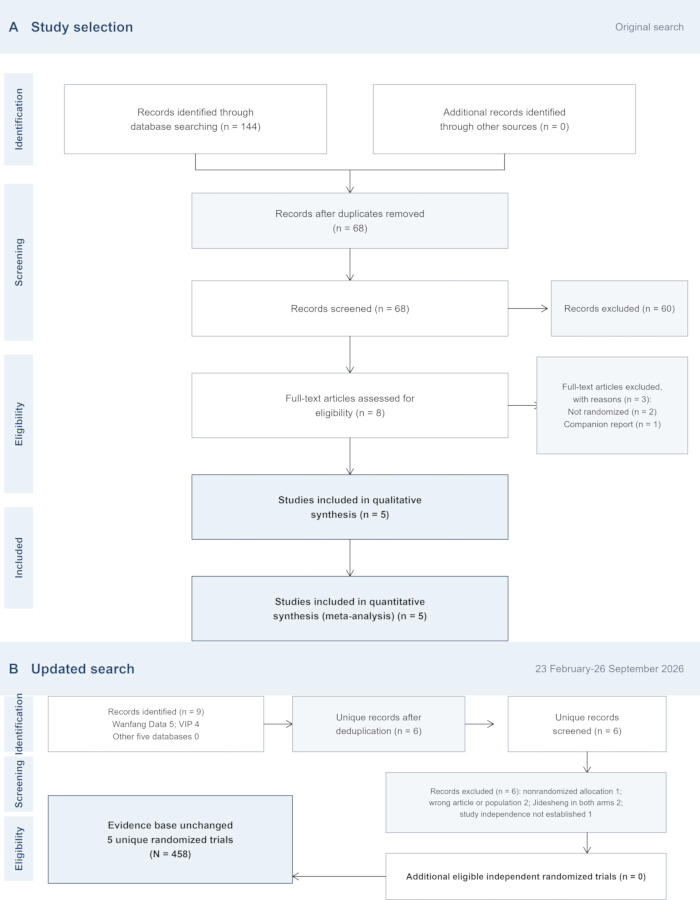
Figure 1: PRISMA flow diagram. (A) The original search identified 144 records, retained 68 after deduplication, assessed eight full texts, and included five unique randomized trials. The three original full-text exclusions were two nonrandomized studies and one companion report. (B) The updated bibliographic search from 23 February through 26 September 2026 identified nine records, retained six unique records after cross-database deduplication, and identified no additional eligible independent randomized trial. The evidence base remained five unique randomized trials involving 458 participants. Please click here to view a larger version of this figure.
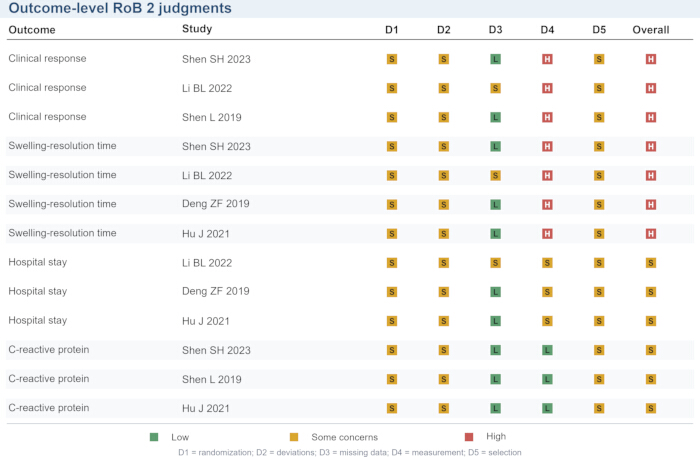
Figure 2: Outcome-level RoB 2 judgments. Green indicates low risk, amber indicates some concerns, and red indicates high risk. D1, randomization process; D2, deviations from intended interventions; D3, missing outcome data; D4, outcome measurement; D5, selection of the reported result. Please click here to view a larger version of this figure.
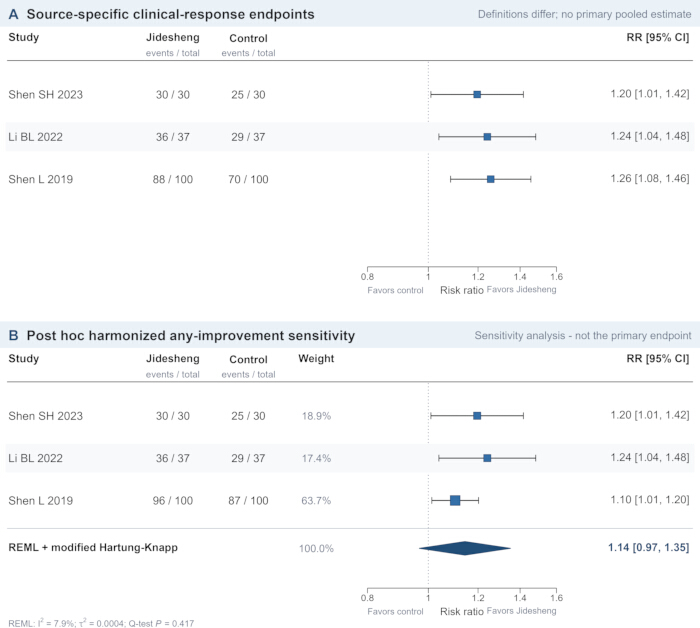
Figure 3: Clinical-response effects. (A) Source-specific response effects are shown without a pooled primary estimate because definitions differ. (B) The post hoc any-improvement sensitivity analysis uses a restricted maximum-likelihood random-effects model with modified Hartung-Knapp confidence intervals. RR, risk ratio; CI, confidence interval. Please click here to view a larger version of this figure.
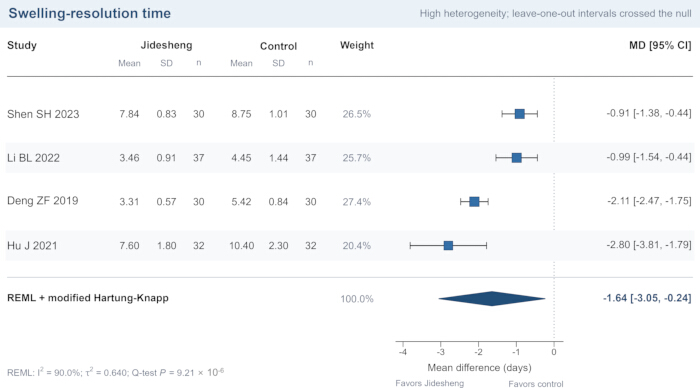
Figure 4: Swelling-resolution time. Study mean differences and the pooled restricted maximum-likelihood random-effects estimate with modified Hartung-Knapp confidence intervals are shown. Negative values favor adjunctive Jidesheng treatment. Please click here to view a larger version of this figure.
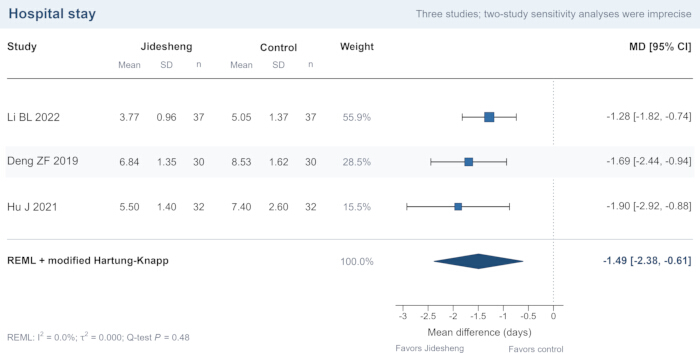
Figure 5: Hospital stay. Study mean differences and the pooled restricted maximum-likelihood random-effects estimate with modified Hartung-Knapp confidence intervals are shown. Negative values favor adjunctive Jidesheng treatment. Please click here to view a larger version of this figure.
| Study | Population/species ascertainment | n (T/C) | Randomization / concealment | Product and manufacturer | Route | Oral regimen | Topical preparation | Duration | Comparator / antivenom | Principal outcomes and timing |
| Shen SH 2023 | Clinically diagnosed viper bite; exact species confirmation unclear | 30/30 | Random-number allocation; concealment NR | Jidesheng Snake Tablets; Jinghua; Z32020048 | Oral + topical | 10 tablets q6h | 20 tablets + 20 mL saline; applied 3–4 h | Not fixed | Conventional care including anti-viper serum; therapeutic timing NR | Clinical response after treatment; swelling time; CRP after treatment, exact day unclear |
| Li BL 2022 | Venomous insect stings or snakebite; snakebite subgroup not separable | 37/37 | Random-number table; concealment NR | Jidesheng Snake Tablets 0.4 g; Jinghua; Z32020048 | Oral + topical | First 20 tablets, then 10 q6h; flexible escalation | Mixed with water and applied; quantity/frequency incompletely standardized | 7–10 d | Antivenom according to condition; timing NR | Clinical response after treatment; swelling time; hospital stay |
| Deng ZF 2019 | Clinically diagnosed viper bite | 30/30 | Random-number table; concealment NR | Jidesheng Snake Tablets; Jinghua; Z32020048 | Oral + topical | First 20 tablets, then 10 q6h | 10 tablets + saline; once daily | 7 d | Anti-viper serum 6000 U IV; exact timing NR | Swelling-disappearance time; hospital stay |
| Hu J 2021 | 17 species-identified; 47 unidentified or reportedly nonvenomous exposures | 32/32 | Random-number table; concealment NR | Jidesheng Snake Tablets 0.4 g; Jinghua; Z32020048 | Oral + topical | First 8 g, then 4 g q6h | 8 g + ~20 mL 75% ethanol; once daily | 7 d | Matching IV antivenom only if species identified; not uniform | Swelling-resolution time; hospital stay; hs-CRP day 7 |
| Shen L 2019 | Clinically diagnosed viper bite | 100/100 | Random-number table; concealment NR | Jidesheng Snake Tablets; Jinghua; approval unclear | Oral only | 10 tablets four times daily | Not used (oral-only regimen) | 6 d | Anti-viper serum 6000 U IV; exact timing NR | Marked response and CRP at day 6 |
Table 1: Characteristics of the five unique randomized trials. The table summarizes population, intervention reproducibility, comparator, and principal outcome definitions. Complete source mappings are provided in Supplementary File 1.
NOTE: NR, not reported; T, treatment group; C, control group. Full intervention details are provided in Supplementary Table 1 and exact outcome definitions in Supplementary Table 2.
| Outcome | Analysis | Model | k | Effect (95% CI) | T2 | I2 | Interpretation |
| Clinical response | Source-specific | No primary pool | 3 | Shen SH RR 1.20 (1.01-1.42); Li BL RR 1.24 (1.04-1.48); Shen L RR 1.26 (1.08-1.46) | — | — | Definitions differed |
| Any improvement | Post hoc harmonized | REML + modified Hartung-Knapp | 3 | RR 1.14 (0.97-1.35) | 4E-04 | 7.9% | CI includes 1 |
| Any improvement | Fixed-effect sensitivity | Fixed effect | 3 | RR 1.14 (1.06-1.22) | — | 0% | Sensitivity only |
| Swelling-resolution time | Primary | REML + modified Hartung-Knapp | 4 | MD -1.64 d (-3.05 to -0.24) | 0.64 | 90.0% | High heterogeneity; leave-one-out unstable |
| Swelling-resolution time | Fixed-effect sensitivity | Fixed effect | 4 | MD -1.59 d (-1.84 to -1.34) | — | 88.5% | Not preferred |
| Swelling-resolution time | Exclude Li BL 2022 | REML + modified Hartung-Knapp | 3 | MD -1.88 d (-4.22 to 0.46) | 0.762 | 91.2% | Population sensitivity; CI crosses 0 |
| Hospital stay | Primary | REML + modified Hartung-Knapp | 3 | MD -1.49 d (-2.38 to -0.61) | 0 | 0% | Discharge criteria not standardized |
| Hospital stay | Fixed-effect sensitivity | Fixed effect | 3 | MD -1.49 d (-1.90 to -1.09) | — | 0% | Sensitivity only |
| Hospital stay | Exclude Li BL 2022 | REML + modified Hartung-Knapp | 2 | MD -1.76 d (-5.70 to 2.17) | 0 | 0% | Population sensitivity; CI crosses 0 |
| CRP / hs-CRP | Narrative only | No raw-MD pooling | 3 | No pooled estimate | — | — | Analyte label, printed unit and time differed |
| Publication bias | Not assessable | No formal test | <10 per outcome | — | — | — | Funnel/asymmetry tests not performed |
Table 2: Final quantitative synthesis and sensitivity analyses. Random-effects estimates use restricted maximum likelihood with modified Hartung-Knapp confidence intervals. Fixed-effect estimates are sensitivity analyses.
NOTE: Complete leave-one-out results are provided in Supplementary Table 6. Negative mean difference (MD) values favor adjunctive Jidesheng treatment.
| Outcome | Evidence base | Main finding | Certainty | Main reasons for downgrading |
| Clinical response | 3 RCTs; 334 participants | Source-specific RRs were 1.20 (95% CI 1.01–1.42), 1.24 (1.04–1.48), and 1.26 (1.08–1.46); results were not pooled as the primary analysis. Post hoc harmonized sensitivity: RR 1.14 (0.97–1.35). | Very low | Serious risk of bias, indirectness, and imprecision; response definitions differed across studies. |
| Swelling-resolution time | 4 RCTs; 258 participants | REML + modified Hartung-Knapp: MD -1.64 days (95% CI -3.05 to -0.24); I² = 90.0%. Every leave-one-out robust CI crossed 0. | Very low | Serious risk of bias, inconsistency, indirectness, and imprecision. |
| Hospital stay | 3 RCTs; 198 participants | REML + modified Hartung-Knapp: MD -1.49 days (95% CI -2.38 to -0.61); I² = 0.0%. Every two-study sensitivity robust CI crossed 0. | Very low | Serious risk of bias, indirectness, and imprecision. |
| C-reactive protein | 3 RCTs; narrative synthesis only | Raw mean differences were not pooled because analyte labels, printed units, and assessment times differed. | Very low | Serious risk of bias, indirectness, and imprecision; quantitative synthesis was not interpretable. |
Table 3: GRADE certainty assessment. All principal outcomes were rated very low certainty. NOTE: Publication bias was not assessable because fewer than 10 studies contributed to every outcome. Detailed domain-level GRADE judgments are provided in Supplementary Table 5.
Supplementary File 1: Source-verified dataset and evidence-assessment materials. This file contains the extracted numerical data, source mappings, intervention and outcome definitions, duplicate-report audit, final R results, sensitivity analyses, RoB 2 signaling responses, GRADE assessments, legacy-file provenance, and the updated-search screening and exclusion audit.Please click here to download this file.
Supplementary File 2: Executable R workflow. This file contains the R code used for (A) the statistical analyses and (B–C) reproducibility of the meta-analysis.Please click here to download this file.
Supplementary Table 1: Detailed intervention characteristics of the five included trials. Detailed characteristics of the interventions and comparators used in the five included randomized controlled trials, including the Jidesheng Snake intervention regimen, route of administration, treatment duration, and corresponding conventional-care regimen, as reported in each study.Please click here to download this file.
NOTE: Product and regimen details are transcribed from the six uploaded primary reports; NR denotes not reported.
Supplementary Table 2: Outcome definitions and data-handling decisions for the included trials. Detailed definitions of the outcomes reported across the included trials, together with the corresponding extraction, harmonization, and data-handling decisions applied for the systematic review and quantitative synthesis.Please click here to download this file.
NOTE: The 96/87 classification for Shen L 2019 is a post hoc derivation, not the source-defined marked-response endpoint.
Supplementary Table 3: Duplicate-publication audit comparing the companion reports of the same randomized trial. Detailed comparison of the companion reports originating from the same randomized controlled trial, including overlapping study characteristics and outcome information, was used to identify the reports as duplicate publications and determine which report was retained for analysis.Please click here to download this file.
NOTE: The exact matching features support treatment of Gong XH 2018 as a companion report of the Shen L 2019 trial.
Supplementary Table 4: Outcome-level Risk of Bias 2 domain judgments and rationales. Outcome-level Risk of Bias 2 assessments for the included randomized controlled trials, including domain-specific judgments and the corresponding rationales supporting each judgment.Please click here to download this file.
NOTE: D1–D5 are the five Cochrane RoB 2 domains. Complete signaling-question responses are in Supplementary File 1.
Supplementary Table 5: GRADE certainty-of-evidence judgments and downgrading rationales. GRADE certainty-of-evidence judgments for the evaluated outcomes, including assessments of the relevant certainty domains and the specific rationales for any downgrading of the evidence.Please click here to download this file.
NOTE: GRADE certainty: high, moderate, low or very low. Domain judgments and rationale are outcome specific.
Supplementary Table 6: Exact quantitative synthesis and sensitivity analyses, including leave-one-out results. Detailed results of the quantitative syntheses and sensitivity analyses, including pooled effect estimates, measures of heterogeneity, and leave-one-out analyses used to evaluate the robustness of the findings.Please click here to download this file.
NOTE: All random-effects analyses use REML with the modified Hartung-Knapp safeguard. Fixed-effect estimates are sensitivity analyses only.
Supplementary Table 7: Updated bibliographic search audit and exclusion decisions. Database-specific yields for the update period from 23 February through 26 September 2026, the six unique records screened after deduplication, the screening decision for each record, the concise exclusion reason, and source or full-text status are reported.Please click here to download this file.
NOTE: The Wei 2026 decision concerns the inability to establish dataset independence; it is not an allegation of misconduct. The updated search did not change the five-trial, 458-participant evidence base.
讨论
This review found directional evidence that adjunctive Jidesheng treatment may shorten the time to swelling resolution and hospital stay. It did not establish a reliable clinical-response benefit. The central analytical change was separating the three source-defined response constructs from the post hoc any-improvement reclassification. Study-specific estimates favored adjunctive treatment, but the harmonized random-effects confidence interval included no effect. In contrast, the fixed-effects sensitivity interval excluded the null effect. This difference illustrates why the apparent absence of statistical heterogeneity cannot justify a fixed-effect-led conclusion across three clinically heterogeneous studies. Control-group response rates were also high, leaving limited room for additional benefit. The response results concern investigator-defined short-term categories and should not be interpreted as evidence of lower mortality, disability, amputation, or long-term tissue injury.
The pattern of shorter swelling duration is biologically plausible, but plausibility does not establish efficacy. Local envenoming involves toxin-mediated microvascular disruption, myonecrosis, edema, pain, and secondary inflammation13,14,15,16,17,18,41. A treatment that modifies inflammatory signaling, oxidative stress, vascular permeability, or tissue metabolism could theoretically influence local recovery after circulating venom has been neutralized. The mouse metabolomic study of Jidesheng treatment offers preliminary mechanistic hypotheses24. Other preclinical approaches have reduced selected aspects of local venom injury42. However, these observations cannot identify the active component, the effective dose, the pharmacokinetics, or the clinically relevant route of Jidesheng administration. Jidesheng Snake Pills contain multiple components, and oral and topical use may produce different exposure profiles. Batch consistency, product authentication, concomitant treatment, and compatibility with wound care also remain unresolved. Mechanistic evidence, therefore, supports further testing but cannot explain the clinical estimates on its own.
The swelling estimate favored adjunctive treatment, but heterogeneity was substantial, and every leave-one-out robust interval crossed zero. Snake classification, baseline severity, antivenom timing, topical preparation, treatment duration, and the threshold for 'resolution' varied. These differences can change both the biological course and the measured endpoint. The hospital-stay estimate was statistically more consistent, but discharge is influenced by local practice, bed availability, clinician expectations, and nonblinded assessment. No trial reported standardized discharge criteria. Future studies should distinguish time to medical stability, cessation of swelling progression, functional ambulation, and administrative discharge. Four trials used both oral and topical treatment, whereas one used oral treatment alone. Doses, solvents, pastes, application schedules, and durations were not uniform. The available data cannot isolate route-specific effects or define one standardized formulation-specific regimen.
The evidence is indirect for many clinical decisions. All trials were conducted in China and largely involved viper, mixed, or incompletely classified bite populations. Li et al. combined insect stings and snakebite27, and Hu et al. included uncertain or reportedly nonvenomous exposures25. Species classification matters because the natural history of local injury and the role of antivenom differ among snake groups. Future trials should use expert identification, photographs, syndromic criteria, or validated diagnostics when feasible43. Venom composition, antivenom products, conventional care, Jidesheng preparation, and cultural acceptance may differ between health systems. Extrapolation to elapid neurotoxicity, sea-snake myotoxicity, or other care settings is therefore inappropriate. None of the trials consistently evaluated mortality, disability, limb function, quality of life, return to work, or validated functional recovery. Biomarker changes cannot substitute for these patient-important outcomes, and short-term symptom categories cannot establish durable benefit.
Safety cannot be established from the available reports. Nonreporting is especially uninformative because structured adverse-event collection was absent. Oral multi-ingredient products may cause allergic, gastrointestinal, hepatic, renal, or drug-interaction effects. Topical preparations may irritate skin, introduce contamination, obscure wound progression, or interfere with wound care. Future trials should be multicenter, prospectively registered, adequately concealed, and analyzed according to an accessible statistical plan. Conventional care and antivenom indications should be standardized, and outcome assessment should be blinded when feasible. The product should be documented by manufacturer, batch, composition, dose, route, preparation, sterility, application boundaries, dressing schedule, duration, and stopping criteria. Outcomes should prioritize mortality, organ support, necrosis, surgery, amputation, validated pain and limb function, medically stable discharge, quality of life, and return to work. Active adverse-event surveillance and follow-up beyond discharge are essential. These requirements allow a culturally familiar adjunct to be evaluated as part of evidence-based care without creating a false choice between traditional treatment and antivenom.
This review has several strengths. All numerical inputs were re-extracted from the six primary reports, and companion publications were adjudicated before analysis. The review corrected the Hu et al. standard deviation and separated the two Shen et al. response definitions. It also used executable R code, robust small-sample random-effects methods, outcome-level RoB 2, conservative GRADE judgments, and transparent sensitivity analyses. The legacy RevMan and extraction files were retained only to trace discrepancies, and the source-verified dataset now provides an auditable link from each PDF to every final estimate. Important limitations remain. Only five small trials were available; allocation concealment was unreported, blinding was limited, and clinical and intervention heterogeneity were substantial. The search covered major Chinese and international databases and was updated through 26 September 2026 without identifying an additional eligible independent randomized trial. Registry searches were completed through 8 September 2026, but unpublished evidence may exist. Publication bias, subgroup effects, dose-response relationships, oral-versus-topical contributions, and interactions with antivenom timing could not be assessed reliably. These limitations justify further investigation but preclude routine or geographically broad clinical recommendations. Current randomized evidence suggests that adjunctive Jidesheng Snake Pills may reduce swelling-resolution time and hospital stay in the studied Chinese settings. Certainty is very low, and a reliable improvement in clinical response was not established after accounting for incompatible definitions and robust random-effects uncertainty. The intervention should remain adjunctive to indicated antivenom and comprehensive supportive care. Larger registered multicenter trials should use standardized products, species, and severity classification, patient-important outcomes, blinded assessment, and rigorous safety monitoring before broader clinical use is considered.
披露
The authors disclose research involvement through Grant No. 2025003, which supports a prospective randomized study of the same intervention. No financial relationship with the product manufacturer was reported. The present review used only data from published studies, and the funded study contributed no data. At the time of the final systematic-review search, the funded study had not been registered, initiated, or begun participant recruitment. OpenAI Codex was used during revision to assist with English-language editing, R code generation, consistency checks, and document formatting. The authors remain responsible for source verification, analytical decisions, interpretation, and final content.
致谢
This work was supported by the 2025 Chengdu High-tech Zone Medical Research Project (Prospective Randomized Controlled Study on the Efficacy of Jidesheng Snake Pills Wet Application in Patients with Viper Bite Syndrome of Traditional Chinese Medicine Syndrome [wind-fire toxin], Grant No. 2025003). The funded prospective study was separated from this systematic review and contributed no data to the present analyses. At the time of the final systematic review search, the trial had not been registered, initiated, or begun participant recruitment. The funder had no role in the design, conduct, analysis, interpretation, or reporting of this systematic review.
材料
| 姓名 | 公司 | 目录编号 | 评论 |
|---|---|---|---|
| CNKI; Wanfang; VIP; SinoMed | Database providers | Original search through February 2026; updated through 26 September 2026 | Chinese-language literature search |
| PubMed; Embase; Web of Science | Database providers | Original search through February 2026; updated through 26 September 2026 | International literature search |
| ClinicalTrials.gov | U.S. National Library of Medicine | Searched through 8 September 2026 | Supplementary registry search |
| Chinese Clinical Trial Registry | ChiCTR | Searched through 8 September 2026 | Supplementary registry search |
| WHO ICTRP | World Health Organization | Searched through 8 September 2026 | Supplementary registry search |
| R | R Foundation for Statistical Computing | Version 4.5.2 | Reproducible statistical analysis |
| metafor | R package | Version 5.0-1 | Meta-analysis and sensitivity analyses |
| readxl; openxlsx | R packages | Versions 1.5.0; 4.2.9 | Workbook import and export |
参考文献
- World Health Organization. Snakebite envenoming: a strategy for prevention and control. Geneva: World Health Organization; 2019.
- Kasturiratne A, et al. The global burden of snakebite: a literature analysis and modelling based on regional estimates of envenoming and deaths. PLoS Med. 2008;5(11):e218.
- Afroz A, et al. Snakebite envenoming: a systematic review and meta-analysis of global morbidity and mortality. PLoS Negl Trop Dis. 2024;18(4):e0012080.
- Williams DJ, et al. Strategy for a globally coordinated response to a priority neglected tropical disease: snakebite envenoming. PLoS Negl Trop Dis. 2019;13(2):e0007059.
- Gutiérrez JM, et al. Snakebite envenoming. Nat Rev Dis Primers. 2017;3:17063.
- Chippaux JP. Snakebite envenomation turns again into a neglected tropical disease. J Venom Anim Toxins Incl Trop Dis. 2017;23:38.
- Harrison RA, Hargreaves A, Wagstaff SC, Faragher B, Lalloo DG. Snake envenoming: a disease of poverty. PLoS Negl Trop Dis. 2009;3(12):e569.
- Seifert SA, Armitage JO, Sanchez EE. Snake envenomation. N Engl J Med. 2022;386(1):68–78.
- Warrell DA, Williams DJ. Clinical aspects of snakebite envenoming and its treatment in low-resource settings. Lancet. 2023;401(10385):1382–1398.
- He L, et al. Knowledge and practices related to snakebite prevention, China: a cross-sectional study. Bull World Health Organ. 2024;102(4):234–243.
- Li QB, et al. Chinese expert consensus on snakebite treatment. Chin J Crit Care Med.2018;38(12):1026–1034.
- Lu HY, et al. Clinical predictors of early surgical intervention in patients with venomous snakebites. Eur J Med Res. 2023;28(1):131.
- Bittenbinder MA, et al. Tissue-damaging toxins in snake venoms: mechanisms of action, pathophysiology and treatment strategies. Commun Biol. 2024;7(1):358.
- Teixeira C, Fernandes CM, Leiguez E, Chudzinski-Tavassi AM. Inflammation induced by platelet-activating viperid snake venoms: perspectives on thromboinflammation. Front Immunol. 2019;10:2082.
- Cintra-Francischinelli M, et al. Bothrops snake myotoxins induce a large efflux of ATP and potassium with spreading of cell damage and pain. Proc Natl Acad Sci U S A. 2010;107(32):14140–14145.
- Ibiapina HNS, et al. An inflammasome-related cytokine storm in experimental Bothrops atrox envenomation. Front Immunol. 2019;10:1882.
- León G, et al. Immune response towards snake venoms. Inflamm Allergy Drug Targets. 2011;10(5):381–398.
- Herrera C, et al. Muscle tissue damage induced by Bothrops asper venom: early and late pathological events identified by proteomic analysis. PLoS Negl Trop Dis. 2016;10(4):e0004599.
- de Silva HA, Ryan NM, de Silva HJ. Adverse reactions to snake antivenom, and their prevention and treatment. Br J Clin Pharmacol. 2016;81(3):446–452.
- Alangode A, Rajan K, Nair BG. Snake antivenom: challenges and alternate approaches. Biochem Pharmacol. 2020;181:114135.
- Rojnuckarin P, Suteparak S, Sibunruang S. A randomized, double-blind, placebo-controlled trial of antivenom for local effects of green pit viper bites. Trans R Soc Trop Med Hyg. 2006;100(9):879–884.
- Williams HF, et al. The urgent need to develop novel strategies for the diagnosis and treatment of snakebites. Toxins. 2019;11(6):363.
- Félix-Silva J, Silva-Junior AA, Zucolotto SM, Fernandes-Pedrosa MF. Medicinal plants for local tissue damage induced by snake venoms: traditional use and pharmacological evidence. Evid Based Complement Alternat Med. 2017;2017:5748256.
- Luo J, Guo M, Xie K, Han TL, Ai S. Metabolomic analysis of Agkistrodon halys venom poisoning mouse treatment by Jidesheng snake pill based on GC-MS. Front Pharmacol. 2024;15:1419609.
- Hu J, et al. Effects and mechanism of Jidesheng Snake Tablets on local wound inflammation and systemic inflammatory response in snakebite patients. China Pharmacy. 2021;32(17):2102–2107.
- Shen SH. Clinical observation of Jidesheng Snake Tablets combined with Western medicine for Agkistrodon halys bite. Technology and Health. 2023;2(7):125–128.
- Li BL, Luo CM. Efficacy of oral and topical Jidesheng Snake Tablets for venomous insect stings and snakebite. J Clin Ration Drug Use. 2022;15(28):90–93.
- Deng ZF. Antivenom combined with Jidesheng Snake Tablets for limb swelling caused by viper bite: analysis of 60 cases. Jilin Med J. 2019;40(1):106–107.
- Shen L, et al. Clinical study of conventional Western therapy plus Jidesheng Snake Tablets for viper bite. J Emerg Tradit Chin Med. 2019;28(5):828–832.
- Page MJ, et al. The PRISMA 2020 statement: an updated guideline for reporting systematic reviews. BMJ. 2021;372:n71.
- Gong XH, et al. Jidesheng snake medicine for 100 patients with viper bite. Shanghai Med Pharm J. 2018;39(S1):21–24.
- Higgins JPT, et al., editors. Cochrane Handbook for Systematic Reviews of Interventions. 2nd ed. Chichester (UK): John Wiley & Sons; 2019.
- Sterne JAC, et al. RoB 2: a revised tool for assessing risk of bias in randomised trials. BMJ. 2019;366:l4898.
- Guyatt GH, et al. GRADE: an emerging consensus on rating quality of evidence and strength of recommendations. BMJ. 2008;336(7650):924–926.
- Balshem H, et al. GRADE guidelines: 3. Rating the quality of evidence. J Clin Epidemiol. 2011;64(4):401–406.
- Higgins JPT, Thompson SG, Deeks JJ, Altman DG. Measuring inconsistency in meta-analyses. BMJ. 2003;327(7414):557–560.
- Mantel N, Haenszel W. Statistical aspects of the analysis of data from retrospective studies of disease. J Natl Cancer Inst. 1959;22(4):719–748.
- DerSimonian R, Laird N. Meta-analysis in clinical trials. Control Clin Trials. 1986;7(3):177–188.
- Sterne JAC, et al. Recommendations for examining and interpreting funnel plot asymmetry in meta-analyses of randomised controlled trials. BMJ. 2011;343:d4002.
- Egger M, Davey Smith G, Schneider M, Minder C. Bias in meta-analysis detected by a simple, graphical test. BMJ. 1997;315(7109):629–634.
- Gutiérrez JM, Rucavado A, Escalante T, Díaz C. Hemorrhage induced by snake venom metalloproteinases: mechanisms involved in microvessel damage. Toxicon. 2005;45(8):997–1011.
- Prado NDR, et al. Single-domain antibody efficacy in mitigating local tissue damage induced by Bothrops envenomation. Int Immunopharmacol. 2024;134:112215.
- Knudsen C, et al. Snakebite envenoming diagnosis and diagnostics. Front Immunol. 2021;12:661457.