Postoperative cognitive impairment affects up to half of older surgical patients. Perioperative prevention strategies have expanded beyond opioid-sparing analgesia to include anesthetic technique, neuromonitoring, physiological optimization, and non-pharmacological care; while the benefit is most consistent with a multi-component bundle, outcomes are measured inconsistently across strategy categories.
Übersichtsartikel
Brain-Protective Perioperative Care for Reducing Postoperative Cognitive Impairment in Older Adults: A Scoping Review
In diesem Artikel
Zusammenfassung
Zusammenfassung
Postoperative cognitive impairment (POCI) occurs in 10–50% of older adults after surgery and is associated with increased morbidity and accelerated cognitive decline. The focus of perioperative prevention has expanded from opioid-sparing analgesia to broader brain-protective perioperative care; however, evidence for individual strategies remains variable, and cognitive outcome assessment is heterogeneous. This scoping review aimed to map perioperative interventions used to prevent POCI in older surgical patients and characterize how cognitive outcomes are defined, assessed, and prioritized. The review followed Joanna Briggs Institute methodology and PRISMA-ScR reporting guidance. Seven electronic databases were searched without a date restriction. Eligible studies included adults aged 60 years or older undergoing surgery and evaluated at least one perioperative strategy with a delirium or cognitive outcome. Twenty-three studies were identified across five strategy categories: opioid-sparing and multimodal analgesia; anesthetic agents and techniques; intraoperative neuromonitoring; physiological optimization; and multicomponent non-pharmacological care and pharmacological prophylaxis. Multicomponent non-pharmacological interventions showed the most consistent signal for reducing postoperative delirium, whereas findings for individual pharmacological and technical strategies were inconsistent. Long-term cognitive outcomes were infrequently evaluated. The evidence supports a whole-pathway approach to brain-protective perioperative care while highlighting important gaps in long-term outcome assessment, standardization of cognitive testing, and direct evaluation of cognitive outcomes associated with opioid-sparing strategies.
Einleitung
In developed countries, more than 40% of surgical patients are older adults, and this proportion is expected to increase with population aging1. Cognitive morbidity is among the most common and clinically important perioperative complications in this population. A landmark international study reported measurable cognitive dysfunction in 25.8% of patients 1 week after major noncardiac surgery2, while other prospective studies demonstrated significant associations between postoperative cognitive dysfunction and morbidity and mortality3,4.
Terminology in this field has evolved considerably with the introduction of perioperative neurocognitive disorders (PND), which encompass postoperative delirium (POD), delayed neurocognitive recovery (dNCR), and postoperative neurocognitive disorder (pNCD), classified according to the timing of onset and criteria from the Diagnostic and Statistical Manual of Mental Disorders, 5th edition (DSM-5)5. This standardized nomenclature was introduced to reduce inconsistencies across observational and interventional research. Postoperative cognitive impairment (POCI) is used as an umbrella term for this spectrum of outcomes. Postoperative cognitive dysfunction (POCD) is retained when describing studies or reviews that specifically reported outcomes using that terminology, whereas the 2018 nomenclature is otherwise applied. The incidence of postoperative delirium varies according to the surgical procedure and patient population, with reported rates ranging from 10% to 50%; postoperative delirium is also associated with longer hospital stays, functional decline, and an increased risk of dementia6.
POCI is multifactorial, with proposed mechanisms including surgery-related cerebral injury, perioperative physiological insults, cholinergic deficiency, dopaminergic excess, and impaired cerebral autoregulation, particularly in older adults with reduced physiological reserve7,8. Preclinical studies have also indicated that volatile anesthetic agents may promote amyloid-beta oligomerization and neuroapoptosis, although the clinical relevance of these effects in older surgical patients remains uncertain9.
Early approaches to POCI prevention focused primarily on reducing opioid exposure. Meperidine and high-dose opioid analgesia were repeatedly associated with delirium, contributing to the adoption of opioid-sparing multimodal analgesia and enhanced recovery pathways for patients at increased risk. Multicomponent non-pharmacological interventions, particularly the Hospital Elder Life Program, were associated with more consistent reductions in delirium, with reported decreases of approximately 30–40%10,11.
As the evidence base expanded, the emphasis broadened from opioid-sparing analgesia to anesthetic, monitoring, physiological, pharmacological, and non-pharmacological strategies intended to reduce perioperative brain injury. Findings across these approaches have been heterogeneous and are examined in this review12,13,14,15,16,17,18,19,20.
This evolution represents a shift from opioid-sparing analgesia toward whole-pathway, brain-protective perioperative care. However, evidence remains limited across several intervention categories, while cognitive outcome definitions, assessment methods, and follow-up periods remain heterogeneous21,22. A comprehensive mapping of this continuum remains lacking. Accordingly, this scoping review examines perioperative strategies investigated for POCI in older surgical populations and evaluates how cognitive outcomes have been defined, measured, and prioritized. Particular attention is given to opioid-sparing and multimodal analgesia, brain-protective anesthetics, and non-pharmacological strategies, cognitive outcome assessment and timing, current evidence gaps, and priorities for future research and clinical practice.
Überprüfung und Perspektive
Scope and approach to the review
This scoping review examines the evolution of perioperative strategies intended to reduce postoperative cognitive impairment in older surgical patients, with particular attention to the transition from opioid-sparing analgesia toward broader brain-protective perioperative care. The review was conducted using the methodological framework of Arksey and O'Malley, refined by Levac, Colquhoun, and O'Brien, together with Joanna Briggs Institute guidance for scoping reviews, and was reported according to PRISMA-ScR23,24,25,26,27. The purpose was to map the range and distribution of available evidence rather than pool effect estimates or determine comparative treatment efficacy. The review question, eligibility criteria, information sources, study-selection procedures, data-charting plan, strategy taxonomy, and synthesis plan were specified in an internal a priori protocol (Supplementary File 1).
Seven electronic databases—MEDLINE (PubMed), Embase, CENTRAL, CINAHL, PsycINFO, Scopus, and Web of Science Core Collection—were searched from inception through December 25, 2025. Gray-literature sources included ClinicalTrials.gov, WHO ICTRP, and ProQuest Dissertations and Theses. Complete database-specific search strategies, retrieval counts, search concept blocks, and details of forward citation tracking are provided in Supplementary File 2. Reference lists of the included studies were also examined, and forward citation tracking was performed for seven publications identified a priori as central to the topic. These supplementary searches identified no additional records beyond those retrieved through the database searches.
Data were charted using predefined fields covering study design, population characteristics, perioperative intervention, strategy domain, cognitive outcome, assessment instrument, assessment timepoint, endpoint role, effect direction, and adverse events. The complete data-charting form, coding instructions, version log, seven-domain strategy taxonomy, and mapping to the five reporting categories are provided in Supplementary File 3.
After deduplication, 614 unique records were screened, 199 reports underwent full-text review, and 23 reports were retained in the evidence map (Figure 1). The identified interventions were organized for reporting into five clinically relevant categories: opioid-sparing and multimodal analgesia; anesthetic agents and techniques; neuromonitoring and depth-of-anesthesia guidance; physiological optimization; and multicomponent non-pharmacological care. The relationship between these five reporting categories and the seven a priori strategy-taxonomy domains is presented in Table 1. Characteristics of the included studies according to these categories are summarized in Table 2. This framework provides a means of examining how the field has expanded from individual analgesic interventions toward a broader concept of perioperative brain protection. Critical appraisal was not undertaken for this scoping review, as indicated in the checklist and the manuscript limitations.
Evolution from opioid-sparing analgesia to brain-protective perioperative care
Early approaches to reducing postoperative cognitive complications focused heavily on limiting exposure to potentially deliriogenic medications, particularly opioids. Meperidine and high-dose opioid regimens were repeatedly associated with delirium risk, contributing to the adoption of multimodal and opioid-sparing analgesic approaches7. However, postoperative cognitive impairment is multifactorial. Age-related reductions in physiological reserve, cerebral hypoperfusion, inflammation, altered neurotransmission, anesthetic exposure, pain, sleep disturbance, immobility, dehydration, and sensory impairment may all contribute to perioperative cognitive vulnerability6,7,8,9.
Consequently, the concept of prevention has expanded beyond analgesic choice. Current brain-protective perioperative care encompasses anesthetic selection, regional anesthesia, pharmacological adjuncts, electroencephalography-based anesthetic guidance, cerebral oxygenation monitoring, hemodynamic optimization, and multicomponent postoperative interventions. This transition is important because the available literature does not indicate that postoperative cognitive outcomes are determined by opioid exposure alone. Instead, the evidence mapped in this review suggests that cognitive outcomes arise within a broader perioperative environment in which several modifiable and non-modifiable factors interact.
The importance of extending brain-protective care beyond the immediate postoperative period is also supported by evidence of persistent cognitive consequences after surgery. Longitudinal assessment after coronary artery bypass surgery demonstrated postoperative changes in neurocognitive function28, while postoperative delirium has been associated with subsequent cognitive and functional decline29. These findings reinforce the need to consider both acute delirium and longer-term cognitive outcomes when evaluating perioperative interventions.
Opioid-sparing and multimodal analgesia
Opioid-sparing strategies identified in the literature include regional and fascial-plane blocks, non-opioid intravenous agents, gabapentinoids, and structured multimodal postoperative analgesic regimens. These approaches have an established rationale for reducing opioid consumption and improving pain management, but their direct relationship with postoperative cognitive outcomes is substantially less clear7,30.
Several small studies reported reductions in opioid consumption alongside favorable cognitive findings, including reduced delayed neurocognitive recovery. However, cognitive outcomes were frequently secondary or exploratory, and the studies were generally not designed or powered primarily to demonstrate neurocognitive benefit. Consequently, reduced opioid exposure cannot automatically be interpreted as evidence of cognitive protection.
This distinction represents an important evidence gap. Opioid-sparing analgesia may contribute to a brain-protective pathway, but adequate analgesia itself remains important because poorly controlled pain can also contribute to delirium and functional decline. Potential adverse effects of individual opioid-sparing agents must also be considered; for example, gabapentinoids may cause sedation, dizziness, and falls in older adults. Future studies, therefore, need to evaluate analgesic quality, opioid exposure, adverse effects, delirium, and longer-term cognitive outcomes together rather than assuming that opioid reduction is itself a surrogate for neuroprotection.
Anesthetic agents, techniques, and pharmacological adjuncts
Considerable research has examined whether anesthetic selection independently influences postoperative cognition. Comparisons of propofol-based total intravenous anesthesia with volatile anesthesia have not produced a consistent cognitive advantage across surgical populations12,31. Similarly, evidence comparing regional and general anesthesia has challenged the assumption that avoiding general anesthesia necessarily reduces postoperative delirium.
The REGAIN trial compared spinal and general anesthesia in approximately 1,600 older adults undergoing hip fracture surgery and found no meaningful difference in postoperative delirium15. The RAGA trial similarly found no significant difference in delirium between regional anesthesia without sedation and general anesthesia in older patients undergoing hip fracture surgery16. Together, these findings suggest that anesthetic technique alone may not determine cognitive outcome and that other components of perioperative management, including sedation, physiological stability, analgesia, and postoperative care, require consideration.
Pharmacological adjuncts show similarly heterogeneous findings. Dexmedetomidine has been associated with lower postoperative delirium incidence in some non-cardiac surgical populations17, whereas ketamine did not reduce delirium in the multicenter PODCAST trial18. Evidence concerning dexmedetomidine in cardiac surgery is less consistent, and potential adverse effects such as hypotension and bradycardia remain clinically relevant32,33,34. The literature mapped in this review also does not provide consistent support for prophylactic antipsychotics, cholinesterase inhibitors, or corticosteroids as broadly applicable strategies for preventing postoperative cognitive impairment22,35.
These findings reinforce the distinction between an intervention having a plausible neuroprotective mechanism and demonstrating reproducible clinical cognitive benefit.
Neuromonitoring and depth-of-anesthesia guidance
Processed electroencephalography has been proposed as a method of limiting excessive anesthetic exposure and burst suppression in neurologically vulnerable older patients. The biological rationale includes the possibility that excessive anesthetic depth may contribute to neuroinflammatory or other neurological changes associated with postoperative cognitive dysfunction9,36.
Clinical evidence, however, remains inconsistent. Earlier work using bispectral index titration and auditory evoked potential monitoring reported reductions in postoperative delirium and cognitive decline13. In contrast, the ENGAGES randomized clinical trial, involving 1,232 adults aged over 60 years undergoing major surgery, did not demonstrate a significant reduction in postoperative delirium with EEG-guided anesthetic administration14.
These contrasting findings illustrate an important feature of the evidence base: a monitoring technology should not necessarily be considered independently from the clinical responses it prompts. EEG guidance may influence anesthetic dosing, but cognitive outcomes may simultaneously be affected by hypotension, medication combinations, baseline vulnerability, surgical stress, pain, and postoperative management. Cerebral oximetry has likewise been investigated, particularly during cardiac surgery, but findings have been variable37. Thus, current evidence supports continued investigation of neuromonitoring as one component of a broader brain-protective pathway rather than as an independently established neuroprotective intervention.
Physiological optimization
Physiological optimization represents another important component of brain-protective perioperative care. Studies have examined blood pressure, cerebral perfusion, glucose control, temperature, oxygenation, and ventilation as potentially modifiable determinants of postoperative cognitive outcomes. Proposed mechanisms of postoperative cognitive dysfunction include interactions among surgical stress, inflammation, physiological disturbance, and patient vulnerability38.
Observational evidence has linked intraoperative hypotension with postoperative delirium, consistent with the proposed mechanism of transient cerebral hypoperfusion in vulnerable older patients8. Nevertheless, mechanistic plausibility is stronger than the direct interventional evidence. Few trials have specifically tested whether targeting particular hemodynamic thresholds reduces postoperative delirium or longer-term neurocognitive disorders, and the available studies use heterogeneous targets and designs.
This discrepancy between biological rationale and interventional evidence is a prominent gap in the literature. Future studies should prospectively define physiological targets and evaluate standardized cognitive outcomes, rather than relying predominantly on associations between physiological abnormalities and subsequent delirium.
Multicomponent non-pharmacological care
Multicomponent non-pharmacological interventions represent a distinct approach because they address multiple modifiable precipitants of delirium simultaneously. Programs modeled on the Hospital Elder Life Program combine interventions such as orientation and reorientation, early mobilization, sleep promotion, restoration of visual and hearing aids, hydration, and structured pain management10,35.
Among the strategies mapped in this review, these interventions produced the most consistent signal for reducing postoperative delirium, although results were not uniform across settings. Two of the four multicomponent trials identified in the included evidence did not reproduce the magnitude of delirium reduction reported in earlier HELP-related literature39,40. Consequently, these interventions should not be described as producing a universal or fixed reduction in the risk of delirium.
Their apparent advantage may arise from simultaneously addressing several precipitating factors rather than acting through a single neuroprotective mechanism41. This interpretation also fits the broader transition toward whole-pathway brain-protective care. Importantly, the evidence should not be extrapolated from delirium prevention to long-term cognitive preservation. None of the four multicomponent trials identified in this review focused primarily on delayed neurocognitive recovery or postoperative neurocognitive disorder at 3–12 months. Therefore, the available evidence supports a more consistent signal for acute delirium prevention than for preservation of longer-term cognitive function.
Cognitive outcome measurement and follow-up
Interpretation of this literature is complicated by substantial variation in outcome definitions, assessment instruments, and follow-up periods (Table 3). Postoperative delirium was the most frequently assessed outcome and was commonly measured using the Confusion Assessment Method or related instruments. The Delirium Rating Scale-Revised-98 was also used, whereas longer-term cognitive outcomes were assessed using instruments ranging from the Mini-Mental State Examination to formal neuropsychological batteries. These instruments should not be treated as interchangeable. Brief cognitive screening tools assess different constructs from multidomain neuropsychological batteries, and inconsistent measurement contributes directly to difficulty comparing studies5,42.
Among the 23 included reports, 20 (87%) designated a delirium or cognitive measure as a primary endpoint, two (9%) as a secondary endpoint, and one (4%) as a co-primary endpoint. Longer-term assessment was considerably less represented than acute postoperative delirium. Four reports—Rasmussen, the haloperidol-prophylaxis trial, the DECS cognition sub-study, and the geriatric-consultation trial—reported follow-up time points only after 30 days20,43,44,45.
This distribution demonstrates that evidence density is greatest for acute postoperative delirium and becomes progressively more limited for delayed neurocognitive recovery and postoperative neurocognitive disorder. Standardized cognitive assessment and longer follow-up therefore remain central methodological priorities.
Evidence gaps and interpretation
The distribution of included studies across strategy categories and cognitive outcome windows is summarized in Table 4 and visualized in the strategy-by-outcome evidence gap matrix (Figure 2). First, acute postoperative delirium is considerably better represented than neurocognitive outcomes at 3–12 months. Second, opioid-sparing research frequently focuses on analgesia and opioid consumption without directly establishing whether those changes translate into cognitive benefit. Third, physiological optimization has a substantial gap between mechanistic and observational evidence and prospective interventional evidence. Fourth, heterogeneity in cognitive assessment tools and timing limits meaningful comparison across studies. Fifth, older adults with pre-existing cognitive impairment or dementia are underrepresented despite being among those at greatest risk of perioperative cognitive complications46,47.
The evidence-gap matrix should therefore be interpreted as a representation of where evidence exists, not as a hierarchy of treatment effectiveness. A densely populated strategy-outcome cell does not necessarily indicate greater efficacy or higher-quality evidence. Similarly, an intervention with biologically plausible mechanisms should not be regarded as clinically effective solely because mechanistic evidence is strong.
Applicability, implementation, and potential harms
The applicability of the available evidence to the most vulnerable surgical populations remains uncertain. Many trials excluded patients with pre-existing cognitive impairment or dementia6,46,47. These patients may have both greater baseline susceptibility to postoperative cognitive complications and different requirements for interventions involving orientation, pain assessment, sleep management, mobilization, or caregiver participation.
Implementation also matters. Multicomponent bundles require staffing, delirium screening, mobilization resources, sensory aids, family or caregiver engagement, and sustained postoperative monitoring. The included literature did not provide sufficiently consistent cost or staffing data to determine the feasibility of implementing these programs across different healthcare settings.
Potential harms also require consideration. Dexmedetomidine may cause hypotension and bradycardia, particularly at higher doses34. Gabapentinoids may contribute to sedation, dizziness, and falls, while excessively restrictive opioid-sparing strategies may result in undertreated pain. Because adverse events were not systematically charted across all strategy categories in this scoping review, the present evidence map should not be interpreted as a comparative safety assessment.
Perspectives and future directions
Taken together, the literature suggests that perioperative brain protection is better conceptualized as a pathway of care than as a single pharmacological or technical intervention. No individual drug, anesthetic technique, or monitoring device demonstrated a consistently reproducible cognitive benefit across the evidence mapped in this review. Multicomponent non-pharmacological care showed the most consistent signal for reducing acute postoperative delirium, but even this evidence varied across settings and does not establish protection against longer-term neurocognitive decline. The underrepresentation of older adults with baseline cognitive impairment remains particularly important because cognitive vulnerability may influence both postoperative risk and responsiveness to preventive strategies46,47.
Future research should directly evaluate cognitive outcomes when investigating individual components of brain-protective perioperative care. Gabapentin has been investigated as a potential strategy for reducing postoperative delirium in older surgical patients48, while comparisons of propofol-based total intravenous anesthesia and volatile anesthesia have examined postoperative delirium after cardiac surgery49. Additional randomized studies have evaluated dexmedetomidine compared with morphine-based therapy50, rivastigmine51, haloperidol prophylaxis52, intraoperative dexamethasone53, and dexmedetomidine54. Intravenous acetaminophen administered with propofol or dexmedetomidine has also been evaluated for postoperative delirium after cardiac surgery55. Beyond pharmacological approaches, prospective randomized evidence has examined whether targeting a higher intraoperative mean arterial blood pressure reduces postoperative delirium56. Collectively, these studies illustrate the diversity of interventions under investigation and support continued evaluation of cognitive outcomes across pharmacological, anesthetic, analgesic, and physiological strategies.
Three priorities emerge for future research. First, trials designed to evaluate brain-protective interventions should prospectively specify delirium or cognitive outcomes as primary endpoints where appropriate, particularly when investigating opioid-sparing and physiological strategies. Second, follow-up should extend beyond the immediate postoperative period to assess delayed neurocognitive recovery and postoperative neurocognitive disorder at 3–12 months. Third, future studies should adopt more standardized cognitive assessment instruments and time points and intentionally include older adults with baseline cognitive impairment.
Future research would also benefit from evaluating integrated perioperative pathways rather than isolated interventions. Such studies could examine whether combinations of appropriate analgesia, avoidance of excessive anesthetic exposure, physiological stability, delirium prevention, early mobilization, sleep preservation, hydration, sensory support, and structured postoperative monitoring provide more reproducible cognitive benefit than individual interventions studied in isolation.
Schlussfolgerungen
Perioperative measures to prevent POCI have shifted from opioid-sparing analgesia to a more holistic approach to brain-protective care in the perioperative period in older adults. The strongest signal in the evidence mapped in this review was for multicomponent non-pharmacological bundles to reduce postoperative delirium, with mixed results for individual pharmacological and technical strategies, and no consistent signal for delayed neurocognitive recovery or longer-term postoperative neurocognitive disorder. The most obvious future research priorities are harmonizing cognitive outcome measures, extending follow-up duration, and including older adults with baseline cognitive impairments.
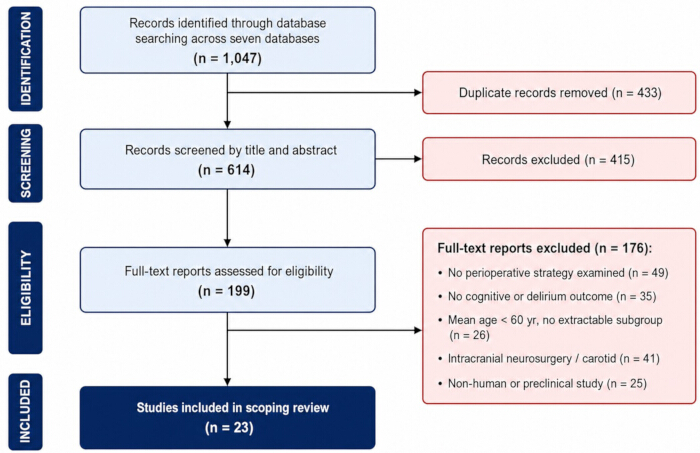
Figure 1: PRISMA-ScR flow diagram of the study selection process. The seven electronic database searches identified 1,047 records. After removal of 433 duplicate records, 614 unique records underwent title and abstract screening, of which 415 were excluded. The full texts of 199 reports were assessed for eligibility, and 176 reports were excluded for the reasons shown in the diagram, resulting in 23 included studies. Forward citation tracking and reference-list hand-searching identified no additional records beyond those retrieved through the database searches and are therefore not shown as separate identification pathways. Abbreviations: PRISMA-ScR = Preferred Reporting Items for Systematic Reviews and Meta-Analyses extension for Scoping Reviews. Please click here to view a larger version of this figure.
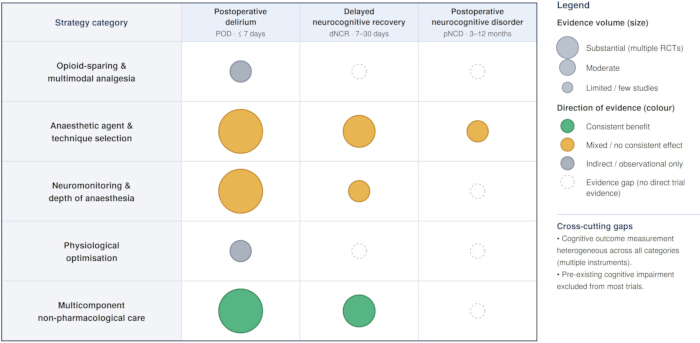
Figure 2: Strategy-by-outcome evidence gap matrix. Each row represents a perioperative strategy category used in this review, and each column represents a cognitive outcome according to the postoperative assessment period: postoperative delirium (POD; ≤7 days), delayed neurocognitive recovery (dNCR; 7–30 days), and postoperative neurocognitive disorder (pNCD; 3–12 months). Bubble size represents the number of included studies for each strategy-outcome combination; the corresponding study counts are provided in Table 4. Bubble color represents the direction and consistency of the reported findings rather than evidence quality or treatment effectiveness: green = consistent positive direction; amber = mixed or no consistent direction; gray = indirect or observational evidence only. An open dashed ring indicates that no interventional evidence was identified for the corresponding strategy-outcome combination. The side panel indicates two limitations that apply across the matrix: heterogeneity in cognitive outcome measurement and the exclusion of patients with pre-existing cognitive impairment from most trials. Abbreviations: dNCR = delayed neurocognitive recovery; pNCD = postoperative neurocognitive disorder; POD = postoperative delirium; RCT = randomized controlled trial. Please click here to view a larger version of this figure.
| Category (A-E) | Category name | Corresponding domain(s) | Domain name |
| A | Opioid-sparing and multimodal analgesia | 5 | Postoperative analgesia |
| B | Anesthetic agent and technique selection | 2, 3, 7 | Intraoperative pharmacological; intraoperative anesthetic technique; postoperative pharmacological prophylaxis |
| C | Neuromonitoring and depth-of-anesthesia guidance | 4 (part) | Intraoperative neuromonitoring and physiological management (neuromonitoring component) |
| D | Physiological optimization | 4 (part) | Intraoperative neuromonitoring and physiological management (hemodynamic/glycemic/temperature component) |
| E | Multicomponent non-pharmacological care | 6 | Postoperative multicomponent non-pharmacological care |
| - | (Not separately reported as a category) | 1 | Preoperative optimization - no included study addressed this domain as a primary intervention |
Table 1: Mapping of the five reporting categories to the seven a priori strategy-taxonomy domains. The five strategy categories (A–E) used in the Review and Perspectives section, tables, and Figure 2 are mapped to the seven a priori strategy-taxonomy domains. Domain 4 is divided between category C (neuromonitoring and depth-of-anesthesia guidance) and category D (physiological optimization). Domain 1, preoperative optimization, is not represented as a separate reporting category because no included study evaluated this domain as the primary intervention.
Table 2: Characteristics of the included studies. The included studies are organized according to the five strategy categories shown in Figure 2 and Table 3. For each study, the table presents study design, patient population and setting, country, age, surgery type, perioperative strategy, and comparator, strategy category, and key findings. Eligibility status according to the review criterion of a mean or median age ≥60 years is indicated for each study using the symbols defined in the table notes. Abbreviations are defined in the accompanying table notes. Please click here to download this file.
Table 3: Cognitive outcome measures in the included studies. Studies are organized according to the same strategy categories used in Table 2. The table presents the perioperative neurocognitive disorder entity assessed, delirium and/or cognitive assessment instrument, postoperative assessment timepoint or timepoints, and classification of the cognitive outcome as a primary, secondary, or co-primary endpoint. Abbreviations are defined in the accompanying table notes. Please click here to download this file.
Table 4: Number of included studies by strategy category and cognitive outcome window. Assessment timepoints reported in Table 3 are consolidated across the five strategy categories according to postoperative outcome windows: postoperative delirium (POD; ≤7 days), delayed neurocognitive recovery (dNCR; 7–30 days), and postoperative neurocognitive disorder (pNCD; 3–12 months). The counts correspond to the bubble sizes shown in Figure 2. Studies reporting outcomes at more than one applicable time point are counted in each corresponding column. Abbreviations: dNCR = delayed neurocognitive recovery; pNCD = postoperative neurocognitive disorder; POD = postoperative delirium. Please click here to download this file.
Supplementary File 1: Review protocol. The internal a priori review protocol describes the review question and objectives; eligibility criteria by population, concept, and context; information sources; search strategy; study-selection process; data-charting plan; seven-domain perioperative strategy taxonomy; data-synthesis plan; and protocol registration status. The protocol was not publicly registered. Please click here to download this file.
Supplementary File 2: Search and retrieval methods and records. Complete database-specific search strategies for the seven electronic databases and gray-literature sources, search dates, numbers of records retrieved from each source, search concept blocks, and landmark publications used for forward citation tracking are provided. Database searches were completed on December 25, 2025. Gray-literature searching, reference-list checking, and forward citation tracking identified no additional records beyond those retrieved through the database searches. Please click here to download this file.
Supplementary File 3: Data-charting form and strategy taxonomy. The data-charting form presents the predefined charting fields, response options, reviewer coding instructions, version log, seven-domain perioperative strategy taxonomy, and mapping of the five reporting categories to the seven a priori taxonomy domains. Please click here to download this file.
Offenlegungen
The authors declare that they have no competing interests.
Danksagungen
The authors extend their appreciation to the researchers supported by General Medical Research Fund, with project number: TYYLKYJJ-2022-010, for financial support.
Referenzen
- Kehlet H, Dahl JB. Anaesthesia, surgery, and challenges in postoperative recovery. Lancet. 2003;362(9399):1921-1928.
- Moller JT et al. Long-term postoperative cognitive dysfunction in the elderly: ISPOCD1 study. Lancet. 1998;351(9106):857-861.
- Monk TG et al. Predictors of cognitive dysfunction after major noncardiac surgery. Anesthesiology. 2008;108(1):18-30.
- Steinmetz J et al. Long-term consequences of postoperative cognitive dysfunction. Anesthesiology. 2009;110(3):548-555.
- Evered L et al. Recommendations for the nomenclature of cognitive change associated with anaesthesia and surgery—2018. Journal of Alzheimer’s Disease. 2018;66(1):1-10.
- Inouye SK, Westendorp RGJ, Saczynski JS. Delirium in elderly people. Lancet. 2014;383(9920):911-922.
- Inouye SK. Delirium in older persons. New England Journal of Medicine. 2006;354(11):1157-1165.
- Deiner S, Silverstein J. Postoperative delirium and cognitive dysfunction. British Journal of Anaesthesia. 2009;103(Suppl 1):i41-i46.
- Eckenhoff RG et al. Inhaled anesthetic enhancement of amyloid-β oligomerization and cytotoxicity. Anesthesiology. 2004;101(3):703-709.
- Inouye SK et al. A multicomponent intervention to prevent delirium in hospitalized older patients. New England Journal of Medicine. 1999;340(9):669-676.
- Inouye SK et al. Postoperative delirium in older adults: best practice statement from the American Geriatrics Society. Journal of the American College of Surgeons. 2015;220(2):136-148.
- Miller D et al. Intravenous versus inhalational maintenance of anaesthesia for postoperative cognitive outcomes in elderly people undergoing non-cardiac surgery. Cochrane Database of Systematic Reviews. 2018;(8).
- Chan MTV et al. BIS-guided anesthesia decreases postoperative delirium and cognitive decline. Journal of Neurosurgical Anesthesiology. 2013;25(1):33-42.
- Wildes TS et al. Effect of electroencephalography-guided anesthetic administration on postoperative delirium among older adults undergoing major surgery: the ENGAGES randomized clinical trial. JAMA. 2019;321(5):473-483.
- Neuman MD et al. Spinal anesthesia or general anesthesia for hip surgery in older adults. New England Journal of Medicine. 2021;385(22):2025-2035.
- Li T et al. Effect of regional vs general anesthesia on incidence of postoperative delirium in older patients undergoing hip fracture surgery: the RAGA randomized trial. JAMA. 2022;327(1):50-58.
- Su X et al. Dexmedetomidine for prevention of delirium in elderly patients after non-cardiac surgery: a randomised, double-blind, placebo-controlled trial. Lancet. 2016;388(10054):1893-1902.
- Avidan MS et al. Intraoperative ketamine for prevention of postoperative delirium or pain after major surgery in older adults: an international, multicentre, double-blind, randomised clinical trial. Lancet. 2017;390(10091):267-275.
- Zeng K, Long J, Li Y, Hu J. Preventing postoperative cognitive dysfunction using anesthetic drugs in elderly patients undergoing noncardiac surgery: a systematic review and meta-analysis. International Journal of Surgery. 2023;109(1):21-31.
- Rasmussen LS et al. Does anaesthesia cause postoperative cognitive dysfunction? A randomised study of regional versus general anaesthesia in 438 elderly patients. Acta Anaesthesiologica Scandinavica. 2003;47(3):260-266.
- Deiner S et al. Adherence to recommended practices for perioperative anesthesia care for older adults among US anesthesiologists: results from the ASA Committee on Geriatric Anesthesia-Perioperative Brain Health Initiative ASA member survey. Perioperative Medicine. 2020;9(1):6.
- Aldecoa C et al. Update of the European Society of Anaesthesiology and Intensive Care Medicine evidence-based and consensus-based guideline on postoperative delirium in adult patients. European Journal of Anaesthesiology. 2024;41(2):81-108.
- Arksey H, O’Malley L. Scoping studies: towards a methodological framework. International Journal of Social Research Methodology. 2005;8(1):19-32.
- Levac D, Colquhoun H, O’Brien KK. Scoping studies: advancing the methodology. Implementation Science. 2010;5(1):69.
- Peters MDJ et al. Scoping reviews. JBI Manual for Evidence Synthesis. 2020.
- Tricco AC et al. PRISMA extension for scoping reviews (PRISMA-ScR): checklist and explanation. Annals of Internal Medicine. 2018;169(7):467-473.
- Munn Z et al. Systematic review or scoping review? Guidance for authors when choosing between a systematic review or scoping review approach. BMC Medical Research Methodology. 2018;18(1):143.
- Newman MF et al. Longitudinal assessment of neurocognitive function after coronary-artery bypass surgery. New England Journal of Medicine. 2001;344(6):395-402.
- Bickel H, Gradinger R, Kochs E, Förstl H. High risk of cognitive and functional decline after postoperative delirium: a three-year prospective study. Dementia and Geriatric Cognitive Disorders. 2008;26(1):26-31.
- Siddiqi N et al. Interventions for preventing delirium in hospitalised non-ICU patients. Cochrane Database of Systematic Reviews. 2016;(3).
- Evered L, Scott DA, Silbert B, Maruff P. Postoperative cognitive dysfunction is independent of type of surgery and anesthetic. Anesthesia & Analgesia. 2011;112(5):1179-1185.
- Maldonado JR et al. Dexmedetomidine and the reduction of postoperative delirium after cardiac surgery. Psychosomatics. 2009;50(3):206-217.
- Djaiani G et al. Dexmedetomidine versus propofol sedation reduces delirium after cardiac surgery. Anesthesiology. 2016;124(2):362-368.
- Zhuang X et al. The effect of perioperative dexmedetomidine on postoperative delirium in adult patients undergoing cardiac surgery with cardiopulmonary bypass: a systematic review and meta-analysis of randomized controlled trials. BMC Anesthesiology. 2024;24(1):332.
- Oh ES, Fong TG, Hshieh TT, Inouye SK. Delirium in older persons: advances in diagnosis and treatment. JAMA. 2017;318(12):1161-1174.
- Cerejeira J, Firmino H, Vaz-Serra A, Mukaetova-Ladinska EB. The neuroinflammatory hypothesis of delirium. Acta Neuropathologica. 2010;119(6):737-754.
- Silbert B, Evered L, Scott DA. Cognitive decline in the elderly: is anaesthesia implicated? Best Practice & Research Clinical Anaesthesiology. 2011;25(3):379-393.
- Krenk L, Rasmussen LS, Kehlet H. New insights into the pathophysiology of postoperative cognitive dysfunction. Acta Anaesthesiologica Scandinavica. 2010;54(8):951-956.
- Lundström M et al. A multifactorial intervention program reduces the duration of delirium, length of hospitalization, and mortality in delirious patients. Journal of the American Geriatrics Society. 2005;53(4):622-628.
- Hempenius L et al. Outcomes of a geriatric liaison intervention to prevent the development of postoperative delirium in frail elderly cancer patients: report on a multicentre, randomized, controlled trial. PLoS One. 2013;8(6):e64834.
- Gleason LJ et al. Effect of delirium and other major complications on outcomes after elective surgery in older adults. JAMA Surgery. 2015;150(12):1134-1140.
- Pandharipande PP et al. Long-term cognitive impairment after critical illness. New England Journal of Medicine. 2013;369(14):1306-1316.
- Kalisvaart KJ et al. Haloperidol prophylaxis for elderly hip-surgery patients at risk for delirium: a randomized placebo-controlled study. Journal of the American Geriatrics Society. 2005;53(10):1658-1666.
- Ottens TH et al. Effects of dexamethasone on cognitive decline after cardiac surgery: a randomized clinical trial. Anesthesiology. 2014;121(3):492-500.
- Marcantonio ER, Flacker JM, Wright RJ, Resnick NM. Reducing delirium after hip fracture: a randomized trial. Journal of the American Geriatrics Society. 2001;49(5):516-522.
- Crosby G, Culley DJ, Hyman BT. Preoperative cognitive assessment of the elderly surgical patient: a call for action. Anesthesiology. 2011;114(6):1265.
- Tow A et al. Cognitive reserve and postoperative delirium in older adults. Journal of the American Geriatrics Society. 2016;64(6):1341-1346.
- Leung JM et al. Pilot clinical trial of gabapentin to decrease postoperative delirium in older patients. Neurology. 2006;67(7):1251-1253.
- Varsha AV et al. Comparison of propofol-based total intravenous anesthesia versus volatile anesthesia with sevoflurane for postoperative delirium in adult coronary artery bypass grafting surgery: a prospective randomized single-blinded study. Journal of Cardiothoracic and Vascular Anesthesia. 2024;38(9):1932-1940.
- Shehabi Y et al. Prevalence of delirium with dexmedetomidine compared with morphine based therapy after cardiac surgery: a randomized controlled trial (DEXmedetomidine COmpared to Morphine-DEXCOM Study). Anesthesiology. 2009;111(5):1075-1084.
- Gamberini M et al. Rivastigmine for the prevention of postoperative delirium in elderly patients undergoing elective cardiac surgery—a randomized controlled trial. Critical Care Medicine. 2009;37(5):1762-1768.
- Wang W et al. Haloperidol prophylaxis decreases delirium incidence in elderly patients after noncardiac surgery: a randomized controlled trial. Critical Care Medicine. 2012;40(3):731-739.
- Sauër AMC et al. Intraoperative dexamethasone and delirium after cardiac surgery: a randomized clinical trial. Anesthesia & Analgesia. 2014;119(5):1046-1052.
- Li X et al. Impact of dexmedetomidine on the incidence of delirium in elderly patients after cardiac surgery: a randomized controlled trial. PLoS One. 2017;12(2):e0170757.
- Subramaniam B et al. Effect of intravenous acetaminophen vs placebo combined with propofol or dexmedetomidine on postoperative delirium among older patients following cardiac surgery: the DEXACET randomized clinical trial. JAMA. 2019;321(7):686-696.
- Zhang Y et al. Higher intraoperative mean arterial blood pressure does not reduce postoperative delirium in elderly patients following gastrointestinal surgery: a prospective randomized controlled trial. PLoS One. 2022;17(12):e0278827.