This video demonstrates the synthesis of bacteriophages using a cell-free transcription–translation (TXTL) system. A master mix is prepared using a bacterial crude extract, an energy mix, an amino acid mix, an inhibitor for a DNA-degrading enzyme, and bacteriophage DNA, then incubated. The in vitro molecular machinery enables viral protein expression and DNA replication, which assemble to form new phage particles.
Un abonnement JoVE est requis pour visualiser ce contenu. Connectez-vous ou commencez votre période d'essai gratuite.
Article de méthode
Bacteriophage Synthesis Using a Cell-Free Transcription-Translation System
224 vues
⸱
1 juillet 2026
Dans cet article
Résumé
Protocole
- Cell-free reaction
NOTE: The cell-free transcription-translation or TXTL reactions are composed of 33% crude Escherichia coli extract (8.9-9.9 mg/mL protein) with the other 67% comprised of reaction buffer and phage genome. Final reaction conditions are: 8.9-9.9 mg/mL protein (from crude extract), 3-6 mM magnesium or Mg-glutamate, 40-100 mM potassium or K-glutamate, 2-4% polyethylene glycol (PEG) 8000, 3-4 mM of each amino acid, and an energy mix solution, composed of 0.33-3.33 mM dithiothreitol (DTT), 50 mM 4-(2-hydroxyethyl)-1-piperazineethanesulfonic acid (HEPES), 1.5 mM adenosine triphosphate (ATP) and guanosine triphosphate (GTP), 0.9 mM cytidine triphosphate (CTP) and uridine triphosphate (UTP), 0.2 mg/mL transfer ribonucleic acid (tRNA), 0.26 mM coenzyme A (CoA), 0.33 mM nicotinamide adenine dinucleotide (NAD), 0.75 mM cyclic adenosine monophosphate (cAMP), 0.068 mM folinic acid, 1 mM spermidine, and 30 mM 3-phosphoglyceric acid (3-PGA). DNA-type phages require genome concentrations of 0.5-10 nM, and RNA-type phages require a range of 50-150 nM. Final reaction concentrations are unique to the particular phage synthesized and will fall within the ranges described above. For optimal oxygenation of the reactions, final reaction volumes should be between 10-20 µL. There are small variations in the reaction protocol, which depend on the form of the genomic molecule. For example, linear genome molecules require an additional component in the reaction to inhibit the digestion of linear DNA pieces by the recBCD enzyme present in the crude extract.
- Complete the "reaction details" section in Table 1 by entering the total number of reactions and the final volume of the reaction.
- Design the experiment by determining the constant components and variable components of the reaction. Enter the fractional volume percentage of the master mix, which is the ratio of the total volume of the constant reaction components to the product of the final reaction volume and number of samples. Enter the stock and final concentrations of the reaction reagents in the "Master Mix Reaction Recipe" section in Table 1. Enter the stock and final concentrations of the variable reagent(s) to be tested.
NOTE: The volumes of reaction components will automatically be calculated based on the master mix volume and the final volume of each individual reaction. - Remove the necessary amount of tubes (indicated in the "Tubes to thaw" section of Table 1) of crude cell extract, energy buffer mix, and amino acid mix from -20 °C or -80 °C and thaw on ice.
NOTE: Once thawed, combine multiple aliquots of like components (if necessary). - Aliquot the indicated volume of crude extract, 33% of the final reaction volume, into a microcentrifuge tube.
- Prepare the master mix as per Table 1. Homogenize all components under "Master Mix Reaction Recipe" by vortexing. Add the appropriate volume of each component to the crude extract.
- If working with a phage with a linear DNA genome (e.g., T7), add 1 µM of the gam protein of bacteriophage lambda to the reaction. Vortex to homogenize the solution, and place the reaction on ice for 5 min. This inhibits the digestion of the linear DNA pieces by the recBCD complex, which is endogenous in the crude extract.
- After adding the last component, as per Table 1, homogenize the reaction by vortexing. Then, split the master mix into n microcentrifuge tubes.
NOTE: The volume of each split is the product of the fractional master mix volume percentage and the final volume of reaction. For example, for a fractional master mix volume percentage of 90% and the final reaction volume of 12 µL, the volume of each split is 10.8 µL. - Add the indicated volumes of the variable components to the master mix array (see Table 1). Add water to each reaction to reach the desired final reaction volume. Homogenize each reaction by vortexing. Incubate the microcentrifuge tubes at 29 °C for at least 8 h or overnight.
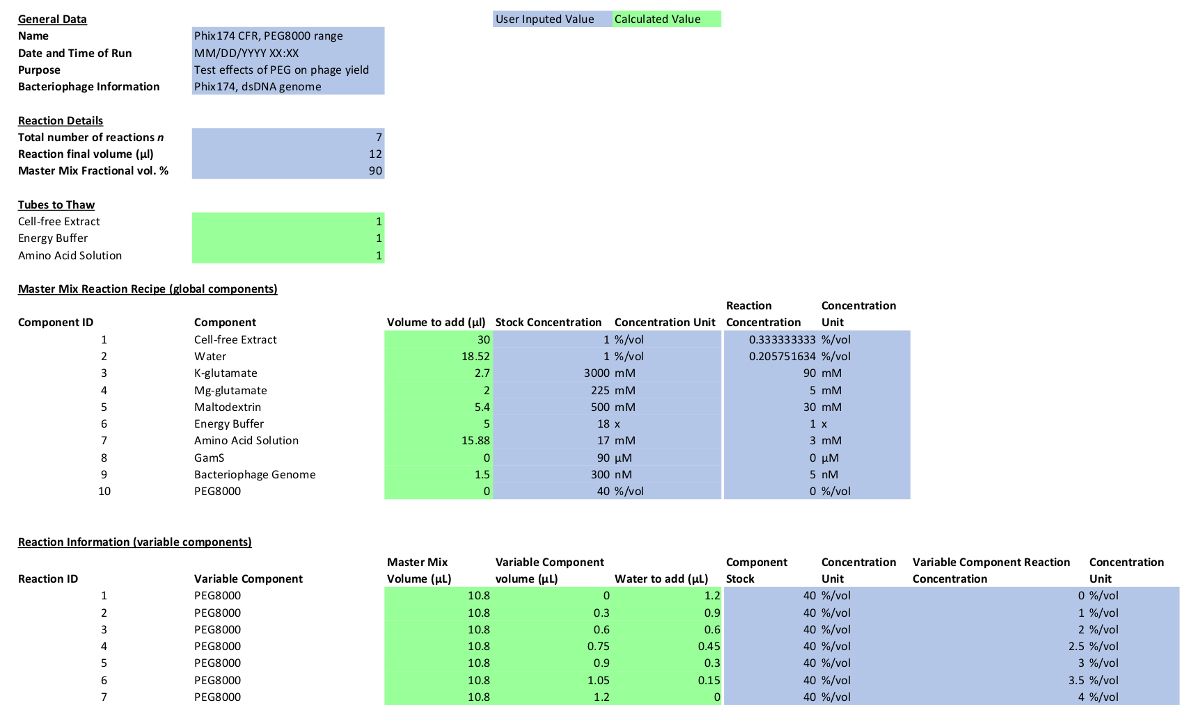
Table 1: Reaction composition.
Accès restreint. Veuillez vous connecter ou commencer un essai pour afficher ce contenu.
Matériaux
| Nom | Entreprise | Numéro de catalogue | Commentaires |
|---|---|---|---|
| Ultracentrifugation tubes | Beckman Coulter | 344057 | |
| Conical tubes | Falcon | 352070 | |
| Culture tubes | Fischerbrand | 14-961-33 | |
| Cell-free system | Mycroarray Inc | Mytxtl | |
| BioComp Gradient Master | BioComp Instruments | Model 105ME |
