Source : Shandra, O. et al., Inducing Post-Traumatic Epilepsy in a Mouse Model of Repetitive Diffuse Traumatic Brain Injury. J. Vis. Exp. (2020)
Un abonnement JoVE est requis pour visualiser ce contenu. Connectez-vous ou commencez votre période d'essai gratuite.
Article de méthode
Technique pour induire des convulsions post-traumatiques dans un modèle murin via une blessure traumatique de perte de poids
883 vues
⸱
8 juillet 2025
Dans cet article
Résumé
Protocole
Toutes les procédures impliquant des modèles animaux ont été examinées par le comité institutionnel local de protection des animaux et le comité d’examen vétérinaire JoVE.
1. Procédure de chute de poids
- Placez la souris dans une chambre d’induction. Réglez le débit d’oxygène et de vide à 1 L/min et le niveau de gaz isoflurane à 3 % à 5 %. Anesthésie la souris pendant 5 min.
- Retirez la souris de la chambre d’induction et placez-la sur un coussin en mousse. Testez l’absence de réponse à un pincement de l’orteil ou de la queue.
- Administrer un analgésique (0,1 mg/kg de buprénorphine) par voie sous-cutanée. Si l’électroencéphalographie (EEG) est pratiquée le jour même, administrez la buprénorphine par voie sous-cutanée en association avec l’anti-inflammatoire non stéroïdien carprofène (5 mg/kg).
- Administrer la solution de lactate de sodium (3 μL par gramme du poids de l'animal) par voie sous-cutanée avant ou après le dernier impact. La solution de lactate de sodium peut être mélangée aux analgésiques pour une administration rapide en une seule injection.
REMARQUE : La solution de lactate de sodium contient un mélange de chlorure de sodium, de chlorure de potassium, de chlorure de calcium et de lactate de sodium dans l’eau. Cette étape aide à remplacer les liquides et les électrolytes, ce qui facilite la récupération. - Placez la tête de la souris sous le tube de chute de poids (Figure 1A) et placez un disque plat en acier inoxydable (1,3 cm de diamètre, 1 mm d’épaisseur et 880 mg de poids) au centre de la tête, entre la ligne des yeux et des oreilles.
REMARQUE : Ce disque diffuse l’impact sur toute la surface du crâne (Figure 1B). - Retirez la goupille dans le tube de chute de poids pour libérer la tige de poids de 100 g d’une hauteur de 50 cm. Pour induire la blessure simulée pour les souris témoins, retirez la tige de poids du tube pour éviter le relâchement accidentel de la goupille et la chute de poids.
REMARQUE : La tête de l'animal doit être positionnée à plat, de sorte que la tige tombe librement sur toute la surface du disque. - Placez l’animal inconscient sur le dos pour le récupérer sur un coussin chauffant recouvert d’une serviette absorbante stérile polydoublée. Le temps de récupération du réflexe de redressement (c’est-à-dire le temps qu’il faut à la souris pour se redresser sur le dos) peut être mesuré comme une lecture du temps passé inconscient.
Accès restreint. Veuillez vous connecter ou commencer un essai pour afficher ce contenu.
Résultats
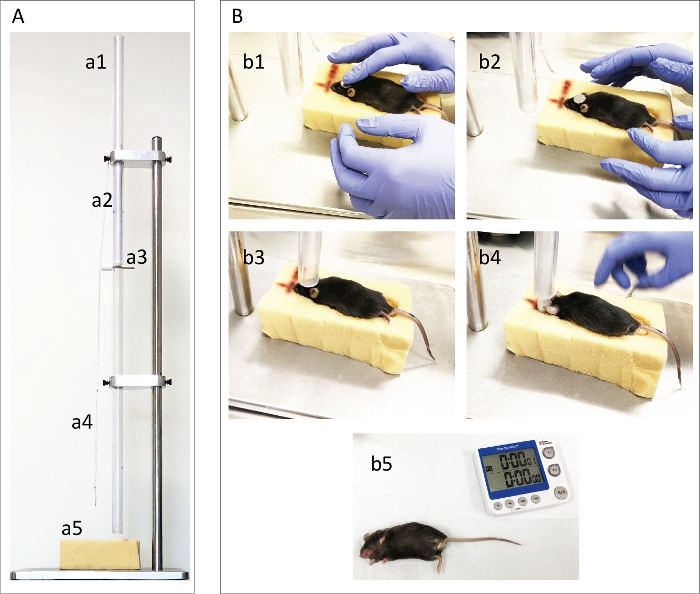
Figure 1 : Le modèle murin de lésions cérébrales traumatiques diffuses répétitives (TCC). (A) Dispositif de chute de poids. (a1) Tube de chute de poids. (a2) Une tige de poids de 100 g. (a3) Goupille tenant la tige. (a4) Ficelle pour soulever la tige si vous changez la hauteur ou retirez la tige du tube de chute de ...
Accès restreint. Veuillez vous connecter ou commencer un essai pour afficher ce contenu.
Déclarations de divulgation
Aucun conflit d’intérêts n’a été déclaré.
Matériaux
| Nom | Entreprise | Numéro de catalogue | Commentaires |
|---|---|---|---|
| Buprénorphine | Par Pharmaceuticals, Cos. Inc., Spring Valley, NY, États-Unis | 60969 | |
| souris C57BL/6 | Harlan/Envigo Laboratories Inc | mâle, 12-16 semaines | |
| souris C57BL/6 | Le Laboratoire Jackson | mâle, 12-16 semaines | |
| Carprofène | Zoetis Services LLC, Parsippany, NJ, États-Unis | 26357 | REMARQUE : ce médicament n’est ajouté lors de la perte de poids que si l’implantation d’électrodes stéréotaxiques doit être effectuée le même jour |
| Fluriso liquide pour l’anesthésie par inhalation | MWI Veterinary Supply Co., États-Unis | 502017 | |
| Disque en acier inoxydable | Sur mesure | ||
| Serviettes absorbantes stériles doublées de polyéthylène | Cardinal Health, États-Unis | 3520 |
Explorer plus d’articles
Modèle de traumatisme crânien par chute de poidsModèle murin de crises d'épilepsie post-traumatiquesInduction d'un traumatisme crânienMécanisme d'hyperexcitabilité neuronaleActivation des récepteurs du glutamateCrises par influx calciquePréparation de souris anesthésiéePlacement d'un disque en acier inoxydableMécanisme de relâchement de la tige de poidsModèle de traumatisme crânien
