ここで紹介するプロトコルは、カブトムシから生成されたシトクロムcオキシダーゼサブユニットI(COI)遺伝子配列のコンピュータベースの処理についてユーザーをガイドすることを目的としています。これにより、分子操作分類単位(MOTU)と呼ばれる種クラスタリング仮説をDNAから生成できます。
このコンテンツを表示するには、JoVEへの購読が必要です。 または、無料トライアルをお申し込みください。
この記事について
サマリー
要約
生物多様性の減少は想像を絶する速さで進行していますが、生物多様性のモニタリングは、ベースラインの多様性の不完全なインベントリや熟練した分類学者の人口の減少など、多くの要因によって妨げられています。「ダークタクサ」、つまり分類学で十分に研究されていないことが多い超多様なグループの種目録におけるこの障害を埋めることは、克服できない環境圧力に直面している熱帯地方では特に重要です。形態学に基づくアルファ分類学は、種同定のゴールドスタンダードであり続けていますが、DNAベースの方法は、種の描写と発見を加速する上で大きな可能性を示しています。ここでは、フィリピンの2つの非常に目立たないカブトムシ属、すなわちLimnichidae科の Byrrhinus Motschulsky(1858年)とHydrophilidae科の Anacaena Thomson(1859年)に実装された6つの分子種境界アプローチを含む分子運用分類単位(MOTU)を生成するための調合パイプラインについて説明します。このプロトコルはDNAバーコードの処理に焦点を当てており、これらの遺伝子データはシーケンシングまたはオンラインデータベースからのダウンロードによって取得できることを考えると、ここで説明するプロトコルの出発点はDNA配列です。COIバーコードを考慮すると、パイプラインは、TaxonDNA、K2P、ASAPの3つの閾値ベースの分子種境界アプローチの組み合わせを利用し、配列アラインメントを入力データとして使用します。さらに、パイプラインは PTP-ML、PTP-BI、MPTP の 3 つの合体ベースのアプローチで進行し、入力データとしてツリー ファイルが必要です。Webサーバーを使用するアプローチもあれば、ローカルソフトウェアを使用するアプローチもあります。提示されたアルゴリズム手法の選択により、MOTUはコンセンサスまたは多数決によって識別できます。驚くべきことに、このパイプラインは、フィリピンからのほとんど目立つカブトムシの種を描写し、同じまたは隣接する地域から記録されたものでさえも描写しました。
概要
さまざまな分類群で地球規模の種が前例のない速度で減少しているため 1,2,3,4、これまで発見されていなかった種や記載されていない種を含む包括的な生物多様性インベントリを作成する推進力は、時間との競争になります 2,5。一つには、生物多様性の保全は、適切な分類学的知識に照らしてのみ意味をなす6,7。したがって、密接に関連しているが異なる種が独自の基本的なニッチを持っている可能性があることを考えると、種レベルでの生物多様性の特定が必要である8。
カブトムシの系統学では、アルファ分類学または伝統的な分類学は、すべてではないにしてもほとんどの動物グループと同様に、種の同定におけるゴールドスタンダードです9。このアプローチは、形態学的特徴に依存して、より高い分類法で生物を分類し、種レベルでの同定を提供します10,11。多くの場合、科12、あるいは属レベルの同定13でさえも、体型や特殊な適応のような外部形態学的特徴のみを用いて行うことができる。一方、カブトムシの種レベルの同定は、通常、ネデアガスまたは雄性器の構造的詳細の比較を通じて行われる14,15,16。
この形態学に基づくアルファ分類学が広く受け入れられているにもかかわらず、種の発見に対するこのアプローチは、特に無脊椎動物の間で、多数の「分類学的障害」6,17,18によって妨げられています19。カブトムシの系統学では、アルファ分類学を用いた種の同定および/または発見は、熟練した分類学者の数が限られている20,21、簡潔でほとんど情報提供されていない以前の記述22、および文献やタイプ標本へのアクセスに関連する物流上の問題23という課題に直面している。
これは、問題の分類群が不可解であったり、非常に目立たない場合にも悪化します。不可解な種とは、微妙な種間フェネティックな違いを考えると、比較形態によって容易に描写できない、同じ属、または異なる属の種のセットを指します24。「暗い分類群」25,26,27と見なされる一部の謎めいた分類群は、さらに、非常に多様でありながら非常に研究が不十分であることに苦しんでいます。残念ながら、これは河畔および水生のカブトムシ8,28では珍しいことではありません。謎めいた暗い分類群の種の描写に対処しないと、潜在的に異なるニッチと生態学的要件を持つ生物に画一的な保全措置が与えられるため、生物多様性が脅かされます8,29。
これらの課題を考えると、「統合分類学」23、またはアルファ分類学を別の一連の証拠と結びつけるアプローチは、過去20年間で新種を育てる手段として勢いを増してきた30,31,32。カブトムシ33,34,35,36,37,38,39およびその他の昆虫目40,41,42,43,44,45に関する統合分類学的研究で使用される証拠の1つは、DNA配列です。特に、ミトコンドリアのシトクロムcオキシダーゼサブユニットI(COI)遺伝子は、その適度に保守的な性質46,47,48のために、多様な動物のセットをバーコード化するために使用されている。その658bp長の5'末端(COI-5')は、「バーコードフラグメント」または「フォルマーフラグメント」とも呼ばれ、「診断」配列49として提案されているが、3'末端50,51,52のプライマーセットが頑健であるため、723bp長のCOI-3'も使用されている。
COIを用いたDNAバーコーディングは、種レベルの同定のために考案されたが、それは、GenBank54およびBOLD55のような先験的な配列リポジトリ53によって制限されるが、分子種境界アプローチは、前提条件リポジトリ56なしで提供されたDNA配列のみを使用して種の制限を設定する。入力ファイルに基づく分子種境界設定アプローチには、2つのクラスがあります。まず、配列のアラインメントをインプットとして使用すると、閾値ベースのアプローチでは、カットオフ値を使用して種間および種内の分岐を決定します48,57,58。距離ベースの方法として、これらのアプローチは、昆虫について観察された最大種内距離の3%に依存しており、これは「バーコードギャップ」と呼ばれています51,59。閾値に基づくアプローチには、TaxonDNA60に実装されたSpeciesIdentifier、Kimura 2-parameter(K2P)61による遺伝的距離、およびASAP(Assemble Species by Automatic Partitioning)62がある。
次に、系統を入力ファイルとして使用して、合体ベースのアプローチは、系統分岐率63,64,66の変化を決定することにより、種の境界を特定し、独立した系統をソートします。多くの場合、系統発生種の概念67に依存し、合体ベースのアプローチには、ポアソンツリープロセス(PTP)68とそのバリエーションであるマルチレートPTP69が含まれます。いずれにせよ、分子種境界アプローチによって形成されたクラスターは、総称して分子操作分類単位(MOTU)と呼ばれます。
ここでは、3つの閾値ベースのアプローチと3つの合体ベースのアプローチを含むMOTUを生成するための調合パイプラインの方法を紹介します(図1)。パイプラインは、(1)統合分類法と未記載種からの追加配列を使用して以前に建てられた2つの公開種35で構成される河岸のByrrhinus Motschulsky、1858年のカブトムシのCOI-3'配列、および(2)Anacaena Thomson、1859年のカブトムシのCOI-5'配列、2つの公開種70の配列でテストされます以前は、アルファ分類法と未記載の種からの追加配列を使用して建てられました。
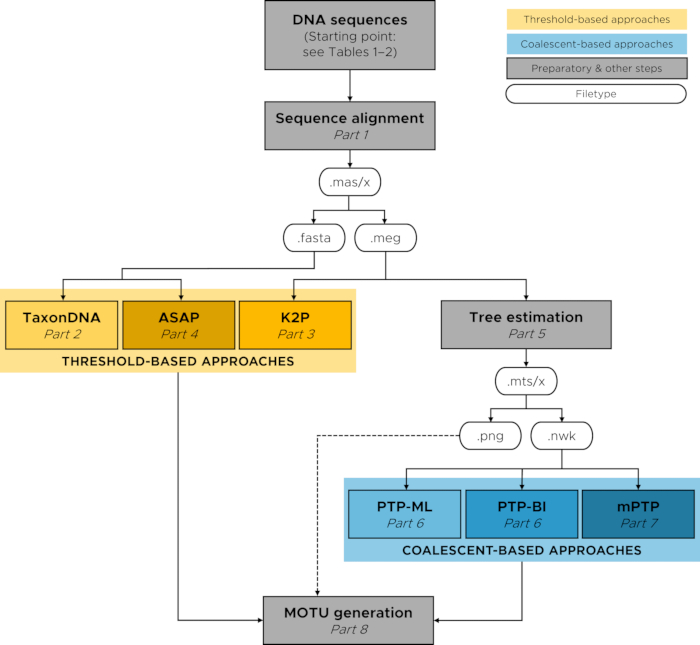
図1:MOTUを生成するための調合パイプラインのフローチャート。 この図の拡大版を表示するには、ここをクリックしてください。
アクセスが制限されています。このコンテンツを表示するにはログインするか、トライアルを開始してください。
プロトコル
この調合パイプラインの出発物質はDNA配列であり、オンラインリポジトリ(BOLD、GenBankなど)からダウンロードするか、またはサンガーシーケンシング71から生成することができます。 Table 1 と Table 2 は、この論文で代表的な結果が示されているデータセットのアクセッション番号を示しています。
1. 閾値ベースアプローチの準備ステップ:配列アラインメント
- MEGA X72のロードシーケンス。
注:MEGA Xは https://www.megasoftware.net/ からダウンロードできます- [整列]をクリックしてドロップダウンメニューを開きます。[編集/線形作成]をクリックし、[新しい線形を作成]を選択します。[OK]をクリックして、この選択を確定します。アライメントのデータ型として DNA を選択します。
- 「編集」タブにマウスを合わせ、「ファイルからシーケンスを挿入」を選択します。シーケンスのあるディレクトリに移動し、MEGAにロードするシーケンスを選択します。
- 配列を整列するには、[Alignment] をクリックし、[Align by ClustalW73] をクリックします。デフォルト設定を続行し、[OK]をクリックします。
- シーケンスを手動で編集するには、両端をトリミングし、挿入や欠落をクリーニングします。
- 挿入物を削除するには、挿入されたベースや位置をクリックし、キーボードの Delete キーを押します。
- 削除を修正するには、「-」で示されているように、削除されたと思われる位置をクリックします。「-」を削除し、目的のベースを入力します。
- すべてのシーケンスに文字がある最も早い位置を見つけます。決定された位置の左側にある位置の行ヘッダーの空白のボックスをクリックし、開始終了までのすべてのシーケンスの余分な位置が選択されるまでドラッグします。 Delete キーを押してトリミングします。
- 手順 1.3.3 を繰り返して、すべてのシーケンスに文字がある最後の位置を探します。決定された位置の右側にある位置のヘッダー行にある空白のボックスをクリックし、ターミナル終了までのすべてのシーケンスの余分な位置が選択されるまでドラッグします。 Delete キーを押します。
注: 図2A は、DNA配列の良好なアラインメントを示しています。最終的なデータセットは、同じ長さのシーケンスの行列です。したがって、配列の長さは研究の結果に影響を与える要因ではありません。参照配列は、アラインメントマトリックスの最終的な長さの基礎として機能します。
- COIがタンパク質をコードする配列であることを考慮して、終止コドンをチェックするために配列を翻訳します。
- すべての配列を選択し、 Translated Protein Sequences タブをクリックします。
- プロンプトが表示されたら、遺伝暗号が 無脊椎動物ミトコンドリアであることを確認します。遺伝暗号が異なる場合は、[ いいえ]をクリックすると、 無脊椎動物のミトコンドリア 遺伝暗号のチェックボックスをオンにするためのメニューが表示されます。
- アラインメントボディにアスタリスクで示されている終止コドンがカラム全体に存在する場合は、 DNA Sequences をクリックし、すべての配列の最初の位置を削除します。
- 停止コドンが任意の配列にまだ存在する場合は、前のステップを繰り返します。
- 終止コドンがまだ存在する場合は、以前に削除した位置を復元します。すべてのシーケンスを選択し、[ データ ]タブにマウスを合わせて [リバース]をクリックします。
- 手順1.4.1を繰り返します。終止コドンがまだ存在する場合は、手順1.4.3と1.4.4を繰り返します。
注: 図2B は、コドンの良好な位置合わせを示しています。
- DNA Sequencesをクリックし、配列のアラインメントを.mas/xに保存します。シーケンスを .meg ファイルや .fasta ファイルなど、他の関連するファイルタイプにエクスポートします。
注:特定の分子種境界アプローチは、アウトグループなしでより適切に機能します。したがって、考えられる考慮事項は、アウトグループなしでアライメントファイルのコピーを生成することです。
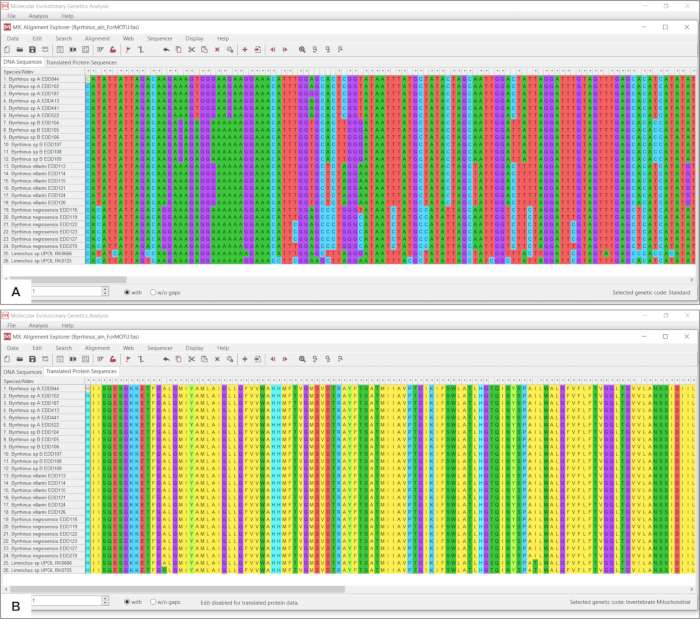
図2:MEGA Xの配列アラインメント。 (A)手動で洗浄した最終DNA配列のアラインメント、および(B) Byrrhinus データセットの翻訳タンパク質配列のアラインメントは、挿入、欠失、およびギャップを示していません。 この図の拡大版を表示するには、ここをクリックしてください。
2. Species Identifier 1.8における分類群DNAモジュールによる区切り
注:種識別子は https://taxondna.sourceforge.net/ からダウンロードできます
- TaxonDNAを開きます。「Import」をクリックし、「FASTA」をクリックします。アライメントを .fasta 形式でアップロードします。
- [Modules] をクリックし、[Cluster] をクリックします。しきい値を 3% に設定します。次に、[Generate information about individual cluster] をオンにします (図 3)。
- [ 今すぐクラスターを作成!] をクリックします。スクリーンショットを撮って結果を保存します。
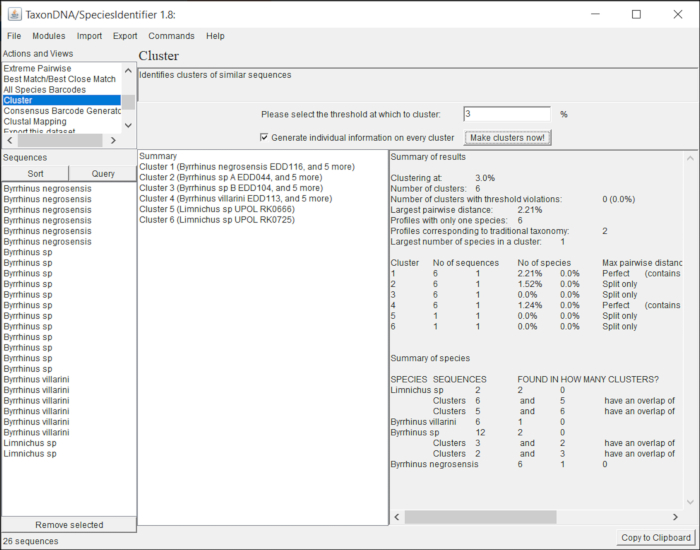
図3:Species Identifier 1.8ウィンドウのTaxonDNAは、ユーザーが特定した区切りの3%の閾値を示しています。 この図の拡大版を表示するには、ここをクリックしてください。
3. MEGA Xにおける木村2パラメータ(K2P)による区切り
- MEGAで、[ ファイル]、[ ファイル/セッションを開く]の順にクリックして.megファイルを開きます。 [Distance] をクリックし、[ Compute Pairwise Distances] をクリックします。区切りの .meg ファイルを確認します。
- [モデル/メソッド] の横にある黄色のボックスの上にマウスを置き、ボックスの右側に表示される矢印をクリックします。
- ドロップダウンメニューから Kimura 2-parameter model を選択します。[ OK] をクリックしてプログラムを実行します。データ出力ウィンドウを開きます(図4)。
- 「File」をクリックし、「Export/Print Distances」をクリックします。
- [出力形式]の横にあるドロップダウンメニューを開き、[XL:MicrosoftExcelワークブック]を選択します。[小数点以下の桁数] で [4] を選択します。
- 結果のスプレッドシートを Microsoft Excel に保存します。条件付き書式を使用して、距離が 0.03 (または 3%) 未満のものを強調表示します。
注: この記事で説明した他のアプローチとは異なり、K2P はユーザーが識別したしきい値に依存するため、クラスタリングをすぐには提供しません。このパイプラインは、閾値が 3% であると仮定して機能しており、これは、遺伝的距離が 3% 未満の配列のペアが同じ分子クラスターに属していることを意味します。
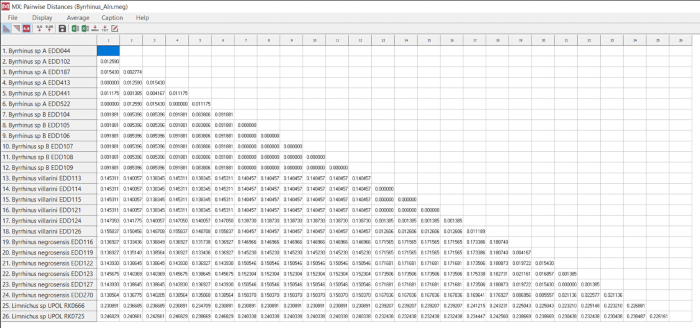
図 4: MEGA X の結果を示すウィンドウ Kimura-2-parameter この 図の拡大版を表示するには、ここをクリックしてください。
4. 自動分割によるアセンブル種による境界設定 (ASAP)
- ASAP に移動します web サーバー: https://bioinfo.mnhn.fr/abi/public/asap/asapweb.html
- アライメントをアップロードするには、[ Choose a file...] というラベルの付いたオレンジ色のボックスをクリックし、.fasta ファイルを選択します。または、 .fasta ファイルをオレンジ色のボックスにドラッグします。下にスクロールして、[ 実行]をクリックします。
- クラスタリングをダウンロードするには、ASAPスコアが最も低く、p-valランクが最も高い行 のリスト をクリックします(図5)。
注:結果の出力は、分子クラスターのサブセットを示す.txtファイルです。
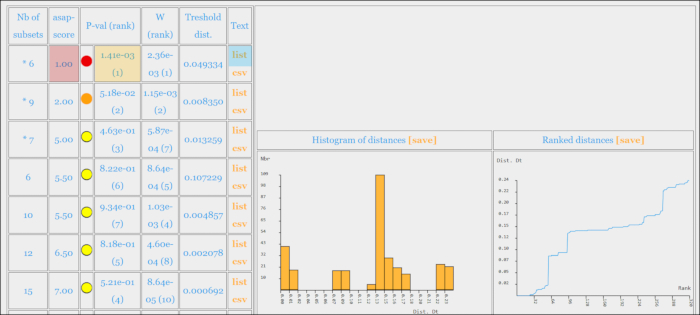
図5:可能な区切りを示すASAPの結果ウィンドウ。 最初の結果 (青いボックス) は、最も低い ASAP スコア (赤いボックス) と最も高い P-val ランク (黄色のボックス) のために受け入れられます。 この図の拡大版を表示するには、ここをクリックしてください。
5. 合体ベースアプローチの準備段階:樹木推定
- [データ]をクリックし、[ファイル/セッションを開く]をクリックして.megファイルを開きます。最適適合の代替モデルをテストします。
- 「モデル」をクリックし、「ベストDNA/タンパク質モデル(ML)」を見つけます。解析のために .meg ファイルを確認します。
- Analysis PreferencesメニューのOkをクリックします(図6A)。BIC と AICc の値が最も低い値を使用した最適なモデルに注意してください (図 6B)。
注: これは通常、結果のウィンドウに表示されるモデルのリストの最初のモデルです。表示されるウィンドウの下部にある省略されたモデル名の完全な名前を参照してください。
- ツリーを生成します。
- [系統発生] をクリックし、[最尤木の構築/テスト] をクリックします。
- 最適なヌクレオチド置換モデルを使用してください。これを行うには、モデル/メソッドの横にある黄色のボックスをクリックします。ドロップダウンメニューからモデルを選択します。
- 最適なヌクレオチド置換モデルが「+G」または「+I」、あるいはその両方である場合は、[Rates among Sites]の横のボックスをクリックし、ドロップダウンメニューからパラメータ(G、I、G + I)を選択します(図6C)。
- [Phylogeny Test]で、[Test of Phylogeny]の横にあるボックスをクリックし、ドロップダウンメニューから[Bootstrapメソッド]を選択します。「いいえ」の横にあるボックスをクリックします。of Bootstrap Replications」と入力し、1000 と入力します (図 6C)。[OK]をクリックして解析を実行します。
- 結果のツリーを含むウィンドウ (図 6D) が開いたら、ツリー セッションを .mts/x として保存します。出力を .nwk ファイルとして保存します。ツリーも画像ファイルとして保存.png。
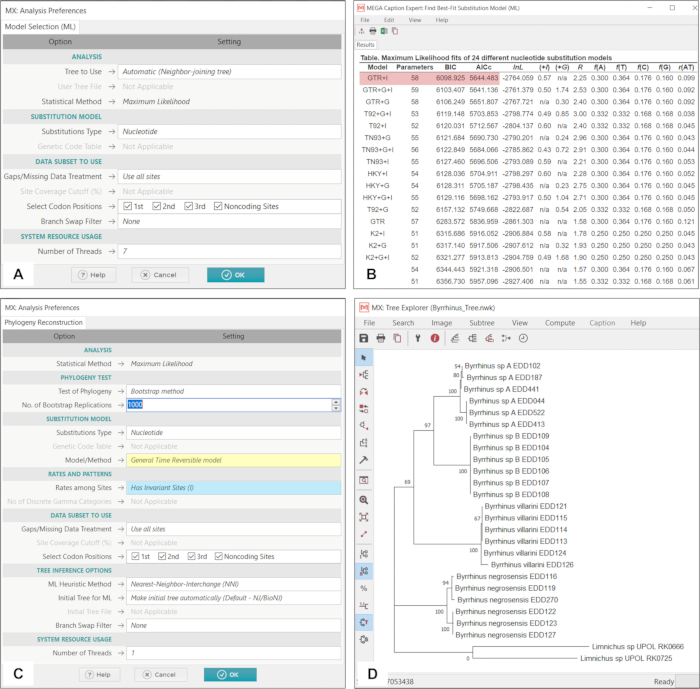
図6:合体ベースのアプローチの準備ステップとしてのMEGA Xでの樹木推定。 (A)最適なヌクレオチド置換モデルを決定するための設定。(B) Byrrhinus データセットの場合、BIC と AICc の値が最も低いため、最適なモデルは GTR + I です (赤枠)。(C)最尤木の実行では、GTR(黄色のボックス)+I(青いボックス)をパラメータとして設定しました。(D)後続の分析で使用される結果の生のMLツリー。 この図の拡大版を表示するには、ここをクリックしてください。
6. ポアソンツリープロセス(PTP)による区切り
注: 次の手順では、PTP-ML と PTP-BI の結果が得られます。
- PTP Web サーバーに移動します: https://species.h-its.org/ptp/
- 「 Choose file」をクリックして、newickファイルをアップロードします。 [My tree is](私のツリー)で、[ Rooted](ルート化) を選択します(図7A)。
- 解析のパラメータを入力します。 [No. MCMC generations] に 100000 を入力します。 [間引き] に 100 を入力します。 [バーンイン] で、「 0.1」と入力します。 [シード] に 123 を入力します。
- アウトグループ分類群の名前 (存在する場合) の下のボックスにヒントの名前を入力して、アウトグループを入力します。入力の書式設定の手順は、入力ボックスの右側にあります。
- 対応するフィールドにメールアドレスを入力し、[ 送信]をクリックします。PTP種区切り結果ウィンドウで、 ここ をクリックして結果ウィンドウを開きます。
- 最尤解で、境界設定結果のダウンロードをクリックして PTP-ML の結果をダウンロードします (図 7B)。
- ベイジアンがサポートするソリューションで、[区切り結果のダウンロード] をクリックして PTP-BI の結果をダウンロードします。
注 : 結果は、パーティション内のシーケンスのグループを示します。これらは、番号付きの種としてラベル付けされ、その後にサポート値が付きます(1.000が理想的です)。
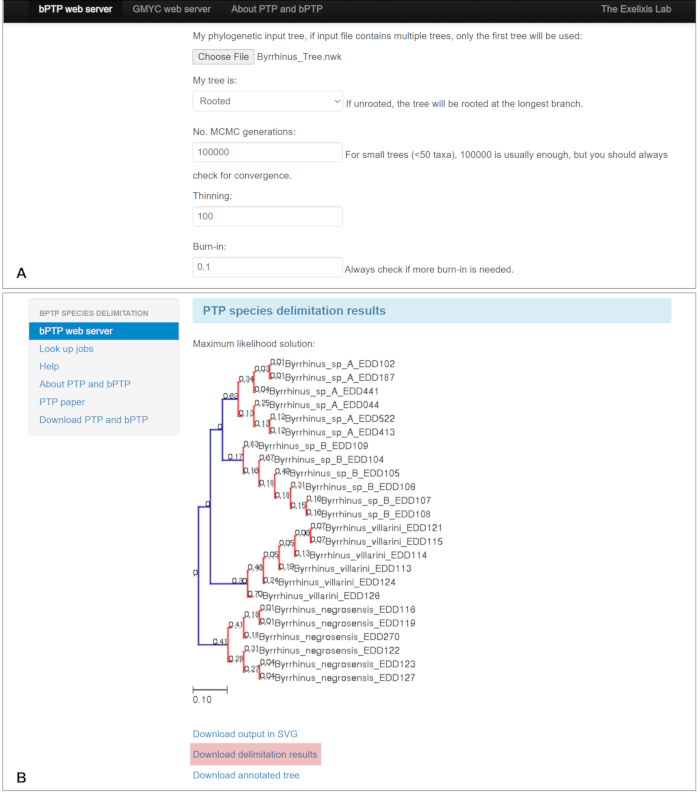
図7:ポアソンツリープロセスによる分子種の区切り (A)入力パラメータを示すウィンドウ。(B)PTP Webサーバーの結果ウィンドウ、区切り結果を含むリンク(赤いボックス)。 この図の拡大版を表示するには、ここをクリックしてください。
7. マルチレートポアソン木過程(mPTP)による区切り
- mPTPに移動します web サーバー:https://mptp.h-its.org/#/tree
- newick ファイルをアップロードするには、灰色の長方形にドラッグするか、長方形をクリックします。データが同じページに読み込まれたら、[ Proceed to outgroup selection ] をクリックします (図 8A)。
- アウトグループ仕様ページで、アウトグループ標本の分類群ラベルの横にあるボックスをクリックして、アウトグループを選択します。シーケンスの下部にある「Crop Outgroup」オプションをクリックします。[モデルの選択]をクリックします。
- [MPTP] をクリックし、[Visualization Options] をクリックします。[視覚化オプション] ページで、既定の設定をそのまま使用します。
注:または、SVG幅の下に値(px単位)を入力して、合計画像サイズを調整することもできます。テキストのフォントと間隔は、SVGフォントサイズ、ヒント間のスペース、左マージン、右マージン、上マージン、および下マージンの下に希望のサイズ(px)を入力することで調整できます。 - [連絡先の詳細]をクリックします。後で結果を参照できるように、メールアドレスを入力します(オプション)。
- [概要]をクリックします。入力した分類群の数と選択したアウトグループを必ず確認してください。
- [送信]をクリックします。[ダウンロード可能なファイル] (図 8B) の下のファイルを右クリックし、[名前を付けて保存] を選択して結果を保存します。
注:出力テキストファイルは、結果の先頭に区切られた種の総数を示します。次に、どのシーケンスが各クラスターに該当するかを示します。これらのクラスターと対応するシーケンスは、.svg ファイルで生成されたツリーと同様に配置されます。mPTP SVG ファイルには、シーケンスのクラスタリングが表示されます。クラスターは、ツリーに沿って赤い枝で接続されたシーケンスのグループによって表されます。分離された赤い枝の各セットは、単一のMOTUを示します。
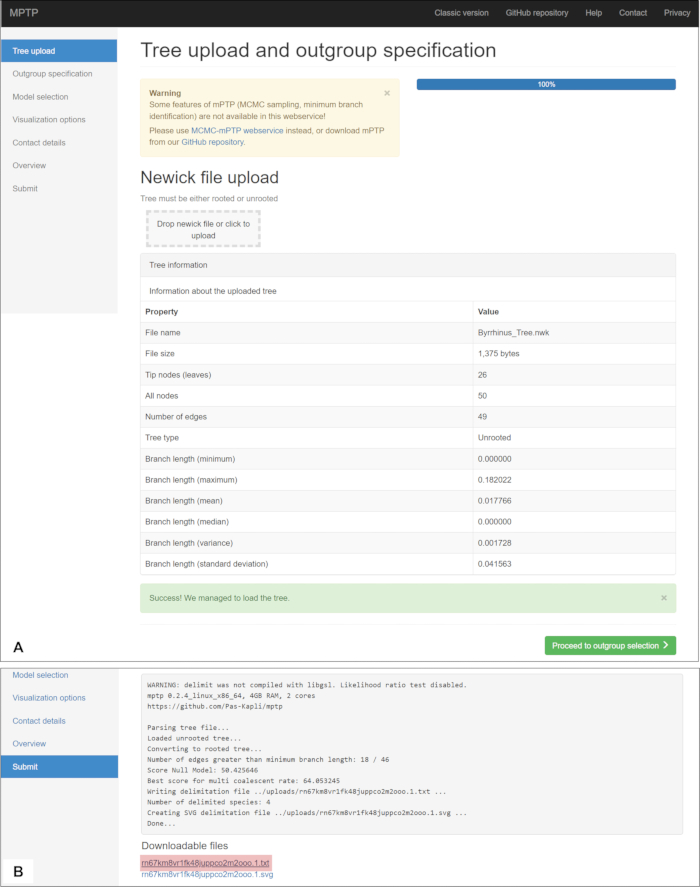
図8:マルチレートポアソンツリープロセスによる分子種の境界。 (A)アップロードされたツリーに関するmPTP読み取り情報を表示するウィンドウ。(B)mPTP Webサーバーの結果ウィンドウ、区切り結果を含むリンク(赤いボックス)。 この図の拡大版を表示するには、ここをクリックしてください。
8. MOTUの生成
- フォトエディタプログラムまたはPowerPointを使用してツリーを開きます。
- 各分子種境界アプローチの結果を表すバーを作成します(サンプルについては 、図9 および 図10 を参照)。1 本のバーが、その分子クラスターに含まれる配列と一致していることを確認します。
- これら2つのアプローチのいずれかによってMOTUを決定する74
- すべてのアプローチが特定の分子クラスターに対して同じ結果を生成する場合は、コンセンサスによって分子クラスターをMOTUとして構築します。
- ほとんどのアプローチで特定の分子クラスターに対して同じ結果が得られる場合は、分子クラスターを大多数でMOTUとして立てます。
アクセスが制限されています。このコンテンツを表示するにはログインするか、トライアルを開始してください。
結果
この記事では、TaxonDNA、K2P、ASAP、PTPの2つのバリエーション、およびmPTPを含む分子種境界調合パイプラインを水生および河岸のカブトムシに実装しました。6つのアプローチのそれぞれの結果は「分子クラスター」と呼ばれ、要約は「分子操作分類単位」またはMOTU75と呼ばれます。
調合パイプラインは、2つのデータセットでテストされました。最初のデータセット(表1、図9)は、フィリピンから収集された1858匹のカブトムシである河岸のByrrhinus Motschulskyの24のCOI-3'配列と、1829種76の未同定のLimnichus Latreilleの24の配列で構成されています。Byrrhinusの配列には、K2P境界を指定した形態学に基づくα分類法を用いて構築された、以前に発表された2つの種
アクセスが制限されています。このコンテンツを表示するにはログインするか、トライアルを開始してください。
ディスカッション
DNA配列、特にCOI49は、バイオ同定システム46のためのオンライン公開リポジトリ54,55,79,80の参照配列22,53,78と比較することができるが、そのようなアプローチは、利用可能な寄託配列によって制限される。それどころか、分子種境界の使用は、種の制限を設定し、前提条件としての配列リポジトリを必要とせずに分子クラスタリングを形成することができる56。分子種境界アプローチの2つのクラ...
アクセスが制限されています。このコンテンツを表示するにはログインするか、トライアルを開始してください。
開示事項
私たちには開示するものは何もありません。
謝辞
私たちは、生物多様性サンプリングを実施するための事前のインフォームドコンセントを私たちに与えてくれた漁業水産資源局(BFAR)と関係する地方自治体に感謝します。分類学の作業に関する指導をいただいたHendrik Freitag博士に感謝します。また、レビュアーと編集者の有益で建設的なコメントに感謝します。最後に、この研究に資金を提供してくださったアテネオ・デ・マニラ大学の大学研究評議会ビッグプロジェクト助成金(URC 2022-09)とオープンアクセス出版助成金、アテネオ科学工学研究所のSCジョンソン社環境リーダーシップ学生研究開発基金、ロンドンのリンネ協会とシステマティクス協会のLinnéSys:Systematics Research Fundに心から感謝いたします。
アクセスが制限されています。このコンテンツを表示するにはログインするか、トライアルを開始してください。
材料
| 名前 | 会社 | カタログ番号 | コメント |
|---|---|---|---|
| できるだけ早く | スパルトエクスプローラ | https://bioinfo.mnhn.fr/abi/public/asap/asapweb.html | |
| コンピュータ | 任意の処理ユニット | ||
| メガX | MEGAソフトウェア | https://www.megasoftware.net/ | |
| mPTP Web サーバー | https://mptp.h-its.org/#/tree | ||
| PTP Web サーバー | ハイデルベルク理論研究所(HITS) | https://species.h-its.org/ptp/ | |
| 種識別子 | https://taxondna.sourceforge.net/ |
参考文献
- Ceballos, G., Ehrlich, P. R. Mammal population losses and the extinction crisis. Science. 296 (5569), 904-907 (2002).
- Dirzo, R., et al. Defaunation in the Anthropocene. Science. 345 (6195), 401-406 (2014).
- Cardoso, P., et al. Scientists' warning to humanity on insect extinctions. Biol Conserv. 242, 108426(2020).
- Wagner, D. L., Grames, E. M., Forister, M. L., Berenbaum, M. R., Stopak, D. Insect decline in the Anthropocene: Death by a thousand cuts. Proc Natl Acad Sci U S A. 118 (2), 1-10 (2021).
- Steffen, W., Crutzen, P. J., McNeill, J. R. Welcome to the Anthropocene. Ambio. 36 (8), 614-621 (2007).
- de Carvalho, M. R., et al. Taxonomic impediment or impediment to taxonomy? A commentary on systematics and the cybertaxonomic-automation paradigm. Evol Biol. 34 (3-4), 140-143 (2007).
- Satler, J. D., Carstens, B. C., Hedin, M. Multilocus species delimitation in a complex of morphologically conserved trapdoor spiders (Mygalomorphae, Antrodiaetidae, Aliatypus). Syst Biol. 62 (6), 805-823 (2013).
- Arribas, P., Andújar, C., Sánchez-Fernández, D., Abellán, P., Millán, A. Integrative taxonomy and conservation of cryptic beetles in the Mediterranean region (Hydrophilidae). Zool Scr. 42 (2), 182-200 (2013).
- Baker, K., et al. Carpooling with ecologists, geographers and taxonomists: Perceptions from conducting environmental research in tropical regions. Biodivers Conserv. 28 (4), 975-981 (2019).
- Tan, D. S. H., Ang, Y., Lim, G. S., Bin Ismail, M. R., Meier, R. From "cryptic species" to integrative taxonomy: An iterative process involving DNA sequences, morphology, and behaviour leads to the resurrection of Sepsis pyrrhosoma (Sepsidae: Diptera). Zool Scr. 39 (1), 51-61 (2010).
- Tan, M. K., Storozhenko, S. Y., Hwang, W. S., Meier, R. Integrative taxonomy reveals two sympatric species of the genus Eucriotettix Hebard, 1930 (Orthoptera: Tetrigidae). Zootaxa. 4268 (3), 377-394 (2017).
- Yule, C. M. Freshwater invertebrates. Freshwater Invertebrates of the Malaysian Region. , 23-31 (2004).
- Komarek, A., Jäch, M. A., Ji, L. Hydrophilidae: I. Check list and key to Palearctic and Oriental genera of aquatic Hydrophilidae (Coleoptera). Water Beetles of China. 3, 383-395 (2003).
- Rudoy, A., Ribera, I. The macroevolution of size and complexity in insect male genitalia. PeerJ. 4, e1882(2016).
- Rudoy, A., Beutel, R. G., Ribera, I. Evolution of the male genitalia in the genus Limnebius Leach, 1815 (Coleoptera, Hydraenidae). Zool J Linn Soc. 178, 97-127 (2016).
- Shapiro, A. The lock-and-key hypothesis: Evolutionary and biosystematic interpretation of insect genitalia. Annu Rev Entomol. 34 (1), 231-245 (1989).
- Scotland, R., Hughes, C., Bailey, D., Wortley, A. The big machine and the much-maligned taxonomist. Syst Biodivers. 1 (2), 139-143 (2003).
- Vinarski, M. V. Roots of the taxonomic impediment: Is the "integrativeness" a remedy. Integr Zool. 15 (1), 2-15 (2020).
- Cardoso, P., Erwin, T. L., Borges, P. A. V., New, T. R. The seven impediments in invertebrate conservation and how to overcome them. Biol Conserv. 144 (11), 2647-2655 (2011).
- Engel, M. S., et al. The taxonomic impediment: A shortage of taxonomists, not the lack of technical approaches. Zool J Linn Soc. XX, 1-7 (2021).
- Tancoigne, E., Dubois, A. Cladistics taxonomy: No decline, but inertia. Cladistics. , 1-4 (2013).
- Riedel, A., Sagata, K., Suhardjono, Y. R., Tänzler, R., Balke, M. Integrative taxonomy on the fast track: Towards more sustainability in biodiversity research. Front Zool. 10 (15), 1-9 (2013).
- Dayrat, B. Towards integrative taxonomy. Biol J Linn Soc. 85 (3), 407-415 (2005).
- Bickford, D., et al. Cryptic species as a window on diversity and conservation. Trends Ecol Evol. 22 (3), 148-155 (2007).
- Page, R. D. M. DNA barcoding and taxonomy: Dark taxa and dark texts. Philos Trans R Soc Lond B Biol Sci. 371 (1702), 20150334(2016).
- Morinière, J., et al. A DNA barcode library for 5,200 German flies and midges (Insecta: Diptera) and its implications for metabarcoding-based biomonitoring. Mol Ecol Resour. 19 (4), 900-928 (2019).
- Hartop, E., Srivathsan, A., Ronquist, F., Meier, R. Towards large-scale integrative taxonomy (LIT): Resolving the data conundrum for dark taxa. Syst Biol. 71 (6), 1404-1422 (2022).
- Fossen, E. I., Ekrem, T., Nilsson, A. N., Bergsten, J. Species delimitation in northern European water scavenger beetles of the genus Hydrobius (Coleoptera, Hydrophilidae). ZooKeys. 564, 71-120 (2016).
- Bálint, M., et al. Cryptic biodiversity loss linked to global climate change. Nat Clim Change. 1 (6), 313-318 (2011).
- Padial, J. M., De La Riva, I. A response to recent proposals for integrative taxonomy. Biol J Linn Soc. 101 (3), 747-756 (2010).
- Andújar, C., Arribas, P., Ruiz, C., Serrano, J., Gómez-Zurita, J. Integration of conflict into integrative taxonomy: Fitting hybridization in species delimitation of Mesocarabus (Coleoptera: Carabidae). Mol Ecol. 23 (17), 4344-4361 (2014).
- Schlick-Steiner, B. C., et al. Integrative taxonomy: A multisource approach to exploring biodiversity. Annu Rev Entomol. 55 (1), 421-438 (2010).
- Stüben, P. E., Astrin, J. J. Integrative taxonomy, phylogeny, and new species of the weevil genus Onyxacalles Stüben (Coleoptera: Curculionidae: Cryptorhynchinae). Psyche (Lond). 2012, 1-22 (2012).
- Hawlitschek, O., et al. Pleistocene climate change promoted rapid diversification of aquatic invertebrates in Southeast Australia. BMC Evol Biol. 12 (142), 1-15 (2012).
- Delocado, E. D., Freitag, H. Two new species of Byrrhinus Motschulsky, 1858 (Coleoptera, Limnichidae, Limnichinae) from Negros, Philippines. ZooKeys. 1070, 51-72 (2021).
- De Vera, G. C. M., Sia, J. I. L., Freitag, H., Delocado, E. D. The first new species of Leptelmis Sharp, 1888 (Coleoptera, Elmidae) from the Philippines in the last 50 years. Tijdschr Entomol. 166 (2-3), 175-186 (2023).
- Seno, C. B. N., Delocado, E. D., Freitag, H. Three new species of Ancyronyx Erichson, 1847 (Coleoptera, Elmidae) from Mindanao, Philippines. Tijdschr Entomol. 72, 61-80 (2022).
- López-López, A., Hudson, P., Galián, J. Islands in the desert: Species delimitation and evolutionary history of Pseudotetracha tiger beetles (Coleoptera: Cicindelidae: Megacephalini) from Australian salt lakes. Mol Phylogenet Evol. 101, 279-285 (2016).
- Ibarra, J. W. B., Bantiding, F. J. A., Delocado, E. D. First Georissidae (Coleoptera) from the Philippines with description of two new species of Georissus Latreille, 1809. Tijdschr Entomol. , 45-58 (2025).
- Boonsoong, B., Sartori, M. Review and integrative taxonomy of the genus Prosopistoma Latreille, 1833 (Ephemeroptera, Prosopistomatidae) in Thailand, with description of a new species. ZooKeys. 825, 123-144 (2019).
- Wang, Y., Nansen, C., Zhang, Y. Integrative insect taxonomy based on morphology, mitochondrial DNA, and hyperspectral reflectance profiling. Zool J Linn Soc. 177 (2), 378-394 (2016).
- Schutze, M. K., et al. One and the same: Integrative taxonomic evidence that Bactrocera invadens (Diptera: Tephritidae) is the same species as the Oriental fruit fly Bactrocera dorsalis. Syst Entomol. 40 (2), 472-486 (2015).
- Schär, S., et al. Integrative biodiversity inventory of ants from a Sicilian archipelago reveals high diversity on young volcanic islands (Hymenoptera: Formicidae). Org Divers Evol. 20, 405-416 (2020).
- Ševčík, J., et al. Integrative taxonomy of Central European Planetella (Diptera: Cecidomyiidae) indicates high species diversity, intraspecific variation and low host specificity. Acta Entomol Musei Natl Pragae. 63 (2), 413-450 (2023).
- Mengual, X., Ståhls, G., Vujić, A., Marcos-García, M. Á Integrative taxonomy of Iberian Merodon species (Diptera, Syrphidae). Zootaxa. 1377, 1-26 (2006).
- Hebert, P. D. N., et al. Biological identifications through DNA barcodes. Proc R Soc B Biol Sci. 270 (1512), 313-321 (2003).
- Hebert, P. D. N., et al. Ten species in one: DNA barcoding reveals cryptic species in the neotropical skipper butterfly Astraptes fulgerator. Proc Natl Acad Sci U S A. 101 (41), 14812-14817 (2004).
- Hebert, P. D. N., Gregory, T. R. The promise of DNA barcoding for taxonomy. Syst Biol. 54 (5), 852-859 (2005).
- Hebert, P. D. N., Ratnasingham, S., DeWaard, J. R. Barcoding animal life: Cytochrome c oxidase subunit 1 divergences among closely related species. Proc R Soc Lond B. 270 (Suppl), S96-S99 (2003).
- Simon, C., et al. Evolution, weighting, and phylogenetic utility of mitochondrial gene sequences and a compilation of conserved polymerase chain reaction primers. Ann Entomol Soc Am. 87 (6), 651-701 (1994).
- Hendrich, L., et al. Mitochondrial Cox1 sequence data reliably uncover patterns of insect diversity but suffer from high lineage-idiosyncratic error rates. PLoS ONE. 5 (12), e14448(2010).
- Balke, M., et al. Suggestions for a molecular biodiversity assessment of Southeast Asian freshwater invertebrates: Lessons from the megadiverse beetles (Coleoptera). J Limnol. 72 (Suppl 2), 61-68 (2013).
- Virgilio, M., et al. Comparative performances of DNA barcoding across insect orders. BMC Bioinformatics. 11, 206(2010).
- Benson, D. A., et al. GenBank. Nucleic Acids Res. 41 (D1), 36-42 (2013).
- Ratnasingham, S., Hebert, P. D. N. BOLD: The barcode of life data system. Mol Ecol Notes. 7, 355-364 (2007).
- Pons, J., et al. Sequence-based species delimitation for the DNA taxonomy of undescribed insects. Syst Biol. 55 (4), 595-609 (2006).
- Puillandre, N., et al. automatic barcode gap discovery for primary species delimitation. Mol Ecol. 21 (8), 1864-1877 (2012).
- Fontaneto, D., Flot, J. F., Tang, C. Q. Guidelines for DNA taxonomy, with a focus on the meiofauna. Mar Biodivers. 45 (3), 433-451 (2015).
- Balke, M., et al. New Guinea highland origin of a widespread arthropod supertramp. Proc R Soc B Biol Sci. 276 (1666), 2359-2367 (2009).
- Meier, R., et al. DNA barcoding and taxonomy in Diptera: A tale of high intraspecific variability and low identification success. Syst Biol. 55 (5), 715-728 (2006).
- Kimura, M. A simple method for estimating evolutionary rates of base substitutions through comparative studies of nucleotide sequences. J Mol Evol. 16 (2), 111-120 (1980).
- Puillandre, N., Brouillet, S., Achaz, G. ASAP: Assemble species by automatic partitioning. Mol Ecol Resour. 21 (2), 609-620 (2021).
- Wiens, J. J., Penkrot, T. A. Delimiting species using DNA and morphological variation and discordant species limits in spiny lizards (Sceloporus). Syst Biol. 51 (1), 69-91 (2002).
- Fujisawa, T., Barraclough, T. G. Delimiting species using single-locus data and the generalized mixed Yule coalescent approach: A revised method and evaluation on simulated data sets. Syst Biol. 62 (5), 707-724 (2013).
- Yang, Z., Rannala, B. Unguided species delimitation using DNA sequence data from multiple loci. Mol Biol Evol. 31 (12), 3125-3135 (2014).
- Leaché, A. D., Fujita, M. K. Bayesian species delimitation in West African forest geckos (Hemidactylus fasciatus). Proc R Soc B Biol Sci. 277 (1697), 3071-3077 (2010).
- Luo, A., et al. Comparison of methods for molecular species delimitation across a range of speciation scenarios. Syst Biol. 67 (5), 830-846 (2018).
- Zhang, J., et al. A general species delimitation method with applications to phylogenetic placements. Bioinformatics. 29 (22), 2869-2876 (2013).
- Kapli, P., et al. Multi-rate Poisson tree processes for single-locus species delimitation under maximum likelihood and Markov chain Monte Carlo. Bioinformatics. 33 (11), 1630-1638 (2017).
- Sanchez, E. G. S., Delocado, E. D., Freitag, H. Two new species of Anacaena Thomson, 1859 (Coleoptera, Hydrophilidae) from the Philippines. ZooKeys. 1112, 11-25 (2022).
- Sanger, F., Coulson, A. R. A rapid method for determining sequences in DNA by primed synthesis with DNA polymerase. J Mol Biol. 94 (3), 441-448 (1975).
- Kumar, S., et al. MEGA X: Molecular evolutionary genetics analysis across computing platforms. Mol Biol Evol. 35 (6), 1547-1549 (2018).
- Thompson, J. D., Higgins, D. G., Gibson, T. J. CLUSTAL W: Improving the sensitivity of progressive multiple sequence alignment through sequence weighting, position-specific gap penalties and weight matrix choice. Nucleic Acids Res. 22, 4673-4680 (1994).
- Pentinsaari, M., Vos, R., Mutanen, M. Algorithmic single-locus species delimitation: Effects of sampling effort, variation and nonmonophyly in four methods and 1870 species of beetles. Mol Ecol Resour. 17 (3), 393-404 (2017).
- Galimberti, A., et al. Integrated operational taxonomic units (IOTUs) in echolocating bats: A bridge between molecular and traditional taxonomy. PLoS ONE. 7 (6), e40122(2012).
- Kundrata, R., Jäch, M. A., Bocak, L. Molecular phylogeny of the Byrrhoidea-Buprestoidea complex (Coleoptera, Elateriformia). Zool Scr. 46 (2), 150-164 (2017).
- Komarek, A., Freitag, H. Taxonomic revision of Agraphydrus Règimbart, 1903 V. Philippine species and their first DNA barcodes. Koleopt Rundsch. 90, 201-242 (2020).
- Tautz, D., et al. A plea for DNA taxonomy. Trends Ecol Evol. 18 (2), 70-74 (2003).
- Altschul, S. F., et al. Basic local alignment search tool. J Mol Biol. 215 (3), 403-410 (1990).
- Porter, T., Hajibabaei, M. Over 2.5 million COI sequences in GenBank and growing. bioRxiv. , 353904(2018).
- Gómez, R. A., Reddell, J., Will, K., Moore, W. Up high and down low: Molecular systematics and insight into the diversification of the ground beetle genus Rhadine LeConte. Mol Phylogenet Evol. 98, 161-175 (2016).
- Kodada, J., et al. Ancyronyx clisteri, a new spider riffle beetle species from Borneo, redescription of A. sarawacensis Jäch including a description of the larva and new distribution data for A. procerus Jäch using DNA barcodes (Coleoptera, Elmidae). ZooKeys. 912, 25-64 (2020).
- Hajibabaei, M., Janzen, D. H., Burns, J. M., Hallwachs, W., Hebert, P. D. N. DNA barcodes distinguish species of tropical Lepidoptera. Proc Natl Acad Sci U S A. 103 (4), 968-971 (2006).
- Yeo, D., Srivathsan, A., Meier, R. Longer is not always better: Optimizing barcode length for large-scale species discovery and identification. Syst Biol. 69 (5), 999-1015 (2020).
- Sabordo, M. R., Delocado, E., Freitag, H. Two new species of the genus Ancyronyx Erichson, 1847 from the island of Negros, Philippines (Insecta, Coleoptera, Elmidae). Tijdschr Entomol. 163 (1), 13-30 (2020).
- Astrin, J. J., et al. Exploring diversity in cryptorhynchine weevils (Coleoptera) using distance-, character- and tree-based species delineation. Mol Phylogenet Evol. 63 (1), 1-14 (2012).
- Pritchard, J. K., Stephens, M., Donnelly, P. Inference of population structure using multilocus genotype data. Genetics. 155, 945-959 (2000).
- Huelsenbeck, J. P., Andolfatto, P., Huelsenbeck, E. T. Structurama: Bayesian inference of population structure. Evol Bioinform. 7, 55-59 (2011).
- Hausdorf, B., Hennig, C. Species delimitation using dominant and codominant multilocus markers. Syst Biol. 59 (5), 491-503 (2010).
- Fujita, M. K., et al. Coalescent-based species delimitation in an integrative taxonomy. Trends Ecol Evol. 27 (9), 480-488 (2012).
- Monaghan, M. T., et al. Accelerated species inventory on Madagascar using coalescent-based models of species delineation. Syst Biol. 58 (3), 298-311 (2009).
- Yang, Z., Rannala, B. Bayesian species delimitation using multilocus sequence data. Proc Natl Acad Sci U S A. 107 (20), 9264-9269 (2010).
- Ence, D. D., Carstens, B. C. SpedeSTEM: A rapid and accurate method for species delimitation. Mol Ecol Resour. 11 (3), 473-480 (2011).
- de Queiroz, K. Species concepts and species delimitation. Syst Biol. 56 (6), 879-886 (2007).
- Blair, C., Bryson, R. W. Cryptic diversity and discordance in single-locus species delimitation methods within horned lizards (Phrynosomatidae: Phrynosoma). Mol Ecol Resour. 17 (6), 1168-1182 (2017).
- Dellicour, S., Flot, J. F. Delimiting species-poor data sets using single molecular markers: A study of barcode gaps, haplowebs and GMYC. Syst Biol. 64 (6), 900-908 (2015).
- Dellicour, S., Flot, J. F. The hitchhiker's guide to single-locus species delimitation. Mol Ecol Resour. 18 (6), 1234-1246 (2018).
- Liu, L., et al. Estimating phylogenetic trees from genome-scale data. Ann N Y Acad Sci. 1360 (1), 36-53 (2015).
- Lim, G. S., Balke, M., Meier, R. Determining species boundaries in a world full of rarity: Singletons, species delimitation methods. Syst Biol. 61 (1), 165-169 (2012).
- Zhou, Z., et al. molecular species delimitation based on COI-5P barcode sequences revealed high cryptic/undescribed diversity for Chinese katydids (Orthoptera: Tettigoniidae). BMC Evol Biol. 19 (1), (2019).
- Toussaint, E. F. A., et al. Comparative molecular species delimitation in the charismatic Nawab butterflies (Nymphalidae, Charaxinae, Polyura). Mol Phylogenet Evol. 91, 194-209 (2015).
- Carstens, B. C., Dewey, T. A. Species delimitation using a combined coalescent and information-theoretic approach: An example from North American Myotis bats. Syst Biol. 59 (4), 400-414 (2010).
- Esselstyn, J. A., et al. Single-locus species delimitation: A test of the mixed Yule-coalescent model, with an empirical application to Philippine round-leaf bats. Proc R Soc Lond B. 279 (1743), 3678-3686 (2012).
- Stech, M., et al. Molecular species delimitation in the Racomitrium canescens complex (Grimmiaceae) and implications for DNA barcoding of species complexes in mosses. PLoS One. 8 (1), e53134(2013).
- Kekkonen, M., Hebert, P. D. N. DNA barcode-based delineation of putative species: Efficient start for taxonomic workflows. Mol Ecol Resour. 14 (4), 706-715 (2014).
- Meier, R., et al. "Dark taxonomy": A new protocol for overcoming the taxonomic impediments for dark taxa and broadening the taxon base for biodiversity assessment. Cladistics. 41, 223-238 (2025).
- Ebach, M. C., Holdrege, C. DNA barcoding is no substitute for taxonomy. Nature. 434, 697(2005).
- Ebach, M. C., Holdrege, C. More taxonomy, not DNA barcoding. BioScience. 55 (10), 822-823 (2005).
- Mora, C., et al. How many species are there on Earth and in the ocean. PLoS Biol. 9 (8), e1001127(2011).
- Stork, N. E. How many species of insects and other terrestrial arthropods are there on Earth. Annu Rev Entomol. 63, 31-45 (2018).
- Scheffers, B. R., et al. What we know and don't know about Earth's missing biodiversity. Trends Ecol Evol. 27 (9), 501-510 (2012).
- Carbayo, F., Marques, A. C. The cost of describing the entire animal kingdom. Trends Ecol Evol. 26 (4), 153-154 (2011).
- Walsh, J. C., et al. Trends and biases in the listing and recovery planning for threatened species: An Australian case study. Oryx. 47 (1), 134-143 (2013).
- Carrizo, S. F., et al. Freshwater megafauna: Flagships for freshwater biodiversity under threat. BioScience. 67 (10), 919-927 (2017).
アクセスが制限されています。このコンテンツを表示するにはログインするか、トライアルを開始してください。
再版と許可
