18.15
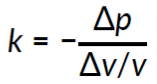
벌크 계수는 균일한 압축에 대한 재료의 저항을 설명하는 데 사용되는 과학 용어입니다. 이는 압력 변화를 결과적인 상대 부피 변화와 연결하는 비례 상수입니다.
이 개념은 등방성 재료 요소가 단위 부피의 입방체로 시각화되면 더욱 명확해집니다. 이 큐브에 수직 응력이 가해지…
벌크 탄성률은 균일한 압축에 대한 재료의 저항을 측정합니다. 이는 압력의 변화와 그에 따른 상대적 부피 변화 사이의 비례 상수로 정의됩니다.
단위 부피의 등방성 입방체를 고려하십시오. 수직 응력을 받으면 새로운 볼륨이 있는 평행 육면체의 직사각형으로 변형됩니다.
이 새로운 책과 원래 책의 차이를 재료의 팽창이라고 합니다. 팽창은 세 방향 모두에서 변형률의 합으로 표현할 수 있습니다.
균일한 정수압을 받는 물체의 경우 응력의 각 구성 요소는 정수압의 음수와 같습니다.
이러한 값을 팽창 방정식에 대입하면 벌크 계수로 알려진 상수를 도입하는 표현식이 생성되며, 이는 탄성 계수와 동일한 단위로 표현됩니다.
정수압 하에서 안정된 재료는 부피가 감소하여 팽창이 음수이고 벌크 계수가 양수가됩니다.
푸아송 비율이 0인 이상적인 재료는 측면 수축 없이 늘어날 수 있습니다. 반대로 푸아송 비율 0.5는 완벽한 비압축성을 의미합니다.
View the full transcript and gain access to JoVE Core videos
Q1: What does bulk modulus measure in materials?
Bulk modulus measures a material's resistance to uniform compression. It is defined as the proportionality constant between a change in pressure and the resulting relative volume change. Materials with higher bulk modulus values resist compression more effectively than those with lower values.
Q2: How is dilatation related to bulk modulus?
Dilatation represents the total volume change of a material and is calculated as the sum of strains in all three directions. When a material undergoes uniform hydrostatic pressure, the dilatation becomes negative for stable materials. The bulk modulus is derived by substituting stress components into the dilatation equation.
Q3: What happens to an isotropic cube under hydrostatic pressure?
An isotropic cube of unit volume deforms into a rectangular parallelepiped when subjected to normal stresses. The difference between the new volume and original volume is termed dilatation. Under uniform hydrostatic pressure, each stress component equals the negative of the pressure applied.
Q4: How does Poisson's ratio affect material incompressibility?
Poisson's ratio determines lateral contraction behavior during deformation. A material with zero Poisson's ratio can stretch without lateral contraction. Conversely, a Poisson's ratio of 0.5 signifies perfect incompressibility, meaning the material maintains constant volume during deformation under the relation between Poisson's ratio, modulus of elasticity and modulus of rigidity.
Q5: Why is bulk modulus always positive for stable materials?
Stable materials decrease in volume when subjected to hydrostatic pressure, making dilatation negative. Since bulk modulus is the proportionality constant relating pressure change to relative volume change, the negative dilatation combined with negative pressure results in a positive bulk modulus value.
Q6: What units does bulk modulus use?
Bulk modulus is expressed in the same units as the modulus of elasticity, typically pascals (Pa) or megapascals (MPa). This consistency in units allows for direct comparison between bulk modulus and other elastic constants when analyzing material behavior under various loading conditions.
Q7: How does bulk modulus differ from other elastic constants?
Bulk modulus specifically measures resistance to uniform volumetric compression, while other elastic constants address different deformation modes. The modulus of elasticity measures resistance to axial loading, and modulus of rigidity measures resistance to shear. Bulk modulus uniquely characterizes material behavior under hydrostatic pressure.