단백질 상호 작용은 세포의 기능의 핵심이다. 열량 및 분광 기술은 일반적으로 그 특성을하는 데 사용됩니다. 여기에서 우리는 Shwachman - 다이아몬드 증후군 (SBDS)에 돌연변이 단백질과 신장 인자 같은 1는 GTPase (EFL1) 사이의 상호 작용을 연구하는 도구로 형광 이방성을 설명합니다.
이 콘텐츠를 보려면 JoVE 구독이 필요합니다. 로그인하거나 오늘 무료 평가판을 시작하세요.
이 논문에서
요약
초록
단백질 - 단백질 상호 작용은 살아있는 유기체의 기능에 필수적인 역할을한다. 상호 작용이 식별되고 확인되면 그 구조 및 기계적인 레벨을 특성화하는 것이 필요하다. 여러 생화학 및 생물 물리학 적 방법은 이러한 목적을 위해 존재한다. 형광 표지 된 단백질의 형광 강도가 단백질 - 단백질 상호 작용에 따라 일정하게 유지 될 때 그 중에서도 형광 이방성 특히 사용하는 강력한 기술이다. 이 방법에서, 형광 표지 된 단백질을 선택적으로 수신 빔의 상대적인 방향에 따른 형광체의 일부를 여기 적절한 파장의 수직 편광 된 광에 의해 여기된다. 다음과 같이 생성 된 배출량은 누구의 수직 및 수평 평면에 관계 이방성 (r)을 정의하는 방향성을 가지고 : r은 (I VV -I VH가) / (I VV + 2I VH), 나는 절과 I = 위치
서론
세포는 끊임없이 서로 상호 작용 생체 거대 분자의 다수 포함되어 있습니다. 이 연관은 신호 전달, 유전자 발현 및 다른 이들 세포 이동의 조절에서 이들의 기능을 담당 세포 경로에 참여 착물을 일으킨다. 세포 내에서 발생하는 모든 단백질 - 단백질 상호 작용은 상호 작용 체라고하는 네트워크를 포함한다. 사카로 마이 세스 세레 비지에서의 단백질의 70 % 이상이 상호 작용 파트너 일을하는 것으로 나타났다. 셀의 상호 작용 체를 이해하고 그 기능은 복잡성과 생물의 다양성에 관련 정보를 제공합니다. 여러 방법은 단백질 - 단백질 상호 작용을 확인하고 특성화하기 위해 설명되었다. 효모 두 하이브리드 2, 단백질 단편 보완 분석 (3), 질량 분석 및 단백질 microarra에 결합 친 화성 정제 4로 넣어 방법을 통해 높은 다른YS는 5,6- 작용을 식별하기 위해 사용된다. 식별되면,이를 검증하기 위해 필요하며, 이는 경우에 따라 달라질 수있다. 일반적으로, 이들 실험은 유전자 결실 또는 단백질 중 하나의 과다 발현에 의해 상호 작용 쌍 등의 각 부재의 수준에서 작용 자체를 방해 포함하고 상기 다른 부재의 특성의 변화 나 함수를 찾고 세포 수준. 이어서, 생물 리 학적 기법 7은 분자 수준에서 단백질 - 단백질 상호 작용을 특성화하기 위해 사용된다. 열량 형광 분광법 정량적 및 기계적으로이를 설명하기 위해 사용되는 동안이를 위해, 단백질 복합체의 구조는 X 선 결정학, 핵 자기 공명 및 극저온 전자 현미경에 의해 결정된다.
본 연구에서는 형광의 이방성이는 GTPase EFL1 및 SBD 간의 상호 작용을 특성화하는 방법을 사용 하였다S 단백질. 이 단백질은 60S 리보솜 서브 유닛 (8)의 표면에서 진핵 개시 인자 (6)의 방출을 촉진하여 리보솜의 합성에 참여하고 있습니다. SBDS 단백질 EFL1는 구아노 신 다이 포스페이트 (10, 11)에 대한 그것의 친화도를 감소시키는 구아닌 뉴클레오타이드 교환 인자로서 Shwachman 증후군 다이아몬드-9 및 행위로 알려진 질환 돌연변이된다. SBDS의 질병 돌연변이는 EFL1과의 상호 작용을 폐지하고, 따라서 그것의 활성화를 방지 할 수 있습니다.
형광의 이방성은 일반적으로 단백질 - 펩타이드 또는 단백질 - 핵산 상호 작용을 연구하는 생물학 분야에 사용된다. 이것은 형광 물질이 부분적으로 편광 된 방사의 편광 결과 여기 있다는 원리에 기초한다. 형광 이방성은 수학 식 1에 의해 정의된다 :

나는 절 내가 VH는 어디에수직 편광 된 광 (12)에 시료가 여기 될 때 수직 (VV) 및 가로 (VH)의 형광 발광 강도를 편광. 형광 이방성 형광의 회전 확산 속도에 영향을주는 요인에 민감하므로, 온도, 용액의 점도 및 형광 물질의 겉보기 분자 크기에 따라 달라진다. 또 다른 단백질과 같은 변화와 상호 작용할 때 형광 증가를 함유하는 단백질의 겉보기 크기이어서 이방성의 변화로 평가 될 수있다. 구체적으로는, 그것의 형광 수명을 용액 상대적으로 천천히 회전 형광 비교적 큰 이방성을 나타내는 것 때문에 큰 I VV의 값 I VH 작은 값을 가질 것이다. 자신의 형광 수명에 빠르게 상대 공중제비 형광, 나는 절 내가 VH는 유사합니다 및 이방성 값이 작은 것 (12) (그림 1). 또한, 노이즈 측정에 좋은 이방성 신호를 들면, 대상 분자의 회전 상관 시간 유사한 형광 수명을 가진 형광 물질이 필요하다. 그렇지 않으면 정확하게 복잡 프리 단백질과 그 이방성의 차이를 기록 할 수 없다. 예를 들어, 다 100의 저 분자량 화합물에 부착 같은 형광 또는 로다 민과 같은 4 NSEC 가까운 수명과 형광 프로브의 이방성은 0.05이다. kDa의 0.29로 그 이방성 값을 증가 (160)의 분자에 결합; 정확하게 측정 할 수있는 차이. 반면에, 그 증가 분자 크기가 변화 65 내지 1,000 kDa의 결합 반응에 관여 동일한 형광 프로브는 정확하게 측정하기에는 너무 작 0.3-0.28의 이방성이 변화 될 것이다. 이 시나리오에서 400 나노초의 수명이 프로브 (12)에 더 적합 할 것이다.
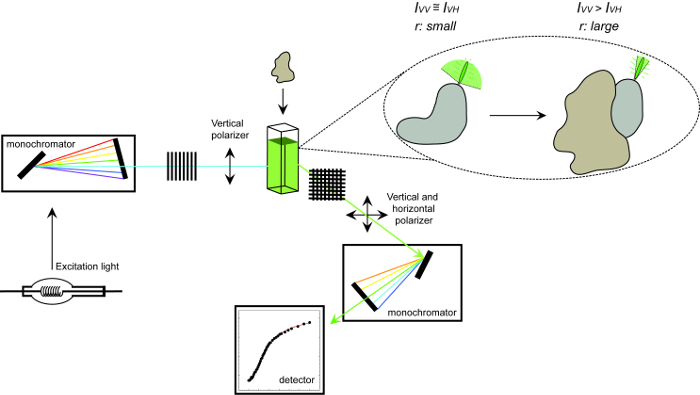
형광 이방성 절차를 측정하는 데 사용되는 장치의 개략도 1.도. 단백질 - 단백질 상호 작용의 실험 측정 형광 이방성을 수행하는 데 사용되는 장치의 개략도. 상호 작용 파트너의 결합에 증가 빠른 디스플레이 작은 이방성을 공중제비 형광. 이 그림의 더 큰 버전을 보려면 여기를 클릭하십시오.
형광 응용 연구 분자 중 어느 하나의 형광의 존재를 필요로한다. 형광의 세 가지 유형이 단백질 - 단백질 상호 작용을 연구하는 방법 : 1) 단백질에 존재하는 트립토판 잔류 물, 2) 녹색 형광 단백질 (GFP)와 deriva 같은 화학적으로 부착 된 형광 3) 형광 융합 파트너tives. 대부분의 단백질은 그 구조의 상호 작용을 측정하는 것이 가장 간단한 방법 대응 형광 스펙트럼의 변화를 모니터링함으로써 또는 트립토판 잔기의 형광 강도의 변화를 감시함으로써이다 트립토판 잔기를 갖는다. 그러나, 트립토판 잔기의 분석을 복잡 단백질 모두에 존재할 수있다. 형광 인한 상호 작용을 형광의 속성을 변경하는 한편, 또는 결합 부위 근처에 위치해야하며 상호 자체를 방해 할 수있다. 같은 GFP와 같은 부피가 큰 형광체를 사용할 때 특별한주의가 필요합니다. 이 형광체 중에 결합 연구에 사용 할 수없는 경우는, 관여하는 단백질의 하나 외인성 형광체를 도입 할 필요가있다. 많은 화학적으로 합성 된 형광체는 존재 공유 같은 아민 기 (라이신 또는 N 말단의 측쇄) 및 시스테인의 티올기를 그들의 반응성기를 통해 단백질에 부착 될 수있다. 에프요오도 아세트 아미드 및 말레이 미드가 티올 - 반응성 기 (13) 동안 이소 티오 시아 네이트 및 숙신 이미 딜 에스테르로 luorophore 유도체 아미드 기와 반응. 형광 애플리케이션에서 가장 일반적으로 사용되는 염료는 플루오 레세 인 유도체 및 로다 민 그린 염료, 쿠마린, BODIPY 형광 단 알렉사 형석 염료이다. 상업적으로 입수 가능한 형광체와 그 사용의 자세한 목록은 참고 문헌 14, 15에서 볼 수있다. 성공적인 라벨링, 반응성 그룹은 단백질 표면에 노출되어야하지만 의한 폴리펩티드 전형적으로 존재하는 반응성 관능기의 다수는 부위 특이 적 변형을 얻는 것은 매우 어렵다. 이 연구에 대한 관심의 단백질, SBDS, 여러 사이트 표시 될 수 있습니다 5 무료 시스테인, 33 라이신이 포함되어 있습니다. 불균일 한 표시는 결합에 영향을 미칠 수있는 다른 형광 분자가 결합에 따라 상이한 형광 강도 신호를 유도 할 수있다으로 데이터 분석을 복잡하게한다. 비켜하려면이 문제를 rcome 우리는 플래시 형광, 4 '부위 - 직접 라벨, 5'- 비스 (1,3,2 dithioarsolan -2- 일) - 플루오 레세 SBDS 단백질을 사용 하였다. 이 모티프는 X 시스테인 (16, 17) 이외의 아미노산 서열로 이루어진 플래시 CCXXCC 태그로 알려진 네 개의 이격 시스테인에 대한 높은 친 화성을 갖는 arsenoxide 염료이다. 이 tetracysteine 모티브 함께 단백질의 전체 스크롤의 중단을 방지하기 위해 적당한 링커로 유전 공학에 의해 N- 또는 단백질의 C 말단에 부가된다. 플래시 염료 및 플래시 태그 이루어지는 쌍은 원래 셀 17 거주 지역 사이트 별 라벨 단백질 설계되었지만, 또한 여기에 열거 된 바와 같이 시험 관내에서 정제 된 단백질의 라벨을 사용할 수있다. 또한, 효소 적 전략은 단백질 (18)의 부위 특이 적 작용을 가능하게하기 위해 개발되어왔다.
이 논문에서는 형광 이방성 (A)의 유용성을 설명SA 도구는 단백질 - 단백질 상호 작용을 연구합니다. 정량적 인 정보는 실험 데이터의 피트로부터 얻어 질 수있는 반면 결합은 결합 곡선 형상의 간단한 검사에 의해 평가 될 수있다.
액세스가 제한되었습니다. 이 콘텐츠를 보려면 로그인하거나 체험판을 시작하세요.
프로토콜
1. SBDS 플래시 태그 단백질 발현 및 정제
주 : 이방성 실험 들어, 플래시 태그 시스테인은 시스테인 - - 프로의 Gly-Cys 또는 Cys이고-는 PCR에 의해 서열을 코딩하는 인간 SBDS의 C 말단에 추가 된 시퀀스에 대응. 이 구조는 발현 벡터 pRSET-A에 서브 클로닝하여 N- 말단 헥사 히스티딘 태그 (그의 태그)를 코딩하는 단백질을 발현하는 대장균 C41 세포에 형질 전환하고, 시퀀스 및 C 말단 플래시 태그 (10)를 부호화 인간 SBDS.
- SBDS 플래시 단백질 발현
- 관할 E. 변환 표준 열 충격 프로토콜 (19)을 이용하여 플라스미드 pRSET-HisSBDS 플래시와 대장균 C41 셀. 100 μg의 / ㎖의 앰피 실린이 보충 된 고체 루리아 - 베르 타니 (LB) 배지에서 세포를 플레이트. LB 고체 배지 조성물은 10g의 NaCl, 5g 효모 추출물, 10g 트립 톤 1 L의 볼륨 20g 한천로 구성되어 있습니다.
- 37 ° C에서 문화 형질 전환 된 박테리아까지600 nm의 (A 600)에서 흡광도를 100 μg의 / ㎖의 앰피 실린이 보충 된 LB 액체 매체의 1 L에 0.5-0.7에 도달한다.
- 배양액에 0.5 mM의 이소 프로필 β-D-1- 티오 갈 락토 피 라노 사이드를 첨가하여 단백질 발현을 유도하고 추가 5 시간 동안 인큐베이션을 계속한다.
- 4 ℃에서 10 분 동안 3,800 XG에서 원심 분리하여 세균 현탁액을 수집합니다. 뜨는을 제거합니다. 이 때, -20 ° C에서 세포 펠렛을 저장 있거나, 단백질 정제를 위해 즉시 사용한다.
- SBDS 플래시 단백질 정제
참고 : 모든 크로마토 그래피 단계는 고속 단백질 액체 크로마토 그래피 (FPLC) 시스템 또는 연동 펌프를 사용하여 수행됩니다. 니켈 2 + - 친 화성 크로마토 그래피는 5 ml의 빠른 흐름 열을 사용합니다. 음이온 교환 크로마토 그래피는 5 ml의 강한 설포 프로필의 양이온 교환 컬럼을 사용합니다. 3 ㎖의 유속 / 분의 모든 크로마토 그래피 단계를 이용 하였다.- SBDS 용해 B 35 ml의 세포를 재현 탁uffer 4 분 OFF 10 초 ON과 30 초의 사이클을 사용하는 전체 시간 동안 초음파 처리하여 1mM의 페닐 메틸 설 포닐 플루오 라이드 (PMSF) 및 다운 Lyse 보충 (의 50 mM 인산 완충액 pH 7.5, 300 mM의 염화나트륨, 20 mM의 이미 다졸) 4에서 기음.
- 4 ℃에서 50 분 동안 9,000 XG에서 샘플을 원심 분리기.
- 뜨는을 유지하고 세포 파편을 제거하는 펠렛을 폐기합니다.
- SBDS 용해 버퍼의 3 열 볼륨 (CV)와 니켈 2 + 친 화성 컬럼을 평형과 컬럼에 뜨는을 명확히 전체를 소개합니다.
- SBDS 용해 버퍼의 3 CV로 세척하여 언 바운드 단백질을 제거하고 SBDS 용출 버퍼의 3 CV (50 mM의 인산 완충액 pH 7.5, 300 mM의 NaCl을, 250 mM의 이미 다졸)로 용출.
- 50 mM의 인산염 완충액 pH 6.5 용출 된 단백질 6 배 희석하고 0.22 μm의 셀룰로오스 막을 통해 여과에 의해 가능한 집계를 제거합니다.
- 낮은 소금 S 컬럼의 3 CV와 설포 프로필의 양이온 교환 컬럼을 평형완충액 (50 mM의 인산 완충액 pH 6.5, 50 mM의 염화나트륨) 및 이전 단계로부터의 단백질 샘플을 소개한다.
- 워시 바운드 낮은 염 S 컬럼 완충액 3 CV로 소재의 50 mM 인산 완충액 pH 6.5, 1 M NaCl을 하나의 공정에서 단백질을 용출시킨다.
- 50 mM의 인산염 완충액 pH 6.5 용출 된 단백질 3.3 배 희석. 15 분 동안 3800 × g으로 원심 분리하여 한외 여과 장치와 단백질을 농축시킨다. 플래시는 액체 질소의 단백질을 동결하고 추가로 사용할 때까지 -80 ° C에서 보관합니다.
- SDS-PAGE 분석하고 쿠마시 20 염색으로 단백질의 순도를 확인한다.
2. EFL1 단백질 발현 및 정제
참고 : EFL1는 걸 1/10 발산 프로모터 (21)와 벡터 pRS426의 사카로 마이 세스 세레 비지에 MAT 3'UTR의 규정에 따라 표현되었다. 재조합 단백질은 담배 식각 바이러스 단백질 분해 효소에 융합 된 인간 EFL1 이성체 1 (부호화TEV) 인식 부위 및 C 말단에 헥사 히스티딘 태그.
- EFL1 단백질 발현
- S. 변환 표준 아세트산 리튬 프로토콜 (22)을 이용하여 플라스미드 pRS426-EFL1TevHis와 cerevisiae에 BCY123 셀. 2 % (w / v)의 포도당 보충 우라실 (SD-URA)없이 미디어 밖으로 합성 드롭의 모든 형질 전환 된 세포를 플레이트. 는 SD-URA 매체의 구성 아미노산없이 8g 효모 질소베이스, 11g의 카사 미노산, 55 mg의 아데닌 설페이트, 55 mg의 티로신, 60 mg을 류신 1 L 부피 60 mg을 트립토판으로 구성되어 있습니다.
- 600 0.5 % (w / v) 글루코오스로 보충 SD-URA 매체 1 1.8 L에 도달 할 때까지 배양은 30 ° C에서 효모 형질 전환.
- 문화에 갈락토스 (/ V W) 2.8 %를 추가하여 단백질 발현을 유도하고 30 ° C에서 추가로 18 시간 동안 배양을 계속합니다.
- 4 ℃에서 10 분 동안 3,800 XG에서 원심 분리하여 효모 현탁액을 수집합니다. 뜨는을 제거합니다.이 때, -20 ° C에서 세포 펠렛을 저장 있거나, 단백질 정제를 위해 즉시 사용한다.
- EFL1의 단백질 정제
참고 : 모든 크로마토 그래피 단계는 FPLC 시스템 또는 연동 펌프를 사용하여 수행됩니다. 니켈 2+ - 친 화성 크로마토 그래피 / 분으로 3 ㎖의 유속으로 5 ㎖ 패스트 플로우 칼럼을 사용한다. 크기 배제 크로마토 그래피에 의해 125 ml의 컬럼 1 ㎖ / 분의 유속으로 수퍼 덱스 200 수지로 미리 충전을 사용한다.- 1mM의 PMSF 및 1 ㎜의 벤즈 아미 딘이 보충 EFL1 용해 완충액 (50 mM Tris-HCl pH를 8, 300 mM의 염화나트륨, 20 mM의 이미 다졸, 5 밀리미터의 MgCl 2, 10 % 글리세롤) 50ml에 세포를 재현 탁에 의해 세포를 파괴 4 ℃에서, 2 분 ON 및 OFF 15 분 6 분 사용주기의 총 시간을 유리 비드 (Ø = 0.5 mm)를 이용하여 비드 비터 마찰.
- 4 ℃에서 50 분 동안 9,000 XG에서 샘플을 원심 분리기.
- 뜨는을 유지하고 세포 파편을 제거하는 펠렛을 폐기합니다.
- EFL1 용해 버퍼의 3 CV와 니켈 2 + 친 화성 컬럼을 평형과 열의에 모든 명확히 뜨는을 소개합니다.
- EFL1 용해 완충액 3 CV로 세척하여 결합되지 않은 단백질을 제거하고 EFL1 용출 완충제 3 CV (50mM 트리스 - 염산 pH를 8, 300 mM의 NaCl을 250 mM의 이미 다졸, 5 밀리미터의 MgCl 2, 10 % 글리세롤)로 용출.
- 이방성 완충액 1.5 CV (50mM 트리스 - 염산 pH를 7.5, 300 mM의 NaCl을 5 밀리미터의 MgCl 2, 10 % 글리세롤, 5 밀리미터 β 머 캅토 에탄올)으로 크기 배제 컬럼을 평형화.
- 1 ml의 원하는 볼륨으로 3,800 XG에서 원심 분리하여 한외 여과 장치와 니켈 2 + 친 화성 컬럼에서 용출 EFL1 단백질에 집중. 크기 제외 칼럼에 샘플을 소개합니다.
- 용출 된 단백질을 수집하고 약 30 μM의 최종 농도로 한외 여과로 농축시켰다. 플래시는 더 사용할 때까지 -80 ° C에서 액체 질소와 저장소에있는 단백질을 동결. 일 확인SDS-PAGE 분석하고 쿠마시 20 염색으로 단백질 E 순도.
플래시 형광 염료 4 ', 5'- 비스 (1,3,2 dithioarsolan -2- 일) 플루 오레와 SBDS 플래시 3. 라벨링
- , 4 '의 3 nmol의와 5'- 비스 (1,3,2 dithioarsolan -2- 일) 이방성 버퍼의 5 μl의 볼륨에 형광 염료를 SBDS 플래시 단백질의 3 nmol의 혼합.
- 반응이 4 ℃에서 8 시간 동안 진행하자. 무료 염료를 제거하기 위해 밤새 이방성 버퍼에 대한 샘플을 투석.
- 표지 단백질의 %를 정량화하기 위해 램버트 - 비어 법을 사용합니다. 280 nm의 적절한 용적을 석영 큐벳을 사용하여 분광 광도계의 508 nm에서의 흡광도를 측정한다. 참고 : 다음과 같은 몰 흡수 계수 (M -1 cm -1)을 고려 :

- 수학 식 2 사용하여 라벨 SBDS 플래시 단백질의 농도를 계산한다.

- 이전 단계에서 계산 된 C SBDS 플래시를 대체하여 식 (3) 사용하여 총 SBDS 단백질의 농도를 계산한다.

- 식 4 사용하여 라벨이 단백질의 비율을 계산합니다.

4. 형광 이방성 실험
주 : 이방성 실험 편광 도구와 데이터 수집은 장치의 소프트웨어에서 제공 이방성 프로그램을 사용하여 수행 하였다 구비 한 분광에서 수행 하였다. 여기 파장은 8 nm의 스펙트럼 대역폭을 갖는 494 nm에서 설정하고, 발광은 530 ± 25 ㎚의 밴드 패스 필터를 사용하여 기록 하였다. 측정은 5mm 경로 길이 (10) 200 ㎕를 큐벳에 25 ℃에서 수행 하였다.
- 형광 큐벳에서, 이방성 버퍼에 30 nM의 SBDS 플래시의 200 μl를 배치하고 30 μM의 EFL1 2 μl를 적정한다. 철저하게 혼합하고 반응이 이방성 값을 측정하기 전에 3 분간 방치 할 수 있습니다.
- EFL1 40 μL의 총 부피 때까지 단계를 반복 4.1이 추가되었습니다.
5. 데이터 분석
- 비선형 최소 자승 회귀 알고리즘을 사용하여 적절한 결합 모델에 데이터를 장착한다. 가장 흔한 결합 모델 방정식은 표 1에 제시되어있다.
- 피팅 (23)의 잔류를 검사하여 단백질 사이의 상호 작용을 설명하는 가장 좋은 모델을 평가합니다. 추가 실험으로 선택한 모델을 지원합니다.
표 1. 일반 단백질 - 단백질 상호 작용 결합 모델을 설명하는 수학적 방정식.0 / 54640table1large.jpg "대상 ="_ 빈 ">이 테이블의 더 큰 버전을 보려면 여기를 클릭하십시오. 
액세스가 제한되었습니다. 이 콘텐츠를 보려면 로그인하거나 체험판을 시작하세요.
결과
어떤 이방성 실험을 수행하기 위해 그 종의 혼합물의 관찰 이방성을 수학 식 5에 의해 표현되기 때문에, 형광체의 형광 강도의 큰 변화를 배제하는 것이 중요하다 :

F 내가 각 구성 요소 및 R의 소수 형광을 나타낸다 내가 해당 이방성이다. 각 성분의 소수 형광 양에 따라 식 (6)에 의해 정의되는 농도 및 상대적인 형광 :
액세스가 제한되었습니다. 이 콘텐츠를 보려면 로그인하거나 체험판을 시작하세요.
토론
단백질과 대부분의 생화학 실험에 관계없이 사용되는 기술, 순수 단백질뿐만 아니라, 그들 중 많은 양뿐만 아니라 필요합니다. 그것은 여기에 제시된 경우와 같이이 때문에, 실험의 이러한 유형에 사용되는 단백질은, 이종 발현에 의해 얻어진다. 개화 분광법은 공부 분자에 형광의 존재를 필요로한다. 이들은 대부분의 단백질에 공통적 모두에 존재할 것이기 때문에, 방향족 잔기가 단백질 - 단백질 상호 작용을 연구하기 위해 분석을 그 신호를 복잡하게 이용하지만, 단백질의 고유 형광을 구성 수용체 단백질과 리간드. 또한 트립토판의 수명은 형광 이방성 실험하기에는 너무 짧다. 이러한 이유로, 단백질 연구 중 하나 외인성 형광 단을 추가하는 것이 일반적이다. 이를 위해, 형광 염료 4 ', 5'- 비스 (1,3,2 dithioarsolan -2- 일) - (F) 사이의 배위 결합을 통해 SBDS의 C 말단에 첨가유전 공학에 의한 단백질에 도입 된 tetracysteine 모티브로 luorescein. 형광을 지탱 단백질을 선택하...
액세스가 제한되었습니다. 이 콘텐츠를 보려면 로그인하거나 체험판을 시작하세요.
공개 사항
저자는 공개할 것이 없으며 경쟁하는 금전적 이해관계도 없습니다.
감사의 글
저자는 CONACyT 프로젝트 번호 167359 및 177138와 DGAPA-UNAM 프로젝트 번호 IN201615의 재정적 지원을 인정합니다.
액세스가 제한되었습니다. 이 콘텐츠를 보려면 로그인하거나 체험판을 시작하세요.
재료
| 이름 | 회사 | 카탈로그 번호 | 댓글 |
|---|---|---|---|
| 0.5mm 유리 구슬 | Biospec 제품 | 11079105 | |
| Tris Base | Formedium | TRIS01 | 초순수 |
| 글리세롤 | Sigma-Aldrich | G5516 | |
| 염료 4',5'-bis(1,3,2 dithioarsolan-2-yl) fluorescein | ThermoFischer Scientific | LC6090 | 이 키트에는 FlAsH 태그 Ampiciline을 표시하는 염료가 포함되어 있습니다 |
| IBI Shelton Scientific, Inc | IB02040 | ||
| D(+)-글루코스 무수 | formedium | GLU03 | |
| D(+)-갈락토스 | formedium | GAL03 | |
| L-류신 | formedium | DOC0157 | |
| l-tryptofan | Formedium | DOC0189 | |
| Bezamidine hydrochloride | Sigma-Aldrich | B6506-5G | |
| PMSF | Gold Biotechnology, Inc | P-470-25 | Phenylmethylsulfonyl fluoride |
| NaCl | Formedium | NAC02 | 염화나트륨 |
| 글리세롤 | Tecsiquim, S.A. 드 C.V. | GT1980-6 | |
| MgCl2 | Merck Millipore Corporation | 1725711000 | 염화마그네슘 |
| 이미다졸 | 시그마-알드리치 | I2399-500G | |
| 2-메르캅토에탄올 | 시그마-알드리치 | M6250-100ML | |
| K2HPO4 | Sigma-Aldrich | P3786-500G | 인산칼륨 이염 기성 |
| NaH 2 < / sub>PO 4 < / sub> | Sigma-Aldrich | S3139-500G | 인산 나트륨 아미노산이없는 일 염 |
| 효모 질소 염기 | Formedium | CYN0410 | |
| 효모 추출물 | Formedium | YEM03 | 마이크로 과립 |
| L-Tyroisne | Formedium | DOC0193 | |
| 아데닌 황산염 | Formedium | DOC0230 | |
| Casamino acids | Formedium | CAS03 | |
| Tryptone | IBI Shelton Scientific, Inc | IB49182 | |
| IPTG | Formedium | IPTG025 | |
| 여과 유닛 | Merck Millipore Corporation | UFC901096 | Amicon Ultra-15, membrana PLGC Ultracel-PL, 10 kDa |
| 멤브레인 필터 | Merck Millipore Corporation | GSWP04700 | 멤브레인 필터, 혼합 셀룰로오스 에스테르, 친수성, 0.22 &마이크로; 남, 47 mm, 흰색, 일반 |
| Ni2+ 친화도 칼럼 | QIAGEN | 30760 | 카트리지는 5 ml Ni-NTA Superflow |
| Strong Sulfopropyl 양이온 교환기 컬럼 | GE Healthcare Life Science | 17-5157-01 | HiTrap SP Sepharose FF 5 ml |
| 크기 제외 컬럼 | GE Healthcare Life Science | 28989335 | HiLoad 16/600 Superdex 200 PG |
| 형광 셀 | Hellma Analytics | 111-057-40 | |
| 분광 광도계 | Agilent Technologies | G6860AA | 캐리 60 UV-Vis |
| 셰이커 | ThermoFischer Scientific | SHKA4000-7 | MaxQ 4000 벤치탑 온도 범위 Ambient-15° to 60° C |
| Centrifuge | ThermoFischer Scientific | 75004271 | Heraeus Megafuge 16R |
| FPLC | Pharmacia Biotech | 단종 | FPLC 시스템 전도도 UV-MM II 모니터 P500 펌프 분 |
| 획 분광 형광계 | Olis | 해당 없음 | Olis DM 45 with Polarization Toolbox |
참고문헌
- Krogan, N. J., et al. Global landscape of protein complexes in the yeast Saccharomyces cerevisiae. Nature. 440 (7084), 637-643 (2006).
- Fields, S., Song, O. A novel genetic system to detect protein-protein interactions. Nature. 340, 245-246 (1989).
- Michnick, S. W., Hien Ear, P., Landry, C., Malleshaiah, M. K., Messier, V. A toolkit of protein-fragment complementation assays for studying and dissecting large-scale and dynamic protein-protein interactions in living cells. Methods in Enzymology. 470, 336-366 (2010).
- Puig, O., et al. The tandem affinity purification (TAP) method: a general procedure of protein complex purification. Methods. 24, 218-229 (2001).
- Dwane, S., Kiely, P. A. Tools used to study how protein complexes are assembled in signaling cascades. Bioeng Bugs. 2 (5), 247-259 (2011).
- Snider, J., et al. Fundamentals of protein interaction network mapping. Mol Syst Biol. 11 (12), 848(2015).
- Fersht, A. Structure and mechanism in protein science: a guide to enzyme catalysis and protein folding. Baldwin, R. L. , W. H. Freeman and Company. 191-214 (2002).
- Menne, T. F., et al. The Shwachman-Bodian-Diamond syndrome protein mediates translational activation of ribosomes in yeast. Nat Genet. 39 (4), 486-495 (2007).
- Boocock, G. R., et al. Mutations in SBDS are associated with Shwachman-Diamond syndrome. Nat Genet. 33 (1), 97-101 (2003).
- Garcia-Marquez, A., Gijsbers, A., de la Mora, E., Sanchez-Puig, N. Defective Guanine Nucleotide Exchange in the Elongation Factor-like 1 (EFL1) GTPase by Mutations in the Shwachman-Diamond Syndrome Protein. J Biol Chem. 290 (29), 17669-17678 (2015).
- Gijsbers, A., Garcia-Marquez, A., Luviano, A., Sanchez-Puig, N. Guanine nucleotide exchange in the ribosomal GTPase EFL1 is modulated by the protein mutated in the Shwachman-Diamond syndrome. Biochem Biophys Res Commun. 437 (3), 349-354 (2013).
- Lakowicz, J. R. Principles of fluorescence spectroscopy. , Third, Springer US. (2010).
- Nishigaki, T., Treviño, C. L. Tools to understand protein-protein interactions. Gòmez, I. 37, Transworld Research Network. 1-14 (2012).
- Johnson, I. The Molecular Probes Handbook: A Guide to Fluorescent Probes and Labeling Technologies. , 11th, Life Technologies Corporation. (2010).
- Sabnis, R. W. Handbook of Fluorescent Dyes and Probes. , Wiley. (2015).
- Adams, S. R., et al. New biarsenical ligands and tetracysteine motifs for protein labeling in vitro and in vivo: synthesis and biological applications. J Am Chem Soc. 124 (21), 6063-6076 (2002).
- Griffin, B. A., Adams, S. R., Tsien, R. Y. Specific covalent labeling of recombinant protein molecules inside live cells. Science. 281 (5374), 269-272 (1998).
- Rashidian, M., Dozier, J. K., Distefano, M. D. Enzymatic labeling of proteins: techniques and approaches. Bioconjug Chem. 24 (8), 1277-1294 (2013).
- Maniatis, T., Fritsch, E. F., Sambrook, J. Molecular cloning: A laboratory manual. , 3rd, Cold Spring Harbor Laboratory Press. (2001).
- Neuhoff, V., Arold, N., Taube, D., Ehrhardt, W. Improved staining of proteins in polyacrylamide gels including isoelectric focusing gels with clear background at nanogram sensitivity using Coomassie Brilliant Blue G-250 and R-250. Electrophoresis. 9 (6), 255-262 (1988).
- West, R. W. Jr, Chen, S. M., Putz, H., Butler, G., Banerjee, M. GAL1-GAL10 divergent promoter region of Saccharomyces cerevisiae contains negative control elements in addition to functionally separate and possibly overlapping upstream activating sequences. Genes Dev. 1 (10), 1118-1131 (1987).
- Ito, H., Fukuda, Y., Murata, K., Kimura, A. Transformation of intact yeast cells treated with alkali cations. J Bacteriol. 153 (1), 163-168 (1983).
- Eftink, M. R. Fluorescence methods for studying equilibrium macromolecule-ligand interactions. Methods Enzymol. 278, 221-257 (1997).
- Han, H., et al. Binding of Substrates to the Central Pore of the Vps4 ATPase Is Autoinhibited by the Microtubule Interacting and Trafficking (MIT) Domain and Activated by MIT Interacting Motifs (MIMs). J Biol Chem. 290 (21), 13490-13499 (2015).
- Sanchez-Puig, N., Veprintsev, D. B., Fersht, A. R. Binding of natively unfolded HIF-1alpha ODD domain to p53. Mol Cell. 17 (1), 11-21 (2005).
- Trusch, F., et al. The N-terminal Region of the Ubiquitin Regulatory X (UBX) Domain-containing Protein 1 (UBXD1) Modulates Interdomain Communication within the Valosin-containing Protein p97. J Biol Chem. 290 (49), 29414-29427 (2015).
- Kamp, F., Beyer, K. Binding of alpha-synuclein affects the lipid packing in bilayers of small vesicles. The Journal of Biological Chemsitry. 281, 9251-9259 (2006).
- Bujalowski, W. M., Jezewska, M. J. Fluorescence Intensity, Anisotropy, and Transient Dynamic Quenching Stopped-Flow Kinetics. Spectroscopic Methods of Analysis. 875, 105-133 (2012).
- Asano, N., et al. Direct interaction between EFL1 and SBDS is mediated by an intrinsically disordered insertion domain. Biochem Biophys Res Commun. 443 (4), 1251-1256 (2014).
액세스가 제한되었습니다. 이 콘텐츠를 보려면 로그인하거나 체험판을 시작하세요.
재인쇄 및 허가
