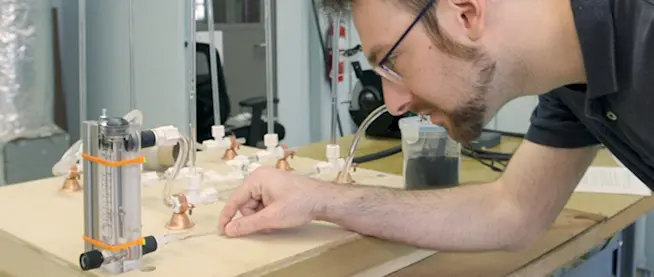
Source: Alexander S Rattner and Sanjay Adhikari; Department of Mechanical and Nuclear Engineering, The Pennsylvania State University, University Park, PA Objects, vehicles, and organisms immersed in fluid mediums experience forces from the surrounding fluid in the form of buoyancy- a vertical upward force due to fluid weight, drag- a resistive force opposite the direction of motion, and lift- a force perpendicular to the direction of motion. Prediction and characterization of these forces is...
Video Duration: 11 minutes and 30 seconds
Mechanical Engineering
Visual demonstrations of key scientific experiments

Table of Contents
Mechanical Engineering
15 Videos - 171 Minutes
View AllSource: Alexander S Rattner and Kevin Rao Li Department of Mechanical and Nuclear Engineering, The Pennsylvania State University, University Park, PA The objective of this experiment is to demonstrate the phenomenon of stability of floating vessels - the ability to self-right when rolled over to the side by some external force. Careful design of hull shapes and internal mass distribution enables seagoing vessels to be stable with low drafts (submerged depth of hull), improving vessel...
Video Duration: 13 minutes and 10 secondsSource: Alexander S Rattner; Department of Mechanical and Nuclear Engineering, The Pennsylvania State University, University Park, PA Aircraft, rockets, and ships produce propulsion by accelerating surrounding fluid or high temperature combustion products to high velocity. Because of the principle of conservation of momentum, the increased fluid velocity results in an effective thrust force on the vehicle. The thrust capabilities of propulsion systems are often measured with static thrust tests.
Video Duration: 10 minutes and 50 secondsSource: Alexander S Rattner, Department of Mechanical and Nuclear Engineering, The Pennsylvania State University, University Park, PA This experiment introduces the measurement and modeling of pressure losses in piping networks and internal flow systems. In such systems, frictional flow resistance from channel walls, fittings, and obstructions causes mechanical energy in the form of fluid pressure to be converted to heat. Engineering analyses are needed to size flow hardware to ensure...
Video Duration: 12 minutes and 27 secondsSource: Alexander S Rattner, Sanjay Adhikari, and Mahdi Nabil; Department of Mechanical and Nuclear Engineering, The Pennsylvania State University, University Park, PA Controlled heating followed by rapid cooling is an important element of many materials processing applications. This heat-treating procedure can increase material hardness, which is important for cutting tools or surfaces in high wear environments. The rapid cooling stage is called quenching, and is often performed by immersing...
Video Duration: 10 minutes and 57 secondsSource: Alexander S Rattner and Mahdi Nabil; Department of Mechanical and Nuclear Engineering, The Pennsylvania State University, University Park, PA When liquid flows along an open channel at high velocity, the flow can become unstable, and slight disturbances can cause the liquid upper surface to transition abruptly to a higher level (Fig. 1a). This sharp increase in the liquid level is called a hydraulic jump. The increase in the liquid level causes a reduction in the average flow velocity.
Video Duration: 9 minutes and 15 secondsSource: Alexander S Rattner and Christopher J Greer; Department of Mechanical and Nuclear Engineering, The Pennsylvania State University, University Park, PA Heat exchangers transfer thermal energy between two fluid streams, and are ubiquitous in energy systems. Common applications include car radiators (heat transfer from hot engine coolant to surrounding air), refrigerator evaporators (air inside refrigerator compartment to evaporating refrigerant), and cooling towers in power plants...
Video Duration: 11 minutes and 38 secondsSource: Alexander S Rattner and Christopher J Greer; Department of Mechanical and Nuclear Engineering, The Pennsylvania State University, University Park, PA This experiment demonstrates the principles of vapor compression refrigeration. The vapor compression cycle is the dominant refrigeration technology, found in most refrigerators, freezers, air-conditioning systems, and heat pumps. In this cycle, cooling (heat acquisition) is achieved with low-pressure evaporation of refrigerant. Thermal...
Video Duration: 12 minutes and 9 secondsSource: Ricardo Mejia-Alvarez and Hussam Hikmat Jabbar, Department of Mechanical Engineering, Michigan State University, East Lansing, MI Hot-wire anemometers have a very short time-response, which makes them ideal to measure rapidly fluctuating phenomena such as turbulent flows. The purpose of this experiment is to demonstrate the use of hot-wire anemometry.
Video Duration: 9 minutes and 17 secondsSource: Ricardo Mejia-Alvarez and Hussam Hikmat Jabbar, Department of Mechanical Engineering, Michigan State University, East Lansing, MI Turbulent flows exhibit very high frequency fluctuations that require instruments with high time-resolution for their appropriate characterization. Hot-wire anemometers have a short enough time-response to fulfill this requirement. The purpose of this experiment is to demonstrate the use of hot-wire anemometry to characterize a turbulent jet. In this...
Video Duration: 10 minutes and 5 secondsSource: Ricardo Mejia-Alvarez, Hussam Hikmat Jabbar and Mahmoud N. Abdullatif, Department of Mechanical Engineering, Michigan State University, East Lansing, MI Owing to the non-linear nature of its governing laws, fluid motion induces complicated flow patterns. Understanding the nature of these patterns has been the subject of intense scrutiny for centuries. Although personal computers and supercomputers are extensively used to deduce fluid flow patterns, their capabilities are still...
Video Duration: 10 minutes and 32 secondsSource: Ricardo Mejia-Alvarez and Hussam Hikmat Jabbar, Department of Mechanical Engineering, Michigan State University, East Lansing, MI The goal of this experiment is to demonstrate how a fluid flow exerts forces on structures by conversion of dynamic pressure into static pressure. To this end, we will make a plane jet impinge on a flat plate and will measure the resulting pressure distribution along the plate. The resultant force will be estimated by integrating the product between the...
Video Duration: 13 minutes and 29 secondsSource: Ricardo Mejia-Alvarez and Hussam Hikmat Jabbar, Department of Mechanical Engineering, Michigan State University, East Lansing, MI The purpose of this experiment is to demonstrate the application of the energy conservation equation to determine the performance of a flow system. To this end, the energy equation for steady, incompressible flow is applied to a short pipe with a gate valve. The gate valve is then gradually closed and its influence on flow conditions is characterized. In...
Video Duration: 10 minutes and 16 secondsSource: Ricardo Mejia-Alvarez and Hussam Hikmat Jabbar, Department of Mechanical Engineering, Michigan State University, East Lansing, MI The purpose of this experiment is to demonstrate the calibration of a flow passage as a flowmeter using a control volume (CV) formulation [1, 2]. The CV analysis focuses on the macroscopic effect of flow on engineering systems, rather than the detailed description that could be achieved with a detailed differential analysis. These two techniques should be...
Video Duration: 13 minutes and 35 secondsSource: Ricardo Mejia-Alvarez and Hussam Hikmat Jabbar, Department of Mechanical Engineering, Michigan State University, East Lansing, MI The purpose of this experiment is to demonstrate forces on bodies as the result of changes in the linear momentum of the flow around them using a control volume formulation [1, 2]. The control volume analysis focuses on the macroscopic effect of flow on engineering systems, rather than the detailed description that could be achieved with a differential...
Video Duration: 11 minutes and 31 seconds