This bibliometric analysis maps research development, major themes, and pharmacological directions in traditional Chinese medicine-derived regulation of macrophage polarization.
Onderzoeksartikel
Bibliometric Analysis of Traditional Chinese Medicine-Derived Bioactive Constituents in Macrophage Polarization Regulation
* These authors contributed equally
In dit artikel
Samenvatting
Samenvatting
Macrophage polarization contributes to inflammatory regulation, tumor immunity, tissue repair, and fibrosis. However, the knowledge structure, research evolution, and emerging pharmacological directions concerning the regulation of macrophage polarization by traditional Chinese medicine (TCM)-derived bioactive constituents have not been systematically characterized at the field level. English-language articles and reviews published between 1 January 2000 and 31 March 2026 were retrieved from the Web of Science Core Collection. After screening, 478 records were analyzed using VOSviewer 1.6.20 and CiteSpace 6.3.R1 to characterize publication trends, contributors, collaboration networks, co-citation relationships, keyword clusters, and citation bursts. Publication output increased markedly after 2019 and accelerated from 2022. China contributed the largest number of publications, with TCM-focused universities and institutes forming the principal institutional network. Major research themes included M1/M2 polarization, inflammatory signaling, tumor-associated macrophages, inflammatory bowel disease, gut microbiota, fibrosis, wound healing, and network pharmacology. Flavonoids, polyphenols, saponins, polysaccharides, and alkaloids were the main constituent classes identified. Recent research increasingly links macrophage regulation with immunometabolism, disease-specific microenvironments, microbiota-metabolite interactions, and direct target validation. The findings map the development and pharmacological directions of this research field and highlight the need for chemical profiling, multi-omics, single-cell technologies, and experimental target validation to clarify the material basis, molecular mechanisms, and disease-context-dependent effects of representative constituents.
Inleiding
Macrophages are major components of the innate immune system and are distributed throughout the liver, lung, intestine, spleen, and tumor microenvironment. They contribute to pathogen clearance, inflammatory responses, tissue homeostasis, and repair following injury. Their marked heterogeneity and plasticity allow transitions between functional states in response to local microenvironmental signals1. For descriptive purposes, macrophage activation is often classified into M1-like and M2-like categories; however, in vivo, these states represent a dynamic, overlapping continuum shaped by the surrounding microenvironment. M1 macrophages produce pro-inflammatory mediators, including tumor necrosis factor-alpha (TNF-α), interleukin-1 beta (IL-1β), and interleukin-6 (IL-6), and participate mainly in antimicrobial defense and amplification of inflammation. M2-associated states are more closely related to inflammation resolution, tissue repair, immunosuppression, and tumor progression2,3. Dysregulated macrophage polarization has been associated with cancer, infectious and metabolic diseases, cardiovascular disorders, and impaired tissue repair4,5,6, making it an important subject in basic and translational medicine.
The therapeutic effects of traditional Chinese medicine are partly attributable to diverse bioactive constituents, including flavonoids, polysaccharides, alkaloids, saponins, anthraquinones, terpenoids, and phenolic acids7,8. Modern pharmacological studies have increasingly associated these constituents with the regulation of macrophage polarization. Reported mechanisms involve NF-κB, MAPK, PI3K/Akt, JAK/STAT, the NOD-, leucine-rich repeat-, and pyrin domain-containing protein 3 (NLRP3) inflammasome, oxidative stress, and metabolic reprogramming9,10,11,12,13,14,15. Through these regulatory processes, bioactive TCM constituents may exert anti-inflammatory, antitumor, antifibrotic, immunomodulatory, and tissue-protective effects. Their effects on macrophage polarization have attracted particular attention in studies of the tumor immune microenvironment16, inflammatory diseases17, and repair after infection-related tissue injury.
Bibliometric analysis provides a quantitative approach for examining contributors, collaborative relationships, knowledge structures, and evolving research interests within a scientific field based on publication and citation data18. The Web of Science Core Collection (WoSCC) is commonly used as a literature source for such analyses, while CiteSpace and VOSviewer support co-occurrence, clustering, and citation-burst analysis. Research on the regulation of macrophage polarization by bioactive TCM constituents now encompasses inflammatory diseases, the tumor immune microenvironment, fibrosis, wound healing, metabolic disorders, and related topics. Previous reviews have generally focused on individual diseases, selected TCM constituents, or specific signaling pathways, whereas bibliometric studies in related areas have mainly examined broader TCM research or disease-specific applications. However, these studies have not provided an integrated field-level quantitative characterization that simultaneously links research contributors, collaboration and co-citation structures, representative constituent classes, disease-related contexts, and emerging validation strategies.
The present study, therefore, systematically retrieved and screened the relevant literature and used VOSviewer and CiteSpace to characterize publication trends, collaboration and co-citation structures, keyword evolution, clustering patterns, and citation bursts. The bibliometric findings were further integrated with representative pharmacological studies to identify major constituent classes, recurring mechanistic themes, disease-context-dependent patterns of macrophage regulation, and emerging methodological priorities. The research question was whether an integrated bibliometric analysis could define the development, knowledge structure, major pharmacological directions, and emerging research priorities of studies examining TCM-derived bioactive constituents and macrophage polarization.
Protocol
This study analyzed bibliographic records obtained from the Web of Science Core Collection and did not involve human participants, identifiable personal data, animals, or biological specimens. Therefore, institutional ethics approval and informed consent were not applicable. The analytical tools used in the study are listed in the Table of Materials.
1. Data source and retrieval strategy
The Web of Science Core Collection (WoSCC) was used as the literature source for the bibliometric analysis. A comprehensive literature search was conducted on March 31, 2026, covering publications from January 1, 2000, to March 31, 2026. The search strategy was designed to retrieve studies concerning the regulation of macrophage polarization by traditional Chinese medicine (TCM)-derived bioactive constituents. The complete search strategy is provided in Supplementary Table 1.
Only English-language articles and reviews were included. Titles and abstracts were independently screened by two researchers. Records were excluded when broad natural-product or bioactive-constituent terminology was present, but the study did not examine a TCM-derived substance in relation to macrophage polarization. Differences in eligibility assessment were resolved through discussion, and a third researcher adjudicated cases in which agreement was not reached. After screening, 478 publications were included in the bibliometric analysis.
Eligible records were exported from WoSCC with Full Record and Cited References selected as the record content and Plain Text selected as the file format. The exported records were used for subsequent bibliometric analyses.
2. Data analysis and visualization
Bibliometric analysis and scientific knowledge mapping were performed using VOSviewer version 1.6.20 and CiteSpace version 6.3.R1. Microsoft Excel for Microsoft 365 and OriginPro were used for data organization and graphical presentation.
VOSviewer was used to perform keyword co-occurrence and co-citation analyses and to construct collaboration networks among authors, institutions, and countries or regions. For collaboration-network analyses, the minimum publication thresholds for authors, institutions, and countries or regions were set at 3, 5, and 1, respectively. For co-citation analyses, the minimum occurrence thresholds for co-cited authors, references, and journals were set at 20, 10, and 60, respectively.
CiteSpace was used for keyword co-occurrence, clustering, timeline, and citation-burst analyses. The analysis covered January 1, 2000, through March 31, 2026, with each year treated as a separate time slice. Connections between nodes were weighted using cosine similarity, and the network was pruned using Pathfinder with the auxiliary pruning option. Clusters were derived from the keyword co-occurrence network and labeled using the log-likelihood ratio (LLR) method. Parameters not otherwise specified retained their default values. Parameter settings were selected based on the number of network nodes, network readability, and the interpretability of the results.
Figure 1 summarizes the literature screening, data processing, and bibliometric visualization workflow.
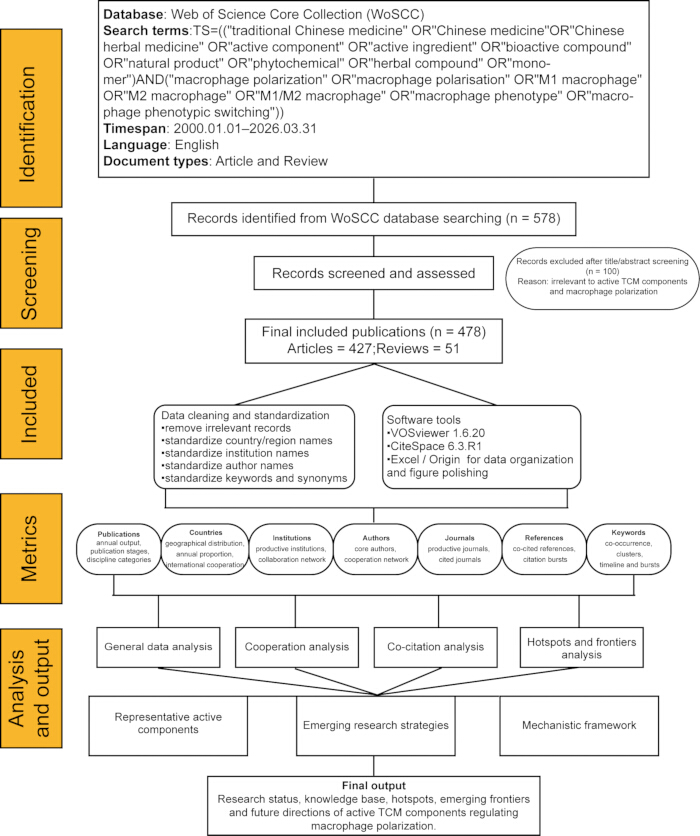
Figure 1: Literature screening, data processing, and bibliometric analysis workflow. The workflow summarizes literature retrieval from the Web of Science Core Collection, screening and inclusion of eligible records, data processing, and subsequent bibliometric analyses performed using VOSviewer and CiteSpace. Please click here to view a larger version of this figure.
Resultaten
Annual publication trends and general characteristics
Of the 478 eligible WoSCC records, 427 were articles and 51 were reviews (Figure 2A). Publications were sporadic before 2014, followed by a sustained increase. Annual output remained at six or fewer publications during 2014–2018, increased to 18–28 publications between 2019 and 2021, and rose from 38 publications in 2022 to 151 in 2025 (Figure 2B). An additional 60 records were indexed during the first quarter of 2026; because these represented a partial year, they were excluded from direct comparison with complete annual outputs. Pharmacology and Pharmacy accounted for the largest proportion of publications (25.55%), followed by Integrative and Complementary Medicine (14.84%). Other publications were distributed across Plant Sciences, Chemistry, Immunology, and Biochemistry and Molecular Biology (Figure 2C).
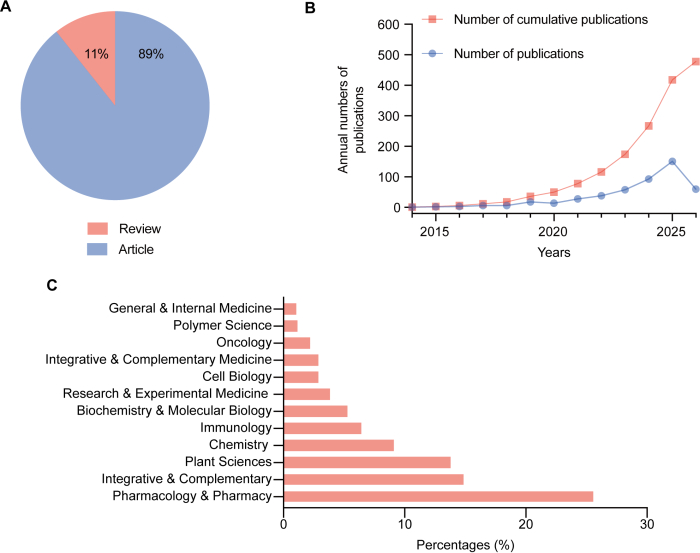
Figure 2: Publication characteristics of studies on macrophage polarization regulation by bioactive traditional Chinese medicine constituents. (A) Distribution of document types. (B) Annual and cumulative publication output from 2000 to March 2026. (C) Distribution of publications across Web of Science subject categories. Data for 2026 were collected through March 31, 2026. Please click here to view a larger version of this figure.
Collaboration networks among countries or regions, institutions, and authors
The 478 publications involved 3,689 researchers from 592 institutions across 34 countries or regions (Figure 3). Li, Wei was the most productive author, with seven publications, while Fu, Chaomei, Li, Jing, and Zhang, Jinming each contributed six. Fu, Chaomei and Zhang, Jinming had the highest author-level total link strength (TLS = 31 each), followed by Wu, Yihan (TLS = 29) and Li, Jingjing (TLS = 28) (Figure 3A).
China contributed 450 publications, followed by the United States (n = 14), Iran (n = 7), and South Korea (n = 5) (Figure 3B). China also had the highest TLS (30), with its strongest bilateral connection involving the United States (TLS = 17). The international collaboration network also included links with Japan, Germany, Thailand, the United Kingdom, and Canada (Figure 3D).
At the institutional level, Nanjing University of Chinese Medicine contributed 32 publications, while Guangzhou University of Chinese Medicine and Shanghai University of Traditional Chinese Medicine contributed 27 each (Figure 3C and Table 1). The China Academy of Chinese Medical Sciences had the highest institutional TLS (23), followed by Nanjing University of Chinese Medicine (TLS = 19). Guangzhou University of Chinese Medicine, Shanghai University of Traditional Chinese Medicine, and Zhejiang Chinese Medical University also showed relatively high network connectivity.
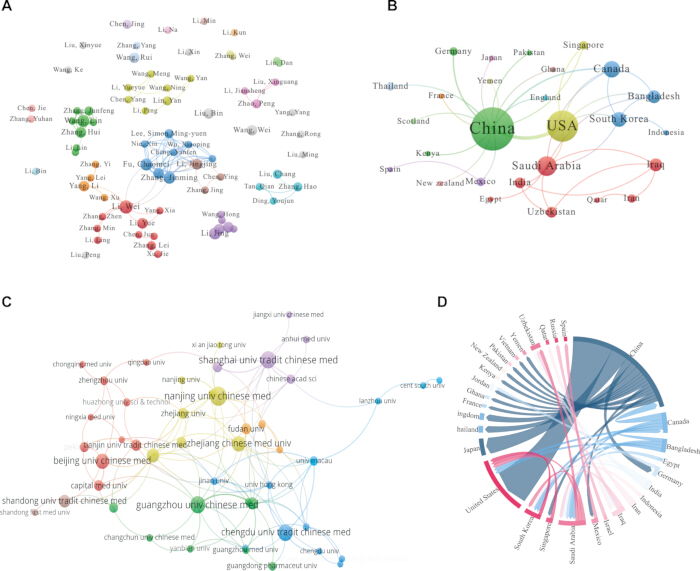
Figure 3: Collaboration patterns in research on macrophage polarization regulation by bioactive traditional Chinese medicine constituents. (A) Author collaboration network. (B) Country or region collaboration network. (C) Institutional collaboration network. (D) International collaboration chord diagram. Node or sector size represents publication output or collaboration frequency, links indicate collaborative relationships, and link thickness reflects collaboration strength. Country or region analyses were performed using the full-counting method. Please click here to view a larger version of this figure.
Table 1: Top 10 institutions by publication output and collaboration strength. The table summarizes the leading institutions according to total link strength, number of documents, total citations, and average citations per publication in research on macrophage polarization regulation by bioactive traditional Chinese medicine constituents. Please click here to download this file.
Co-citation analysis of authors, journals, and references
Author co-citation analysis showed that Wang Y had the highest co-citation frequency (83), followed by Zhang Y (77), Li Y (72), Mantovani A (68), and Liu Y (67) (Figure 4A). Zhang Y had the highest TLS (492), followed by Li Y (475), Liu Y (453), Wang Y (447), and Murray PJ (410). The network included authors associated with macrophage polarization and immune regulation as well as authors associated with natural-product pharmacology and inflammatory disease models.
The 478 publications were distributed among 140 journals. The 10 journals with the highest citation-related metrics are summarized in Table 2. Journal of Ethnopharmacology ranked first in publication output (83 articles), whereas Biomedicine & Pharmacotherapy ranked first in total citations (811), followed by Journal of Ethnopharmacology (810), Phytomedicine (790), International Immunopharmacology (738), and Frontiers in Immunology (550). The highest average citation counts per article were observed for Frontiers in Aging Neuroscience (143.00), Cellular Physiology and Biochemistry (108.50), and Biomedicine & Pharmacotherapy (45.06). Nine of the top 10 journals were classified as JCR Q1. Source co-citation analysis included 3,286 journals (Figure 4B), with the highest co-citation frequencies recorded for Frontiers in Immunology (862), Journal of Ethnopharmacology (785), International Immunopharmacology (675), Frontiers in Pharmacology (630), and Phytomedicine (550).
Table 3 presents the 10 publications with the highest total citation counts. Zhou et al.'s 2015 article in Cellular Physiology and Biochemistry ranked first with 174 citations19, followed by Yang et al.'s 2019 study in Biomedicine & Pharmacotherapy with 15520 citations and Xu et al.'s 2020 study in Pharmaceutical Biology with 14821 citations. These publications addressed atherosclerosis, cerebral ischemia-reperfusion injury, and myocardial ischemia/reperfusion injury, respectively.
Reference co-citation analysis is shown in Figure 4, and the 10 references with the highest co-citation frequencies are listed in Table 4. Shapouri-Moghaddam et al.'s 2018 review had the highest co-citation frequency (40; TLS = 161)22. Chen et al.’s 2020 review was co-cited 36 times (TLS = 124)2, followed by Sica and Mantovani's 2012 review with 34 co-citations (TLS = 86)23 and Vergadi et al.’s 2017 study with 27 co-citations (TLS = 74)24. The remaining highly co-cited references addressed macrophage plasticity and activation spectra, polarization nomenclature, tissue repair, fibrosis, and cancer epidemiology.
Citation-burst analysis identified references that received concentrated attention during specific periods (Figure 4D). Murray et al. 2017 review showed the strongest burst (strength = 4.53, 2021–2022)25, followed by Shapouri-Moghaddam et al. (strength = 4.46, 2022–2023)22. Wynn et al. (2016) review showed an earlier burst (strength = 3.71, 2018–2020)4, while Viola et al. 2019 review showed a burst during 2023–202426.
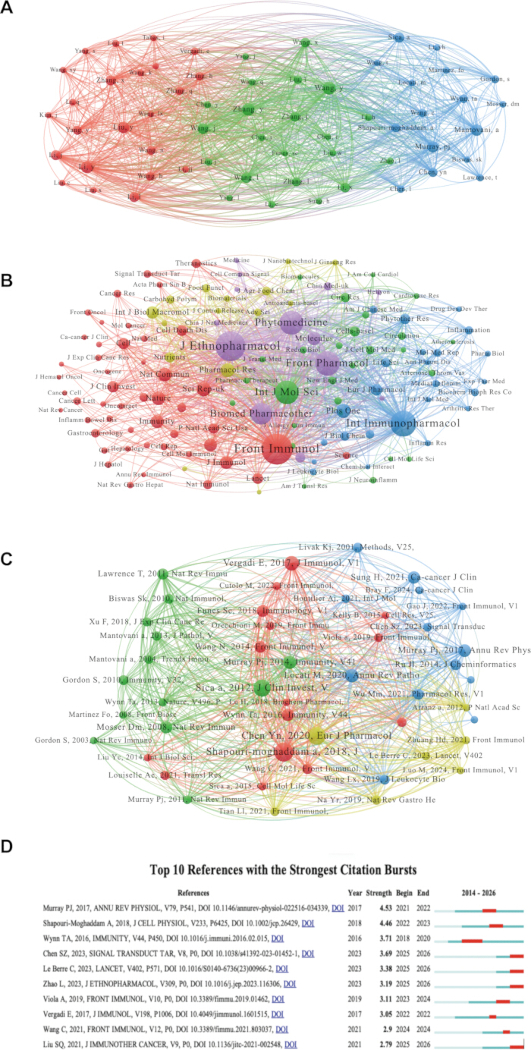
Figure 4: Co-citation and citation-burst analyses of authors, journals, and references. (A) Co-cited author network. (B) Source-journal co-citation network. (C) Co-cited reference network. (D) Top 10 references with the strongest citation bursts. Node size represents co-citation frequency, links indicate co-citation relationships, and citation-burst bars represent periods of concentrated scholarly attention. Please click here to view a larger version of this figure.
Table 2: Top 10 journals by publication output and citation frequency. The table summarizes the leading journals according to publication output, total citations, average citations per publication, journal impact factor, and JCR quartile. Please click here to download this file.
Table 3: Top 10 publications by total citation count. The table lists the 10 most highly cited publications in the analyzed dataset, including article title, journal, total citations, publication year, first author, and document type. Please click here to download this file.
Table 4: Top 10 references by co-citation frequency. The table summarizes the 10 most frequently co-cited references, including first author, publication year, article title, journal, citation frequency, total link strength, and main topic. Please click here to download this file.
Keyword co-occurrence, clustering, and burst analysis
VOSviewer grouped terms meeting the predefined occurrence threshold into four clusters (Figure 5A,B). The yellow cluster included macrophage polarization, ulcerative colitis, inflammatory bowel disease, injury, mechanisms, and inhibition. The green cluster included inflammation, traditional Chinese medicine, macrophage, oxidative stress, pathway, and acute lung injury. The red cluster included activation, NF-κB, signaling pathway, cancer, tumor-associated macrophages, gut microbiota, and natural products. The blue cluster included expression, macrophages, polarization, apoptosis, angiogenesis, and pathogenesis.
The overlay visualization showed earlier average publication years for expression, apoptosis, polarization, angiogenesis, pathogenesis, and NF-κB, whereas more recent average publication years were observed for macrophage polarization, network pharmacology, natural products, gut microbiota, ulcerative colitis, inflammatory bowel disease, and mechanism (Figure 5B).
The CiteSpace keyword network contained 370 nodes and 1,596 links, with a network density of 0.0234 (Figure 5C). The modularity Q value was 0.4871, and the weighted mean silhouette S value was 0.7558. Prominent nodes included macrophage polarization, traditional Chinese medicine, inflammation, activation, cells, expression, oxidative stress, NF-κB, acute lung injury, ulcerative colitis, network pharmacology, and mechanisms.
The timeline map contained nine principal clusters: #0 ulcerative colitis, #1 tumor-associated macrophage, #2 tumor microenvironment, #3 intestinal mucositis, #4 expression, #5 M1 macrophage, #6 macrophage polarization, #7 M2 polarization, and #8 network pharmacology (Figure 5D). Macrophage polarization, M1 macrophage, and M2 polarization remained visible across much of the timeline. Near the end of the timeline, ulcerative colitis, intestinal mucositis, macrophage polarization, and network pharmacology remained prominent.
Keyword-burst analysis identified changes in research attention from 2014 onward (Figure 5E). Extract had the longest burst duration, from 2016 – 2023 (strength = 1.79). Earlier bursts included in vitro (strength = 2.29, 2017–2021), injury (strength = 2.42, 2018–2021), and autophagy (strength = 1.95, 2018–2021). Tumor-associated macrophages showed a burst from 2019 to 2022 (strength = 3.28). Subsequent bursts included NF-κB (strength = 2.45, 2020–2022), alternative activation (strength = 2.21, 2020–2021), macrophage polarization (strength = 2.07, 2021–2022), and signaling pathway (strength = 2.07, 2022–2024). Colorectal cancer, gut microbiota, pulmonary fibrosis, diabetic wound healing, network pharmacology, and ulcerative colitis remained active through 2025–2026.
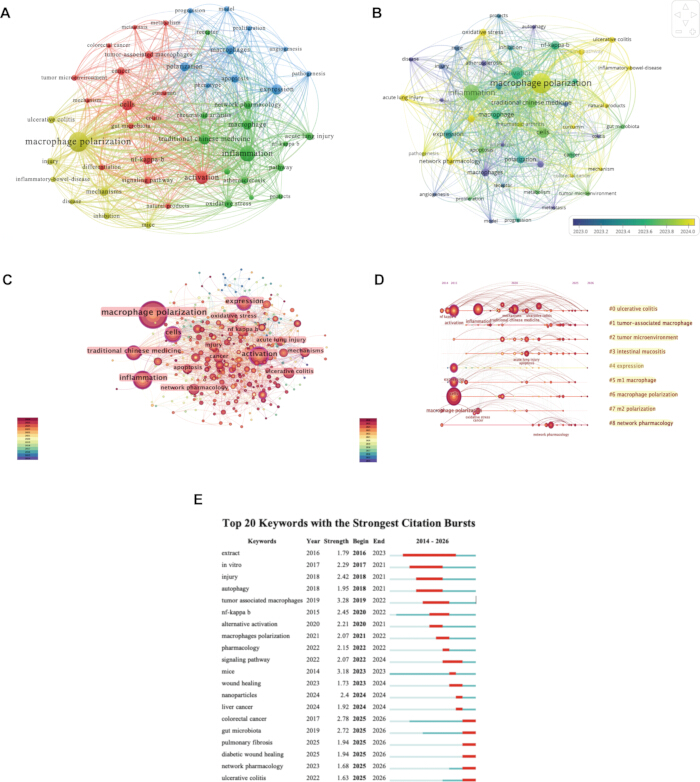
Figure 5: Keyword co-occurrence, clustering, timeline, and citation-burst analyses. (A) VOSviewer keyword co-occurrence network. (B) Keyword overlay visualization, in which colors indicate the average publication year of the keywords. (C) CiteSpace keyword co-occurrence network. (D) Keyword timeline visualization. (E) Top 20 keywords with the strongest citation bursts. Node size represents keyword occurrence frequency, and links between nodes indicate keyword co-occurrence relationships. Please click here to view a larger version of this figure.
The analysis of 478 publications showed marked growth in research on TCM-derived bioactive constituents and macrophage polarization after 2019, with a further increase from 2022 onward. The literature included research on macrophage plasticity and M1/M2 polarization, inflammatory signaling, tumor immune microenvironments, inflammatory bowel disease, lung injury, fibrosis, wound healing, gut microbiota, and network pharmacology. Constituent classes represented in the literature included flavonoids and polyphenols, saponins and polysaccharides, alkaloids, diterpenoid quinones, anthraquinones, glycosides, organic acids, and volatile oils. Reported effects involved inflammatory signaling, immunometabolic regulation, fibrosis- and repair-related pathways, and gut microbiota-metabolite interactions, with the direction of macrophage regulation varying across disease contexts.
Data Availability
The publication-level bibliographic metadata for the included records are provided in Supplementary File 1. The complete original Web of Science Core Collection Plain Text export file used for the VOSviewer and CiteSpace analyses, including Full Record and Cited References, is provided in Supplementary File 2. The complete search strategy and retrieval parameters are provided in Supplementary Table 1.
Supplementary File 1: Bibliographic dataset of the publications included in the bibliometric analysis. The file contains publication-level metadata for the 478 records included in the final analysis, including title, authors, publication year, journal, document type, DOI, author keywords, Keywords Plus, citation count, affiliations, and Web of Science accession number. Please click here to download this file.
Supplementary File 2: Original Web of Science Core Collection Plain Text export of the records included in the bibliometric analysis. The file contains the complete original WoSCC export for the 478 records included in the final analysis, with Full Record and Cited References selected as the record content, and was used for the VOSviewer and CiteSpace analyses. Please click here to download this file.
Supplementary Table 1: Web of Science Core Collection search strategy and retrieval parameters. The table summarizes the database, search query, publication period, language, and document-type restrictions, search date, export settings, and the final number of records included in the bibliometric analysis. Please click here to download this file.
Discussie
The bibliometric patterns identified in this study indicate that research on bioactive traditional Chinese medicine (TCM) constituents and macrophage polarization has developed from a relatively limited natural-product pharmacology topic into an interdisciplinary field involving inflammation, immunometabolism, disease microenvironments, and tissue remodeling. Publication growth became more pronounced after 2019 and accelerated from 2022 onward. This expansion occurred alongside increasing use of network pharmacology27, molecular docking, high-throughput sequencing, single-cell analysis, and multi-omics approaches28. The publication and collaboration patterns also showed a strong concentration of research activity in China, with TCM-focused universities and research institutes forming the principal institutional network. The broader journal distribution across ethnopharmacology, natural-product pharmacology, immunology, and molecular medicine further reflects the increasingly interdisciplinary character of the field.
Reference and keyword analyses indicated a shift from early studies of natural extracts, cellular injury, inflammation, and autophagy toward macrophage polarization, immune-microenvironment remodeling, disease-specific regulation, and mechanistic validation. More recent research has increasingly focused on tumor-associated macrophages, gut microbiota, network pharmacology, ulcerative colitis, pulmonary fibrosis, and diabetic wound healing. These trends suggest that the central question in the field is shifting from whether a bioactive constituent exerts an anti-inflammatory effect to how it modifies macrophage functional states within a specific pathological microenvironment. This distinction is important because macrophage regulation does not follow a uniform M1-to-M2 pattern across diseases. Instead, the direction of regulation depends on the cellular state, disease context, and local immune or metabolic environment.
Representative constituent classes further illustrate this context dependence. Flavonoids and polyphenols, including curcumin, quercetin, kaempferol, baicalein, and baicalin, have been associated with TLR4, NF-κB, MAPK, PTGS2-PGE2, JAK1/STAT1/SOCS1, and related pathways11,19,20,21,29,30,31,32,33,34,35. Saponins and polysaccharides, including astragaloside IV, ginsenosides, Panax notoginseng saponins, Lycium barbarum polysaccharides, and Astragalus polysaccharides, have been linked to STAT, PPARγ, HMGB1-TLR4, AMPK/mTOR-glycolysis, STAT6, STAT1/STAT6, and ROS/NF-κB signaling36,37,38,39,40,41,42. Importantly, the same constituent may produce different macrophage-related effects in different settings. Astragaloside IV, for example, has been associated with repair-related M2 polarization in inflammatory and ischemic conditions but with inhibition of M2-associated tumor-promoting effects in ovarian cancer36,37,38. Similar context-dependent patterns are evident for berberine, tanshinone IIA, emodin, and other alkaloid or quinone compounds43,44,45,46,47,48,49, as well as for paeoniflorin, puerarin, geniposide, salvianolic acid B, and chlorogenic acid50,51,52,53,54,55,56. These findings support a common regulatory principle in which bioactive TCM constituents act through multiple signaling and metabolic pathways, while the resulting macrophage phenotype is shaped by the surrounding disease microenvironment rather than by a single fixed directional effect.
Studies of formulas, herb pairs, and combination systems extend this principle beyond isolated constituents. Huanglian Wendan Decoction, the Alisma orientale–Atractylodes macrocephala herb pair, Renshen Pingfei Formula, Yangqing Chenfei Formula, Wenyang Xiaozheng Decoction, and Zuogui Yin have been associated with changes in macrophage polarization through gut microbiota-related pathways, NLRP3 signaling, TGF-β/Smad, JAK2/STAT3, and IL-4/JAK2/STAT6 signaling57,58,59,60,61,62. These studies suggest that formula-level effects may involve coordinated regulation of inflammatory signaling, metabolism, tissue injury, and the immune microenvironment. However, the material basis, direct targets, and constituent-level synergistic relationships of these interventions remain incompletely resolved. Network pharmacology and databases such as TCMSP and BATMAN-TCM can support hypothesis generation63,64. Recent studies have also integrated single-cell sequencing with network pharmacology and molecular docking65,66, while molecular docking can assess predicted constituent-target interactions67. Such computational approaches remain hypothesis-generating and require experimental confirmation. Related studies have incorporated disease-oriented experimental validation, microbiota-related analyses, and multi-omics approaches68,69,70,71, while direct target-validation methods include surface plasmon resonance, cellular thermal shift assay, and drug affinity responsive target stability72,73,74.
Taken together, the literature indicates that the principal regulatory pattern is not promotion or inhibition of a single macrophage phenotype but context-dependent modulation of inflammatory signaling, cellular metabolism, intercellular communication, and the local tissue environment. Recurrently identified mechanistic nodes include NF-κB, MAPK, TLR4, JAK/STAT, PI3K/Akt, the NLRP3 inflammasome, PPARγ, AMPK/mTOR/HIF-1α, TGF-β/Smad, and the gut microbiota-metabolite axis. In inflammatory bowel disease, acute lung injury, and wound healing, studies more often emphasized suppression of excessive M1-associated inflammation or support of repair-related macrophage states. In tumor and fibrotic microenvironments, however, attention more often focused on limiting immunosuppressive or profibrotic macrophage states. This context dependence provides a plausible explanation for the apparent bidirectional regulation reported for some constituents and indicates that future mechanistic studies should evaluate constituent identity, macrophage state, disease microenvironment, signaling networks, and metabolic changes together rather than treating M1/M2 polarization as an isolated endpoint.
Several limitations should be considered. The analysis was restricted to English-language articles and reviews indexed in the Web of Science Core Collection, so studies from other databases and Chinese-language or specialist TCM journals may be underrepresented. Search strategy, screening decisions, software parameters, and inconsistent terminology for constituents, extracts, herb pairs, and formulas may also have influenced the resulting networks and clusters. Citation rankings for publications from 2025 and early 2026 should be interpreted cautiously because of their shorter citation windows. In addition, bibliometric analyses describe publication, co-citation, and keyword patterns but cannot establish constituent efficacy or confirm predicted targets and causal mechanisms. Future research should therefore combine chemical profiling, network pharmacology, molecular docking and dynamics, multi-omics, single-cell and spatial analyses, microbiota-related approaches, and direct target-validation methods with rigorous in vitro and in vivo validation. Such integration may help clarify disease-context-dependent mechanisms and the translational value of representative bioactive TCM constituents while supporting broader collaboration across institutions, disciplines, and countries.
Openbaarmakingen
The authors declare no conflicts of interest associated with this publication.
Author Contributions:
Wen Guo, Haoran Zheng, and Zhenhua Jia contributed to conceptualization. Wen Guo and Haoran Zheng contributed to methodology, formal analysis, and visualization. Wen Guo, Haoran Zheng, Ningxin Han, Lu Liu, Zeheng Cheng, Peipei Jin, and Yawen Li contributed to data curation. Ningxin Han, Lu Liu, Zeheng Cheng, Peipei Jin, and Yawen Li contributed to investigation. Wen Guo and Haoran Zheng prepared the original draft. Ningxin Han, Lu Liu, Zeheng Cheng, Peipei Jin, Yawen Li, and Zhenhua Jia contributed to review and editing. Zhenhua Jia contributed to supervision, project administration, and funding acquisition. All authors read and approved the final manuscript.
Dankbetuigingen
The authors thank the developers of the software used in this study. This work was supported by the National Natural Science Foundation of China (Grant No. 82130123) and the Innovation Team and Talents Cultivation Program of the National Administration of Traditional Chinese Medicine (Grant No. ZYYCXTD-D-202206).
Materialen
| Naam | Bedrijf | Catalogusnummer | Opmerkingen |
|---|---|---|---|
| CiteSpace | Drexel University | N/A | Version 6.3.R1; used for keyword co-occurrence, clustering, timeline, and citation-burst analyses |
| Microsoft Excel for Microsoft 365 | Microsoft Corporation | N/A | Used for data organization and tabulation |
| OriginPro | OriginLab Corporation | N/A | Used for graphical presentation |
| VOSviewer | Centre for Science and Technology Studies (CWTS), Leiden University | N/A | Version 1.6.20; used for collaboration-network, co-citation, and keyword co-occurrence analyses |
| Web of Science Core Collection | Clarivate | N/A | Bibliographic database used for literature retrieval and record export |
Referenties
- Funes SC, Rios M, Escobar-Vera J, Kalergis AM. Implications of Macrophage Polarization in Autoimmunity. Immunology. 2018;154:186–195. doi:10.1111/imm.12910.
- Chen Y, Hu M, Wang L, Chen W. Macrophage M1/M2 Polarization. Eur. J. Pharmacol. 2020;877:173090. doi:10.1016/j.ejphar.2020.173090.
- Luo M et al. Macrophage Polarization: An Important Role in Inflammatory Diseases. Front. Immunol. 2024;15:1352946. doi:10.3389/fimmu.2024.1352946.
- Wynn TA, Vannella KM. Macrophages in Tissue Repair, Regeneration, and Fibrosis. Immunity. 2016;44:451–462. doi:10.1016/j.immuni.2016.02.015.
- Gallerand A, Han J, Ivanov S, Randolph GJ. Mouse and Human Macrophages and Their Roles in Cardiovascular Health and Disease. Nat. Cardiovasc. Res. 2024;3:1424–1437. doi:10.1038/s44161-024-00580-3.
- Saeed AF. Tumor-Associated Macrophages: Polarization, Immunoregulation, and Immunotherapy. Cells. 2025;14:741. doi:10.3390/cells14100741.
- Tian Y et al. Holistic Concept Guided Quality Control of Traditional Chinese Medicines for Optimizing Bioavailability. Chin. Med. 2025;20:202. doi:10.1186/s13020-025-01269-w.
- Zhang W-J et al. Pharmacodynamic Material Basis of Traditional Chinese Medicine Based on Biomacromolecules: A Review. Plant Methods. 2020;16:26. doi:10.1186/s13007-020-00571-y.
- Qi Y et al. Targeting Tumor-Associated Macrophage Polarization with Traditional Chinese Medicine Active Ingredients: Dual Reversal of Chemoresistance and Immunosuppression in Tumor Microenvironment. Pharmacol. Res. 2025;216:107788. doi:10.1016/j.phrs.2025.107788.
- Qin Y et al. Bilobalide Ameliorates Osteoporosis by Influencing the SIRT3/NF-κB Axis in Osteoclasts and Promoting M2 Polarization in Macrophages. Int. J. Biol. Macromol. 2024;281:136504. doi:10.1016/j.ijbiomac.2024.136504.
- Liu S-Y et al. Baicalin Ameliorates Ulcerative Colitis by Regulating Macrophage Polarization through the JAK1/STAT1/SOCS1 Pathway. J. Ethnopharmacol. 2026;359:121057. doi:10.1016/j.jep.2025.121057.
- Yang F et al. Inhibition of NLRP3 Inflammasome Activation and Pyroptosis in Macrophages by Taraxasterol Is Associated with Its Regulation on mTOR Signaling. Front. Immunol. 2021;12:632606. doi:10.3389/fimmu.2021.632606.
- An Y et al. Qingyi Decoction and Its Active Ingredients Ameliorate Acute Pancreatitis by Regulating Acinar Cells and Macrophages via NF-κB/NLRP3/Caspase-1 Pathways. Phytomedicine. 2025;139:156424. doi:10.1016/j.phymed.2025.156424.
- Bai X et al. Macrophage Polarization in Cancer and beyond: From Inflammatory Signaling Pathways to Potential Therapeutic Strategies. Cancer Lett. 2025;625:217772. doi:10.1016/j.canlet.2025.217772.
- Chen S et al. Traditional Chinese medicine in regulating macrophage polarization in immune response of inflammatory diseases. J. Ethnopharmacol. 2024;325:117838. doi:10.1016/j.jep.2024.117838.
- Liu Q-P et al. Natural Products Targeting Macrophages in Tumor Microenvironment Are a Source of Potential Antitumor Agents. Phytomedicine Int. J. Phytother. Phytopharm. 2023;109:154612. doi:10.1016/j.phymed.2022.154612.
- Wang R et al. Natural Products Inhibit Inflammatory Diseases by Regulating Macrophage Polarization. Int. Immunopharmacol. 2025;166:115615. doi:10.1016/j.intimp.2025.115615.
- Lazarides MK, Lazaridou I-Z, Papanas N. Bibliometric Analysis: Bridging Informatics with Science. Int. J. Low. Extrem. Wounds. 2025;24:515–517. doi:10.1177/15347346231153538.
- Zhou Y et al. Curcumin Modulates Macrophage Polarization through the Inhibition of the Toll-like Receptor 4 Expression and Its Signaling Pathways. Cell. Physiol. Biochem. 2015;36:631–641. doi:10.1159/000430126.
- Yang S et al. Baicalein Administered in the Subacute Phase Ameliorates Ischemia-Reperfusion-Induced Brain Injury by Reducing Neuroinflammation and Neuronal Damage. Biomed. Pharmacother. 2019;117:109102. doi:10.1016/j.biopha.2019.109102.
- Xu M, Li X, Song LC. Baicalin regulates macrophages polarization and alleviates myocardial ischaemia/reperfusion injury via inhibiting JAK/STAT pathway. Pharm. Biol. 2020;58:655–663. doi:10.1080/13880209.2020.1779318.
- Shapouri-Moghaddam A et al. Macrophage Plasticity, Polarization, and Function in Health and Disease. J. Cell. Physiol. 2018;233:6425–6440. doi:10.1002/jcp.26429.
- Sica A, Mantovani A. Macrophage Plasticity and Polarization: In Vivo Veritas. J. Clin. Invest. 2012;122:787–795. doi:10.1172/JCI59643.
- Vergadi E et al. Akt Signaling Pathway in Macrophage Activation and M1/M2 Polarization. J. Immunol. 2017;198:1006–1014. doi:10.4049/jimmunol.1601515.
- Murray PJ. Macrophage Polarization. Annu. Rev. Physiol. 2017;79:541–566. doi:10.1146/annurev-physiol-022516-034339.
- Viola A et al. The Metabolic Signature of Macrophage Responses. Front. Immunol. 2019;10:1462. doi:10.3389/fimmu.2019.01462.
- Zhao L et al. Network Pharmacology, a Promising Approach to Reveal the Pharmacology Mechanism of Chinese Medicine Formula. J. Ethnopharmacol. 2023;309:116306. doi:10.1016/j.jep.2023.116306.
- Li W-F, Jiang J-G, Chen J. Chinese Medicine and Its Modernization Demands. Arch. Med. Res. 2008;39:246–251. doi:10.1016/j.arcmed.2007.09.011.
- Wu R et al. Quercetin, the Ingredient of Xihuang Pills, Inhibits Hepatocellular Carcinoma by Regulating Autophagy and Macrophage Polarization. Front. Biosci. 2022;27:323. doi:10.31083/j.fbl2712323.
- Lv W et al. Forsythia Suspensa Polyphenols Regulate Macrophage M1 Polarization to Alleviate Intestinal Inflammation in Mice. Phytomedicine Int. J. Phytother. Phytopharm. 2024;125:155336. doi:10.1016/j.phymed.2024.155336.
- Chen H et al. Kaempferol Reprograms Pro-Inflammatory Macrophage Polarization by Targeting the PTGS2-PGE2 Axis: A Multi-Omics Deconvolution of a Traditional Anti-Inflammatory Herb Pair. Biochem. Pharmacol. 2026;248:117865. doi:10.1016/j.bcp.2026.117865.
- Zhu W et al. Baicalin Ameliorates Experimental Inflammatory Bowel Disease through Polarization of Macrophages to an M2 Phenotype. Int. Immunopharmacol. 2016;35:119–126. doi:10.1016/j.intimp.2016.03.030.
- Lai Y-S, Putra RBDS, Aui S-P, Chang K-T. M2C Polarization by Baicalin Enhances Efferocytosis via Upregulation of MERTK Receptor. Am. J. Chin. Med. 2018;46:1899–1914. doi:10.1142/S0192415X18500957.
- Ma X et al. Baicalein Inhibits the Polarization of Microglia/Macrophages to the M1 Phenotype by Targeting STAT1 in EAE Mice. Int. Immunopharmacol. 2022;113:109373. doi:10.1016/j.intimp.2022.109373.
- He S et al. Baicalein Potentiated M1 Macrophage Polarization in Cancer through Targeting PI3Kγ/NF-κB Signaling. Front. Pharmacol. 2021;12:743837. doi:10.3389/fphar.2021.743837.
- Tian L et al. Astragaloside IV Alleviates the Experimental DSS-Induced Colitis by Remodeling Macrophage Polarization through STAT Signaling. Front. Immunol. 2021;12:740565. doi:10.3389/fimmu.2021.740565.
- Li L et al. Astragaloside IV Promotes Microglia/Macrophages M2 Polarization and Enhances Neurogenesis and Angiogenesis through PPARγ Pathway after Cerebral Ischemia/Reperfusion Injury in Rats. Int. Immunopharmacol. 2021;92:107335. doi:10.1016/j.intimp.2020.107335.
- Wang X et al. Astragaloside IV Antagonizes M2 Phenotype Macrophage Polarization-Evoked Ovarian Cancer Cell Malignant Progression by Suppressing the HMGB1-TLR4 Axis. Mol. Immunol. 2021;130:113–121. doi:10.1016/j.molimm.2020.11.014.
- Fu Y et al. Ginsenoside Derivative AD-1 Suppresses Colitis-Associated Colorectal Cancer Progression by Reprogramming Tumor-Associated Macrophage Polarization via the AMPK/mTOR-Glycolysis Pathway. Bioorg. Chem. 2026;169:109458. doi:10.1016/j.bioorg.2025.109458.
- Wang X et al. Panax Notoginseng Saponins Ameliorate LPS-Induced Acute Lung Injury by Promoting STAT6-Mediated M2-like Macrophage Polarization. Phytomedicine Int. J. Phytother. Phytopharm. 2025;139:156513. doi:10.1016/j.phymed.2025.156513.
- Wang J et al. Lycium Barbarum Polysaccharide Alleviates Dextran Sodium Sulfate-Induced Inflammatory Bowel Disease by Regulating M1/M2 Macrophage Polarization via the STAT1 and STAT6 Pathways. Front. Pharmacol. 2023;14:1044576. doi:10.3389/fphar.2023.1044576.
- Liu X et al. Composite Microneedles Loaded with Astragalus Membranaceus Polysaccharide Nanoparticles Promote Wound Healing by Curbing the ROS/NF-κB Pathway to Regulate Macrophage Polarization. Carbohydr. Polym. 2024;345:122574. doi:10.1016/j.carbpol.2024.122574.
- Lin J et al. Berberine, a Traditional Chinese Medicine, Reduces Inflammation in Adipose Tissue, Polarizes M2 Macrophages, and Increases Energy Expenditure in Mice Fed a High-Fat Diet. Med. Sci. Monit. 2019;25:87–97. doi:10.12659/MSM.911849.
- He L, Zhong Z, Liu F, Wen S. Berberine Alleviates DSS-Induced Colitis by Modulating Macrophage Phenotype via PPAR-γ/mTOR/HIF-1α Signaling Pathway. J. Ethnopharmacol. 2026;362:121350. doi:10.1016/j.jep.2026.121350.
- Zhao J-Y et al. Tanshinone IIA Prevents Acute Lung Injury by Regulating Macrophage Polarization. J. Integr. Med. 2022;20:274–280. doi:10.1016/j.joim.2022.01.006.
- Zhang N et al. Tanshinone IIA Inhibits Alveolar Macrophage Polarization, Inflammation and Mitochondrial Damage by Regulating the PAPR-1 Signaling Pathway. Iran. J. Pharm. Res. 2025;24:e166272. doi:10.5812/ijpr-166272.
- Iwanowycz S et al. Emodin Bidirectionally Modulates Macrophage Polarization and Epigenetically Regulates Macrophage Memory. J. Biol. Chem. 2016;291:11491–11503. doi:10.1074/jbc.M115.702092.
- Song H et al. Emodin Nanocapsules Inhibit Acute Pancreatitis by Regulating Lipid Metabolic Reprogramming in Macrophage Polarization. Phytomedicine Int. J. Phytother. Phytopharm. 2024;130:155763. doi:10.1016/j.phymed.2024.155763.
- Huang Q-T et al. A Hepatic Oxidative Metabolite of Palmatine Ameliorates DSS-Induced Ulcerative Colitis by Regulating Macrophage Polarization Through AMPK/NF-κB Pathway. Am. J. Chin. Med. 2025;53:285–307. doi:10.1142/S0192415X25500119.
- Tang X et al. Paeoniflorin Attenuates Hepatic Ischemia-Reperfusion Injury by Modulating Tmem176b+ Macrophages Polarization. Int. Immunopharmacol. 2025;167:115657. doi:10.1016/j.intimp.2025.115657.
- Shi C et al. Paeoniflorin Attenuates the Progression of Diabetic Kidney Disease by Regulating Macrophage Differentiation. Phytother. Res. 2026;40:213–226. doi:10.1002/ptr.70118.
- Li S et al. Puerarin Improves Diabetic Wound Healing via Regulation of Macrophage M2 Polarization Phenotype. Burns Trauma. 2022;10:tkac046. doi:10.1093/burnst/tkac046.
- He P et al. Geniposide Ameliorates Atherosclerosis by Regulating Macrophage Polarization via Perivascular Adipocyte-Derived CXCL14. J. Ethnopharmacol. 2023;314:116532. doi:10.1016/j.jep.2023.116532.
- Chen Q et al. Catalpol Inhibits Macrophage Polarization and Prevents Postmenopausal Atherosclerosis through Regulating Estrogen Receptor Alpha. Front. Pharmacol. 2021;12:655081. doi:10.3389/fphar.2021.655081.
- Zhao M et al. Salvianolic Acid B Regulates Macrophage Polarization in Ischemic/Reperfused Hearts by Inhibiting mTORC1-Induced Glycolysis. Eur. J. Pharmacol. 2020;871:172916. doi:10.1016/j.ejphar.2020.172916.
- Ji Y et al. Targeting JAK2/STAT3-Dependent Macrophage Polarization by Chlorogenic Acid Attenuates Hepatic Inflammation in Chronic Stress. Cells. 2025;14:1848. doi:10.3390/cells14231848.
- Su Z et al. Huanglian Wendan Decoction Alleviates Metabolic Syndrome by Reprogramming Macrophage Polarization: Evidence from Multi-Omics Integration. Phytomedicine Int. J. Phytother. Phytopharm. 2025;146:157119. doi:10.1016/j.phymed.2025.157119.
- Ma C et al. Zexie-Baizhu Herb Pair Attenuates MASH via the Gut-Liver Axis by Suppressing NLRP3 Inflammasome Activation and M1-Macrophage Polarization. Bioorg. Chem. 2026;169:109451. doi:10.1016/j.bioorg.2025.109451.
- Hong L et al. Study on the Anti-Pulmonary Fibrosis Mechanism of Renshen Pingfei Formula by Inhibiting M2 Macrophage Polarization and Regulating TGF-β/SMAD Signaling Pathway. J. Ethnopharmacol. 2026;363:121465. doi:10.1016/j.jep.2026.121465.
- Tian X et al. Yangqing Chenfei Formula Alleviates Silica-Induced Pulmonary Inflammation in Rats by Inhibiting Macrophage M1 Polarization. Chin. Med. 2023;18:79. doi:10.1186/s13020-023-00787-9.
- Lin X et al. Wenyang Xiaozheng Decoction Modulates Macrophage Polarization via JAK2/STAT3 Signaling Pathway to Reduce Renal Fibrosis. J. Ethnopharmacol. 2026;354:120497. doi:10.1016/j.jep.2025.120497.
- Wang Y et al. Zuoguiyin Modulates M2 Macrophage Polarization to Inhibit Glycolysis in Esophageal Squamous Cell Carcinoma. J. Ethnopharmacol. 2026;362:121404. doi:10.1016/j.jep.2026.121404.
- Ru J et al. TCMSP: A Database of Systems Pharmacology for Drug Discovery from Herbal Medicines. J. Cheminformatics. 2014;6:13. doi:10.1186/1758-2946-6-13.
- Kong X et al. BATMAN-TCM 2.0: An Enhanced Integrative Database for Known and Predicted Interactions between Traditional Chinese Medicine Ingredients and Target Proteins. Nucleic Acids Res. 2024;52:D1111–D1120. doi:10.1093/nar/gkad926.
- Wan L et al. Dissecting Macrophage Heterogeneity and Kaempferol in Lung Adenocarcinoma: A Single-Cell Transcriptomic Approach and Network Pharmacology. Discov. Oncol. 2025;16:104. doi:10.1007/s12672-025-01832-9.
- Li H et al. Single-Cell Sequencing and Network Pharmacology Coupled with Molecular Docking and Experimental Validation Reveal the Effects of YPFS on Macrophages in Stage I Non-Small Cell Lung Cancer. Cancer Immunol. Immunother. 2026;75:58. doi:10.1007/s00262-026-04305-2.
- Trott O, Olson AJ. AutoDock Vina: Improving the Speed and Accuracy of Docking with a New Scoring Function, Efficient Optimization, and Multithreading. J. Comput. Chem. 2010;31:455–461. doi:10.1002/jcc.21334.
- Zheng Z et al. KAJF Alleviated Colorectal Cancer Liver Metastasis by Reshaping the Gut Microbiota and Inhibiting M2-like Macrophage Polarization. Phytomedicine Int. J. Phytother. Phytopharm. 2025;142:156766. doi:10.1016/j.phymed.2025.156766.
- Zhao M, Che Y, Gao Y, Zhang X. Application of Multi-Omics in the Study of Traditional Chinese Medicine. Front. Pharmacol. 2024;15:1431862. doi:10.3389/fphar.2024.1431862.
- Liu Y et al. Bushen Guchong Decoction Facilitates M2 Polarization through JAK2/STAT3 for URSA Treatment. Phytomedicine Int. J. Phytother. Phytopharm. 2026;150:157635. doi:10.1016/j.phymed.2025.157635.
- Guo K et al. Integration of Microbiomics, Metabolomics, and Transcriptomics Reveals the Therapeutic Mechanism Underlying Fuzheng-Qushi Decoction for the Treatment of Lipopolysaccharide-Induced Lung Injury in Mice. J. Ethnopharmacol. 2024;334:118584. doi:10.1016/j.jep.2024.118584.
- Boozer C et al. Looking towards Label-Free Biomolecular Interaction Analysis in a High-Throughput Format: A Review of New Surface Plasmon Resonance Technologies. Curr. Opin. Biotechnol. 2006;17:400–405. doi:10.1016/j.copbio.2006.06.012.
- Martinez Molina D et al. Monitoring Drug Target Engagement in Cells and Tissues Using the Cellular Thermal Shift Assay. Science. 2013;341:84–87. doi:10.1126/science.1233606.
- Lomenick B, Jung G, Wohlschlegel JA, Huang J. Target Identification Using Drug Affinity Responsive Target Stability (DARTS). Curr. Protoc. Chem. Biol. 2011;3:163–180. doi:10.1002/9780470559277.ch110180.