Wykorzystanie świń w badaniach naukowych wzrosło w ostatnich latach. Niemniej jednak świnie charakteryzują się trudną anatomią dróg oddechowych. Poprzez pokazanie, jak przeprowadzić endoskopową intubację dotchawiczą, niniejszy protokół ma na celu dalsze zwiększenie bezpieczeństwa zwierząt laboratoryjnych, aby uniknąć cierpienia i niepotrzebnej śmierci zwierząt.
Subskrypcja JoVE jest wymagana do oglądania tego materiału. Zaloguj się lub rozpocznij bezpłatny okres próbny.
Artykuł metodologiczny
Intubacja dotchawicza z wykorzystaniem elastycznego endoskopu intubacyjnego jako ustandaryzowany model bezpiecznego udrażniania dróg oddechowych u świń
W tym artykule
Informacja o sprostowaniu
Important: There has been an erratum issued for this article. View Erratum Notice
Podsumowanie
Streszczenie
Intubacja dotchawicza jest często podstawowym wymogiem dla badań translacyjnych na modelach świńskich dla różnych interwencji, które wymagają zabezpieczonych dróg oddechowych lub wysokiego ciśnienia wentylacji. Intubacja dotchawicza jest trudną umiejętnością, wymagającą minimalnej liczby udanych intubacji dotchawiczych, aby osiągnąć wysoki wskaźnik sukcesu w optymalnych warunkach, co często jest nieosiągalne dla badaczy nieanestezjologicznych. Ze względu na specyficzną anatomię dróg oddechowych świń zwykle można założyć, że drogi oddechowe są trudne. Niemożność ustalenia bezpiecznych dróg oddechowych może spowodować obrażenia, zdarzenia niepożądane lub śmierć zwierzęcia laboratoryjnego. Stosując prospektywne, randomizowane, kontrolowane podejście do oceny, wykazano, że intubacja dotchawicza wspomagana światłowodem trwa dłużej, ale ma wyższy wskaźnik powodzenia pierwszego przejścia niż intubacja konwencjonalna, nie powodując klinicznie istotnych spadków saturacji tlenem. Model ten przedstawia ustandaryzowany schemat endoskopowej intubacji dotchawiczej, zapewniając zabezpieczone drogi oddechowe, szczególnie dla badaczy, którzy nie mają doświadczenia w technice intubacji dotchawiczej za pomocą bezpośredniej laryngoskopii. Oczekuje się, że procedura ta zminimalizuje cierpienie zwierząt i niepotrzebne straty zwierząt.
Wprowadzenie
Intubacja dotchawicza jest często podstawowym wymogiem dla badań translacyjnych na modelach świńskich dla różnych interwencji, które wymagają zabezpieczonej drogi oddechowej lub wysokiego ciśnienia wentylacji (takich jak wentylacja podczas resuscytacji krążeniowo-oddechowej1 lub zespół ostrej niewydolności oddechowej2) lub wymagają, aby przepływ krwi w mózgu nie był zakłócony przez wewnętrzną kompresję przez urządzenia do udrażniania dróg oddechowych3, które są czasami propagowane jako alternatywy w kontekście przewidywanych trudności w udrażnianiu dróg oddechowych u świń4,5.
Podczas gdy fizjologia płuc świń wykazuje podobne cechy do ludzkiej6, zabezpieczenie dróg oddechowych jest czasami znacznie trudniejsze7 ze względu na specyficzne różnice w anatomii jamy ustnej i tchawicy świni. Pysk świni ma wąski otwór z bardzo dużym językiem, krtań jest niezwykle ruchoma, a nagłośnia jest stosunkowo duża, z wolnym końcem, który rozciąga się do podniebienia miękkiego. Ogonowo krtań tworzy kąt rozwarty z tchawicą. Chrząstki arytenoidalne są duże8. Najwęższa część dróg oddechowych znajduje się na poziomie podgłośniowym9, porównywalnym z anatomią dróg oddechowych u dzieci10. Ponieważ krtań u świń jest bardzo ruchoma, istnieje ryzyko, że koniec rurki dotchawiczej przejdzie przez struny głosowe, ale krtań zostanie przesunięta doogonowo tylko o kilka centymetrów, co można pomylić z prawidłową intubacją8,11. Dodatkowo, intubacja przełyku jest częstym ryzykiem w przypadku udrażniania dróg oddechowych u świń12.
Wskaźniki trudnych lub niemożliwych intubacji dotchawiczych, które miały odpowiednio negatywny wpływ na eksperyment lub wczesną śmiertelność, nie były systematycznie rejestrowane, ale opublikowano kilka opisów przypadków13,14. U ludzi istnieje możliwość zastosowania elastycznego endoskopu intubacyjnego w kontekście nieoczekiwanie trudnej konwencjonalnej intubacji15. Często przed tym środkiem poprzedzają różne fałszywe intubacje. Te powtarzające się próby intubacji są związane ze zdarzeniami niepożądanymi u ludzi16,17, zwłaszcza powikłania dróg oddechowych18. Takie zdarzenia są szkodliwe u badanych zwierząt, ponieważ, w najprostszym przypadku, stanowią one zmienną zakłócającą w doświadczeniu; W najgorszym przypadku mogą doprowadzić do niepotrzebnej utraty zwierzęcia.
Niniejsze badanie opracowało model oparty na wytycznych dotyczących spodziewanego trudnego udrażniania dróg oddechowych u ludzi15,19,20,21,22,23,24. Wcześniej podobna technika została opisana do nauki intubacji światłowodem w badaniach na ludziach25,26. Protokół przedstawiony w niniejszym raporcie ma na celu zapewnienie ustandaryzowanego i łatwego do dostosowania modelu intubacji, który umożliwia również specjalistom niezajmującym się drogami oddechowymi przeprowadzenie udanej i bezpiecznej intubacji dotchawiczej u świń.
Dostęp ograniczony. Zaloguj się lub rozpocznij wersję próbną, aby wyświetlić tę treść.
Protokół
Eksperymenty w tym protokole zostały zatwierdzone przez Państwowy i Instytucjonalny Komitet Opieki nad Zwierzętami (Landesuntersuchungsamt Rheinland-Pfalz, Koblenz, Niemcy; nr zatwierdzenia G20-1-135). Eksperymenty przeprowadzono zgodnie z wytycznymi ARRIVE. Ogółem w niniejszym badaniu wykorzystano 10 znieczulonych samców świń (Sus scrofa domestica) o średniej masie ciała 30 kg ± 2 kg i wieku 12-16 tygodni.
1. Przygotowanie zwierząt
- Utrzymuj normalne środowisko dla zwierząt, aby zminimalizować stres. Wstrzymaj się z jedzeniem na 6 godzin przed planowanym eksperymentem, aby zmniejszyć ryzyko zachłyśnięcia, ale pozwól na dostęp do wody.
- Uspokoić świnie za pomocą złożonego wstrzyknięcia midazolamu (0,5 mg/kg) i azaperonu (2-3 mg/kg) (patrz Tabela materiałów) w mięsień pośladkowy lub szyję za pomocą igły (20 G) do wstrzykiwań domięśniowych. Pozostaw zwierzęta w spokoju, aż do momentu ustąpienia (15-20 min).
UWAGA: W zależności od przepisów krajowych, podawanie środków uspokajających może podlegać kontroli i może, ale nie musi, wymagać nadzoru przeszkolonego lekarza weterynarii. Skonsultuj się z lokalnymi władzami przed zaplanowaniem eksperymentów. - Przetransportuj uśpione zwierzęta ze stajni do laboratorium. Czas transportu nie może przekraczać odpowiedniego czasu sedacji (w tym przypadku 30-60 min). Zapewnić wystarczające zatrzymywanie ciepła, aby zwierzę nie wpadło w hipotermię (tj. poniżej 38 °C), na przykład przykrywając ciało kocem w zależności od temperatury zewnętrznej.
- Za pomocą czujnika (patrz Tabela materiałów) przypiętego do ucha lub ogona, monitoruj obwodowe nasycenie tlenem (SpO2).
- Zdezynfekuj skórę środkiem dezynfekującym (alkoholowym) przed włożeniem kaniuli żył obwodowych (22 G) do żyły usznej. Spryskaj obszar, wytrzyj raz, a następnie spryskaj ponownie i pozostaw środek dezynfekujący do wyschnięcia. Zabezpiecz kaniulę ucha plastrem (patrz tabela materiałów).
2. Znieczulenie i wentylacja mechaniczna
- Środek przeciwbólowy należy podawać w postaci dożylnego wstrzyknięcia 4 μg/kg fentanylu. Wywołać znieczulenie za pomocą dożylnego wstrzyknięcia 3 mg/kg propofolu (patrz Tabela Materiałów).
UWAGA: Dzięki zastosowaniu bolusa lek szybko zalewa komorę czynną, zapewniając szybki początek głębokiego znieczulenia. - Połóż świnię na noszach w pozycji leżącej na plecach i przymocuj ją bandażami. Zastosować środek zwiotczający mięśnie poprzez dożylne wstrzyknięcie 0,5 mg/kg atrakurium (patrz tabela materiałów).
- Natychmiast rozpocznij wentylację nieinwazyjną za pomocą maski wentylacyjnej dla psa (patrz tabela materiałów) lub podobnych modeli. Aby zapewnić ścisłe dopasowanie maski, umieść wybrzuszenie i kciuki obu rąk na masce, jednocześnie wykonując pchnięcie szczęki pozostałymi palcami.
UWAGA: Parametry wentylacji: FiO2 (wdechowa frakcja tlenu) = 100%, szczytowe ciśnienie wdechowe = <20 cmH20, częstość oddechów = 18-20 oddechów/min, PEEP (dodatnie ciśnienie końcowo-wydechowe) = 5 cmH20. - Utrzymuj znieczulenie poprzez ciągłą infuzję 0,1-0,2 mg/kg/h fentanylu i 8-12 mg/kg/h propofolu. Rozpocząć infuzję w ilości 5 ml/kg/h zbilansowanego roztworu elektrolitu (patrz tabela materiałów) w sposób ciągły. Stale utrzymuj odpowiednią głębokość znieczulenia.
UWAGA: Parametrami zastępczymi dla tego są brak ruchu, brak własnych wysiłków oddechowych po intubacji oraz brak nagłego wzrostu częstości akcji serca. Jeśli to możliwe, unikaj trwałego rozluźnienia mięśni, aby umożliwić reakcje motoryczne jako oznakę niewystarczającej głębokości znieczulenia.
3. Intubacja dotchawicza
- Niech asystent stanie po lewej stronie głowy. Niech lewa ręka asystenta otworzy usta i uszczypnij język na zewnątrz i pozostaw z kompresem. Poproś asystenta, aby nacisnął prawą górną wargę prawym palcem wskazującym, aby zapewnić lepsze otwarcie ust.
- Wykonaj laryngoskopię bezpośrednią. Aby to zrobić, włóż laryngoskop (patrz Spis materiałów) po prawej stronie jamy ustnej i popchnij go do przodu, jednocześnie popychając język w lewo. Przesuń końcówkę laryngoskopu, aż spocznie w walleculi nagłośniowej.
UWAGA: Nagłośnia zwykle zasłania głośnię, przyklejając się do podniebienia miękkiego. - Ostrożnie odepchnij nagłośnię na bok za pomocą drutu prowadzącego rurkę (patrz Tabela materiałów) delikatnym ruchem nabierania od prawego wgłębienia w kształcie gruszki w lewo wzdłuż podniebienia miękkiego.
- Przekaż uchwyt laryngoskopu asystentowi, aby zamocować go w bieżącej pozycji.
- Teraz weźmy elastyczny endoskop intubacyjny, na którym została już zamontowana rurka dotchawicza i która jest podłączona do monitora wideo. Wprowadzić endoskop doustnie i przesuwać go po podstawie języka, aż głośnia zostanie uwidoczniona.
UWAGA: Aby uniknąć zaparowania aparatu, zaleca się wcześniejsze zastosowanie środków przeciwmgielnych (patrz Tabela materiałów). - Przesuń endoskop między więzadłami głosowymi do tchawicy. Potwierdź anatomię tchawicy, wizualnie identyfikując pierścienie chrzęstne i pars membranacea. Przesuń endoskop, aż spocznie nad cariną. Staraj się nie dotykać wrażliwej błony śluzowej końcówką endoskopu, aby uniknąć obrzęku i krwawienia.
- Utrzymując pozycję endoskopu, przesuwaj rurkę dotchawiczą, aż stanie się widoczna na obrazie z kamery.
UWAGA: Jeśli rurka dotchawicza nie może zostać wysunięta przez płaszczyznę głośni, istnieje możliwość, że zaczepiła się o chrząstkę arytenoidalną. W takim przypadku rurkę dotchawiczą należy wyjąć o 1 cm i obrócić o 90° przed ponownym delikatnym przesunięciem. W razie potrzeby manewr ten można powtórzyć. Podobne kalibry elastycznego endoskopu intubacyjnego i rurki dotchawiczej mogą zminimalizować ryzyko wystąpienia tego problemu. Jeśli rurka dotchawicza nie może być wysunięta pomimo tego manewru, jest prawdopodobne, że zwężenie podgłośniowe - najwęższa część krtani świni - nie może zostać przejść. W takim przypadku należy wybrać mniejszy rozmiar rurki dotchawiczej. Zwykłe dostępne na rynku rurki dotchawicze w rozmiarach 6,5 cm lub 7,0 cm ID powinny być w stanie przejść przez głośnię, o ile nie występują żadne nieprawidłowości anatomiczne. Wymagania dotyczące rozmiaru rurki dotchawiczej różnią się w zależności od wielkości i rasy prosiąt. - Wycofać elastyczny endoskop intubacyjny, zachowując pozycję rurki dotchawiczej.
- Za pomocą strzykawki o pojemności 10 ml napompuj mankiet 10 ml powietrza. Kontroluj ciśnienie mankietu za pomocą menedżera mankietu (wartość docelowa: 30 cmH2O, patrz Tabela materiałów).
- Potwierdź prawidłowe ułożenie rurki dotchawiczej i odpowiednią wentylację poprzez okresowe i regularne wydychanie dwutlenku węgla za pomocą kapnografii24 oraz dwustronną wentylację za pomocą osłuchiwania15.
- Wentylację mechaniczną należy rozpocząć po podłączeniu rurki do respiratora (PEEP = 5 cmH2O, częstość oddechów = zmienna, aby osiągnąć CO2 na końcu oddechu na poziomie <6 kPa, zwykle 30-50 min−1, FiO2 = 0,4, I:E (stosunek wdechu do wydechu) = 1:2, objętość oddechowa = 6-8 ml / kg).
- Rozszerz monitorowanie (np. ustanowienie wewnątrztętniczego pomiaru ciśnienia krwi, instalacja centralnego cewnika żylnego lub płucnego 27) lub kontynuuj interwencję.
UWAGA: W zależności od kwestii dalszych eksperymentów, należy określić wartości graniczne dla parametrów życiowych i opcji interwencji oraz odpowiednio ustalić monitorowanie w protokole badania.
Dostęp ograniczony. Zaloguj się lub rozpocznij wersję próbną, aby wyświetlić tę treść.
Wyniki
Intubację endotrachealną przeprowadzono u 10 samców świń (wiek 12–16 tygodni, masa ciała 30 kg ± 3 kg) w ramach prospektywnego, randomizowanego badania kontrolowanego. Świnie zrandomizowano do dwóch grup: w jednej zastosowano konwencjonalną intubację laryngoskopową (grupa CI), a w drugiej intubację wspomaganą poprzez elastyczny endoskop do intubacji opisany w protokole (grupa FIE). Przydział do grup odbywał się poprzez losowanie zapieczętowanych kopert. Badacz był przydzielany w sposób losowy w trybie dziennym.<...
Dostęp ograniczony. Zaloguj się lub rozpocznij wersję próbną, aby wyświetlić tę treść.
Dyskusja
W poprzednich badaniach nasza grupa badawcza opisała już szczegółowe informacje dotyczące korzyści translacyjnych modelu świńskiego 2,27,32,33. Ogólnie rzecz biorąc, zmniejszenie poziomu stresu u zwierzęcia i niepotrzebnego bólu powinno być integralną częścią każdego protokołu badania i ma zasadnicze znaczenie dla generowania wiarygodnych, odtwarzalnych danych. Dlatego intubacja świni pod kontr...
Dostęp ograniczony. Zaloguj się lub rozpocznij wersję próbną, aby wyświetlić tę treść.
Oświadczenia
Elastyczny endoskop intubacyjny i jego akcesoria zostały bezwarunkowo dostarczone przez producenta wyłącznie do celów badawczych. Autorzy deklarują brak dalszych finansowych lub innych konfliktów interesów.
Podziękowania
Autorzy pragną podziękować Dagmar Dirvonskis za doskonałe wsparcie techniczne.
Dostęp ograniczony. Zaloguj się lub rozpocznij wersję próbną, aby wyświetlić tę treść.
Materiały
| Nazwa | Firma | Numer katalogowy | Komentarze |
|---|---|---|---|
| Ambu aScope Regular | Ambu GmbH, Medizinprodukte, Bad Nauheim, Niemcy | Jednorazowy światłowód o średnicy zewnętrznej 5 mm | |
| Ambu aView Monitor | Ambu GmbH, Medizinprodukte, Bad Nauheim, Niemcy | ||
| monitor Atracurium Hikma 50 mg/5mL | Hikma Pharma GmbH, Martinsried | atracurium | |
| Azaperone (Stresnil) 40mg/mL | Lilly Deutschland GmbH, Bad Homburg, Niemcy | azaperon | |
| BD Discardit II Spritze 2, 5, 10, 20 ml | Becton Dickinson S.A. Carretera, Mequinenza Fraga, Hiszpania | strzykawka | |
| BD Luer Connecta | Becton Dickinson Infusion Therapy, AB Helsingborg, Szwecja | 3-drogowy kran | |
| BD Microlance 3 20 G | Becton Dickinson S.A. Carretera, Mequinenza Fraga, Hiszpania | kaniula | |
| Curafix i.v. classics | Lohmann & Rauscher International GmbH & Co. KG, Rengsdorf, Niemcy | Opatrunek retencyjny kaniuli | |
| Engströ m Carestation | GE Heathcare, Madison USA | respirator | |
| Fentanyl-Janssen 0,05 mg/ml | Janssen-Cilag GmbH, Neuss | fentanyl | |
| Fü hrungsstab, Durchmesser 4.3 | Rü Wprowadzenie | do rurki dotchawiczej | |
| IBM SPSS Statistics dla systemu Windows, wersja 20 | IBM SPSS Statistics dla systemu Windows, wersja 20.0. Armonk, Nowy Jork: IBM Corp.) | Oprogramowanie statystyczne | |
| Incetomat-line 150 cm | Fresenius, Kabi Deutschland, GmbH | linia perfusorów | |
| Intrafix Primeline | B. Braun Melsungen AG, Melsungen, Niemcy | Linia infuzyjna | |
| JOZA Einmal Nitril Untersuchungshandschuhe | JOZA, Mü nchen, Niemcy | rękawiczki jednorazowe | |
| Laryngoskop, 45.48.50, KL 2000 | Uchwyt laryngoskopowy | Medicon | |
| Stetoskop Littmann Classic III | 3M Deutschland GmbH, Neuss, Niemcy | stetoskop | |
| Luer Lock | B.Braun Melsungen AG, Niemcy | ||
| Mforced Vlieskompresse | Mforced GmbH, Neuenkirchen, Niemcy | Kompres z polaru do mocowania języka | |
| Masimo LNCS Adtx SpO2 sensor | Masimo Corporation Irvine, Ca 92618 USA | klips saturacyjny do ogona | |
| Masimo LNCS TC-I SpO2 czujnik klipsa na ucho | Masimo Corporation Irvine, Ca 92618 USA | Klips nasycający do ucha | |
| Masimo Radical 7 | Masimo Corporation Irvine, Ca 92618 USA | obwodowe nasycenie tlenem | |
| Midazolam 15 mg/3 ml | Hameln Pharma GmbH, Hameln, Niemcy | midazolam | |
| Midmark Maska dla psów Mała plastikowa z membraną FRSCM-0005 | Midmark Corp., Dayton, Ohio, USA | maska wentylacyjna dla psa | |
| Octeniderm farblos | Schü lke & Mayr GmbH, Nordenstedt, Niemcy | Alkoholowy środek dezynfekujący | |
| Oryginalna strzykawka Perfusor 50 ml | B.Braun Melsungen AG, Niemcy | strzykawka do perfusora | |
| Perfusor FM Braun | B.Braun Melsungen AG, Niemcy | pompa strzykawkowa | |
| Propofol 2% 20 mg/ml (kolby 50 mL) | Fresenius, Kabi Deutschland, GmbH | propofol | |
| RÜ SCH Fü hrungsstab fü r Rurka dotchawicza (ID 5,6 mm) | Teleflex Medical Sdn. Bhd, Malezja | Drut prowadzący rurkę powlekaną PVC | |
| Rü schelit Super Safety Clear >ID 6/6,5 /7,0 mm | Teleflex Medical Sdn. Bhd, rurka | dotchawicza | |
| Malezja Nierdzewny Macintosh Grö ß e 4 | Ostrze Welch Allyn69604 | do laryngoskopu | |
| Sterofundin | B.Braun Melsungen AG, Melsungen, Niemcy | Zrównoważony roztwór elektrolitu | |
| Butelka Ultrastop Antibeschlagmittel z zakraplaczem 25 ml | Sigmapharm Arzneimittel GmbH, Wiedeń, Austria | Środek przeciwmgielny | |
| Vasofix Safety 22 G-16 G | B.Braun Melsungen AG, Niemcy | cewnik | |
| żylnyManometr mankietowy VBM | VBM Medizintechnik GmbH, Sulz a.N., Niemcy | manometr mankietowy | |
| Zelette | Lohmann & Rauscher International GmbH & Co. KG, Rengsdorf, Niemcy | Wymaz tkankowy |
Bibliografia
- Kleinman, M. E., Oh, W., Stonestreet, B. S. Comparison of intravenous and endotracheal epinephrine during cardiopulmonary resuscitation in newborn piglets. Critical Care Medicine. 27 (12), 2748-2754 (1999).
- Rissel, R., et al. Bronchoalveolar lavage and oleic acid-injection in pigs as a double-hit model for acute respiratory distress syndrome (ARDS). Journal of Visualized Experiments. (159), e61358(2020).
- Segal, N., et al. Impairment of carotid artery blood flow by supraglottic airway use in a swine model of cardiac arrest. Resuscitation. 83 (8), 1025-1030 (2012).
- Goldmann, K., Kalinowski, M., Kraft, S. Airway management under general anaesthesia in pigs using the LMA-ProSeal: A pilot study. Veterinary Anaesthesia and Analgesia. 32 (5), 308-313 (2005).
- Wemyss-Holden, S. A., Porter, K. J., Baxter, P., Rudkin, G. E., Maddern, G. J. The laryngeal mask airway in experimental pig anaesthesia. Lab Animal. 33 (1), 30-34 (1999).
- Kobayashi, E., Hishikawa, S., Teratani, T., Lefor, A. T. The pig as a model for translational research: overview of porcine animal models at Jichi Medical University. Transplantation Research. 1 (1), 8(2012).
- Judge, E. P., et al. Anatomy and bronchoscopy of the porcine lung. A model for translational respiratory medicine. American Journal of Respiratory Cell and Molecular Biology. 51 (3), 334-343 (2014).
- Dondelinger, R. F., et al. Relevant radiological anatomy of the pig as a training model in interventional radiology. European Radiology. 8 (7), 1254-1273 (1998).
- Nickel, R., Schummer, A., Seiferle, E. Lehrbuch der Anatomie der Haustiere, Band I: Bewegungsapparat. , Parey. Singhofen, Germany. (2003).
- Wani, T. M., Rafiq, M., Akhter, N., AlGhamdi, F. S., Tobias, J. D. Upper airway in infants-A computed tomography-based analysis. Paediatric Anaesthesia. 27 (5), 501-505 (2017).
- Chum, H., Pacharinsak, C. Endotracheal intubation in swine. Lab Animal. 41 (11), 309-311 (2012).
- Ettrup, K. S., et al. Basic surgical techniques in the Göttingen minipig: Intubation, bladder catheterization, femoral vessel catheterization, and transcardial perfusion. Journal of Visualized Experiments. (52), e2652(2011).
- Steinbacher, R., von Ritgen, S., Moens, Y. P. S. Laryngeal perforation during a standard intubation procedure in a pig. Laboratory Animals. 46 (3), 261-263 (2012).
- Iliff-Sizemore, S. A., Chrisp, C. E., Rush, H. G. Peritracheolaryngeal abscess: An iatrogenic complication of endotracheal intubation in swine. Laboratory Animal Science. 39 (5), 455-458 (1989).
- Piepho, T., et al. S1 guidelines on airway management. Der Anaesthesist. 64 (11), 859-873 (2015).
- Mort, T. C. Emergency tracheal intubation: Complications associated with repeated laryngoscopic attempts. Anesthesia & Analgesia. 99 (2), 607-613 (2004).
- Hasegawa, K., et al. Association between repeated intubation attempts and adverse events in emergency departments: An analysis of a multicenter prospective observational study. Annals of Emergency Medicine. 60 (6), 749-754 (2012).
- Martin, L. D., Mhyre, J. M., Shanks, A. M., Tremper, K. K., Kheterpal, S. 3,423 emergency tracheal intubations at a university hospital: airway outcomes and complications. Anesthesiology. 114 (1), 42-48 (2011).
- Ahmad, I., et al. Difficult Airway Society guidelines for awake tracheal intubation (ATI) in adults. Anaesthesia. 75 (4), 509-528 (2020).
- Frerk, C., et al. Difficult Airway Society 2015 guidelines for management of unanticipated difficult intubation in adults. British Journal of Anaesthesia. 115 (6), 827-848 (2015).
- Cook, T. M., et al. Consensus guidelines for managing the airway in patients with COVID-19: Guidelines from the Difficult Airway Society, the Association of Anaesthetists the Intensive Care Society, the Faculty of Intensive Care Medicine and the Royal College of Anaesthetists. Anaesthesia. 75 (6), 785-799 (2020).
- Kornas, R. L., Owyang, C. G., Sakles, J. C., Foley, L. J., Mosier, J. M. Evaluation and management of the physiologically difficult airway: Consensus recommendations from Society for Airway Management. Anesthesia & Analgesia. 132 (2), 395-405 (2021).
- Higgs, A., et al. Guidelines for the management of tracheal intubation in critically ill adults. British Journal of Anaesthesia. 120 (2), 323-352 (2018).
- Apfelbaum, J. L., et al. American Society of Anesthesiologists Practice Guidelines for Management of the Difficult Airway. Anesthesiology. 136 (1), 31-81 (2022).
- Doyle, D. J. GlideScope-assisted fiberoptic intubation: A new airway teaching method. Anesthesiology. 101 (5), 1252(2004).
- Lenhardt, R., et al. Is video laryngoscope-assisted flexible tracheoscope intubation feasible for patients with predicted difficult airway? A prospective, randomized clinical trial. Anesthesia & Analgesia. 118 (6), 1259-1265 (2014).
- Ruemmler, R., Ziebart, A., Garcia-Bardon, A., Kamuf, J., Hartmann, E. K. Standardized model of ventricular fibrillation and advanced cardiac life support in swine. Journal of Visualized Experiments. (155), e60707(2020).
- Dodge, Y. Kolmogorov-Smirnov Test. The Concise Encyclopedia of Statistics. , Springer. New York, NY. 283-287 (2008).
- Ross, A., Willson, V. L. Independent Samples T-test. Basic and Advanced Statistical Tests: Writing Results Sections and Creating Tables and Figures. , SensePublishers. Rotterdam, The Netherlands. 13-16 (2017).
- Mann, H. B., Whitney, D. R. On a test of whether one of two random variables is stochastically larger than the other. The Annals of Mathematical Statistics. 18 (1), 50-60 (1947).
- Spearman, C. The proof and measurement of association between two things. American Journal of Psychology. 100 (3-4), 441-471 (1987).
- Ziebart, A., et al. Standardized hemorrhagic shock induction guided by cerebral oximetry and extended hemodynamic monitoring in pigs. Journal of Visualized Experiments. (147), e59332(2019).
- Kamuf, J., et al. Oleic acid-injection in pigs as a model for acute respiratory distress syndrome. Journal of Visualized Experiments. (140), e57783(2018).
- Kurita, T., Kawashima, S., Morita, K., Nakajima, Y. Assessment of the benefits of head-up preoxygenation using near-infrared spectroscopy with pulse oximetry in a swine model. Journal of Clinical Monitoring and Computing. 35 (1), 155-163 (2021).
- Ruemmler, R., Ziebart, A., Ott, T., Dirvonskis, D., Hartmann, E. K. Flexible fibreoptic intubation in swine - Improvement for resident training and animal safety alike. BMC Anesthesiology. 20 (1), 206(2020).
- Cook, J. A., Ramsay, C. R., Fayers, P. Using the literature to quantify the learning curve: A case study. International Journal of Technology Assessment in Health Care. 23 (2), 255-260 (2007).
- Buis, M. L., Maissan, I. M., Hoeks, S. E., Klimek, M., Stolker, R. J. Defining the learning curve for endotracheal intubation using direct laryngoscopy: A systematic review. Resuscitation. 99, 63-71 (2016).
- Knapp, S., et al. The assessment of four different methods to verify tracheal tube placement in the critical care setting. Anesthesia & Analgesia. 88 (4), 766-770 (1999).
- Schmidt, R. F. Physiologie des Menschen. 31, Springer. New York, NY. (2010).
- Eberlein, C. M., Luther, I. S., Carpenter, T. A., Ramirez, L. D. First-pass success intubations using video laryngoscopy versus direct laryngoscopy: A retrospective prehospital ambulance service study. Air Medical Journal. 38 (5), 356-358 (2019).
- Lohse, J., Noppens, R. Awake video laryngoscopy - An alternative to awake fiberoptic intubation. Anasthesiologie, Intensivmedizin, Notfallmedizin, Schmerztherapie. 51 (11-12), 656-663 (2016).
- Johnson, C., Roberts, J. T. Clinical competence in the performance of fiberoptic laryngoscopy and endotracheal intubation: A study of resident instruction. Journal of Clinical Anesthesia. 1 (5), 344-349 (1989).
- Geovanini, G. R., Pinna, F. R., Prado, F. A., Tamaki, W. T., Marques, E. Standardization of anesthesia in swine for experimental cardiovascular surgeries. Revista Brasileira de Anestesiologia. 58 (4), 363-370 (2008).
Dostęp ograniczony. Zaloguj się lub rozpocznij wersję próbną, aby wyświetlić tę treść.
Przedruki i uprawnienia
Sprostowanie
Formal Correction: Erratum: Endotracheal Intubation Using a Flexible Intubation Endoscope As a Standardized Model for Safe Airway Management in Swine
Posted by JoVE Editors on 4/03/2023. Citeable Link.
An erratum was issued for: Endotracheal Intubation Using a Flexible Intubation Endoscope As a Standardized Model for Safe Airway Management in Swine. The Protocol, Representative Results, and Discussion sections were updated.
In the Protocol, step 1.5 was updated from:
Disinfect the skin with a disinfectant (alcoholic) before inserting a peripheral vein cannula (22 G) into an ear vein. Spray the area, wipe once, then spray again, and allow the disinfectant to dry.
to:
Disinfect the skin with a disinfectant (alcoholic) before inserting a peripheral vein cannula (22 G) into an ear vein. Spray the area, wipe once, then spray again, and allow the disinfectant to dry. Secure the ear cannula with a band-aid (See Table of Materials).
In the Protocol, step 3.7 was updated from:
While maintaining the position of the endoscope, advance the endotracheal tube until it becomes visible in the camera image.
NOTE: If the endotracheal tube cannot be advanced through the glottic plane, there is a possibility that it has become caught on the arytenoid cartilage. In this case, the endotracheal tube must be withdrawn 1 cm and rotated by 90° before gently advancing again. If necessary, this maneuver can be repeated. Similar calibers of flexible intubation endoscope and endotracheal tube can minimize the risk of this issue occurring. If the endotracheal tube cannot be advanced despite this maneuver, it is likely that the subglottic narrowness-the narrowest part of the porcine larynx-cannot be passed. In this case, a smaller endotracheal tube size needs to be selected. Regular commercially available endotracheal tubes in sizes 6.5 cm or 7.0 cm ID should be able to pass the glottis as long as no anatomic abnormalities are present.
to:
While maintaining the position of the endoscope, advance the endotracheal tube until it becomes visible in the camera image.
NOTE: If the endotracheal tube cannot be advanced through the glottic plane, there is a possibility that it has become caught on the arytenoid cartilage. In this case, the endotracheal tube must be withdrawn 1 cm and rotated by 90° before gently advancing again. If necessary, this maneuver can be repeated. Similar calibers of flexible intubation endoscope and endotracheal tube can minimize the risk of this issue occurring. If the endotracheal tube cannot be advanced despite this maneuver, it is likely that the subglottic narrowness-the narrowest part of the porcine larynx-cannot be passed. In this case, a smaller endotracheal tube size needs to be selected. Regular commercially available endotracheal tubes in sizes 6.5 cm or 7.0 cm ID should be able to pass the glottis as long as no anatomic abnormalities are present. Endotracheal tube size requirements vary depending on the piglet size and breed.
In the Representative Results, the sixth paragraph was updated from:
Statistical analyses were performed using commercially available software (see Table of Materials). Normal distribution was examined using the Kolmogorov-Smirnoff test28. If a normal distribution was determined, group differences were analyzed using t-tests of independent samples29 or the Mann-Whitney U test30 for the non-parametric version. Data are presented as mean (± standard deviation). Correlations of ordinal-scale data were examined using Spearman's correlation coefficient31. A significance level of p < 0.05 was assumed.
to:
Statistical analyses were performed using commercially available software (see Table of Materials). Normal distribution was examined using the Kolmogorov-Smirnoff test28. If a normal distribution was determined, group differences were analyzed using t-tests of independent samples29 or the Mann-Whitney U test30 for the non-parametric version. Data are presented as mean (± standard deviation). Correlations of ordinal-scale data were examined using Spearman's correlation coefficient31. A significance level of p < 0.05 was assumed. All tests were performed with exploratory intention; therefore p-values are descriptive. Nevertheless, p < 0.05 was accepted as indicative of statistical significance.
In the Representative Results, the legend for figure 1 was updated from:
Figure 1: Number of intubation attempts in group comparison. For the group that was intubated using a flexible intubation endoscope, every intubation attempt was successful; in the group that was conventionally intubated, it took an average of 1.4 attempts before the endotracheal tube could be placed correctly. Error bars show the standard deviation. Please click here to view a larger version of this figure.
to:
Figure 1: Number of intubation attempts in group comparison. For the group that was intubated using a flexible intubation endoscope, every intubation attempt was successful; in the group that was conventionally intubated, it took an average of 1.4 attempts before the endotracheal tube could be placed correctly. Error bars show the standard deviation. n = 5 (for each group). Please click here to view a larger version of this figure.
In the Representative Results, figure 2 was updated from:
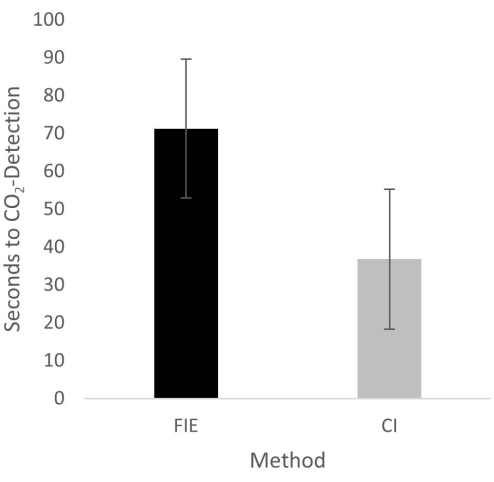
Figure 2: Time until CO2 detection in group comparison. For the group that was intubated using a flexible intubation endoscope, it took significantly longer until end-tidal CO2 could be detected, depicted as mean and standard deviation. Please click here to view a larger version of this figure.
to:
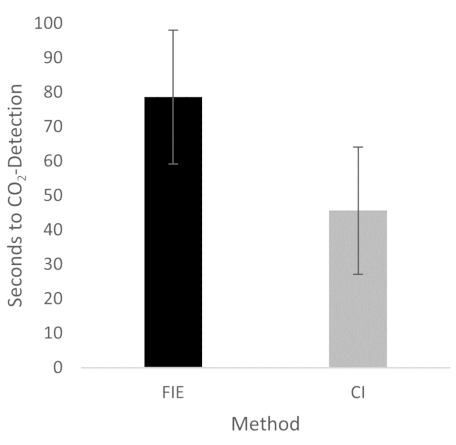
Figure 2: Time until CO2 detection in group comparison. For the group that was intubated using a flexible intubation endoscope, it took significantly longer until end-tidal CO2 could be detected, depicted as mean and standard deviation. n = 5 (for each group). Please click here to view a larger version of this figure.
In the Discussion, the fifth paragraph was updated from:
The increased duration had no clinical significance in this cohort. At no time was the termination criterion-a saturation of less than 93%-reached. This is shown in the results because a procedure change was unnecessary at any time. Prior adequate mask ventilation is a critical step to allow sufficient time for fiberoptic endotracheal tube placement to avoid rapid desaturation34. These results are consistent with previous studies comparing conventional intubation and endoscopically assisted intubations with inexperienced providers35.
to:
The increased duration had no clinical significance in this cohort. At no time was the termination criterion-a saturation of less than 93%-reached. This is shown in the results because a procedure change was unnecessary at any time. Prior adequate mask ventilation is a critical step to allow sufficient time for fiberoptic endotracheal tube placement to avoid rapid desaturation34. These results are consistent with previous studies comparing conventional intubation and endoscopically assisted intubations with inexperienced providers35. We attribute the prolonged duration of fiberoptic intubation to the fact that one must first reorient again after insertion, whereas with conventional intubation, one retains a view of the glottis. It is also important to avoid contact with the mucosa with the flexible intubation endoscope during advancement. This requires occasional corrective maneuvers. Last but not least, after successful placement, retraction of the relatively long endoscope is required, which increases the time to CO2 detection slightly.
