Este protocolo apresenta um guia para a aplicação precisa e centrada no paciente da estimulação magnética transcraniana repetitiva para depressão maior resistente ao tratamento. São fornecidos detalhes sobre procedimentos para localização precisa da bobina, dosagem ajustável de estímulos, medidas rigorosas de segurança e estratégias que maximizam conforto, reprodutibilidade e eficácia clínica a longo prazo em sessões agudas e de manutenção.
Artigo de método
Estimulação Magnética Transcraniana Repetitiva Convencional para Depressão: Um Protocolo Passo a Passo
Neste artigo
Resumo
Resumo
A Estimulação Magnética Transcraniana Repetitiva (rTMS) é uma abordagem não invasiva para estimulação cerebral, com eficácia e eficácia comprovadas para tratar o Transtorno Depressivo Maior (TDM), especialmente para episódios que não respondem a medicamentos antidepressivos. Um protocolo estruturado de Estimulação Magnética Transcraniana (TMS) centrado no paciente, focado em precisão, conforto e segurança, deve ser fornecido nas clínicas de TMS que tratam o TDM. O procedimento começa com o paciente sentado confortavelmente em uma poltrona reclinável, equipada com suporte para cabeça e pés. Um travesseiro é colocado ao redor do pescoço do paciente para garantir estabilidade e conforto da cabeça durante toda a reunião. Uma tampa de lycra é colocada na cabeça do paciente, e a área de tratamento é marcada na tampa para garantir a colocação correta da bobina eletromagnética. Duas estratégias principais, baseadas nos pontos de referência da cabeça para cada paciente individual, têm sido amplamente utilizadas para identificar a área de tratamento: a regra dos 5 cm e o método F3 do Feixe. Para iniciar o tratamento, a bobina é posicionada no alvo do tratamento para fornecer uma série de pulsos eletromagnéticos. Os pacientes ouvem um som de clique e sentem uma leve sensação de batidas no couro cabeludo. Para proteção acústica, protetores auriculares são fornecidos antes do início da sessão. A estimulação em si normalmente não causa desconforto, e os pacientes podem retomar suas atividades diárias normais após a sessão. No entanto, dirigir é desaconselhado imediatamente após as sessões de tratamento. O protocolo rTMS para tratar o TDM consiste em 20 a 30 sessões diárias ao longo de quatro a seis semanas, monitoradas por consultas regulares com um psiquiatra, para acompanhar o progresso e ajustar se necessário. Sessões de manutenção podem se seguir para manter os benefícios clínicos. Esse protocolo passo a passo garante conforto, consistência e entrega eficaz do tratamento para pacientes que estão passando por terapia rTMS.
Introdução
A Estimulação Magnética Transcraniana (EMT) é uma técnica de neuromodulação não invasiva baseada no princípio da induçãoeletromagnética 1. Se uma corrente elétrica passar por uma bobina TMS, ela gera um campo eletromagnético perpendicular à direção1 da corrente. Quando esse campo interage com material condutor, como tecido neural, ele induz atividade elétrica1. Isso permite a modulação direcionada da atividade neuronal em regiões discretas do córtex cerebral, abrindo novas oportunidades tanto para pesquisas neurocientíficas quanto para aplicaçõesclínicas 2. A evolução da tecnologia TMS levou ao desenvolvimento da TMS repetitiva (rTMS), envolvendo a entrega de pulsos eletromagnéticos repetidos para uma região cortical alvo em uma frequênciapredeterminada 3. A rTMS de alta frequência (≥ 5 Hz) normalmente facilita a excitabilidade cortical, enquanto a rTMS de baixa frequência (≤ 1 Hz) asuprime 3. Protocolos mais complexos para rTMS, como a estimulação intermitente por explosão theta (iTBS) e a estimulação contínua por explosão theta (cTBS), também permitem a modulação da atividade cerebral e foram integrados à práticaclínica 3.
O potencial terapêutico da rTMS para transtornos psiquiátricos foi explorado pela primeira vez na década de 1990, com estudos demonstrando seus efeitos em pacientes com depressão resistente amedicamentos 4,5. Desde então, inúmeros ensaios clínicos e meta-análises estabeleceram a rTMS como um tratamento seguro e eficaz para transtornosneuropsiquiátricos 6. Em 2008, a Food and Drug Administration (FDA) dos EUA aprovou o rTMS de alta frequência para episódios de depressão resistente ao tratamento (TRD)7,8,9,10, marcando a primeira aplicação oficial neuropsiquiátrica da técnica 11. Decisões regulatórias subsequentes se seguiram, incluindo a aprovação do iTBS para TRD em 2018, após evidências de eficácia equivalente ao protocolo convencional de TMS, e do rTMS para transtorno obsessivo-compulsivo (TOC) em 2019, bem como a designação do rTMS como uma terapia inovadora para depressãobipolar 11. O arcabouço regulatório europeu, por meio da Marque Conformité Européenne (CE), certificou de forma semelhante múltiplos dispositivos e protocolos TMS para usoclínico 11.
Recomendações baseadas em evidências baseadas em consenso de especialistas e diretrizes clínicas reforçaram o papel terapêutico da rTMS nadepressão 12. Dados clínicos robustos apoiam sua eficácia na TRD, com taxas de resposta variando de 39,5% a 70% e taxas de remissão entre 16,6% e 76,9%. Importante destacar que os efeitos antidepressivos da EMT têm mostrado persistência, com 53% dos respondentes mantendo melhorias aos seis meses e 46% aos 14 anosapós o tratamento. O córtex pré-frontal dorsolateral esquerdo (L-DLPFC) é o alvo liberado para tratamento da depressão, embora protocolos alternativos envolvendo estimulação da DLPFC direita ou abordagens bilaterais também tenham sidoexplorados 15. Os tratamentos convencionais oferecem sessões diárias de estimulação ao longo de várias semanas, enquanto protocolos acelerados mais recentes foram desenvolvidos com múltiplas sessões por dia por um período maiscurto 16. Neste trabalho, adicionando às diretrizesexistentes 17, buscamos fornecer um guia passo a passo para a aplicação da rTMS convencional no tratamento de um episódio depressivo maior, incorporando elementos como estratégias estruturadas de ramping, cronogramas pré-definidos de avaliação psicométrica e medidas detalhadas de conforto e segurança, dentro de um ambiente clínico que garanta consistência, entrega eficaz do tratamento e adesão às autorizações regulatórias ourecomendações 11. Por isso, buscamos fornecer orientações para a aplicação clínica da EMT no tratamento da depressão, visando mitigar a variabilidade na aplicação dos tratamentos, ao mesmo tempo em que melhoramos a tolerabilidade, consistência e implementação no mundo real.
Protocolo
Esse protocolo oferece uma abordagem padronizada para o tratamento da depressão utilizando um protocolo convencional para Estimulação Magnética Transcraniana (EMT). As sessões de TMS são categorizadas em três tipos: Primeira Sessão, Sessões Regulares e Sessões de Avaliação. Os procedimentos desse protocolo são realizados na Fundação Champalimaud usando um estimulador magnético MagVenture MagPro X100, com uma bobina Cool-B65 em forma de oito. Os protetores auriculares de segurança SINGER B38 são fornecidos a todos os participantes e técnicos TMS.
1. Prescrição de TMS (realizada pelo médico prescritor)
- Avalie a elegibilidade para o tratamento de SMT durante a entrevista clínica, detalhando o histórico médico atual e passado:
- Confirme o diagnóstico do episódio depressivo maior atual para uso aprovado.
- Rastreie o risco de efeitos colaterais (por exemplo, convulsões) e contraindicações de tratamento17,18. Contraindicações absolutas para a rTMS são a presença de implantes eletrônicos ou metálicos no cérebro. Embora não haja motivos absolutos para suspender o tratamento, uma avaliação cuidadosa de risco e benefício é necessária em casos de doenças médicas ativas e não controladas que exijam atenção imediata, implantes eletrônicos ou metálicos no corpo que não sejam compatíveis com campos eletromagnéticos, epilepsia, gravidez, amamentação, mulheres planejando gestação e transtornos psicóticos ou de humor que exijam hospitalização imediata.
- Obtenha consentimento informado explicando claramente procedimentos, riscos, incluindo convulsões e qualquer uso fora de indicação17,18.
- Prescrever TMS em um processo de decisão compartilhado com o paciente, considerando indicações aprovadas, off-label eemergentes 11.
2. Clínica e equipe de TMS
- Use equipamentos com autorização regulatória, incluindo o estimulador TMS, a bobina TMS e o sistema de resfriamento TMS.
- Tenha suporte de vida e planos de emergência para síncope econvulsões 19,20.
- Garantir que todos os funcionários sejam treinados em mecanismos de TMS, riscos e gestão de emergências, com pelo menos habilidades básicas de suporte à vida17, 18, 21.
- Inclua um médico licenciado que supervisione o tratamento, que deve estar acessível, pelo menos por telefone, durante assessões 17, 18 e 21.
3. Primeira sessão de TMS
- Chegada e check-in administrativo (equipe administrativa)
- Cumprimentem o paciente ao chegar à Clínica TMS.
- Confirme a documentação necessária para a admissão, incluindo prescrição de TMS, consentimento informado preenchido e verificação de segurança.
- Apresente o paciente ao técnico de TMS.
- Peça ao técnico de TMS explicar os procedimentos gerais.
- Forneça ao paciente uma prancheta contendo os seguintes materiais de avaliação para avaliar variáveis sociodemográficas e coletar dados psicométricos autorrelatados (por técnico de TMS). i) Questionário sociodemográfico: Questionário de autorrelato para coletar informações como idade, gênero, escolaridade, profissão, lateralidade, modo de transporte de ida e volta ao tratamento e hábitos, entre outros, considerados relevantes para cada contexto específico. ii) Inventário de Depressão de Beck-II (BDI-II): uma escala de 20 itens que avalia a gravidade dos sintomas depressivos, completada pelo paciente22. Outras escalas de autorrelato para avaliar a gravidade da depressão estão disponíveis. Recomenda-se que pelo menos uma escala de autorrelato inclua um ou mais itens para avaliar ideação suicida e/ou intenção. iii) Escala Visual Analógica (VAS): Uma linha de 10 cm usada para avaliar o humor do paciente, onde 0 representa o pior humor possível e 10 representa o melhor humor possível.
- Verificação pré-sessão do dispositivo (por técnico TMS)
- Verifique e confirme a integridade do estimulador e da bobina.
- Confirme a integridade do resfriamento ativo (se aplicável).
NOTA: A inspeção técnica rotineira e a calibração do dispositivo TMS são recomendadas. O cronograma de manutenção deve seguir as diretrizes do fabricante e pode variar dependendo da idade e condição do equipamento. Consulte o fornecedor do dispositivo para recomendações específicas.
- Introdução ao TMS (por técnico do TMS)
- Chame o paciente para a sala de tratamento. Normalmente, a sessão é conduzida apenas com o técnico e o paciente. Com consentimento explícito do paciente, acompanhantes (por exemplo, familiares) ou estagiários podem estar presentes.
- Introduza a técnica TMS, incluindo uma explicação dos mecanismos conhecidos de ação em termos leigos.
- Discuta possíveis efeitoscolaterais 23.
- Demonstração (por técnico de TMS):
- Convide o paciente a experimentar a estimulação no antebraço, garantindo que a bobina esteja posicionada corretamente e que o paciente seja informado sobre a breve sensação de batidadinhas ou formigamento.
- Demonstre a sensação de TMS no antebraço do paciente, geralmente na parte interna, no meio do caminho entre o punho e o cotovelo, usando um único pulso em baixa intensidade (por exemplo, 30-40% da saída máxima do estimulador).
NOTA: Esta etapa de familiarização ajuda a reduzir a ansiedade, criar empatia e aumentar o conforto durante o procedimento. Evite essa demonstração em pacientes com implantes eletrônicos (por exemplo, marcapassos, neuroestimuladores) ou em gestantes. Embora a exposição periférica a campos eletromagnéticos seja considerada segura, pode apresentar riscosteóricos 18. Nesses casos, use explicação verbal e conforto em vez de estimulação direta, ou estimule uma região diferente, mais distante do dispositivo elétrico ou do abdômen (por exemplo, tornozelo).
- Entrevistas clínicas (por técnico de TMS): Realizar entrevistas clínicas semiestruturadas para avaliar a gravidade dos sintomas. Instrumentos psicométricos servem para estabelecer parâmetros de referência para monitorar o progresso do tratamento. A seguir, dois exemplos de escalas aplicadas por clínicos:
- Escala de Avaliação de Depressão Montgomery-Asberg (MADRS): Utilize-a para avaliar a gravidade dos sintomasdepressivos 24. O MADRS (e o BDI-II) podem ser usados para auxiliar na avaliação do resultado do tratamento. Embora a avaliação definitiva do desfecho seja realizada colaborativamente pelo paciente e pelo médico prescritor, definições quantitativas de resposta e remissão são relativamente consensuais na literaturadisponível 25.
NOTA: Um respondente parcial é definido como um paciente que apresenta pelo menos 25% de redução nos sintomas depressivos, enquanto um respondente completo apresenta 50% de redução ou mais. Essas definições são usadas tanto em ambientes clínicos quanto de pesquisa24. Remissão é definida como o estado em que os sintomas depressivos foram reduzidos a um nível considerado dentro da faixa normal, indicando resolução próxima ou completa do episódio depressivo, geralmente operacionalizado como um escore total abaixo de um limiar específico de cada instrumento (por exemplo, MADRS ≤ 10)16,26. - Escala de Avaliação de Mania Jovem (YMRS): Utilize-a para avaliar a gravidade dos sintomas maníacos ou hipomaníacos. A mania é uma preocupação entre pacientes com diagnóstico conhecido de transtorno bipolar, mas também pode ocorrer em pacientes sem diagnóstico prévio de transtorno bipolar. Escalas como a YMRS são usadas para monitorar a ocorrência de mania como possível efeito colateral do tratamento.
NOTA: Uma vez concluídas as avaliações de base, o técnico TMS inicia todos os procedimentos que exigem o uso do dispositivo TMS. As avaliações clínicas são repetidas em intervalos variáveis, dependendo dos recursos disponíveis e das necessidades dos pacientes. Escalas de autorrelato e/ou entrevistas clínicas são repetidas pelo menos após a conclusão das sessões de EMT, para auxiliar na avaliação da resposta ao tratamento.
- Escala de Avaliação de Depressão Montgomery-Asberg (MADRS): Utilize-a para avaliar a gravidade dos sintomasdepressivos 24. O MADRS (e o BDI-II) podem ser usados para auxiliar na avaliação do resultado do tratamento. Embora a avaliação definitiva do desfecho seja realizada colaborativamente pelo paciente e pelo médico prescritor, definições quantitativas de resposta e remissão são relativamente consensuais na literaturadisponível 25.
4. Procedimentos completos de TMS (realizados pelo técnico de TMS)
NOTA: Procedimentos completos de SMT, incluindo a determinação do limiar motor, são realizados na primeira sessão de SMT e podem ser repetidos em intervalos variáveis entre os centros de SMT, dependendo dos recursos disponíveis e das necessidades do paciente. Alguns centros realizam uma única sessão completa no início da fase aguda de tratamento da SMT, enquanto outros realizam todas as avaliações diariamente17,27. Uma abordagem baseada em evidências é repetir todas as avaliações a cada cinco sessões (ou seja, semanalmente), tipicamente nas sessões 6, 11, 16, 21 e 26, para permitir a definição da intensidade da EMT na semanaseguinte de 27.
- Procedimentos iniciais: Sistemas que usam bobinas semelhantes acapacetes 11 possuem um protocolo particular, descrito em detalhes por Feifel e Pappas28. Os passos a seguir são usados para sistemas TMS com bobinas em forma de oito, que são predominantes na maioria dos países.
- Coloque uma tampa de lycra no paciente para marcar áreas de interesse no couro cabeludo. Confirme que a touca está alinhada de acordo com as sobrancelhas do paciente e a parte superior das orelhas, garantindo pontos de referência consistentes para a colocação da tampa nas sessões seguintes.
- Forneça protetores auriculares ao paciente para minimizar o desconforto causado pelos sons de estimulação. Use seus próprios protetores auriculares durante os procedimentos de SMT.
- Registre esses procedimentos no prontuário clínico do paciente.
- Determinando o ponto quente motor: Esta etapa envolve identificar o ponto quente de estimulação para o córtex motor primário (MH) da região da mão no hemisfério esquerdo.
- Use uma fita métrica para determinar e marcar a linha média sagital, que vai do nasion (o topo da ponte nasal) até o inion (o protuberância proeminente na parte de trás do crânio).
- Marque a linha do intertrágum colocando uma das extremidades da fita em um trago (ponto logo à frente da orelha) e esticando-a até o outro lado.
- Considere a interseção dessas duas linhas como o vértice craniano, a partir do qual medições adicionais são feitas para localizar o ponto quente do córtex motor.
- Marque um triângulo estendendo uma linha 5 cm para a esquerda ao longo da linha intertrágica e 5 cm para frente ao longo da linha médio sagital, ambas começando no vértice craniano. O terceiro lado é desenhado na diagonal para ligar as extremidades livres das duas primeiras linhas. O ponto de referência para iniciar a busca pelo ponto quente do motor manual está localizado 2,5 cm ao longo da linha diagonal, medido a partir do vértice mais à esquerda do triângulo.
- Marque 4 pontos adicionais posicionados 0,5 cm anterior, posterior, lateral e medial a partir desse ponto de referência para facilitar a exploração.
- Use os 5 pontos acima como locais onde a borda anterior da bobina TMS é posicionada durante o procedimento de detecção de hotspots motores.
- Para iniciar a busca pelo ponto de interesse motor, instrua o paciente a apoiar os braços e mãos nos apoios de braço da cadeira ou no colo, garantindo que fiquem visíveis e relaxados.
- Coloque a alça da bobina TMS em forma de oito na cabeça do paciente em um ângulo de 45° em relação à linha média sagital (cabo voltado para trás e para a esquerda).
- Aplique pulsos mantendo a bobina na posição mencionada acima. Para familiarizar o paciente com o procedimento, administre pulsos iniciais em intensidades mais baixas (por exemplo, 20-30%), enquanto avalia a experiência sensorial do paciente. Confirme a contração visível dos músculos contralaterais da mão.
- Se nenhuma resposta motora for observada nessas intensidades iniciais nos pontos de referência marcados do passo anterior, aumente a intensidade da estimulação em incrementos de 5% até que uma resposta motora seja provocada, definida como uma contração visível da mão direita (ou seja, a mão contralateral ao hemisfério estimulado).
NOTA: Dependendo da anatomia do paciente, o técnico de TMS busca determinar especificamente a área responsável pela contração muscular do abdutor do polegar curto e/ou do primeiro dígito interósseo (contração dos dois primeiros dígitos)29,30. - Uma vez detectada uma resposta motora, explore os vários pontos de referência marcados para identificar o local onde a resposta motora é máxima.
- Marque e use pontos de referência adicionais conforme necessário, em diferentes posições cardeais e/ou espaçados a mais de 0,5 cm (por exemplo, 1 cm). O ponto quente é o local onde a contração apresenta a maior magnitude.
- Uma vez identificado o local ideal de estimulação, trace uma linha côncava seguindo a borda anterior da bobina e marque o centro dessa linha.
- Se nenhuma resposta motora for observada nessas intensidades iniciais nos pontos de referência marcados do passo anterior, aumente a intensidade da estimulação em incrementos de 5% até que uma resposta motora seja provocada, definida como uma contração visível da mão direita (ou seja, a mão contralateral ao hemisfério estimulado).
- Confirme a saúde mental em intervalos regulares. Se o refinamento da saúde mental for necessário durante uma sessão ou durante um ciclo de tratamento, marque a nova saúde mental no limite do paciente e registre o motivo do refinamento no prontuário clínico, conforme protocolo (por exemplo, avaliações semanais de saúde mental) ou por outro motivo.
- Determinação do limiar motor em repouso (rMT): Após encontrar a MH, avalie a rMT. Essa é a dose mínima necessária para provocar a contração da mão em pelo menos 5 de 10 pulsos entregues à saúde mental.
- Comece esse processo após um período de adaptação.
- Administre pulsos a 50% da intensidade máxima da máquina. Confirme que uma contração visível dos músculos contralaterais da mão está ocorrendo em pelo menos 5 de cada 10 pulsos.
- Se uma contração da mão não for provocada em pelo menos 5 de cada 10 pulsos, aumente a intensidade em 2% até que isso seja alcançado.
- Se isso ocorrer, diminua a intensidade em 1% até que a intensidade mínima que provoca uma resposta motora seja encontrada, considerando o critério de resposta em pelo menos 5 de 10 pulsos.
- Registre o rMT no prontuário clínico do paciente para uso posterior nas sessões seguintes.
- Se a reavaliação da rMT for necessária durante a sessão ou durante o ciclo de tratamento, registre a nova rMT e o motivo da reavaliação, ou seja, conforme o protocolo (por exemplo, avaliações semanais de rMT) ou por motivo inesperado (por exemplo, mudança de medicação que pode impactar a rMT).
NOTA: Este procedimento é adaptado para dispositivos TMS onde a intensidade de estimulação é expressa como uma porcentagem da saída máxima do dispositivo. Para dispositivos que representam intensidade usando diferentes unidades, são feitas adaptações apropriadas.
- Determinação do local de tratamento (TS): Após identificar a MH e determinar o rMT, prossiga para localizar o TS. Existem vários métodos para determinar o TS, incluindo métodos neuronavegados, conforme descrito por Dunlop et al.31. Aqui, o foco está em abordagens não neuronavegadas, que dependem de medições baseadas no couro cabeludo e têm sido amplamente utilizadas e apoiadas na práticaclínica 17. Dois métodos foram defendidos: a regra dos 5 cm e a Feixe F3.
- Regra dos 5 cm: A partir do ponto médio da linha côncava desenhada após determinar o ponto quente motor, estenda uma linha parassagital para frente e marque o ponto de estimulação para a DLPFC esquerda em 5-6 cm (mais frequentemente 5,5 cm) nessa linha.
- Feixe F3: Use essa estratégia para localizar a posição F3 do sistema eletroencefalograma 10-20 no couro cabeludo, um marco alternativo para o L-DLPFC. Insira as medidas específicas da cabeça do paciente em um software de computador disponível gratuitamente que forneça instruções para marcar F3 de acordo com o tamanho da cabeça do paciente (ver Tabela de Materiais)32.
- Obtenha 3 medições usando uma fita métrica: i) Meça a distância nasion-íon do nasion (o topo da ponte nasal) até o íon (a proeminência na parte de trás do crânio). ii) Meça a distância intertrágica do trago esquerdo ao direito. iii) Mede a circunferência da cabeça passando a fita métrica sobre o íon na altura das sobrancelhas.
- Insira essas medidas na interface do software para gerar duas saídas. Primeiro, a distância à esquerda da linha média ao longo da circunferência da cabeça (Ponto X). Segundo, a distância do vértice ao longo de uma reta que intersecta o Ponto X (Ponto Y). O ponto Y é o L-DLPFC TS determinado pelo método do Feixe F3. Use essas duas distâncias para marcar o TS.
- Determine a TS em intervalos regulares. Se o refinamento do TS for necessário durante a sessão ou durante o ciclo de tratamento, marque o novo TS no boné do paciente e registre o motivo do refinamento no prontuário clínico do paciente, conforme protocolo (por exemplo, avaliações semanais de TS) ou por outro motivo.
- Protocolo de tratamento: Atualmente, dois protocolos convencionais para estimulação do L-DLPFC são aprovados e/ou aprovados por agências reguladoras para tratamento da depressão, e estão disponíveis na maioria dos centros de SMT como esquemas de tratamento TMS agudo/indução, com sessões diárias realizadas em 20 a 30 sessões diárias nosdias úteis às 23h horas
- rTMS de alta frequência: Entrega pulsos com intensidade a 120% da rMT e frequência de 10 Hz (3000 pulsos por sessão, em ciclos sequenciais de 4 s ligados e 26 segundos desligados, com duração total de 37,5 min).
- iTBS: Entrega pulsos com intensidade a 120% rMT, em rajadas tripletas de 50 Hz, repetidas a 5 Hz (600 pulsos por sessão, em ciclos sequenciais de 2 s ligados e 8 segundos desligados, com duração total de 3 min e 9 s).
- Durante a sessão: Certifique-se de que a bobina permaneça corretamente posicionada na cabeça sobre o TS durante toda a sessão. Se o paciente sentir qualquer desconforto, ajude a normalizar a sensação e ajuste a intensidade se necessário. A sessão pode ser pausada ou descontinuada a pedido do paciente.
- Procedimentos pós-sessão
- Instrua o paciente a se levantar lentamente, enquanto monitora sinais de tontura ou desequilíbrio.
- Avalie a presença dedesconforto 23. Para medidas de mitigação, sugira o uso de analgésicos vendidos sem receita ou contato com o médico responsável, em caso de sintomas graves ou persistentes.
5. Sessões de tratamento de SMT (realizadas por um técnico de SMT)
- Verificação pré-sessão
- Pergunte ao paciente se ele teve algum efeito colateral na sessão anterior.
- Peça aos pacientes qualquer mudança na medicação que possa afetar o rMT. Após mudanças significativas na medicação, reavalie o rMT.
- Confirmação de hotspot
- Coloque a tampa de lycra marcada de volta na cabeça do paciente e verifique a saúde mental para garantir que as regiões previamente marcadas permaneçam precisas.
- Se ajustes forem necessários, siga os procedimentos descritos para a primeira sessão para redefinir a MH.
- Tratamento
- Coloque a bobina no TS e administre a estimulação de acordo com o protocolo de tratamento selecionado e a avaliação mais recente de rMT.
- Verifique a posição da bobina na cabeça do paciente durante a sessão para garantir sua precisão.
- Ramping: Durante as sessões iniciais de tratamento, alguns pacientes experimentam desconforto no couro cabeludo ou contrações musculares que impedem a entrega imediata da intensidade total de estimulação especificada no protocolo TMS. Nesses casos, implemente ramping para aumentar o conforto e a tolerância do paciente. Ramping na TMS refere-se ao aumento gradual da intensidade da estimulação nas primeiras sessões, geralmente na primeira semana de tratamento (5 sessões).
- Em vez de começar na intensidade máxima prescrita, inicie a estimulação em uma porcentagem menor do limiar motor (por exemplo, 100% rMT).
- Aumenta a intensidade da estimulação dentro da sessão e/ou entre sessões, até que a intensidade-alvo seja atingida, ou seja, 120% da rMT.
NOTA: Essa abordagem ajuda a reduzir o desconforto inicial, melhorar a adesão do paciente e minimizar efeitos colaterais como dor no couro cabeludo ou dores de cabeça. O ramping é particularmente benéfico para pessoas novas na TMS e para aquelas com sensibilidade aumentada à estimulação.
- Procedimentos pós-sessão: Siga os procedimentos descritos acima (passo 4.7).
6. Avaliação médica (realizada pelo médico prescritor)
NOTA: Dependendo dos recursos físicos e humanos disponíveis em cada centro de SMT, consultas médicas com o médico do SMT são agendadas durante toda a fase de tratamento agudo da SMT.
- Avalie o progresso do paciente, analise quaisquer efeitos colaterais e discuta possíveis estratégias demitigação 17,23.
- Após o paciente completar 4 semanas de tratamento, ajuste a frequência das sessões com base na resposta clínica.
- Após a fase de tratamento agudo, avalie o progresso geral do paciente e discuta os próximos passos do tratamento.
- Se clinicamente indicado, recomende a transição para uma fase de manutenção de acordo com protocolos e recursos do centro, e preferênciado paciente 14.
Resultados
A eficácia da estimulação magnética transcraniana no tratamento de episódios de depressão maior tem sido consistentemente confirmada em múltiplas meta-análises, com taxas de resposta variando de 40% a 70% e taxas de remissão de 17% a 77%13. Consequentemente, suas aplicações clínicas e de pesquisa têm seexpandido em 33 lugares. No entanto, a variabilidade significativa nos desfechos do tratamentopersiste 13, possivelmente devido a diferenças nos protocolos entre os centros deSMT 12. Aqui, fornecemos um guia estruturado, passo a passo, que promove a consistência entre os centros, visando melhorar a eficácia clínica e a qualidade de vida dos pacientes. Além disso, a padronização dos protocolos facilita uma coleta de dados clínicos mais robusta, contribuindo para pesquisas em ambientes reais 24,27,34.
Como exemplo, nosso centro de TMS aplica rotineiramente esse protocolo padronizado e contribuiu para um estudo de evidências do mundo real que avaliou a eficácia da TMS para a depressão24. Este estudo, que analisou dados de mais de 500 pacientes em vários centros em vários países, comparou os desfechos do tratamento entre adultos mais velhos e jovens24 anos. Na Fundação Champalimaud, o estudo foi aprovado pelo Comitê de Ética de Champalimaud, e foi obtido consentimento informado de todos os participantes. Entre maio de 2019 e abril de 2021, 35 pacientes tratados em nosso local atenderam aos critérios de elegibilidade para inclusão. Neste estudo, além da elegibilidade para tratamento com rTMS para TRD, os participantes foram excluídos se os dados de idade ou limiar motor estivessem ausentes, o dispositivo de tratamento fosse trocado no meio do curso, menos de 10 sessões fossem concluídas ou o intervalo médio entre as sessões fosse ≥ 2,5 dias. A idade média era de 48,6 ± 16 anos, e 51,4% eram mulheres. A indicação mais comum para encaminhamento foi depressão unipolar (80%), com 20% dos pacientes diagnosticados com depressão bipolar. A maioria dos pacientes (88,6%) recebeu iTBS em vez do L-DLPFC. Nos casos em que o protocolo do lado esquerdo não era tolerado, utilizava-se um protocolo de baixa frequência do lado direito (R-DLPFC) (11,4%). O rMT foi avaliado semanalmente, consistente com os procedimentos da nossa pesquisaanterior 27. A média de rMT inicial foi de 59,4 ± 14,0%, e a rMT no final do tratamento foi de 58,1 ± 16,8%. A maioria dos pacientes (80%) completou o tratamento agudo completo de seis semanas, com 8,6%, 2,9%, 5,7% e 2,9% completando apenas cinco, quatro, três e duas semanas, respectivamente. Nenhuma queda foi atribuída a problemas relacionados ao protocolo (por exemplo, desconforto da bobina, incapacidade de alcançar o rMT alvo), e a inconclusão resultou da desistência por motivos não especificados. Os desfechos clínicos estão ilustrados na Figura 1. A redução média do MADRS foi de 9,13 (± 9,82 de DS), o que foi significativamente diferente de zero (teste t de uma amostra, p < 0,001). As taxas de resposta e remissão não foram substancialmente diferentes das evidências previamente relatadas que apoiavam a eficácia da EMT no tratamento de transtornosdepressivos 13. Quanto à variabilidade dos técnicos, usamos um modelo de efeitos mistos bidirecionais para calcular o coeficiente de correlação intraclasse (ICC) para concordância absoluta na avaliação de rMT entre as duas primeiras medições semanais de rMT. As análises foram realizadas separadamente para medições feitas pelo mesmo técnico (intraavaliador) e por diferentes técnicos (interavaliadores). Ambos os valores do ICC indicaram excelente confiabilidade (ICCIntra = 0,92, IC 95% 0,75-0,98, F[11,11] = 23,79; p < 0,001; ICCInter = 0,88, IC 95% 0,75-0,95; F[22,22] = 6,4; p < 0,001).
Quanto aos resultados da amostra geral, embora ambos os grupos etários tenham apresentado respostas antidepressivas semelhantes, os adultos mais velhos apresentaram resposta tardia em comparação com seus colegas mais jovensde 24 anos. Esses achados sugerem que estender a duração do tratamento com EMT pode ser necessário para alcançar resultados terapêuticos comparáveis em pacientes mais velhos e estão alinhados com pesquisas anteriores que confirmaram a eficácia da SMT em populações mais velhas, ao mesmo tempo em que destacam o potencial para adaptações específicas de idade nos protocolosde tratamento 35.
Integrar esses achados à prática clínica exige cuidadosa consideração, pois eles apoiam diretamente aspectos-chave do protocolo TMS descrito neste trabalho. Especificamente, eles enfatizam a necessidade de monitoramento regular e prolongado do progresso do tratamento, bem como o papel fundamental de gerenciar efetivamente as preocupações e expectativas dos pacientes em relação aos efeitos variados daTMS 36. Além disso, destacam a importância de desenvolver planos de tratamento individualizados que incorporem avaliações abrangentes e rotineiras de múltiplos determinantes, incluindo fatores sociodemográficos (por exemplo, idade), variáveis clínicas (por exemplo, regimes medicacionais concomitantes) e parâmetros relacionados ao tratamento (por exemplo, ponto de interesse motor, limiar motor e determinação do local de tratamento)17. Esses fatores desempenham um papel crucial na otimização tanto da eficácia clínica quanto da tolerância aotratamento 6.
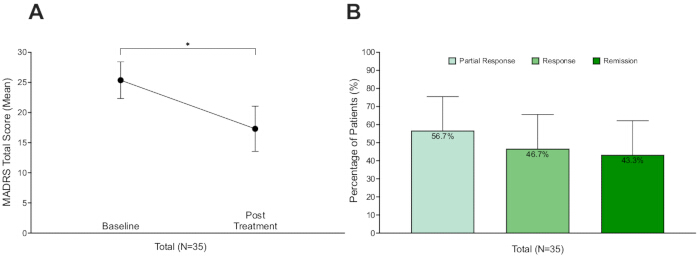
Figura 1: Efeito antidepressivo após 6 semanas de tratamento. (A) A gravidade dos sintomas depressivos foi avaliada usando a Escala de Avaliação de Depressão Montgomery-Asberg (MADRS). A redução média do MADRS foi de 9,13 (± 9,82 de DS), o que foi estatisticamente significativamente diferente de zero (teste t de uma amostra, p < 0,001). Barras de erro correspondem a um intervalo de confiança de 95%. (B) Um respondente parcial foi definido como um paciente que apresenta uma redução de pelo menos 25% na gravidade da depressão, enquanto um respondente foi considerado se uma redução de 50% ou mais na gravidade dos sintomas foiobservada 24. Por fim, remissão foi definida como um escore total de MADRS ≤ 10, 16,26. Os desfechos clínicos foram semelhantes aos relatadosanteriormente 13. Barras de erro correspondem a um intervalo de confiança de 95%. Por favor, clique aqui para ver uma versão ampliada desta figura.
Discussão
A implementação de um protocolo padronizado de SMT em ambientes clínicos garante consistência na entrega do tratamento, otimiza os resultados dos pacientes e aumenta a confiabilidade das intervenções terapêuticas para depressão17. O protocolo descrito neste estudo fornece uma estrutura estruturada para clínicos e técnicos, abordando elementos-chave do procedimento, como preparação do paciente, determinação de hotspots motores e localização do local de tratamento. Ao manter a adesão a essas etapas, os profissionais podem reduzir a variabilidade na aplicação do tratamento 14,37,38, aumentando assim potencialmente a probabilidade de alcançar resultados clínicos ótimos. Além disso, integrar avaliações psicométricas em intervalos pré-definidos permite o acompanhamento sistemático da resposta do paciente, garantindo que ajustes no tratamento possam ser feitos também com base em dados empíricos. Em contraste com asdiretrizes existentes 23, esse protocolo especifica estratégias estruturadas de ramping para otimizar o conforto do paciente durante as sessões iniciais e incorpora cronogramas pré-definidos de avaliação psicométrica para orientar ajustes sistemáticos e baseados em dados.
A tomada de decisão sobre o uso da TMS para tratar um episódio de depressão deve ser uma decisão colaborativa entre o paciente e o médico prescritor. Na maioria das circunstâncias, o clínico é um psiquiatra, já responsável pelo cuidado do paciente, ou a quem o paciente foi encaminhado para avaliação do possível uso da SMT. Indicações com aprovação regulatória incluem TRD, com e sem ansiedade comórbida, mas também TOC e transtornos por uso de substâncias, com recente aprovação de um protocolo para cessação dotabagismo 11. Protocolos aprovados por agências reguladoras para depressão incluem estimulação L-DLPFC de altafrequência 11,39. Usos off-label podem ser considerados com base em evidências clínicas e diretrizes de especialistas. Além disso, dados promissores também apoiam o possível uso futuro de outras síndromes psiquiátricas, nomeadamente sintomas negativos de esquizofrenia e transtorno de estresse pós-traumático, ainda sem aprovaçãoregulatória 11,12.
Embora o foco deste artigo seja um protocolo para rTMS convencional, outros protocolos também estão disponíveis. A escolha de um protocolo TMS específico deve ser guiada pelo médico assistente, considerando tanto as preferências do paciente quanto do clínico, o dispositivo TMS disponível e o nível de experiência da equipe clínica. Um protocolo acelerado de SMT (Tratamento de Neuromodulação de Stanford) foi aprovado pela FDA para depressão resistente aotratamento 11,16, mas não é amplamente acessível na maioria dos centros de SMT, apesar de ser uma estratégia muito promissora, especialmente em relação à velocidade de início36,37. Outros protocolos, como rTMS de baixa frequência direcionada ao R-DLPFC ou estimulação bilateral envolvendo tanto o L- quanto o R-DLPFC, demonstraram eficáciaclínica 6,12. No entanto, essas abordagens atualmente possuem níveis de recomendaçãoinferiores 12 e ainda não receberam autorização ou aprovaçãoregulatória 11. A rTMS de baixa frequência do R-DLPFC, que pode ser necessária quando a estimulação em alta frequência não é tolerada e/ou a L-DLPFC não está acessível, é realizada com procedimentos para determinar MH, rMT e TS conforme descrito acima, mas adaptado para o hemisfério direito e a mão esquerda.
Questões éticas e regulatórias devem governar o uso da TMS na práticaclínica 17,18. Um requisito fundamental é obter consentimento informado, que deve ser livre e antes do tratamento, baseado na fornecimento de todas as informações relevantes sobre procedimentos, riscos potenciais e desconfortos de formacompreensível 17,18. O consentimento informado deve discutir claramente a possibilidade de ocorrência de efeitos colaterais, especialmente uma convulsão, e os profissionais devem garantir que os pacientes compreendam as informaçõesfornecidas 17,18. A divulgação completa do plano de tratamento, incluindo se protocolos off-label são utilizados, é fundamental no processo de consentimentoinformado 17,18. A segurança é outra consideração crítica17,18. Embora geralmente seguro e bem tolerado, o efeito adverso agudo mais grave é a ocorrência de uma convulsão, que é extremamente rara quando o tratamento é administrado dentro dos parâmetrosrecomendados 11, 17 e 18. Certas condições e medicamentos podem aumentar o risco de convulsões, como histórico pessoal de epilepsia, lesões cerebrais, administração de medicamentos que reduzem o limiar de convulsões, privação de sono ealcoolismo 18. Outros efeitos adversos, em sua maioria leves e autolimitados, podem incluir dor no couro cabeludo, dor de cabeça, espasmos musculares, tontura, náusea, ansiedade, insônia, hipomania ezumbido 11,17,18,39. Contraindicações absolutas incluem a presença de hardware metálico em contato próximo com a bobina, como implantes cocleares ou geradores de pulsos implantados, devido ao risco de induzir mau funcionamento dodispositivo 18. Outras condições, como gravidez ou doenças cardíacas graves, envolvem risco aumentado ouincerto 18.
O conforto e a adesão do paciente 40,41,42 desempenham papéis cruciais no sucesso do tratamento 43. O protocolo inclui medidas específicas para melhorar a tolerabilidade, como familiarização inicial com as sensações da SMT, uso de protetores auriculares para aumentar a segurança auditiva e implementação de estratégias de aumento gradual da intensidade da estimulação. Essas adaptações são particularmente valiosas para indivíduos que sentem desconforto durante as primeiras sessões, podendo melhorar a retenção do paciente e a eficácia geral dotratamento 43. A inclusão de avaliações estruturadas pós-sessão também possibilita a detecção precoce e o manejo dos efeitos colaterais, reforçando a segurança e o engajamento do paciente ao longo do ciclode tratamento 43.
Além dos equipamentos TMS com aprovação ou autorização regulatória local (por exemplo, marca CE na UE, FDA nos EUA), os locais onde o rTMS é administrado devem estar equipados com equipamentos adequados de suporte à vida, e o acesso a instalações médicas de emergência também é recomendado em ambientes médicos onde tratamentos ambulatoriais de TMSsão administrados 18. As clínicas de SMT devem ter um plano explícito para tratar síncopes e convulsões, e cada membro da equipe de SMT deve estar familiarizado comisso 18. Para suspeita de síncope, deitar o paciente em posição supina com as pernas elevadas éo 18 apropriado. Em caso de convulsões, os esforços devem se concentrar em prevenir complicações como aspiração, virando o paciente de lado (a posição do decúbito lateral esquerdo é desejável) quando o movimentocessa. As convulsões induzidas por TMS são tipicamente breves e autolimitadas; a recuperação tardia da consciência além de 30 s justifica avaliação médica adicional18. Embora equipamentos de suporte de vida devam estar disponíveis nos centros clínicos deTMS 18 para ambientes ambulatoriais que aplicam protocolos padrão, o consenso da Clinical TMS Society é que acesso intravenoso, desfibriladores cardíacos, sucção e oxigênio não sãonecessários 17.
O treinamento adequado para o pessoal é um passo crucial para a criação de uma clínicaTMS 19. As credenciais e treinamentos exigidos dependem do local e dos requisitos regulatórios locais, bem como do tipo e propósito da aplicaçãoTMS 17, 18, 19. No nosso centro, isso inclui a conclusão de um programa de treinamento certificado em TMS e a atuação supervisionada da TMS. Os participantes devem demonstrar proficiência na localização de MH e determinação de rMT, posicionamento preciso das bobinas e cumprimento dos procedimentos de segurança, antes da operação independente. Reavaliações periódicas e treinamentos de atualização também são recomendados para manter a padronização. Particularmente quando o rTMS é usado como tratamento para uma condição médica, um médico licenciado, atuando como clínico responsável por questões médicas, supervisiona a aplicação dos tratamentos, que podem ser realizados por um assistente médicotreinado 17, 18, 19. Técnicos em EMT, especialmente aqueles sem formação médica, devem ter conhecimento básico de fisiologia cerebral, mecanismos de SMT, riscos potenciais e mudanças fisiológicas induzidas pelotratamento 17,18,19. Também é recomendado que os técnicos de TMS tenham treinamento cardiopulmonar ou básico de suporte de vida17,18. Além disso, pessoal qualificado no manejo de síncope e convulsão deve estar presente nas clínicasde SMT 17,18. Por fim, para sessões clínicas de rotina, um médico deve estar disponível em caso de emergência17,18.
Outro componente crítico para a administração eficaz da TMS é a determinação precisa do localde estimulação 17. Aqui, destacamos a importância de usar abordagens estruturadas não neuronavegadas, como a regra dos 5 cm e o método Beam F3, para identificar o L-DLPFC como o principal alvo do tratamento da depressão44,45. Embora métodos não neuronavegados sejam práticos, eles ainda apresentam limitações, como variação anatômica inerente entre indivíduos, com implicações para precisão, exatidão e reprodutibilidade 45,46,47,48. Por outro lado, embora a neuronavegação ofereça a maior precisão49, a disponibilidade limitada em ambientes clínicos pode limitar o acesso se outros métodos não forem usados17. Além disso, a neuronavegação não ofereceu uma vantagem clínica consistente em comparação com métodos nãoneuronavegados 50. O protocolo passo a passo apresentado aqui fornece orientações detalhadas sobre essas abordagens, garantindo que, mesmo sem neuronavegação, os locais de tratamento possam ser determinados de forma consistentee confiável 27. Pesquisas futuras devem explorar como o progresso em tecnologia de imagem e neuronavegação em tempo real pode aumentar ainda mais a precisão e a eficácia das intervenções de SMT.
As sessões estruturadas de avaliação incorporadas ao protocolo fornecem uma abordagem baseada em evidências para monitorar a eficácia do tratamento e a resposta do paciente. A avaliação psicométrica regular, utilizando instrumentos padronizados como o BDI-II e o MADRS, permite que os profissionais acompanhem melhorias e determinem se são necessárias modificações no planode tratamento 24,27. Além disso, reavaliações periódicas do rMT garantem que os parâmetros de estimulação permaneçam ótimos, levando em conta quaisquer mudanças fisiológicas que possam ocorrer ao longo dotratamento 27,51. Embora se espere que isso contribua significativamente para a segurança da rTMS, evidências recentes indicam que nem o limiar motor, nem sua estabilidade, nem a intensidade do tratamento preveem de forma confiável os desfechosclínicos 27,52. Por fim, avaliações de linha de base, como a YMRS, podem ser usadas para identificar pacientes em risco de mania, hipomania ou estadosmistos 50. Nesses casos, os ajustes no tratamento podem incluir monitoramento clínico mais rigoroso e coordenação com o médico prescritor, ajustes na medicação (por exemplo, otimização dos estabilizadores de humor) para mitigar o risco de mudança de humor e a consideração da necessidade de adiar o tratamento comrTMS 50. Essa abordagem sistemática ressalta a importância da tomada de decisão objetiva e baseada em dados na terapia TMS.
Dependendo dos recursos e protocolos de cada centro de SMT, bem como da preferência do paciente, o tratamento pode transitar para um protocolo de TMS em fase de manutenção, caso isso seja considerado de interesseclínico 14. Essa decisão normalmente se baseia na resposta clínica à TMS e no risco de recaída, seguindo um cronograma pré-definido (por exemplo, sessões semanais ou quinzenais) que pode ser ajustado conforme a avaliação psiquiátrica contínua. Embora não exista um protocolo padronizado para a transição para manutenção, uma redução gradual na frequência das sessões é comumente empregada (por exemplo, três sessões por semana, depois duas sessões por semana e, finalmente, semanalmente) até que o cronograma de manutenção alvo (por exemplo, quinzenal) seja atingidoem 14,30. Protocolos de manutenção provocados por sintomas também foram descritos, onde ciclos curtos de sessões de SMT de resgate são aplicados quando os sintomas recaem14,30. Atualmente, não há evidências que apoiem um determinado tipo de estratégia de manutenção em relação a outras14,30.
Mesmo com um protocolo estruturado, podem surgir desafios durante a administração do rTMS. A dificuldade em provocar ou localizar o ponto quente motor pode frequentemente ser tratada verificando a orientação e o contato da bobina, explorando posições adjacentes do couro cabeludo, aumentando a intensidade em pequenos passos e garantindo que o paciente estejarelaxado 17,18,36. Se o paciente não tolerar a estimulação, as estratégias incluem aumentar a intensidade nas sessões iniciais, ajustar levemente a posição das bobinas ou usar analgésicos vendidos sem receita 17,18,36. Em caso de interrupções da sessão devido a problemas com o equipamento, desconforto do paciente ou eventos imprevistos, a sessão deve ser pausada, o problema resolvido e a estimulação retomada somente após a confirmação correta da posição da bobina e da prontidão do paciente. A instabilidade das bobinas pode ser minimizada com suporte adequado para cabeça e pescoço, alinhamento consistente da tampa e dispositivos de fixação debobinas 17,18. A variabilidade nas medições do limiar motor deve motivar a reavaliação e revisão da técnica e do equipamento se as mudanças foremabruptas 17,18,24,36. O desconforto auditivo é melhor evitado com protetores auriculares bem ajustados e regularmentesubstituídos 17,18. A aplicação dessas medidas melhora o conforto, a precisão e a consistência do tratamento.
Embora nosso objetivo seja oferecer orientações práticas para o uso clínico da TMS na depressão, várias limitações merecem destaque. Primeiro, dependemos da mira no couro cabeludo não neurogerida (regra dos 5 cm, Feixe F3). Esses métodos são acessíveis e padronizados, mas dependem da anatomia individual e podem reduzir a precisão do posicionamento. A neuronavegação pode melhorar a precisão da colocação das bobinas, mas não está universalmente disponível e não demonstrou uma vantagem clínica consistente nos resultados do tratamento. Segundo, embora a dosagem baseada em rMT seja essencial para segurança e padronização, ela não prevê de forma confiável a eficácia dos antidepressivos. No entanto, até o momento, nenhuma abordagem alternativa de dosagem apresentou resultados suficientemente consistentes para substituir o rMT como âncora dosável. Por fim, apresentamos o tratamento de manutenção como opcional porque os cronogramas variam entre os centros e nenhuma estratégia única se mostrou superior. Trabalhos futuros devem definir cronogramas de manutenção mais específicos e baseados em evidências.
Em conclusão, o protocolo descrito neste estudo fornece uma estrutura abrangente e passo a passo para a aplicação da rTMS no tratamento da depressão, equilibrando padronização com cuidados individualizados. A variabilidade nos desfechos clínicos é abordada por meio do uso de métodos de direcionamento consistentes, definições claras dos parâmetros de estimulação e etapas procedurais estruturadas, ao mesmo tempo em que permitem flexibilidade para ajustes específicos do paciente. Em ambientes ricos em recursos, a integração da neuronavegação e do direcionamento baseada em imagem funcional pode aumentar ainda mais a precisão e a reprodutibilidade. Estudos futuros devem focar na otimização dos parâmetros de estimulação, refinamento das estratégias de direcionamento e avaliação da eficácia a longo prazo dos protocolos estruturados de SMT, incluindo o papel das sessões de manutenção e ajustes personalizados para sustentar os benefícios terapêuticos além da fase aguda.
Divulgações
AJO-M é beneficiário de uma bolsa da Schuhfried GmBH para normalização e validação de testes cognitivos, e foi coordenador nacional para Portugal de ensaios de terapia com psilocibina para depressão resistente ao tratamento, patrocinados pela Compass Pathways, Ltd (número EudraCT 2017-003288-36 e 2020-001348-25), e de esketamina para depressão resistente ao tratamento, patrocinada pela Janssen-Cilag, Ltd (NÚMERO EudraCT: 2019-002992-33); recebeu pagamento, honorários ou apoio por participar de reuniões e participar de conselhos consultivos da MSD, Neurolite AG, Janssen Pharmaceuticals, Angelini Pharma e do Centro Europeu de Monitoramento para Drogas e Dependência de Drogas; recebeu honorários de consultoria da Bioprojet Pharma e da NaturalX Health Ventures (todos fora do trabalho submetido); é Vice-Presidente da Sociedade Portuguesa de Psiquiatria e Saúde Mental; é chefe do Grupo de Trabalho de Psiquiatria da Junta Nacional de Exames Médicos da Associação Médica Portuguesa e do Ministério da Saúde de Portugal; é presidente do Comitê de Ética do Public Institute for Addictive Behaviors and Dependence; e é Presidente do Conselho Científico da Fundação Portuguesa para Transtorno Obsessivo-Compulsivo. Os autores restantes declaram que não possuem potenciais conflitos de interesse envolvendo esta obra, incluindo atividades financeiras relevantes fora da obra submetida e quaisquer outras relações ou atividades que os leitores possam perceber como influenciadas, ou que possam dar a impressão de influenciar o que está sendo escrito. Nenhuma dessas agências teve papel no desenho e condução do estudo, na coleta, gestão, análise e interpretação dos dados, na preparação, revisão ou aprovação do manuscrito, nem na decisão de submeter o manuscrito.
Agradecimentos
O GC é apoiado por uma Bolsa NARSAD Young Investigator 2023 da Brain & Behavior Research Foundation. O AJO-M é apoiado por uma Bolsa Inicial do Conselho Europeu de Pesquisa (acordo de subvenção nº 950357) e pelo projeto PsyPal (acordo de subvenção nº 875358), ambos financiados pelo Programa de Pesquisa e Inovação Horizon 2020 da União Europeia. GC e AJO-M são apoiados por uma Bolsa de Prova de Conceito do Conselho Europeu de Pesquisa (acordo de subvenção nº 101158262). O conteúdo deste estudo é exclusivamente da responsabilidade dos autores e não representa necessariamente as opiniões oficiais de nenhuma das agências financiadoras.
Materiais
| Nome | Empresa | Número de catálogo | Comentários |
|---|---|---|---|
| BA9 BA8 BA43 Sistema de Localização | Will Beam & Jeff Borckardt | Interface Web Desenvolvido em 07/06/2010 | https://clinicalresearcher.org/F3/ |
| Computador Desktop/Laptop | Irrelavant | Não aplicável | Necessário para acessar o site do BeamF3 |
| Cadeira Confortável | Irrelavant | Não aplicável | Para que o paciente se sente enquanto todos os procedimentos de SMT são realizados |
| Bobina Cool-B65 | Magventure | 9016E0491 | Bobina TMS |
| Microsoft Excel | Microsoft | Pessoal do Office 365 | Útil para armazenar dados clínicos de pacientes com TMS |
| Papel | Irrelevante | Não aplicável | Obrigado a imprimir os instrumentos psicométricos e as folhas de pontuação |
| Caneta | Irrelevante | Não aplicável | Necessário para completar os instrumentos psicométricos |
| Impressora | Irrelevante | Não aplicável | Obrigado a imprimir os instrumentos psicométricos e as folhas de pontuação |
| Estimulação Magnética Transcraniana (TMS) MagPro X100 | Magventure | 9016D0041 | Sistema de operação TMS |
Referências
- Lefaucheur, J. P. Transcranial magnetic stimulation. Handb Clin Neurol. 160, 559-580 (2019).
- Citri, A., Malenka, R. C. Synaptic plasticity: multiple forms, functions, and mechanisms. Neuropsychopharmacology. 33, 18-41 (2008).
- Klomjai, W., Katz, R., Lackmy-Vallée, A. Basic principles of transcranial magnetic stimulation (TMS) and repetitive TMS (rTMS). Ann Phys Rehabil Med. 58, 208-213 (2015).
- Pascual-Leone, A., Rubio, B., Pallardó, F., Catalá, M. D. Rapid-rate transcranial magnetic stimulation of left dorsolateral prefrontal cortex in drug-resistant depression. Lancet. 348, 233-237 (1996).
- George, M. S., et al. Daily repetitive transcranial magnetic stimulation (rTMS) improves mood in depression. Neuroreport. 6, 1853-1856 (1995).
- Mutz, J., et al. Comparative efficacy and acceptability of non-surgical brain stimulation for the acute treatment of major depressive episodes in adults: systematic review and network meta-analysis. BMJ. 364, l1079(2019).
- Bessa, J., et al. Real-world evidence from a European cohort study of patients with treatment resistant depression: country-specific data for Portugal. J Affect Disord Rep. 17, 100791(2024).
- Heerlein, K., et al. Real-world evidence from a European cohort study of patients with treatment resistant depression: healthcare resource utilization. J Affect Disord. 298, 442-450 (2022).
- Heerlein, K., et al. Real-world evidence from a European cohort study of patients with treatment resistant depression: treatment patterns and clinical outcomes. J Affect Disord. 290, 334-344 (2021).
- Heerlein, K., et al. Real-world evidence from a European cohort study of patients with treatment resistant depression: baseline patient characteristics. J Affect Disord. 283, 115-122 (2021).
- Cotovio, G., Ventura, F., Rodrigues da Silva, D., Pereira, P., Oliveira-Maia, A. J. Regulatory clearance and approval of therapeutic protocols of transcranial magnetic stimulation for psychiatric disorders. Brain Sci. 13, 1029(2023).
- Lefaucheur, J. P., et al. Evidence-based guidelines on the therapeutic use of repetitive transcranial magnetic stimulation (rTMS): an update (2014-2018). Clin Neurophysiol. 131 (2), 474-528 (2020).
- Thompson, L. Treating major depression and comorbid disorders with transcranial magnetic stimulation. J Affect Disord. 276, 453-460 (2020).
- Senova, S., Cotovio, G., Pascual-Leone, A., Oliveira-Maia, A. J. Durability of antidepressant response to repetitive transcranial magnetic stimulation: systematic review and meta-analysis. Brain Stimul. 12, 119-128 (2019).
- Lefaucheur, J. P., et al. Evidence-based guidelines on the therapeutic use of repetitive transcranial magnetic stimulation (rTMS): an update (2014-2018). Clin Neurophysiol. 131, 474-528 (2020).
- Cole, E. J., et al. Stanford neuromodulation therapy (SNT): a double-blind randomized controlled trial. Am J Psychiatry. 179 (2), 132-141 (2022).
- Perera, T., et al. The Clinical TMS Society consensus review and treatment recommendations for TMS therapy for major depressive disorder. Brain Stimul. 9, 336-346 (2016).
- Rossi, S., Hallett, M., Rossini, P. M., Pascual-Leone, A. Safety of TMS Consensus Group. Safety, ethical considerations, and application guidelines for the use of transcranial magnetic stimulation in clinical practice and research. Clin Neurophysiol. 120, 2008-2039 (2009).
- Morales, I. G., et al. Emergency management of epileptic seizures: a consensus statement. Emergencias. 32, 353-362 (2020).
- Furlan, L., et al. Syncope in the emergency department: a practical approach. J Clin Med. 13, 3231(2024).
- Ventura, F., Cotovio, G., Frias, P., Oliveira-Maia, A. J. Training in transcranial magnetic stimulation: experience from a clinical and research centre. Rev Port Psiquiatr Saúde Ment. 9, 77-84 (2023).
- Almeida, S., et al. Criterion and construct validity of the Beck Depression Inventory (BDI-II) to measure depression in patients with cancer: the contribution of somatic items. Int J Clin Health Psychol. 23, 100350(2023).
- Rossi, S., et al. Safety and recommendations for TMS use in healthy subjects and patient populations, with updates on training, ethical and regulatory issues: expert guidelines. Clin Neurophysiol. 132 (1), 269-306 (2021).
- Cotovio, G., Boes, A. D., Press, D. Z., Oliveira-Maia, A. J., Pascual-Leone, A. In older adults the antidepressant effect of repetitive transcranial magnetic stimulation is similar but occurs later than in younger adults. Front Aging Neurosci. 14, 919734(2022).
- Nierenberg, A. A., DeCecco, L. M. Definitions of antidepressant treatment response, remission, nonresponse, partial response, and other relevant outcomes: a focus on treatment-resistant depression. J Clin Psychiatry. 62, 5-9 (2001).
- Cole, E., et al. accelerated intelligent neuromodulation therapy for treatment-resistant depression (SAINT-TRD). Brain Stimul. 12, 402(2019).
- Cotovio, G., et al. Day-to-day variability in motor threshold during rTMS treatment for depression: clinical implications. Brain Stimul. 14 (5), 1118-1125 (2021).
- Feifel, D., Pappas, K. Treating clinical depression with repetitive deep transcranial magnetic stimulation using the Brainsway H1-coil. J Vis Exp. (116), e53858(2016).
- Seybert, C., et al. Replicability of motor cortex-excitability modulation by intermittent theta burst stimulation. Clin Neurophysiol. 152, 22-33 (2023).
- Faro Viana, F., et al. Reducing motor evoked potential amplitude variability through normalization. Front Psychiatry. 15, 1279072(2024).
- Dunlop, K., et al. MRI-guided dmPFC-rTMS as a treatment for treatment-resistant major depressive disorder. J Vis Exp. (102), e53129(2015).
- Beam, W., Borckardt, J. J., Reeves, S. T., George, M. S. An efficient and accurate new method for locating the F3 position for prefrontal TMS applications. Brain Stimul. 2, 50-54 (2009).
- Yang, J., et al. Status and trends of TMS research in depressive disorder: a bibliometric and visual analysis. Front Psychiatry. 15, 1432792(2024).
- Bouaziz, N., et al. Real-world transcranial magnetic stimulation for major depression: a multisite, naturalistic, retrospective study. J Affect Disord. 326, 26-35 (2023).
- Valiengo, L., et al. Repetitive transcranial magnetic stimulation for major depressive disorder in older adults: systematic review and meta-analysis. J Gerontol A Biol Sci Med Sci. 77 (4), 851-860 (2022).
- Xu, Y., Zhang, Y., Zhao, D., Tian, Y., Yuan, T. F. Growing placebo response in TMS treatment for depression: a meta-analysis of 27-year randomized sham-controlled trials. Nat Ment Health. 1, 792-809 (2023).
- Kar, S. K. Predictors of response to repetitive transcranial magnetic stimulation in depression: a review of recent updates. Clin Psychopharmacol Neurosci. 17, 25(2019).
- Valiengo, L., et al. Repetitive transcranial magnetic stimulation for major depressive disorder in older adults: systematic review and meta-analysis. J Gerontol A Biol Sci Med Sci. 77, 851-860 (2022).
- Chen, L., et al. Treating depression with repetitive transcranial magnetic stimulation: a clinician's guide. Am J Psychiatry. 182 (6), 525-541 (2025).
- Rossi, S., et al. Safety and recommendations for TMS use in healthy subjects and patient populations, with updates on training, ethical and regulatory issues: expert guidelines. Clin Neurophysiol. 132, 269-306 (2021).
- Stultz, D. J., Osburn, S., Burns, T., Pawlowska-Wajswol, S., Walton, R. Transcranial magnetic stimulation (TMS) safety with respect to seizures: a literature review. Neuropsychiatr Dis Treat. 16, 2989-3000 (2020).
- Wieczorek, T., et al. Transcranial magnetic stimulation (TMS) in treatment of psychiatric disorders: review of current studies. Psychiatr Pol. 55, 565-583 (2021).
- Mallon, S., Walker, K., Bayley, Z., Griffiths, C. Practitioner perspectives on best practice in non-treatment factors that support the delivery of repetitive transcranial magnetic stimulation (rTMS) for depression. J Psychiatr Ment Health Nurs. 29, 463(2022).
- Trapp, N. T., Pace, B. D., Neisewander, B., Ten Eyck, P., Boes, A. D. A randomized trial comparing Beam F3 and 5.5 cm targeting in rTMS treatment of depression demonstrates similar effectiveness. Brain Stimul. 16, 1392-1400 (2023).
- Trapp, N. T., et al. Reliability of targeting methods in TMS for depression: Beam F3 vs. 5.5 cm. Brain Stimul. 13, 578-581 (2020).
- Herwig, U., Padberg, F., Unger, J., Spitzer, M., Schönfeldt-Lecuona, C. Transcranial magnetic stimulation in therapy studies: examination of the reliability of "standard" coil positioning by neuronavigation. Biol Psychiatry. 50, 58-61 (2001).
- Sack, A. T., et al. Optimizing functional accuracy of TMS in cognitive studies: a comparison of methods. J Cogn Neurosci. 21, 207-221 (2009).
- Mir-Moghtadaei, A., et al. Concordance between Beam F3 and MRI-neuronavigated target sites for repetitive transcranial magnetic stimulation of the left dorsolateral prefrontal cortex. Brain Stimul. 8, 965-973 (2015).
- Caulfield, K. A., et al. Neuronavigation maximizes accuracy and precision in TMS positioning: evidence from 11,230 distance, angle, and electric field modeling measurements. Brain Stimul. 15, 1192-1205 (2022).
- Hebel, T., et al. A direct comparison of neuronavigated and non-neuronavigated intermittent theta burst stimulation in the treatment of depression. Brain Stimul. 14, 335-343 (2021).
- Cotovio, G., et al. Reply: variability in motor threshold. Brain Stimul. 14, 1523-1524 (2021).
- Lee, N. A., et al. Motor threshold parameters do not predict repetitive transcranial magnetic stimulation and intermittent theta burst stimulation outcomes in major depressive disorder. J Affect Disord. 372, 144-148 (2025).
Reimpressões e permissões
