
Assessing Student Understanding in NGSS-Aligned Classrooms
Effective assessment is crucial in Next Generation Science Standards (NGSS)-aligned classrooms. Despite NGSS adoption in over 40 states, fewer than 40% of educators feel current state assessments adequately support NGSS-aligned instruction, highlighting a clear gap between instruction and assessment (source). JoVE helps educators overcome this gap by providing multimedia resources tailored for NGSS instruction.
Why Assessing Student Understanding Matters
NGSS emphasizes three-dimensional learning—integrating science content, practices, and crosscutting concepts. Traditional tests rarely capture these dimensions effectively. As the Smithsonian Science Education Center notes, assessment and instruction must align closely to accurately measure true student understanding (source).
Key Strategies for Effective NGSS Assessment
1. Inquiry-Based Labs as Formative Assessments
Inquiry-based learning activities serve as effective formative assessments, allowing teachers to observe students’ science practices directly. For instance, JoVE’s Enzyme Activity video provides a structured inquiry model, enabling educators to assess students’ skills in experimental design, data collection, and interpretation.
Formative assessments help educators adjust instruction, significantly boosting student performance by actively involving learners in ongoing feedback (source).
2. Animated Videos
Multimedia resources simplify complex scientific concepts, making them ideal for assessing student understanding. JoVE’s Cellular Respiration video clearly demonstrates biological processes, facilitating targeted, concept-based assessment questions. Research indicates students using visual multimedia outperformed peers using text-based resources by up to 60% on comprehension assessments (source).
Using multimedia in assessments can thus improve both student engagement and accurate measurement of learning.
Built in Quizzes
Performance tasks enable students to actively demonstrate scientific skills by applying knowledge to new contexts, such as designing experiments or solving real-world problems. Research has shown that performance assessments significantly enhance students’ critical-thinking and inquiry skills (source).
JoVE’s multimedia library supports these tasks effectively. Educators can use JoVE’s Group Behavior video to inspire collaborative, performance-based tasks that align with NGSS practices, assessing students’ skills in teamwork, data analysis, and scientific reasoning.
4. Claim-Evidence-Reasoning (CER) Framework
The CER framework promotes structured, evidence-based scientific explanations. Students articulate a claim, support it with evidence, and provide scientific reasoning. Incorporating CER-based questions regularly assesses students’ depth of understanding and critical-thinking skills.
JoVE’s Natural Selection video offers scenarios suitable for CER assessments. Students can explain observable phenomena using the CER framework, revealing their mastery of key concepts and scientific argumentation skills.
NGSS Assessment Challenges
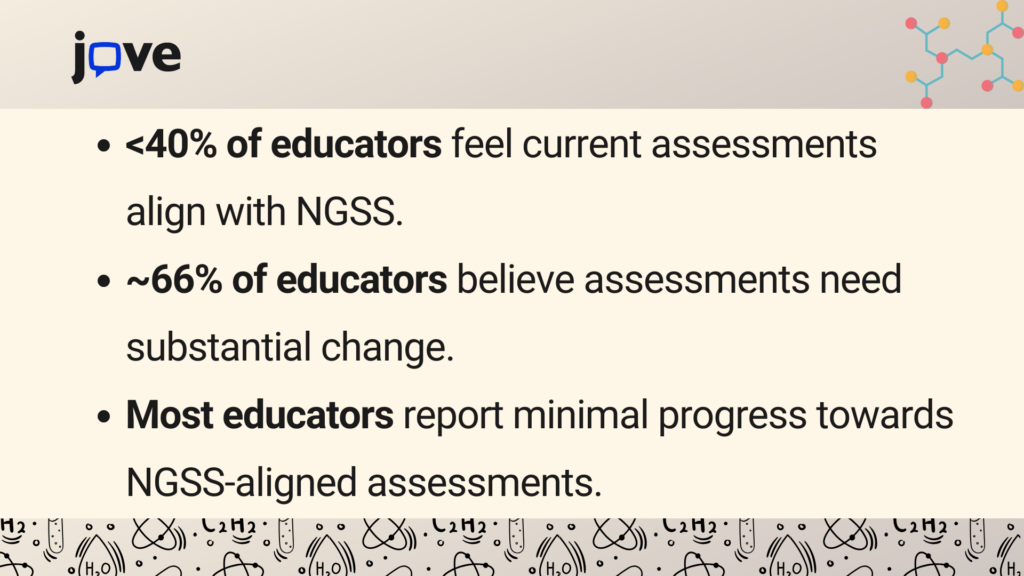
(Source: Carnegie Report, 2020)
Case Study: Multimedia and NGSS Science Assessments in Action
JoVE’s multimedia approach significantly enhances student understanding and assessment performance. A study from the JoVE Advantage Report revealed that students who viewed JoVE instructional videos before lab activities scored 100% higher on pre-lab and 76% higher on post-lab assessments compared to peers using traditional text-based materials alone. These students reported increased confidence and preparedness in performing scientific tasks, directly translating to improved assessment outcomes (source).
Conclusion
NGSS-aligned assessment goes beyond testing—it’s integral to effective science instruction. Employing inquiry labs, multimedia, performance tasks, and CER strategies ensures accurate, meaningful measures of student understanding. JoVE’s Middle & High School platform provides rich multimedia tools essential for implementing these strategies.

