
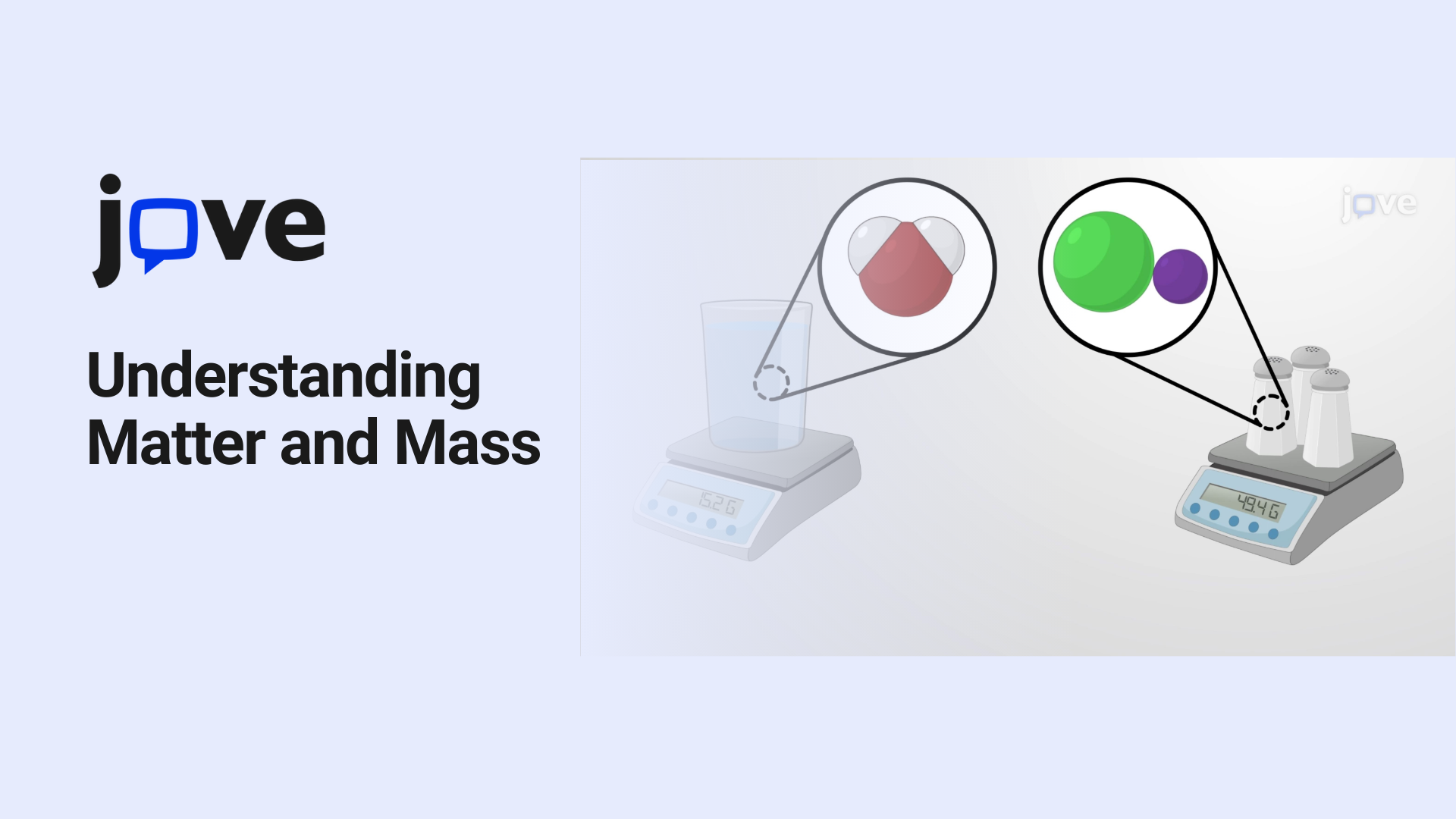
Understanding Matter and Mass: Visual Learning for the Middle School Classroom
Connecting Everyday Objects to Foundational Science
What’s the difference between matter and mass? For many middle schoolers, it’s more than just vocabulary—it’s a real conceptual hurdle. While students see and touch objects every day, grasping the scientific explanation behind matter and mass requires clear visuals and relatable examples.
That’s where JoVE’s NGSS-aligned middle school video lessons come in. By combining animated science content with hands-on exploration, students get to observe, measure, and model the essential properties of matter in their world.
🎥 Begin with JoVE’s Introduction to Matter to establish key terms and examples using engaging classroom visuals.
What Are Matter and Mass?
Before diving into hands-on experiments or NGSS-aligned labs, it’s important that students first understand what these terms actually mean.
- Matter is anything that has mass and takes up space. Everything around us—air, water, wood, metal—is made of matter, even if we can’t always see it.
- Mass is a measure of how much matter is in an object. It’s commonly measured using a scale in units like grams or kilograms, and unlike weight, it doesn’t change with location or gravity.
This foundational understanding helps students recognize that the physical world is made up of measurable materials—and sets the stage for exploring volume, density, and other related concepts.
Why Matter and Mass Are Essential to Teach Early
Matter and mass serve as the building blocks of physical science. According to NGSS standard MS-PS1-1, students must “develop models to describe the atomic composition of simple molecules and extended structures.” But before atoms and molecules, students need to clearly understand that all matter has mass, takes up space, and is affected by forces like gravity.
In the classroom, this means shifting from definition-only learning to interactive exploration—using tools to measure, compare, and classify materials. These strategies support middle school science activities that align to real-world observation and support future physics and chemistry units.
This is how to teach matter and mass to middle school students in ways that are relatable, measurable, and memorable.
What Students Should Know Before Starting
Before you dive into NGSS-aligned activities for understanding physical properties, students should be able to:
- Define matter as anything with mass and volume
- Understand how mass is measured in grams/kilograms
- Recognize the three common states of matter (solid, liquid, gas)
- Use simple tools like a balance scale or graduated cylinder
Use JoVE’s States of Matter Video to reinforce how solids, liquids, and gases differ in particle arrangement and behavior.
Classroom Activity – Investigating Matter and Mass
Objective:
Explore how different objects can be compared and classified by their mass and volume using hands-on tools.
Materials:
- Triple-beam or digital balances
- Graduated cylinders
- Measuring cups
- Water, small rocks, sand, and various classroom items
- NGSS-aligned worksheet
- JoVE’s video library on matter and measurement
Instructions:
- Start the lesson with JoVE’s video on measuring mass and volume.
- Provide each group of students with 3–5 objects of different materials.
- Students measure the mass of each object using a scale.
- Use water displacement to calculate volume of irregular solids.
- Calculate and compare density using mass ÷ volume.
- Discuss which properties helped identify materials and explain behavior.
This hands-on lesson supports NGSS physical science standards and builds student skill in comparing observable properties.
Common Misconceptions – Clarified with Visuals
❌ “Mass and weight are the same.”
✅ Clarified: Mass is the amount of matter; weight is the force of gravity on that matter.
❌ “Air isn’t matter because you can’t see it.”
✅ Clarified: Air has mass and takes up space—it just needs different tools to observe.
🎥 JoVE’s Classifying Matter by Composition gives a visual demonstration of invisible matter in action.
Real-World Application – Using Measurement to Explore Food Science
A science class investigated lunchbox contents to better understand teaching mass and volume. Students used digital scales and measuring cylinders to analyze snacks—calculating the density of grapes, chips, and juice boxes.
With JoVE’s science video lessons for classrooms, students visualized how matter properties exploration affects what they eat. They also explored how packaging uses different materials for efficiency and storage, connecting classroom lessons to real-world sustainability and material science.
Crosscutting Concept – Scale, Proportion, and Quantity
|
Physical Property |
Measurement Tool |
Conceptual Understanding |
|
Mass |
Digital scale |
How much matter an object contains |
|
Volume |
Graduated cylinder |
How much space an object takes up |
|
Density |
Calculation (m ÷ v) |
How mass and volume relate |
This concept framework aligns with NGSS crosscutting concepts and helps students relate numeric data to scientific understanding.
Conclusion – Build Early Science Confidence Through Measurement
By exploring matter and mass through JoVE’s NGSS-aligned videos and activities, teachers make abstract science both hands-on and visual. Students build confidence in identifying, measuring, and analyzing materials—core skills for future success in STEM.
With the right tools and guided experimentation, middle school science activities turn observation into insight, and confusion into clarity.
Ready to bring measurement and matter to life in your classroom?
Book a FREE Demo today and get full access to JoVE’s animated videos, interactive resources, and solar science experiments!
JoVE access starting as low as $2/student.*
*Pricing based on 1,500 students.

