9.10
Resonance

The Lewis structure of a nitrite anion (NO2−) may actually be drawn in two different ways, distinguished by the locations of the N-O and N=O bonds.
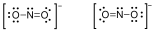
If…
Most molecules and ions can be represented using unique Lewis structures. However, certain compounds can be shown by multiple, equally valid Lewis structures.
Consider the Lewis structure for sulfur trioxide. The single bonds between each oxygen and the central sulfur atoms satisfy the octet for oxygen atoms. However, to reach a full octet for the sulfur, an additional bond must be formed between sulfur and one of the oxygen atoms. Since any of the three oxygens can form the double bond with sulfur, three different Lewis structures can be drawn.
These multiple Lewis structures are called resonance structures, where the skeletal structures remain the same, but electrons are distributed differently.
All three structures are valid and equivalent representations of the molecule, yet all are non-existent in nature. The actual structure does not oscillate between the resonance structures but is a hybrid or an average of the three Lewis structures, which can be measured in bond lengths.
In sulfite, the length of a sulfur-oxygen single bond is 1.51 angstrom, while in sulfur trioxide, the sulfur-oxygen bond length is 1.42 angstrom. Thus, in the hybrid molecule, the bond length is an intermediate between single and double bonds.
In hybrid molecules, electrons participating in double bonds or lone pairs are often delocalized over multiple bonds or atoms, meaning they are not stationary on one particular atom. The delocalization reduces the potential energy of electrons resulting in stabilization called resonance stabilization.
Resonance is also observed for aromatic compounds such as benzene. Benzene is a hexagonal carbon-ring with one hydrogen bonded to each of the carbon atoms, and alternating single and double bonds between the carbon atoms. Based on the location of carbon-carbon double bonds, benzene can have two resonance structures.
Recall that double bonds are usually shorter than single bonds. However, all the carbon-carbon bonds in benzene have equal bond lengths, which are intermediate between carbon-carbon single and double bonds.
Hence, benzene exists as a resonance hybrid and can be represented as a hexagon with a circle inside. The circle indicates that benzene is a blend of two resonance structures, and the double bonds cannot be localized to any two specific carbon atoms.
View the full transcript and gain access to JoVE Core videos
Q1: What are resonance structures and why do molecules have multiple Lewis representations?
Resonance structures are multiple, equally valid Lewis structures for a single molecule where the skeletal arrangement remains identical but electrons distribute differently. Certain compounds like sulfur trioxide and nitrite ions cannot be accurately represented by a single Lewis structure. Instead, two or more resonance forms are needed to describe the actual electron distribution. These structures are not interchangeable; the molecule exists as a resonance hybrid, an average of all possible structures.
Q2: How does a resonance hybrid differ from the individual resonance structures?
A resonance hybrid is the actual electronic structure of a molecule, representing an average of all resonance forms rather than oscillating between them. Individual resonance structures are convenient, imaginary representations used to describe bonding. The hybrid never possesses the electronic structure of any single resonance form. Like a rhinoceros is neither a dragon nor a unicorn, a resonance hybrid is neither of its resonance forms at any given time, yet it is a real entity confirmed by experimental evidence.
Q3: What does electron delocalization mean in resonance hybrid molecules?
Electron delocalization occurs when electrons participating in double bonds or lone pairs are not stationary on one particular atom but spread across multiple bonds or atoms. This distribution reduces the potential energy of electrons, resulting in resonance stabilization that makes the molecule more stable. In sulfur trioxide, electrons are delocalized across the sulfur-oxygen bonds, creating intermediate bond lengths between single and double bonds rather than distinct bond types.
Q4: Why do resonance hybrid molecules have intermediate bond lengths?
In resonance hybrids, bond lengths are intermediate between single and double bonds because electrons are delocalized across multiple bonding positions. For example, sulfur-oxygen bonds in sulfur trioxide measure 1.42 angstroms, between a typical single bond (1.51 angstroms) and a double bond. Similarly, all carbon-carbon bonds in benzene are equal and intermediate in length, confirming that the molecule exists as a hybrid rather than alternating single and double bonds.
Q5: How is benzene represented as a resonance hybrid?
Benzene is a hexagonal carbon ring with alternating single and double bonds between carbons. However, since all carbon-carbon bonds have equal lengths intermediate between single and double bonds, benzene cannot be represented by either resonance structure alone. Instead, benzene is depicted as a hexagon with a circle inside, indicating it is a blend of two resonance structures where double bonds cannot be localized to specific carbon atoms.
Q6: What experimental evidence confirms that molecules are resonance hybrids rather than oscillating structures?
Experimental measurements of bond lengths and bond strengths provide direct evidence for resonance hybrids. In nitrite ions and carbonate ions, all bonds are experimentally identical in length and strength, even though resonance structures suggest different bond types. If molecules oscillated between resonance forms, bonds would show different properties. Instead, the uniform measurements confirm that molecules exist as stable averages of resonance structures, not as fluctuating entities.
Q7: Why is resonance stabilization important for molecular stability?
Resonance stabilization lowers the potential energy of electrons through delocalization across multiple atoms or bonds, making resonance hybrid molecules more stable than any single resonance structure would predict. This energy reduction explains why molecules like benzene and carbonate ions are particularly stable and unreactive. The delocalized electron distribution provides greater stability than if electrons were confined to specific bonds, as shown in individual Lewis structures.