7.6
Power Factor

View the full transcript and gain access to JoVE Core videos
Q1: What is power factor and how is it calculated?
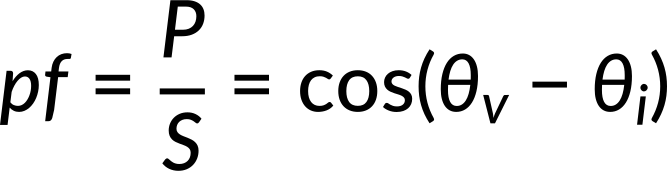
Power factor is the ratio of active power to apparent power in an AC circuit. It equals the cosine of the phase difference between voltage and current, ranging from zero to one. For a purely resistive load with in-phase voltage and current, the power factor equals unity, meaning all apparent power converts to useful active power.
Q2: Why does power factor matter for electricity costs?
Utility companies charge for apparent power, which includes both active and reactive power. A lower power factor means more reactive power is wasted without performing real work, increasing electricity bills. Reducing reactive power to bring the power factor closer to unity maximizes value and lowers costs for consumers.
Q3: What is the difference between leading and lagging power factor?
A leading power factor occurs when current leads voltage, indicating a capacitive load. A lagging power factor occurs when current lags behind voltage, indicating an inductive load. Both represent phase differences between voltage and current that reduce the power factor below unity.
Q4: How does load type affect power factor?
Purely resistive loads produce a unity power factor of one, with voltage and current in phase. Purely reactive loads produce a zero power factor with no active power. Real circuits contain combinations of resistive and reactive elements, resulting in power factors between zero and one depending on the load impedance angle.
Q5: What does the power factor angle represent?
The power factor angle is the phase difference between voltage and current, equal to the angle of the load impedance. Its cosine yields the power factor value. This angle determines whether the power factor is leading or lagging and directly influences how much active power the circuit delivers.
Q6: How can the coffee and foam analogy explain power factor?
In this analogy, coffee represents useful active power that performs real work, while foam represents reactive power that does not perform real work but is utilized by certain appliances. The entire glass represents apparent power, which utilities charge for. Reducing foam (reactive power) maximizes the value of what you pay for.
Q7: What happens to power factor in purely reactive circuits?
In purely reactive circuits, the phase difference between voltage and current is 90 degrees, resulting in a power factor of zero. This means active power is zero, and all power is reactive. No useful work is performed, though reactive power is essential for maintaining voltage levels in power systems.
Explore Related Chapters

Basics of Electric Circuits

DC Circuit Analysis

Operational Amplifiers

Energy Storage Elements

First and Second-Order Circuits

AC Circuit Analysis
Three-Phase Circuits

Frequency Response

Basics of Semiconductors

Diodes

Transistors

Introduction to Signals and Systems

Linear Time- Invariant Systems

The Laplace Transform

Fourier Series

The Fourier Transform

Sampling

z-Transform

Introduction to Control Systems

Modeling in Time and Frequency Domain

Diagrams and Signal Flow Graphs

Transient and Steady-state Response Analysis

Root-Locus Method

Design of Control Systems

Power Transformers

Transmission Line Parameters

Steady-State Transmission Lines and Power Flows

Symmetrical and Unsymmetrical Faults

System Protection

Transient Stability and System Controls

Transmission Lines: Transient Operation

Power Distributions

Now Playing
7.6 : Power Factor
AC Steady State Power
1.1K Views

7.1 : Instantaneous Power
AC Steady State Power
1.2K Views

7.2 : Average Power
AC Steady State Power
1.3K Views

7.3 : Effective Value of a Periodic Waveform
AC Steady State Power
1.6K Views

7.4 : Complex Power
AC Steady State Power
1.2K Views

7.5 : Conservation of AC Power
AC Steady State Power
977 Views

7.7 : Power Factor Correction
AC Steady State Power
907 Views

7.8 : The Power Superposition Principle
AC Steady State Power
853 Views

7.9 : The Maximum Power Transfer Theorem
AC Steady State Power
1.4K Views