-1::1
Simple Hit Counter
Skip to content

Products

Solutions

×
×
Sign In

EN

EN - EnglishCN - 简体中文DE - DeutschES - EspañolKR - 한국어IT - ItalianoFR - FrançaisPT - Português do BrasilPL - PolskiHE - עִבְרִיתRU - РусскийJA - 日本語TR - TürkçeAR - العربية
Sign In Start Free Trial

RESEARCH

JoVE Journal

Peer reviewed scientific video journal

Behavior
Biochemistry
Bioengineering
Biology
Cancer Research
Chemistry
Developmental Biology
View All
JoVE Encyclopedia of Experiments

Video encyclopedia of advanced research methods

Biological Techniques
Biology
Cancer Research
Immunology
Neuroscience
Microbiology
JoVE Visualize

Visualizing science through experiment videos

EDUCATION

JoVE Core

Video textbooks for undergraduate courses

Analytical Chemistry
Anatomy and Physiology
Biology
Calculus
Cell Biology
Chemistry
Civil Engineering
Electrical Engineering
View All
JoVE Science Education

Visual demonstrations of key scientific experiments

Advanced Biology
Basic Biology
Chemistry
View All
JoVE Lab Manual

Videos of experiments for undergraduate lab courses

Biology
Chemistry

BUSINESS

JoVE Business

Video textbooks for business education

Accounting
Finance
Macroeconomics
Marketing
Microeconomics

OTHERS

JoVE Quiz

Interactive video based quizzes for formative assessments

Authors

Teaching Faculty

Librarians

K12 Schools

Biopharma

Products

RESEARCH

JoVE Journal

Peer reviewed scientific video journal

JoVE Encyclopedia of Experiments

Video encyclopedia of advanced research methods

JoVE Visualize

Visualizing science through experiment videos

EDUCATION

JoVE Core

Video textbooks for undergraduates

JoVE Science Education

Visual demonstrations of key scientific experiments

JoVE Lab Manual

Videos of experiments for undergraduate lab courses

BUSINESS

JoVE Business

Video textbooks for business education

OTHERS

JoVE Quiz

Interactive video based quizzes for formative assessments

Solutions

Authors
Teaching Faculty
Librarians
K12 Schools
Biopharma

Language

English

EN

English

CN

简体中文

DE

Deutsch

ES

Español

KR

한국어

IT

Italiano

FR

Français

PT

Português do Brasil

PL

Polski

HE

עִבְרִית

RU

Русский

JA

日本語

TR

Türkçe

AR

العربية

    Menu

    JoVE Journal

    Behavior

    Biochemistry

    Bioengineering

    Biology

    Cancer Research

    Chemistry

    Developmental Biology

    Engineering

    Environment

    Genetics

    Immunology and Infection

    Medicine

    Neuroscience

    Menu

    JoVE Encyclopedia of Experiments

    Biological Techniques

    Biology

    Cancer Research

    Immunology

    Neuroscience

    Microbiology

    Menu

    JoVE Core

    Analytical Chemistry

    Anatomy and Physiology

    Biology

    Calculus

    Cell Biology

    Chemistry

    Civil Engineering

    Electrical Engineering

    Introduction to Psychology

    Mechanical Engineering

    Medical-Surgical Nursing

    View All

    Menu

    JoVE Science Education

    Advanced Biology

    Basic Biology

    Chemistry

    Clinical Skills

    Engineering

    Environmental Sciences

    Physics

    Psychology

    View All

    Menu

    JoVE Lab Manual

    Biology

    Chemistry

    Menu

    JoVE Business

    Accounting

    Finance

    Macroeconomics

    Marketing

    Microeconomics

Start Free Trial
Loading...
Home
JoVE Core
Chemistry
Resonance
Video Quiz
Resonance
JoVE Core
Chemistry
A subscription to JoVE is required to view this content.  Sign in or start your free trial.
JoVE Core Chemistry
Resonance

9.10: Resonance

69,122 Views
02:52 min
September 3, 2020

Overview

The Lewis structure of a nitrite anion (NO2−) may actually be drawn in two different ways, distinguished by the locations of the N-O and N=O bonds.
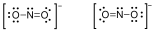
Structural formulas of nitrite ion, showing resonance; diagram illustrating bond arrangement.

If nitrite ions do indeed contain a single and a double bond, the two bond lengths are expected to be different. A double bond between two atoms is shorter (and stronger) than a single bond between the same two atoms. However, experiments show that both N–O bonds in NO2− have the same strength and length, and are identical in all other properties. It is not possible to write a single Lewis structure for NO2− in which nitrogen has an octet and both bonds are equivalent.

Instead, the concept of resonance is used: if two or more Lewis structures with the same arrangement of atoms can be written for a molecule or ion, the actual distribution of electrons is an average of that shown by the various Lewis structures. The actual distribution of electrons in each of the nitrogen-oxygen bonds in NO2− is the average of a double bond and a single bond.

The individual Lewis structures are called resonance forms. The actual electronic structure of the molecule (the average of the resonance forms) is called a resonance hybrid of the individual resonance forms. A double-headed arrow between Lewis structures indicates that they are resonance forms.

Nitrite ion resonance structures, molecular formula diagram, illustrating electron delocalization.

The carbonate anion, CO32−, provides a second example of resonance.

Resonance structures of carbonate ion, CO3^2-, showing electron delocalization, chemical diagram.

  • One oxygen atom must have a double bond to a carbon to complete the octet on the central atom.
  • All oxygen atoms, however, are equivalent, and the double bond could form from any one of the three atoms. This gives rise to three resonance forms of the carbonate ion.
  • Since three identical resonance structures can be written, the actual arrangement of electrons in the carbonate ion is known to be the average of the three structures.
  • Again, experiments show that all three C–O bonds are exactly the same.

Always remember that a molecule described as a resonance hybrid never possesses an electronic structure described by either resonance form. It does not fluctuate between resonance forms; rather, the actual electronic structure is always the average of that shown by all resonance forms.

George Wheland, one of the pioneers of resonance theory, used a historical analogy to describe the relationship between resonance forms and resonance hybrids. A medieval traveler, having never before seen a rhinoceros, described it as a hybrid of a dragon and a unicorn because it had many properties in common with both. Just as a rhinoceros is neither a dragon sometimes nor a unicorn at other times, a resonance hybrid is neither of its resonance forms at any given time.

Like a rhinoceros, it is a real entity that experimental evidence has shown to exist. It has some characteristics in common with its resonance forms, but the resonance forms themselves are convenient, imaginary images (like the unicorn and the dragon).

This text is adapted from Openstax, Chemistry 2e, Section 7.4: Formal Charges and Resonance.

Transcript

Most molecules and ions can be represented using unique Lewis structures. However, certain compounds can be shown by multiple, equally valid Lewis structures. 

Consider the Lewis structure for sulfur trioxide. The single bonds between each oxygen and the central sulfur atoms satisfy the octet for oxygen atoms. However, to reach a full octet for the sulfur, an additional bond must be formed between sulfur and one of the oxygen atoms. Since any of the three oxygens can form the double bond with sulfur, three different Lewis structures can be drawn. 

These multiple Lewis structures are called resonance structures, where the skeletal structures remain the same, but electrons are distributed differently.

All three structures are valid and equivalent representations of the molecule, yet all are non-existent in nature. The actual structure does not oscillate between the resonance structures but is a hybrid or an average of the three Lewis structures, which can be measured in bond lengths. 

In sulfite, the length of a sulfur-oxygen single bond is 1.51 angstrom, while in sulfur trioxide, the sulfur-oxygen bond length is 1.42 angstrom. Thus, in the hybrid molecule, the bond length is an intermediate between single and double bonds. 

In hybrid molecules, electrons participating in double bonds or lone pairs are often delocalized over multiple bonds or atoms, meaning they are not stationary on one particular atom. The delocalization reduces the potential energy of electrons resulting in stabilization called resonance stabilization. 

Resonance is also observed for aromatic compounds such as benzene. Benzene is a hexagonal carbon-ring with one hydrogen bonded to each of the carbon atoms, and alternating single and double bonds between the carbon atoms. Based on the location of carbon-carbon double bonds, benzene can have two resonance structures. 

Recall that double bonds are usually shorter than single bonds. However, all the carbon-carbon bonds in benzene have equal bond lengths, which are intermediate between carbon-carbon single and double bonds. 

Hence, benzene exists as a resonance hybrid and can be represented as a hexagon with a circle inside. The circle indicates that benzene is a blend of two resonance structures, and the double bonds cannot be localized to any two specific carbon atoms. 

Key Terms and Definitions

  • Resonance - A concept in which electrons are delocalized over three or more centres.
  • Resonance Structures - Different Lewis structures for the same molecule.
  • Resonance Hybrid - Actual structure of the molecule represented as the average of the resonance forms.
  • Lewis Structure - A graphical representation of the molecular structure of a compound.
  • Delocalization - The spread of electrons over more than two atoms.

Learning Objectives

  • Define Resonance – An understanding of electron delocalization (e.g., resonance in chemistry).
  • Contrast Lewis Structure vs Resonance Structures – Identify the difference (e.g., bonding in NO2-).
  • Explore Resonance of Nitrite Ion – Visualize how resonance structures are drawn (e.g., Lewis structure of NO2-).
  • Explain Resonance Hybrid – Better understanding of the actual molecular structure.
  • Apply Delocalization in Context – Understand how electrons spread over different atoms.

Questions that this video will help you answer

  • How does the concept of resonance explain electron delocalization?
  • What is resonance hybrid and how is it different from resonance structures?
  • What is delocalization and how does it affect molecular structure?

This video is also useful for

  • Students – Understand resonance, how it affects molecular structure, and its importance in chemistry.
  • Educators – Get a clear understanding of resonance and its importance in teaching related topics in chemistry.
  • Researchers – Important for understanding molecular structures in research work.
  • Chemistry Enthusiasts – Offers insights into a complex concept in chemistry and enhances knowledge.

Explore More Videos

ResonanceLewis StructuresCompoundsSulfur TrioxideOctetBondsOxygen AtomsMultiple StructuresResonance StructuresSkeletal StructuresElectronsHybrid StructureBond LengthsSulfiteSulfur-oxygen Bond LengthDouble BondsLone PairsDelocalization

Related Videos

Types of Chemical Bonds

02:37

Types of Chemical Bonds

Chemical Bonding: Basic Concepts

95.4K Views

Lewis Symbols and the Octet Rule

02:36

Lewis Symbols and the Octet Rule

Chemical Bonding: Basic Concepts

84.3K Views

Ionic Bonding and Electron Transfer

02:48

Ionic Bonding and Electron Transfer

Chemical Bonding: Basic Concepts

52.7K Views

The Born-Haber Cycle

02:44

The Born-Haber Cycle

Chemical Bonding: Basic Concepts

25.7K Views

Trends in Lattice Energy: Ion Size and Charge

02:54

Trends in Lattice Energy: Ion Size and Charge

Chemical Bonding: Basic Concepts

26.9K Views

Covalent Bonding and Lewis Structures

02:46

Covalent Bonding and Lewis Structures

Chemical Bonding: Basic Concepts

66.3K Views

Electronegativity

02:54

Electronegativity

Chemical Bonding: Basic Concepts

85.7K Views

Bond Polarity, Dipole Moment, and Percent Ionic Character

02:48

Bond Polarity, Dipole Moment, and Percent Ionic Character

Chemical Bonding: Basic Concepts

36.2K Views

Lewis Structures of Molecular Compounds and Polyatomic Ions

02:54

Lewis Structures of Molecular Compounds and Polyatomic Ions

Chemical Bonding: Basic Concepts

47.5K Views

Formal Charges

02:42

Formal Charges

Chemical Bonding: Basic Concepts

41.0K Views

Exceptions to the Octet Rule

02:55

Exceptions to the Octet Rule

Chemical Bonding: Basic Concepts

38.2K Views

Bond Energies and Bond Lengths

02:49

Bond Energies and Bond Lengths

Chemical Bonding: Basic Concepts

31.9K Views

Bonding in Metals

02:32

Bonding in Metals

Chemical Bonding: Basic Concepts

55.1K Views

JoVE logo
Contact Us Recommend to Library
Research
  • JoVE Journal
  • JoVE Encyclopedia of Experiments
  • JoVE Visualize
Business
  • JoVE Business
Education
  • JoVE Core
  • JoVE Science Education
  • JoVE Lab Manual
  • JoVE Quizzes
Solutions
  • Authors
  • Teaching Faculty
  • Librarians
  • K12 Schools
  • Biopharma
About JoVE
  • Overview
  • Leadership
Others
  • JoVE Newsletters
  • JoVE Help Center
  • Blogs
  • JoVE Newsroom
  • Site Maps
Contact Us Recommend to Library
JoVE logo

Copyright © 2026 MyJoVE Corporation. All rights reserved

Privacy Terms of Use Policies
WeChat QR code