2.8
Effect of Temperature Change on Reaction Rate

A reaction's rate law defines the relationship between a reactant concentration and the reaction rate in terms of a rate constant, ‘k’.
The rate constant describes the relationship between temperature and kinetic parameters relating to the collision, orientation, and activation energy of reacting molecules via the Arrhenius equation. ‘A’ is a constant called the Arrhenius factor or frequency factor. ‘e’ is an exponential factor integrating activation energy measured in joules-per-mole, the gas constant, and the temperature in kelvin.
The parameters’ temperature dependence can be explained with the collision model, which states that reacting molecules should collide with sufficient energy in the correct orientation to initiate a chemical reaction.
The frequency factor constitutes two components—the collision frequency and the orientation factor. The collision frequency is the number of molecular collisions per unit time, whereas the orientation factor describes the probability of collisions with a favorable orientation.
Still, only a small fraction of collisions leads to a reaction. This is because the reacting molecules have to overcome an energy barrier, called the activation ener
The Arrhenius equation,
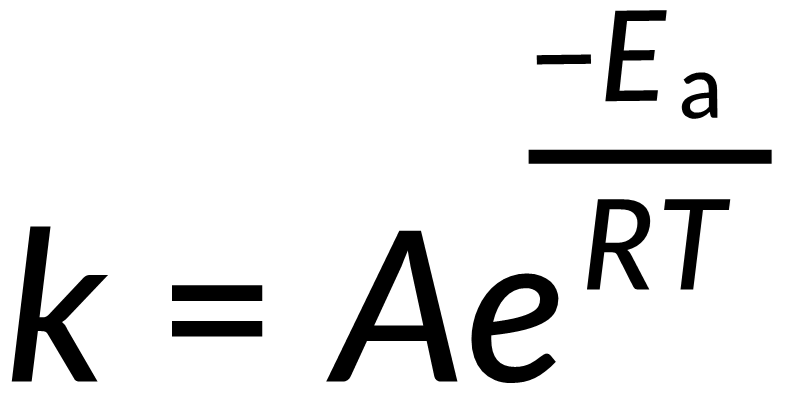
relates the activation energy and the rate constant, k, for many chemical reactions.
In this equation, R is the ideal gas cons…
Copyright © 2026 MyJoVE Corporation. All rights reserved.