Method Article

Recombinant Merkel Cell Polyomavirus (MCPyV) Virion Preparation: A Technique to Produce High-titer Recombinant MCPyV Virion

April 30th, 2023

In This Article

Abstract

Loading...
$$\rightleftharpoonup{xx}$$ $$\longleftharp{xx}$$, $$\longrightharp{xx}$$,

Source: Wei Liu et al. Merkel Cell Polyomavirus Infection and Detection, J. Vis. Exp. (2019)

In this video, we show the preparation of Merkel cell polyomavirus or MCPyV virions using 273TT cells. This technology helps to produce high-titer of the recombinant MCPyV virions.
Protocol

Loading...
$$\rightleftharpoonup{xx}$$ $$\longleftharp{xx}$$, $$\longrightharp{xx}$$,

1. Recombinant MCPyV virion preparation

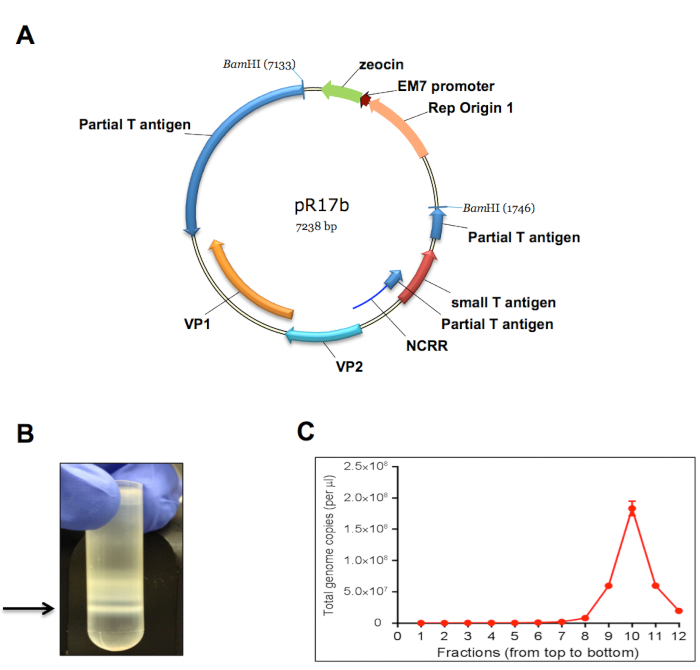
  1. Digest 50 µg of pR17b plasmid (carrying MCPyV genome) with 250 U of BamHI-HF in a 200 µL volume (4 h at 37 °C) to separate the viral genome from the vector backbone (Figure 1).
  2. Add 1200 µL of buffer PB (supplemented with 10 µL of 3 M NaAc, pH 5.2) to the digested DNA and purify over 2 miniprep spin columns (20 µg DNA capacity). Elute the digested pR17b plasmid from each column with 200 µL of TE buffer (10 mM Tris-HCl, pH8.0, 1 mM EDTA).
  3. Prepare the ligation reaction in a 50 mL centrifuge tube. Add 400 µL of purified plasmid DNA from step 1.2, 8.6 mL of 1.05x T4 ligase buffer and 6 µL of high concentration T4 ligase. Incubate at 16 °C overnight.
  4. Add 45 mL of buffer PB (supplemented with 10 µL of 3 M NaAc, pH 5.2) to the ligation and use a vacuum manifold to load through 2 miniprep spin columns. Elute each column with 50 µL of TE buffer. Expect a yield of about 30 µg of DNA.
  5. In the late afternoon/evening, seed 6 x 10⁶ 293TT cells into a 10 cm dish containing DMEM medium supplemented with 10% fetal calf serum, 1% non-essential amino acids, and 1% L-glutamine without hygromycin B.
  6. The next morning, ensure that the cells are about 50% confluent. Transfect using 66 µL of transfection reagent (1.1 µL/cm2), 12 µg of re-ligated MCPyV isolate R17b DNA from step 1.4, 8.4 µg of ST expression plasmid pMtB and 9.6 µg of LT expression plasmid pADL.
  7. When the transfected cells are nearly confluent, the following day, trypsinize the cells and transfer them to a 15 cm dish for continued expansion.
  8. Optionally take a small number of 293TT cells upon expansion and perform IF staining for MCPyV LT (CM2B4) and VP1 (MCV VP1 rabbit) to determine transfection efficiency. At this stage, nuclear LT signals may be visible, but VP1 expression probably will not be detectable.
  9. When the 15 cm dish becomes nearly confluent (usually 5-6 days after initial transfection), transfer the cells into three 15 cm dishes. Harvest the cells from the 15 cm dishes when they become nearly confluent and follow the virus harvest protocol below.
    NOTE: Optionally perform quality control IF as described in step 1.8. Most of the cells should be both MCPyV LT and VP1 positive at this stage.
  10. To harvest the virus, trypsinize the cells, spin at 180 x g for 5 min at RT and remove the supernatant. Add one cell pellet volume of DPBS-Mg (DPBS with 9.5 mM MgCl2 and 1x antibiotic-antimycotic). Then, add 25 mM ammonium sulfate (from a 1 M pH 9 stock solution) followed by 0.5% Triton X-100 (from a 10% stock solution), 0.1% Benzonase, and 0.1% of an ATP-Dependent DNase. Mix well and incubate at 37 °C overnight.
  11. Incubate the mixture for 15 min on ice and then add 0.17 volume of 5M NaCl. Mix and incubate on ice for another 15 min. Spin for 10 min at 12,000 x g in a 4 °C centrifuge. If the supernatant is not clear, gently invert the tube and repeat the spinning step. Transfer the supernatant to a new tube.
  12. Resuspend the pellet using one volume of DPBS supplemented with 0.8 M NaCl, and spin again, as described in step 1.11.
  13. Combine the supernatants from step 1.11 and 1.12, and spin one more time as described in step 1.11.
  14. Pour gradients of iodixanol in thin wall 5 mL polyallomer tubes by underlaying (27%, then 33%, then 39%) ~0.7 mL steps using a 3 mL syringe fitted with a long needle or a p1000 pipette.
  15. Load 3 mL of clarified virus-containing supernatant on the prepared iodixanol gradient.
  16. Spin for 3.5 h at 234,000 x g and 16 °C in an SW55ti rotor. Set the acceleration and deceleration to slow.
  17. After ultracentrifugation, collect 12 fractions in siliconized tubes (each fraction is ~400 µL).
  18. Analyze the fractions for the presence of virus by dsDNA reagent and/or Western blot for VP1 (MCV VP1 rabbit). Pool gradient fractions with peak dsDNA and/or VP1 content and characterize the stock by quantitative PCR to calculate the viral genome equivalent. Store MCPyV virion stock at -80 °C.

Access restricted. Please log in or start a trial to view this content.

Results

Loading...
$$\rightleftharpoonup{xx}$$ $$\longleftharp{xx}$$, $$\longrightharp{xx}$$,

Plasmid map diagram (pR17b), viral protein purification setup, DNA quantification graph.
Figure 1. Production of MCPyV virion using recombinant viral genome. (A) A plasmid map of pR17b (MCPyV genome plasmid). (B) A representative picture of an MCPyV virion sample harvested and purified over a gradient. Arrow marks the ...

Access restricted. Please log in or start a trial to view this content.

Disclosures

Loading...
$$\rightleftharpoonup{xx}$$ $$\longleftharp{xx}$$, $$\longrightharp{xx}$$,
No conflicts of interest declared.

Materials

List of materials used in this article
NameCompanyCatalog NumberComments
DMEM/F12 mediumThermo Fisher Scientific11330-032
Recombinant Human EGF Protein, CFR&D systems236-EG-200Store at -80 degree celsius
CHIR99021Cayman Chemical13122Store at -80 degree celsius
CHIR99021SigmaSML1046Store at -80 degree celsius
Collagenase type IVThermo Fisher Scientific17104019
Dispase IIRoche4942078001
Antibiotic-AntimycoticThermo Fisher Scientific15240-062Protect from light
DMEM mediumThermo Fisher Scientific11965084
ParaformaldehydeSigmaP6148
Anti-MCPyV LT (CM2B4)Santa Cruzsc-136172Lot # B2717
MCV VP1 rabbitRabbit polyclonal serum #10965https://home.ccr.cancer.gov/lco/BuckLabAntibodies.htm

Reprints and Permissions

Request permission to reuse the text or figures of this JoVE article

Request Permission

Tags

Viral Genome TransfectionCell Lysis DNase TreatmentDensity Gradient CentrifugationIodixonal UltracentrifugationVirion Fraction Collection293TT Cell CultureViral Replication Promotion

Related Articles