A subscription to JoVE is required to view this content. Sign in or start your free trial.

Method Article

Nuclear Magnetic Resonance Spectroscopy to Identify Multiple Phosphorylations in Proteins

1.2K views

⸱

July 8th, 2025

In This Article

Abstract

Source: Danis, C. et. al., Nuclear Magnetic Resonance Spectroscopy for the Identification of Multiple Phosphorylations of Intrinsically Disordered Proteins. J. Vis. Exp. (2016).

This video demonstrates the use of nuclear magnetic resonance spectroscopy (NMR) techniques to identify multiple phosphorylations in a protein. The phosphorylation of a protein at specific amino acid causes the deshielding of the neighboring amide hydrogen, which generates the spectral difference.
Protocol

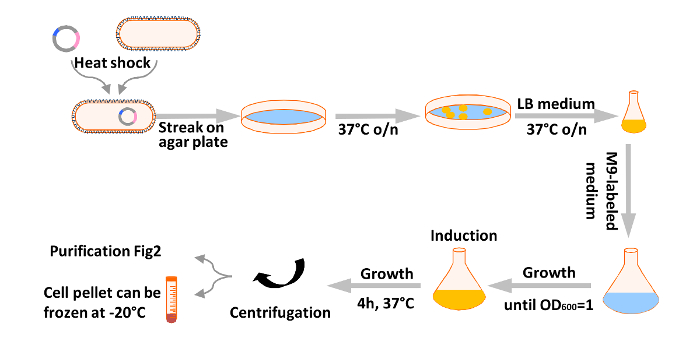
1. Production of 15N, 13C-Tau (Figure 1)

  1. ATransform pET15b-Tau recombinant T7 expression plasmid into BL21(DE3) competent Escherichia coli bacterial cells.
    NOTE: the cDNA coding for the longest (441 amino acid residues) Tau isoform is cloned between NcoI and XhoI restriction sites in the pET15b plasmid.
    1. Mix gently 50 µl of competent BL21(DE3) cells, forming 1-5 x 10⁷ colonies per µg of plasmid DNA, with 100 ng of plasmid DNA in a 1.5 ml plastic tube.
      NOTE: Codon-usage optimized bacterial strains for eukaryotic ....

Access restricted. Please log in or start a trial to view this content.

Results

Bacterial transformation process flowchart: heat shock, agar streaking, LB growth, centrifuge, freeze.
Figure 1: Scheme of the main steps of recombinant protein production and isotopic labeling. Steps from bacteria transformation to recombinant protein production are outlined as described in paragraph 1 of the protocol.

Access restricted. Please log in or start a trial to view this content.

Disclosures

No conflicts of interest declared.

Materials

List of materials used in this article
NameCompanyCatalog NumberComments
pET15B recombinant T7 expression plasmidNovagen69257Keep at -20°C
BL21(DE3) transformation-competent E.coli bacteriaNew England BiolabsC2527IKeep at -80°C
Autoclaved LB Broth, LennoxDIFCO240210Bacterial Growth Medium
MEM vitamin complements 100XSigma58970CBacterial Growth Medium Supplement
<sup>15</sup>N, <sup>13</sup>C-ISOGRO complete medium powderSigma608297Bacterial Growth Medium Supplement
<sup>15</sup>NH4ClSigma299251Isotope
<sup>13</sup>C-GlucoseSigma389374Isotope Keep at 4&#176;C
Protease inhibitor tabletsRoche50564890011 tablet in 1ml is 40X solution that can be kept at -20&#176;C
DNaseIEUROMEDEX1307Keep at -20&#176;C
Homogenizer (EmulsiFlex-C3)AVESTINLysis is realized at 4&#176;C
Pierce<sup>TM</sup> Unstained Protein MW MarkerPierce266109
Active human MEK1 kinase, GST-TaggedSigmaM8822Keep at -80&#176;C
AKT&#196; Pure chromatography systemGE HealthcareFPLC
HiTrap SP Sepharose FF (5 mL column)GE Healthcare17-5156-01Cation exchange chromatography columns
HiPrep 26/10 DesaltingGE Healthcare17-5087-01Protein Desalting column
PD MidiTrap G-25GE Healthcare28-9180-08Protein Desalting column
Tris D11, 97% DCortecnetCD4035P5Deuterated NMR buffer
5 mm Symmetrical Microtube SHIGEMI D<sub>2</sub>O ( set of 5 inner &#38; outerpipe)Euriso-topBMS-005BNMR Shigemi Tubes
eVol kit-electronic syringe starter kitCortecnet2910000Pipetting
Bruker 900MHz AvanceIII with a triple resonance cryogenic probeheadBrukerNMR spectrometer for data acquisition
Bruker 600MHz DMX600 with a triple resonance cryogenic probeheadBrukerNMR spectrometer for data acquisition

Explore More Articles

Protein PhosphorylationAmide Hydrogen DeshieldingTwo-Dimensional NMR SpectrumPhosphorylated Serine ThreonineNitrogen-15 LabelingInternal NMR ReferenceProtease Inhibitor CocktailMagnetic Field ShimmingProton Radiofrequency Pulse