This video demonstrates in vivo gene transfer to Schwann cells of the rodent sciatic nerve using electroporation. A plasmid DNA–dye solution is injected into the nerve, and electric pulses facilitate DNA entry. The DNA later integrates into the cell’s genome, enabling successful gene transfer in Schwann cells.
A subscription to JoVE is required to view this content. Sign in or start your free trial.
Method Article
Gene Transfer into Schwann Cells of the Rodent Sciatic Nerve via Electroporation
494 views
⸱
August 29th, 2025
In This Article
Abstract
Protocol
All procedures involving animal models have been reviewed by the local institutional animal care committee and the JoVE veterinary review board.
1. Preparation of Plasmid DNA
- Generate DNA plasmids for in vivo electroporation by subcloning the complementary DNA (cDNA) or short hairpin RNA (shRNA) sequence into an expression plasmid for mammalian cells. Use a cytomegalovirus immediate early enhancer and chicken β-actin promoter fusion (CAG) promoter-driven plasmid because it allows strong and stable expression. For expression of shRNAs under the control of a CAG promoter, use a mir30-based shRNA cassette system for subcloning the shRNA.
- Purify plasmid DNA with a maxi-prep kit according to manufacturer's instructions, and resuspend the DNA with HEPES-buffered saline (140 mM sodium chloride, NaCl, 0.75 mM di-sodium hydrogen phosphate, Na2HPO4, 25 mM 4-(2-hydroxyethyl)-1-piperazineethanesulfonic acid (HEPES); pH 7.40). Adjust the concentration of DNA to ≥4 µg/µl.
- Prepare the plasmid DNA solution to a concentration of 4 µg/µl, and add a minimal amount of fast green dye (final concentration of 0.01%) to label the injection site. When simultaneous electroporation of multiple plasmids is required, adjust the total concentration of the plasmid DNA solution to 4 µg/µl.
NOTE: The optimal composition of plasmid DNAs should be determined according to the transfection efficiency of each plasmid.
2. Sterilization of Surgical Instruments and Saline
- Autoclave surgical instruments and the 0.9% NaCl solution.
3. Preparation of the Glass Micropipette
- Pull glass pipettes using a pipette puller. Cut the tip of the pipette to a diameter of 30-50 µm. Use the following parameters: Heat, 600; Velocity, 50; Time, 75.
4. Animal Surgery, DNA Injection, and Electroporation
NOTE: An overview of this step is described in Figure 1. Although the procedure for rat pups is described here, the method is also applicable to more mature animals using the same procedure.
- Anesthetize the rat with isoflurane in the induction box until the animal becomes immobile by adjusting the oxygen flow to 0.4 L/min and the isoflurane concentration to 4% (vol/vol). Perform toe pinching to confirm proper anesthetization.
- Put the rat on the preheated warmer under a binocular microscope and maintain anesthesia by continuously administering isoflurane through the face mask. Adjust the oxygen flow to 0.2 L/min and the isoflurane concentration to 2% (vol/vol). Use eye drops to prevent dryness of the eyes if the eyes of the animal are open.
- Fix the legs with surgical tape.
- Clean the skin on the posterior thigh with povidone-iodine and make an incision with a scalpel
NOTE: Shave surgical areas if they are covered with hair. - Expose the sciatic nerve by creating an opening between the quadriceps femoris muscle and the biceps femoris muscle with sewing needles.
- Wet the nerve with 0.9% NaCl solution. Absorb excess water with lint-free paper.
- Insert the base of a glass micropipette onto flexible tubing, and fill the adequate amount of DNA solution (at least one microliter) into the micropipette by gently aspirating.
- Lift the exposed nerve by gently pulling the distal side of the nerve using a needle.
NOTE: Do not apply tension to the nerve to minimize mechanical stress. - Insert the glass micropipette into the distal site on the nerve, and inject the DNA solution by applying pressure (i.e. by blowing into the open end of the flexible tube). Inject DNA solution until the nerve appears green (1 µl maximum). Because frequent insertion of the micropipette can damage the nerve, do not insert the micropipette more than twice.
- Place a tweezer-type platinum electrode about 1-2 mm apart from the nerve. Fill the gap between the electrode and the nerve with 0.9% NaCl solution.
NOTE: Do not hold the nerve with the electrode to avoid mechanical stress on the nerve. - Apply electric pulses to the injection site using an electroporator with the electrode. After the first pulse set, invert the electrode and apply another pulse set. Use the following parameters: voltage, 50 V; pulse duration, 5 msec; pulse interval, 100 msec; pulse number, 4 times.
- Clean the electroporation site with 0.9% NaCl solution.
5. Post-electroporation
- Close the incisions with cyanoacrylate glue.
- After drying the glue, clean the wound with povidone-iodine.
- Release the pup from the face mask. Warm the pup on a warmer for at least an hour in order to allow it to fully recover from anesthesia.
Access restricted. Please log in or start a trial to view this content.
Results
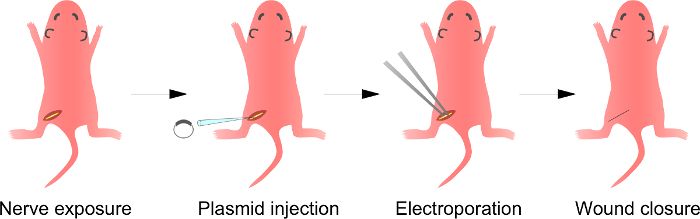
Figure 1: Schematic of the in vivo Electroporation Method. First, the sciatic nerve of the anesthetized r...
Access restricted. Please log in or start a trial to view this content.
Materials
| Name | Company | Catalog Number | Comments |
|---|---|---|---|
| Genopure plasmid Maxi kit | Roche | 03 143 422 001 | Plasmid DNA purification kit |
| Fast Green CFC | WAKO | 069-00032 | Dye for DNA injection |
| GC 150T-10 | HARVARD APPARATUS | 30-0062 | Glass capillary |
| Suction tubing | Drummond | 05-2000-00 | Suction tubing for micro injection |
| MODEL P-97 | SUTTER INSTRUMENT CO. | Micropipette puller | |
| CUY21 Single cell | BEX | Electroporator CUY21 Single Cell | Pulse generator |
| Electric warmer | KODEN | CAH-6A | Warmer during the surgery |
| Isofluolane | Mylan | 1119701G1076 | Anesthetic |
Explore More Articles
