This video demonstrates the protocol for delivering high-frequency deep brain stimulation to a mouse hippocampal dentate gyrus, detailing its effects on neuronal activation, synaptic plasticity, and neurogenesis.
A subscription to JoVE is required to view this content. Sign in or start your free trial.
Method Article
High-Frequency Stimulation to Enhance Neuronal Activation and Neurogenesis in the Mouse Dentate Gyrus
544 views
⸱
August 29th, 2025
In This Article
Abstract
Protocol
All procedures involving animal models have been reviewed by the local institutional animal care committee and the JoVE veterinary review board.
- High-Frequency Stimulation Delivery
- Connect the electrode implanted in the mouse brain to a programmable stimulator via leads. Set up the software interface as presented in Figure 1. Set the high-frequency stimulation (HFS) parameters as 6 series of 6 trains of 6 pulses at 400 Hz (Figure 2B, 100 ms between the trains, 20 s between the series). Set the stimulation intensity to 200 μA.
- Deliver an HFS for the desired period of time as set up. Deliver the stimulation 2x a day at 8:00 a.m. and at 8:00 p.m.
- For the control group, implant electrodes in the mice and do not perform stimulation.
- For the c-fos staining, stimulate the experimental mice acutely (2x per day). For the bromodeoxyuridine (BrdU) labeling, divide the experimental mice into an acute stimulation group (applied 2x per day) and a chronic stimulation group (applied 10x in 5 days, 2x per day). During the course of the stimulation, make sure the mouse is awake. Remember to ensure the leads are not twisted.
NOTE: At the last day of the procedure, the mice in the acute stimulation group were stimulated simultaneously. - When the stimulation is done, carefully disconnect the electrode pin from the electrode holder and the connector of the recording system.
Access restricted. Please log in or start a trial to view this content.
Results
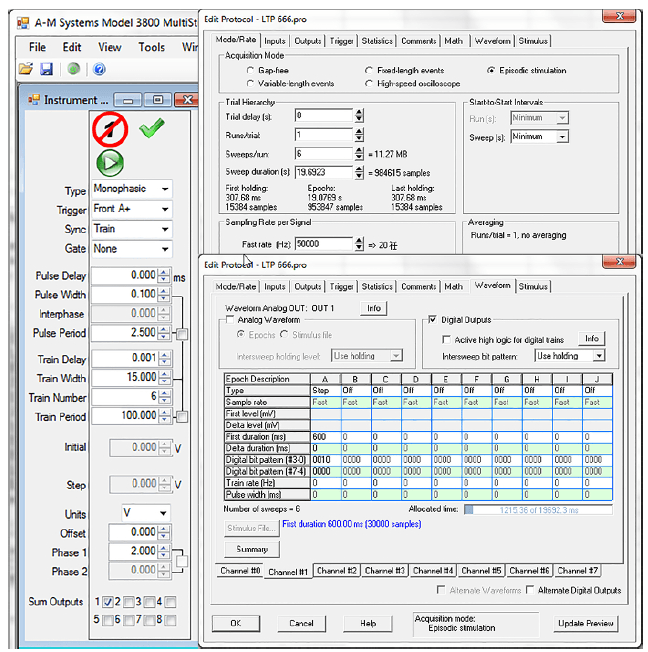
Figure1. Interface and parameters of the multistimulator. The stimulator was connect...
Access restricted. Please log in or start a trial to view this content.
Materials
| Name | Company | Catalog Number | Comments |
|---|---|---|---|
| Stimulator | A-M systems | Model 3800 | MultiStim 8-Channel programmable stimulator |
| Digidata 1550 Digitizer | Molecular Devices | AXON 1550 | High-resolution data acquisition |
