This video demonstrates the method of vagus nerve stimulation (VNS) in a rat model to reduce freezing behavior. Fear-conditioned rats receive VNS during sound re-exposure, leading to reduced freezing and revealing its therapeutic potential.
A subscription to JoVE is required to view this content. Sign in or start your free trial.
Method Article
Vagus Nerve Stimulation in a Rat Model to Reduce Freezing Behavior
891 views
⸱
August 29th, 2025
In This Article
Abstract
Protocol
All procedures involving animal models have been reviewed by the local institutional animal care committee and the JoVE veterinary review board.
1. Auditory Fear Conditioning
NOTE: This fear conditioning protocol is more intensive than most because the goal of these experiments is to enhance extinction. With mild fear conditioning that is easily extinguished, a floor effect can obscure this enhancement.
- House animals on a 12 hr light/dark cycle with ad libitum access to food and water. Handle animals daily during recovery from surgery.
- Set up the conditioning and testing apparatus, consisting of an operant box housed in a sound-attenuated chamber (Figure 1C). The operant box has clear plastic walls, 20 x 20 x 20 cm, and has a stainless steel grid floor, which is connected to a foot shock generator. Use a white-house light to illuminate the chamber for video recording. Use a 9 kHz, 85 dB sound pressure level (SPL) tone as the conditioned stimulus (CS).
- Record behavior using a digital camera located inside the chamber above the operant box. View and monitor the session on a computer located outside the behavior room. Save videos for later analysis.
- Wipe chambers with 70% ethanol before and after each session to eliminate olfactory cues.
- Fear-condition the rats for 2 days (Figure 2A). Confirm that the rats are not innately afraid of the tone by presenting 5 tones (9 kHz, 85 dB, 30 s) on the first day. Ensure that the freezing levels are negligible.
- Follow the initial tone presentations with 8 tone-footshock (1 s, 0.5 mA) pairings on each of 2 consecutive days. Repeat the tone-footshock pairings again on the second day. Vary the inter-stimulus-interval (ISI) between 2 and 4 min, averaging 3 min for every trial. Randomize the point at which the shock occurs during the tone.
- On the third day, test the strength of the tone/shock association. Play 4 tones with an ISI of 3, 4, or 5 min (4 min average) in the absence of footshocks and record the animals’ freezing behavior during the tone presentations and during the inter-stimulus-intervals as measures of the conditioned fear response (CFR).
- On day 4, begin extinction training with vagus nerve stimulation (VNS) or sham VNS.
- Plug the rats into the stimulator by inserting the male connectors from the stimulator into the stimulation input site. Place animals into the chamber (Figure 1A, 1C). Set the stimulator to 0.4 mA, 500 µs pulse width at 30 Hz. Set stimulation to a total duration of 30.15 s, starting 150 ms before the onset of the tone. Play animals 4 tones and pair each tone presentation with VNS or sham VNS.
- Periodically test the electrical integrity of the cuff and input site using an oscilloscope.
- Plug the animal in as normal and split the output from the stimulator to the oscilloscope.
- Set the range on the oscilloscope as -20 V to +20 V and run stimulation. The waveform of the 30 Hz stimulation should be visible on the oscilloscope. Stimulations exceeding 10 V in size indicate high impedance and an improperly functioning cuff or connection at the stimulation input site.
- To test the effect of VNS on extinction training, run a second CFR test on day 5. Record the time spent freezing during tone presentations and compare it to the baseline freezing recorded during the first CFR test.
- Analyze the videos using an independent observer who is blind to the treatment conditions. Measure time spent freezing during tone presentations using a stopwatch. Freezing is defined as complete immobility, during which the rat exhibits rapid respiration, lowered head, and spread paws. Analysis of freezing behavior can be split into two phases: during tone presentation and during the inter-stimulus interval.
Access restricted. Please log in or start a trial to view this content.
Results
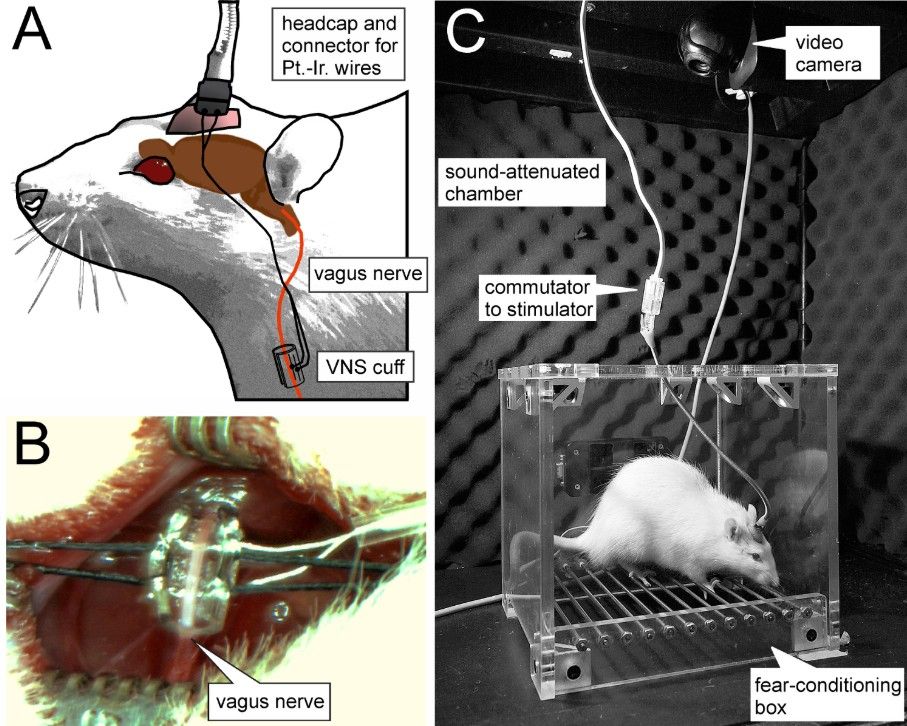
Figure 1. Vagus nerve stimulation and experimental setup. (A) Schematic of the setup used for VNS. Animals are...
Access restricted. Please log in or start a trial to view this content.
Materials
| Name | Company | Catalog Number | Comments |
|---|---|---|---|
| Betadine | Henry Schein | 69066950 | |
| Digital camera - Logitech webcam C210 | Logitech | B003LVZO88 | |
| Platinum iridium wire | Medwire | 10IR9/49T | |
| Isolated pulse stimulator model 2100 | A-M Systems | 720000 | |
| Sinometer 10 MHz single channel oscilloscope | Sinometer | CQ5010C | |
| Extech 407730 40-130-decibel digital sound level meter | Extech Instruments | B000EWY67W | |
| DSCK-C dual output, scrambled shocker | Kinder Scientific Co |
