This video demonstrates the isolation and cultivation of bacterial species associated with Caenorhabditis elegans. A bead-based lysis of C. elegans, followed by selective culturing, enables the isolation of diverse microbial strains for further analysis.
A subscription to JoVE is required to view this content. Sign in or start your free trial.
Method Article
Isolation and Cultivation of Caenorhabditis elegans-Associated Bacteria
426 views
⸱
February 2nd, 2026
In This Article
Abstract
Protocol
1. Isolation and cultivation of nematode-associated bacteria (Figure 1)
- To isolate bacteria, prepare a 96-well plate with three sterile 1 mm beads, 20 µL of M9 minimal medium salts (M9) buffer per well, and pipette an individual, washed nematode to each well, transferring as little liquid as possible.
NOTE: Alternatively, worm populations can be washed from the plates with M9-buffer, and ~300 µL of worm-containing M9-buffer can be transferred to 2 mL tubes with 10-15 beads. - Break up the nematodes using a bead homogenizer (e.g., bead-beating for 3 min at 30 Hz). Centrifuge the plate or tubes briefly to get the liquid to the bottom (e.g., for 10 s at 8000 x g at room temperature, RT).
NOTE: The usage of this method led to the isolation of bacterial taxa similar to those revealed by 16S ribosomal DNA (rDNA) amplicon sequencing, suggesting that the described bead-beating leaves most bacterial cells intact. - Collect the supernatant, serially dilute it at 1:10, and plate up to 100 µL onto 9 cm agar plates.
- To ensure that most bacteria can be cultivated, use a variety of alternative media with different nutrient compositions, including diluted trypticase soy agar (TSA, 1:10 dilution), MacConkey agar, Sabouraud glucose agar, potato dextrose agar, or yeast peptone dextrose agar.
- Incubate the plates at the average temperature conditions of the sampling location (e.g., temperatures between 15-20 °C for temperate locations) for 24-48 h.
- Use the standard three-streak technique and a sterile loop to obtain pure bacterial cultures (Figure 1).
- Pick a single colony from a plate using a sterile loop or toothpick and streak it out onto a new agar plate containing the same agar medium as used for purification. Make sure to use only roughly 1/3 of the plate.
- Either use a new sterile loop or sterilize a reusable loop and drag it through the first streak to create a second streak on another 1/3 of the same plate.
- Repeat this step by dragging a sterile loop through the second streak.
- Incubate the plate under the same growth conditions used for isolation. This technique must result in single colonies growing in the area of the third streak.
NOTE: It might be necessary to repeat the purification step multiple times as natural isolates tend to form biofilms and/or aggregates.
- Grow the pure colonies in a liquid medium (of the same type as the agar medium) using the same temperature and growth time as above (step 1.4)
Access restricted. Please log in or start a trial to view this content.
Results
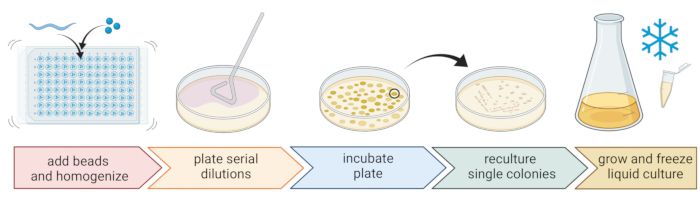
Figure 1: Species identification and isolation of individual bacteria. Individual nematodes are broken up ...
Access restricted. Please log in or start a trial to view this content.
