This video demonstrates the method of using a parallel-plate flow chamber to perfuse fluorescently labeled bacteria over vascular graft tissues, enabling controlled analysis of bacterial adhesion and early pathogenesis under shear flow conditions.
A subscription to JoVE is required to view this content. Sign in or start your free trial.
Method Article
In Vitro Parallel-Plate Flow Model to Study Bacterial Adhesion on a Tissue Biopsy
271 views
⸱
March 31st, 2026
In This Article
Abstract
Protocol
All procedures involving animal samples have been reviewed and approved by the appropriate animal ethical review committee.1. In vitro Perfusion Experiments using a Parallel-Plate Flow Chamber
- Mount tissue biopsies of 10 mm in diameter and the same thickness into a flow chamber system with the inner surface facing up to get in contact with the bacterial suspension.
NOTE: The same tissue thickness across various grafts ensures that the same tissue height is reached in the channel allowing laminar flow in all conditions. All elements of the flow chamber are presented and described in Figure 1.- To begin the protocol, place the round tissue piece between a microscope slide with an 8 mm circular perforation and a rubber gasket.
NOTE: The microscope slide possesses the ultra-thin bottom film to allow the generation of the 8 mm hole. Together with the rubber sheet, it fixes the tissue to enable the direct contact between the specimen and the flowing medium and also prevents the dislocation of the biopsy during the experiment. The surface of the investigated tissue, which is exposed to the flow (smaller diameter) cannot be manipulated by the forceps.- Insert the holder with the tissue into the gasket sheet that is embedded in the bottom metal frame of the chamber.
- Attach the upper metal frame with the corresponding gasket sheet onto the bottom part of the chamber with the previously inserted tissue holder. Subsequently mount the entire chamber with eight screws and screw nuts. Make sure that the chamber height is always the same across grafts.
NOTE: The chamber height should be determined always upon tightening the screws. Use a caliper or ruler.
- To begin the protocol, place the round tissue piece between a microscope slide with an 8 mm circular perforation and a rubber gasket.
- Connect the flow chamber with a peristaltic pump and the fluid reservoir with the tubes.
- Perfuse the tissues with suspensions of 107 CFU/mL (verified by CFU (Colony-forming unit) counting and related to OD600 (Optical density) measurements) fluorescently-labeled bacteria in PBS (Phosphate buffered saline) with a shear stress of 3 dyne/cm2 (dyne per square centimeter pressure unit) by means of the peristaltic pump (flow rate 4 mL/min) for 1 h using a 400 mL bacterial reservoir (In-house design, Figure 1) conditioned at 37 °C using a plate thermostat (Table of Materials).
- Recirculate continuously the 100 mL bacterial suspension using the same collection reservoir.
- After perfusion, dismantle the chamber to release the graft and wash the tissue piece two times with 4 mL of PBS in a 12-well plate using the laboratory orbital shaker for 3 min each. Subsequently cut the inner part of the graft using a skin biopsy punch of a smaller diameter.
- Place each tissue biopsy into a separate 14 mL tube containing 1 mL of sterile 0.9% NaCl. Label the tube as #1.
- Detach the bacteria from the tissue using a sonication bath for 10 min (amplitude = 100% and frequency = 45 kHz).
NOTE: Full detachment of bacteria from the tissue grafts should be evaluated upon incubation of patches overnight at 37 °C in TSB (Tryptic soy broth) liquid medium followed by OD600 measurements compared to control patches treated with a bacteria free solution.
Access restricted. Please log in or start a trial to view this content.
Results
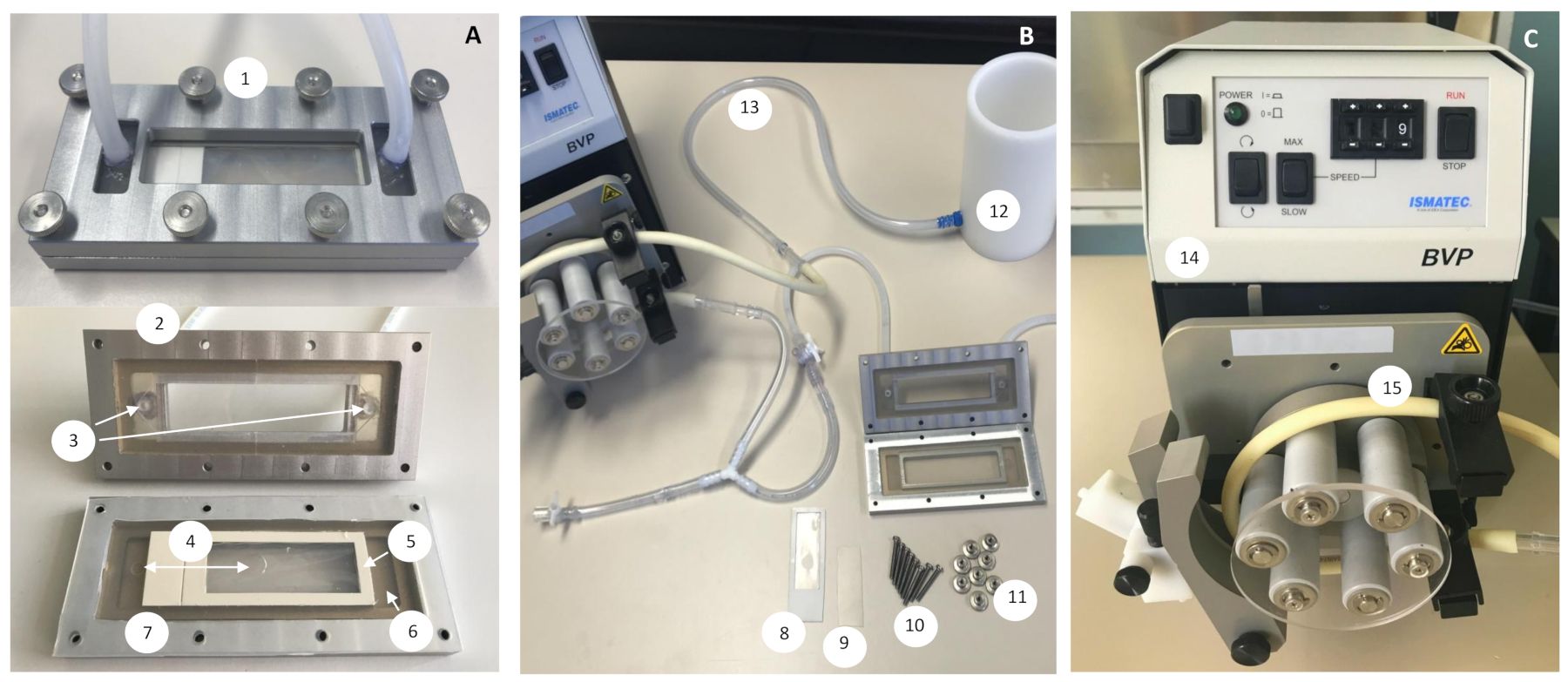
Figure 1: Image of a newly developed flow chamber system (in-house design). A. The flow chamber (1...
Access restricted. Please log in or start a trial to view this content.
Materials
| Name | Company | Catalog Number | Comments |
|---|---|---|---|
| Bovine Pericardium (BP) patch, Supple Peri-Guard Pericardium | Synovis Surgical Innovations, USA | PC-0404SN | |
| Bovine Jugular Vein conduits (BJV) | Contegra conduit; Medtronic Inc, USA | M333105D001 | |
| CH cryopreserved homograft | European Homograft Bank (EHB) | - | |
| Acu-Punch | Acuderm Inc, USA | P850 (8 mm); P1050 (10 mm) | |
| Human Albumin | Flexbumin; Baxter, Belgium | BE171464LOT:16G12C | |
| Tryptic soy broth (TSB) | Fluka, Steinheim, Germany | 22092-500G | |
| Heart infusion broth (BHI) | Fluka | 53286-500G | |
| Phosphate buffered saline (PBS). | Gibco | 14190-094 | |
| 5(6)-Carboxyfluorescein N-hydroxysuccinimide ester (CF) | Sigma-Aldrich, Germany | 21878-100MG-F | |
| Peristaltic pump (MODEL ISM444B) | Ismatec BVP-Z Standard; Cole Parmer, Wertheim, Germany | 631942-2 | |
| Sonication bath | VWR Ultrasonic Cleaner; VWR, Radnor, Pa | 142-6044 | 230V/50 -60Hz 60VA; HF45kHz, 30W |
| ProLong Gold Antifade Mountant | Invitrogen by ThermoFisher | P36930 | |
| Arium Pro VF - ultrapure water - H2O MilliQ | Millipore | 87206462 | |
| Microscopic slides - Tissue Culture Chambers (1-well) | Sarstedt | 94.6140.102 | |
| 1-well on Lumox detachable | Sarstedt | 94.6150.101 | |
| Stainless Steel - surgical Blades | Swann-Morton | 311 | |
| Tygon Silicone Tubing, 1/8"ID x 1/4"OD | Cole-Parmer | EW-95702-06 | Temperature range: –80 to 200°CSterilize: With ethylene oxide, gamma irradiation, or autoclave for 30 min, 15 psi of pressure |
| PharMed BPT Tubing | Saint-Gobain | AY242012 | Autoclavable 30 min at 121°C |
| Tygon LMT-55 Tubing | Saint Gobain Performance Plastics™ | 15312022 | |
| Thermostat | BMG BIOMEDIZINTECHNIK | 300-0042 | 230V, 90VA, 50Hz |
