A subscription to JoVE is required to view this content. Sign in or start your free trial.

Method Article

Potato Virus X-Based MicroRNA Silencing in Potato Plants

90 views

⸱

August 31st, 2026

In This Article

Abstract

Source: Zhao, J., et al. Potato Virus X-Based microRNA Silencing (VbMS) In Potato. J. Vis. Exp. (2020).

This video demonstrates the use of Agrobacterium tumefaciens to deliver a Potato Virus X (PVX)-based construct into in vitro-grown potato plants for virus-based microRNA silencing (VbMS). The method enables systemic suppression of a target microRNA, allowing researchers to study its role in plant development through observable phenotypic changes.
Protocol

1. Perform PVX-based VbMS assay in potato plants.

  1. Transplant 4-week-old in vitro potato plants into soil. The transplanted plants will be subjected to VbMS assay 3–4 days later.
  2. Inoculate potato plants with Agrobacterium containing the PVX-STTM (Short Tandem Target Mimic) plasmids.
    NOTE: For the VbMS assay in potato, Agrobacterium-mediated infiltration and toothpick-scratching inoculation are performed simultaneously.
    1. Pick and inoculate positive transformants containing PVX-STTM vectors into 50 mL of liquid LB containing 50 μg/mL kanamycin and 50 μg/mL rifampicin. Grow in a 28 °C incubator at 220 rpm for 16 h until OD600 = 1.0.
    2. At the same time, streak the positive Agrobacterium colonies onto at least two new LB plates containing 50 μg/mL kanamycin and 50 μg/mL rifampicin and grow at 28 °C for 1 day. Include the PVX-LIC vector as a control and PVX-GFP to monitor virus spread.
    3. Collect the Agrobacterium liquid culture by centrifugation at 3,400 x g for 10 min at room temperature. Resuspend Agrobacterium cells with an equal volume of infiltration buffer (10 mM MgCl2, 10 mM MES, and 200 µM acetosyringone, pH = 5.6) and adjust to OD600 = 1.0. Incubate at room temperature for 6 h.
    4. Infiltrate the Agrobacterium culture into the abaxial side of fully expanded leaves with a 1 mL needleless syringe.
      1. Flip and hold a leaf with one hand, then use one finger to support the leaf lamina from the adaxial side at the infiltration site. Keep the syringe vertical to the leaf surface with the other hand and infiltrate the Agrobacterium culture into the abaxial side of lamina.
    5. Scrape the Agrobacterium culture from the LB plates and scratch the stem surface of the first one or two internodes of the infiltrated potato plants with a toothpick. Gently scratch the epidermis of the stem. Avoid piercing through the stem, which may cause severe damage to the plants.
  3. Grow the infiltrated plants at 22 °C with a 16 h light/8 h dark photoperiod and light intensity of 120 μmol/m2∙ s1 in a greenhouse.
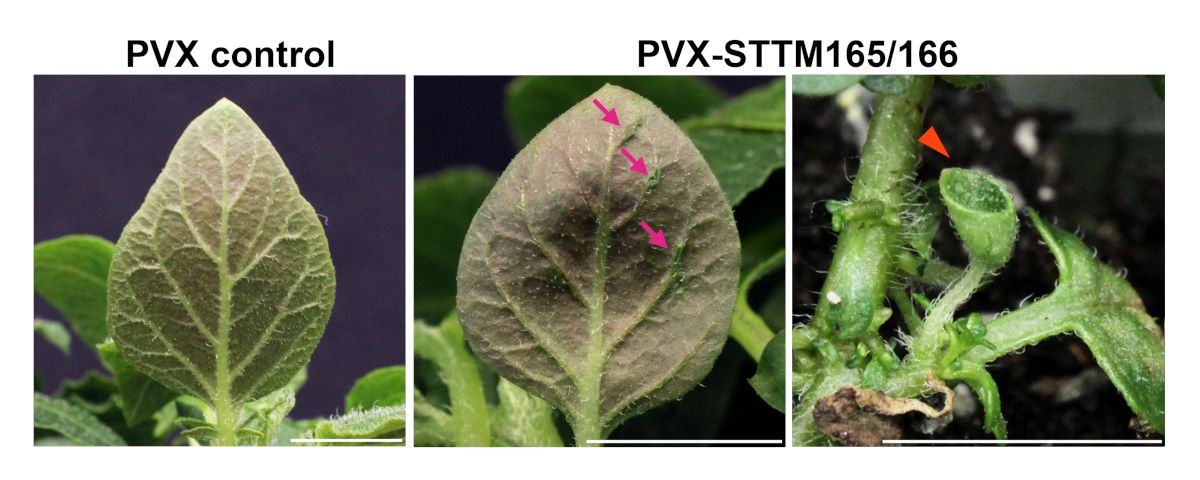
    NOTE: Phenotypes caused by miRNA silencing usually appear in 2–4 weeks postinoculation (Figure 1, Figure 2). It typically takes 10–20 days for the VbMS phenotype to appear after infiltration. The VbMS phenotype depends on the properties of the specific miRNA and target genes, growth conditions, and potato varieties.

Access restricted. Please log in or start a trial to view this content.

Results

figure-results-1

Figure 1: VbMS of miR165/166 in the tetraploid potato variety Katahdin. Phenotypes of the potato plants (Katahdin) expressing the PVX vector control or PVX-STTM165/166. Magenta arrows denote ectopically generated leaf structures in the leaf...

Access restricted. Please log in or start a trial to view this content.

Materials

List of materials used in this article
NameCompanyCatalog NumberComments
Agrobacterium tumefaciens strains: GV3101, GV2260 or EHA105.   
Fertilizer: Peters Peat Lite Special 15-0-15 Dark Weather FeedICL Specialty Fertilizers, Summerville, SC 29483, USAG99260 
MgCl₂ThermoFisher, Waltham, MA 02451, USAMFCD00149781 
PVX VIGS vector: PVX-LIC   
Soil: Metro-Mix 360Sun Gro Horticulture, Agawam, MA 01001-2907, USAMetro-Mix 360 


   Zhao et al., 2016

Explore More Articles

Virus-Based SilencingAgrobacterium TumefaciensT-DNA TransferNon-Coding RNAPlant DevelopmentLeaf AbnormalitiesSystemic Silencing