This video demonstrates a microplate-based assay to evaluate the lytic activity of phage cocktails against E.coli bacterial cultures. It highlights how changes in optical density reveal phage potency and the concentration needed for complete bacterial inhibition
A subscription to JoVE is required to view this content. Sign in or start your free trial.
Method Article
Assessing Phage-Mediated Bacterial Growth Inhibition Using Optical Density Measurements
91 views
⸱
August 31st, 2026
In This Article
Abstract
Protocol
1. Preparation of buffer and reagents
- Make 500 mL of tryptic soy broth (TSB) (15 g of TSB powder and 500 mL of ultrapure water) and autoclave.
NOTE: This can be stored at room temperature for up to 3 months or at 4 °C for up to 6 months. - Make 500 mL of tryptic soy agar (TSA) (20 g of TSA powder and 500 mL of ultrapure water) and autoclave.
NOTE: This can be stored at 4 °C for up to 3 months. - Make 500 mL of Phosphate Buffered Saline (PBS; 4 g of NaCl, 0.1 g of KCl, 0.77 g of Na2HPO4, and 0.12 g of KH2PO4, 500 mL of ultrapure water), measure and adjust the pH to 7.2 ± 0.2 at 25 °C and autoclave.
NOTE: This can be stored at 4 °C for up to 6 months. - Make 200 mL of 1 M MgSO4 (49.294 g and 200 mL of ultrapure water) and sterilize via 0.22 µm polyethersulfone filter.
- Make 500 mL of TSB with 10 mM MgSO4 (mTSB; 15 g of TSB powder, 500 mL of ultrapure water, and 5 mL of 1 M MgSO4) and autoclave; let the autoclaved media cool to room temperature. Apply the aseptic technique. Using a serological pipette, carefully transfer 5.0 mL of 1 M MgSO4; swirl gently to mix.
2. Preparation of bacterial culture
- To prepare Bacterial Research Laboratory Culture (BRLC), remove glycerol stock vial(s) from the freezer inventory and transfer to the laboratory.
- Use a disposable inoculation loop or equivalent, dip into the vial, remove a scraping of inoculum (frozen slush), and streak onto a TSA plate or equivalent within a level II biological safety cabinet. Incubate the plate at 37 ± 2 °C for 15−18 h.
- Bag the prepared BRLC plates and store at 4 °C.
NOTE: General expiry period for BRLC: 14 days at 4 °C after generation. - Inoculate a single colony of each E. coli O157 strain from the BRLC plates to be tested in 10 mL of TSB and statically incubate at 37 °C for 18 h to reach 9 log10 CFU/mL.
- Prepare a serial dilution of the overnight cultures (the following morning), each E. coli O157 strain using mTSB containing 10 mM of MgSO4 to achieve 4-5 log10 CFU/ml (or other desired inoculum level).
- Mix an equal volume of an overnight culture of each strain to achieve 4-5 log10 CFU/mL in total (or as desired) to prepare the bacterial mixture.
- Immediately place the diluted bacterial culture at 4 °C for pending use.
- Dilute the inoculum culture 10 or 100-fold and plate 0.1 mL aliquots of these dilutions on the TSA plates to obtain the isolated colonies.
3. Preparation of phage working solutions
- Propagate high-titer working stocks for each phage to be screened (≥108 PFU/mL) by following the standard methods4.
NOTE: The general expiry period for the phage stocks is 3 months in a plastic bottle at 4 °C after generation. - To achieve the desired titer of, e.g., ~108 PFU/mL for lysis kinetics, dilute individual phage preparations with mTSB containing 10 mM of MgSO4. Prepare phage cocktails by mixing equal volumes of each working stock with the same titer in all the possible combinations.
4. Preparation of in-vitro lysis kinetics for individual phage and phage cocktails
- Prepare serial 10-fold dilutions of each phage in Columns 1-8 in sterile 96-well microplates to set up the microplate assay.
NOTE: Four phages against one bacterial strain can be tested in duplicate, in adjacent columns, on each plate. The remaining four columns are for controls, which are without phage, as well as the mTSB blank (Figure 1). - Place 180 µL of mTSB in wells from Columns 1 to 12 of the 96-well microplate.
- Add 20 µL of diluted individual phages or phage cocktails (~108 PFU/mL) to wells 1-8 of the top row of the microplate (Row A).
- For the phage-free and Blank control, add 20 µL of mTSB to the top well of Columns 9, 10, and 11.
- With a 12-channel pipette, dilute the plate. Transfer 20 µL from row to row. Mix the contents well by gentle repeated aspiration, ejection (at least five times), and changing tips between dilutions. Remove 20 µL from the last row (Row H).
NOTE: Using tips with filters is recommended to prevent cross-contamination. - Set up a reservoir for each strain. Use a 1 mL pipette to transfer 2-3 mL of the diluted culture into the reservoir. For columns 1-10, use a multichannel pipette to add 20 µL of the diluted bacterial culture to each well. Change tips between each addition.
- Cover and incubate the microplate at desired conditions (e.g., 37 °C for 10 h or 22 °C for 22 h).
- At 2 h or other desired intervals, remove the microplates from the incubator.
Access restricted. Please log in or start a trial to view this content.
Results
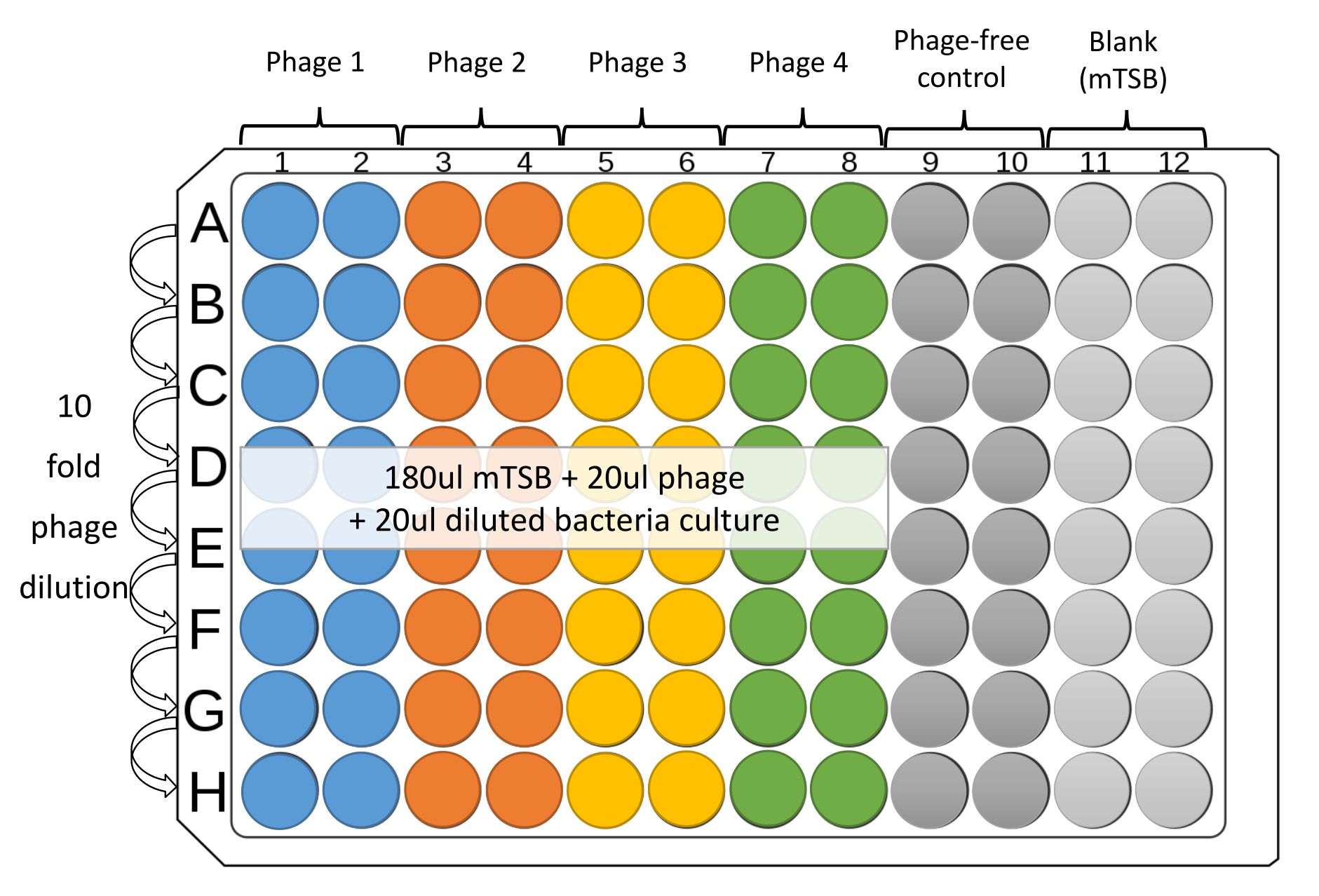
Figure 1: Suggested layout of 96-well microplate assay. Serial 10-fold dilutions of each phage are prepared in Columns 1-8 of sterile 96-well microplates. Four phages against one bacterial strain can be tested in duplicate, in adjacent colum...
Access restricted. Please log in or start a trial to view this content.
Materials
| Name | Company | Catalog Number | Comments |
|---|---|---|---|
| Essential supplies, reagents, and equipment | |||
| Magnesium sulfate heptahydrate | Sigma | 1374361 | |
| Pipet-Lite LTS Pipette L-1000XLS+ | METTLER TOLEDO | 17014382 | |
| Pipet-Lite LTS Pipette L-300XLS+ | METTLER TOLEDO | 17014405 | |
| Pipet-Lite Multi Pipette L12-20XLS+ | METTLER TOLEDO | 17013808 | |
| Pipet-Lite Pipette, Unv. SL-20XLS+ | METTLER TOLEDO | 17014412 | |
| Pipette Tips RT LTS 1000µL FL 768A/8-low retention | METTLER TOLEDO | 30389213 | |
| Pipette Tips SR LTS 20µL F 960A/5 | METTLER TOLEDO | 17005860 | |
| Reservoir | METTLER TOLEDO | 89094-662 | |
| Sterile, clear, 96-well flat-bottom polystyrene microplates with lids | Fisher | 168055 | |
| Tryptic soy agar (TSA) | Sigma | 105458-0500 | |
| Tryptic soy broth (TSB) | Sigma | 105459-0500 | |
| T-Shaped Cell Spreaders | VWR | 76299-566 | |
| Instruments | |||
| Compact Microbiological Incubators | Fisher | 50125590H | |
| Polygon Stir Bars | FIsher | 14-512-125 | length: 20 mm |
| Synergy Neo2 Hybrid Multi-Mode Reader | Fisher | BTNEO2M | |
| Software | |||
| SAS | SAS Institute | 9.4 |
