Source: Schildge, S. et al. Isolation and Culture of Mouse Cortical Astrocytes. J. Vis. Exp. (2013)
In this video, we describe the method to obtain a pure preparation of astrocytes from newly born mice.
A subscription to JoVE is required to view this content. Sign in or start your free trial.
Method Article
5.2K views
⸱
April 30th, 2023
Source: Schildge, S. et al. Isolation and Culture of Mouse Cortical Astrocytes. J. Vis. Exp. (2013)
In this video, we describe the method to obtain a pure preparation of astrocytes from newly born mice.
All procedures involving animal models have been reviewed by the local institutional animal care committee and the JoVE veterinary review board.
1. Isolation and Plating of Mixed Cortical Cells
Mixed cortical cell isolation for astrocyte cultures can be performed using P1 to P4 mouse pups. In order to achieve proper astrocyte density it is necessary to use 4 mouse pup cortices per T75 tissue culture flask. Therefore, volumes in the following protocol are calculated for a cell preparation using 4 mouse pups.
Access restricted. Please log in or start a trial to view this content.
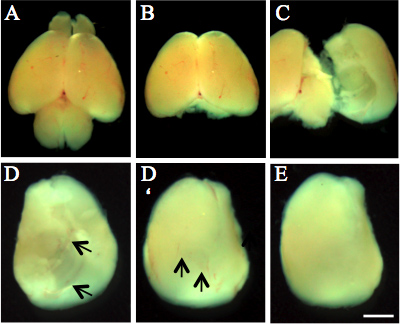
Figure 1. Dissection of postnatal (P3) mouse cortex. A) Whole brain. B) Brain after removal of olfactory bulbs and cerebellum. C) Isolation of cortices by peeling off the plate-like structure of the cortex from the brain. D, D') Cortex from ventral and dorsal.......
Access restricted. Please log in or start a trial to view this content.
| Name | Company | Catalog Number | Comments |
|---|---|---|---|
| <strong>Astrocyte culture media</strong> | |||
| DMEM high glucose | Life Technologies | 31966-021 | |
| FBS heat-inactivated | Life Technologies | 10082-147 | Final Concentration: 10% |
| Penicillin-Streptomycin | Life Technologies | 15140-122 | Final Concentration: 1% |
| <strong>Solution for brain tissue digestion</strong> | |||
| HBSS | Life Technologies | 14170-088 | |
| 2.5% Trypsin | Life Technologies | 15090-046 | Final Concentration: 0.25% |
| <strong>Other</strong> | |||
| 70% (vol/vol) ethanol | Roth | 9065.2 | |
| Poly-D-Lysine | Millipor A-003 | A-003-E | |
| Water | PAA | S15-012 | Cell culture grade |
| PBS | PAA | H15-002 | Cell culture grade |
| 0.05% Trypsin-EDTA | Life Technologies | 25300-062 | |
| 0.45 µm Sterile filter | Sartorius | 16555 | |
| 3.5 cm petri dish | BD Falcon | 353001 | |
| 15 ml Falcon tube | BD Falcon | 352096 | |
| 50 ml Falcon tube | BD Falcon | 352070 | |
| 75 cm2 Tissue culture flask | BD Falcon | 353136 | |
| Forceps fine | Dumont | 2-1032; 2-1033 | #3c; #5 |
| Forceps flat tip | KLS Martin | 12-120-11 | |
| 13 cm surgical scissors | Aesculap | BC-140-R | |
| Stereomicroscope | Leica | MZ7.5 | |
| Stereomicroscope + Camera | Leica | MZ16F; DFC320 | |
| Microscope + Camera | Zeiss; Canon | Primo Vert; PowerShot A650 IS | |
| Centrifuge | Eppendorf | 5805000.017 | Centrifuge5804R |
| Orbital Shaker | Thermo Scientific | SHKE 4450-1CE | MaxQ 4450 |
| Water bath | Julabo | SW20; 37 °C |
