$$\rightleftharpoonup{xx}$$
$$\longleftharp{xx}$$,
$$\longrightharp{xx}$$,
All procedures involving animal models have been reviewed by the local institutional animal care committee and the JoVE veterinary review board
1. Culture of Mosquito Adults
NOTE: Insecticide susceptible strains of mosquitoes are available from the Malaria Research and Reagent Reference Repository. Recommended strains are as follows: Aedes aegypti Liverpool (LVP) strain, Anopheles gambiae Kisumu (KISUMU1) strain, and Culex quinquefasciatus Johannesburg (JHB) strain.
- Culture mosquito larvae from eggs on a 12 h day/12 h night cycle at 28 °C and 75-85% relative humidity (RH) in 25 cm x 40 cm plastic trays (~ 400 larvae per tray) as described by Nuss. Feed the larvae ground gerbil (A. aegypti and An. gambiae) or flake fish food (C. quinquefasciatus). For larval assays, collect larvae at the third larval (L3) instar stage.
- Rear adult mosquitoes from pupae that have been transferred to plastic cups and place inside 20 L plastic cages in an insectary under the conditions described above. Maintain mosquitoes on 20% sugar solution as described elsewhere. Collect adults at 3-5 days post-emergence.
2. Adult Topical Assay (Single Point Dose or Dose Response Assay)
NOTE: The adult topical assay is conducted using acetone as a solvent. Alternative solvents may be an option, but it is essential to first confirm that the final concentration does not cause more than 10% mortality at 48 h post-exposure. The assay may be performed as a single-point dose or dose-response assay and is used to determine lethal dose (LD). If performing the latter, it is recommended to test a range of concentrations (minimum of five), spanning the expected LD50.
- Determine the number of adult female mosquitoes required to complete the assay.
NOTE: A point dose assay with a single chemistry will require a minimum of 90 mosquitoes (30 for the positive control, 30 for the acetone-only negative control, and 30 for the test chemistry).
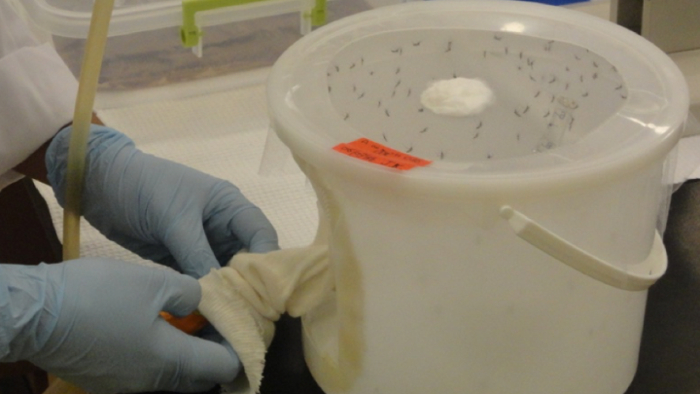
- Culture 3 to 5-day-old adult female mosquitoes and move to a separate 20 mL plastic bucket using an aspirator (Figure 1).
- Label 9 oz paper cups with the name and concentration of the test chemistry. Set aside 10 cm x 10 cm mesh squares and rubber bands for each cup (see Figure 2).
- Select an existing insecticide as a positive control (e.g., the synthetic pyrethroid, bifenthrin) and prepare a 1% stock solution (10 µg/µL) in acetone.
NOTE: Calculations should take into account the purity of the chemistry. For example, for a chemistry that is 99% pure, dissolve 10.1 mg in 1,000 µL of acetone to obtain a 1% solution. Seal with paraffin film and store at -20 °C.
- Using the same procedure as above, prepare a stock solution of the test chemistry.
NOTE: Many test chemistries are highly labile, and solutions should preferably be made fresh each time the bioassay is performed.
- Prepare serial dilutions of the positive control and test chemistries from stock solutions as shown in Figure 3 using 20 mL glass vials previously rinsed with acetone.
- Purge a 1 mL glass syringe with acetone, fill with acetone, and secure in the micro-applicator adjusted to deliver a volume of 0.25 µL.
- Working in batches of ten, remove 3 - 5-day old adult female mosquitoes from cages using an aspirator and anesthetize for up to five min at 4 °C in a fridge or on ice. Next, transfer mosquitoes to a Petri dish and place on ice for up to 10 min.
- Working quickly, remove a single female with fine tweezers, and apply 0.25 µL of test solution to the dorsal thorax using the syringe micro-applicator. Confirm delivery of chemistry by observation using a dissecting microscope to ensure each mosquito receives the appropriate volume of test chemistry.
- Transfer the mosquito to a labeled paper cup resting on ice, and repeat nine times to obtain n = 10 treated mosquitoes. Seal the mosquitoes in the cup with a mesh square secured with a rubber band, and transfer to a plastic tub or growth chamber under constant conditions of 28 °C and 75-85% RH (on a 12 h day/12 h night cycle is preferable).
- Repeat the above experiment twice to obtain n = 3 technical replicates (i.e., 30 mosquitoes total) per treatment or control group.
- Repeat steps 2.7 - 2.10 first with the test chemistry and then the positive control.
NOTE: Another useful control to include if sufficient mosquitoes are available is a "blank" of 30 anesthetized mosquitoes that do not receive either test chemistry or solvent.
- Record the number of "dead/non-responsive" mosquitoes at 30 min, 60 min, 2, 24, and 48 h post-exposure (or alternative time points) using the score sheet (Table 1). Score mosquitoes as "dead/non-responsive" if they show lack of movement, defined as laying on one side or on the back and with the inability to fly.
- If desired, correct for control mortality using the modified Abbott's formula as follows:
Mortality (%) = (X-Y) *100/(100-Y),
where X = the percent mortality in the treated sample, and Y = the percent mortality in the control.
- Display results as a histogram or an exponential curve. For a dose-response assay, calculate the LD50, LD75, or LD90 value for the test chemistry relative to the control.
- Repeat the assay at least twice using separate batches of mosquitoes to obtain n = 3 or more biological replicates.